GRID
COMPUTING
GNIT--3rd Yr IT
1
PRESENTED BY: PRAMIT KARMAKAR
Overview
 What is Grid Computing?
How does Grid works
 View of Grid environment
 Why do we need Grid Computing?
 Grid Computing v/s Cloud Computing
 Advantages
 Disadvantages
 Example
 Conclusion
GNIT--3rd Yr IT 2
What is Grid Computing
• A distributed computing system
• Where a group of computers are
connected
• To create and work as one large
computing
power, storage, database, applica
tion, and service.
GNIT--3rd Yr IT 3
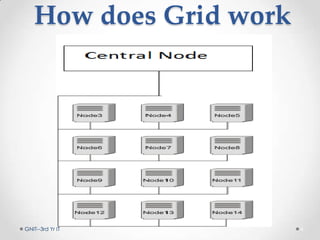
How does Grid work
GNIT--3rd Yr IT 4
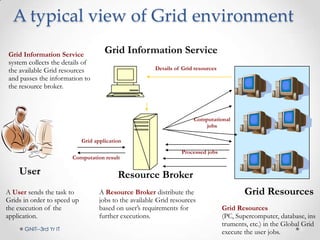
A typical view of Grid environment
User Resource Broker
Grid Resources
Grid Information Service
A User sends the task to
Grids in order to speed up
the execution of the
application.
A Resource Broker distribute the
jobs to the available Grid resources
based on user’s requirements for
further executions.
Grid Resources
(PC, Supercomputer, database, ins
truments, etc.) in the Global Grid
execute the user jobs.
Grid Information Service
system collects the details of
the available Grid resources
and passes the information to
the resource broker.
Computation result
Grid application
Details of Grid resources
Processed jobs
Computational
jobs
GNIT--3rd Yr IT 5
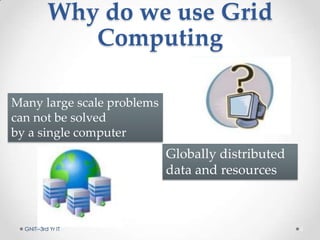
Why do we use Grid
Computing
Many large scale problems
can not be solved
by a single computer
Globally distributed
data and resources
GNIT--3rd Yr IT 6
Grid computing v/s Cloud
computing
Grid Computing
divide a huge task
into a lot of
independent and no
related
subtasks, and then
let every node do the
jobs. Even any node
fails the process is
not affected.
In Cloud computing
a user may apply
resource from the
resource pool to
deploy its
application,
not submit its
task to grid
and let the grid
complete it.
GNIT--3rd Yr IT 7
Advantages
• Can solve larger, more complex
problems in a shorter time
• Easier to collaborate with other
organizations
• Make better use of existing
hardware
GNIT--3rd Yr IT 8
Disadvantages
• Grid software and standards
are still evolving
• Non-interactive job
submission
• Confidentiality interrupted
GNIT--3rd Yr IT 9
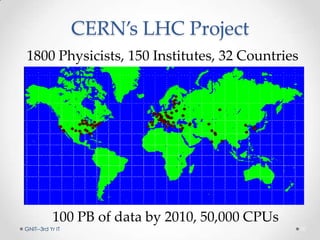
CERN’s LHC Project
1800 Physicists, 150 Institutes, 32 Countries
100 PB of data by 2010, 50,000 CPUs
GNIT--3rd Yr IT 10
Conclusion
• By implementing the Grid it is very easy
to download multiple files very fast
• Further implementations could be
carried out in the nearest future
GNIT--3rd Yr IT 11
References
[1]www.ieeexplore.ieee.org
[2]www.gridcomputing.com
[3]www.researchgate.net
[4]www.ibm.com
[5]www.home.cern.ch
GNIT--3rd Yr IT 12
Thank You
GNIT--3rd Yr IT 13

Grid computing

  • 1.
  • 2.
    Overview  What isGrid Computing? How does Grid works  View of Grid environment  Why do we need Grid Computing?  Grid Computing v/s Cloud Computing  Advantages  Disadvantages  Example  Conclusion GNIT--3rd Yr IT 2
  • 3.
    What is GridComputing • A distributed computing system • Where a group of computers are connected • To create and work as one large computing power, storage, database, applica tion, and service. GNIT--3rd Yr IT 3
  • 4.
    How does Gridwork GNIT--3rd Yr IT 4
  • 5.
    A typical viewof Grid environment User Resource Broker Grid Resources Grid Information Service A User sends the task to Grids in order to speed up the execution of the application. A Resource Broker distribute the jobs to the available Grid resources based on user’s requirements for further executions. Grid Resources (PC, Supercomputer, database, ins truments, etc.) in the Global Grid execute the user jobs. Grid Information Service system collects the details of the available Grid resources and passes the information to the resource broker. Computation result Grid application Details of Grid resources Processed jobs Computational jobs GNIT--3rd Yr IT 5
  • 6.
    Why do weuse Grid Computing Many large scale problems can not be solved by a single computer Globally distributed data and resources GNIT--3rd Yr IT 6
  • 7.
    Grid computing v/sCloud computing Grid Computing divide a huge task into a lot of independent and no related subtasks, and then let every node do the jobs. Even any node fails the process is not affected. In Cloud computing a user may apply resource from the resource pool to deploy its application, not submit its task to grid and let the grid complete it. GNIT--3rd Yr IT 7
  • 8.
    Advantages • Can solvelarger, more complex problems in a shorter time • Easier to collaborate with other organizations • Make better use of existing hardware GNIT--3rd Yr IT 8
  • 9.
    Disadvantages • Grid softwareand standards are still evolving • Non-interactive job submission • Confidentiality interrupted GNIT--3rd Yr IT 9
  • 10.
    CERN’s LHC Project 1800Physicists, 150 Institutes, 32 Countries 100 PB of data by 2010, 50,000 CPUs GNIT--3rd Yr IT 10
  • 11.
    Conclusion • By implementingthe Grid it is very easy to download multiple files very fast • Further implementations could be carried out in the nearest future GNIT--3rd Yr IT 11
  • 12.
  • 13.