Who Do They Turn To? Information Seeking Preferences of 5th Grade StudentsResearch ProposalApril 17, 2010Jenny LinnLIS 7920
Who  do students turn to when they are seeking information.TeachersPeersParents?Others??Librarian!
Why do students turn to particular individuals?ConvenienceComfort levelQuality of answersQuality of assistance
General Characteristics of Student Information Seeking BehaviorFill in the blank mentalityFocus on “amount” of informationSeek most convenient sourcesCopy rather then understand informationLack of knowledge tends to affect searchingCommon Thread in studies “Path of least resistance”
Human sources of informationAgosto and Hughes-Hassell studyA majority of participants preferred human sources in their everyday information seeking.FriendsFamilySchool Employees
Crow’s studyIntrinsically motivated studentsApproach information seeking differentlyLook for challengesView learning and discovering as an enjoyable endeavorWillingly follow where the search leads
MethodologyQualitative Methods ApproachOne on one semi structured interviews20-30 minutes in length5 prepared guiding questionSubjects were 3 - 5th grade students2 female 1 male2 students 1 neighbor
Adjustments – mid researchInterviewed two studentsResearch ProjectRole of studentSimilar responsesInterviewed a neighborUsed examples outside of the school setting
CodingMy coding focused on words and/or phrases that indicated the following:Resources:  human and non humanFeelingsPreferencesRoles of human resources 
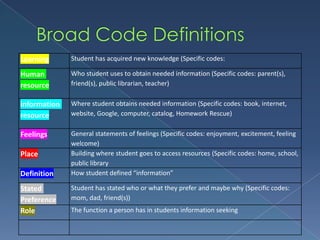
Broad Code Definitions
Who do Students most often ask for help?HierarchyAt schoolClassmate before teacher“If I need a little bit of information I ask a friend, if I need more then I ask the teacher.”No mention of School LibrarianAt HomeCertain family members preferred based on subject“Dad is a computer type thing so he helps a lot with Math.”
Why do students turn to particular individuals? ConvenienceAsk closest personComfort LevelMore comfortable asking classmate then teacher?Quality of informationStudents did consider this.
My thoughtsFocus more on the “Why” next time. Would address students preferences2 research questions did not get addressedI failed to ask the questions in the interviewImportant research Understudied groupUseful information for programming decisions
Adjustments for Full StudyAdd questions about preferenceUse three data collections methodsQuestionnaireSmall group discussionsOne on one interviewsUse recording devicesConsider timing of researchConsider using more than one school
Discussion QuestionsBased on what you have heard AND what you already knew What is the best use of a librarians time and resources when it comes to teaching information literacy skills? Parents, students Teachers?Librarians were rarely mentioned by the students interviewed. What can we do to make librarians more visible to students?

Research Proposal

  • 1.
    Who Do TheyTurn To? Information Seeking Preferences of 5th Grade StudentsResearch ProposalApril 17, 2010Jenny LinnLIS 7920
  • 2.
    Who dostudents turn to when they are seeking information.TeachersPeersParents?Others??Librarian!
  • 3.
    Why do studentsturn to particular individuals?ConvenienceComfort levelQuality of answersQuality of assistance
  • 4.
    General Characteristics ofStudent Information Seeking BehaviorFill in the blank mentalityFocus on “amount” of informationSeek most convenient sourcesCopy rather then understand informationLack of knowledge tends to affect searchingCommon Thread in studies “Path of least resistance”
  • 5.
    Human sources ofinformationAgosto and Hughes-Hassell studyA majority of participants preferred human sources in their everyday information seeking.FriendsFamilySchool Employees
  • 6.
    Crow’s studyIntrinsically motivatedstudentsApproach information seeking differentlyLook for challengesView learning and discovering as an enjoyable endeavorWillingly follow where the search leads
  • 7.
    MethodologyQualitative Methods ApproachOneon one semi structured interviews20-30 minutes in length5 prepared guiding questionSubjects were 3 - 5th grade students2 female 1 male2 students 1 neighbor
  • 8.
    Adjustments – midresearchInterviewed two studentsResearch ProjectRole of studentSimilar responsesInterviewed a neighborUsed examples outside of the school setting
  • 9.
    CodingMy coding focusedon words and/or phrases that indicated the following:Resources: human and non humanFeelingsPreferencesRoles of human resources 
  • 10.
  • 11.
    Who do Studentsmost often ask for help?HierarchyAt schoolClassmate before teacher“If I need a little bit of information I ask a friend, if I need more then I ask the teacher.”No mention of School LibrarianAt HomeCertain family members preferred based on subject“Dad is a computer type thing so he helps a lot with Math.”
  • 12.
    Why do studentsturn to particular individuals? ConvenienceAsk closest personComfort LevelMore comfortable asking classmate then teacher?Quality of informationStudents did consider this.
  • 13.
    My thoughtsFocus moreon the “Why” next time. Would address students preferences2 research questions did not get addressedI failed to ask the questions in the interviewImportant research Understudied groupUseful information for programming decisions
  • 14.
    Adjustments for FullStudyAdd questions about preferenceUse three data collections methodsQuestionnaireSmall group discussionsOne on one interviewsUse recording devicesConsider timing of researchConsider using more than one school
  • 15.
    Discussion QuestionsBased onwhat you have heard AND what you already knew What is the best use of a librarians time and resources when it comes to teaching information literacy skills? Parents, students Teachers?Librarians were rarely mentioned by the students interviewed. What can we do to make librarians more visible to students?

Editor's Notes

  • #3 Rather then focusing on “what” resources student use in their information seeking I am interested in learning WHO 5th grade students use to meet an information need.The information from this study could be used guide librarians…who should their information literacy programs be focused on? Teachers, parents or students?
  • #4 I am also interested in the motivation behind why students turn to particular individuals. Convenience: sitting by the smart kid in class, so why bother the teacherComfort Level: the librarian never smiles at me, so I will ask my teacher laterThe literature review made me wonder: do students consider the quality of the answers they are getting??? Do they ask the same individuals for assitance over and over again bacasue they are confidnet that the informtion they are receiveing is “good”.
  • #5 These are the general characteristics of student information seeking behavior that I gleaned from the literature review. Two of these statements were very relivant to my study.Fill in the blank mentality and Seeking of most convenient source
  • #6 Most important study to my research was one done by Agosto and Hughes Hassell. These individual studied urban young adults. Friends, Family and School employees in that order.
  • #7 I did not mention Crow’s study inmy initial presentation of my lit review. Did not seem all that relevant at the time, I just thought it was an interesting study! Low and behold one of the students I interviewed WAS one of these kids. It threw me for a loop for a while. So glad that I had read this study so that I was prepared for this student.
  • #8 Two interviews were done at school in the library the other at my kitchen table. Kids took on the “role” that they normally do with me. Two were my students the other was a neighbor girl that spends time hanging out with my family (well the dogs actually) Chose this age for develoopmental reasons… tend to be content withthemselves and the world around them. Not dealing with “hormones” untill und of school year. This age student also tends to have positive relationship with the adults in their lives…as well as their peers.
  • #9 During the research project I made a few adjustment to my original plan the biggest one being my decision to intreview a 5th grader that was not my student.
  • #10 This was done to help me see the information that was truly important in answwering the questions that I sset out to answer. I did try to keep it well defined and fairly simple
  • #12 So, what did I discover? Each student stated a hierarchy when it came to asking people for help. In all cases this was true at school and at home.
  • #13 Convenience: no surprise really…this was shown in some of the studies in the literature reviewComfort Level: there is not enough data to make a statement. I feel like the convenience outweighs the comfort level Nice surprise was Quality Level: Although I do not think that student think in terms of quality they definitely turn to individuals that they feel will be the most likely to give them the answwer that they need. My favorite example of this is the student that always asks Jordan, becaseu she is the teacehrs kid, so she is really smart
  • #14 I want to learn more about Why…more information in this are wold pull the study togeter more. So…why do you ask your neighbor and not the teacher? Is it because it is the easiest, it is because the teacher is scary? Is it because the teacher said stay in your seat?I am also interested in learning WHO given the opportunity to ask anone for help (convenience set aside) sho would it be?