A component or peripheral device (such as a barcode reader, graphic
tablet, keyboard, magnetic-stripe reader, modem, mouse, scanner, or
stylus) that feeds data or instruction into a computer for display,
processing, storage, or outputting or transmission.
Input devices convert the user's actions and analog data into digital
electronic signals that can be processed by a computer does not
require any conversion and is input direct into a computer. It is
through input devices that a user exercises control over a computer,
its operations, and outputs.
KEYBOARDS
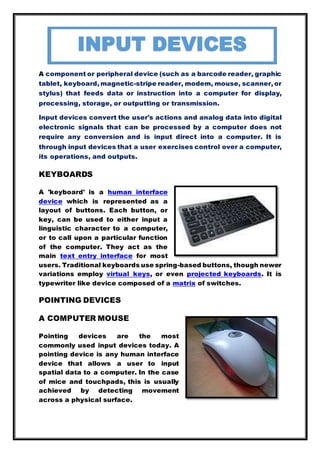
A 'keyboard' is a human interface
device which is represented as a
layout of buttons. Each button, or
key, can be used to either input a
linguistic character to a computer,
or to call upon a particular function
of the computer. They act as the
main text entry interface for most
users. Traditional keyboards use spring-based buttons, though newer
variations employ virtual keys, or even projected keyboards. It is
typewriter like device composed of a matrix of switches.
POINTING DEVICES
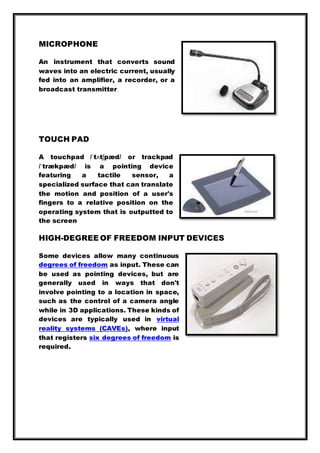
A COMPUTER MOUSE
Pointing devices are the most
commonly used input devices today. A
pointing device is any human interface
device that allows a user to input
spatial data to a computer. In the case
of mice and touchpads, this is usually
achieved by detecting movement
across a physical surface.
INPUT DEVICES
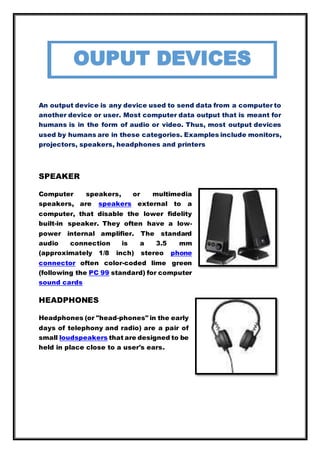
MICROPHONE
An instrument that converts sound
waves into an electric current, usually
fed into an amplifier, a recorder, or a
broadcast transmitter.
TOUCH PAD
A touchpad /ˈtʌtʃpæd/ or trackpad
/ˈtrækpæd/ is a pointing device
featuring a tactile sensor, a
specialized surface that can translate
the motion and position of a user's
fingers to a relative position on the
operating system that is outputted to
the screen
HIGH-DEGREE OF FREEDOM INPUT DEVICES
Some devices allow many continuous
degrees of freedom as input. These can
be used as pointing devices, but are
generally used in ways that don't
involve pointing to a location in space,
such as the control of a camera angle
while in 3D applications. These kinds of
devices are typically used in virtual
reality systems (CAVEs), where input
that registers six degrees of freedom is
required.
An output device is any device used to send data from a computer to
another device or user. Most computer data output that is meant for
humans is in the form of audio or video. Thus, most output devices
used by humans are in these categories. Examples include monitors,
projectors, speakers, headphones and printers
SPEAKER
Computer speakers, or multimedia
speakers, are speakers external to a
computer, that disable the lower fidelity
built-in speaker. They often have a low-
power internal amplifier. The standard
audio connection is a 3.5 mm
(approximately 1/8 inch) stereo phone
connector often color-coded lime green
(following the PC 99 standard) for computer
sound cards
HEADPHONES
Headphones (or "head-phones" in the early
days of telephony and radio) are a pair of
small loudspeakers that are designed to be
held in place close to a user's ears.
OUPUT DEVICES
MONITOR
A monitor or a display is an electronic visual
display for computers. The monitor comprises
the display device, circuitry and an enclosure.
The display device in modern monitors is
typically a thin film transistor liquid crystal
display (TFT-LCD) thin panel, while older
monitors used a cathode ray tube (CRT) about as deep as the screen
size
PRINTER
In computing, a printer is a peripheral which
makes a persistent human readable
representation of graphics or text on paper or
similar physical media.[1]
The two most
common printer mechanisms are black and
white laser printers used for common
documents, and color inkjet printers which
can produce high quality photograph quality
output.
PROJECTOR
A projector or image projector is an optical device that projects an
image (or moving images) onto a surface,
commonly a projection screen.
Most projectors create an image by shining a
light through a small transparent lens, but
some newer types of projectors can project
the image directly, by using lasers.

Input and output devices

  • 1.
    A component orperipheral device (such as a barcode reader, graphic tablet, keyboard, magnetic-stripe reader, modem, mouse, scanner, or stylus) that feeds data or instruction into a computer for display, processing, storage, or outputting or transmission. Input devices convert the user's actions and analog data into digital electronic signals that can be processed by a computer does not require any conversion and is input direct into a computer. It is through input devices that a user exercises control over a computer, its operations, and outputs. KEYBOARDS A 'keyboard' is a human interface device which is represented as a layout of buttons. Each button, or key, can be used to either input a linguistic character to a computer, or to call upon a particular function of the computer. They act as the main text entry interface for most users. Traditional keyboards use spring-based buttons, though newer variations employ virtual keys, or even projected keyboards. It is typewriter like device composed of a matrix of switches. POINTING DEVICES A COMPUTER MOUSE Pointing devices are the most commonly used input devices today. A pointing device is any human interface device that allows a user to input spatial data to a computer. In the case of mice and touchpads, this is usually achieved by detecting movement across a physical surface. INPUT DEVICES
  • 2.
    MICROPHONE An instrument thatconverts sound waves into an electric current, usually fed into an amplifier, a recorder, or a broadcast transmitter. TOUCH PAD A touchpad /ˈtʌtʃpæd/ or trackpad /ˈtrækpæd/ is a pointing device featuring a tactile sensor, a specialized surface that can translate the motion and position of a user's fingers to a relative position on the operating system that is outputted to the screen HIGH-DEGREE OF FREEDOM INPUT DEVICES Some devices allow many continuous degrees of freedom as input. These can be used as pointing devices, but are generally used in ways that don't involve pointing to a location in space, such as the control of a camera angle while in 3D applications. These kinds of devices are typically used in virtual reality systems (CAVEs), where input that registers six degrees of freedom is required.
  • 3.
    An output deviceis any device used to send data from a computer to another device or user. Most computer data output that is meant for humans is in the form of audio or video. Thus, most output devices used by humans are in these categories. Examples include monitors, projectors, speakers, headphones and printers SPEAKER Computer speakers, or multimedia speakers, are speakers external to a computer, that disable the lower fidelity built-in speaker. They often have a low- power internal amplifier. The standard audio connection is a 3.5 mm (approximately 1/8 inch) stereo phone connector often color-coded lime green (following the PC 99 standard) for computer sound cards HEADPHONES Headphones (or "head-phones" in the early days of telephony and radio) are a pair of small loudspeakers that are designed to be held in place close to a user's ears. OUPUT DEVICES
  • 4.
    MONITOR A monitor ora display is an electronic visual display for computers. The monitor comprises the display device, circuitry and an enclosure. The display device in modern monitors is typically a thin film transistor liquid crystal display (TFT-LCD) thin panel, while older monitors used a cathode ray tube (CRT) about as deep as the screen size PRINTER In computing, a printer is a peripheral which makes a persistent human readable representation of graphics or text on paper or similar physical media.[1] The two most common printer mechanisms are black and white laser printers used for common documents, and color inkjet printers which can produce high quality photograph quality output. PROJECTOR A projector or image projector is an optical device that projects an image (or moving images) onto a surface, commonly a projection screen. Most projectors create an image by shining a light through a small transparent lens, but some newer types of projectors can project the image directly, by using lasers.