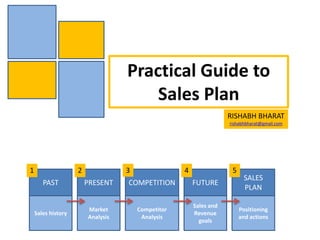
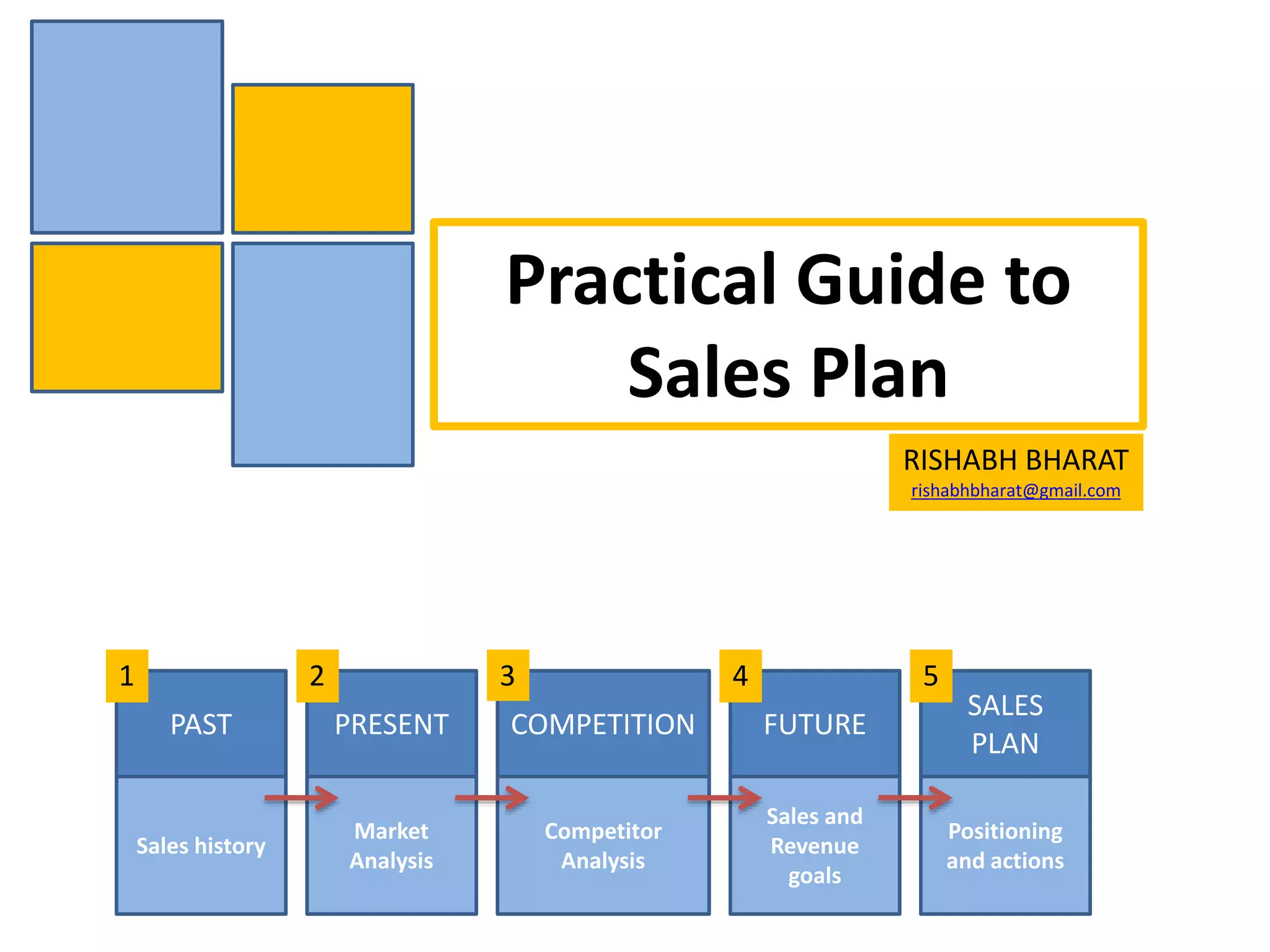

Practical Guide to
Sales Plan
PAST PRESENT COMPETITION FUTURE
SALES
PLAN
Sales history
Market
Analysis
Competitor
Analysis
Sales and
Revenue
goals
Positioning
and actions
1 2 3 4 5
RISHABH BHARAT
rishabhbharat@gmail.com
Past- Sales History
Revenue
Internal data analysis and record check should be done for revenue sources,
Quantum of business performed for product wise business estimations region
wise business.
Key performance
Indicators (KPIs)
Different metrics should be identified, which should showcase the performance
of the business, business effectiveness should be check over those metric
Sales mix
Study product wise business, analyzing 80-20 rule application. Identify Which
products performs best, what is our customer sale profile. Make sure- business
should not be centered around small groups and location,
Business mix
Study the business mix considering the most and least revenue sources
Ex- State, district, city wise business distribution
Cost of Sales
Estimate the costs incurred by the business for example costs for managing digital
business, creative design, digital campaign, third party costs
and staff costs.
Seasonality
Determine weak and strong periods, trends, forecast. Ex- Sale of Travel insurance
in May , June
New/renewal/
existing business
Growth opportunity associated with new policy introduction, customer personas
analysis, retention and renewal rate analysis. Ex- Policy renewal rate plays a
critical role in Insurance domain
1
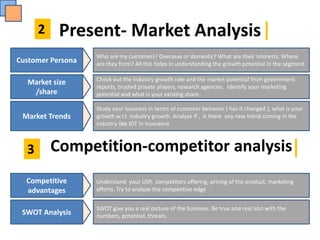
Present- Market Analysis
Customer Persona
Who are my customers? Overseas or domestic? What are their interests, Where
are they from? All this helps in understanding the growth potential in the segment
Market size
/share
Check out the industry growth rate and the market potential from government
reports, trusted private players, research agencies. Identify your marketing
potential and what is your existing share.
Market Trends
Study your business in terms of customer behavior ( has it changed ), what is your
growth w.r.t industry growth. Analyze if , is there any new trend coming in the
industry like IOT in Insurance .
Competition-competitor analysis
Competitive
advantages
Understand your USP, competitors offering, pricing of the product, marketing
efforts. Try to analyze the competitive edge
SWOT Analysis
SWOT give you a real picture of the business. Be true and real istci with the
numbers, potential, threats.
2
3
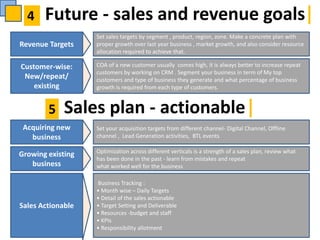
Set sales targets by segment , product, region, zone. Make a concrete plan with
proper growth over last year business , market growth, and also consider resource
allocation required to achieve that.
Revenue Targets
Future - sales and revenue goals
Customer-wise:
New/repeat/
existing
COA of a new customer usually comes high, it is always better to increase repeat
customers by working on CRM . Segment your business in term of My top
customers and type of business they generate and what percentage of business
growth is required from each type of customers.
Sales plan - actionable
Acquiring new
business
Set your acquisition targets from different channel- Digital Channel, Offline
channel , Lead Generation activities, BTL events
Growing existing
business
Optimization across different verticals is a strength of a sales plan, review what
has been done in the past - learn from mistakes and repeat
what worked well for the business
Sales Actionable
Business Tracking :
• Month wise – Daily Targets
• Detail of the sales actionable
• Target Setting and Deliverable
• Resources -budget and staff
• KPIs
• Responsibility allotment
4
5
Good Luck with your Sales Targets !
RISHABH BHARAT
rishabhbharat@gmail.com

Practical guide to sales plan

  • 1.
    Practical Guide to SalesPlan PAST PRESENT COMPETITION FUTURE SALES PLAN Sales history Market Analysis Competitor Analysis Sales and Revenue goals Positioning and actions 1 2 3 4 5 RISHABH BHARAT rishabhbharat@gmail.com
  • 2.
    Past- Sales History Revenue Internaldata analysis and record check should be done for revenue sources, Quantum of business performed for product wise business estimations region wise business. Key performance Indicators (KPIs) Different metrics should be identified, which should showcase the performance of the business, business effectiveness should be check over those metric Sales mix Study product wise business, analyzing 80-20 rule application. Identify Which products performs best, what is our customer sale profile. Make sure- business should not be centered around small groups and location, Business mix Study the business mix considering the most and least revenue sources Ex- State, district, city wise business distribution Cost of Sales Estimate the costs incurred by the business for example costs for managing digital business, creative design, digital campaign, third party costs and staff costs. Seasonality Determine weak and strong periods, trends, forecast. Ex- Sale of Travel insurance in May , June New/renewal/ existing business Growth opportunity associated with new policy introduction, customer personas analysis, retention and renewal rate analysis. Ex- Policy renewal rate plays a critical role in Insurance domain 1
  • 3.
    Present- Market Analysis CustomerPersona Who are my customers? Overseas or domestic? What are their interests, Where are they from? All this helps in understanding the growth potential in the segment Market size /share Check out the industry growth rate and the market potential from government reports, trusted private players, research agencies. Identify your marketing potential and what is your existing share. Market Trends Study your business in terms of customer behavior ( has it changed ), what is your growth w.r.t industry growth. Analyze if , is there any new trend coming in the industry like IOT in Insurance . Competition-competitor analysis Competitive advantages Understand your USP, competitors offering, pricing of the product, marketing efforts. Try to analyze the competitive edge SWOT Analysis SWOT give you a real picture of the business. Be true and real istci with the numbers, potential, threats. 2 3
  • 4.
    Set sales targetsby segment , product, region, zone. Make a concrete plan with proper growth over last year business , market growth, and also consider resource allocation required to achieve that. Revenue Targets Future - sales and revenue goals Customer-wise: New/repeat/ existing COA of a new customer usually comes high, it is always better to increase repeat customers by working on CRM . Segment your business in term of My top customers and type of business they generate and what percentage of business growth is required from each type of customers. Sales plan - actionable Acquiring new business Set your acquisition targets from different channel- Digital Channel, Offline channel , Lead Generation activities, BTL events Growing existing business Optimization across different verticals is a strength of a sales plan, review what has been done in the past - learn from mistakes and repeat what worked well for the business Sales Actionable Business Tracking : • Month wise – Daily Targets • Detail of the sales actionable • Target Setting and Deliverable • Resources -budget and staff • KPIs • Responsibility allotment 4 5
  • 5.
    Good Luck withyour Sales Targets ! RISHABH BHARAT rishabhbharat@gmail.com