Flipcharts and Photos from:
               Innovation and Design Class
                                                                    Amsterdam
                                                                  23-27 May 2011


                                           Dr. Anthony Shingleton & Dr. Michael Ohler
                                                    Principals, BMGI Europe


         The following slides present a selection of the tools discussed and outcomes achieved during the course.


1

    © BMGI. Except as may be expressly authorized by a written license agreement signed by BMGI, no portion may be altered, rewritten, edited, modified or used to create any derivative works.
Participant Comments and Feedback

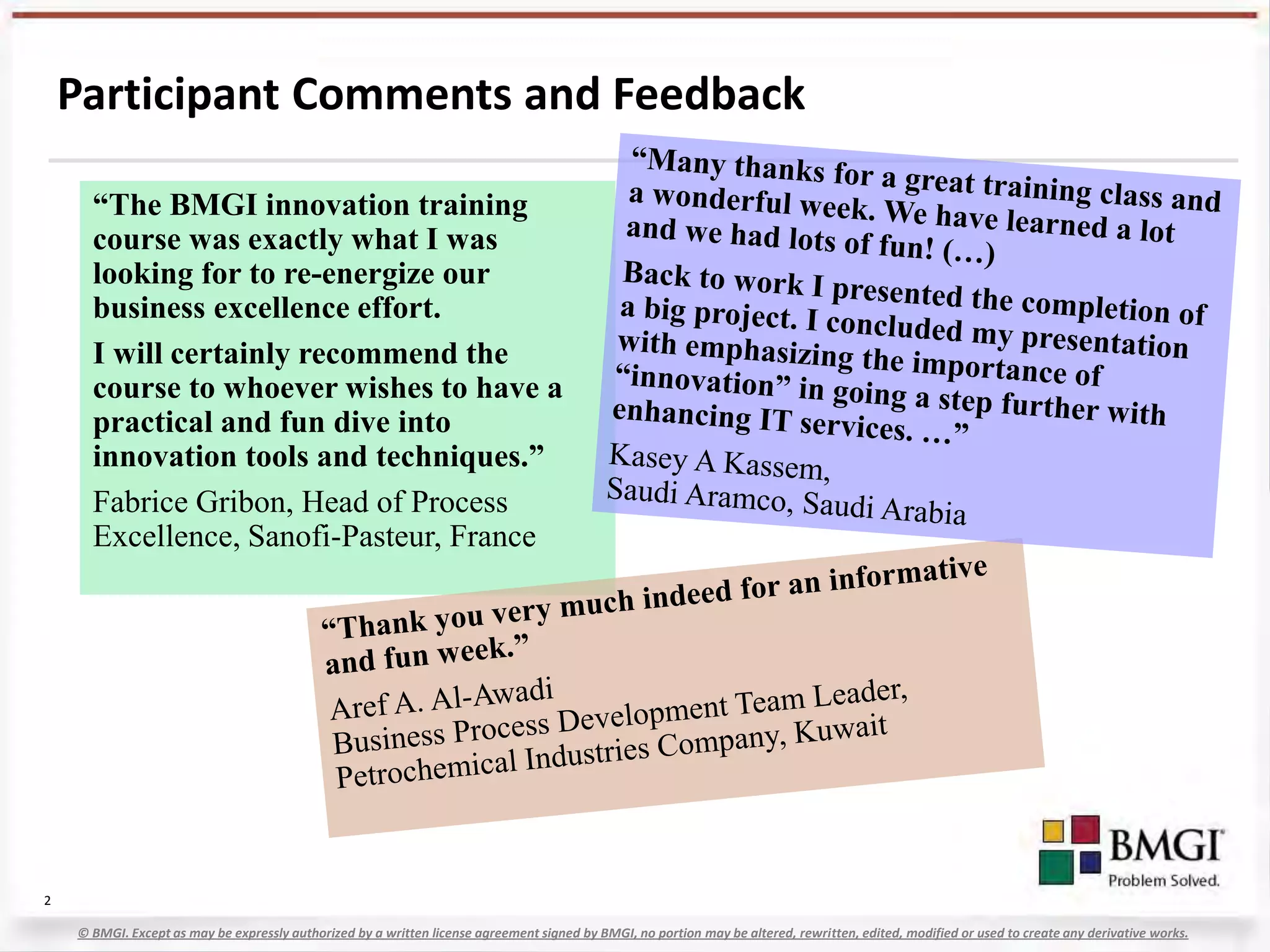
      “The BMGI innovation training
      course was exactly what I was
      looking for to re-energize our
      business excellence effort.
      I will certainly recommend the
      course to whoever wishes to have a
      practical and fun dive into
      innovation tools and techniques.”
      Fabrice Gribon, Head of Process
      Excellence, Sanofi-Pasteur, France


2

    © BMGI. Except as may be expressly authorized by a written license agreement signed by BMGI, no portion may be altered, rewritten, edited, modified or used to create any derivative works.
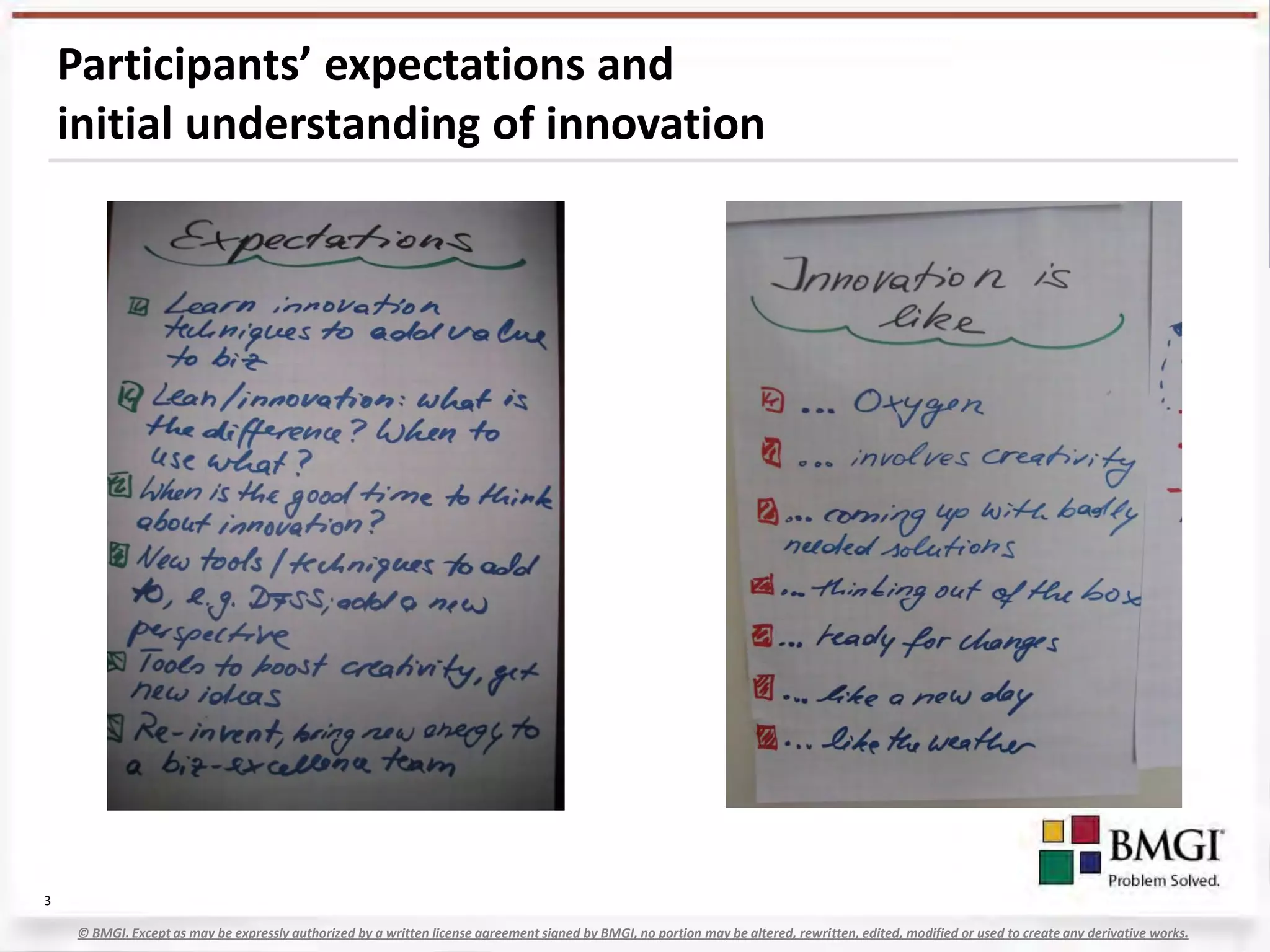
Participants’ expectations and
    initial understanding of innovation


3

     © BMGI. Except as may be expressly authorized by a written license agreement signed by BMGI, no portion may be altered, rewritten, edited, modified or used to create any derivative works.
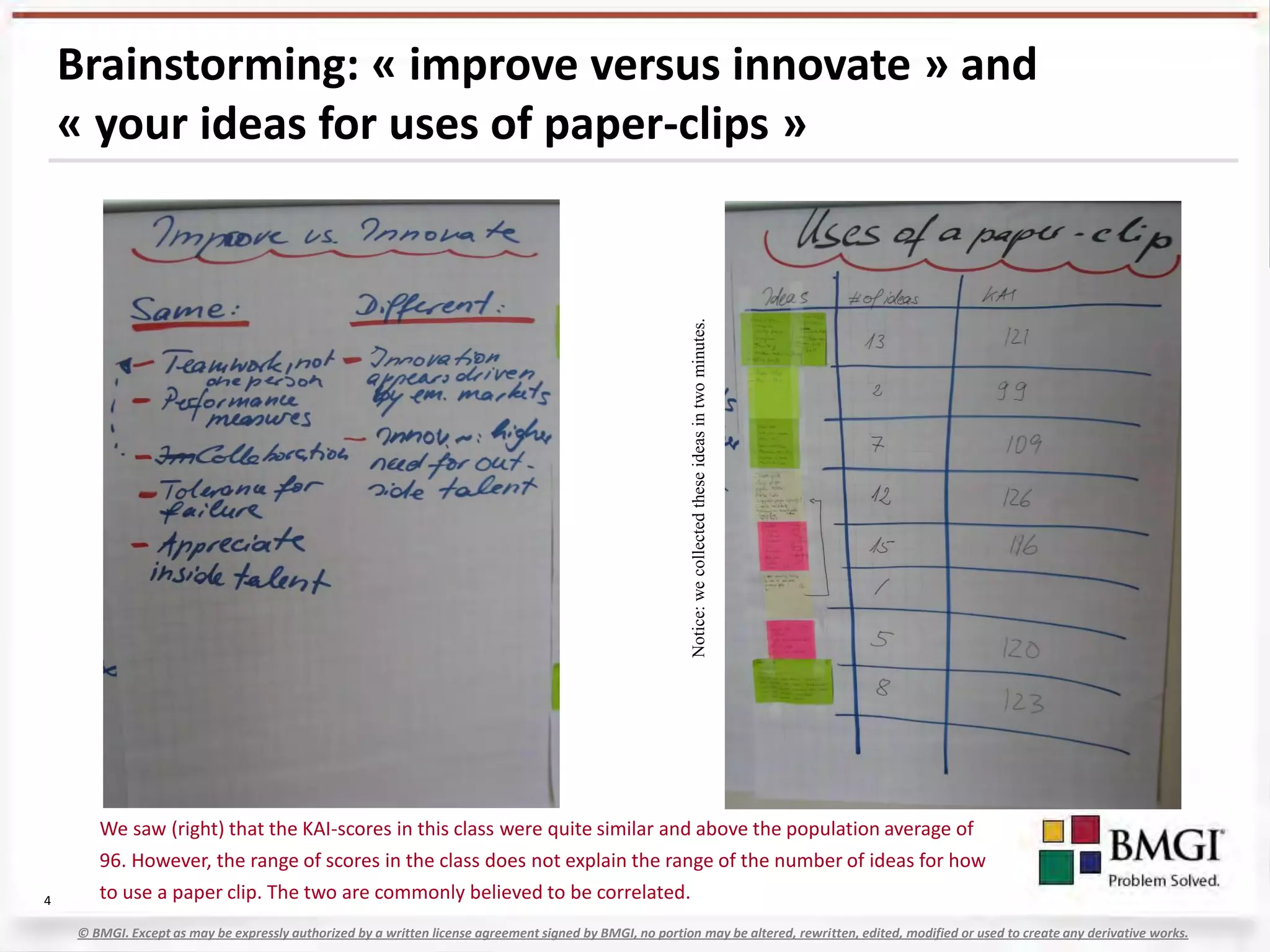
Brainstorming: « improve versus innovate » and
    « your ideas for uses of paper-clips »


                                                                                                           Notice: we collected these ideas in two minutes.


       We saw (right) that the KAI-scores in this class were quite similar and above the population average of
       96. However, the range of scores in the class does not explain the range of the number of ideas for how
4      to use a paper clip. The two are commonly believed to be correlated.
    © BMGI. Except as may be expressly authorized by a written license agreement signed by BMGI, no portion may be altered, rewritten, edited, modified or used to create any derivative works.
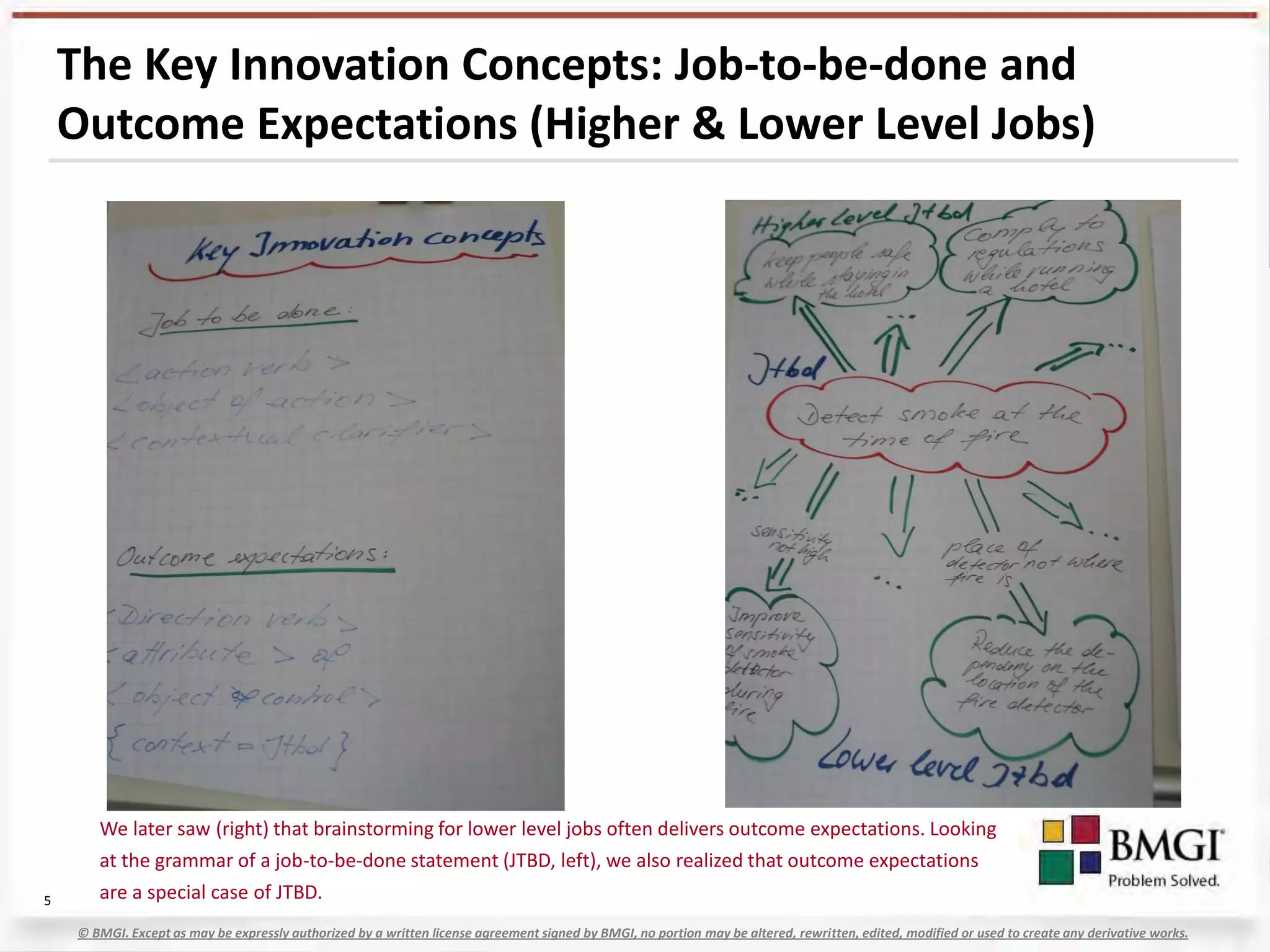
The Key Innovation Concepts: Job-to-be-done and
    Outcome Expectations (Higher & Lower Level Jobs)


       We later saw (right) that brainstorming for lower level jobs often delivers outcome expectations. Looking
       at the grammar of a job-to-be-done statement (JTBD, left), we also realized that outcome expectations
5      are a special case of JTBD.
    © BMGI. Except as may be expressly authorized by a written license agreement signed by BMGI, no portion may be altered, rewritten, edited, modified or used to create any derivative works.
Understanding Innovation Opportunity
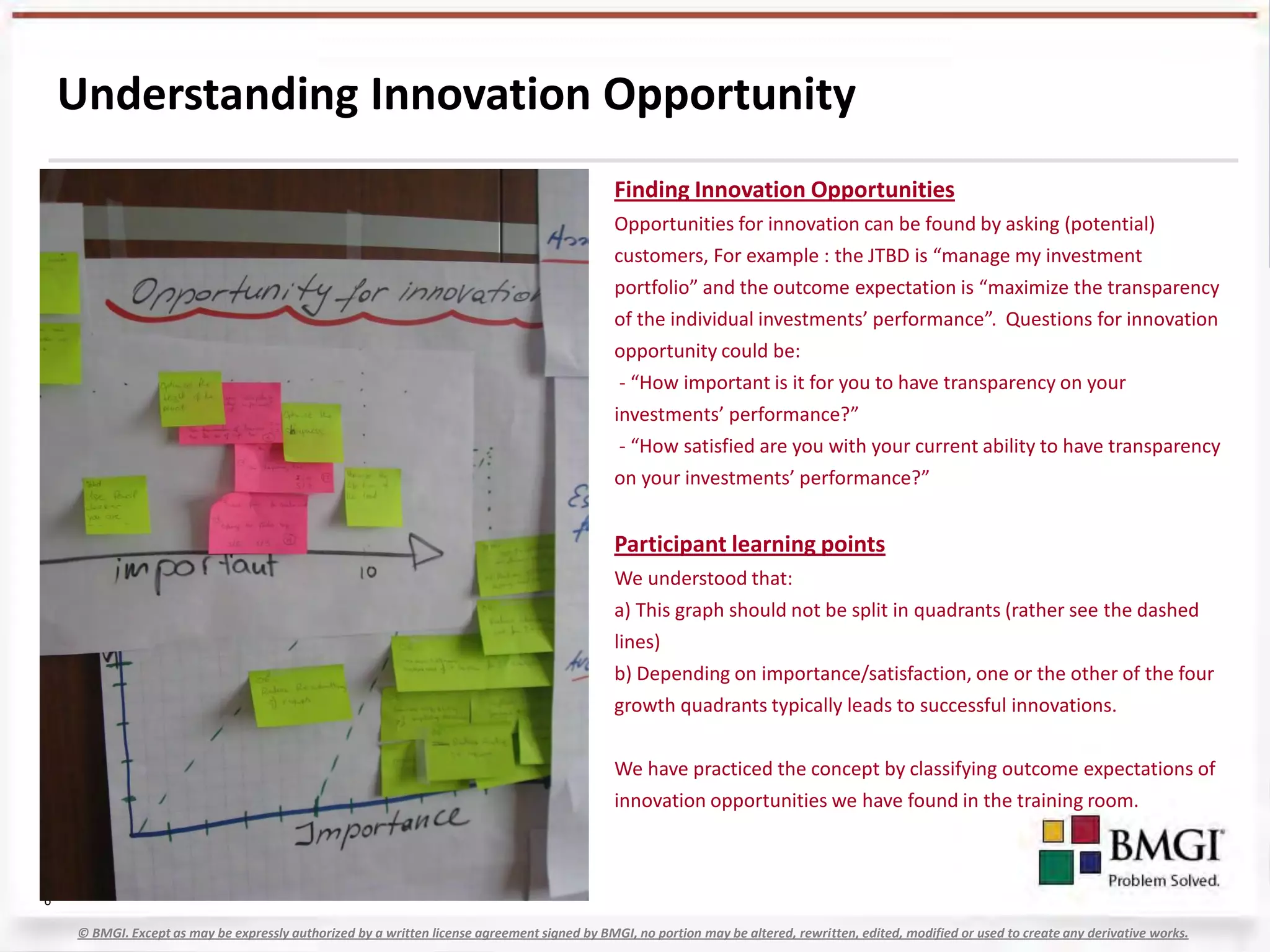
                                                                                              Finding Innovation Opportunities
                                                                                              Opportunities for innovation can be found by asking (potential)
                                                                                              customers, For example : the JTBD is “manage my investment
                                                                                              portfolio” and the outcome expectation is “maximize the transparency
                                                                                              of the individual investments’ performance”. Questions for innovation
                                                                                              opportunity could be:
                                                                                               - “How important is it for you to have transparency on your
                                                                                              investments’ performance?”
                                                                                               - “How satisfied are you with your current ability to have transparency
                                                                                              on your investments’ performance?”


                                                                                              Participant learning points
                                                                                              We understood that:
                                                                                              a) This graph should not be split in quadrants (rather see the dashed
                                                                                              lines)
                                                                                              b) Depending on importance/satisfaction, one or the other of the four
                                                                                              growth quadrants typically leads to successful innovations.


                                                                                              We have practiced the concept by classifying outcome expectations of
                                                                                              innovation opportunities we have found in the training room.


6

    © BMGI. Except as may be expressly authorized by a written license agreement signed by BMGI, no portion may be altered, rewritten, edited, modified or used to create any derivative works.
Making sense out of different examples of innovation
    – and general principle behind solution finding


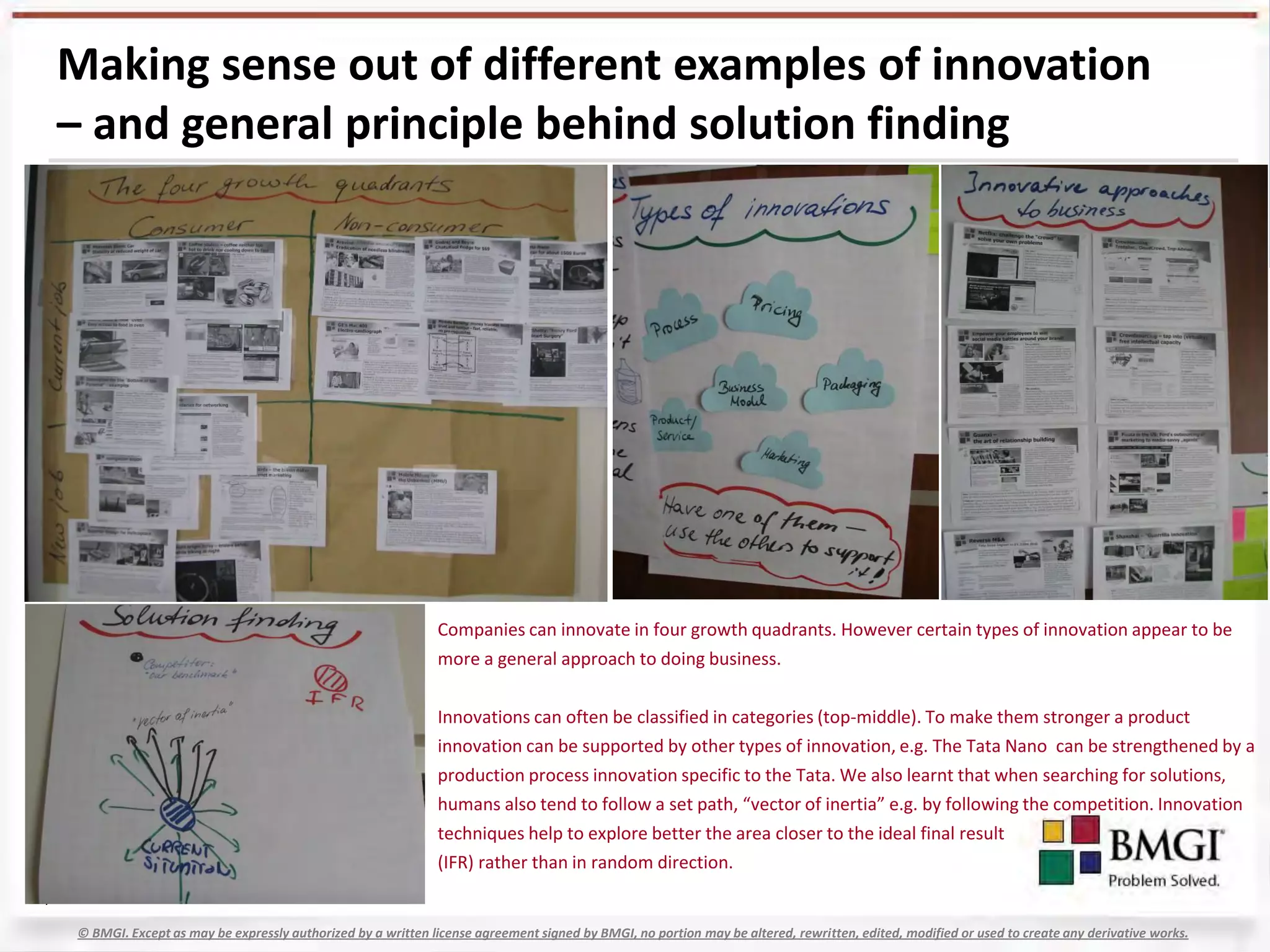
                                                                Companies can innovate in four growth quadrants. However certain types of innovation appear to be
                                                                more a general approach to doing business.

                                                                Innovations can often be classified in categories (top-middle). To make them stronger a product
                                                                innovation can be supported by other types of innovation, e.g. The Tata Nano can be strengthened by a
                                                                production process innovation specific to the Tata. We also learnt that when searching for solutions,
                                                                humans also tend to follow a set path, “vector of inertia” e.g. by following the competition. Innovation
                                                                techniques help to explore better the area closer to the ideal final result
                                                                (IFR) rather than in random direction.
7

    © BMGI. Except as may be expressly authorized by a written license agreement signed by BMGI, no portion may be altered, rewritten, edited, modified or used to create any derivative works.
Learning to listen: Spotting outcome expectations


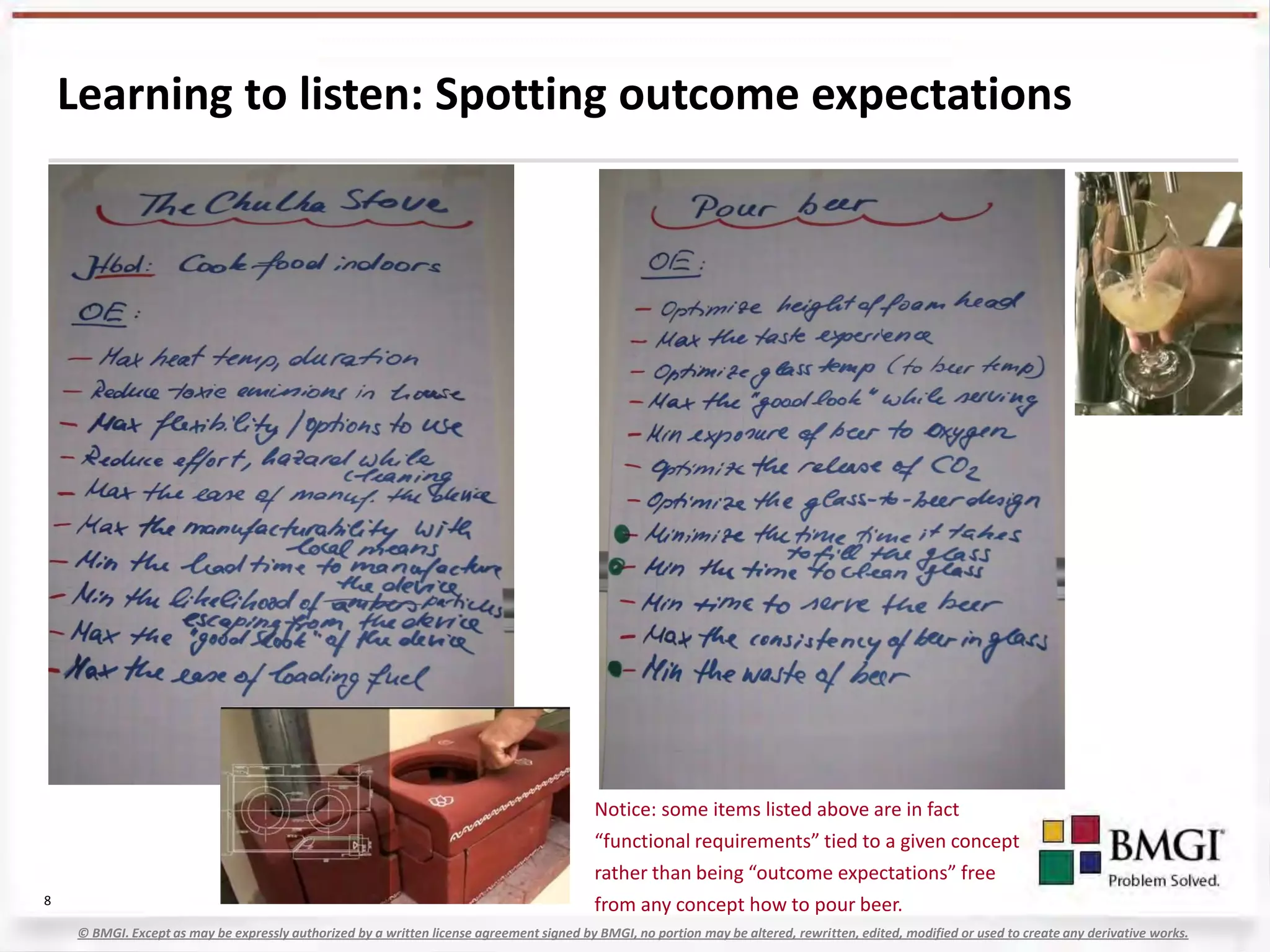
                                                                                           Notice: some items listed above are in fact
                                                                                           “functional requirements” tied to a given concept
                                                                                           rather than being “outcome expectations” free
8                                                                                          from any concept how to pour beer.
    © BMGI. Except as may be expressly authorized by a written license agreement signed by BMGI, no portion may be altered, rewritten, edited, modified or used to create any derivative works.
The biz-cases for our in-class innovation projects and
    participants’ feedback as of day 2


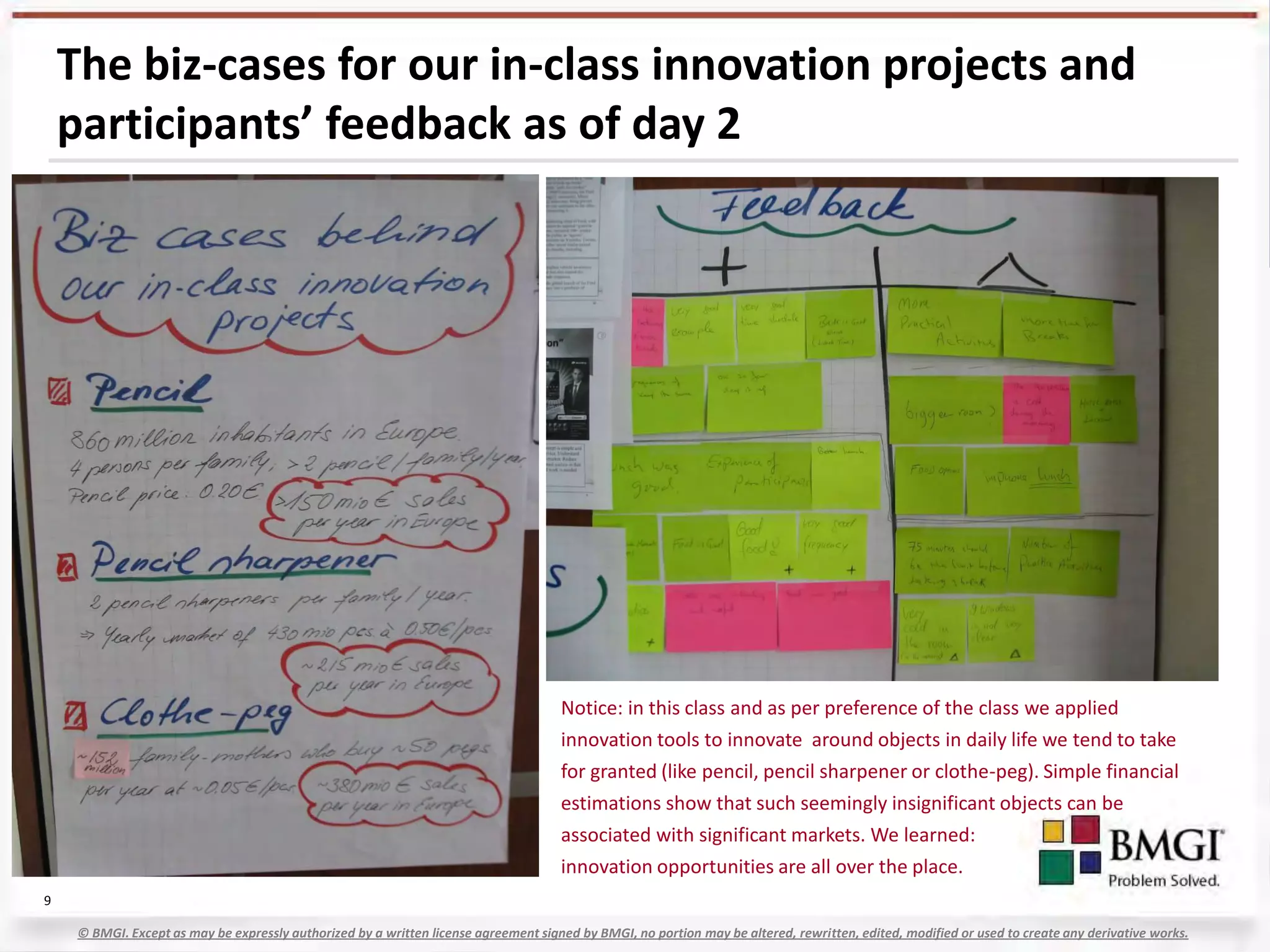
                                                                                      Notice: in this class and as per preference of the class we applied
                                                                                      innovation tools to innovate around objects in daily life we tend to take
                                                                                      for granted (like pencil, pencil sharpener or clothe-peg). Simple financial
                                                                                      estimations show that such seemingly insignificant objects can be
                                                                                      associated with significant markets. We learned:
                                                                                      innovation opportunities are all over the place.
9

     © BMGI. Except as may be expressly authorized by a written license agreement signed by BMGI, no portion may be altered, rewritten, edited, modified or used to create any derivative works.
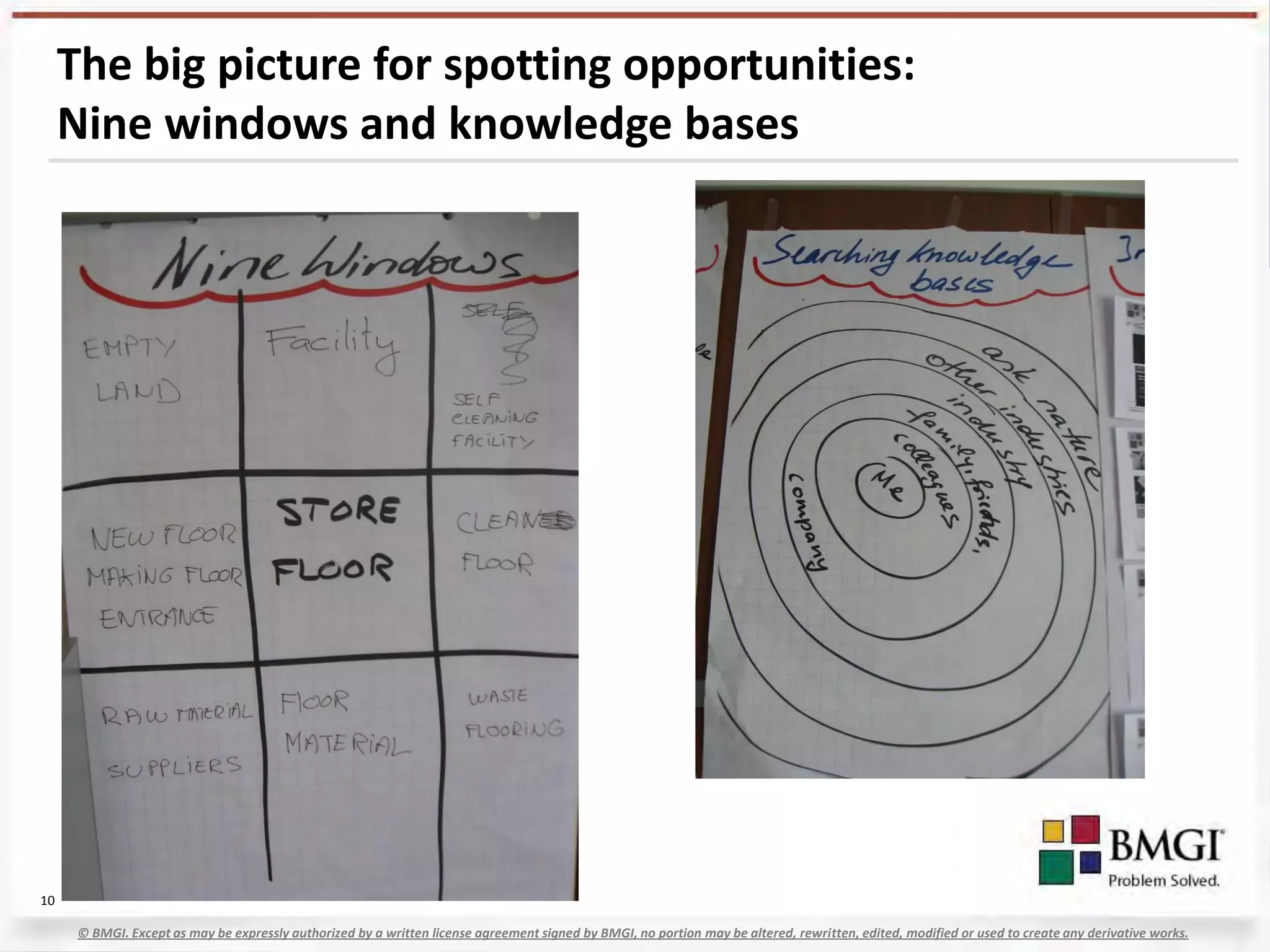
The big picture for spotting opportunities:
     Nine windows and knowledge bases


10

      © BMGI. Except as may be expressly authorized by a written license agreement signed by BMGI, no portion may be altered, rewritten, edited, modified or used to create any derivative works.
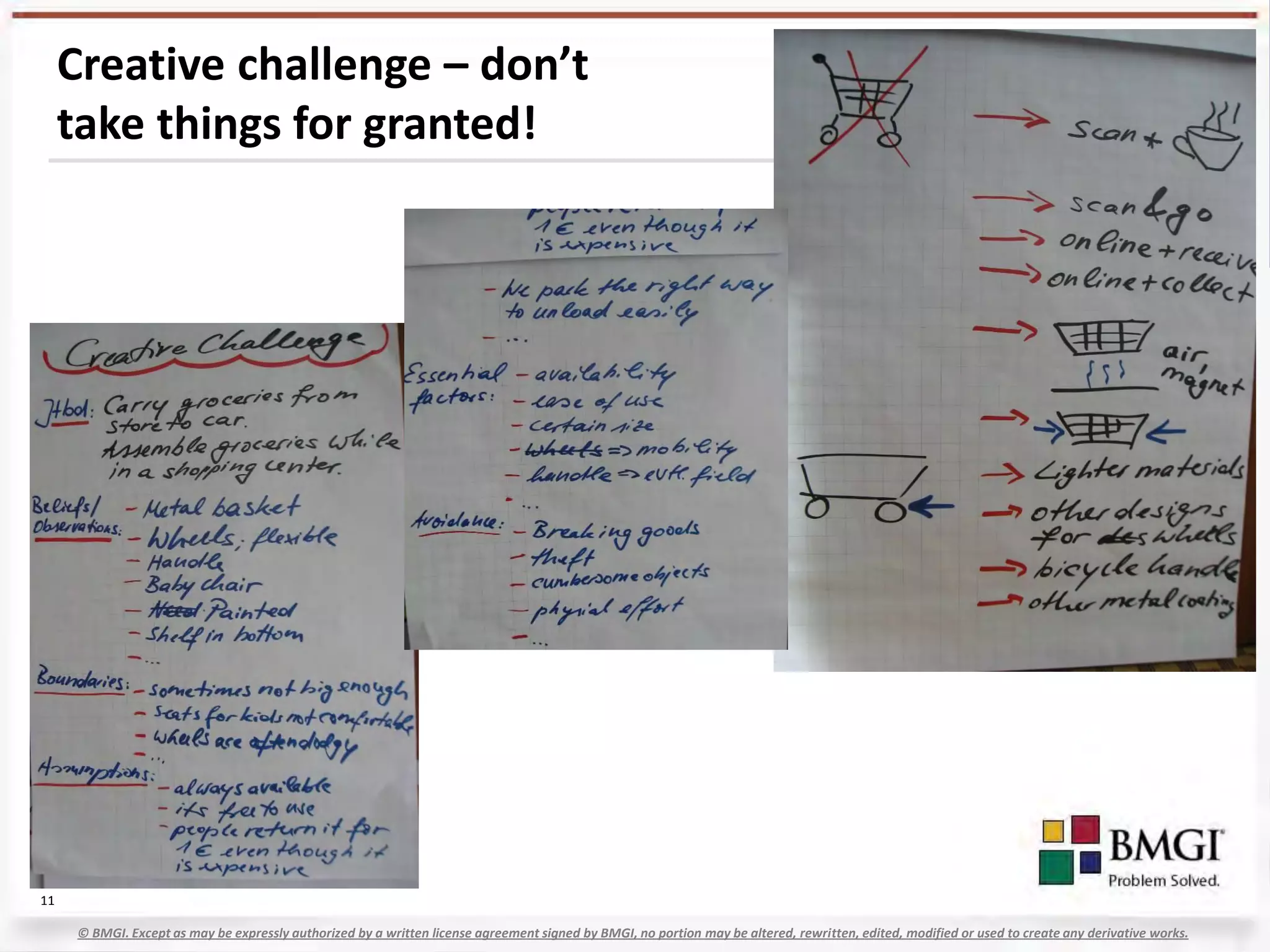
Creative challenge – don’t
     take things for granted!


11

      © BMGI. Except as may be expressly authorized by a written license agreement signed by BMGI, no portion may be altered, rewritten, edited, modified or used to create any derivative works.
Morphological matrix: A tremendous boost to creativity
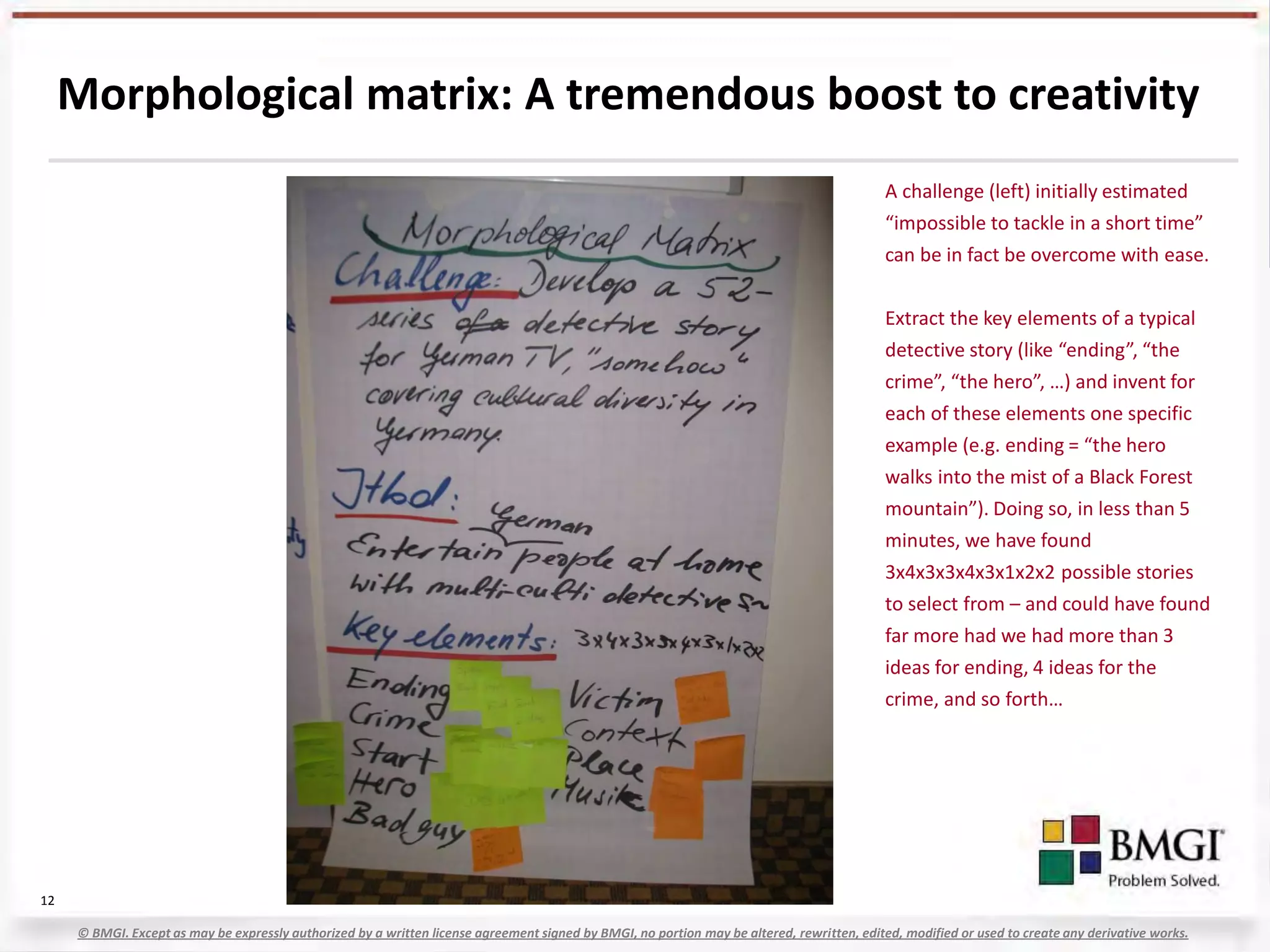
                                                                                                                                            A challenge (left) initially estimated
                                                                                                                                            “impossible to tackle in a short time”
                                                                                                                                            can be in fact be overcome with ease.


                                                                                                                                            Extract the key elements of a typical
                                                                                                                                            detective story (like “ending”, “the
                                                                                                                                            crime”, “the hero”, …) and invent for
                                                                                                                                            each of these elements one specific
                                                                                                                                            example (e.g. ending = “the hero
                                                                                                                                            walks into the mist of a Black Forest
                                                                                                                                            mountain”). Doing so, in less than 5
                                                                                                                                            minutes, we have found
                                                                                                                                            3x4x3x3x4x3x1x2x2 possible stories
                                                                                                                                            to select from – and could have found
                                                                                                                                            far more had we had more than 3
                                                                                                                                            ideas for ending, 4 ideas for the
                                                                                                                                            crime, and so forth…


12

     © BMGI. Except as may be expressly authorized by a written license agreement signed by BMGI, no portion may be altered, rewritten, edited, modified or used to create any derivative works.
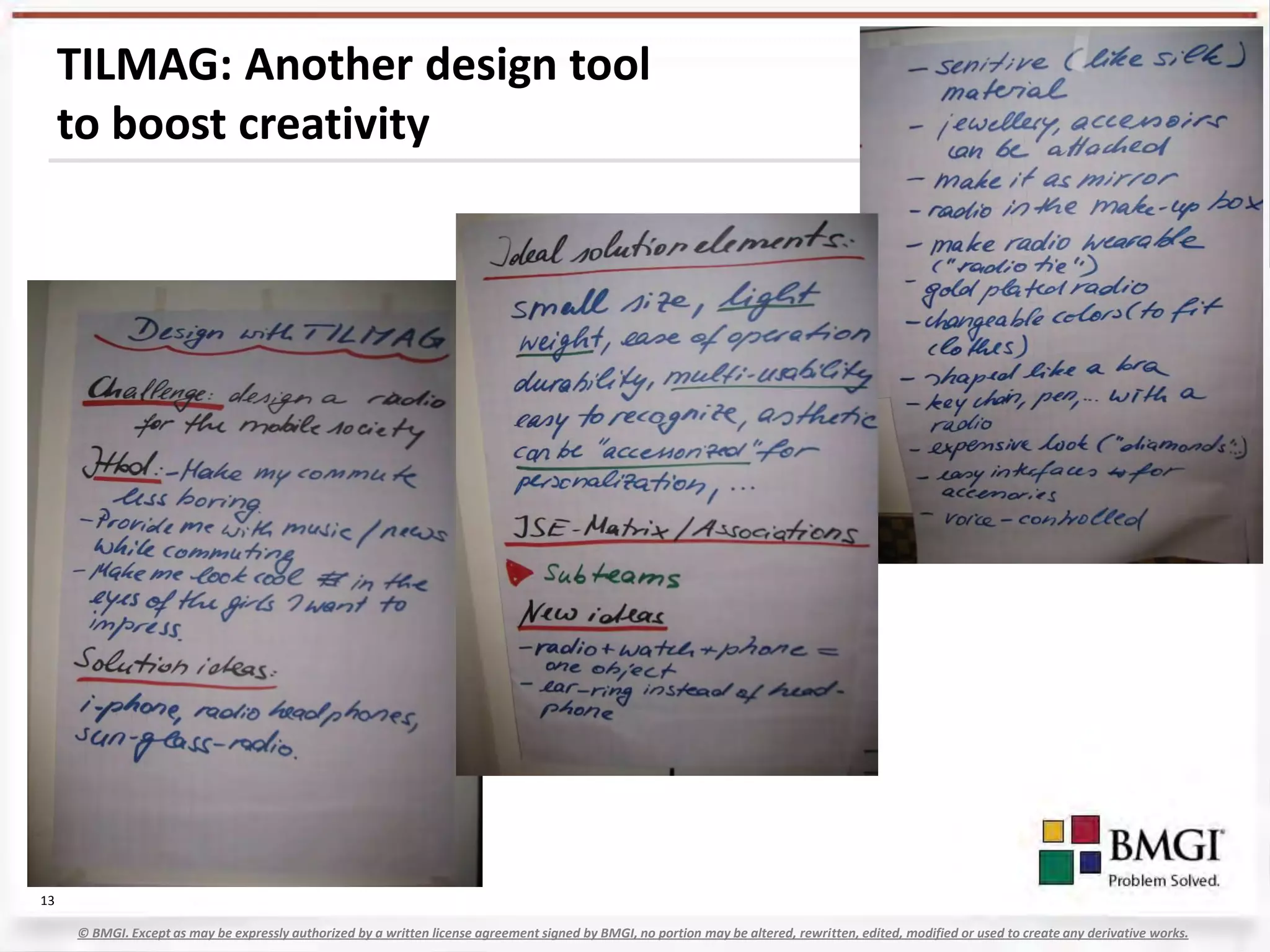
TILMAG: Another design tool
     to boost creativity


13

     © BMGI. Except as may be expressly authorized by a written license agreement signed by BMGI, no portion may be altered, rewritten, edited, modified or used to create any derivative works.
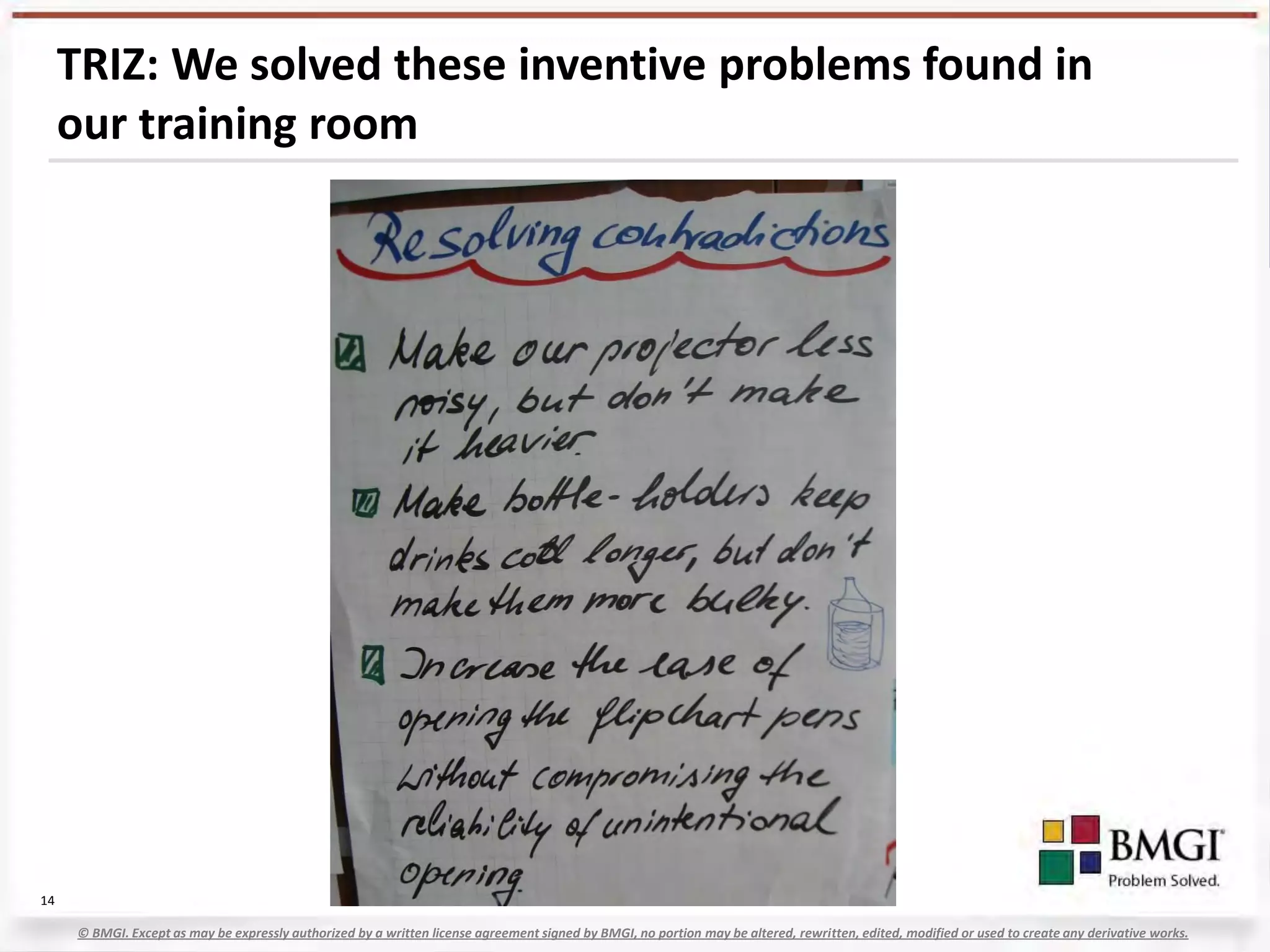
TRIZ: We solved these inventive problems found in
     our training room


14

     © BMGI. Except as may be expressly authorized by a written license agreement signed by BMGI, no portion may be altered, rewritten, edited, modified or used to create any derivative works.
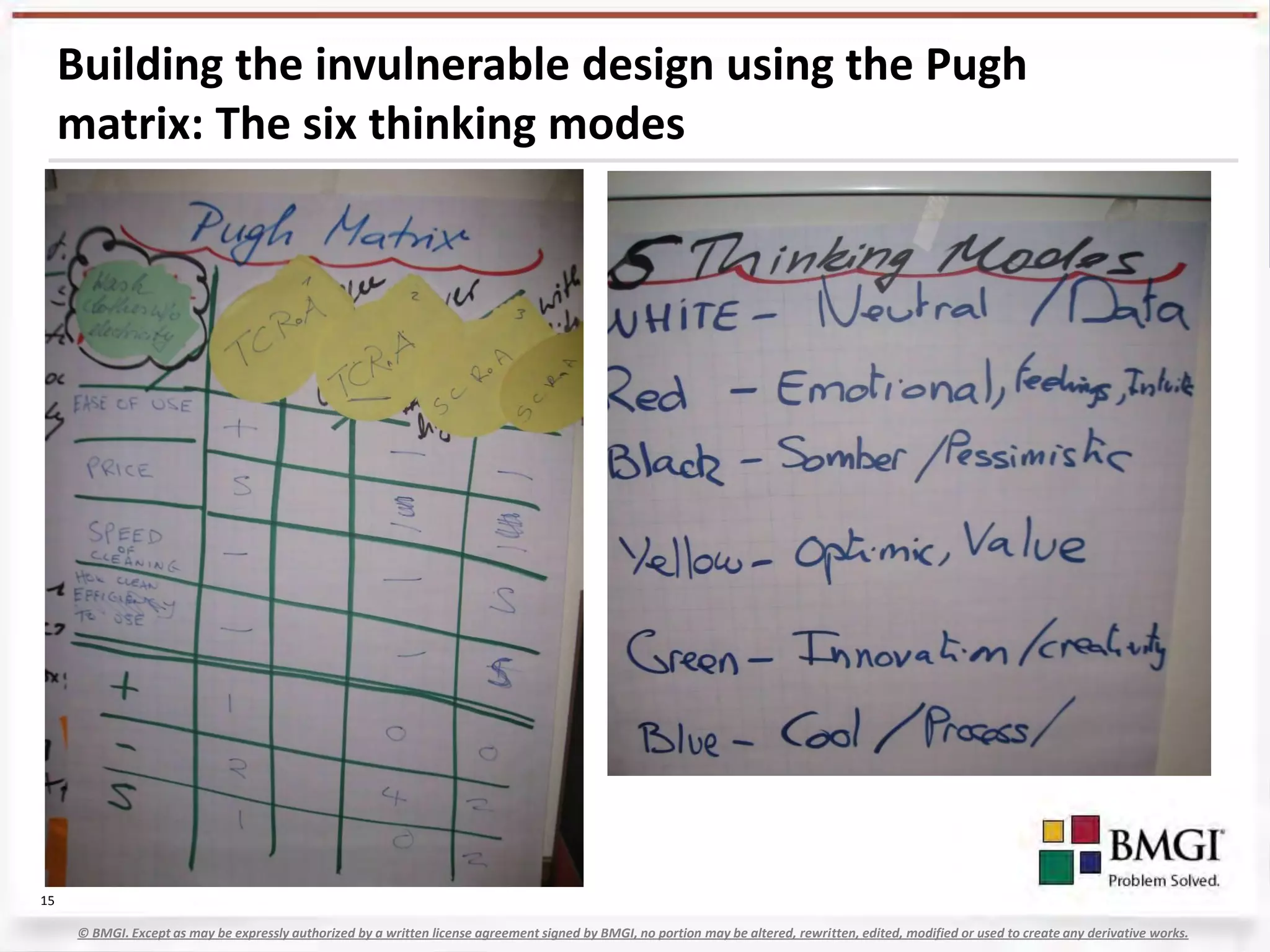
Building the invulnerable design using the Pugh
     matrix: The six thinking modes


15

     © BMGI. Except as may be expressly authorized by a written license agreement signed by BMGI, no portion may be altered, rewritten, edited, modified or used to create any derivative works.
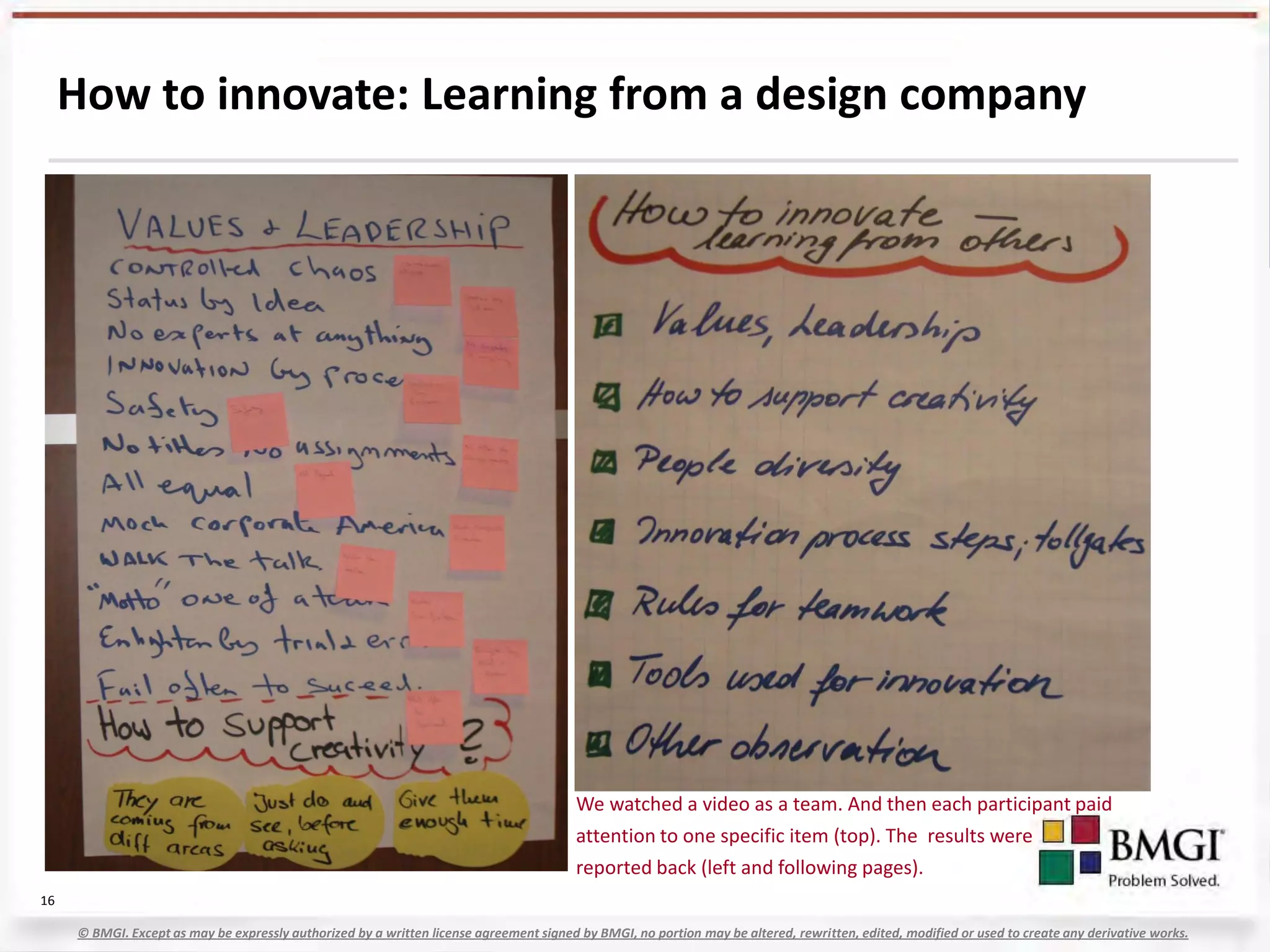
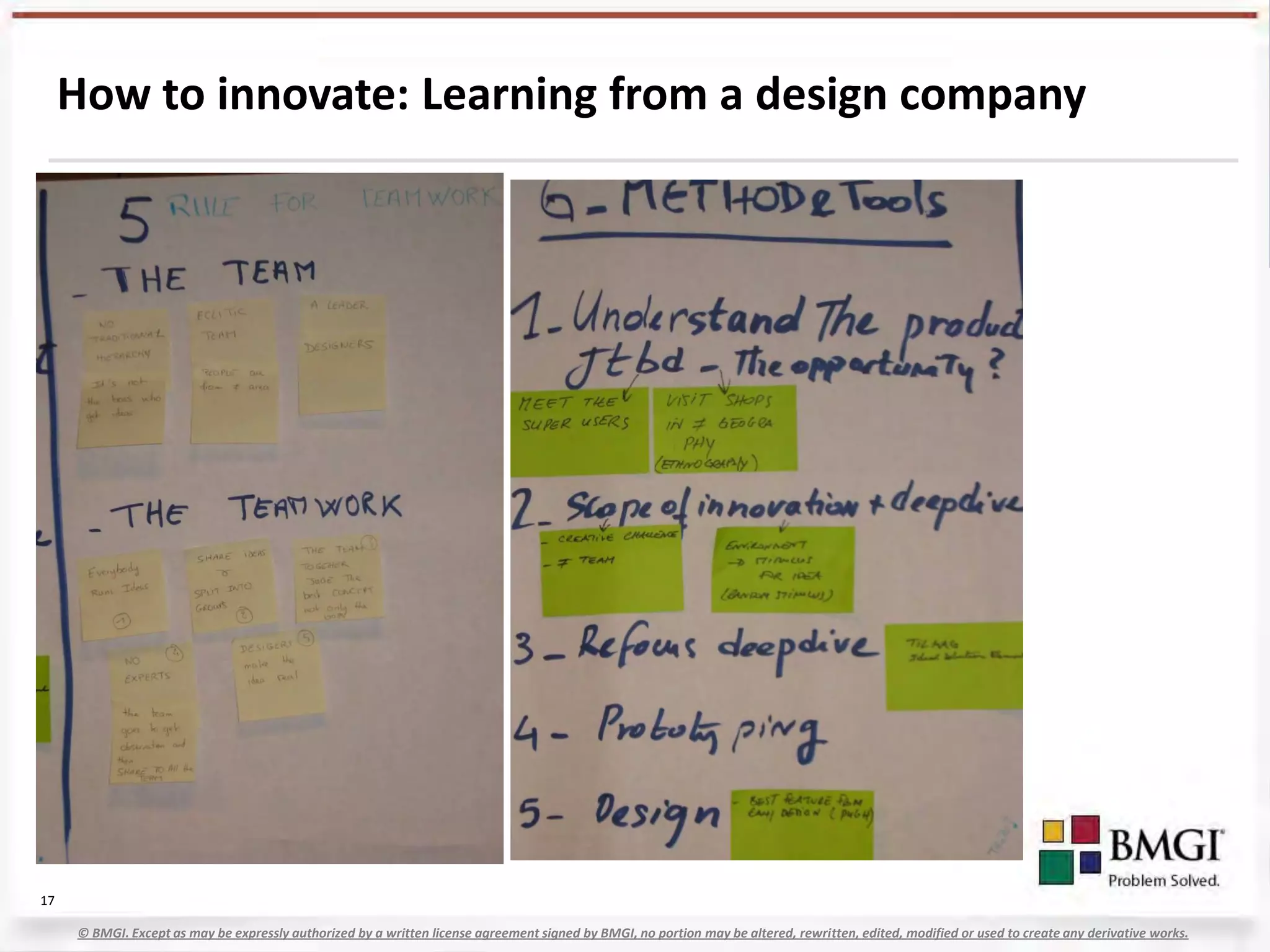
How to innovate: Learning from a design company


                                                                                        We watched a video as a team. And then each participant paid
                                                                                        attention to one specific item (top). The results were
                                                                                        reported back (left and following pages).
16

     © BMGI. Except as may be expressly authorized by a written license agreement signed by BMGI, no portion may be altered, rewritten, edited, modified or used to create any derivative works.
How to innovate: Learning from a design company


17

     © BMGI. Except as may be expressly authorized by a written license agreement signed by BMGI, no portion may be altered, rewritten, edited, modified or used to create any derivative works.
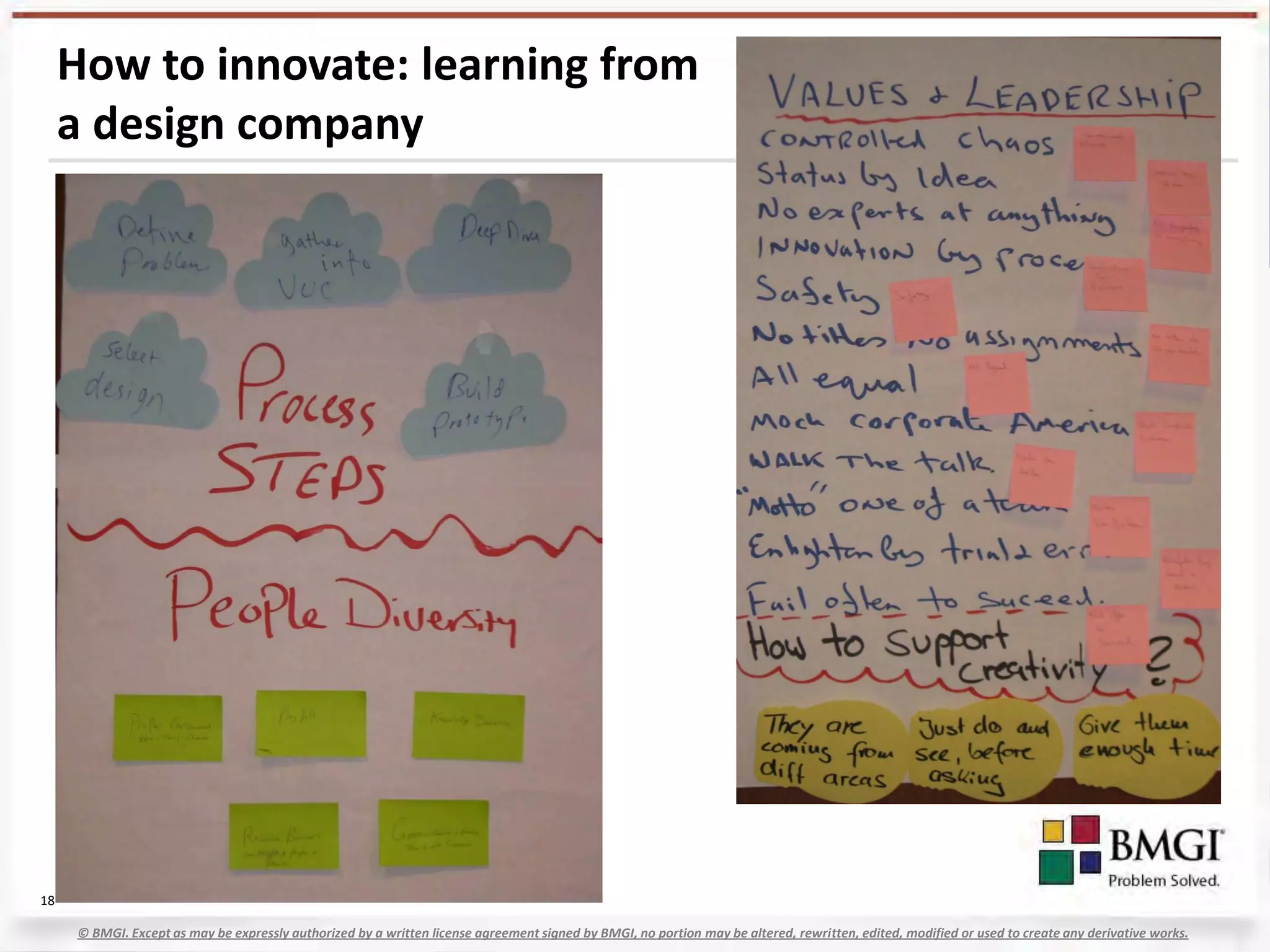
How to innovate: learning from
     a design company


18

     © BMGI. Except as may be expressly authorized by a written license agreement signed by BMGI, no portion may be altered, rewritten, edited, modified or used to create any derivative works.
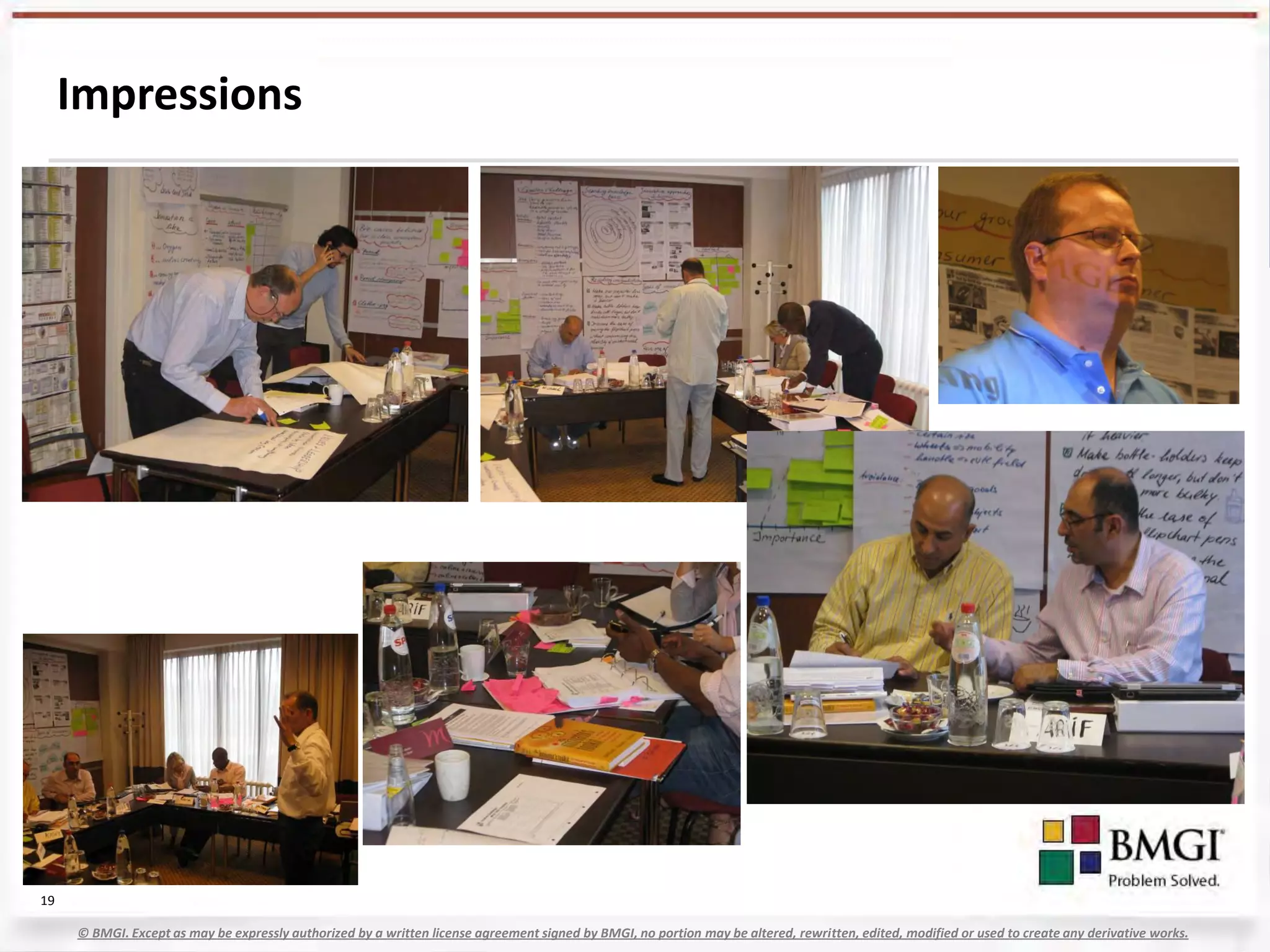
Impressions


19

     © BMGI. Except as may be expressly authorized by a written license agreement signed by BMGI, no portion may be altered, rewritten, edited, modified or used to create any derivative works.
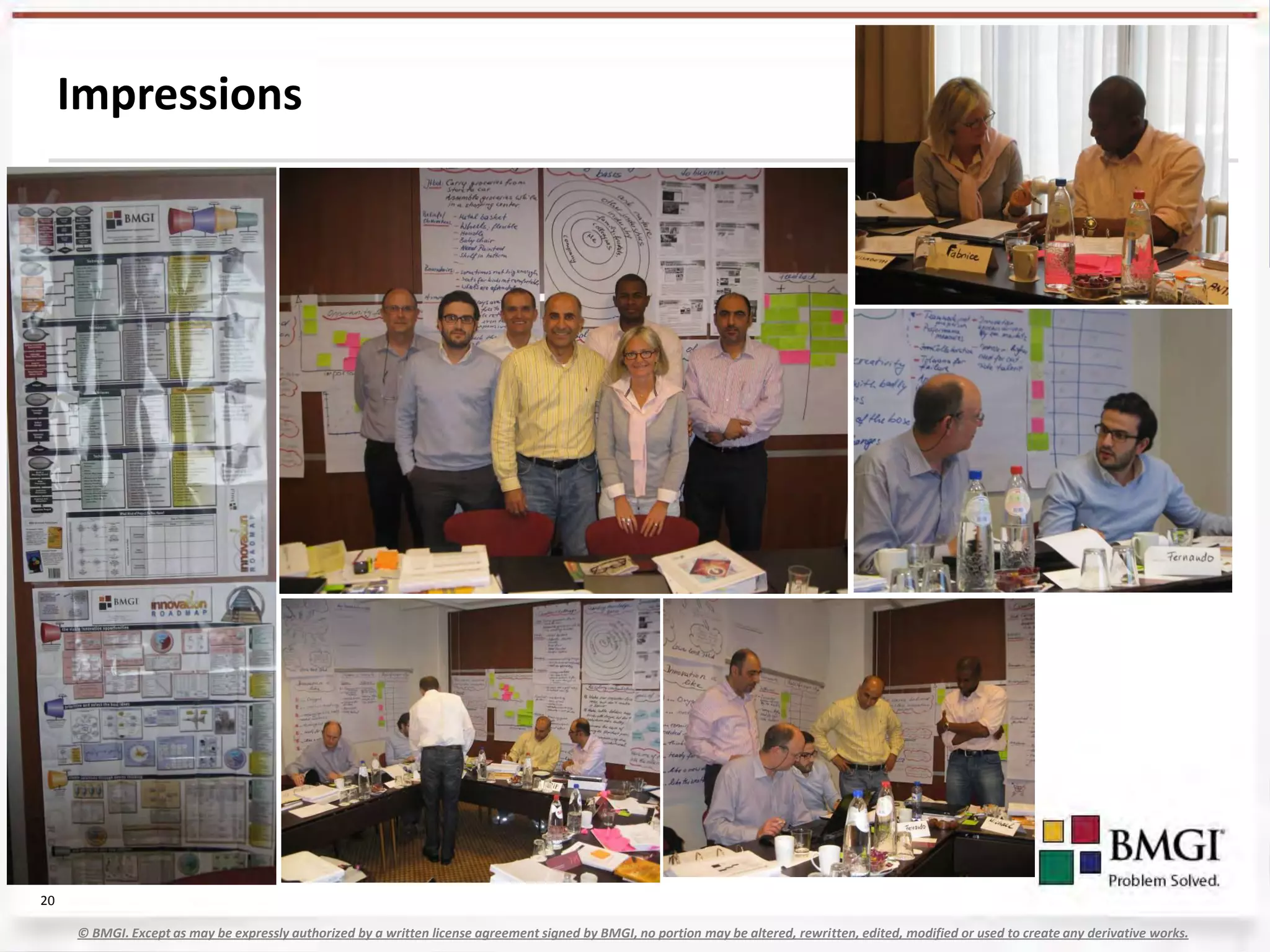
Impressions


20

     © BMGI. Except as may be expressly authorized by a written license agreement signed by BMGI, no portion may be altered, rewritten, edited, modified or used to create any derivative works.
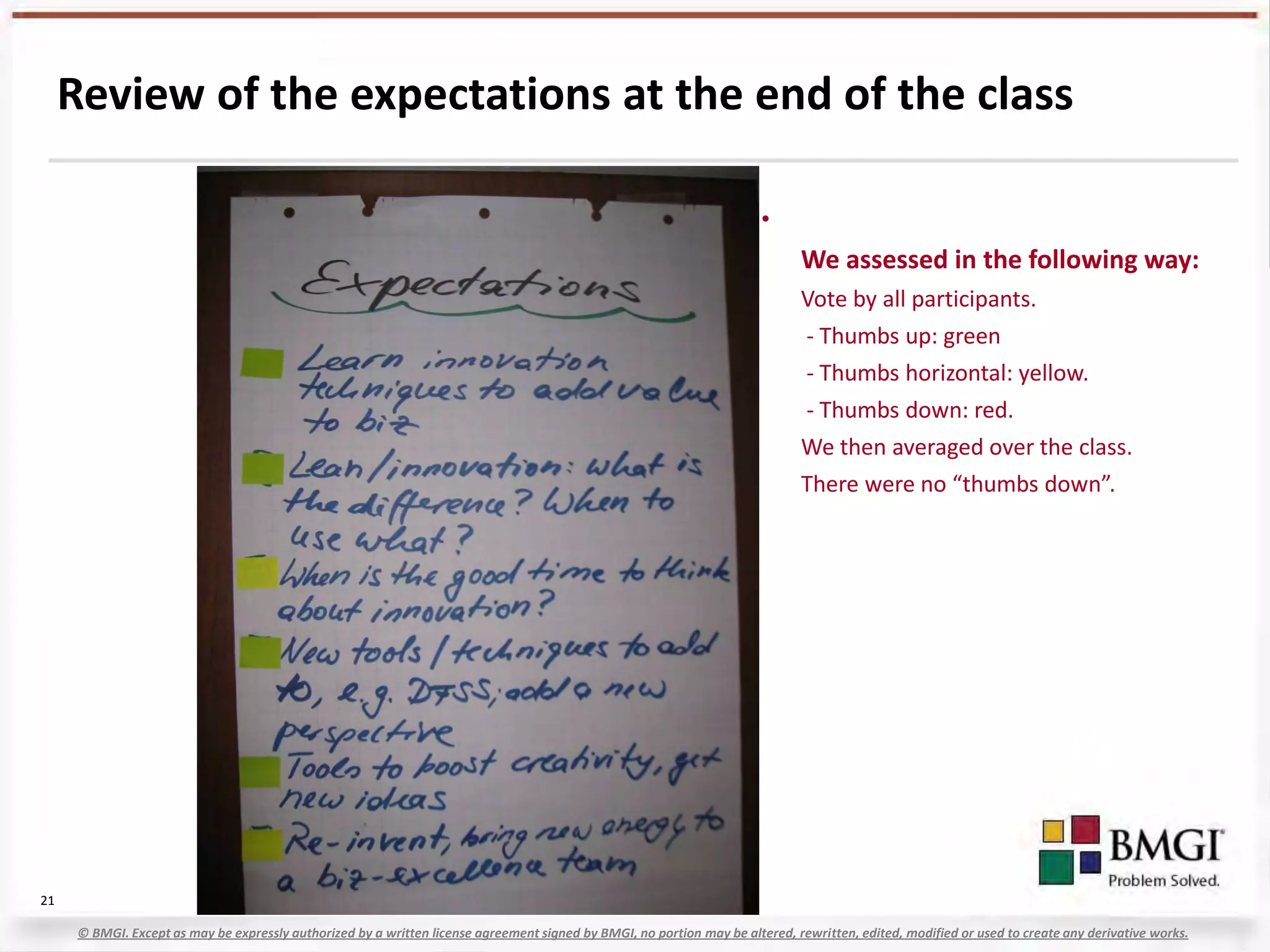
Review of the expectations at the end of the class

                                                                                                                         •
                                                                                                                               We assessed in the following way:
                                                                                                                               Vote by all participants.
                                                                                                                               - Thumbs up: green
                                                                                                                               - Thumbs horizontal: yellow.
                                                                                                                               - Thumbs down: red.
                                                                                                                               We then averaged over the class.
                                                                                                                               There were no “thumbs down”.


21

      © BMGI. Except as may be expressly authorized by a written license agreement signed by BMGI, no portion may be altered, rewritten, edited, modified or used to create any derivative works.
Thank you for joining!


22

     © BMGI. Except as may be expressly authorized by a written license agreement signed by BMGI, no portion may be altered, rewritten, edited, modified or used to create any derivative works.

Innovation And Design Tools Class Storyboard Small

  • 1.
    Flipcharts and Photosfrom: Innovation and Design Class Amsterdam 23-27 May 2011 Dr. Anthony Shingleton & Dr. Michael Ohler Principals, BMGI Europe The following slides present a selection of the tools discussed and outcomes achieved during the course. 1 © BMGI. Except as may be expressly authorized by a written license agreement signed by BMGI, no portion may be altered, rewritten, edited, modified or used to create any derivative works.
  • 2.
    Participant Comments andFeedback “The BMGI innovation training course was exactly what I was looking for to re-energize our business excellence effort. I will certainly recommend the course to whoever wishes to have a practical and fun dive into innovation tools and techniques.” Fabrice Gribon, Head of Process Excellence, Sanofi-Pasteur, France 2 © BMGI. Except as may be expressly authorized by a written license agreement signed by BMGI, no portion may be altered, rewritten, edited, modified or used to create any derivative works.
  • 3.
    Participants’ expectations and initial understanding of innovation 3 © BMGI. Except as may be expressly authorized by a written license agreement signed by BMGI, no portion may be altered, rewritten, edited, modified or used to create any derivative works.
  • 4.
    Brainstorming: « improveversus innovate » and « your ideas for uses of paper-clips » Notice: we collected these ideas in two minutes. We saw (right) that the KAI-scores in this class were quite similar and above the population average of 96. However, the range of scores in the class does not explain the range of the number of ideas for how 4 to use a paper clip. The two are commonly believed to be correlated. © BMGI. Except as may be expressly authorized by a written license agreement signed by BMGI, no portion may be altered, rewritten, edited, modified or used to create any derivative works.
  • 5.
    The Key InnovationConcepts: Job-to-be-done and Outcome Expectations (Higher & Lower Level Jobs) We later saw (right) that brainstorming for lower level jobs often delivers outcome expectations. Looking at the grammar of a job-to-be-done statement (JTBD, left), we also realized that outcome expectations 5 are a special case of JTBD. © BMGI. Except as may be expressly authorized by a written license agreement signed by BMGI, no portion may be altered, rewritten, edited, modified or used to create any derivative works.
  • 6.
    Understanding Innovation Opportunity Finding Innovation Opportunities Opportunities for innovation can be found by asking (potential) customers, For example : the JTBD is “manage my investment portfolio” and the outcome expectation is “maximize the transparency of the individual investments’ performance”. Questions for innovation opportunity could be: - “How important is it for you to have transparency on your investments’ performance?” - “How satisfied are you with your current ability to have transparency on your investments’ performance?” Participant learning points We understood that: a) This graph should not be split in quadrants (rather see the dashed lines) b) Depending on importance/satisfaction, one or the other of the four growth quadrants typically leads to successful innovations. We have practiced the concept by classifying outcome expectations of innovation opportunities we have found in the training room. 6 © BMGI. Except as may be expressly authorized by a written license agreement signed by BMGI, no portion may be altered, rewritten, edited, modified or used to create any derivative works.
  • 7.
    Making sense outof different examples of innovation – and general principle behind solution finding Companies can innovate in four growth quadrants. However certain types of innovation appear to be more a general approach to doing business. Innovations can often be classified in categories (top-middle). To make them stronger a product innovation can be supported by other types of innovation, e.g. The Tata Nano can be strengthened by a production process innovation specific to the Tata. We also learnt that when searching for solutions, humans also tend to follow a set path, “vector of inertia” e.g. by following the competition. Innovation techniques help to explore better the area closer to the ideal final result (IFR) rather than in random direction. 7 © BMGI. Except as may be expressly authorized by a written license agreement signed by BMGI, no portion may be altered, rewritten, edited, modified or used to create any derivative works.
  • 8.
    Learning to listen:Spotting outcome expectations Notice: some items listed above are in fact “functional requirements” tied to a given concept rather than being “outcome expectations” free 8 from any concept how to pour beer. © BMGI. Except as may be expressly authorized by a written license agreement signed by BMGI, no portion may be altered, rewritten, edited, modified or used to create any derivative works.
  • 9.
    The biz-cases forour in-class innovation projects and participants’ feedback as of day 2 Notice: in this class and as per preference of the class we applied innovation tools to innovate around objects in daily life we tend to take for granted (like pencil, pencil sharpener or clothe-peg). Simple financial estimations show that such seemingly insignificant objects can be associated with significant markets. We learned: innovation opportunities are all over the place. 9 © BMGI. Except as may be expressly authorized by a written license agreement signed by BMGI, no portion may be altered, rewritten, edited, modified or used to create any derivative works.
  • 10.
    The big picturefor spotting opportunities: Nine windows and knowledge bases 10 © BMGI. Except as may be expressly authorized by a written license agreement signed by BMGI, no portion may be altered, rewritten, edited, modified or used to create any derivative works.
  • 11.
    Creative challenge –don’t take things for granted! 11 © BMGI. Except as may be expressly authorized by a written license agreement signed by BMGI, no portion may be altered, rewritten, edited, modified or used to create any derivative works.
  • 12.
    Morphological matrix: Atremendous boost to creativity A challenge (left) initially estimated “impossible to tackle in a short time” can be in fact be overcome with ease. Extract the key elements of a typical detective story (like “ending”, “the crime”, “the hero”, …) and invent for each of these elements one specific example (e.g. ending = “the hero walks into the mist of a Black Forest mountain”). Doing so, in less than 5 minutes, we have found 3x4x3x3x4x3x1x2x2 possible stories to select from – and could have found far more had we had more than 3 ideas for ending, 4 ideas for the crime, and so forth… 12 © BMGI. Except as may be expressly authorized by a written license agreement signed by BMGI, no portion may be altered, rewritten, edited, modified or used to create any derivative works.
  • 13.
    TILMAG: Another designtool to boost creativity 13 © BMGI. Except as may be expressly authorized by a written license agreement signed by BMGI, no portion may be altered, rewritten, edited, modified or used to create any derivative works.
  • 14.
    TRIZ: We solvedthese inventive problems found in our training room 14 © BMGI. Except as may be expressly authorized by a written license agreement signed by BMGI, no portion may be altered, rewritten, edited, modified or used to create any derivative works.
  • 15.
    Building the invulnerabledesign using the Pugh matrix: The six thinking modes 15 © BMGI. Except as may be expressly authorized by a written license agreement signed by BMGI, no portion may be altered, rewritten, edited, modified or used to create any derivative works.
  • 16.
    How to innovate:Learning from a design company We watched a video as a team. And then each participant paid attention to one specific item (top). The results were reported back (left and following pages). 16 © BMGI. Except as may be expressly authorized by a written license agreement signed by BMGI, no portion may be altered, rewritten, edited, modified or used to create any derivative works.
  • 17.
    How to innovate:Learning from a design company 17 © BMGI. Except as may be expressly authorized by a written license agreement signed by BMGI, no portion may be altered, rewritten, edited, modified or used to create any derivative works.
  • 18.
    How to innovate:learning from a design company 18 © BMGI. Except as may be expressly authorized by a written license agreement signed by BMGI, no portion may be altered, rewritten, edited, modified or used to create any derivative works.
  • 19.
    Impressions 19 © BMGI. Except as may be expressly authorized by a written license agreement signed by BMGI, no portion may be altered, rewritten, edited, modified or used to create any derivative works.
  • 20.
    Impressions 20 © BMGI. Except as may be expressly authorized by a written license agreement signed by BMGI, no portion may be altered, rewritten, edited, modified or used to create any derivative works.
  • 21.
    Review of theexpectations at the end of the class • We assessed in the following way: Vote by all participants. - Thumbs up: green - Thumbs horizontal: yellow. - Thumbs down: red. We then averaged over the class. There were no “thumbs down”. 21 © BMGI. Except as may be expressly authorized by a written license agreement signed by BMGI, no portion may be altered, rewritten, edited, modified or used to create any derivative works.
  • 22.
    Thank you forjoining! 22 © BMGI. Except as may be expressly authorized by a written license agreement signed by BMGI, no portion may be altered, rewritten, edited, modified or used to create any derivative works.