Learning from Diversity
eTwinning professional development workshop
   Intercultural appreciation and inclusion:
               challenging schools

               Isabel Paes
            ACIDI, IP – Portugal
High Comissioner for Immigration
 and Intercultural Dialogue (ACIDI)

(…)‘to fight all forms of discrimination,
  through positive actions of awareness,
  education and training, and to promote
  interculturality, through intercultural and
  inter-religious dialogue, based on the
  respect of the Constitution, the Law and
  recognising the value of cultural diversity
  and mutual respect.’
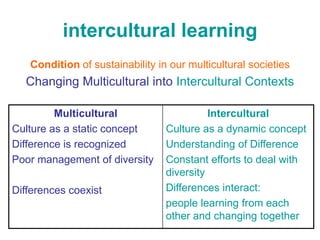
intercultural learning
   Condition of sustainability in our multicultural societies
  Changing Multicultural into Intercultural Contexts

         Multicultural                     Intercultural
Culture as a static concept      Culture as a dynamic concept
Difference is recognized         Understanding of Difference
Poor management of diversity     Constant efforts to deal with
                                 diversity
Differences coexist              Differences interact:
                                 people learning from each
                                 other and changing together
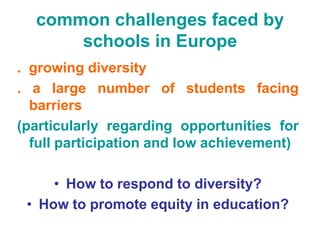
common challenges faced by
      schools in Europe
. growing diversity
. a large number of students facing
  barriers
(particularly regarding opportunities for
  full participation and low achievement)

     • How to respond to diversity?
 • How to promote equity in education?
equity in education
• high expectations: every person is able
                     to learn and achieve
                     something
 and
• relevant opportunities for all:
                              - participation
                              - learning
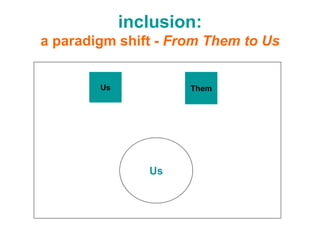
inclusion:
a paradigm shift - From Them to Us


        Us           Them


                Us
challenging beliefs in school

  Opposite ways of looking at educational difficulties:

Perspective 1: Difficulties defined in terms of
  student characteristics (deficit perspective)


Perspective 2: Difficulties defined in terms of
  organizational conditions (curricular
  perspective)

From Ainscow, M. (1994) Special Needs in the Classroom: A Teacher
   Education Guide. Cambridge: UNESCO Publ.
example: Learning from Diversity
       a school development guide
Developing a School’s Network – Inclusive Education Project (ME)
   Disseminating a Guide for School Development (ACIDI/ME)

                         key issues
•   collaboration
•   coordination teams
•   shared leadership
•   joint problem solving
•   managing time for development activities
•   action learning
•   external elements
•   school’s networks
                           Learning from Diversity (Caldeira et al., 2004)
                                                      www.acidi.gov.pt
example: developing a schools’
               network
        The project challenge for the schools
    developing a curricular perspective approach:
● How can we make a better use of the resources available
  for learning and participation?
    - students
    - teachers and their partners in school
    - parents and other partners in the community
    - other schools and external elements

● How can we reorganize the curriculum and school’s
  policies in order to improve opportunities for all
  students in the local community?

   Using the INDEX FOR INCLUSION (Booth e Ainscow, 2001, CSIE)
key lessons: developing more
          inclusive schools
• improvement has to be led from within
• it is a long development process requiring
  leaders committed and fixed in a school
• ‘building bridges’, an effective role for leaders:
     - shared leadership
     - involving different people
     - developing new values and a shared
       commitment towards equity
     - encouraging experimentation
  Collaboration in school and supportive school’s
  networks are the best means of mobilising
  available expertise. (Mel Ainscow, 2008)
inclusive education:
      an organizational perspective
• The process of increasing the participation of
  students in, and reducing their exclusion from the
  curricula, cultures and communities of local schools

• Restructuring the cultures, policies and practices of
  schools so that they respond to the diversity of
  students in their locality

• The presence, participation and achievement of all
  students vulnerable to exclusionary pressures, not
  only those with impairments or those who are
  categorised as ‘having special educational needs’

From Ainscow, M., Booth, T. and Dyson, A. (2006) ‘Improving
   Schools, Developing Inclusion’. London: Routledge
developing more inclusive schools
 a process of removing barriers to learning and
 participation - specially those faced by the students
 most vulnerable to marginalization...

... starting with removing the obstacles buried in our
   own minds:
learning to live together - learning from diversity

         The best way to reach new values:
  involving all people in a school’s community in
     successful initiatives that bring innovation
learning from diversity in school
• looking at diversity as an opportunity for
  learning: developing intercultural skills
• building welcoming cooperative learning
  environments that fosters collaboration:
  partnerships/organizing learning events
• developing research skills through
  collaborative inquiry – analysis of the
  school context
• using evidence as an engine for change
building intercultural skills in school
• Intercultural competence as an essential tool for all
• Critical reflection: sharing different views/challenging
  beliefs: a cross curricular task

      Creating conditions for personal and social change
               looking at oneself as a learner
It requires:
• Modifying the process of knowledge construction:
    learning through cooperation; creating conditions for
    cooperative learning
• Giving students a more active role in their own learning
• Changings in the hidden curriculum, in classroom
    management and interaction and in the teacher’s role.

                                    (From Díaz-Aguado, 2000)
organizing school-based learning events
 •   Meeting different people with different roles
 •   Getting to know each other
 •   Sharing good practices and achievements
 •   Providing and getting feedback
 •   Discussing the details of practice with peers
 •   Developing self-confidence
 •   Building new tools and strategies
 •   Creating a common language
 •   Sustaining communities of practice
            Learning to work in collaboration
             Learning together in school
school context analysis through
         collaborative inquiry
•   Developing a focus
•   Inviting external elements as ‘critical friends’
•   Involving students as researchers
•   Listening to different / hidden voices
•   Classroom / school observation
•   Writing ‘stories’
            an action learning approach
                  (Mel Ainscow, 2008)
using evidence as a stimulus for
     change: overcoming barriers
    opportunities for joint planning and practice:
•   involving different people from every group in
    the local community
•   developing a common sense of purpose
•   engaging with evidence
•   leading change step by step
The most important factor: the collective will to
      make it happen (Ainscow, 2008)
“… if you think the subject of education is knowledge, then
to make it more powerful, wonderful and inclusive, it follows
that knowledge should get more general, that some
knowledge should illuminate other knowledge. Perhaps that
is why the idea of ‘theory’ is so appealing.

But the subject of education isn't knowledge - it's
people. To make them more powerful, wonderful, and
inclusive, we can only help create with them
circumstances in which they can gradually transform
their own needs, knowledgeability, and grasp of their
future possibilities.”
                                  (Lave, 2001)
bibliography
Ainscow, M. (1994) Special Needs in the Classroom: A Teacher Education
   Guide. Cambridge: UNESCO Publ.

Ainscow, M.; Booth, T. (2001) Index for Inclusion. Bristol: CSIE.

Ainscow, M., Booth, T. and Dyson, A. (2006) Improving Schools, Developing
   Inclusion. London: Routledge.

Caldeira, E.; Micaelo, M.; Paes, I.; Vitorino, T. (2004) Learning from
   Difference. A School Development Guide (Portuguese version). Lisboa:
   ACIME/DEB (ME)

Díaz-Aguado, M.J. (1996) Programa de Educación para la Tolerancia y
   Prevención de la Violencia en los Jóvenes. Madrid: Ministerio del TAS

Lave, J. (2001) Learning in Practice: The Kalundborg Production School. CUP

Learning from difference

  • 1.
    Learning from Diversity eTwinningprofessional development workshop Intercultural appreciation and inclusion: challenging schools Isabel Paes ACIDI, IP – Portugal
  • 2.
    High Comissioner forImmigration and Intercultural Dialogue (ACIDI) (…)‘to fight all forms of discrimination, through positive actions of awareness, education and training, and to promote interculturality, through intercultural and inter-religious dialogue, based on the respect of the Constitution, the Law and recognising the value of cultural diversity and mutual respect.’
  • 3.
    intercultural learning Condition of sustainability in our multicultural societies Changing Multicultural into Intercultural Contexts Multicultural Intercultural Culture as a static concept Culture as a dynamic concept Difference is recognized Understanding of Difference Poor management of diversity Constant efforts to deal with diversity Differences coexist Differences interact: people learning from each other and changing together
  • 4.
    common challenges facedby schools in Europe . growing diversity . a large number of students facing barriers (particularly regarding opportunities for full participation and low achievement) • How to respond to diversity? • How to promote equity in education?
  • 5.
    equity in education •high expectations: every person is able to learn and achieve something and • relevant opportunities for all: - participation - learning
  • 6.
    inclusion: a paradigm shift- From Them to Us Us Them Us
  • 7.
    challenging beliefs inschool Opposite ways of looking at educational difficulties: Perspective 1: Difficulties defined in terms of student characteristics (deficit perspective) Perspective 2: Difficulties defined in terms of organizational conditions (curricular perspective) From Ainscow, M. (1994) Special Needs in the Classroom: A Teacher Education Guide. Cambridge: UNESCO Publ.
  • 8.
    example: Learning fromDiversity a school development guide Developing a School’s Network – Inclusive Education Project (ME) Disseminating a Guide for School Development (ACIDI/ME) key issues • collaboration • coordination teams • shared leadership • joint problem solving • managing time for development activities • action learning • external elements • school’s networks Learning from Diversity (Caldeira et al., 2004) www.acidi.gov.pt
  • 9.
    example: developing aschools’ network The project challenge for the schools developing a curricular perspective approach: ● How can we make a better use of the resources available for learning and participation? - students - teachers and their partners in school - parents and other partners in the community - other schools and external elements ● How can we reorganize the curriculum and school’s policies in order to improve opportunities for all students in the local community? Using the INDEX FOR INCLUSION (Booth e Ainscow, 2001, CSIE)
  • 10.
    key lessons: developingmore inclusive schools • improvement has to be led from within • it is a long development process requiring leaders committed and fixed in a school • ‘building bridges’, an effective role for leaders: - shared leadership - involving different people - developing new values and a shared commitment towards equity - encouraging experimentation Collaboration in school and supportive school’s networks are the best means of mobilising available expertise. (Mel Ainscow, 2008)
  • 11.
    inclusive education: an organizational perspective • The process of increasing the participation of students in, and reducing their exclusion from the curricula, cultures and communities of local schools • Restructuring the cultures, policies and practices of schools so that they respond to the diversity of students in their locality • The presence, participation and achievement of all students vulnerable to exclusionary pressures, not only those with impairments or those who are categorised as ‘having special educational needs’ From Ainscow, M., Booth, T. and Dyson, A. (2006) ‘Improving Schools, Developing Inclusion’. London: Routledge
  • 12.
    developing more inclusiveschools a process of removing barriers to learning and participation - specially those faced by the students most vulnerable to marginalization... ... starting with removing the obstacles buried in our own minds: learning to live together - learning from diversity The best way to reach new values: involving all people in a school’s community in successful initiatives that bring innovation
  • 13.
    learning from diversityin school • looking at diversity as an opportunity for learning: developing intercultural skills • building welcoming cooperative learning environments that fosters collaboration: partnerships/organizing learning events • developing research skills through collaborative inquiry – analysis of the school context • using evidence as an engine for change
  • 14.
    building intercultural skillsin school • Intercultural competence as an essential tool for all • Critical reflection: sharing different views/challenging beliefs: a cross curricular task Creating conditions for personal and social change looking at oneself as a learner It requires: • Modifying the process of knowledge construction: learning through cooperation; creating conditions for cooperative learning • Giving students a more active role in their own learning • Changings in the hidden curriculum, in classroom management and interaction and in the teacher’s role. (From Díaz-Aguado, 2000)
  • 15.
    organizing school-based learningevents • Meeting different people with different roles • Getting to know each other • Sharing good practices and achievements • Providing and getting feedback • Discussing the details of practice with peers • Developing self-confidence • Building new tools and strategies • Creating a common language • Sustaining communities of practice Learning to work in collaboration Learning together in school
  • 16.
    school context analysisthrough collaborative inquiry • Developing a focus • Inviting external elements as ‘critical friends’ • Involving students as researchers • Listening to different / hidden voices • Classroom / school observation • Writing ‘stories’ an action learning approach (Mel Ainscow, 2008)
  • 17.
    using evidence asa stimulus for change: overcoming barriers opportunities for joint planning and practice: • involving different people from every group in the local community • developing a common sense of purpose • engaging with evidence • leading change step by step The most important factor: the collective will to make it happen (Ainscow, 2008)
  • 18.
    “… if youthink the subject of education is knowledge, then to make it more powerful, wonderful and inclusive, it follows that knowledge should get more general, that some knowledge should illuminate other knowledge. Perhaps that is why the idea of ‘theory’ is so appealing. But the subject of education isn't knowledge - it's people. To make them more powerful, wonderful, and inclusive, we can only help create with them circumstances in which they can gradually transform their own needs, knowledgeability, and grasp of their future possibilities.” (Lave, 2001)
  • 19.
    bibliography Ainscow, M. (1994)Special Needs in the Classroom: A Teacher Education Guide. Cambridge: UNESCO Publ. Ainscow, M.; Booth, T. (2001) Index for Inclusion. Bristol: CSIE. Ainscow, M., Booth, T. and Dyson, A. (2006) Improving Schools, Developing Inclusion. London: Routledge. Caldeira, E.; Micaelo, M.; Paes, I.; Vitorino, T. (2004) Learning from Difference. A School Development Guide (Portuguese version). Lisboa: ACIME/DEB (ME) Díaz-Aguado, M.J. (1996) Programa de Educación para la Tolerancia y Prevención de la Violencia en los Jóvenes. Madrid: Ministerio del TAS Lave, J. (2001) Learning in Practice: The Kalundborg Production School. CUP