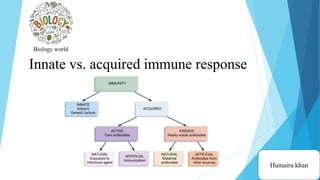
Innate vs. acquired immune response
Humaira khan
Biology world
BASIC TERMS
IMMUNOLOGY:
 Immunology is a branch of biology that covers the study of
immune systems in all organisms.
IMMUNITY:
 Immunity is the ability of an organism to resist infections by
pathogens.
IMMUNE SYSTEM:
 The array of cells, tissue and organs which carry out this activity
is called immune system
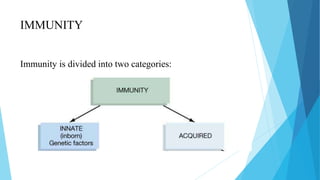
IMMUNITY
Immunity is divided into two categories:
INNATE IMMUNITY
 Present since birth
 Operates almost any foreign molecules and pathogens.
 First-line of defence.
 Non-specific.
 Does not rely on previous exposure.
 Does not have memory.
 Consists of physical, chemical and cellular defence
against pathogens.
ADAPTIVE IMMUNITY
 The second line of defence against non-self pathogens is
called adaptive immune system.
 known as specific or acquired immunity.
 Adaptive immunity display four characteristics:
a. ANTIGENIC SPECIFICITY:
b. IMMUNOLOGICAL MEMORY
c. DIVERSITY
d. SELF/NON-SLEF RECOGNITION
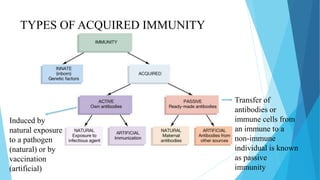
TYPES OF ACQUIRED IMMUNITY
Induced by
natural exposure
to a pathogen
(natural) or by
vaccination
(artificial)
Transfer of
antibodies or
immune cells from
an immune to a
non-immune
individual is known
as passive
immunity
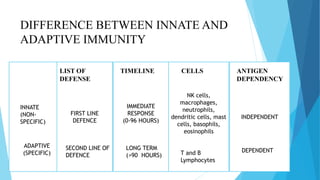
DIFFERENCE BETWEEN INNATE AND
ADAPTIVE IMMUNITY
ADAPTIVE
(SPECIFIC)
FIRST LINE
DEFENCE
IMMEDIATE
RESPONSE
(0-96 HOURS)
NK cells,
macrophages,
neutrophils,
dendritic cells, mast
cells, basophils,
eosinophils
INDEPENDENT
LIST OF
DEFENSE
TIMELINE CELLS ANTIGEN
DEPENDENCY
INNATE
(NON-
SPECIFIC)
SECOND LINE OF
DEFENCE
LONG TERM
(>90 HOURS) T and B
Lymphocytes
DEPENDENT

Innate vs. adaptive immunity

  • 1.
    Innate vs. acquiredimmune response Humaira khan Biology world
  • 2.
    BASIC TERMS IMMUNOLOGY:  Immunologyis a branch of biology that covers the study of immune systems in all organisms. IMMUNITY:  Immunity is the ability of an organism to resist infections by pathogens. IMMUNE SYSTEM:  The array of cells, tissue and organs which carry out this activity is called immune system
  • 3.
    IMMUNITY Immunity is dividedinto two categories:
  • 4.
    INNATE IMMUNITY  Presentsince birth  Operates almost any foreign molecules and pathogens.  First-line of defence.  Non-specific.  Does not rely on previous exposure.  Does not have memory.  Consists of physical, chemical and cellular defence against pathogens.
  • 5.
    ADAPTIVE IMMUNITY  Thesecond line of defence against non-self pathogens is called adaptive immune system.  known as specific or acquired immunity.  Adaptive immunity display four characteristics: a. ANTIGENIC SPECIFICITY: b. IMMUNOLOGICAL MEMORY c. DIVERSITY d. SELF/NON-SLEF RECOGNITION
  • 6.
    TYPES OF ACQUIREDIMMUNITY Induced by natural exposure to a pathogen (natural) or by vaccination (artificial) Transfer of antibodies or immune cells from an immune to a non-immune individual is known as passive immunity
  • 7.
    DIFFERENCE BETWEEN INNATEAND ADAPTIVE IMMUNITY ADAPTIVE (SPECIFIC) FIRST LINE DEFENCE IMMEDIATE RESPONSE (0-96 HOURS) NK cells, macrophages, neutrophils, dendritic cells, mast cells, basophils, eosinophils INDEPENDENT LIST OF DEFENSE TIMELINE CELLS ANTIGEN DEPENDENCY INNATE (NON- SPECIFIC) SECOND LINE OF DEFENCE LONG TERM (>90 HOURS) T and B Lymphocytes DEPENDENT