Lecture outline
• The nomenclature of Immunology
• Types of immunity (innate and adaptive;
active and passive; humoral and cell-
mediated)
• Features of immune responses
• The major cells of the immune system
• Basic science: understanding a complex
biological system
• Impact on many aspects of human disease
• Immunization is the ONLY approach for
eradicating a disease
• New therapies based on biology
• Potential for major role in emerging
therapies (gene therapy, stem cell therapy)
Why the great interest in Immunology?
Definitions
• Immunity: protection against infections
• Immune system: molecules, cells and tissues that
mediate responses to foreign substances
• Antigens: substances recognized by the cells and
molecules of the immune system and to which the
system responds
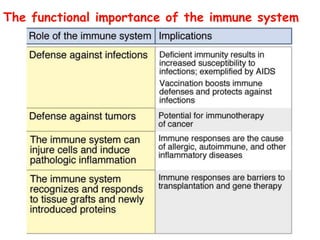
The functional importance of the immune system
The central questions
• How does the immune system respond to different
infections?
– Different types of microbes are eliminated by
different effector mechanisms, which are
designed to best combat each type of microbe
– Microbes and hosts are engaged in an
evolutionary struggle, each trying to overcome
the other; many of the features of the immune
system reflect the consequences of such
evolution
The central questions
• How does the immune system respond to different infections?
– Different types of microbes are eliminated by different
effector mechanisms, which are designed to best combat each
type of microbe
– The evolutionary struggle between microbes and hosts
• Why does the immune system not respond to self
antigens?
• What are the pathogenic mechanisms and clinico-
pathologic consequences of abnormalities in the
immune system?
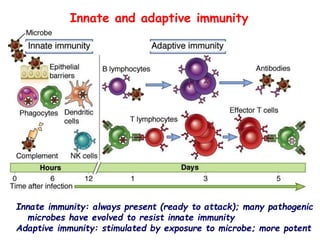
Innate immunity: always present (ready to attack); many pathogenic
microbes have evolved to resist innate immunity
Adaptive immunity: stimulated by exposure to microbe; more potent
Innate and adaptive immunity
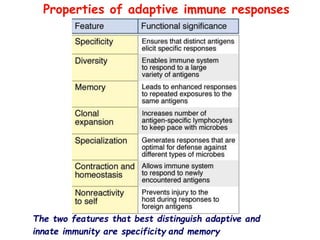
The two features that best distinguish adaptive and
innate immunity are specificity and memory
Properties of adaptive immune responses
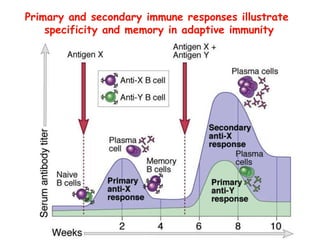
Primary and secondary immune responses illustrate
specificity and memory in adaptive immunity
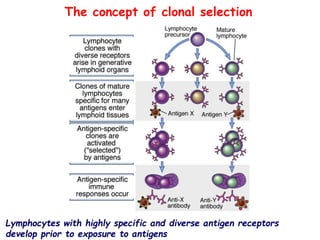
Lymphocytes with highly specific and diverse antigen receptors
develop prior to exposure to antigens
The concept of clonal selection
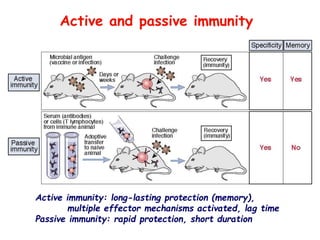
Active and passive immunity
Active immunity: long-lasting protection (memory),
multiple effector mechanisms activated, lag time
Passive immunity: rapid protection, short duration
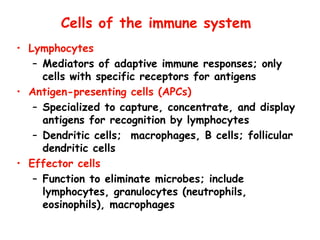
Cells of the immune system
• Lymphocytes
– Mediators of adaptive immune responses; only
cells with specific receptors for antigens
• Antigen-presenting cells (APCs)
– Specialized to capture, concentrate, and display
antigens for recognition by lymphocytes
– Dendritic cells; macrophages, B cells; follicular
dendritic cells
• Effector cells
– Function to eliminate microbes; include
lymphocytes, granulocytes (neutrophils,
eosinophils), macrophages
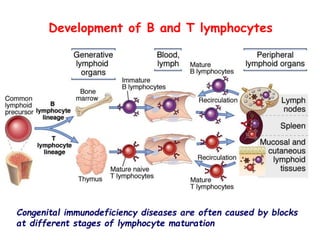
Congenital immunodeficiency diseases are often caused by blocks
at different stages of lymphocyte maturation
Development of B and T lymphocytes
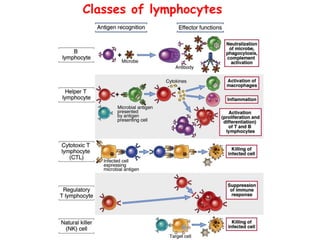
Classes of lymphocytes
The CD Nomenclature
• Structurally defined leukocyte surface molecule that
is expressed on cells of a particular lineage
(“differentiation”) and recognized by a group
(“cluster”) of cell-specific antibodies is called a
member of a cluster of differentiation (CD)
• CD molecules (CD antigens, CD markers) are:
• Used to classify leukocytes into functionally distinct
subpopulations, e.g. helper T cells are CD4+CD8-, CTLs
are CD8+CD4-
• Often involved in leukocyte functions
• Antibodies against various CD molecules are used to:
• Identify and isolate leukocyte subpopulations
• Study functions of leukocytes
• Eliminate particular cell populations
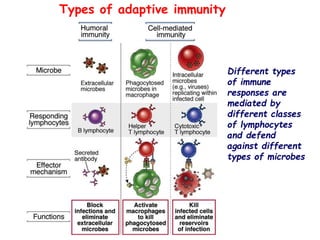
Different types
of immune
responses are
mediated by
different classes
of lymphocytes
and defend
against different
types of microbes
Types of adaptive immunity
Need for proliferation and differentiation results in delay
(typically 4-7 days) in the adaptive immune response
Phases of adaptive immune responses
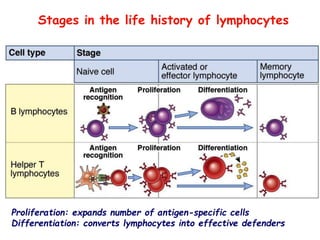
Stages in the life history of lymphocytes
Proliferation: expands number of antigen-specific cells
Differentiation: converts lymphocytes into effective defenders
Naïve, effector and memory lymphocytes
• Naïve lymphocytes
– Mature lymphocytes that have not previously
encountered antigen; function -- antigen
recognition
– Preferential migration to peripheral lymphoid
organs (lymph nodes), the sites where antigens
are concentrated and immune responses start
• Naïve lymphocytes
– Mature lymphocytes that have not previously encountered antigen;
function -- antigen recognition
– Preferential migration to peripheral lymphoid organs (lymph
nodes), the sites where antigens are concentrated and immune
responses start
• Effector lymphocytes
– Activated lymphocytes capable of performing the
functions required to eliminate microbes
(‘effector functions”)
– Effector T lymphocytes: cytokine secretion
(helper cells), killing of infected cells (CTLs)
– B lymphocytes: antibody-secreting plasma cells
Naïve, effector and memory lymphocytes
• Naïve lymphocytes
– Mature lymphocytes that have not previously encountered antigen;
function -- antigen recognition
– Preferential migration to peripheral lymphoid organs (lymph
nodes), the sites where antigens are concentrated and immune
responses start
• Effector lymphocytes
– Activated lymphocytes capable of performing the functions
required to eliminate microbes (‘effector functions”)
– Effector T lymphocytes: cytokine secretion (helper cells), killing
of infected cells (CTLs)
– B lymphocytes: antibody-secreting cells (e.g. plasma cells)
• Memory lymphocytes
– Long-lived, functionally silent cells; mount rapid
responses to antigen challenge (secondary
responses)
Naïve, effector and memory lymphocytes

Immunity physiology .pptx

  • 1.
    Lecture outline • Thenomenclature of Immunology • Types of immunity (innate and adaptive; active and passive; humoral and cell- mediated) • Features of immune responses • The major cells of the immune system
  • 2.
    • Basic science:understanding a complex biological system • Impact on many aspects of human disease • Immunization is the ONLY approach for eradicating a disease • New therapies based on biology • Potential for major role in emerging therapies (gene therapy, stem cell therapy) Why the great interest in Immunology?
  • 3.
    Definitions • Immunity: protectionagainst infections • Immune system: molecules, cells and tissues that mediate responses to foreign substances • Antigens: substances recognized by the cells and molecules of the immune system and to which the system responds
  • 4.
    The functional importanceof the immune system
  • 5.
    The central questions •How does the immune system respond to different infections? – Different types of microbes are eliminated by different effector mechanisms, which are designed to best combat each type of microbe – Microbes and hosts are engaged in an evolutionary struggle, each trying to overcome the other; many of the features of the immune system reflect the consequences of such evolution
  • 6.
    The central questions •How does the immune system respond to different infections? – Different types of microbes are eliminated by different effector mechanisms, which are designed to best combat each type of microbe – The evolutionary struggle between microbes and hosts • Why does the immune system not respond to self antigens? • What are the pathogenic mechanisms and clinico- pathologic consequences of abnormalities in the immune system?
  • 7.
    Innate immunity: alwayspresent (ready to attack); many pathogenic microbes have evolved to resist innate immunity Adaptive immunity: stimulated by exposure to microbe; more potent Innate and adaptive immunity
  • 8.
    The two featuresthat best distinguish adaptive and innate immunity are specificity and memory Properties of adaptive immune responses
  • 9.
    Primary and secondaryimmune responses illustrate specificity and memory in adaptive immunity
  • 10.
    Lymphocytes with highlyspecific and diverse antigen receptors develop prior to exposure to antigens The concept of clonal selection
  • 11.
    Active and passiveimmunity Active immunity: long-lasting protection (memory), multiple effector mechanisms activated, lag time Passive immunity: rapid protection, short duration
  • 12.
    Cells of theimmune system • Lymphocytes – Mediators of adaptive immune responses; only cells with specific receptors for antigens • Antigen-presenting cells (APCs) – Specialized to capture, concentrate, and display antigens for recognition by lymphocytes – Dendritic cells; macrophages, B cells; follicular dendritic cells • Effector cells – Function to eliminate microbes; include lymphocytes, granulocytes (neutrophils, eosinophils), macrophages
  • 13.
    Congenital immunodeficiency diseasesare often caused by blocks at different stages of lymphocyte maturation Development of B and T lymphocytes
  • 14.
  • 15.
    The CD Nomenclature •Structurally defined leukocyte surface molecule that is expressed on cells of a particular lineage (“differentiation”) and recognized by a group (“cluster”) of cell-specific antibodies is called a member of a cluster of differentiation (CD) • CD molecules (CD antigens, CD markers) are: • Used to classify leukocytes into functionally distinct subpopulations, e.g. helper T cells are CD4+CD8-, CTLs are CD8+CD4- • Often involved in leukocyte functions • Antibodies against various CD molecules are used to: • Identify and isolate leukocyte subpopulations • Study functions of leukocytes • Eliminate particular cell populations
  • 16.
    Different types of immune responsesare mediated by different classes of lymphocytes and defend against different types of microbes Types of adaptive immunity
  • 17.
    Need for proliferationand differentiation results in delay (typically 4-7 days) in the adaptive immune response Phases of adaptive immune responses
  • 18.
    Stages in thelife history of lymphocytes Proliferation: expands number of antigen-specific cells Differentiation: converts lymphocytes into effective defenders
  • 19.
    Naïve, effector andmemory lymphocytes • Naïve lymphocytes – Mature lymphocytes that have not previously encountered antigen; function -- antigen recognition – Preferential migration to peripheral lymphoid organs (lymph nodes), the sites where antigens are concentrated and immune responses start
  • 20.
    • Naïve lymphocytes –Mature lymphocytes that have not previously encountered antigen; function -- antigen recognition – Preferential migration to peripheral lymphoid organs (lymph nodes), the sites where antigens are concentrated and immune responses start • Effector lymphocytes – Activated lymphocytes capable of performing the functions required to eliminate microbes (‘effector functions”) – Effector T lymphocytes: cytokine secretion (helper cells), killing of infected cells (CTLs) – B lymphocytes: antibody-secreting plasma cells Naïve, effector and memory lymphocytes
  • 21.
    • Naïve lymphocytes –Mature lymphocytes that have not previously encountered antigen; function -- antigen recognition – Preferential migration to peripheral lymphoid organs (lymph nodes), the sites where antigens are concentrated and immune responses start • Effector lymphocytes – Activated lymphocytes capable of performing the functions required to eliminate microbes (‘effector functions”) – Effector T lymphocytes: cytokine secretion (helper cells), killing of infected cells (CTLs) – B lymphocytes: antibody-secreting cells (e.g. plasma cells) • Memory lymphocytes – Long-lived, functionally silent cells; mount rapid responses to antigen challenge (secondary responses) Naïve, effector and memory lymphocytes