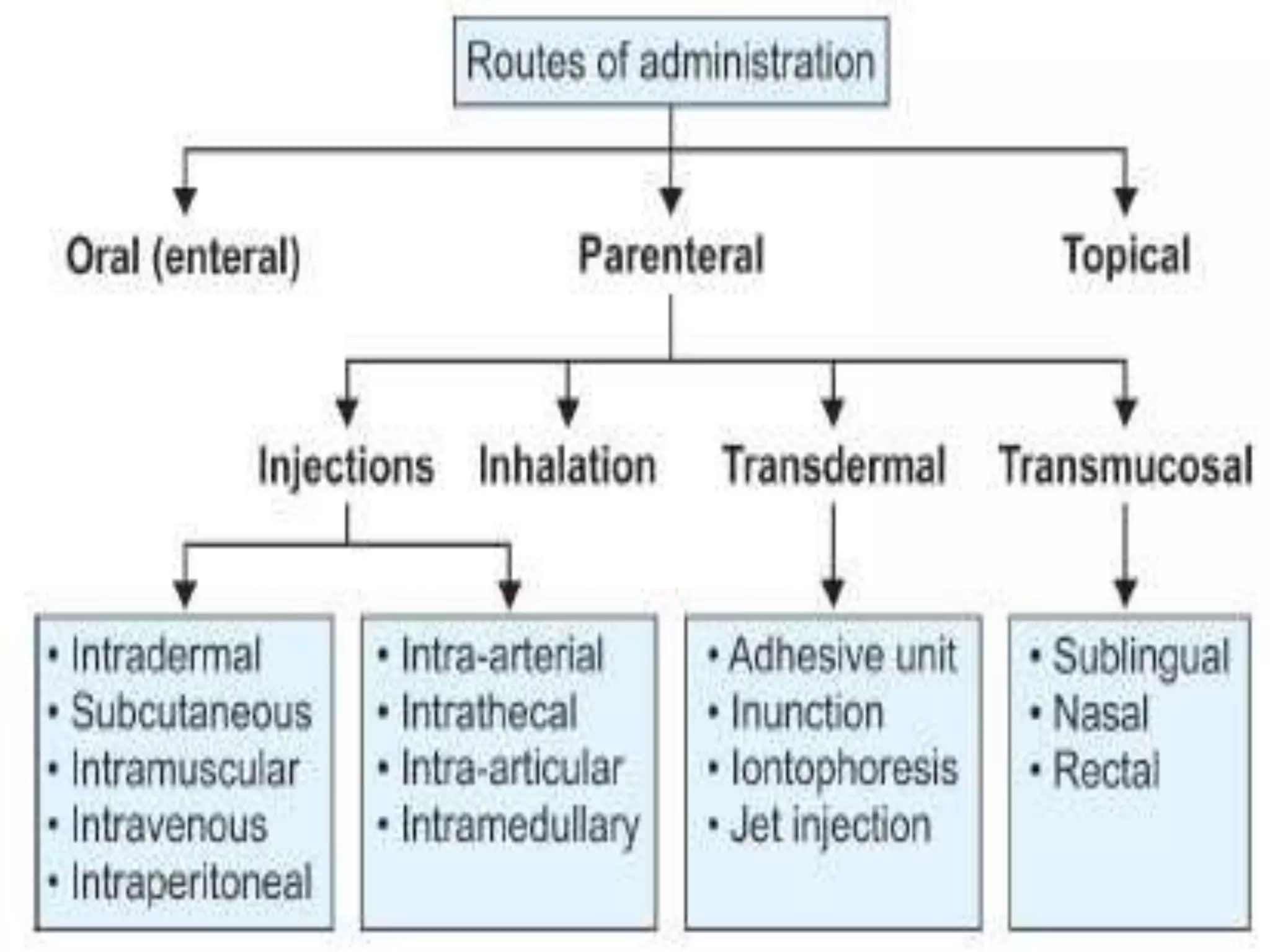
This document provides information on intradermal and subcutaneous injections. It defines intradermal injections as injections into the dermis where absorption is slow, and they are used for sensitivity testing and vaccinations. Subcutaneous injections are injected into the fatty tissue just under the skin for rapid drug effects. Both injections require following proper technique and have potential complications like pain, redness and swelling at the injection site. Tuberculin syringes are commonly used for intradermal injections like tuberculosis skin tests.
INTRODUCTON:-
• Intradermal injectionsare only given for
certain therapies, such as skin testing,
tuberculin screening and allergy tests. It is
preferred as the body’s reaction to substances
is more easily visible since it is close to the
surface. The intradermal sites should be free of
lesions and relatively hairless.
6.
DEFINITION:-
• It isdefined as the shallow and superficial
injection of a medication into the dermis,
where blood supply is reduced and drug
absorbs slowly. It is useful route for certain
vaccination and for allergic testing.
7.
PURPOSE:-
• To performsensitivity test
• To administer vaccination
• To serve as a diagnostic tool for certain
diseases and allergies/testing for antibody
formation for example (PPD for Tuberculosis)
8.
SITES:-
• Usually palmer(inner) side of forearm and
subscapular region of back
• Deltoid region for BCG vaccination in
neonates
• The site selected should be an easily
obtainable area and relatively free from being
rubbed by clothing
9.
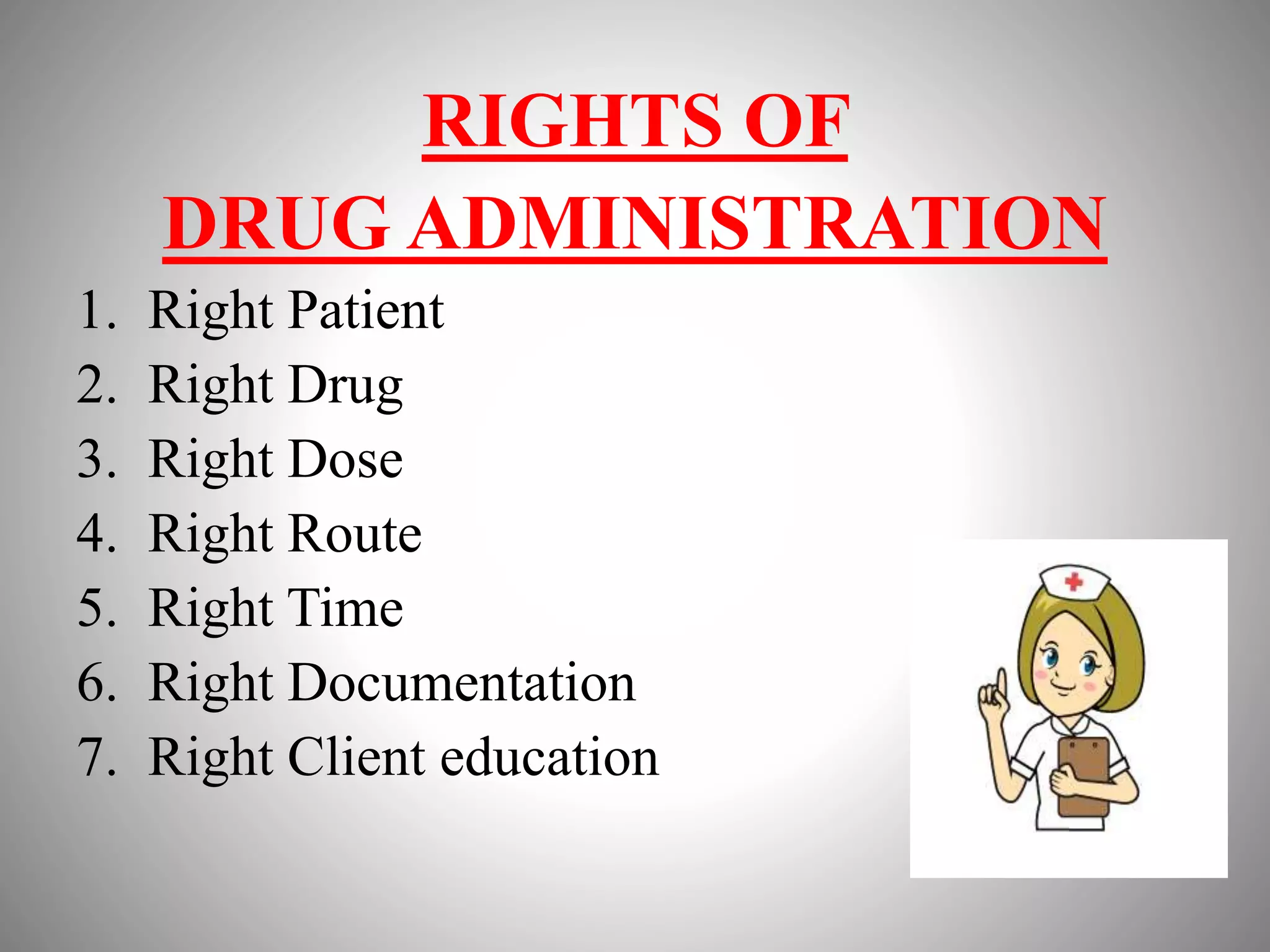
RIGHTS OF
DRUG ADMINISTRATION
1.Right Patient
2. Right Drug
3. Right Dose
4. Right Route
5. Right Time
6. Right Documentation
7. Right Client education
10.
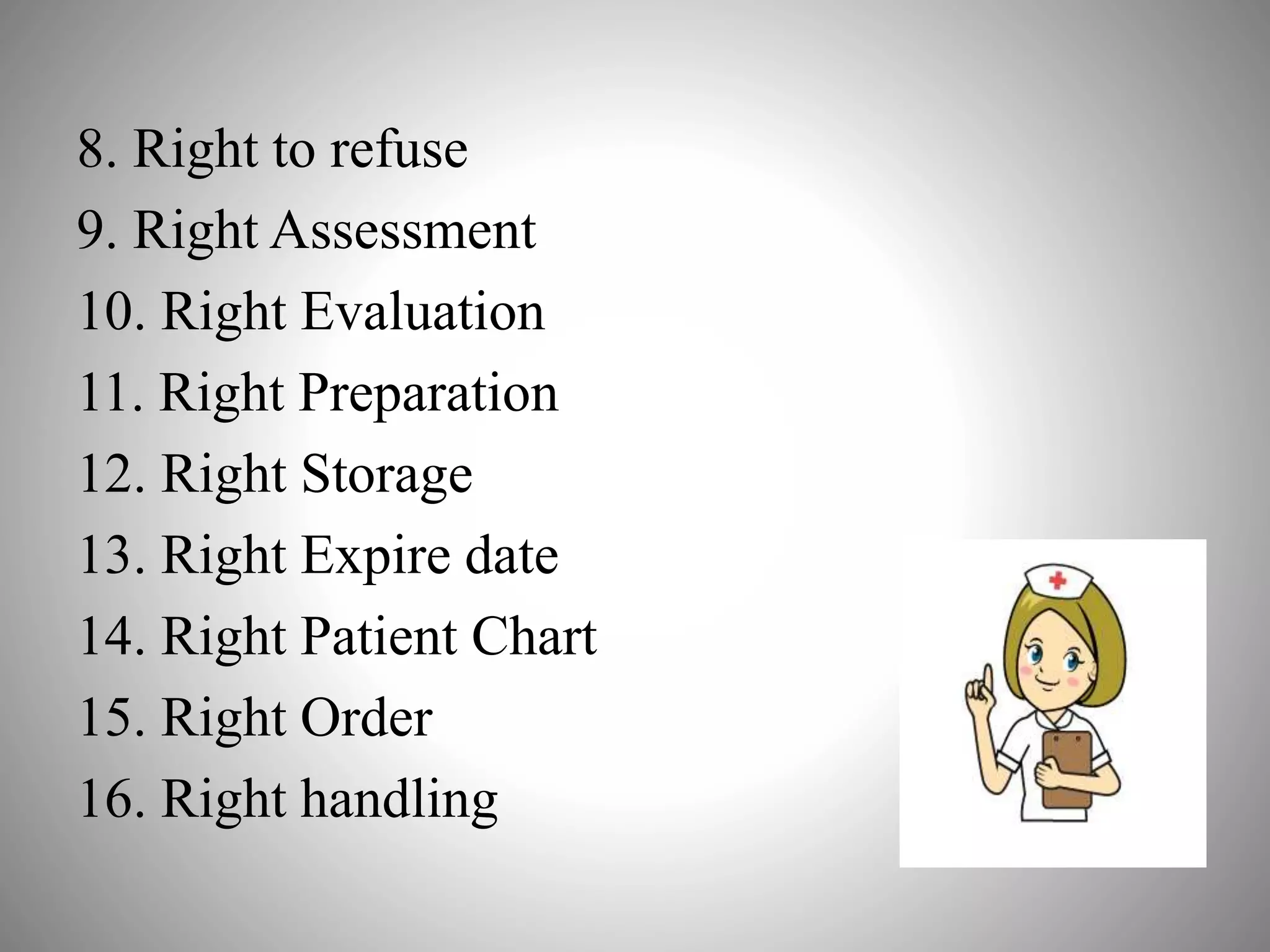
8. Right torefuse
9. Right Assessment
10. Right Evaluation
11. Right Preparation
12. Right Storage
13. Right Expire date
14. Right Patient Chart
15. Right Order
16. Right handling
11.
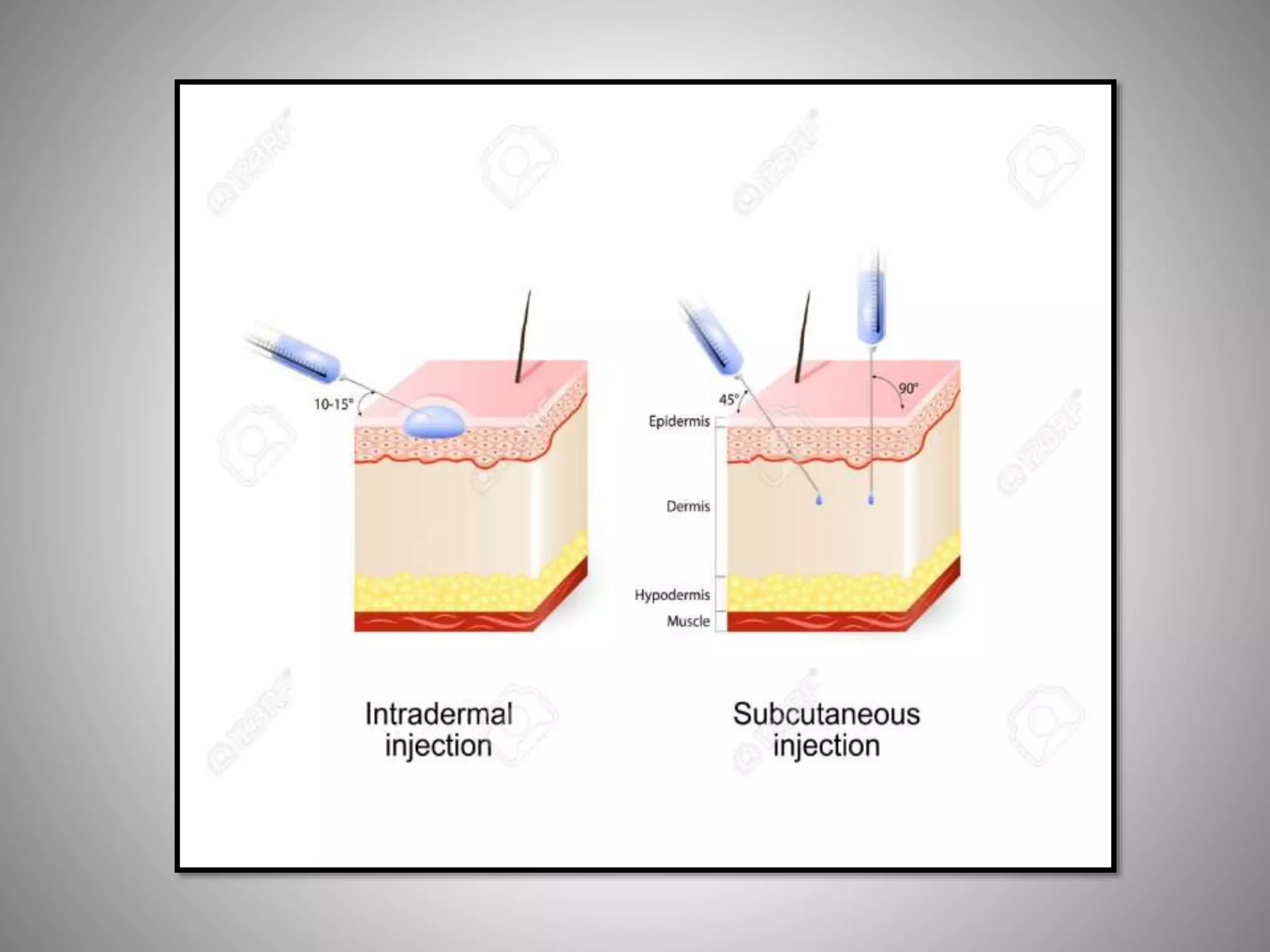
TO GIVE ANINTRADERMAL
INJECTION:
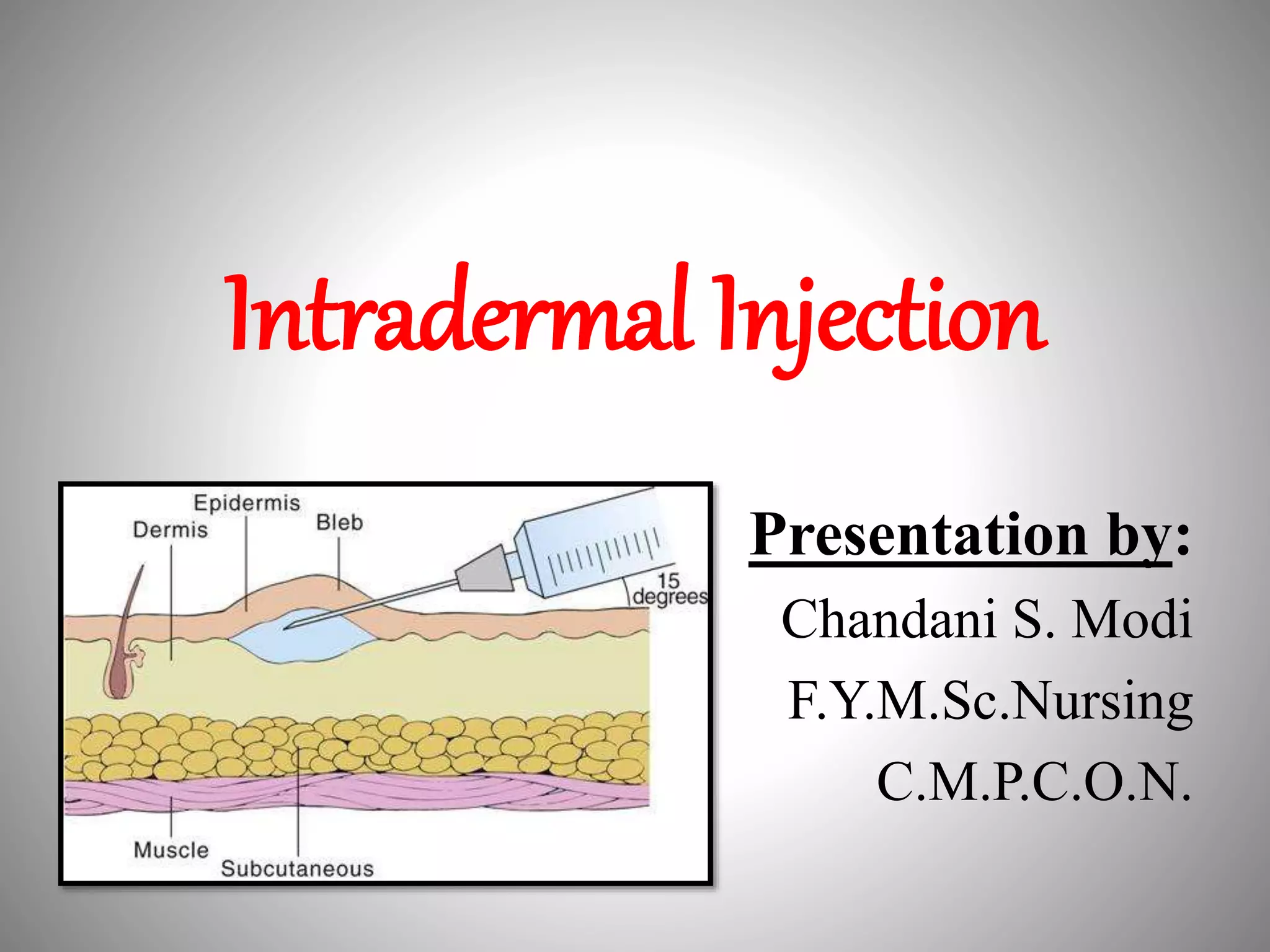
• This method is used for skin tests to detect
allergies. The skin is held taut, by grasping it
under the forearm. With the bevel of the needle
facing up, insert the needle at an angle of 10 to
150 to the skin.
12.
• The needleenters between the two layers of
the skin- the bevel should be practically visible
through the skin. Inject the medication slowly,
to produce a wheel on the skin. A quantity of
0.01 to 0.1 ml of medication is injected intra-
dermally.
• https://www.youtube.com/watch?v=f3w-
MlDAdg0
13.
• In orderto avoid errors in reading the tissue
reaction, a control injection of normal saline is
given on the other arm and a careful record is
kept.
• Take out the needle quickly. Do not try to
clean or massage the area.
14.
• Select anarea where the skin is healthy, free of
an irritation, swelling, edema, discoloration
and where the clothing will not irritate the
skin. Usually the intradermal injections are
given at the inner aspect of the lower arm,
upper aspect of the anterior chest and upper
aspect of the posterior chest.
15.
SPECIAL CONSIDERATION:
• Thisis a painful procedure and is used only
with small amount of solution.
• Ensure that the needle is inserted into the
dermis [ just below the outer layer of skin ]
not subcutaneously as absorption would be
reduced.
• If injection does not from a wheal or if
bleeding is noted ,the injection was probably
too deep and should be repeated .
INTRODUCTION:
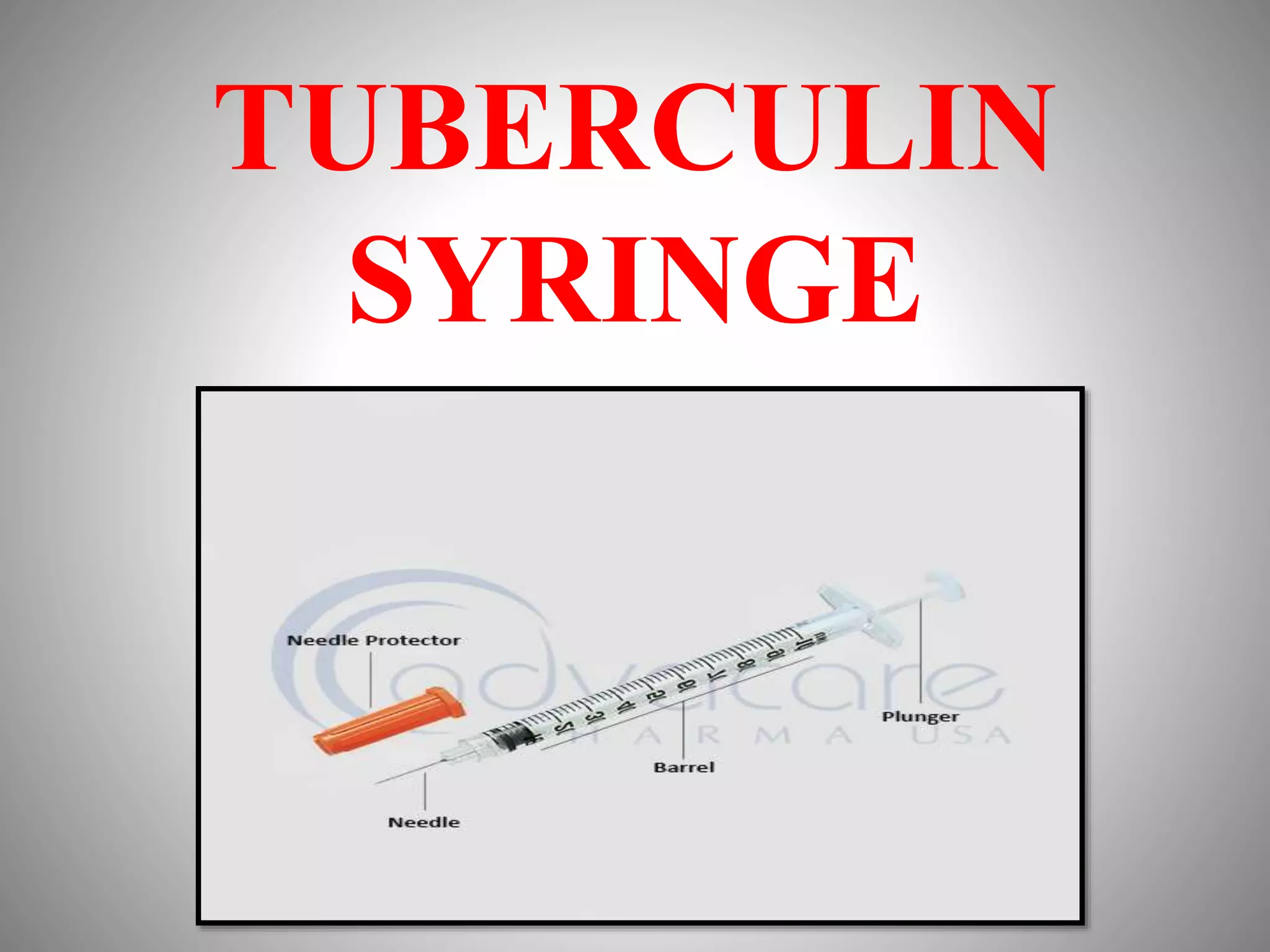
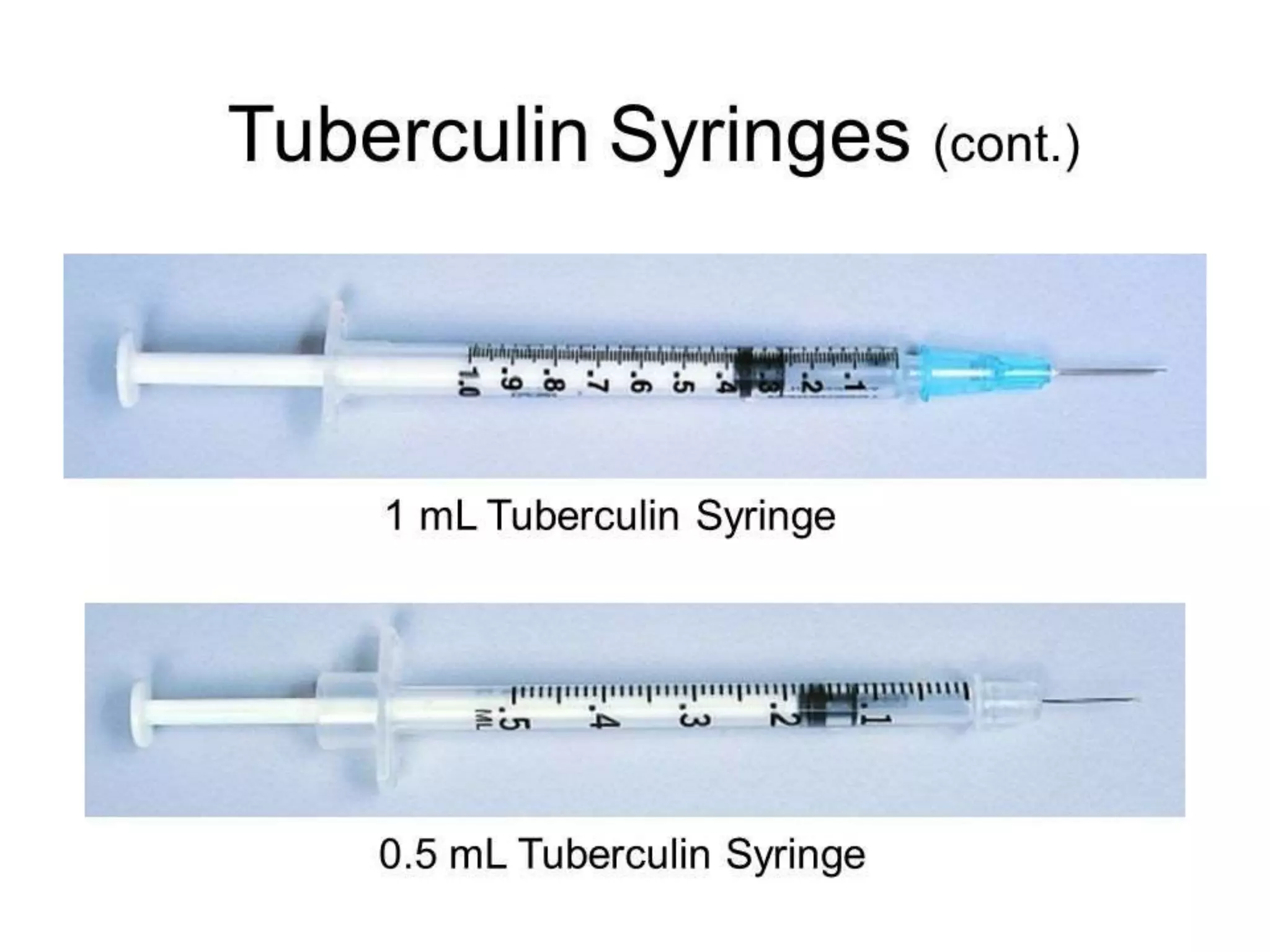
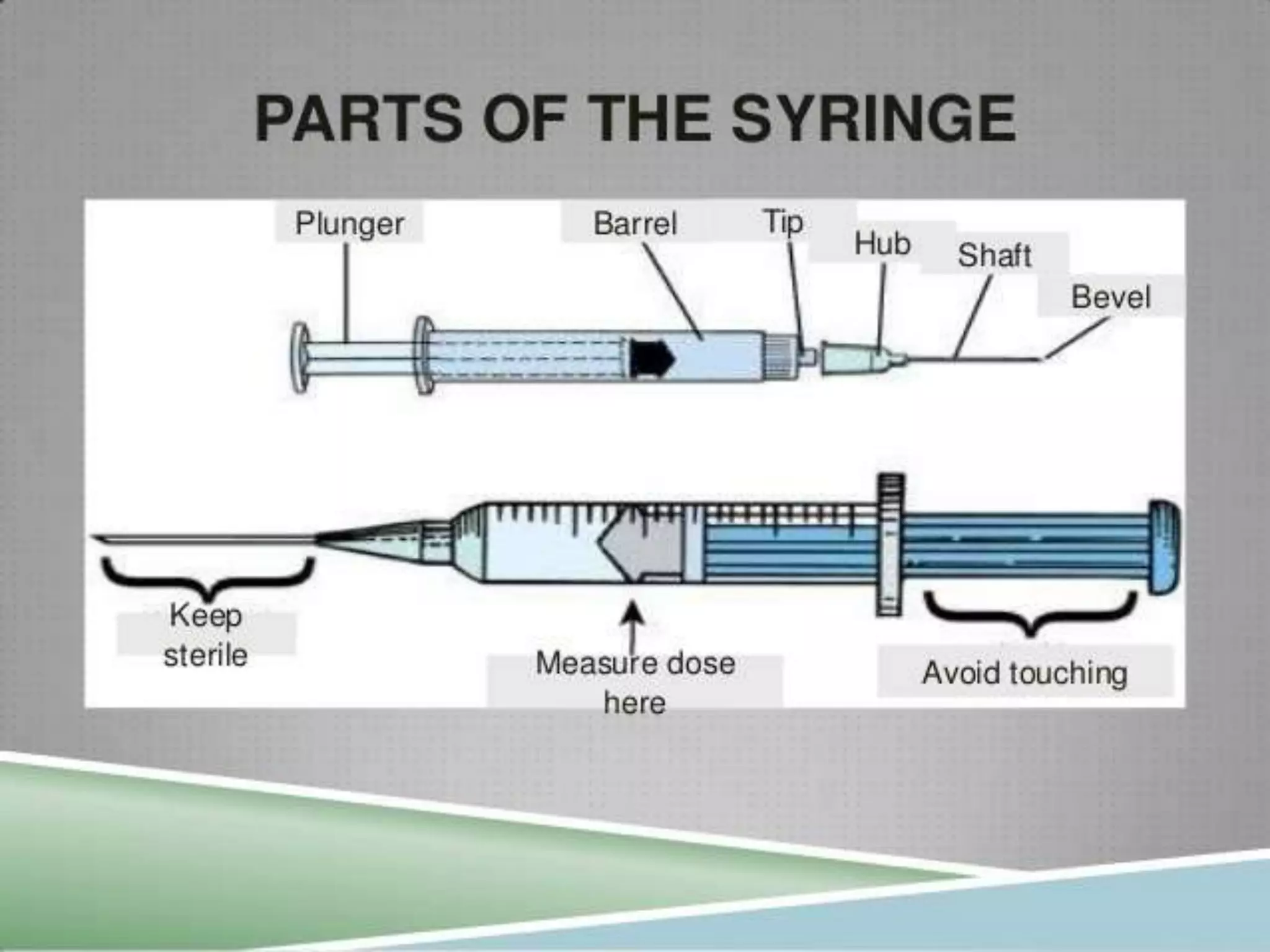
• Tuberculin syringesare devices used to
measure and deliver a specific amount of
liquid through a needle. They are used for
subcutaneous or intradermal injections of
medicines, vaccines or other substances.
19.
• Tuberculin syringesare graduated, hold up to 1
mL/cc of liquid, are sterile and latex-free, and
may have varying needle sizes, including
attached short, fine-gauge needles or a Luer
lock or slip needle hub.
21.
USE:
• Tuberculin syringesare commonly used for
tuberculosis testing or “tb tests.” Tuberculin, a
purified protein derivative, is a glycerol extract
of the tubercle bacillus used for tuberculin
(PPD) skin tests.
22.
• A standarddose of tuberculin is injected
between the layers of the skin. This
method, also called the Mantoux technique,
is typically performed on the inner forearm
and creates a bubble of liquid that is
eventually absorbed by the body.
23.
• Persons exposedto tuberculosis bacteria or
with past tuberculosis infections should exhibit
an immune response to the injected bacterial
proteins, a classic example of delayed-type
hypersensitivity reaction (DTH)
hypersensitivities.
24.
• Local inflammationis produced by T cells and
myeloid cells attracted to the site of the
reaction. After 48 to 72 hours, an area of
induration more than five to ten millimeters in
diameter is considered a positive result.
INTRODUCTION:
• An injectionis a method of putting liquid into
the body with a hollow needle and a syringe,
which is pierced through the skin long enough
for the material to be forced into the body.
28.
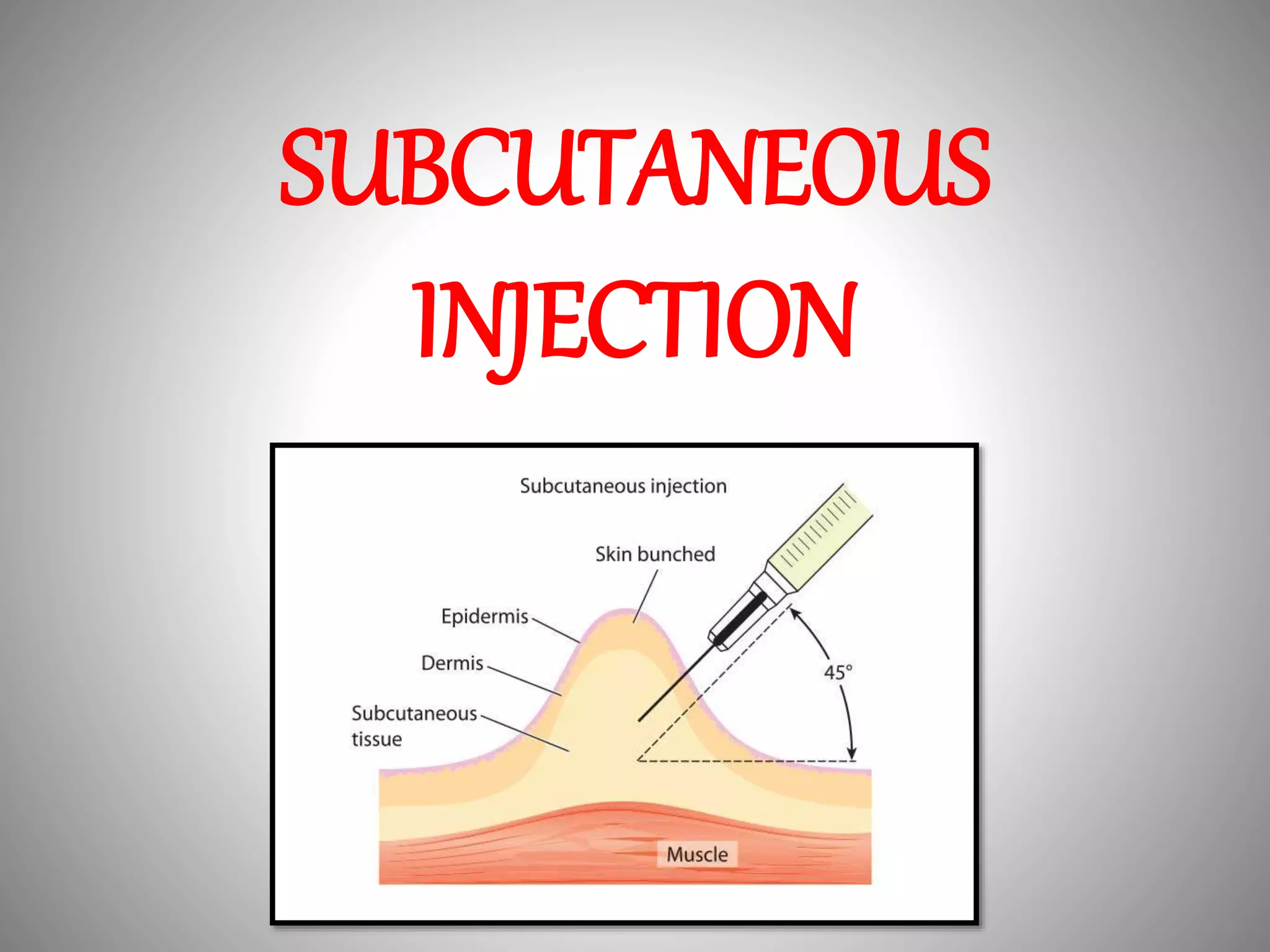
• A subcutaneousinjection is one into the fatty
tissue just beneath the skin. These injections
are shallower than those injected into the
muscle tissue.
29.
DEFINITION:
• A subcutaneousinjection is administered into
the subcutis, the layer of the skin directly
below the dermis and epidermis collectively
referred to as the cutis. Subcutaneous
injections are highly effective in administering
such medications Insulin, Heparin and
Morphine.
30.
PURPOSE:
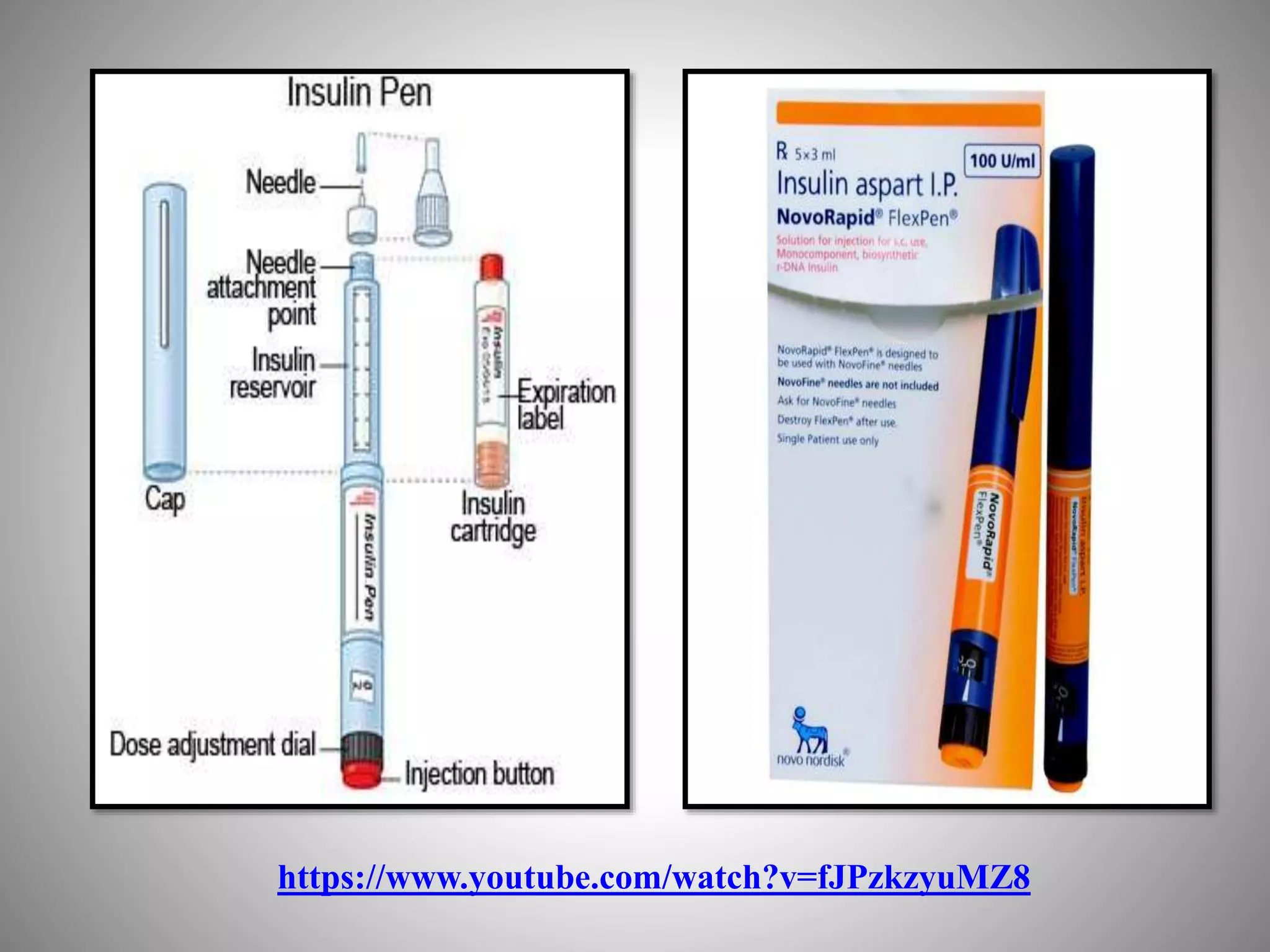
• For rapidsystematic effects of drug , e.g;
heparin, adrenaline and insulin
• Local effects, e.g; anesthetics
• Administer drug when a small amount of fluid
is to be injected
• The patient is unable to take the drug orally
• The drug is destroyed by intestinal secretions
31.
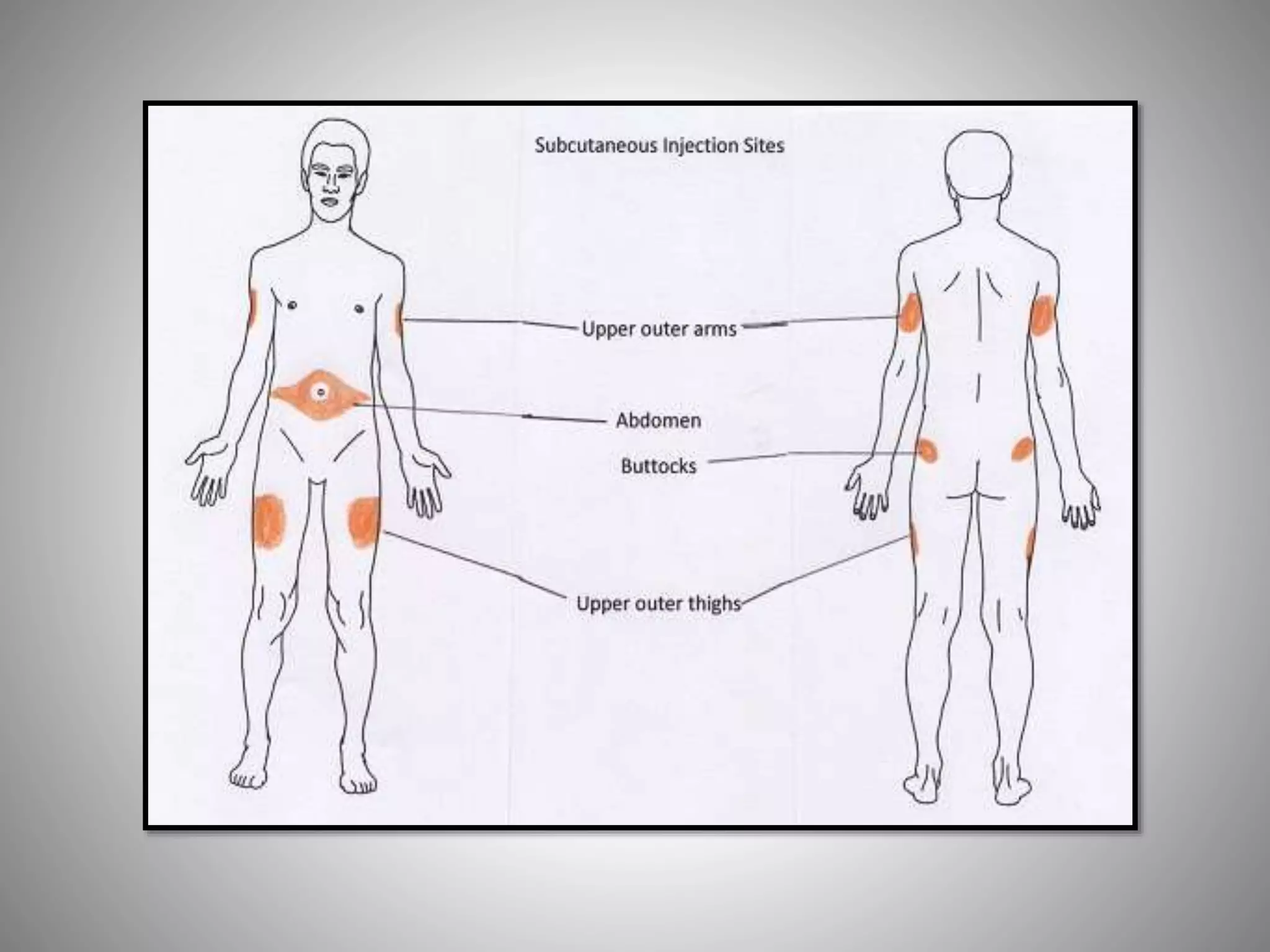
SITES:
• The outerarea of the upper arm
• Just above and below the waist, except the area
right around the naval
• The upper area of buttock, just behind the hip
bone
• The front of the thigh, midway to outside, 4
inches below the top of thigh to 4 inches above
the knee
33.
TO GIVE THESUBCUTANEOUS
INJECTION:
Any site is acceptable if it meets the following
criteria:
• The skin and underlying tissues are free of
abnormalities
• Not over bony prominences
• Free of large blood vessels and nerves
34.
The subcutaneous injectionsare usually given
on the outer aspect of the upper arm, posterior
chest wall below the scapula, anterior
abdominal wall from below the breasts to the
iliac crests and the anterior and lateral aspect
of the thigh.
• https://www.youtube.com/watch?v=XoGpnJ2_t2A
ASSIGNMENT
Write down theNursing responsibility for
administration of Intradermal and
Subcutaneous injection.
Submission date: 03/04/21
Email id: modichandani78@gmail.com
![SPECIAL CONSIDERATION:
• This is a painful procedure and is used only
with small amount of solution.
• Ensure that the needle is inserted into the
dermis [ just below the outer layer of skin ]
not subcutaneously as absorption would be
reduced.
• If injection does not from a wheal or if
bleeding is noted ,the injection was probably
too deep and should be repeated .](https://image.slidesharecdn.com/intradermalsubcutaneousinjection-220927062925-0e8da774/75/Intradermal-Subcutaneous-Injection-pptx-15-2048.jpg)