Initial teacher training Eligio Cerval-Pena, QTS team
The TDA The Training and Development Agency for Schools (TDA) is the national agency and recognised sector body responsible for the training and development of the school workforce. The TDA, on behalf of the Department for Education (DfE), is responsible for the funding of teacher training in England and for improving the quality and efficiency of all routes into the teaching profession. It also plays a role in the continuing professional development (CPD) of serving teachers.
SCHOOL SYSTEM
School system - ages and phases Early Years Ages 3-5 EYFS (Foundation stage) Primary school Ages 5-7  KS1 (School years 1-2) Ages 7-9  KS2 (School years 3-4) Ages 9-11  KS2 (School years 5-6) Secondary school Ages 11-14  KS3 (School years 7-9) Ages 14-16  KS4 (School years 10-11) Further education* Ages 16-19  KS5 (School years 12-13) * Currently non-compulsory, but school-leaving age to rise to 17 in 2013 and 18 in 2015.
School system - school types Mainstream Specialist schools Special schools Pupil referral units Academies and ‘free’ schools Independent
REGULATION OF QUALIFIED TEACHERS
Regulation of qualified teachers Education Act 2002 Conferred on the Secretary of State, through sections 132, 145 and 210, the powers to specify the qualifications required to teach in state-maintained schools and non-maintained special schools. The Education (School Teachers' Qualifications) (England) Regulations 2003 Specifies the requirement for teachers to hold qualified teacher status (QTS), and how they can gain this. The Education (School Teachers’ Qualifications) (England) (Amendment) Regulations 2009 Expands scope of school-based training settings and allows non-ITT route to QTS.
Regulation of qualified teachers 2 Accreditation Criteria Requirements for Initial Teacher Training Professional Standards for Qualified Teacher Status Teachers’ Standards
ITT ACCREDITATION
ITT accreditation - types of training Accrediting ITT providers to recommend for QTS How providers start Different routes into teaching  Mainstream (undergraduate/postgraduate) School-centred ITT (SCITT) Employment-based ITT (EBITT) Assessment Only (AO) Different provider types Higher education institutions  SCITT EBITT
ITT accreditation - criteria Rationale, aims and objectives Partnership with schools Accommodation, facilities and resources Recruitment of trainees Structure and content of the training Assessment of trainees Quality assurance of the training programme Management and staffing Financial administration
ITT REQUIREMENTS
ITT requirements - Entry GCSEs Degree Suitability Interview CRB check Provisional registration Attributes
ITT requirements - Training Programme design Training quality Resources Individual training needs Equality of access Induction Age ranges Time training in schools or settings Two schools
ITT requirements - Management and quality assurance Partnerships Compliance and safeguarding Misconduct Moderation Monitoring and evaluation EBITT conditions
QTS STANDARDS
QTS standards - Professional attributes Relationships with children and young people Frameworks Communicating and working with others Personal professional development
QTS standards - Professional knowledge and understanding Teaching and learning Assessment and monitoring Subjects and curriculum Literacy, numeracy and ICT Achievement and diversity Health and well-being
QTS standards - Professional skills Planning Teaching Assessing, monitoring and giving feedback Reviewing teaching and learning Learning environment Team working and collaboration
TEACHERS’ STANDARDS
Teachers’ standards - Teaching Set high expectations which inspire, motivate and challenge pupils Promote good progress and outcomes by pupils Demonstrate good subject and curriculum knowledge Plan and teach well structured lessons Adapt teaching to respond to the strengths and needs of all pupils Make accurate and productive use of assessment Manage behaviour effectively to ensure a good and safe learning environment Fulfill wider professional responsibilities
ANY QUESTIONS?
Recruitment and quality
Recruitment Allocation of places Over 37,000 places allocated national in England including: over 14,500 in (mainstream) primary, over 17,500 in (mainstream) secondary, and over 5,000 employment-based places. Different training routes for different needs Postgraduate courses Undergraduate courses  Employment-based routes All route place a strong emphasis on school-based training
Recruitment 2 Promoting the profession Targeted marketing to high-quality graduates career changers teachers not in the profession BME group men into Primary Teach First Targeted incentives The government has identified mathematics, physics and chemistry (*) as priority subjects in England. Incentives such as training bursaries and subject knowledge enhancement courses are available to appropriate trainees who are interested in these courses.
Quality: Office for Standards in Education, Children’s Services and Skills (Ofsted) The Ofsted framework effectiveness in securing high-quality outcomes for trainees How well do trainees attain? Recruitment/selection arrangements Training and assessment Resources Provision across the partnership Equality and diversity capacity to secure further improvements and/or to sustain high quality outcomes? Management assessment of performance Response to national and local initiatives Planning and taking action for improvement Providers will receive either a Outstanding, Good, Satisfactory or Inadequate grade for each of their provision (primary, secondary or EBITT)
Quality: support for satisfactory providers Satisfactory (‘grade 3’) providers Providers who are deemed satisfactory by Ofsted are monitored by the TDA to ensure they improve their provision to reduce the risk of them slipping into non-compliance with the Secretary of State’s ITT requirements. Inadequate (‘grade 4’) providers Providers who are deemed inadequate by Ofsted are non-compliant. ITT providers who are found non-compliant can:  continue all ITT provision while addressing any non-compliant aspect of its provision, cease all ITT provision, cease any non-compliant aspect of its ITT provision, or suspend all, or just the non-compliant aspects, of its ITT provision for one year.
ANY QUESTIONS?
Data Collection and Analysis: overview - November 2011 Martin Furner – Head of Data Collection and Analysis
Data collection and analysis - function The main function of the team is to collect operational data about ITT providers, provision and trainees to: Inform recruitment  in a timely way that supports early intervention and informs mitigating actions Assure funding  and facilitate holdback, as well as informing value for money and efficiency judgements about ITT providers and provision Monitor and inform quality  by measuring and evaluating inputs, outputs and outcomes and producing comparative statistics  Drive improvement and change  by identifying effective practice and through evidence based challenge and intervention
Data collection and analysis – links and dependencies The team fulfils its function using a number of key partners and procures innovative online solutions to facilitate data collection, management, analysis and publication The team works with a number of key stakeholders to eliminate duplication and reduce the burden of data collection (Higher Education Statistics Agency – HEI data, Department for Education – Edubase schools data, Higher Education Funding Council for England – National Student Survey, General Teaching Council for England - employment tracking of NQTs)  The team shares data and data collection tasks with the GTCE to support safe and efficient provisional registration and award of Qualified Teacher Status
Data collection and analysis – main datasets Three main data collections support initial teacher training (ITT): Trainee number census  – takes place at the beginning of the academic year (October) – informs recruitment and funding and contributes to the school workforce statistics Performance Profiles  – takes place at the end of the academic year and includes employment of NQTs six months after completion of ITT – published in July – supplemented by employment tracking data from GTCE Annual survey of NQTs  – takes place six months after completion of ITT – published in July – complements Ofsted inspection data and includes NQTs’ employment experiences
Data collection and analysis – Data systems The team has developed an online integrated system (see diagram on next slide) to support and facilitate: Data collection (including help desk support) Data management including validation and quality assurance Data analysis and data analysis tools for a range of stakeholders Data publication for a range of stakeholders (public, press, researchers, ITT providers, prospective trainees)
Data collection and analysis – Data system
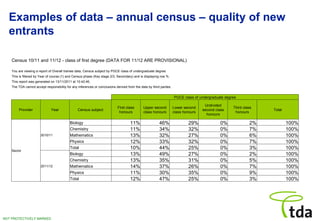
Examples of data – annual census – quality of new entrants Census 10/11 and 11/12 - class of first degree (DATA FOR 11/12 ARE PROVISIONAL) You are viewing a report of Overall trainee data, Census subject by PGCE class of undergraduate degree. This is filtered by Year of course (1) and Census phase (Key stage 2/3, Secondary) and is displaying row %. This report was generated on 13/11/2011 at 10:42:46. The TDA cannot accept responsibility for any inferences or conclusions derived from the data by third parties. PGCE class of undergraduate degree Provider Year Census subject First class honours Upper second class honours Lower second class honours Undivided second class honours Third class honours Total Sector 2010/11 Biology 11% 46% 29% 0% 2% 100% Chemistry 11% 34% 32% 0% 7% 100% Mathematics 13% 32% 27% 0% 6% 100% Physics 12% 33% 32% 0% 7% 100% Total 10% 44% 25% 0% 3% 100% 2011/12 Biology 13% 49% 27% 0% 2% 100% Chemistry 13% 35% 31% 0% 5% 100% Mathematics 14% 37% 26% 0% 7% 100% Physics 11% 30% 35% 0% 9% 100% Total 12% 47% 25% 0% 3% 100%
Examples of data – performance profiles – outcomes of initial training programmes (mathematics) Outcomes of training - Mathematics trainees You are viewing a report of General profiles data, Classification of first degree (UK) by QTS Outcome. This is filtered by Academic year (2009/10), First/Final year (Final year), Assessment based (No), Course type (Secondary, Key stage 2/3) and Subject (publication) (Mathematics) and is displaying value and row %. This report was generated on 14/11/2011 at 19:20:28. The TDA cannot accept responsibility for any inferences or conclusions derived from the data by third parties. QTS Outcome Provider Classification of first degree (UK) Awarded QTS Yet to complete the course Left course before the end Total Sector Not applicable 328 52 20 409 80% 13% 5% 100% 1st 322 21 28 371 87% 6% 8% 100% 2:1 830 66 53 951 87% 7% 6% 100% 2:2 693 59 56 816 85% 7% 7% 100% 3 182 24 26 235 77% 10% 11% 100% Pass 126 13 16 160 79% 8% 10% 100% Class not known 44 5 7 56 79% 9% 13% 100% Total 2,544 244 206 3,021 84% 8% 7% 100%
Examples of data – annual survey of newly qualified teachers
Examples of data – employment tracking of newly qualified teachers (secondary university trained) Year Employment status during 1st year Employment status during 2nd year Employment status during 3rd year Employment status during 4th year Employment status during 5th year Employed Not employed Not matched to GTCE data Total Employed Not employed Not matched to GTCE data Total Employed Not employed Not matched to GTCE data Total Employed Not employed Not matched to GTCE data Total Employed Not employed Not matched to GTCE data Total 2004/05 9,147 4,316 297 13,760 10,657 2,806 297 13,760 10,783 2,680 297 13,760 10,444 3,019 297 13,760 9,806 3,657 297 13,760 66% 31% 2% 100% 77% 20% 2% 100% 78% 19% 2% 100% 76% 22% 2% 100% 71% 27% 2% 100% 2005/06 10,292 3,057 330 13,679 11,051 2,298 330 13,679 10,730 2,619 330 13,679 9,982 3,367 330 13,679         75% 22% 2% 100% 81% 17% 2% 100% 78% 19% 2% 100% 73% 25% 2% 100%         2006/07 10,504 2,568 226 13,298 11,091 1,981 226 13,298 10,315 2,757 226 13,298                 79% 19% 2% 100% 83% 15% 2% 100% 78% 21% 2% 100%                 2007/08 10,338 1,953 289 12,580 10,049 2,242 289 12,580                         82% 16% 2% 100% 80% 18% 2% 100%                         2008/09 10,006 2,258 354 12,618                                 79% 18% 3% 100%                                 Total 50,287 14,152 1,496 65,935 42,848 9,327 1,142 53,317 31,828 8,056 853 40,737 20,426 6,386 627 27,439 9,806 3,657 297 13,760 76% 21% 2% 100% 80% 17% 2% 100% 78% 20% 2% 100% 74% 23% 2% 100% 71% 27% 2% 100%
Data collection and analysis Any questions?
ANNEX
Education Act 2002 132: Qualified teacher status This section defines the term 'qualified teacher'. It provides that the Secretary of State continues to have the power to determine who is a qualified teacher. 145: Specification of qualification Regulations made in relation to teachers' qualifications may refer to initial teacher training (ITT) courses at accredited institutions and may confer a discretion on the Teacher Training Agency…, or other specified persons or bodies. The regulations may also impose a duty on the Teacher Training Agency. The Secretary of State has to consult the GTC about changes to the content of initial teacher training. 210: Orders and regulations All orders or regulations under the Act are to be made by statutory instrument.
The Education (School Teachers' Qualifications) (England) Regulations 2003 (SI 1662) Schedule 2, part 1, paragraph 7 A person is a qualified teacher if the person – holds a first degree or equivalent qualification granted by a United Kingdom institution or an equivalent degree or other qualification granted by a foreign institution; successfully completes a course of initial teacher training at an accredited institution in England; undertakes any period of practical teaching experience for the purposes of that course of initial teacher training wholly or mainly in a school, city college, academy, independent school or other institution (except a pupil referral unit) in England; and is assessed by the accredited institution as meeting the specified standards. and has been awarded qualified teacher status by the GTCE.
The Education (School Teachers' Qualifications) (England) (Amendment) Regulations 2009 (SI 3156) Schedule 2, part 1, paragraph 7 A person is a qualified teacher if the person … undertakes any period of practical teaching experience for the purposes of that course of initial teacher training wholly or mainly in a school, city college, academy, independent school or other institution (except a pupil referral unit) in England  or school administered by Service Children’s Education ; … Schedule 2, part 1, paragraph 7A A person is a qualified teacher if the person – holds a first degree or equivalent qualification granted by a United Kingdom institution or an equivalent degree or other qualification granted by a foreign institution; is assessed by an accredited institution as meeting such criteria as may from time to time be specified by the Secretary of State; and has undertaken a period of practical teaching experience such that the person is assessed by the accredited institution as meeting the specified standards.

Initial Teacher Training - Eligio Cerval-Pena

  • 1.
    Initial teacher trainingEligio Cerval-Pena, QTS team
  • 2.
    The TDA TheTraining and Development Agency for Schools (TDA) is the national agency and recognised sector body responsible for the training and development of the school workforce. The TDA, on behalf of the Department for Education (DfE), is responsible for the funding of teacher training in England and for improving the quality and efficiency of all routes into the teaching profession. It also plays a role in the continuing professional development (CPD) of serving teachers.
  • 3.
  • 4.
    School system -ages and phases Early Years Ages 3-5 EYFS (Foundation stage) Primary school Ages 5-7 KS1 (School years 1-2) Ages 7-9 KS2 (School years 3-4) Ages 9-11 KS2 (School years 5-6) Secondary school Ages 11-14 KS3 (School years 7-9) Ages 14-16 KS4 (School years 10-11) Further education* Ages 16-19 KS5 (School years 12-13) * Currently non-compulsory, but school-leaving age to rise to 17 in 2013 and 18 in 2015.
  • 5.
    School system -school types Mainstream Specialist schools Special schools Pupil referral units Academies and ‘free’ schools Independent
  • 6.
  • 7.
    Regulation of qualifiedteachers Education Act 2002 Conferred on the Secretary of State, through sections 132, 145 and 210, the powers to specify the qualifications required to teach in state-maintained schools and non-maintained special schools. The Education (School Teachers' Qualifications) (England) Regulations 2003 Specifies the requirement for teachers to hold qualified teacher status (QTS), and how they can gain this. The Education (School Teachers’ Qualifications) (England) (Amendment) Regulations 2009 Expands scope of school-based training settings and allows non-ITT route to QTS.
  • 8.
    Regulation of qualifiedteachers 2 Accreditation Criteria Requirements for Initial Teacher Training Professional Standards for Qualified Teacher Status Teachers’ Standards
  • 9.
  • 10.
    ITT accreditation -types of training Accrediting ITT providers to recommend for QTS How providers start Different routes into teaching Mainstream (undergraduate/postgraduate) School-centred ITT (SCITT) Employment-based ITT (EBITT) Assessment Only (AO) Different provider types Higher education institutions SCITT EBITT
  • 11.
    ITT accreditation -criteria Rationale, aims and objectives Partnership with schools Accommodation, facilities and resources Recruitment of trainees Structure and content of the training Assessment of trainees Quality assurance of the training programme Management and staffing Financial administration
  • 12.
  • 13.
    ITT requirements -Entry GCSEs Degree Suitability Interview CRB check Provisional registration Attributes
  • 14.
    ITT requirements -Training Programme design Training quality Resources Individual training needs Equality of access Induction Age ranges Time training in schools or settings Two schools
  • 15.
    ITT requirements -Management and quality assurance Partnerships Compliance and safeguarding Misconduct Moderation Monitoring and evaluation EBITT conditions
  • 16.
  • 17.
    QTS standards -Professional attributes Relationships with children and young people Frameworks Communicating and working with others Personal professional development
  • 18.
    QTS standards -Professional knowledge and understanding Teaching and learning Assessment and monitoring Subjects and curriculum Literacy, numeracy and ICT Achievement and diversity Health and well-being
  • 19.
    QTS standards -Professional skills Planning Teaching Assessing, monitoring and giving feedback Reviewing teaching and learning Learning environment Team working and collaboration
  • 20.
  • 21.
    Teachers’ standards -Teaching Set high expectations which inspire, motivate and challenge pupils Promote good progress and outcomes by pupils Demonstrate good subject and curriculum knowledge Plan and teach well structured lessons Adapt teaching to respond to the strengths and needs of all pupils Make accurate and productive use of assessment Manage behaviour effectively to ensure a good and safe learning environment Fulfill wider professional responsibilities
  • 22.
  • 23.
  • 24.
    Recruitment Allocation ofplaces Over 37,000 places allocated national in England including: over 14,500 in (mainstream) primary, over 17,500 in (mainstream) secondary, and over 5,000 employment-based places. Different training routes for different needs Postgraduate courses Undergraduate courses Employment-based routes All route place a strong emphasis on school-based training
  • 25.
    Recruitment 2 Promotingthe profession Targeted marketing to high-quality graduates career changers teachers not in the profession BME group men into Primary Teach First Targeted incentives The government has identified mathematics, physics and chemistry (*) as priority subjects in England. Incentives such as training bursaries and subject knowledge enhancement courses are available to appropriate trainees who are interested in these courses.
  • 26.
    Quality: Office forStandards in Education, Children’s Services and Skills (Ofsted) The Ofsted framework effectiveness in securing high-quality outcomes for trainees How well do trainees attain? Recruitment/selection arrangements Training and assessment Resources Provision across the partnership Equality and diversity capacity to secure further improvements and/or to sustain high quality outcomes? Management assessment of performance Response to national and local initiatives Planning and taking action for improvement Providers will receive either a Outstanding, Good, Satisfactory or Inadequate grade for each of their provision (primary, secondary or EBITT)
  • 27.
    Quality: support forsatisfactory providers Satisfactory (‘grade 3’) providers Providers who are deemed satisfactory by Ofsted are monitored by the TDA to ensure they improve their provision to reduce the risk of them slipping into non-compliance with the Secretary of State’s ITT requirements. Inadequate (‘grade 4’) providers Providers who are deemed inadequate by Ofsted are non-compliant. ITT providers who are found non-compliant can: continue all ITT provision while addressing any non-compliant aspect of its provision, cease all ITT provision, cease any non-compliant aspect of its ITT provision, or suspend all, or just the non-compliant aspects, of its ITT provision for one year.
  • 28.
  • 29.
    Data Collection andAnalysis: overview - November 2011 Martin Furner – Head of Data Collection and Analysis
  • 30.
    Data collection andanalysis - function The main function of the team is to collect operational data about ITT providers, provision and trainees to: Inform recruitment in a timely way that supports early intervention and informs mitigating actions Assure funding and facilitate holdback, as well as informing value for money and efficiency judgements about ITT providers and provision Monitor and inform quality by measuring and evaluating inputs, outputs and outcomes and producing comparative statistics Drive improvement and change by identifying effective practice and through evidence based challenge and intervention
  • 31.
    Data collection andanalysis – links and dependencies The team fulfils its function using a number of key partners and procures innovative online solutions to facilitate data collection, management, analysis and publication The team works with a number of key stakeholders to eliminate duplication and reduce the burden of data collection (Higher Education Statistics Agency – HEI data, Department for Education – Edubase schools data, Higher Education Funding Council for England – National Student Survey, General Teaching Council for England - employment tracking of NQTs) The team shares data and data collection tasks with the GTCE to support safe and efficient provisional registration and award of Qualified Teacher Status
  • 32.
    Data collection andanalysis – main datasets Three main data collections support initial teacher training (ITT): Trainee number census – takes place at the beginning of the academic year (October) – informs recruitment and funding and contributes to the school workforce statistics Performance Profiles – takes place at the end of the academic year and includes employment of NQTs six months after completion of ITT – published in July – supplemented by employment tracking data from GTCE Annual survey of NQTs – takes place six months after completion of ITT – published in July – complements Ofsted inspection data and includes NQTs’ employment experiences
  • 33.
    Data collection andanalysis – Data systems The team has developed an online integrated system (see diagram on next slide) to support and facilitate: Data collection (including help desk support) Data management including validation and quality assurance Data analysis and data analysis tools for a range of stakeholders Data publication for a range of stakeholders (public, press, researchers, ITT providers, prospective trainees)
  • 34.
    Data collection andanalysis – Data system
  • 35.
    Examples of data– annual census – quality of new entrants Census 10/11 and 11/12 - class of first degree (DATA FOR 11/12 ARE PROVISIONAL) You are viewing a report of Overall trainee data, Census subject by PGCE class of undergraduate degree. This is filtered by Year of course (1) and Census phase (Key stage 2/3, Secondary) and is displaying row %. This report was generated on 13/11/2011 at 10:42:46. The TDA cannot accept responsibility for any inferences or conclusions derived from the data by third parties. PGCE class of undergraduate degree Provider Year Census subject First class honours Upper second class honours Lower second class honours Undivided second class honours Third class honours Total Sector 2010/11 Biology 11% 46% 29% 0% 2% 100% Chemistry 11% 34% 32% 0% 7% 100% Mathematics 13% 32% 27% 0% 6% 100% Physics 12% 33% 32% 0% 7% 100% Total 10% 44% 25% 0% 3% 100% 2011/12 Biology 13% 49% 27% 0% 2% 100% Chemistry 13% 35% 31% 0% 5% 100% Mathematics 14% 37% 26% 0% 7% 100% Physics 11% 30% 35% 0% 9% 100% Total 12% 47% 25% 0% 3% 100%
  • 36.
    Examples of data– performance profiles – outcomes of initial training programmes (mathematics) Outcomes of training - Mathematics trainees You are viewing a report of General profiles data, Classification of first degree (UK) by QTS Outcome. This is filtered by Academic year (2009/10), First/Final year (Final year), Assessment based (No), Course type (Secondary, Key stage 2/3) and Subject (publication) (Mathematics) and is displaying value and row %. This report was generated on 14/11/2011 at 19:20:28. The TDA cannot accept responsibility for any inferences or conclusions derived from the data by third parties. QTS Outcome Provider Classification of first degree (UK) Awarded QTS Yet to complete the course Left course before the end Total Sector Not applicable 328 52 20 409 80% 13% 5% 100% 1st 322 21 28 371 87% 6% 8% 100% 2:1 830 66 53 951 87% 7% 6% 100% 2:2 693 59 56 816 85% 7% 7% 100% 3 182 24 26 235 77% 10% 11% 100% Pass 126 13 16 160 79% 8% 10% 100% Class not known 44 5 7 56 79% 9% 13% 100% Total 2,544 244 206 3,021 84% 8% 7% 100%
  • 37.
    Examples of data– annual survey of newly qualified teachers
  • 38.
    Examples of data– employment tracking of newly qualified teachers (secondary university trained) Year Employment status during 1st year Employment status during 2nd year Employment status during 3rd year Employment status during 4th year Employment status during 5th year Employed Not employed Not matched to GTCE data Total Employed Not employed Not matched to GTCE data Total Employed Not employed Not matched to GTCE data Total Employed Not employed Not matched to GTCE data Total Employed Not employed Not matched to GTCE data Total 2004/05 9,147 4,316 297 13,760 10,657 2,806 297 13,760 10,783 2,680 297 13,760 10,444 3,019 297 13,760 9,806 3,657 297 13,760 66% 31% 2% 100% 77% 20% 2% 100% 78% 19% 2% 100% 76% 22% 2% 100% 71% 27% 2% 100% 2005/06 10,292 3,057 330 13,679 11,051 2,298 330 13,679 10,730 2,619 330 13,679 9,982 3,367 330 13,679         75% 22% 2% 100% 81% 17% 2% 100% 78% 19% 2% 100% 73% 25% 2% 100%         2006/07 10,504 2,568 226 13,298 11,091 1,981 226 13,298 10,315 2,757 226 13,298                 79% 19% 2% 100% 83% 15% 2% 100% 78% 21% 2% 100%                 2007/08 10,338 1,953 289 12,580 10,049 2,242 289 12,580                         82% 16% 2% 100% 80% 18% 2% 100%                         2008/09 10,006 2,258 354 12,618                                 79% 18% 3% 100%                                 Total 50,287 14,152 1,496 65,935 42,848 9,327 1,142 53,317 31,828 8,056 853 40,737 20,426 6,386 627 27,439 9,806 3,657 297 13,760 76% 21% 2% 100% 80% 17% 2% 100% 78% 20% 2% 100% 74% 23% 2% 100% 71% 27% 2% 100%
  • 39.
    Data collection andanalysis Any questions?
  • 40.
  • 41.
    Education Act 2002132: Qualified teacher status This section defines the term 'qualified teacher'. It provides that the Secretary of State continues to have the power to determine who is a qualified teacher. 145: Specification of qualification Regulations made in relation to teachers' qualifications may refer to initial teacher training (ITT) courses at accredited institutions and may confer a discretion on the Teacher Training Agency…, or other specified persons or bodies. The regulations may also impose a duty on the Teacher Training Agency. The Secretary of State has to consult the GTC about changes to the content of initial teacher training. 210: Orders and regulations All orders or regulations under the Act are to be made by statutory instrument.
  • 42.
    The Education (SchoolTeachers' Qualifications) (England) Regulations 2003 (SI 1662) Schedule 2, part 1, paragraph 7 A person is a qualified teacher if the person – holds a first degree or equivalent qualification granted by a United Kingdom institution or an equivalent degree or other qualification granted by a foreign institution; successfully completes a course of initial teacher training at an accredited institution in England; undertakes any period of practical teaching experience for the purposes of that course of initial teacher training wholly or mainly in a school, city college, academy, independent school or other institution (except a pupil referral unit) in England; and is assessed by the accredited institution as meeting the specified standards. and has been awarded qualified teacher status by the GTCE.
  • 43.
    The Education (SchoolTeachers' Qualifications) (England) (Amendment) Regulations 2009 (SI 3156) Schedule 2, part 1, paragraph 7 A person is a qualified teacher if the person … undertakes any period of practical teaching experience for the purposes of that course of initial teacher training wholly or mainly in a school, city college, academy, independent school or other institution (except a pupil referral unit) in England or school administered by Service Children’s Education ; … Schedule 2, part 1, paragraph 7A A person is a qualified teacher if the person – holds a first degree or equivalent qualification granted by a United Kingdom institution or an equivalent degree or other qualification granted by a foreign institution; is assessed by an accredited institution as meeting such criteria as may from time to time be specified by the Secretary of State; and has undertaken a period of practical teaching experience such that the person is assessed by the accredited institution as meeting the specified standards.

Editor's Notes

  • #6 Specialist schools teach the whole curriculum but with a focus on a particular subject area Special schools cater mainly or wholly for children with statutory statements of special educational needs Pupil referral units (PRUs) cater for children of compulsory school age who may otherwise not receive suitable education, and focus on getting them back into a mainstream school.