Routes into Teaching
NTU Careers and Placements
April 2013
1
2
Content of today’s session
 an outline of routes into teaching
 how and when to apply
 basic academic and personal requirements
 funding
• other issues surrounding applications
QTS (Qualified Teacher Status)
To be awarded QTS by the Teaching Agency (TA) you must complete a period
of training known as initial teacher training (ITT)
The routes for gaining this include:
 PGCE (university-based)
 School Direct (salaried and unsalaried)
 SCITT
 Teach First
3
PGCE – University-based
 Postgraduate Certificate in Education – many offer credits at masters level
 Usually a 1 year, full-time course based in a University with substantial school
placements.
 Primary – a minimum of 18 weeks classroom-based training, secondary – a
minimum of 24 weeks – usually in 2 schools.
How to Apply
 Via the GTTR ( Graduate Teacher Training Registry)
www.gttr.ac.uk
>>>STOP PRESS<<<
the GTTR is changing its name to UCAS – Teacher Training
4
5
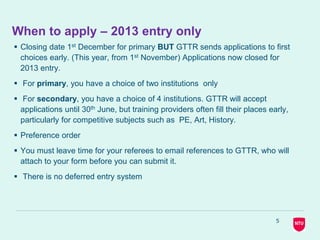
When to apply – 2013 entry only
 Closing date 1st December for primary BUT GTTR sends applications to first
choices early. (This year, from 1st November) Applications now closed for
2013 entry.
 For primary, you have a choice of two institutions only
 For secondary, you have a choice of 4 institutions. GTTR will accept
applications until 30th June, but training providers often fill their places early,
particularly for competitive subjects such as PE, Art, History.
 Preference order
 You must leave time for your referees to email references to GTTR, who will
attach to your form before you can submit it.
 There is no deferred entry system
2014 Entry
 UCAS teacher training application for School Direct as well as other courses
currently via GTTR
 Applications will be submitted from 1 November, there will be no application
deadline.
 Initially 3 choices (Apply 1).These will be considered in parallel by the
providers rather than in preference order as with current applications.
 If unsuccessful in Apply 1, applicants will be able to make additional choices
from places still available. (Sequentially through Apply 2)
 The time for decisions to be made by providers will be reduced (but has not
yet been finalised.)
6
7
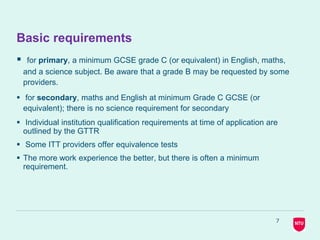
Basic requirements
 for primary, a minimum GCSE grade C (or equivalent) in English, maths,
and a science subject. Be aware that a grade B may be requested by some
providers.
 for secondary, maths and English at minimum Grade C GCSE (or
equivalent); there is no science requirement for secondary
 Individual institution qualification requirements at time of application are
outlined by the GTTR
 Some ITT providers offer equivalence tests
 The more work experience the better, but there is often a minimum
requirement.
8
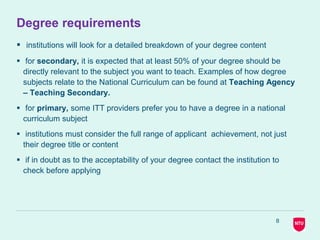
Degree requirements
 institutions will look for a detailed breakdown of your degree content
 for secondary, it is expected that at least 50% of your degree should be
directly relevant to the subject you want to teach. Examples of how degree
subjects relate to the National Curriculum can be found at Teaching Agency
– Teaching Secondary.
 for primary, some ITT providers prefer you to have a degree in a national
curriculum subject
 institutions must consider the full range of applicant achievement, not just
their degree title or content
 if in doubt as to the acceptability of your degree contact the institution to
check before applying
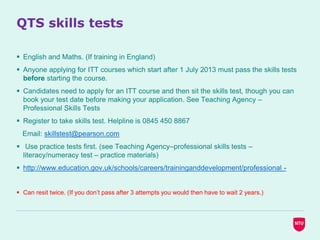
QTS skills tests
 English and Maths. (If training in England)
 Anyone applying for ITT courses which start after 1 July 2013 must pass the skills tests
before starting the course.
 Candidates need to apply for an ITT course and then sit the skills test, though you can
book your test date before making your application. See Teaching Agency –
Professional Skills Tests
 Register to take skills test. Helpline is 0845 450 8867
Email: skillstest@pearson.com
 Use practice tests first. (see Teaching Agency–professional skills tests –
literacy/numeracy test – practice materials)
 http://www.education.gov.uk/schools/careers/traininganddevelopment/professional -
 Can resit twice. (If you don’t pass after 3 attempts you would then have to wait 2 years.)
10
Research
 It is important to investigate the subject area you wish to teach on the National
Curriculum website
www.education.gov.uk/schools/teaching
 And do your homework on the latest developments in education and around your
subject e.g. behaviour management, phonics, literacy, SEND, national curriculum
tests, assessment
Times Educational Supplement (TES) – Friday, Guardian –Tuesday,
Independent –Thursday
 BBC Education website www.bbc.co.uk/education
 Department for Education website www.education.gov.uk/
 There are separate application procedures for teaching in Scotland and Northern
Ireland (see relevant web sites)
11
Personal skills and qualities
 enthusiasm, flexibility, resilience, confidence, warmth,
honesty, objectivity….
 listening skills, communication skills, effective time
management, organisational ability, ability to multi-task
 facilitating, inspiring, reflective, creative, imaginative, self-
disciplined, hardworking …
12
The issue for consideration …
Commitment
The PGCE is not just another course, it is a year of intense
professional training, with several block teaching practices
in school. You will need to think carefully about whether
you can give it the necessary time and commitment
Is straight after degree the right time for you?
It’s not a question of now or never
13
Competition and tactical applications
• Remember some institutions have more places than others (see
individual entries on the GTTR/UCAS teacher training website)
• Some subjects are more competitive than others
• NTU Primary is intensely competitive. You will need to fulfil all
requirements at time of application and have relevant and preferably,
ongoing work experience - for Primary a 2:1 often required
• Some Secondary subjects are also particularly competitive – currently
PE, English.
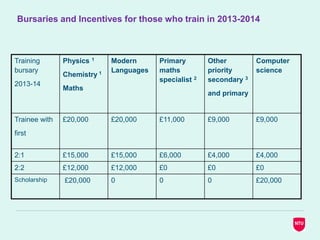
Bursaries and Incentives for those who train in 2013-2014
Training
bursary
2013-14
Physics 1
Chemistry 1
Maths
Modern
Languages
Primary
maths
specialist 2
Other
priority
secondary 3
and primary
Computer
science
Trainee with
first
£20,000 £20,000 £11,000 £9,000 £9,000
2:1 £15,000 £15,000 £6,000 £4,000 £4,000
2:2 £12,000 £12,000 £0 £0 £0
Scholarship £20,000 0 0 0 £20,000
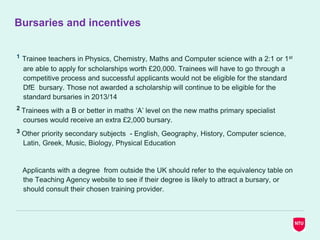
Bursaries and incentives
1 Trainee teachers in Physics, Chemistry, Maths and Computer science with a 2:1 or 1st
are able to apply for scholarships worth £20,000. Trainees will have to go through a
competitive process and successful applicants would not be eligible for the standard
DfE bursary. Those not awarded a scholarship will continue to be eligible for the
standard bursaries in 2013/14
2 Trainees with a B or better in maths ‘A’ level on the new maths primary specialist
courses would receive an extra £2,000 bursary.
3 Other priority secondary subjects - English, Geography, History, Computer science,
Latin, Greek, Music, Biology, Physical Education
Applicants with a degree from outside the UK should refer to the equivalency table on
the Teaching Agency website to see if their degree is likely to attract a bursary, or
should consult their chosen training provider.
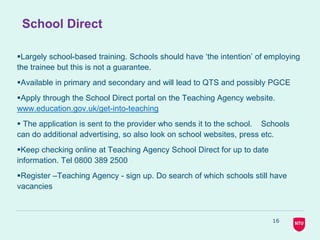
School Direct
Largely school-based training. Schools should have ‘the intention’ of employing
the trainee but this is not a guarantee.
Available in primary and secondary and will lead to QTS and possibly PGCE
Apply through the School Direct portal on the Teaching Agency website.
www.education.gov.uk/get-into-teaching
 The application is sent to the provider who sends it to the school. Schools
can do additional advertising, so also look on school websites, press etc.
Keep checking online at Teaching Agency School Direct for up to date
information. Tel 0800 389 2500
Register –Teaching Agency - sign up. Do search of which schools still have
vacancies
16
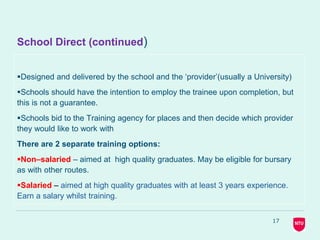
School Direct (continued)
Designed and delivered by the school and the ‘provider’(usually a University)
Schools should have the intention to employ the trainee upon completion, but
this is not a guarantee.
Schools bid to the Training agency for places and then decide which provider
they would like to work with
There are 2 separate training options:
Non–salaried – aimed at high quality graduates. May be eligible for bursary
as with other routes.
Salaried – aimed at high quality graduates with at least 3 years experience.
Earn a salary whilst training.
17
18
SCITT – usually based at one school in a consortium while completing
placements at others
 Application to most SCITT partnerships is via GTTR (but the
Nottingham City Primary SCITT is an exception)
 Gives QTS but does not necessarily award a PGCE; you would need
to check direct with each SCITT
 Often more suitable for candidates with relevant teaching or other
experience of working with young people
 Some specifically cater for local needs
 Finance is the same as for PGCE
19
Teach First
 Two-year leadership development programme based in challenging secondary schools
 2:1 or above is normally required and 300 UCAS points (excluding General Studies)
 Combines QTS with a business internship and mentoring
www.teachfirst.org.uk
 Teach First is to double its size by the end of this parliament, expanding into primary
schools
 Competitive salary
 Candidates need to demonstrate relevant subject knowledge and the following
competencies:
– Humility, respect and empathy, interaction, knowledge, leadership, planning and
organising, resilience, self-evaluation
20
Graduate Teacher Programme (GTP)
The last entry to this programme was in 2012
Making choices
 Some of the options may look similar
 Schools may shape the differences
 Ask questions re your support networks e.g. will there be opportunities to meet
with other chemistry trainees or will you be the only one? How many are they
training this year?
 What level of support will you receive from your mentor?
 Will you gain a PGCE as well as QTS?
 Many will, but not all
 If you intend to work abroad, some countries require a PGCE in addition to
QTS
21
22
Work experience (1)
School experience is vital to help you:
 confirm your decision about your choice of teaching as a
career
 clarify your decision regarding the age group you would
like to teach
 gain understanding of the knowledge and skills required
for teaching (curriculum, environment, teaching styles,
behavioural management, pastoral care etc)
 shine at interview!
23
School experience (2)
 Students in Classrooms organises a range of schemes working in
schools:
www.ntu.ac.uk/studentsinclassrooms
 Good school experience often makes the difference between success
and failure in securing a place on a QTS programme
 NTU volunteering - Initi8 - can offer voluntary work in schools
 You can set up your own placements and volunteering - easier with a
CRB in place
24
GTTR personal statement - your preparation
 Do your homework – research improves your chances of being accepted
 Know what teaching really involves
 Provide evidence of commitment
 Read the educational press
 Talk to teachers
 Be familiar with the curriculum of the age group you want to teach
 Draw on your experience of working with young people and children
 If your degree is not a National Curriculum subject, be prepared to make a
case as to why it is relevant from the knowledge you have gained from the
National Curriculum website and from your teaching experience.
25
Your GTTR personal statement – tips!
 remember the Admissions Tutor will be interested in all your activities and
interests in so far as you can relate them to teaching
 you have a limited amount of space - your content needs to be well written,
relevant, concise and avoid any tired clichés
 make every sentence count
 be reflective and analytical regarding past experiences
 show how your skills and experiences are relevant to teaching – giving
examples
 show evidence of serious research
 be exceptionally careful with spelling and grammar
 For examples see University of Kent www.kent.ac.uk/careers
26
The interview process
 all offers for PGCEs are made after an interview
 interview activities may involve a written test, presentation, group discussion,
teaching a mini-lesson, a subject-specific practical exercise
 interviews vary but are often an intensive half a day
 for PGCE in languages - may be conducted (in part) in the language(s) you
wish to teach
 for PE, it may involve taking part in a sports activity
 may include a group interview
 For more information regarding selection processes, see Prospects
www.prospects.ac.uk/teaching_education_sector.htm
27
Useful links
 GTTR
www.gttr.ac.uk
 Teaching Agency – for School Direct, National Curriculum, Skills Tests
www.education.gov.uk/get-into-teaching
 Times Educational Supplement
www.tes.co.uk
 Department for Education
http://www.education.gov.uk
 Your “to do” list between now and the end of October
School observations
is now a better time than September?
www.education.gov.uk/teachsep Helpline: 0800 389 2500
arrange through individual head teachers
observe actively and keep a reflective log
arrange other work with children over the summer?
Familiarise yourself with the Skills Tests
www.education.gov.uk/teachskilltests
Take the Skills Tests
Research and identify likely courses
Write your personal statement
Attend relevant Careers workshops in October
28

Routes into teaching april 2013

  • 1.
    Routes into Teaching NTUCareers and Placements April 2013 1
  • 2.
    2 Content of today’ssession  an outline of routes into teaching  how and when to apply  basic academic and personal requirements  funding • other issues surrounding applications
  • 3.
    QTS (Qualified TeacherStatus) To be awarded QTS by the Teaching Agency (TA) you must complete a period of training known as initial teacher training (ITT) The routes for gaining this include:  PGCE (university-based)  School Direct (salaried and unsalaried)  SCITT  Teach First 3
  • 4.
    PGCE – University-based Postgraduate Certificate in Education – many offer credits at masters level  Usually a 1 year, full-time course based in a University with substantial school placements.  Primary – a minimum of 18 weeks classroom-based training, secondary – a minimum of 24 weeks – usually in 2 schools. How to Apply  Via the GTTR ( Graduate Teacher Training Registry) www.gttr.ac.uk >>>STOP PRESS<<< the GTTR is changing its name to UCAS – Teacher Training 4
  • 5.
    5 When to apply– 2013 entry only  Closing date 1st December for primary BUT GTTR sends applications to first choices early. (This year, from 1st November) Applications now closed for 2013 entry.  For primary, you have a choice of two institutions only  For secondary, you have a choice of 4 institutions. GTTR will accept applications until 30th June, but training providers often fill their places early, particularly for competitive subjects such as PE, Art, History.  Preference order  You must leave time for your referees to email references to GTTR, who will attach to your form before you can submit it.  There is no deferred entry system
  • 6.
    2014 Entry  UCASteacher training application for School Direct as well as other courses currently via GTTR  Applications will be submitted from 1 November, there will be no application deadline.  Initially 3 choices (Apply 1).These will be considered in parallel by the providers rather than in preference order as with current applications.  If unsuccessful in Apply 1, applicants will be able to make additional choices from places still available. (Sequentially through Apply 2)  The time for decisions to be made by providers will be reduced (but has not yet been finalised.) 6
  • 7.
    7 Basic requirements  forprimary, a minimum GCSE grade C (or equivalent) in English, maths, and a science subject. Be aware that a grade B may be requested by some providers.  for secondary, maths and English at minimum Grade C GCSE (or equivalent); there is no science requirement for secondary  Individual institution qualification requirements at time of application are outlined by the GTTR  Some ITT providers offer equivalence tests  The more work experience the better, but there is often a minimum requirement.
  • 8.
    8 Degree requirements  institutionswill look for a detailed breakdown of your degree content  for secondary, it is expected that at least 50% of your degree should be directly relevant to the subject you want to teach. Examples of how degree subjects relate to the National Curriculum can be found at Teaching Agency – Teaching Secondary.  for primary, some ITT providers prefer you to have a degree in a national curriculum subject  institutions must consider the full range of applicant achievement, not just their degree title or content  if in doubt as to the acceptability of your degree contact the institution to check before applying
  • 9.
    QTS skills tests English and Maths. (If training in England)  Anyone applying for ITT courses which start after 1 July 2013 must pass the skills tests before starting the course.  Candidates need to apply for an ITT course and then sit the skills test, though you can book your test date before making your application. See Teaching Agency – Professional Skills Tests  Register to take skills test. Helpline is 0845 450 8867 Email: skillstest@pearson.com  Use practice tests first. (see Teaching Agency–professional skills tests – literacy/numeracy test – practice materials)  http://www.education.gov.uk/schools/careers/traininganddevelopment/professional -  Can resit twice. (If you don’t pass after 3 attempts you would then have to wait 2 years.)
  • 10.
    10 Research  It isimportant to investigate the subject area you wish to teach on the National Curriculum website www.education.gov.uk/schools/teaching  And do your homework on the latest developments in education and around your subject e.g. behaviour management, phonics, literacy, SEND, national curriculum tests, assessment Times Educational Supplement (TES) – Friday, Guardian –Tuesday, Independent –Thursday  BBC Education website www.bbc.co.uk/education  Department for Education website www.education.gov.uk/  There are separate application procedures for teaching in Scotland and Northern Ireland (see relevant web sites)
  • 11.
    11 Personal skills andqualities  enthusiasm, flexibility, resilience, confidence, warmth, honesty, objectivity….  listening skills, communication skills, effective time management, organisational ability, ability to multi-task  facilitating, inspiring, reflective, creative, imaginative, self- disciplined, hardworking …
  • 12.
    12 The issue forconsideration … Commitment The PGCE is not just another course, it is a year of intense professional training, with several block teaching practices in school. You will need to think carefully about whether you can give it the necessary time and commitment Is straight after degree the right time for you? It’s not a question of now or never
  • 13.
    13 Competition and tacticalapplications • Remember some institutions have more places than others (see individual entries on the GTTR/UCAS teacher training website) • Some subjects are more competitive than others • NTU Primary is intensely competitive. You will need to fulfil all requirements at time of application and have relevant and preferably, ongoing work experience - for Primary a 2:1 often required • Some Secondary subjects are also particularly competitive – currently PE, English.
  • 14.
    Bursaries and Incentivesfor those who train in 2013-2014 Training bursary 2013-14 Physics 1 Chemistry 1 Maths Modern Languages Primary maths specialist 2 Other priority secondary 3 and primary Computer science Trainee with first £20,000 £20,000 £11,000 £9,000 £9,000 2:1 £15,000 £15,000 £6,000 £4,000 £4,000 2:2 £12,000 £12,000 £0 £0 £0 Scholarship £20,000 0 0 0 £20,000
  • 15.
    Bursaries and incentives 1Trainee teachers in Physics, Chemistry, Maths and Computer science with a 2:1 or 1st are able to apply for scholarships worth £20,000. Trainees will have to go through a competitive process and successful applicants would not be eligible for the standard DfE bursary. Those not awarded a scholarship will continue to be eligible for the standard bursaries in 2013/14 2 Trainees with a B or better in maths ‘A’ level on the new maths primary specialist courses would receive an extra £2,000 bursary. 3 Other priority secondary subjects - English, Geography, History, Computer science, Latin, Greek, Music, Biology, Physical Education Applicants with a degree from outside the UK should refer to the equivalency table on the Teaching Agency website to see if their degree is likely to attract a bursary, or should consult their chosen training provider.
  • 16.
    School Direct Largely school-basedtraining. Schools should have ‘the intention’ of employing the trainee but this is not a guarantee. Available in primary and secondary and will lead to QTS and possibly PGCE Apply through the School Direct portal on the Teaching Agency website. www.education.gov.uk/get-into-teaching  The application is sent to the provider who sends it to the school. Schools can do additional advertising, so also look on school websites, press etc. Keep checking online at Teaching Agency School Direct for up to date information. Tel 0800 389 2500 Register –Teaching Agency - sign up. Do search of which schools still have vacancies 16
  • 17.
    School Direct (continued) Designedand delivered by the school and the ‘provider’(usually a University) Schools should have the intention to employ the trainee upon completion, but this is not a guarantee. Schools bid to the Training agency for places and then decide which provider they would like to work with There are 2 separate training options: Non–salaried – aimed at high quality graduates. May be eligible for bursary as with other routes. Salaried – aimed at high quality graduates with at least 3 years experience. Earn a salary whilst training. 17
  • 18.
    18 SCITT – usuallybased at one school in a consortium while completing placements at others  Application to most SCITT partnerships is via GTTR (but the Nottingham City Primary SCITT is an exception)  Gives QTS but does not necessarily award a PGCE; you would need to check direct with each SCITT  Often more suitable for candidates with relevant teaching or other experience of working with young people  Some specifically cater for local needs  Finance is the same as for PGCE
  • 19.
    19 Teach First  Two-yearleadership development programme based in challenging secondary schools  2:1 or above is normally required and 300 UCAS points (excluding General Studies)  Combines QTS with a business internship and mentoring www.teachfirst.org.uk  Teach First is to double its size by the end of this parliament, expanding into primary schools  Competitive salary  Candidates need to demonstrate relevant subject knowledge and the following competencies: – Humility, respect and empathy, interaction, knowledge, leadership, planning and organising, resilience, self-evaluation
  • 20.
    20 Graduate Teacher Programme(GTP) The last entry to this programme was in 2012
  • 21.
    Making choices  Someof the options may look similar  Schools may shape the differences  Ask questions re your support networks e.g. will there be opportunities to meet with other chemistry trainees or will you be the only one? How many are they training this year?  What level of support will you receive from your mentor?  Will you gain a PGCE as well as QTS?  Many will, but not all  If you intend to work abroad, some countries require a PGCE in addition to QTS 21
  • 22.
    22 Work experience (1) Schoolexperience is vital to help you:  confirm your decision about your choice of teaching as a career  clarify your decision regarding the age group you would like to teach  gain understanding of the knowledge and skills required for teaching (curriculum, environment, teaching styles, behavioural management, pastoral care etc)  shine at interview!
  • 23.
    23 School experience (2) Students in Classrooms organises a range of schemes working in schools: www.ntu.ac.uk/studentsinclassrooms  Good school experience often makes the difference between success and failure in securing a place on a QTS programme  NTU volunteering - Initi8 - can offer voluntary work in schools  You can set up your own placements and volunteering - easier with a CRB in place
  • 24.
    24 GTTR personal statement- your preparation  Do your homework – research improves your chances of being accepted  Know what teaching really involves  Provide evidence of commitment  Read the educational press  Talk to teachers  Be familiar with the curriculum of the age group you want to teach  Draw on your experience of working with young people and children  If your degree is not a National Curriculum subject, be prepared to make a case as to why it is relevant from the knowledge you have gained from the National Curriculum website and from your teaching experience.
  • 25.
    25 Your GTTR personalstatement – tips!  remember the Admissions Tutor will be interested in all your activities and interests in so far as you can relate them to teaching  you have a limited amount of space - your content needs to be well written, relevant, concise and avoid any tired clichés  make every sentence count  be reflective and analytical regarding past experiences  show how your skills and experiences are relevant to teaching – giving examples  show evidence of serious research  be exceptionally careful with spelling and grammar  For examples see University of Kent www.kent.ac.uk/careers
  • 26.
    26 The interview process all offers for PGCEs are made after an interview  interview activities may involve a written test, presentation, group discussion, teaching a mini-lesson, a subject-specific practical exercise  interviews vary but are often an intensive half a day  for PGCE in languages - may be conducted (in part) in the language(s) you wish to teach  for PE, it may involve taking part in a sports activity  may include a group interview  For more information regarding selection processes, see Prospects www.prospects.ac.uk/teaching_education_sector.htm
  • 27.
    27 Useful links  GTTR www.gttr.ac.uk Teaching Agency – for School Direct, National Curriculum, Skills Tests www.education.gov.uk/get-into-teaching  Times Educational Supplement www.tes.co.uk  Department for Education http://www.education.gov.uk
  • 28.
     Your “todo” list between now and the end of October School observations is now a better time than September? www.education.gov.uk/teachsep Helpline: 0800 389 2500 arrange through individual head teachers observe actively and keep a reflective log arrange other work with children over the summer? Familiarise yourself with the Skills Tests www.education.gov.uk/teachskilltests Take the Skills Tests Research and identify likely courses Write your personal statement Attend relevant Careers workshops in October 28