The State of the Meta 
Eugene Burmako (@xeno by) 
Ecole Polytechnique Federale de Lausanne 
http://scalameta.org/ 
22 November 2014
Outline 
▶ Why metaprogramming matters 
▶ The present (scala.re
ect) 
▶ The future (scala.meta) 
2
Why metaprogramming matters 
3
Metaprogramming is... 
Metaprogramming is the writing of computer programs that 
write or manipulate other programs or themselves as their data. 
|Wikipedia 
4
Use case #1: Code generation 
Sometimes you have to reach for a sledgehammer: 
▶ High performance 
▶ Integration with external systems 
▶ Abstraction over heterogeneous datatypes 
5
Use case #2: Advanced static checks 
Types are useful, but every now and then they fall short: 
▶ Restrict the types of variables that are captured in closures 
▶ Ensure that communication between actors is sound 
▶ Prevent over
ows or under
ows in computation-heavy code 
6
Use case #3: Advanced domain-speci
c languages 
Even 
exible syntax and powerful types have their limits: 
▶ LINQ 
▶ async/await 
▶ External DSLs 
7
Use case #4: Tooling 
▶ Style checking 
▶ Refactoring 
▶ Incremental compilation 
▶ And much-much more 
8
The present (scala.re
ect) 
9
The present (scala.re
ect) 
▶ Decent support for compile-time metaprogramming (macros) 
▶ Some support for runtime metaprogramming (re
ection, codegen) 
▶ Hardcore compiler internals or reinvented wheels for everything else 
10
Macros by example 
def createArray[T: ClassTag](size: Int, el: T) = { 
val a = new Array[T](size) 
for (i - 0 until size) a(i) = el 
a 
} 
▶ We want to write beautiful generic code, and Scala makes that easy 
▶ Unfortunately, abstractions oftentimes bring overhead 
11
Macros by example 
Object createArray(int size, Object el, ClassTag tag) { 
Object a = tag.newArray(size); 
for (int i=0; isize; i++) ScalaRunTime.array_update(...); 
return a; 
} 
▶ Scala runs on the JVM, so polymorphic signatures have to be erased 
▶ Erasure leads to boxing and boxing creates signi
cant slowdowns 
▶ The snippet above shows a sketch of what createArray compiles to 
12
Macros by example 
def createArray[@specialized T: ClassTag](...) = { 
val a = new Array[T](size) 
for (i - 0 until size) a(i) = el 
a 
} 
▶ Methods can be specialized, but it's viral and heavyweight 
▶ Viral = the entire call chain needs to be specialized 
▶ Heavyweight = specialization leads to duplication of bytecode 
13
Macros by example 
def createArray[T: ClassTag](size: Int, el: T) = { 
val a = new Array[T](size) 
def specBody[@specialized T](a: Array[T], el: T) = { 
for (i - 0 until size) a(i) = el 
} 
classTag[T] match { 
case ClassTag.Int = specBody( 
a.asInstanceOf[Array[Int]], el.asInstanceOf[Int]) 
... 
} 
a 
} 
▶ We want to specialize just as much as we need 
▶ But that's tiresome to do by hand, and this is where macros shine 
14
Macros by example 
def specialized[T](x: = T) = macro impl[T] 
def createArray[T: ClassTag](size: Int, el: T) = { 
val a = new Array[T](size) 
specialized[T] { 
for (i - 0 until size) a(i) = el 
} 
a 
} 
▶ specialized macro gets pretty code and transforms it into fast code 
▶ The transformation is carried out by an associated metaprogram impl 
▶ For more details, see Bridging Islands of Specialized Code 
15
How macros work 
▶ We publish the language model as part of the standard distribution 
▶ scala-reflect.jar contains de
nitions of trees, symbols, types, etc 
▶ Macros are written against data structures from scala.re
ect 
▶ And executed inside scalac which implements the scala.re
ect API 
16
How macros work 
def specialized[T](x: = T) = macro impl[T] 
def impl[T](c: scala.reflect.macros.Context) 
(x: c.Tree)(implicit T: c.WeakTypeTag[T]) = { 
import c.universe._ 
val (specVars, specBody) = Helpers.specialize(x, T) 
q 
def specBody[@specialized T](..$specVars) = $specBody 
classTag[$T] match { case ..$cases } 
 
} 
▶ The entry point to compile-time metaprogramming is a context 
▶ From there we can import a universe of trees, symbols, types, etc 
17
How macros work 
def specialized[T](x: = T) = macro impl[T] 
def impl[T](c: scala.reflect.macros.Context) 
(x: c.Tree)(implicit T: c.WeakTypeTag[T]) = { 
import c.universe._ 
val (specVars, specBody) = Helpers.specialize(x, T) 
q 
def specBody[@specialized T](..$specVars) = $specBody 
classTag[$T] match { case ..$cases } 
 
} 
▶ Re
ection artifacts that model Scala code are
rst-class 
▶ We can pass them around to/from helpers, can create new ones 
18
How macros work 
def specialized[T](x: = T) = macro impl[T] 
def impl[T](c: scala.reflect.macros.Context) 
(x: c.Tree)(implicit T: c.WeakTypeTag[T]) = { 
import c.universe._ 
val (specVars, specBody) = Helpers.specialize(x, T) 
q 
def specBody[@specialized T](..$specVars) = $specBody 
classTag[$T] match { case ..$cases } 
 
} 
▶ Upon completion, a macro returns a tree representing new code 
▶ This tree will replace the macro invocation at the call site 
19
There's more 
▶ Type providers 
▶ Automatic generation of typeclass instances 
▶ Language virtualization 
▶ Deep integration with external DSLs 
▶ For details see our What Are Macros Good For? talk 
20
The future (scala.meta) 
21
The future (scala.meta) 
▶ This year we set out on a journey to create an ultimate 
metaprogramming API 
▶ Here we'll tell you about our design decisions and their impact 
22
scala.meta principles 
▶ Language model should be independent of language implementations 
▶ Interface for syntax trees should be based on hygienic quasiquotes 
▶ Binaries should provide access to their attributed abstract syntax trees 
23
Principle #1: Independent language model 
▶ scala.reflect grew organically from scalac internals 
▶ That was a nice shortcut to get things going easily 
▶ But in the long run dependence on scalac makes everything harder 
24
Principle #1: Independent language model 
25
Principle #1: Independent language model 
Diversity is real: 
▶ ...Intellij (a reimplementation of Scala's typechecker) 
▶ ...Dotty (the next generation Scala compiler) 
▶ ...Typelevel (an experimental community fork) 
▶ ...Policy (a compiler/language technology fork) 
26
Principle #2: Hygienic quasiquotes 
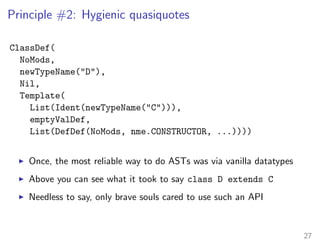
ClassDef( 
NoMods, 
newTypeName(D), 
Nil, 
Template( 
List(Ident(newTypeName(C))), 
emptyValDef, 
List(DefDef(NoMods, nme.CONSTRUCTOR, ...)))) 
▶ Once, the most reliable way to do ASTs was via vanilla datatypes 
▶ Above you can see what it took to say class D extends C 
▶ Needless to say, only brave souls cared to use such an API 
27
Principle #2: Hygienic quasiquotes 
val tree = qclass D extends C 
val qclass $_ extends ..$parents = tree 
▶ Then we introduced quasiquotes, a template-based approach to ASTs 
▶ Quasiquotes can create and match ASTs with minimal overhead 
▶ At this point our metaprogramming API started to look friendly 
28
Principle #2: Hygienic quasiquotes 
import foo.bar.C 
val tree = qclass D extends C 
qclass C; $tree 
▶ The
nal puzzle to solve is prevention of name clashes 
▶ This is what is called hygiene of a metaprogramming API 
▶ Probably the most common pitfall in Scala macros at the moment 
29
Principle #3: Persistent syntax trees 
▶ Every compilation produces attributed syntax trees 
▶ These trees contain a wealth of semantic information about programs 
▶ These trees get thrown away every time 
30
Principle #3: Persistent syntax trees 
What if we saved attributed trees instead of throwing them away? 
▶ Easy interpretation 
▶ Easy code analysis 
▶ And other neat metaprogramming tricks 
31

Eugene Burmako

  • 1.
    The State ofthe Meta Eugene Burmako (@xeno by) Ecole Polytechnique Federale de Lausanne http://scalameta.org/ 22 November 2014
  • 2.
    Outline ▶ Whymetaprogramming matters ▶ The present (scala.re ect) ▶ The future (scala.meta) 2
  • 3.
  • 4.
    Metaprogramming is... Metaprogrammingis the writing of computer programs that write or manipulate other programs or themselves as their data. |Wikipedia 4
  • 5.
    Use case #1:Code generation Sometimes you have to reach for a sledgehammer: ▶ High performance ▶ Integration with external systems ▶ Abstraction over heterogeneous datatypes 5
  • 6.
    Use case #2:Advanced static checks Types are useful, but every now and then they fall short: ▶ Restrict the types of variables that are captured in closures ▶ Ensure that communication between actors is sound ▶ Prevent over ows or under ows in computation-heavy code 6
  • 7.
    Use case #3:Advanced domain-speci
  • 8.
    c languages Even exible syntax and powerful types have their limits: ▶ LINQ ▶ async/await ▶ External DSLs 7
  • 9.
    Use case #4:Tooling ▶ Style checking ▶ Refactoring ▶ Incremental compilation ▶ And much-much more 8
  • 10.
  • 11.
    The present (scala.re ect) ▶ Decent support for compile-time metaprogramming (macros) ▶ Some support for runtime metaprogramming (re ection, codegen) ▶ Hardcore compiler internals or reinvented wheels for everything else 10
  • 12.
    Macros by example def createArray[T: ClassTag](size: Int, el: T) = { val a = new Array[T](size) for (i - 0 until size) a(i) = el a } ▶ We want to write beautiful generic code, and Scala makes that easy ▶ Unfortunately, abstractions oftentimes bring overhead 11
  • 13.
    Macros by example Object createArray(int size, Object el, ClassTag tag) { Object a = tag.newArray(size); for (int i=0; isize; i++) ScalaRunTime.array_update(...); return a; } ▶ Scala runs on the JVM, so polymorphic signatures have to be erased ▶ Erasure leads to boxing and boxing creates signi
  • 14.
    cant slowdowns ▶The snippet above shows a sketch of what createArray compiles to 12
  • 15.
    Macros by example def createArray[@specialized T: ClassTag](...) = { val a = new Array[T](size) for (i - 0 until size) a(i) = el a } ▶ Methods can be specialized, but it's viral and heavyweight ▶ Viral = the entire call chain needs to be specialized ▶ Heavyweight = specialization leads to duplication of bytecode 13
  • 16.
    Macros by example def createArray[T: ClassTag](size: Int, el: T) = { val a = new Array[T](size) def specBody[@specialized T](a: Array[T], el: T) = { for (i - 0 until size) a(i) = el } classTag[T] match { case ClassTag.Int = specBody( a.asInstanceOf[Array[Int]], el.asInstanceOf[Int]) ... } a } ▶ We want to specialize just as much as we need ▶ But that's tiresome to do by hand, and this is where macros shine 14
  • 17.
    Macros by example def specialized[T](x: = T) = macro impl[T] def createArray[T: ClassTag](size: Int, el: T) = { val a = new Array[T](size) specialized[T] { for (i - 0 until size) a(i) = el } a } ▶ specialized macro gets pretty code and transforms it into fast code ▶ The transformation is carried out by an associated metaprogram impl ▶ For more details, see Bridging Islands of Specialized Code 15
  • 18.
    How macros work ▶ We publish the language model as part of the standard distribution ▶ scala-reflect.jar contains de
  • 19.
    nitions of trees,symbols, types, etc ▶ Macros are written against data structures from scala.re ect ▶ And executed inside scalac which implements the scala.re ect API 16
  • 20.
    How macros work def specialized[T](x: = T) = macro impl[T] def impl[T](c: scala.reflect.macros.Context) (x: c.Tree)(implicit T: c.WeakTypeTag[T]) = { import c.universe._ val (specVars, specBody) = Helpers.specialize(x, T) q def specBody[@specialized T](..$specVars) = $specBody classTag[$T] match { case ..$cases } } ▶ The entry point to compile-time metaprogramming is a context ▶ From there we can import a universe of trees, symbols, types, etc 17
  • 21.
    How macros work def specialized[T](x: = T) = macro impl[T] def impl[T](c: scala.reflect.macros.Context) (x: c.Tree)(implicit T: c.WeakTypeTag[T]) = { import c.universe._ val (specVars, specBody) = Helpers.specialize(x, T) q def specBody[@specialized T](..$specVars) = $specBody classTag[$T] match { case ..$cases } } ▶ Re ection artifacts that model Scala code are
  • 22.
    rst-class ▶ Wecan pass them around to/from helpers, can create new ones 18
  • 23.
    How macros work def specialized[T](x: = T) = macro impl[T] def impl[T](c: scala.reflect.macros.Context) (x: c.Tree)(implicit T: c.WeakTypeTag[T]) = { import c.universe._ val (specVars, specBody) = Helpers.specialize(x, T) q def specBody[@specialized T](..$specVars) = $specBody classTag[$T] match { case ..$cases } } ▶ Upon completion, a macro returns a tree representing new code ▶ This tree will replace the macro invocation at the call site 19
  • 24.
    There's more ▶Type providers ▶ Automatic generation of typeclass instances ▶ Language virtualization ▶ Deep integration with external DSLs ▶ For details see our What Are Macros Good For? talk 20
  • 25.
  • 26.
    The future (scala.meta) ▶ This year we set out on a journey to create an ultimate metaprogramming API ▶ Here we'll tell you about our design decisions and their impact 22
  • 27.
    scala.meta principles ▶Language model should be independent of language implementations ▶ Interface for syntax trees should be based on hygienic quasiquotes ▶ Binaries should provide access to their attributed abstract syntax trees 23
  • 28.
    Principle #1: Independentlanguage model ▶ scala.reflect grew organically from scalac internals ▶ That was a nice shortcut to get things going easily ▶ But in the long run dependence on scalac makes everything harder 24
  • 29.
    Principle #1: Independentlanguage model 25
  • 30.
    Principle #1: Independentlanguage model Diversity is real: ▶ ...Intellij (a reimplementation of Scala's typechecker) ▶ ...Dotty (the next generation Scala compiler) ▶ ...Typelevel (an experimental community fork) ▶ ...Policy (a compiler/language technology fork) 26
  • 31.
    Principle #2: Hygienicquasiquotes ClassDef( NoMods, newTypeName(D), Nil, Template( List(Ident(newTypeName(C))), emptyValDef, List(DefDef(NoMods, nme.CONSTRUCTOR, ...)))) ▶ Once, the most reliable way to do ASTs was via vanilla datatypes ▶ Above you can see what it took to say class D extends C ▶ Needless to say, only brave souls cared to use such an API 27
  • 32.
    Principle #2: Hygienicquasiquotes val tree = qclass D extends C val qclass $_ extends ..$parents = tree ▶ Then we introduced quasiquotes, a template-based approach to ASTs ▶ Quasiquotes can create and match ASTs with minimal overhead ▶ At this point our metaprogramming API started to look friendly 28
  • 33.
    Principle #2: Hygienicquasiquotes import foo.bar.C val tree = qclass D extends C qclass C; $tree ▶ The
  • 34.
    nal puzzle tosolve is prevention of name clashes ▶ This is what is called hygiene of a metaprogramming API ▶ Probably the most common pitfall in Scala macros at the moment 29
  • 35.
    Principle #3: Persistentsyntax trees ▶ Every compilation produces attributed syntax trees ▶ These trees contain a wealth of semantic information about programs ▶ These trees get thrown away every time 30
  • 36.
    Principle #3: Persistentsyntax trees What if we saved attributed trees instead of throwing them away? ▶ Easy interpretation ▶ Easy code analysis ▶ And other neat metaprogramming tricks 31