Good Practice Note Code: INGP33

 Good Practice Note


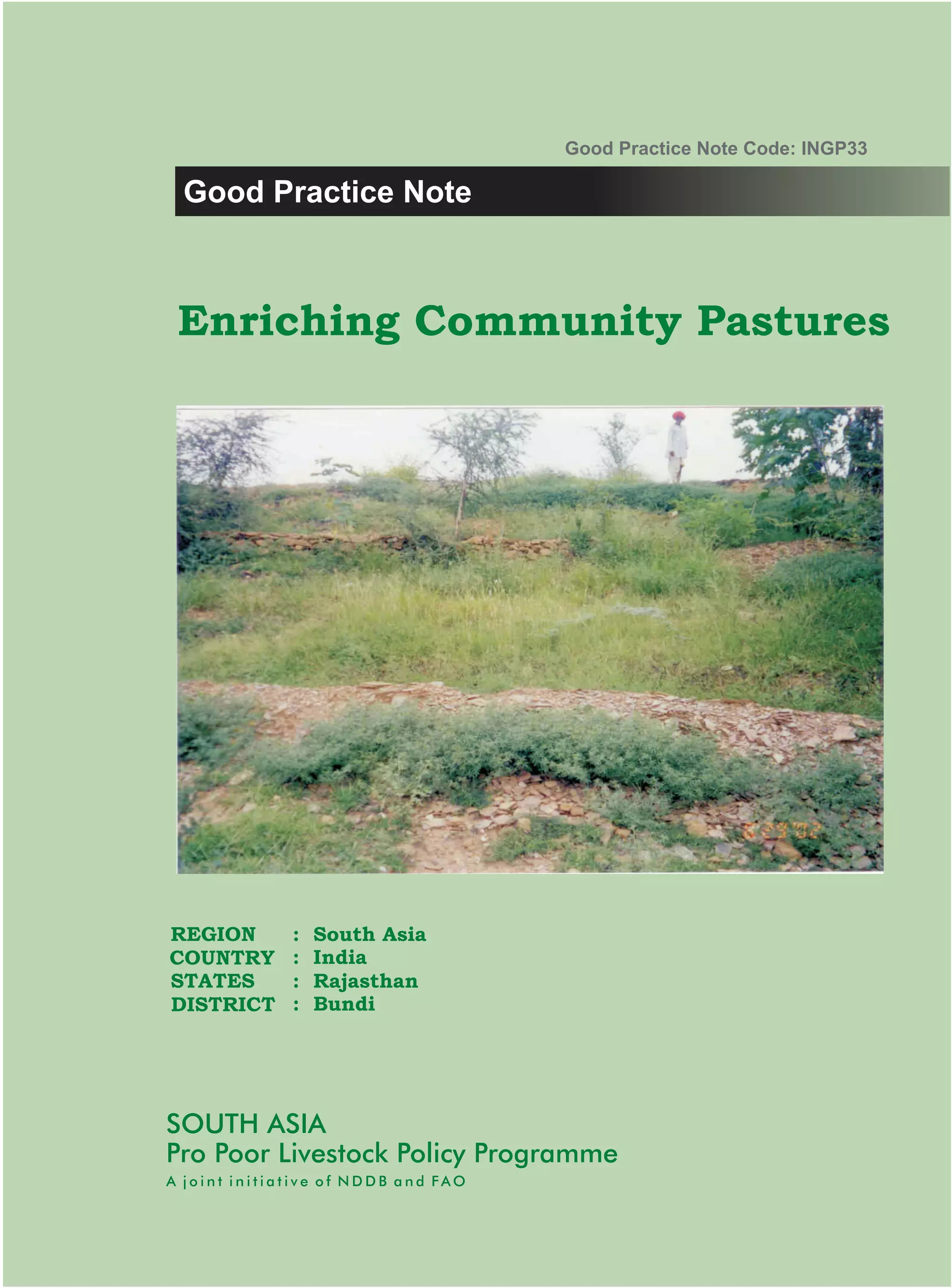
 Enriching Community Pastures


REGION        :   South Asia
COUNTRY       :   India
STATES        :   Rajasthan
DISTRICT      :   Bundi


SOUTH ASIA
Pro Poor Livestock Policy Programme
A joint initiative of NDDB and FAO
GOOD PRACTICE OWNER and GOOD PRACTICE CHAMPIONS

 A GP Owner is a person/group of individuals and/or institution that plays a crucial role in the
 GP. Thus, a GP owner understands all the ins and outs of the GP and is often the initiator of GP.
 Others involved in the Practice (not considered GP Owners) may be invited to assist in the filtering and
 writing process. Such persons, who have insights into what makes the GP pro-poor, are better-
 positioned to help influence policies. Thus, with their thorough understanding of the GP, they (as an
 individual or as a team) can function as GP Champions.


 Enriching Community Pastures:
Villages of Gudha Gokulpura in Bundi, Rajasthan take
the Lead

  Good Practice              RAJASTHAN RURAL INSTITUTE FOR DEVELOPMENT MANAGEMENT
  Owner
                             BAIF DEVELOPMENT RESEARCH FOUNDATION

  Good Practice              Authors:                Mohan Nadoda, S.E. Pawar and B.R. Patil
  Champions
                             Contributors:           A.K. Chourasia, D.D. Pandit, D.S. Devda, K.C. Gujar,
                                                     M.S. Sharma

                             Content                 Anita Paul, Mamta Dhawan, Sheila Koyyana
                             Editors:


Photo Credits: BAIF Development Research Foundation
Publisher: South Asia Pro Poor Livestock Policy Programme (SA PPLPP), a joint initiative of NDDB
and FAO
Suggested Citation: SA PPLPP (2009) Code: INGP33, “Enriching Community Pastures: Villagers of
Gudha Gokulpura in Bundi, Rajasthan take the Lead”. Good Practice Note, Delhi, India
Design: Kriti Team, http://krititeam.blogspot.com
Layout: SA PPLPP Coordination Team
Printing: Satyam Grafix
© SA PPLPP 2009
Disclaimer: The designations employed and the presentation of material in this publication do not imply the expression of any
opinion whatsoever on the part of the National Dairy Development Board of India (NDDB) and the Food and Agriculture
Organisation of the United Nations (FAO) concerning the legal status of any country, territory, city or area or its authorities, or
concerning the delimitations of its frontiers or boundaries. The opinions expressed are solely of the author(s) and reviewer(s) and
do not constitute in any way the official position of the NDDB or the FAO.
Reproduction and dissemination of material in this Good Practice Note for educational or non-commercial purposes are authorised
without any prior written permission from the copyright holders, provided the source is fully acknowledged. Reproduction of material
in this Good Practice Note for resale or other commercial purposes is prohibited without written permission from the copyright holders.
Contents

 1.   Introduction               1


 2.   Project Location           2

 3.   The Good Practice          4


 4.   Problems Identified        5


 5.   Delivery Mechanism         6


 6.   Impact & Replication      11


 7.   Lessons Learnt            16


 8.   Post Project Monitoring   17


 9.   Conclusion                18


      Annexure 1                19

      Annexure 2                20

      References                21

      Abbreviations             21

      Glossary                  22
1. Introduction
 Common lands in villages of India, often referred to as Common Property Resources
 (CPRs), play a crucial role in sustaining and enhancing the livelihoods of rural poor by
 providing a wide variety of essentials like food, fodder, manure, medicinal herbs etc.
 (Jabir Ali, 2007). In India, there is high dependency on CPRs for feed and fodder for
 the livestock sector as a sizeable number of livestock rearing families belong to
 landless, marginal and small land holding categories who are extremely poor.
 Simultaneously, a number of studies indicate that the area under CPRs has declined in
 most parts of the country due to several reasons thereby increasing the pressure on
 the available CPRs (Jodha, 1990). Hence, sustainable management and development
 of common lands becomes a crucial component in poverty alleviation.
 1.1 Common Land in Rajasthan
 Use of common lands in Rajasthan has not been regulated resulting in open access
 which has led to degradation and over exploitation of the CPRs. With the increasing
 livestock population there is an uncontrolled pressure on available grazing resources
 in the villages by large and small ruminants. Encroachment is widespread and has
 been going on for several decades, particularly since independence in 1947 (Jodha,
 1990).
 Under the Rajasthan Tenancy Act (1955), pasture land (charagaha) is defined as land
 used for grazing by cattle of a village or villages or recorded in the settlement records
 as such (cited by Saint, 1993). The common lands are under the jurisdiction of the
 Panchayat – the lowest tier of local Government. Many rural livestock keepers are
 small and marginal farmers who do not have sufficient land give preference to
 growing food crops in comparison to fodder crops. For them the village common land
 is a vital source of forage. Common lands provide fodder for livestock in the form of
 either grass for large ruminants or tree fodder for small ruminants.
 Development programs are interested in restoring village common lands as it has a
 direct impact on the food security and livelihoods through improvements in biomass
 production and conservation of bio-diversity. As a result of soil and water
 conservation measures there is ground water recharge and improvement in water
 regime for crop cultivation. In the process of village common land development there
 is community mobilization and capacity building of the stakeholders involved in
 various field interventions.
 District Bundi is the smallest (area 5.82 lakh ha) district of the 32 districts of
 Rajasthan. Semi-arid with mean annual rainfall of about 420 mm, the district falls
 under drought prone category. A large number of traditional wells support a
 predominantly agricultural economy. Around 60% of the land in the district is under
 cultivation. The fertility and productivity of the land varies radically over different
 parts of the district. The three major crops grown are wheat, rice and maize (BAIF
 2003).
 The Hindoli Tehsil is in the North West of the district where the project was located.
 The Tehsil is mostly hilly with stony, hard soil and is the most backward in the district.
 Scheduled caste and scheduled tribes, who are socio economically backward,
 constitute around 40% of the population.

                                                                   Enriching Community Pastures   1
2. Project Location
          2.1 Village Profile
          Gudha Gokulpura with 270 families and total population of 1,285 is divided in to five
          hamlets namely, Khet ka Jhopda, Devpura, Padiya Pahda, Mavika Pahda and Regar
          Basti. With 55.5% males and 44.5% females, the sex ratio in the village indicates a
          very low status of women in the community. Male and female literacy level is 64%
          and 16% respectively (Baseline Survey Report, 1997). The village is located around
          30 kms from Bundi. The common mode of public transport is privately run jeeps. The
          village has to depend on neighbouring village Thana that has electricity, a secondary
          school, few private doctors and shops.


          2.2 Social Structure
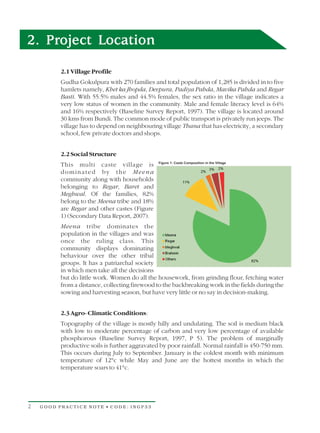
          This multi caste village is
          dominated by the Meena
          community along with households
          belonging to Regar, Baret and
          Meghwal. Of the families, 82%
          belong to the Meena tribe and 18%
          are Regar and other castes (Figure
          1) (Secondary Data Report, 2007).
          Meena tribe dominates the
          population in the villages and was
          once the ruling class. This
          community displays dominating
          behaviour over the other tribal
          groups. It has a patriarchal society
          in which men take all the decisions
          but do little work. Women do all the housework, from grinding flour, fetching water
          from a distance, collecting firewood to the backbreaking work in the fields during the
          sowing and harvesting season, but have very little or no say in decision-making.


          2.3 Agro- Climatic Conditions:
          Topography of the village is mostly hilly and undulating. The soil is medium black
          with low to moderate percentage of carbon and very low percentage of available
          phosphorous (Baseline Survey Report, 1997, P 5). The problem of marginally
          productive soils is further aggravated by poor rainfall. Normal rainfall is 450-750 mm.
          This occurs during July to September. January is the coldest month with minimum
          temperature of 12°c while May and June are the hottest months in which the
          temperature soars to 41°c.


2   GOOD PRACTICE NOTE • CODE: INGP33
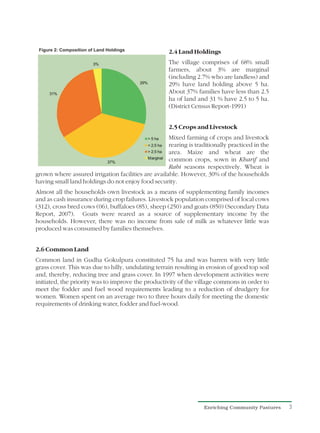
II. The Practice                                     2.4 Land Holdings
                                                     The village comprises of 68% small
                                                     farmers, about 3% are marginal
                                                     (including 2.7% who are landless) and
                                                     29% have land holding above 5 ha.
                                                     About 37% families have less than 2.5
                                                     ha of land and 31 % have 2.5 to 5 ha.
                                                     (District Census Report-1991)


                                                     2.5 Crops and Livestock
                                                    Mixed farming of crops and livestock
                                                    rearing is traditionally practiced in the
                                                    area. Maize and wheat are the
                                                    common crops, sown in Kharif and
                                                    Rabi seasons respectively. Wheat is
grown where assured irrigation facilities are available. However, 30% of the households
having small land holdings do not enjoy food security.
Almost all the households own livestock as a means of supplementing family incomes
and as cash insurance during crop failures. Livestock population comprised of local cows
(312), cross bred cows (06), buffaloes (85), sheep (250) and goats (850) (Secondary Data
Report, 2007). Goats were reared as a source of supplementary income by the
households. However, there was no income from sale of milk as whatever little was
produced was consumed by families themselves.


2.6 Common Land
Common land in Gudha Gokulpura constituted 75 ha and was barren with very little
grass cover. This was due to hilly, undulating terrain resulting in erosion of good top soil
and, thereby, reducing tree and grass cover. In 1997 when development activities were
initiated, the priority was to improve the productivity of the village commons in order to
meet the fodder and fuel wood requirements leading to a reduction of drudgery for
women. Women spent on an average two to three hours daily for meeting the domestic
requirements of drinking water, fodder and fuel-wood.


                                                                   Enriching Community Pastures   3
3. The Good Practice

                               The note presented here showcases the involvement of the community in
                               developing the commons belonging to Gudha Gokulpura village of Bundi district
                               in Rajasthan, India. Acknowledging the importance of village common land
                               restoration in the area, the work was taken up as an entry point activity under the
                               BAIF-ICEF1 project. Developing rain-fed pasture on degraded village commons
                               has led to an increase in fodder resources for poor livestock families, which in
                               turn, has led to positive impacts on family incomes and nutritional status. A
                               participatory mechanism of creating a village level management committee has
                               strengthened the Panchayati Raj System (PRS) and revived the tradition of
                               safeguarding village commons in a sustainable manner. The approach is holistic
                               and addresses inequalities between resource rich and resource poor farmers and
                               empowers the community to manage their CPRs.

                               3.1 Stakeholders of the Good Practice, their Roles and Responsibilities

                               The India Canada Environment Facility (ICEF) financially supported the
                               project which was conceptualised and implemented by BAIF Development
                               Research Foundation (BAIF), a National NGO having its headquarters at Pune.
                               Field implementation was done through RRIDMA, BAIF's associate organization in
                               Rajasthan. BAIF's cattle breeding centre in Thana, provided artificial insemination
                               and health care services and monitored feeding and management practices. A
                               livestock supervisor was stationed in the village to provide services to the cattle
                               owners in the area.
                               BAIF provided guidance in forming a Community Pasture Management
                               Committee (CPMC) with due representation from each caste. The President and
                               Secretary were selected through a participatory approach by common consensus
                               of the members. This committee was responsible for implementation of activities
                               on the village common land with technical support from BAIF.
                               The Rajasthan Rural Institute of Development Management (RRIDMA) was
                               responsible for overall coordination of the project at the State level.
                               The Local Panchayat was responsible for land allocation for silvipasture
*India Canada                  development. The villagers were in charge of management and use of CPRs. They
Environment Facility
(ICEF) a joint initiative of   were also the prime beneficiaries of the project. The Gram Sabha would constitute
Government of India and
Government of Canada           and elect members to the CPMC by consensus.
funded a seven year
(1996-2003) project to
BAIF Development
                               District Collector intervened to resolve conflicts arising out of ownership and
Research Foundation
(BAIF) working with local
                               management issues. The village Panchayat was interested in taking over the
community and
government officials of
                               management of the common land, once revenues started getting generated. The
the area. The broad
objective of the project
                               District Collector intervened and managed to retain the neutral, independent
was water resources
development and energy
                               identity of the CPMC. However, the community was asked to take the Panchayat
conservation for
sustainable
                               into confidence and present accounts in the Gram Sabha every six months.
management of the
Environment. The
project was implemented
in Rajasthan, Uttar
Pradesh and Karnataka.


    4        GOOD PRACTICE NOTE • CODE: INGP33
4. Problems Identified

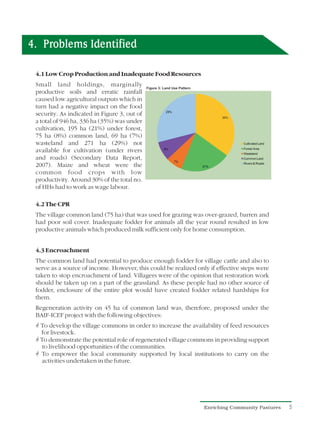
 4.1 Low Crop Production and Inadequate Food Resources
 Small land holdings, marginally
 productive soils and erratic rainfall
 caused low agricultural outputs which in
 turn had a negative impact on the food
 security. As indicated in Figure 3, out of
 a total of 946 ha, 336 ha (35%) was under
 cultivation, 195 ha (21%) under forest,
 75 ha (8%) common land, 69 ha (7%)
 wasteland and 271 ha (29%) not
 available for cultivation (under rivers
 and roads) (Secondary Data Report,
 2007). Maize and wheat were the
 common food crops with low
 productivity. Around 30% of the total no.
 of HHs had to work as wage labour.

 4.2 The CPR
 The village common land (75 ha) that was used for grazing was over-grazed, barren and
 had poor soil cover. Inadequate fodder for animals all the year round resulted in low
 productive animals which produced milk sufficient only for home consumption.


 4.3 Encroachment
 The common land had potential to produce enough fodder for village cattle and also to
 serve as a source of income. However, this could be realized only if effective steps were
 taken to stop encroachment of land. Villagers were of the opinion that restoration work
 should be taken up on a part of the grassland. As these people had no other source of
 fodder, enclosure of the entire plot would have created fodder related hardships for
 them.
 Regeneration activity on 45 ha of common land was, therefore, proposed under the
 BAIF-ICEF project with the following objectives:
 G
 To develop the village commons in order to increase the availability of feed resources
 for livestock.
 G
 To demonstrate the potential role of regenerated village commons in providing support
  to livelihood opportunities of the communities.
 G
 To empower the local community supported by local institutions to carry on the
 activities undertaken in the future.


                                                                 Enriching Community Pastures   5
5. Delivery Mechanism

       BAIF had a presence in Thana village located in the vicinity prior to initiating work in
       Gudha Gokulpura. A cattle development centre was operational in the village since 1990.
       At the field level BAIF team was responsible for overall coordination and monitoring of
       project activities. The resource specialists in the team came from diverse backgrounds
       like agriculture, livestock and social sciences. The BAIF team helped to form the CPMC
       which had amongst its members BAIF Program Officer, Gram Panchayat representatives,
       Livestock Owners, Landless people and village representatives from each caste. This
       ensured democratic
       functioning of the CPMC.
       The CPMC ensured the
       maintenance of the
       village common lands,
       equitable distribution of
       biomass resources and
       linkages with the
       Government. There was a
       resource team at the field
       level comprising of
       Extension Officers who
       were in charge of field
       supervision, record
       keeping and organizing
       local meetings. The
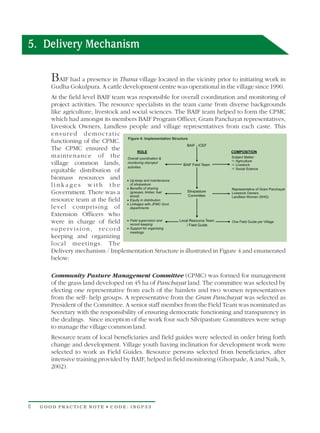
       Delivery mechanism / Implementation Structure is illustrated in Figure 4 and enumerated
       below:

       Community Pasture Management Committee (CPMC) was formed for management
       of the grass land developed on 45 ha of Panchayat land. The committee was selected by
       electing one representative from each of the hamlets and two women representatives
       from the self- help groups. A representative from the Gram Panchayat was selected as
       President of the Committee. A senior staff member from the Field Team was nominated as
       Secretary with the responsibility of ensuring democratic functioning and transparency in
       the dealings. Since inception of the work four such Silvipasture Committees were setup
       to manage the village common land.
       Resource team of local beneficiaries and field guides were selected in order bring forth
       change and development. Village youth having inclination for development work were
       selected to work as Field Guides. Resource persons selected from beneficiaries, after
       intensive training provided by BAIF, helped in field monitoring (Ghorpade, A and Naik, S,
       2002).


6   GOOD PRACTICE NOTE • CODE: INGP33
Basis for the interventions: Location specific interventions were selected for
village common land development keeping in view the overall objective of water
resources development and community outreach programmes proposed under
BAIF-ICEF project. The common land was located at the upstream of the village,
15% of which comprised of sloping land, which had resulted in substantial soil
erosion over the years. In view of this, the interventions planned had a focus on
soil and water conservation to restore soil moisture and to develop a green cover
with suitable mix of grasses and tree species which could meet feed and fodder
requirements of the village cattle and small ruminants.


Community Mobilisation: Several measures were taken to motivate
communities for taking responsibilities of implementing and managing various
project components. Exposure visits to BAIF project areas in Rajasthan and
Gujarat were organised to facilitate interactions with villagers where community
participation had helped to convert barren, undulating wasteland into green
pastures. While, such cross-visits proved beneficial largely for building on the
confidence of the communities, a degree of cynicism remained. One of the reasons
for this was the bitter experience of community lift irrigation scheme in the village
which was non-functional because of mismanagement.


Organizing Gram Sabha for Consensus: The Gram Sabha meeting called by
the project team in June 1997 to discuss issues regarding common land
development received a good response from the villagers. Women's voice in the
meeting prevailed over the reluctance of men, as they were going to be the major
beneficiaries of the regenerated common lands. They had a concern of inadequate
milk for children at home due to unproductive livestock. Common land
development would enable easy availability of fodder and fuel wood, it was
therefore, proposed to develop 45 ha of village common land and the remaining
land to be left for open grazing.


Conflict Resolution: In the initial stages, due to conflict of interests, the project
encountered opposition from the group of villagers that had encroached on the
grazing land. Instead of immediate confrontation, the project team proposed to go
ahead with fodder development plans, as a mechanism for building confidence
amongst all stakeholders.
The Sarpanch (Village Headman) supported the encroachers against the project
which led to the project losing grip on the situation initially. However, the strategy
of exerting pressure from Government officials and projecting the Sarpanch
favourably before others brought good results. Although the solution was
accepted by all, the fact remains that the conflict between the encroachers and the
villagers may keep arising depending upon the balance of power in the village.


                                                              Enriching Community Pastures   7
Area Demarcation & Conservation
        Measures: The boundaries were fixed to         Table 1: Treatment Measures on the CPR
        demarcate 45 hectares proposed to be
        restored and a stone wall of 2,565 running     Stone Fencing                       2,565 m
        meters was constructed, in order to
        demarcate this forest land from the            Continuous Contour Trenches        12,008 m
        neighbouring Bhilwara district. While
                                                       Stone Bunding                       5,176 m
        making the enclosure, area nearer to the
        villages was proposed for open grazing to      Gully Plugs                         112 Nos
        enable easy access. 12,000 meters of
        contour trenches, 112 gully plugs and over     Pit Digging for Plantation       15,315 Nos
        15,000 pits were dug for tree plantation. In
        the enclosure work village women have          Drainage System                      52.5 m
        contributed 80% to 90% of the labour
        (BAIF, 2003). Details of work undertaken       in the common land are presented in
        Table 1.


        Participatory Norms Development: Before initiating activities, discussions on
        cost implications of the proposed work to be completed through project support,
        was held. Unanimously it was decided that 10% of the labour costs would be
        contributed as 'shramdan' (voluntary labour) for generating a corpus to meet
        future maintenance costs. This fund would be administered by the CPMC.
        The Project team agreed to the rates decided by the villagers. Initially labourers
        involved in the work were apprehensive on payment of wages only after six
        months as was the case with other projects in the forest area. They also objected to
        the involvement of the village Panchayat in the disbursal of wages. To reassure the
        labourers the project team decided to pay wages every 15 days. The payment
        process was completely transparent which instilled confidence in the system. As a
        result more and more villagers began to take part in the work and showed a
        gradually increasing level of interest and motivation.


        Reorganisation of the Committee: As work progressed, the need to reorganise
        the Pasture Management Committee was felt in order to ensure adequate
        representation from the community. The re-elected Committee comprises of
        twelve members - with two representatives from every hamlet with elected ward
        Panch being the President and the Secretary of the Panchayat being the Secretary
        of the Committee too, in charge of maintaining all the records.


        Tree Plantation: Since the area was protected it was ideal to develop plantations
        with multipurpose plant species. Fast growing Subabul (Leucaena lucocephala)
        plantation was done along the fencing wall. Other species such as Khejdi (Prosopis


8   GOOD PRACTICE NOTE • CODE: INGP33
cineraria), Shirish (Dalbergia sisoo),
Bamboo (Dendrocalamus strictus), Dhok
(Anogisus pendula), Khair (Acacia
catechu) were also included in the
plantation. In the matrix ranking exercise
done with the villagers species with
multipurpose uses were preferred. Tree
species like Desi Babul (Acacia nilotica),
Ber (Zizypus mauritiana) already existed
in the common land before the work was
initiated. A total of little over 19,000
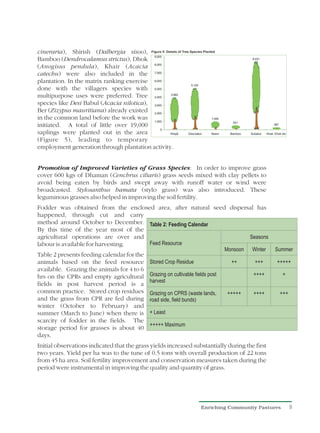
saplings were planted out in the area
(Figure 5), leading to temporary
employment generation through plantation activity.


Promotion of Improved Varieties of Grass Species: In order to improve grass
cover 600 kgs of Dhaman (Cenchrus ciliaris) grass seeds mixed with clay pellets to
avoid being eaten by birds and swept away with runoff water or wind were
broadcasted. Stylosanthus hamata (stylo grass) was also introduced. These
leguminous grasses also helped in improving the soil fertility.
Fodder was obtained from the enclosed area, after natural seed dispersal has
happened, through cut and carry
method around October to December. Table 2: Feeding Calendar
By this time of the year most of the
agricultural operations are over and                                  Seasons
labour is available for harvesting.  Feed Resource
                                                                                 Monsoon   Winter   Summer
Table 2 presents feeding calendar for the
animals based on the feed resource           Stored Crop Residue                   ++       +++     +++++
available. Grazing the animals for 4 to 6
hrs on the CPRs and empty agricultural       Grazing on cultivable fields post             ++++       +
                                             harvest
fields in post harvest period is a
common practice. Stored crop residues        Grazing on CPRS (waste lands,        +++++    ++++      +++
and the grass from CPR are fed during        road side, field bunds)
winter (October to February) and
summer (March to June) when there is         + Least
scarcity of fodder in the fields. The
                                             +++++ Maximum
storage period for grasses is about 40
days.
Initial observations indicated that the grass yields increased substantially during the first
two years. Yield per ha was to the tune of 0.5 tons with overall production of 22 tons
from 45 ha area. Soil fertility improvement and conservation measures taken during the
period were instrumental in improving the quality and quantity of grass.


                                                                      Enriching Community Pastures         9
Benefit Sharing Arrangements: Since animals were not allowed in the commons for
           open grazing it was the task of the Committee to decide mechanisms for grass harvest
           and its equitable distribution. Important participatory decisions taken were as under:
           Tfrom the village was allowed to cut as much grass as he or she wanted during
           Any one
            the one month cutting season in October. Half the grass cut would go to the
            Committee who would sell it in the market. The other half could be taken home to
            feed animals.
           T grass harvest was announced in the village and grass harvest was done in
           Period for
            the presence of Committee members and the watchman. During Committee auctions
            for sale of grass preference for purchase was given to Gudha Gokulpura villagers.
           The revenue generated is then directed towards payment of choukidar (watchman)
           T
            salaries and used for repairs and maintenance work in the commons.


10   GOOD PRACTICE NOTE • CODE: INGP33
6. Impact & Replication

  ? Secondary Impact of Watershed Measures
  6.1
  The core project area constituted of nine micro-watersheds. Soil and water
  conservation work was implemented over the entire watershed area which
  included individual land holdings and village commons spread over 75 ha (of which
  45 ha was handed over to BAIF for development). With the undulating topography
  and hydro-geological conditions of the area the conservation measures undertaken
  led to improved soil moisture and crop yields. The impact achieved is a result of the
  integrated approach to area development. Interventions for development of village
  commons has led to positive impacts on improving soil moisture, water availability,
  feed resources, milk production and crop outputs.


  6.2 Controlled Soil Erosion
  Within the area surrounded by the stone fence and as a result of construction of
  contour trenches (12,008 meter), stone bunding (5,176 meter), gully plugs (112) and
  pits (15,315) soil erosion controlled was to the tune of 19-21 tons per ha. Soil
  conservation and moisture availability together supported good tree growth and
  improved biomass availability from the common land.


  6.3 Improved Water Availability
  With the annual rainfall of 450 - 750 mm and 12,008 running meter Continuous
  Contour Trenches (CCTs) the water conservation achieved from 45 ha common land
  area is 2 million litres per year. In addition, as a result of the treatment measures
  covering the entire project area and in the common land, which is placed at the
  higher reach, there was significant increase in the overall availability of water for
  irrigation and drinking. Rainwater harvesting could improve subsoil water table by
  1.5 - 2.0 m. This was evident from the well water available for irrigation. Of the 227
  wells in the watershed area, 175 had water availability for 9 - 12 months in a year as
  against 88 wells before initiating work in the area. Initially traditional chadas (water
  lifting device made out of leather) were used to lift water from wells for irrigation,
  but now with adequate water, diesel pumps have replaced all the traditional chadas
  as water lifting device. There are 41 diesel engine pump sets as against 8 during
  1997. Well monitoring exercises reflected an improvement of more than 300% in the
  time taken to recharge from 12 - 36 hrs in 1997 to 2 to 12 hrs in 2002 (BAIF, 2003).


  6.4 Improved Grass and Seed Production
  Improvement in soil moisture regime and cultivation of grasses such as Dhaman
  and Stylo has helped in improving fodder biomass availability. Almost all farmers in
  the village benefitted from this activity in the year 2000. Fodder production
  increased from close to 2 quintals/ha in 1987 to a little over 6 quintals / ha by the


                                                                 Enriching Community Pastures   11
year 2000 (Table 3). The excess         Table 3: Details of Grass & seed Production
           grass was sold to the buyers from
           neighbouring villages. A big            Particulars                   Production in         Families
           incentive was the price as, while                                  quintals / ha in 2000   benefitted
           the market rate for fodder was
           Rs. 2/- a bundle the CPMC sold          Dhaman Seed                        0.15               65
           the same at half the cost.              Dhaman Grass (Cenchrus             5.11               170
             It was observed that Dhaman           ciliaris)
             seed collection offered good
                                                       Local Sheen Grass              1.0             85
             opportunity for earning wages @
             Rs 10/- per kg. With one person Buari* Grass                             0.90            205
             collecting 5 kg seeds / day the
             earning were Rs 50 /per day. In *Buari Grass was used for Broom making
             grass harvesting a person can
                                                                         harvest 100 bundles (100 kg)
       Table 4: Economic Returns during the Period 1998-99 to 2002-03 per day and earning wages of
                                                                         Rs 50/- per day. Buari grass
       Particulars                                         Amount (Rs)
                                                                         (broom grass) weighs 5 kg per
       1. Total Expenditure                                      331,965 bundle and each bundle is sold
                                                                         at Rs 10/-. This grass is used by
       2. Income:                                                        landless families for broom
                                                                         making.        Such economic
            a. Surplus Grass Sale                                125,599 opportunities assisted the

            b. Tree Loppings                                      72,958 CPMC in generating a modest
                                                                         surplus in the initial years itself
            c. Other Income (from sale of grass, wood,           151,697 (Table 4). For more details
            seed, grazing charges & encroachment fine)                   refer Annexure 1.
           (See also Annexure 1)

       Total Income 2 (a+b+c)                                    350,254
                                                                 6.5 Fodder Promotion on
       Total Surplus (2(a+b+c))-1                        18,289  Private Land
                                                                 By observing the experience of
            grass production from commons, villagers got motivated to convert their marginally
            productive land areas to private grasslands and for plantations of multipurpose tree
            species. Around 70 HHs have established over 33,000 saplings of 22 assorted species
            on private marginally productive land with 62 % survival rate (Ghorpade, A and Naik,
            S, 2002).


           6.6 Improved Tree Biomass
           A vegetation study was undertaken with technical assistance from Foundation for
           Ecological Security to assess the qualitative and quantitative growth of foliage on the
           regenerated commons. Salient findings of the study are as follows:
           ? per ha has increased from 41 to 187 trees,
           No. of trees


12   GOOD PRACTICE NOTE • CODE: INGP33
? regenerated patches shows a greater diversity and higher palatability,
Grasses on
?
Total palatable biomass including grasses is about 69% more over its availability at the
baseline,
? of biomass from commons available to livestock keepers is estimated to
Total value
have increased to Rs 10,700 per household.
The details of this analysis are provided in Annexure 2.


6.7 Changes in Livestock Trend and Milk Production
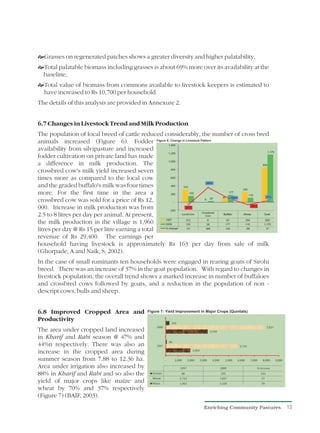
The population of local breed of cattle reduced considerably, the number of cross bred
animals increased (Figure 6). Fodder
availability from silvipasture and increased
fodder cultivation on private land has made
a difference in milk production. The
crossbred cow's milk yield increased seven
times more as compared to the local cow
and the graded buffalo's milk was four times
more. For the first time in the area a
crossbred cow was sold for a price of Rs 12,
000. Increase in milk production was from
2.5 to 8 litres per day per animal. At present,
the milk production in the village is 1,960
litres per day @ Rs 15 per litre earning a total
revenue of Rs 29,400. The earnings per
household having livestock is approximately Rs 163 per day from sale of milk
(Ghorpade, A and Naik, S, 2002).
In the case of small ruminants ten households were engaged in rearing goats of Sirohi
breed. There was an increase of 37% in the goat population. With regard to changes in
livestock population, the overall trend shows a marked increase in number of buffaloes
and crossbred cows followed by goats, and a reduction in the population of non -
descript cows, bulls and sheep.


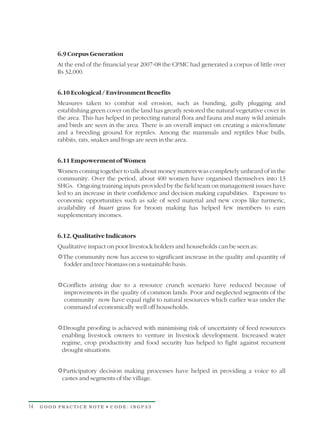
6.8 Improved Cropped Area and
Productivity
The area under cropped land increased
in Kharif and Rabi season @ 47% and
44%n respectively. There was also an
increase in the cropped area during
summer season from 7.88 to 12.36 ha.
Area under irrigation also increased by
88% in Kharif and Rabi and so also the
yield of major crops like maize and
wheat by 70% and 37% respectively
(Figure 7) (BAIF, 2003).
                                                               Enriching Community Pastures   13
6.9 Corpus Generation
          At the end of the financial year 2007-08 the CPMC had generated a corpus of little over
          Rs 32,000.


          6.10 Ecological / Environment Benefits
          Measures taken to combat soil erosion, such as bunding, gully plugging and
          establishing green cover on the land has greatly restored the natural vegetative cover in
          the area. This has helped in protecting natural flora and fauna and many wild animals
          and birds are seen in the area. There is an overall impact on creating a microclimate
          and a breeding ground for reptiles. Among the mammals and reptiles blue bulls,
          rabbits, rats, snakes and frogs are seen in the area.


          6.11 Empowerment of Women
          Women coming together to talk about money matters was completely unheard of in the
          community. Over the period, about 400 women have organised themselves into 13
          SHGs. Ongoing training inputs provided by the field team on management issues have
          led to an increase in their confidence and decision making capabilities. Exposure to
          economic opportunities such as sale of seed material and new crops like turmeric,
          availability of buari grass for broom making has helped few members to earn
          supplementary incomes.


          6.12. Qualitative Indicators
          Qualitative impact on poor livestock holders and households can be seen as:
          R
          The community now has access to significant increase in the quality and quantity of
          fodder and tree biomass on a sustainable basis.


          R
          Conflicts arising due to a resource crunch scenario have reduced because of
          improvements in the quality of common lands. Poor and neglected segments of the
          community now have equal right to natural resources which earlier was under the
          command of economically well off households.


          RDrought proofing is achieved with minimising risk of uncertainty of feed resources
          enabling livestock owners to venture in livestock development. Increased water
          regime, crop productivity and food security has helped to fight against recurrent
          drought situations.


          R decision making processes have helped in providing a voice to all
          Participatory
          castes and segments of the village.


14   GOOD PRACTICE NOTE • CODE: INGP33
R in drudgery for women by reducing time spent on fodder and fuel wood
Reduction
collection. Women have been the major beneficiaries of the regenerated common land.
Now they get adequate fodder for their livestock within easy reach which saves their
time in fodder and fuel-wood collection from 4-5 hrs (baseline) to 1-1.5 hrs at present.


Rcapabilities of the community members towards enforcing rules to maintain
Improved
and manage the commons.


Replication
Based on the success of this pilot initiative, Government of India, provided financial
support under SGSY special project to replicate this programme in 76 villages spread over
2,520 ha area. BAIF has initiated development of 320 ha of community land spread over
9 villages in Bhilwara district of Rajasthan.
The Panchayat of village Mediya which falls in the neighbouring district of Bhilwara
unanimously decided to hand over 37 ha out of 50 ha of common land owned by it for
silvipasture development by BAIF.


                                                                Enriching Community Pastures   15
7. Lessons Learnt

          Confidence building, facilitation and negotiating skills of a facilitating organisation
          T
            has helped in resolving conflicts and arriving at consensus which is very crucial for
            success and sustainability of CPR management. While developing commons the
            likely impact on various stakeholders should be assessed. In this way possible
            conflicts can be solved by facilitating negotiations between groups before initiating
            the work. In the project area, in view of the conflicts within the group of farmers, the
            decision to precede with fodder development plan on 45 ha area was an opportunity
            to get started and convince the villagers with early results of the interventions,
            without upsetting social relations in the village. Process documentation could help
            in analysing potential conflict situations and finding suitable solutions.


          T understanding regarding the exact roles and the functions of the CPMC and
          A clear
            the Gram Panchayat can foster a cordial environment based on cooperation and
            mutual trust.


          T training and orientation of the village Panchayat and CPMC members has
          Regular
            empowered them to play a pivotal role in the management of development funds
            and assets developed. There is a need to educate not only the Panchayat members
            but also the Gram Sabha on the responsibilities and powers of the Panchayat.


          Empowering the community and nurturing able leadership can help in constructive
          T
            decision making for equitable sharing of the benefits and shielding from unwanted
            elements. The norms of benefit sharing should be decided with participation of
            community members and Gram Panchayat. The established local political
            leadership is a major factor that could influence better long term benefits of the
            project in general and the village common in particular.


          Protection of commons can lead to not only increasing the output of grasses and,
          T
            thereby, promoting livestock development, but the renewal of hydrology, due to
            introduction of appropriate technologies, can lead to positive impacts on food
            security.


          Re-sowing of grass seeds after a period of five years was beneficial to maintain grass
          T
            cover and availability. The soils, being marginal, need application of fertilisers
            supplying major nutrients like nitrogen and potash to maintain the fertility and
            improve grass production.


16   GOOD PRACTICE NOTE • CODE: INGP33
8. Post Project Monitoring
  9.1 Initial Efforts and Withdrawal Strategy
  Planning and designing of the work was done by BAIF ICEF project team and field
  implementation was done through field functionaries along with field guides and
  community representatives. No hired labour was brought from outside the village.
  During implementation, training was a major ongoing activity. Knowledge and skill
  transfer in technical areas such as soil and water conservation measures, routine
  maintenance and upkeep of the assets created and maintenance of accounts at the group
  level were provided on a regular basis to ensure future sustainability.
   Youth with good knowledge about local community dynamics and inclination to work
  for the village were selected and trained as field guides. They served as a link between
  BAIF field team and the villagers and also provided a degree of continuity after the exit of
  the facilitating team. Regular orientation, training and coaching provided by BAIF field
  teams enabled them to work effectively. Management responsibilities were handed over
  to the Committee members, two years prior to the withdrawal of the BAIF team. Till the
  time BAIF was involved closely due care was taken to ensure participatory decision
  making and representation for women and marginal landholders.


  9.2 Role of BAIF
  Creating a formal body in the form of a local Committee and set in place rules and
  regulations of governance was the role played by BAIF in the initial years. The
  Committee members were not experienced and completely new to the complexities of
  protecting the pasture plot. BAIF had to assist and coach the committee on matters
  related to effective functioning of the committee. Over the period, the entire experience
  helped the Committee gain confidence and role of BAIF changed from being directly
  involved in the overall facilitation and implementation of the work to that of an advisor
  when required. The village Panchayat has taken interest in managing common land with
  its representation as a member. The Committee is now well equipped to work
  independently. However, with the consensus of the Committee BAIF has continued to be
  a member.


  9.3 Present role of the CPMC
  Since 2004 the village Panchayat is managing the commons in collaboration with the
  CPMC. Women continue to play an active role in its functioning and one of them was
  unanimously selected to work as a office bearer (President) of the committee for one
  year.
  Panchayat is actively engaged in securing funds for the upkeep of the protected
  silvipasture area by dovetailing with other ongoing Government programs. During the
  year 2006, the Panchayat had invested Rs. 2.5 lakhs for minor repairs and had also some
  new plantation. Again during 2008-09, development activities were undertaken through
  funds (Rs 10 lakhs received under National Rural Employment Guarantee scheme
  (NREGA)).


                                                                    Enriching Community Pastures   17
9. Conclusion

        This note on the experiences of the community of Gudha Gokulpura, yet again, clearly
        highlights the strength of collective action in conservation of common pastures and the
        positive impacts on livestock rearing and other natural resource based livelihoods.
        Developing a coalition of interests between the Panchayati Raj institutions and
        community based organisations ensures stability and economic sustainability in
        maintaining the assets created. Lastly, it also highlights the need to factor in and build
        necessary elements of appropriate exit policy by the facilitating organisation into the
        project formulation methodology for assisting in a smooth transition of power by building
        upon the capacities of the primary stakeholders


18   GOOD PRACTICE NOTE • CODE: INGP33
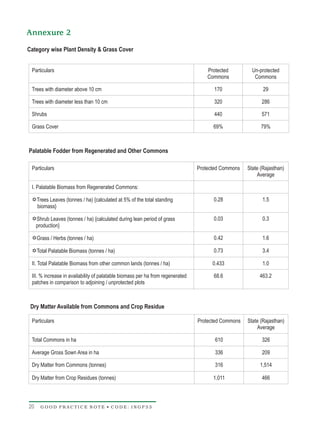
Annexure 1: Economics of the CPR for the 5 Year Period Based on
Direct Benefits

 Particulars                        1998-99       1999-00       2000-01    2001-02       2002-03       Total (Rs)

 Expenditure (Rs)
 Silvipasture developed (ha) @ Rs
 7,377 per ha for providing           77,109       250,604         4,252      -             -            331,965
 enclosure, treatment measures,
 forage seeds and watch & ward

 Dry Fodder (tonnes)                       22.8       24.6          26.2          19.7          14.3       107.6

 Income (Rs)
 Grass Sale                           22,800        24,600        39,300     24,587        14,312        125,599

 Dhaman Seed Sale                      -             7,800        11,610     14,750        18,360         52,520

 Buari Grass Sale                             -      5,500         7,800     47,150        36,800         97,250

 Sale of Tree Loppings                        -             -     21,343     23,715        27,900         72,958

 Other Income                              560         540           360          135           332        1,927

 Total Income                         23,360        25,160        88,413    110,337        97,704        350,254


                                                                           Enriching Community Pastures             19
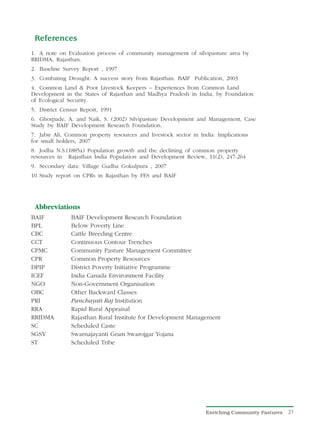
Annexure 2
Category wise Plant Density & Grass Cover


 Particulars                                                                        Protected         Un-protected
                                                                                    Commons            Commons

 Trees with diameter above 10 cm                                                      170                  29

 Trees with diameter less than 10 cm                                                  320                 286

 Shrubs                                                                               440                 571

 Grass Cover                                                                          69%                 79%


Palatable Fodder from Regenerated and Other Commons

 Particulars                                                                    Protected Commons   State (Rajasthan)
                                                                                                        Average

 I. Palatable Biomass from Regenerated Commons:

 Y (tonnes / ha) {calculated at 5% of the total standing
 Trees Leaves                                                                         0.28                1.5
     biomass}

 Y (tonnes / ha) {calculated during lean period of grass
 Shrub Leaves                                                                         0.03                0.3
     production}

 Y (tonnes / ha)
 Grass / Herbs                                                                        0.42                1.6

 Y Biomass (tonnes / ha)
 Total Palatable                                                                      0.73                3.4

 II. Total Palatable Biomass from other common lands (tonnes / ha)                    0.433               1.0

 III. % increase in availability of palatable biomass per ha from regenerated         68.6               463.2
 patches in comparison to adjoining / unprotected plots


 Dry Matter Available from Commons and Crop Residue

 Particulars                                                                    Protected Commons   State (Rajasthan)
                                                                                                        Average

 Total Commons in ha                                                                   610                326

 Average Gross Sown Area in ha                                                         336                209

 Dry Matter from Commons (tonnes)                                                      316               1,514

 Dry Matter from Crop Residues (tonnes)                                               1,011               466


20     GOOD PRACTICE NOTE • CODE: INGP33
References
1. A note on Evaluation process of community management of silvipasture area by
RRIDMA, Rajasthan.
2. Baseline Survey Report , 1997
3. Combating Drought: A success story from Rajasthan. BAIF Publication, 2003
4. Common Land & Poor Livestock Keepers – Experiences from Common Land
Development in the States of Rajasthan and Madhya Pradesh in India, by Foundation
of Ecological Security.
5. District Census Report, 1991
6. Ghorpade, A. and Naik, S. (2002) Silvipasture Development and Management, Case
Study by BAIF Development Research Foundation.
7. Jabir Ali, Common property resources and livestock sector in India: Implications
for small holders, 2007
8. Jodha N.S.(1885a) Population growth and the declining of common property
resources in Rajasthan India Population and Development Review, 11(2), 247-264
9. Secondary data: Village Gudha Gokulpura , 2007
10. Study report on CPRs in Rajasthan by FES and BAIF


 Abbreviations
BAIF           BAIF Development Research Foundation
BPL            Below Poverty Line
CBC            Cattle Breeding Centre
CCT            Continuous Contour Trenches
CPMC           Community Pasture Management Committee
CPR            Common Property Resources
DPIP           District Poverty Initiative Programme
ICEF           India Canada Environment Facility
NGO            Non-Government Organisation
OBC            Other Backward Classes
PRI            Panchayati Raj Institution
RRA            Rapid Rural Appraisal
RRIDMA         Rajasthan Rural Institute for Development Management
SC             Scheduled Caste
SGSY           Swarnajayanti Gram Swarojgar Yojana
ST             Scheduled Tribe


                                                                  Enriching Community Pastures   21
Glossary
          Meena                 Tribal group widespread in south Rajasthan and adjacent areas

          Kharif                The Kharif crop is the autumn harvest (also known as the summer or monsoon crop)
                                in India and Pakistan. Kharif crops are usually sown with the beginning of the first
                                rains in July, during the south-west monsoon season. The term Kharif means
                                "autumn" in Arabic.

          Khejdi (Prosopis      A fast growing fodder tree seen in arid climate areas. Helps in atmospheric nitrogen
          cineraria)            fixation

          Rabi                  The Rabi crop is the spring harvest (also known as the "winter crop") in India and
                                Pakistan. The term Rabi means "spring" in Arabic, which usually spans mid/late April
                                to mid/late June when the crop is harvested.

          Dhaman (Cenchrus      A perennial fast growing fodder crop that grows well in shallow soils The fodder and
          cilaris)              seeds are sources of income to farmers.

          Subabul (Lucaena      Fast growing exotic multipurpose tree species.
          leucocephala)

          Gram Panchayat        Elected Village Council

          Gram Sabha            Village Assembly

          Gully pluggings       A bund constructed on a hill from locally available material to conserve moisture for
                                trees.

          Rainfed Agriculture   Agriculture, which is mainly dependent on rainfall.

          Sarpanch              Elected leader of the Panchayat

          Stylo (Stylosanthus   A perennial fast growing leguminous grass. Grows on medium to light soils. It is used
          hamata)               fore vegetative compaction on field bunds and slopes to prevent soil erosion.

          Taluka                Tehsil / Block

          Collector             Government Representative responsible for administration in a District.

          Choukidar             Watchman

          Charagaha             Common grazing grounds

          Chadas                A traditional device made out of leather for lifting water from wells with the help of
                                bullock.

          Desi babul (Acacia    A native evergreen fast growing tree The tree grows straight with broom shaped
          nilotica)             branches. Grows well in black cotton and heavy soils It provides good quality fuel
                                wood. The fruits and bark have medicinal value.

          Khair (Acacia         A native tree species having medicinal value. Wood extract used for tanning and
          catechu)              dyeing. Katha is obtained from Khair wood and is used extensively in making Paan
                                (betel leaf)

          Dhok(Anogisus         Also called Dhokda. A drought tolerant tree suitable for plantation with grasses in
          pendula)              silvipasture.

22   GOOD PRACTICE NOTE • CODE: INGP33
The NDDB-FAO South Asia Pro-Poor Livestock Policy Programme (SA-PPLPP)
SA PPLPP is a unique livestock development program that aims to 'to ensure that
the interests of poor livestock keepers are reflected in national as well as
international policies and programs affecting their livelihoods'. It endeavors to do
so by a) creating spaces for and facilitating dialogue among the actors playing a
direct and indirect role in the livestock sector of South Asia, and b) drawing from
and using lessons from field experiences to influence livestock-related policies,
programmatic and institutional changes towards the benefit of poor fe/male
livestock keepers in the region.
To access SA PPLPP publications and other information resources, please visit our
website at http://www.sapplpp.org


BAIF Development Research Foundation's mission is to create opportunities of
gainful self-employment for rural families, especially disadvantaged sections,
ensuring sustainable livelihood, enriched environment, improved quality of life
and good human values. This is being achieved through development research,
effective use of local resources, extension of appropriate technologies and
upgradation of skills and capabilities with community participation. BAIF is a non-
political, secular and professionally managed organisation. Various programmes
are implemented by BAIF and its Associate Organisations in more than 47,000
villages in Maharashtra, Karnataka, Andhra Pradesh, Uttar Pradesh,
Uttarakhand, Bihar, Gujarat, Rajasthan, Madhya Pradesh, West Bengal, Orissa
and Jharkhand.
For more information on BAIF, kindly visit their website at http://www.baif.org.in/


Rajasthan Rural Institute of Development Management (RRIDMA) is an
associate organisation of BAIF established in 1993 under the Societies Registration
Act, 1950. The head office is located at Bhilwara. The divisional offices are located
in Udaipur and Bundi.
RRIDMA is implementing the multi-disciplinary programme covering Livestock
Development, Community Pasture Development, Tribal Development, Water and
Energy Conservation Project, Transfer of Technologies for Sustainable
Development Project, and Women Health and Empowerment.
About this Good Practice
 This good practice note based on the experiences of BAIF Development Research
Foundation (BAIF), shows the importance of restoring common property resources
by involving the communities directly, as a way forward for impacting positively on
                               their quality of life.
    This good practice shows how “Protection of Commons” has led to not only
increasing the output of grasses and thereby promoting livestock development, but
   the renewal of hydrology has led to significant increases in acreage as well as
  production of various crops. This has resulted in enhancement of food security
                            amongst the small farmers.


      SOUTH ASIA Pro Poor Livestock Policy Programme
                                   A joint initiative of NDDB and FAO
                                                  Regional Office:
                             NDDB House (6th Floor) PB 4906, Safdarjang Enclave
                                            New Delhi - 110029, INDIA
                          Tel: +91 (0) 11 2619 7851 / 7649 • Fax: +91 (0) 11 2618 9122
                                           E-mail: sapplpp@sapplpp.org
                                            Website: www.sapplpp.org


                                            Partnering Institutions

BRAC                                    Department of Livestock                   BAIF Development Research
BRAC Centre                             Ministry of Agriculture                   Foundation
75 Mohakhali, Dhaka 1212                Thimpu                                    Dr. Manibhai Desai Nagar, NH 4
BANGLADESH                              BHUTAN                                    Warje, Pune 411058, INDIA
Tel: +880 2 8824180-7 Extn: 2311        Tel: +975 (0) 2 351102                    Tel: +91 (0) 20 25231661
Fax: +880 2 8823542, 8826448            Fax: +975 (0) 2 322094, 351222            Fax: +91 (0) 20 25231662
E-mail: saleque@sapplpp.org             E-mail: tshering@sapplpp.org              E-mail: sepawar@sapplpp.org
        saleque.ma@brac.net                      naip@druknet.bt                           sepawar@baif.org.in


      For copies of this publication, kindly contact the Regional Office or the Partnering Institutions

Enriching Community Pastures - Villagers of Gudha Gokulpura in Bundi, Rajasthan take the Lead (INGP33)

  • 1.
    Good Practice NoteCode: INGP33 Good Practice Note Enriching Community Pastures REGION : South Asia COUNTRY : India STATES : Rajasthan DISTRICT : Bundi SOUTH ASIA Pro Poor Livestock Policy Programme A joint initiative of NDDB and FAO
  • 2.
    GOOD PRACTICE OWNERand GOOD PRACTICE CHAMPIONS A GP Owner is a person/group of individuals and/or institution that plays a crucial role in the GP. Thus, a GP owner understands all the ins and outs of the GP and is often the initiator of GP. Others involved in the Practice (not considered GP Owners) may be invited to assist in the filtering and writing process. Such persons, who have insights into what makes the GP pro-poor, are better- positioned to help influence policies. Thus, with their thorough understanding of the GP, they (as an individual or as a team) can function as GP Champions. Enriching Community Pastures: Villages of Gudha Gokulpura in Bundi, Rajasthan take the Lead Good Practice RAJASTHAN RURAL INSTITUTE FOR DEVELOPMENT MANAGEMENT Owner BAIF DEVELOPMENT RESEARCH FOUNDATION Good Practice Authors: Mohan Nadoda, S.E. Pawar and B.R. Patil Champions Contributors: A.K. Chourasia, D.D. Pandit, D.S. Devda, K.C. Gujar, M.S. Sharma Content Anita Paul, Mamta Dhawan, Sheila Koyyana Editors: Photo Credits: BAIF Development Research Foundation Publisher: South Asia Pro Poor Livestock Policy Programme (SA PPLPP), a joint initiative of NDDB and FAO Suggested Citation: SA PPLPP (2009) Code: INGP33, “Enriching Community Pastures: Villagers of Gudha Gokulpura in Bundi, Rajasthan take the Lead”. Good Practice Note, Delhi, India Design: Kriti Team, http://krititeam.blogspot.com Layout: SA PPLPP Coordination Team Printing: Satyam Grafix © SA PPLPP 2009 Disclaimer: The designations employed and the presentation of material in this publication do not imply the expression of any opinion whatsoever on the part of the National Dairy Development Board of India (NDDB) and the Food and Agriculture Organisation of the United Nations (FAO) concerning the legal status of any country, territory, city or area or its authorities, or concerning the delimitations of its frontiers or boundaries. The opinions expressed are solely of the author(s) and reviewer(s) and do not constitute in any way the official position of the NDDB or the FAO. Reproduction and dissemination of material in this Good Practice Note for educational or non-commercial purposes are authorised without any prior written permission from the copyright holders, provided the source is fully acknowledged. Reproduction of material in this Good Practice Note for resale or other commercial purposes is prohibited without written permission from the copyright holders.
  • 3.
    Contents 1. Introduction 1 2. Project Location 2 3. The Good Practice 4 4. Problems Identified 5 5. Delivery Mechanism 6 6. Impact & Replication 11 7. Lessons Learnt 16 8. Post Project Monitoring 17 9. Conclusion 18 Annexure 1 19 Annexure 2 20 References 21 Abbreviations 21 Glossary 22
  • 4.
    1. Introduction Commonlands in villages of India, often referred to as Common Property Resources (CPRs), play a crucial role in sustaining and enhancing the livelihoods of rural poor by providing a wide variety of essentials like food, fodder, manure, medicinal herbs etc. (Jabir Ali, 2007). In India, there is high dependency on CPRs for feed and fodder for the livestock sector as a sizeable number of livestock rearing families belong to landless, marginal and small land holding categories who are extremely poor. Simultaneously, a number of studies indicate that the area under CPRs has declined in most parts of the country due to several reasons thereby increasing the pressure on the available CPRs (Jodha, 1990). Hence, sustainable management and development of common lands becomes a crucial component in poverty alleviation. 1.1 Common Land in Rajasthan Use of common lands in Rajasthan has not been regulated resulting in open access which has led to degradation and over exploitation of the CPRs. With the increasing livestock population there is an uncontrolled pressure on available grazing resources in the villages by large and small ruminants. Encroachment is widespread and has been going on for several decades, particularly since independence in 1947 (Jodha, 1990). Under the Rajasthan Tenancy Act (1955), pasture land (charagaha) is defined as land used for grazing by cattle of a village or villages or recorded in the settlement records as such (cited by Saint, 1993). The common lands are under the jurisdiction of the Panchayat – the lowest tier of local Government. Many rural livestock keepers are small and marginal farmers who do not have sufficient land give preference to growing food crops in comparison to fodder crops. For them the village common land is a vital source of forage. Common lands provide fodder for livestock in the form of either grass for large ruminants or tree fodder for small ruminants. Development programs are interested in restoring village common lands as it has a direct impact on the food security and livelihoods through improvements in biomass production and conservation of bio-diversity. As a result of soil and water conservation measures there is ground water recharge and improvement in water regime for crop cultivation. In the process of village common land development there is community mobilization and capacity building of the stakeholders involved in various field interventions. District Bundi is the smallest (area 5.82 lakh ha) district of the 32 districts of Rajasthan. Semi-arid with mean annual rainfall of about 420 mm, the district falls under drought prone category. A large number of traditional wells support a predominantly agricultural economy. Around 60% of the land in the district is under cultivation. The fertility and productivity of the land varies radically over different parts of the district. The three major crops grown are wheat, rice and maize (BAIF 2003). The Hindoli Tehsil is in the North West of the district where the project was located. The Tehsil is mostly hilly with stony, hard soil and is the most backward in the district. Scheduled caste and scheduled tribes, who are socio economically backward, constitute around 40% of the population. Enriching Community Pastures 1
  • 5.
    2. Project Location 2.1 Village Profile Gudha Gokulpura with 270 families and total population of 1,285 is divided in to five hamlets namely, Khet ka Jhopda, Devpura, Padiya Pahda, Mavika Pahda and Regar Basti. With 55.5% males and 44.5% females, the sex ratio in the village indicates a very low status of women in the community. Male and female literacy level is 64% and 16% respectively (Baseline Survey Report, 1997). The village is located around 30 kms from Bundi. The common mode of public transport is privately run jeeps. The village has to depend on neighbouring village Thana that has electricity, a secondary school, few private doctors and shops. 2.2 Social Structure This multi caste village is dominated by the Meena community along with households belonging to Regar, Baret and Meghwal. Of the families, 82% belong to the Meena tribe and 18% are Regar and other castes (Figure 1) (Secondary Data Report, 2007). Meena tribe dominates the population in the villages and was once the ruling class. This community displays dominating behaviour over the other tribal groups. It has a patriarchal society in which men take all the decisions but do little work. Women do all the housework, from grinding flour, fetching water from a distance, collecting firewood to the backbreaking work in the fields during the sowing and harvesting season, but have very little or no say in decision-making. 2.3 Agro- Climatic Conditions: Topography of the village is mostly hilly and undulating. The soil is medium black with low to moderate percentage of carbon and very low percentage of available phosphorous (Baseline Survey Report, 1997, P 5). The problem of marginally productive soils is further aggravated by poor rainfall. Normal rainfall is 450-750 mm. This occurs during July to September. January is the coldest month with minimum temperature of 12°c while May and June are the hottest months in which the temperature soars to 41°c. 2 GOOD PRACTICE NOTE • CODE: INGP33
  • 6.
    II. The Practice 2.4 Land Holdings The village comprises of 68% small farmers, about 3% are marginal (including 2.7% who are landless) and 29% have land holding above 5 ha. About 37% families have less than 2.5 ha of land and 31 % have 2.5 to 5 ha. (District Census Report-1991) 2.5 Crops and Livestock Mixed farming of crops and livestock rearing is traditionally practiced in the area. Maize and wheat are the common crops, sown in Kharif and Rabi seasons respectively. Wheat is grown where assured irrigation facilities are available. However, 30% of the households having small land holdings do not enjoy food security. Almost all the households own livestock as a means of supplementing family incomes and as cash insurance during crop failures. Livestock population comprised of local cows (312), cross bred cows (06), buffaloes (85), sheep (250) and goats (850) (Secondary Data Report, 2007). Goats were reared as a source of supplementary income by the households. However, there was no income from sale of milk as whatever little was produced was consumed by families themselves. 2.6 Common Land Common land in Gudha Gokulpura constituted 75 ha and was barren with very little grass cover. This was due to hilly, undulating terrain resulting in erosion of good top soil and, thereby, reducing tree and grass cover. In 1997 when development activities were initiated, the priority was to improve the productivity of the village commons in order to meet the fodder and fuel wood requirements leading to a reduction of drudgery for women. Women spent on an average two to three hours daily for meeting the domestic requirements of drinking water, fodder and fuel-wood. Enriching Community Pastures 3
  • 7.
    3. The GoodPractice The note presented here showcases the involvement of the community in developing the commons belonging to Gudha Gokulpura village of Bundi district in Rajasthan, India. Acknowledging the importance of village common land restoration in the area, the work was taken up as an entry point activity under the BAIF-ICEF1 project. Developing rain-fed pasture on degraded village commons has led to an increase in fodder resources for poor livestock families, which in turn, has led to positive impacts on family incomes and nutritional status. A participatory mechanism of creating a village level management committee has strengthened the Panchayati Raj System (PRS) and revived the tradition of safeguarding village commons in a sustainable manner. The approach is holistic and addresses inequalities between resource rich and resource poor farmers and empowers the community to manage their CPRs. 3.1 Stakeholders of the Good Practice, their Roles and Responsibilities The India Canada Environment Facility (ICEF) financially supported the project which was conceptualised and implemented by BAIF Development Research Foundation (BAIF), a National NGO having its headquarters at Pune. Field implementation was done through RRIDMA, BAIF's associate organization in Rajasthan. BAIF's cattle breeding centre in Thana, provided artificial insemination and health care services and monitored feeding and management practices. A livestock supervisor was stationed in the village to provide services to the cattle owners in the area. BAIF provided guidance in forming a Community Pasture Management Committee (CPMC) with due representation from each caste. The President and Secretary were selected through a participatory approach by common consensus of the members. This committee was responsible for implementation of activities on the village common land with technical support from BAIF. The Rajasthan Rural Institute of Development Management (RRIDMA) was responsible for overall coordination of the project at the State level. The Local Panchayat was responsible for land allocation for silvipasture *India Canada development. The villagers were in charge of management and use of CPRs. They Environment Facility (ICEF) a joint initiative of were also the prime beneficiaries of the project. The Gram Sabha would constitute Government of India and Government of Canada and elect members to the CPMC by consensus. funded a seven year (1996-2003) project to BAIF Development District Collector intervened to resolve conflicts arising out of ownership and Research Foundation (BAIF) working with local management issues. The village Panchayat was interested in taking over the community and government officials of management of the common land, once revenues started getting generated. The the area. The broad objective of the project District Collector intervened and managed to retain the neutral, independent was water resources development and energy identity of the CPMC. However, the community was asked to take the Panchayat conservation for sustainable into confidence and present accounts in the Gram Sabha every six months. management of the Environment. The project was implemented in Rajasthan, Uttar Pradesh and Karnataka. 4 GOOD PRACTICE NOTE • CODE: INGP33
  • 8.
    4. Problems Identified 4.1 Low Crop Production and Inadequate Food Resources Small land holdings, marginally productive soils and erratic rainfall caused low agricultural outputs which in turn had a negative impact on the food security. As indicated in Figure 3, out of a total of 946 ha, 336 ha (35%) was under cultivation, 195 ha (21%) under forest, 75 ha (8%) common land, 69 ha (7%) wasteland and 271 ha (29%) not available for cultivation (under rivers and roads) (Secondary Data Report, 2007). Maize and wheat were the common food crops with low productivity. Around 30% of the total no. of HHs had to work as wage labour. 4.2 The CPR The village common land (75 ha) that was used for grazing was over-grazed, barren and had poor soil cover. Inadequate fodder for animals all the year round resulted in low productive animals which produced milk sufficient only for home consumption. 4.3 Encroachment The common land had potential to produce enough fodder for village cattle and also to serve as a source of income. However, this could be realized only if effective steps were taken to stop encroachment of land. Villagers were of the opinion that restoration work should be taken up on a part of the grassland. As these people had no other source of fodder, enclosure of the entire plot would have created fodder related hardships for them. Regeneration activity on 45 ha of common land was, therefore, proposed under the BAIF-ICEF project with the following objectives: G To develop the village commons in order to increase the availability of feed resources for livestock. G To demonstrate the potential role of regenerated village commons in providing support to livelihood opportunities of the communities. G To empower the local community supported by local institutions to carry on the activities undertaken in the future. Enriching Community Pastures 5
  • 9.
    5. Delivery Mechanism BAIF had a presence in Thana village located in the vicinity prior to initiating work in Gudha Gokulpura. A cattle development centre was operational in the village since 1990. At the field level BAIF team was responsible for overall coordination and monitoring of project activities. The resource specialists in the team came from diverse backgrounds like agriculture, livestock and social sciences. The BAIF team helped to form the CPMC which had amongst its members BAIF Program Officer, Gram Panchayat representatives, Livestock Owners, Landless people and village representatives from each caste. This ensured democratic functioning of the CPMC. The CPMC ensured the maintenance of the village common lands, equitable distribution of biomass resources and linkages with the Government. There was a resource team at the field level comprising of Extension Officers who were in charge of field supervision, record keeping and organizing local meetings. The Delivery mechanism / Implementation Structure is illustrated in Figure 4 and enumerated below: Community Pasture Management Committee (CPMC) was formed for management of the grass land developed on 45 ha of Panchayat land. The committee was selected by electing one representative from each of the hamlets and two women representatives from the self- help groups. A representative from the Gram Panchayat was selected as President of the Committee. A senior staff member from the Field Team was nominated as Secretary with the responsibility of ensuring democratic functioning and transparency in the dealings. Since inception of the work four such Silvipasture Committees were setup to manage the village common land. Resource team of local beneficiaries and field guides were selected in order bring forth change and development. Village youth having inclination for development work were selected to work as Field Guides. Resource persons selected from beneficiaries, after intensive training provided by BAIF, helped in field monitoring (Ghorpade, A and Naik, S, 2002). 6 GOOD PRACTICE NOTE • CODE: INGP33
  • 10.
    Basis for theinterventions: Location specific interventions were selected for village common land development keeping in view the overall objective of water resources development and community outreach programmes proposed under BAIF-ICEF project. The common land was located at the upstream of the village, 15% of which comprised of sloping land, which had resulted in substantial soil erosion over the years. In view of this, the interventions planned had a focus on soil and water conservation to restore soil moisture and to develop a green cover with suitable mix of grasses and tree species which could meet feed and fodder requirements of the village cattle and small ruminants. Community Mobilisation: Several measures were taken to motivate communities for taking responsibilities of implementing and managing various project components. Exposure visits to BAIF project areas in Rajasthan and Gujarat were organised to facilitate interactions with villagers where community participation had helped to convert barren, undulating wasteland into green pastures. While, such cross-visits proved beneficial largely for building on the confidence of the communities, a degree of cynicism remained. One of the reasons for this was the bitter experience of community lift irrigation scheme in the village which was non-functional because of mismanagement. Organizing Gram Sabha for Consensus: The Gram Sabha meeting called by the project team in June 1997 to discuss issues regarding common land development received a good response from the villagers. Women's voice in the meeting prevailed over the reluctance of men, as they were going to be the major beneficiaries of the regenerated common lands. They had a concern of inadequate milk for children at home due to unproductive livestock. Common land development would enable easy availability of fodder and fuel wood, it was therefore, proposed to develop 45 ha of village common land and the remaining land to be left for open grazing. Conflict Resolution: In the initial stages, due to conflict of interests, the project encountered opposition from the group of villagers that had encroached on the grazing land. Instead of immediate confrontation, the project team proposed to go ahead with fodder development plans, as a mechanism for building confidence amongst all stakeholders. The Sarpanch (Village Headman) supported the encroachers against the project which led to the project losing grip on the situation initially. However, the strategy of exerting pressure from Government officials and projecting the Sarpanch favourably before others brought good results. Although the solution was accepted by all, the fact remains that the conflict between the encroachers and the villagers may keep arising depending upon the balance of power in the village. Enriching Community Pastures 7
  • 11.
    Area Demarcation &Conservation Measures: The boundaries were fixed to Table 1: Treatment Measures on the CPR demarcate 45 hectares proposed to be restored and a stone wall of 2,565 running Stone Fencing 2,565 m meters was constructed, in order to demarcate this forest land from the Continuous Contour Trenches 12,008 m neighbouring Bhilwara district. While Stone Bunding 5,176 m making the enclosure, area nearer to the villages was proposed for open grazing to Gully Plugs 112 Nos enable easy access. 12,000 meters of contour trenches, 112 gully plugs and over Pit Digging for Plantation 15,315 Nos 15,000 pits were dug for tree plantation. In the enclosure work village women have Drainage System 52.5 m contributed 80% to 90% of the labour (BAIF, 2003). Details of work undertaken in the common land are presented in Table 1. Participatory Norms Development: Before initiating activities, discussions on cost implications of the proposed work to be completed through project support, was held. Unanimously it was decided that 10% of the labour costs would be contributed as 'shramdan' (voluntary labour) for generating a corpus to meet future maintenance costs. This fund would be administered by the CPMC. The Project team agreed to the rates decided by the villagers. Initially labourers involved in the work were apprehensive on payment of wages only after six months as was the case with other projects in the forest area. They also objected to the involvement of the village Panchayat in the disbursal of wages. To reassure the labourers the project team decided to pay wages every 15 days. The payment process was completely transparent which instilled confidence in the system. As a result more and more villagers began to take part in the work and showed a gradually increasing level of interest and motivation. Reorganisation of the Committee: As work progressed, the need to reorganise the Pasture Management Committee was felt in order to ensure adequate representation from the community. The re-elected Committee comprises of twelve members - with two representatives from every hamlet with elected ward Panch being the President and the Secretary of the Panchayat being the Secretary of the Committee too, in charge of maintaining all the records. Tree Plantation: Since the area was protected it was ideal to develop plantations with multipurpose plant species. Fast growing Subabul (Leucaena lucocephala) plantation was done along the fencing wall. Other species such as Khejdi (Prosopis 8 GOOD PRACTICE NOTE • CODE: INGP33
  • 12.
    cineraria), Shirish (Dalbergiasisoo), Bamboo (Dendrocalamus strictus), Dhok (Anogisus pendula), Khair (Acacia catechu) were also included in the plantation. In the matrix ranking exercise done with the villagers species with multipurpose uses were preferred. Tree species like Desi Babul (Acacia nilotica), Ber (Zizypus mauritiana) already existed in the common land before the work was initiated. A total of little over 19,000 saplings were planted out in the area (Figure 5), leading to temporary employment generation through plantation activity. Promotion of Improved Varieties of Grass Species: In order to improve grass cover 600 kgs of Dhaman (Cenchrus ciliaris) grass seeds mixed with clay pellets to avoid being eaten by birds and swept away with runoff water or wind were broadcasted. Stylosanthus hamata (stylo grass) was also introduced. These leguminous grasses also helped in improving the soil fertility. Fodder was obtained from the enclosed area, after natural seed dispersal has happened, through cut and carry method around October to December. Table 2: Feeding Calendar By this time of the year most of the agricultural operations are over and Seasons labour is available for harvesting. Feed Resource Monsoon Winter Summer Table 2 presents feeding calendar for the animals based on the feed resource Stored Crop Residue ++ +++ +++++ available. Grazing the animals for 4 to 6 hrs on the CPRs and empty agricultural Grazing on cultivable fields post ++++ + harvest fields in post harvest period is a common practice. Stored crop residues Grazing on CPRS (waste lands, +++++ ++++ +++ and the grass from CPR are fed during road side, field bunds) winter (October to February) and summer (March to June) when there is + Least scarcity of fodder in the fields. The +++++ Maximum storage period for grasses is about 40 days. Initial observations indicated that the grass yields increased substantially during the first two years. Yield per ha was to the tune of 0.5 tons with overall production of 22 tons from 45 ha area. Soil fertility improvement and conservation measures taken during the period were instrumental in improving the quality and quantity of grass. Enriching Community Pastures 9
  • 13.
    Benefit Sharing Arrangements:Since animals were not allowed in the commons for open grazing it was the task of the Committee to decide mechanisms for grass harvest and its equitable distribution. Important participatory decisions taken were as under: Tfrom the village was allowed to cut as much grass as he or she wanted during Any one the one month cutting season in October. Half the grass cut would go to the Committee who would sell it in the market. The other half could be taken home to feed animals. T grass harvest was announced in the village and grass harvest was done in Period for the presence of Committee members and the watchman. During Committee auctions for sale of grass preference for purchase was given to Gudha Gokulpura villagers. The revenue generated is then directed towards payment of choukidar (watchman) T salaries and used for repairs and maintenance work in the commons. 10 GOOD PRACTICE NOTE • CODE: INGP33
  • 14.
    6. Impact &Replication ? Secondary Impact of Watershed Measures 6.1 The core project area constituted of nine micro-watersheds. Soil and water conservation work was implemented over the entire watershed area which included individual land holdings and village commons spread over 75 ha (of which 45 ha was handed over to BAIF for development). With the undulating topography and hydro-geological conditions of the area the conservation measures undertaken led to improved soil moisture and crop yields. The impact achieved is a result of the integrated approach to area development. Interventions for development of village commons has led to positive impacts on improving soil moisture, water availability, feed resources, milk production and crop outputs. 6.2 Controlled Soil Erosion Within the area surrounded by the stone fence and as a result of construction of contour trenches (12,008 meter), stone bunding (5,176 meter), gully plugs (112) and pits (15,315) soil erosion controlled was to the tune of 19-21 tons per ha. Soil conservation and moisture availability together supported good tree growth and improved biomass availability from the common land. 6.3 Improved Water Availability With the annual rainfall of 450 - 750 mm and 12,008 running meter Continuous Contour Trenches (CCTs) the water conservation achieved from 45 ha common land area is 2 million litres per year. In addition, as a result of the treatment measures covering the entire project area and in the common land, which is placed at the higher reach, there was significant increase in the overall availability of water for irrigation and drinking. Rainwater harvesting could improve subsoil water table by 1.5 - 2.0 m. This was evident from the well water available for irrigation. Of the 227 wells in the watershed area, 175 had water availability for 9 - 12 months in a year as against 88 wells before initiating work in the area. Initially traditional chadas (water lifting device made out of leather) were used to lift water from wells for irrigation, but now with adequate water, diesel pumps have replaced all the traditional chadas as water lifting device. There are 41 diesel engine pump sets as against 8 during 1997. Well monitoring exercises reflected an improvement of more than 300% in the time taken to recharge from 12 - 36 hrs in 1997 to 2 to 12 hrs in 2002 (BAIF, 2003). 6.4 Improved Grass and Seed Production Improvement in soil moisture regime and cultivation of grasses such as Dhaman and Stylo has helped in improving fodder biomass availability. Almost all farmers in the village benefitted from this activity in the year 2000. Fodder production increased from close to 2 quintals/ha in 1987 to a little over 6 quintals / ha by the Enriching Community Pastures 11
  • 15.
    year 2000 (Table3). The excess Table 3: Details of Grass & seed Production grass was sold to the buyers from neighbouring villages. A big Particulars Production in Families incentive was the price as, while quintals / ha in 2000 benefitted the market rate for fodder was Rs. 2/- a bundle the CPMC sold Dhaman Seed 0.15 65 the same at half the cost. Dhaman Grass (Cenchrus 5.11 170 It was observed that Dhaman ciliaris) seed collection offered good Local Sheen Grass 1.0 85 opportunity for earning wages @ Rs 10/- per kg. With one person Buari* Grass 0.90 205 collecting 5 kg seeds / day the earning were Rs 50 /per day. In *Buari Grass was used for Broom making grass harvesting a person can harvest 100 bundles (100 kg) Table 4: Economic Returns during the Period 1998-99 to 2002-03 per day and earning wages of Rs 50/- per day. Buari grass Particulars Amount (Rs) (broom grass) weighs 5 kg per 1. Total Expenditure 331,965 bundle and each bundle is sold at Rs 10/-. This grass is used by 2. Income: landless families for broom making. Such economic a. Surplus Grass Sale 125,599 opportunities assisted the b. Tree Loppings 72,958 CPMC in generating a modest surplus in the initial years itself c. Other Income (from sale of grass, wood, 151,697 (Table 4). For more details seed, grazing charges & encroachment fine) refer Annexure 1. (See also Annexure 1) Total Income 2 (a+b+c) 350,254 6.5 Fodder Promotion on Total Surplus (2(a+b+c))-1 18,289 Private Land By observing the experience of grass production from commons, villagers got motivated to convert their marginally productive land areas to private grasslands and for plantations of multipurpose tree species. Around 70 HHs have established over 33,000 saplings of 22 assorted species on private marginally productive land with 62 % survival rate (Ghorpade, A and Naik, S, 2002). 6.6 Improved Tree Biomass A vegetation study was undertaken with technical assistance from Foundation for Ecological Security to assess the qualitative and quantitative growth of foliage on the regenerated commons. Salient findings of the study are as follows: ? per ha has increased from 41 to 187 trees, No. of trees 12 GOOD PRACTICE NOTE • CODE: INGP33
  • 16.
    ? regenerated patchesshows a greater diversity and higher palatability, Grasses on ? Total palatable biomass including grasses is about 69% more over its availability at the baseline, ? of biomass from commons available to livestock keepers is estimated to Total value have increased to Rs 10,700 per household. The details of this analysis are provided in Annexure 2. 6.7 Changes in Livestock Trend and Milk Production The population of local breed of cattle reduced considerably, the number of cross bred animals increased (Figure 6). Fodder availability from silvipasture and increased fodder cultivation on private land has made a difference in milk production. The crossbred cow's milk yield increased seven times more as compared to the local cow and the graded buffalo's milk was four times more. For the first time in the area a crossbred cow was sold for a price of Rs 12, 000. Increase in milk production was from 2.5 to 8 litres per day per animal. At present, the milk production in the village is 1,960 litres per day @ Rs 15 per litre earning a total revenue of Rs 29,400. The earnings per household having livestock is approximately Rs 163 per day from sale of milk (Ghorpade, A and Naik, S, 2002). In the case of small ruminants ten households were engaged in rearing goats of Sirohi breed. There was an increase of 37% in the goat population. With regard to changes in livestock population, the overall trend shows a marked increase in number of buffaloes and crossbred cows followed by goats, and a reduction in the population of non - descript cows, bulls and sheep. 6.8 Improved Cropped Area and Productivity The area under cropped land increased in Kharif and Rabi season @ 47% and 44%n respectively. There was also an increase in the cropped area during summer season from 7.88 to 12.36 ha. Area under irrigation also increased by 88% in Kharif and Rabi and so also the yield of major crops like maize and wheat by 70% and 37% respectively (Figure 7) (BAIF, 2003). Enriching Community Pastures 13
  • 17.
    6.9 Corpus Generation At the end of the financial year 2007-08 the CPMC had generated a corpus of little over Rs 32,000. 6.10 Ecological / Environment Benefits Measures taken to combat soil erosion, such as bunding, gully plugging and establishing green cover on the land has greatly restored the natural vegetative cover in the area. This has helped in protecting natural flora and fauna and many wild animals and birds are seen in the area. There is an overall impact on creating a microclimate and a breeding ground for reptiles. Among the mammals and reptiles blue bulls, rabbits, rats, snakes and frogs are seen in the area. 6.11 Empowerment of Women Women coming together to talk about money matters was completely unheard of in the community. Over the period, about 400 women have organised themselves into 13 SHGs. Ongoing training inputs provided by the field team on management issues have led to an increase in their confidence and decision making capabilities. Exposure to economic opportunities such as sale of seed material and new crops like turmeric, availability of buari grass for broom making has helped few members to earn supplementary incomes. 6.12. Qualitative Indicators Qualitative impact on poor livestock holders and households can be seen as: R The community now has access to significant increase in the quality and quantity of fodder and tree biomass on a sustainable basis. R Conflicts arising due to a resource crunch scenario have reduced because of improvements in the quality of common lands. Poor and neglected segments of the community now have equal right to natural resources which earlier was under the command of economically well off households. RDrought proofing is achieved with minimising risk of uncertainty of feed resources enabling livestock owners to venture in livestock development. Increased water regime, crop productivity and food security has helped to fight against recurrent drought situations. R decision making processes have helped in providing a voice to all Participatory castes and segments of the village. 14 GOOD PRACTICE NOTE • CODE: INGP33
  • 18.
    R in drudgeryfor women by reducing time spent on fodder and fuel wood Reduction collection. Women have been the major beneficiaries of the regenerated common land. Now they get adequate fodder for their livestock within easy reach which saves their time in fodder and fuel-wood collection from 4-5 hrs (baseline) to 1-1.5 hrs at present. Rcapabilities of the community members towards enforcing rules to maintain Improved and manage the commons. Replication Based on the success of this pilot initiative, Government of India, provided financial support under SGSY special project to replicate this programme in 76 villages spread over 2,520 ha area. BAIF has initiated development of 320 ha of community land spread over 9 villages in Bhilwara district of Rajasthan. The Panchayat of village Mediya which falls in the neighbouring district of Bhilwara unanimously decided to hand over 37 ha out of 50 ha of common land owned by it for silvipasture development by BAIF. Enriching Community Pastures 15
  • 19.
    7. Lessons Learnt Confidence building, facilitation and negotiating skills of a facilitating organisation T has helped in resolving conflicts and arriving at consensus which is very crucial for success and sustainability of CPR management. While developing commons the likely impact on various stakeholders should be assessed. In this way possible conflicts can be solved by facilitating negotiations between groups before initiating the work. In the project area, in view of the conflicts within the group of farmers, the decision to precede with fodder development plan on 45 ha area was an opportunity to get started and convince the villagers with early results of the interventions, without upsetting social relations in the village. Process documentation could help in analysing potential conflict situations and finding suitable solutions. T understanding regarding the exact roles and the functions of the CPMC and A clear the Gram Panchayat can foster a cordial environment based on cooperation and mutual trust. T training and orientation of the village Panchayat and CPMC members has Regular empowered them to play a pivotal role in the management of development funds and assets developed. There is a need to educate not only the Panchayat members but also the Gram Sabha on the responsibilities and powers of the Panchayat. Empowering the community and nurturing able leadership can help in constructive T decision making for equitable sharing of the benefits and shielding from unwanted elements. The norms of benefit sharing should be decided with participation of community members and Gram Panchayat. The established local political leadership is a major factor that could influence better long term benefits of the project in general and the village common in particular. Protection of commons can lead to not only increasing the output of grasses and, T thereby, promoting livestock development, but the renewal of hydrology, due to introduction of appropriate technologies, can lead to positive impacts on food security. Re-sowing of grass seeds after a period of five years was beneficial to maintain grass T cover and availability. The soils, being marginal, need application of fertilisers supplying major nutrients like nitrogen and potash to maintain the fertility and improve grass production. 16 GOOD PRACTICE NOTE • CODE: INGP33
  • 20.
    8. Post ProjectMonitoring 9.1 Initial Efforts and Withdrawal Strategy Planning and designing of the work was done by BAIF ICEF project team and field implementation was done through field functionaries along with field guides and community representatives. No hired labour was brought from outside the village. During implementation, training was a major ongoing activity. Knowledge and skill transfer in technical areas such as soil and water conservation measures, routine maintenance and upkeep of the assets created and maintenance of accounts at the group level were provided on a regular basis to ensure future sustainability. Youth with good knowledge about local community dynamics and inclination to work for the village were selected and trained as field guides. They served as a link between BAIF field team and the villagers and also provided a degree of continuity after the exit of the facilitating team. Regular orientation, training and coaching provided by BAIF field teams enabled them to work effectively. Management responsibilities were handed over to the Committee members, two years prior to the withdrawal of the BAIF team. Till the time BAIF was involved closely due care was taken to ensure participatory decision making and representation for women and marginal landholders. 9.2 Role of BAIF Creating a formal body in the form of a local Committee and set in place rules and regulations of governance was the role played by BAIF in the initial years. The Committee members were not experienced and completely new to the complexities of protecting the pasture plot. BAIF had to assist and coach the committee on matters related to effective functioning of the committee. Over the period, the entire experience helped the Committee gain confidence and role of BAIF changed from being directly involved in the overall facilitation and implementation of the work to that of an advisor when required. The village Panchayat has taken interest in managing common land with its representation as a member. The Committee is now well equipped to work independently. However, with the consensus of the Committee BAIF has continued to be a member. 9.3 Present role of the CPMC Since 2004 the village Panchayat is managing the commons in collaboration with the CPMC. Women continue to play an active role in its functioning and one of them was unanimously selected to work as a office bearer (President) of the committee for one year. Panchayat is actively engaged in securing funds for the upkeep of the protected silvipasture area by dovetailing with other ongoing Government programs. During the year 2006, the Panchayat had invested Rs. 2.5 lakhs for minor repairs and had also some new plantation. Again during 2008-09, development activities were undertaken through funds (Rs 10 lakhs received under National Rural Employment Guarantee scheme (NREGA)). Enriching Community Pastures 17
  • 21.
    9. Conclusion This note on the experiences of the community of Gudha Gokulpura, yet again, clearly highlights the strength of collective action in conservation of common pastures and the positive impacts on livestock rearing and other natural resource based livelihoods. Developing a coalition of interests between the Panchayati Raj institutions and community based organisations ensures stability and economic sustainability in maintaining the assets created. Lastly, it also highlights the need to factor in and build necessary elements of appropriate exit policy by the facilitating organisation into the project formulation methodology for assisting in a smooth transition of power by building upon the capacities of the primary stakeholders 18 GOOD PRACTICE NOTE • CODE: INGP33
  • 22.
    Annexure 1: Economicsof the CPR for the 5 Year Period Based on Direct Benefits Particulars 1998-99 1999-00 2000-01 2001-02 2002-03 Total (Rs) Expenditure (Rs) Silvipasture developed (ha) @ Rs 7,377 per ha for providing 77,109 250,604 4,252 - - 331,965 enclosure, treatment measures, forage seeds and watch & ward Dry Fodder (tonnes) 22.8 24.6 26.2 19.7 14.3 107.6 Income (Rs) Grass Sale 22,800 24,600 39,300 24,587 14,312 125,599 Dhaman Seed Sale - 7,800 11,610 14,750 18,360 52,520 Buari Grass Sale - 5,500 7,800 47,150 36,800 97,250 Sale of Tree Loppings - - 21,343 23,715 27,900 72,958 Other Income 560 540 360 135 332 1,927 Total Income 23,360 25,160 88,413 110,337 97,704 350,254 Enriching Community Pastures 19
  • 23.
    Annexure 2 Category wisePlant Density & Grass Cover Particulars Protected Un-protected Commons Commons Trees with diameter above 10 cm 170 29 Trees with diameter less than 10 cm 320 286 Shrubs 440 571 Grass Cover 69% 79% Palatable Fodder from Regenerated and Other Commons Particulars Protected Commons State (Rajasthan) Average I. Palatable Biomass from Regenerated Commons: Y (tonnes / ha) {calculated at 5% of the total standing Trees Leaves 0.28 1.5 biomass} Y (tonnes / ha) {calculated during lean period of grass Shrub Leaves 0.03 0.3 production} Y (tonnes / ha) Grass / Herbs 0.42 1.6 Y Biomass (tonnes / ha) Total Palatable 0.73 3.4 II. Total Palatable Biomass from other common lands (tonnes / ha) 0.433 1.0 III. % increase in availability of palatable biomass per ha from regenerated 68.6 463.2 patches in comparison to adjoining / unprotected plots Dry Matter Available from Commons and Crop Residue Particulars Protected Commons State (Rajasthan) Average Total Commons in ha 610 326 Average Gross Sown Area in ha 336 209 Dry Matter from Commons (tonnes) 316 1,514 Dry Matter from Crop Residues (tonnes) 1,011 466 20 GOOD PRACTICE NOTE • CODE: INGP33
  • 24.
    References 1. A noteon Evaluation process of community management of silvipasture area by RRIDMA, Rajasthan. 2. Baseline Survey Report , 1997 3. Combating Drought: A success story from Rajasthan. BAIF Publication, 2003 4. Common Land & Poor Livestock Keepers – Experiences from Common Land Development in the States of Rajasthan and Madhya Pradesh in India, by Foundation of Ecological Security. 5. District Census Report, 1991 6. Ghorpade, A. and Naik, S. (2002) Silvipasture Development and Management, Case Study by BAIF Development Research Foundation. 7. Jabir Ali, Common property resources and livestock sector in India: Implications for small holders, 2007 8. Jodha N.S.(1885a) Population growth and the declining of common property resources in Rajasthan India Population and Development Review, 11(2), 247-264 9. Secondary data: Village Gudha Gokulpura , 2007 10. Study report on CPRs in Rajasthan by FES and BAIF Abbreviations BAIF BAIF Development Research Foundation BPL Below Poverty Line CBC Cattle Breeding Centre CCT Continuous Contour Trenches CPMC Community Pasture Management Committee CPR Common Property Resources DPIP District Poverty Initiative Programme ICEF India Canada Environment Facility NGO Non-Government Organisation OBC Other Backward Classes PRI Panchayati Raj Institution RRA Rapid Rural Appraisal RRIDMA Rajasthan Rural Institute for Development Management SC Scheduled Caste SGSY Swarnajayanti Gram Swarojgar Yojana ST Scheduled Tribe Enriching Community Pastures 21
  • 25.
    Glossary Meena Tribal group widespread in south Rajasthan and adjacent areas Kharif The Kharif crop is the autumn harvest (also known as the summer or monsoon crop) in India and Pakistan. Kharif crops are usually sown with the beginning of the first rains in July, during the south-west monsoon season. The term Kharif means "autumn" in Arabic. Khejdi (Prosopis A fast growing fodder tree seen in arid climate areas. Helps in atmospheric nitrogen cineraria) fixation Rabi The Rabi crop is the spring harvest (also known as the "winter crop") in India and Pakistan. The term Rabi means "spring" in Arabic, which usually spans mid/late April to mid/late June when the crop is harvested. Dhaman (Cenchrus A perennial fast growing fodder crop that grows well in shallow soils The fodder and cilaris) seeds are sources of income to farmers. Subabul (Lucaena Fast growing exotic multipurpose tree species. leucocephala) Gram Panchayat Elected Village Council Gram Sabha Village Assembly Gully pluggings A bund constructed on a hill from locally available material to conserve moisture for trees. Rainfed Agriculture Agriculture, which is mainly dependent on rainfall. Sarpanch Elected leader of the Panchayat Stylo (Stylosanthus A perennial fast growing leguminous grass. Grows on medium to light soils. It is used hamata) fore vegetative compaction on field bunds and slopes to prevent soil erosion. Taluka Tehsil / Block Collector Government Representative responsible for administration in a District. Choukidar Watchman Charagaha Common grazing grounds Chadas A traditional device made out of leather for lifting water from wells with the help of bullock. Desi babul (Acacia A native evergreen fast growing tree The tree grows straight with broom shaped nilotica) branches. Grows well in black cotton and heavy soils It provides good quality fuel wood. The fruits and bark have medicinal value. Khair (Acacia A native tree species having medicinal value. Wood extract used for tanning and catechu) dyeing. Katha is obtained from Khair wood and is used extensively in making Paan (betel leaf) Dhok(Anogisus Also called Dhokda. A drought tolerant tree suitable for plantation with grasses in pendula) silvipasture. 22 GOOD PRACTICE NOTE • CODE: INGP33
  • 26.
    The NDDB-FAO SouthAsia Pro-Poor Livestock Policy Programme (SA-PPLPP) SA PPLPP is a unique livestock development program that aims to 'to ensure that the interests of poor livestock keepers are reflected in national as well as international policies and programs affecting their livelihoods'. It endeavors to do so by a) creating spaces for and facilitating dialogue among the actors playing a direct and indirect role in the livestock sector of South Asia, and b) drawing from and using lessons from field experiences to influence livestock-related policies, programmatic and institutional changes towards the benefit of poor fe/male livestock keepers in the region. To access SA PPLPP publications and other information resources, please visit our website at http://www.sapplpp.org BAIF Development Research Foundation's mission is to create opportunities of gainful self-employment for rural families, especially disadvantaged sections, ensuring sustainable livelihood, enriched environment, improved quality of life and good human values. This is being achieved through development research, effective use of local resources, extension of appropriate technologies and upgradation of skills and capabilities with community participation. BAIF is a non- political, secular and professionally managed organisation. Various programmes are implemented by BAIF and its Associate Organisations in more than 47,000 villages in Maharashtra, Karnataka, Andhra Pradesh, Uttar Pradesh, Uttarakhand, Bihar, Gujarat, Rajasthan, Madhya Pradesh, West Bengal, Orissa and Jharkhand. For more information on BAIF, kindly visit their website at http://www.baif.org.in/ Rajasthan Rural Institute of Development Management (RRIDMA) is an associate organisation of BAIF established in 1993 under the Societies Registration Act, 1950. The head office is located at Bhilwara. The divisional offices are located in Udaipur and Bundi. RRIDMA is implementing the multi-disciplinary programme covering Livestock Development, Community Pasture Development, Tribal Development, Water and Energy Conservation Project, Transfer of Technologies for Sustainable Development Project, and Women Health and Empowerment.
  • 27.
    About this GoodPractice This good practice note based on the experiences of BAIF Development Research Foundation (BAIF), shows the importance of restoring common property resources by involving the communities directly, as a way forward for impacting positively on their quality of life. This good practice shows how “Protection of Commons” has led to not only increasing the output of grasses and thereby promoting livestock development, but the renewal of hydrology has led to significant increases in acreage as well as production of various crops. This has resulted in enhancement of food security amongst the small farmers. SOUTH ASIA Pro Poor Livestock Policy Programme A joint initiative of NDDB and FAO Regional Office: NDDB House (6th Floor) PB 4906, Safdarjang Enclave New Delhi - 110029, INDIA Tel: +91 (0) 11 2619 7851 / 7649 • Fax: +91 (0) 11 2618 9122 E-mail: sapplpp@sapplpp.org Website: www.sapplpp.org Partnering Institutions BRAC Department of Livestock BAIF Development Research BRAC Centre Ministry of Agriculture Foundation 75 Mohakhali, Dhaka 1212 Thimpu Dr. Manibhai Desai Nagar, NH 4 BANGLADESH BHUTAN Warje, Pune 411058, INDIA Tel: +880 2 8824180-7 Extn: 2311 Tel: +975 (0) 2 351102 Tel: +91 (0) 20 25231661 Fax: +880 2 8823542, 8826448 Fax: +975 (0) 2 322094, 351222 Fax: +91 (0) 20 25231662 E-mail: saleque@sapplpp.org E-mail: tshering@sapplpp.org E-mail: sepawar@sapplpp.org saleque.ma@brac.net naip@druknet.bt sepawar@baif.org.in For copies of this publication, kindly contact the Regional Office or the Partnering Institutions