BCSE353E: Information Security
Analysis and Audit
A. Avinash, Ph.D.
School of Computer Science and Engineering
Vellore Institute of Technology (VIT), Chennai
Establish and agree work requirements
with appropriate people
Establishing and agreeing on work requirements involves several steps to ensure
clarity, alignment, and accountability.
Step 1: Identify Stakeholders Identify all the individuals or groups who have a stake in
the work being carried out. This may include team members, supervisors, clients, or
any other relevant parties.
Example: Suppose you're a project manager tasked with organizing a marketing
campaign for a new product launch. Stakeholders may include the marketing team,
product development team, sales team, senior management, and external clients.
Step 2: Define Objectives and Scope Clearly articulate the objectives and scope of the
work to be done. This helps ensure that everyone involved understands what needs to
be achieved and what boundaries exist.
Example: In our marketing campaign example, the objective might be to increase
product awareness and generate leads within a specific target market. The scope could
include the types of promotional materials to be created, the channels to be utilized,
and the timeline for execution.
Establish and agree work requirements
with appropriate people
Step 3: Communicate Expectations Communicate expectations regarding roles,
responsibilities, timelines, and deliverables to all stakeholders. Ensure that everyone
understands their role in achieving the objectives and what is expected of them.
Example: You might communicate to the marketing team that they are responsible for
designing the campaign materials, to the sales team that they need to follow up on leads
generated, and to senior management that regular progress reports will be provided.
Step 4: Gather Feedback and Input Encourage open communication and collaboration by
seeking feedback and input from stakeholders. This helps ensure that everyone's
perspectives and concerns are taken into account.
Example: You could hold a meeting with all stakeholders to present the proposed
marketing campaign plan and gather feedback on aspects such as messaging, design
elements, and target audience.
Step 5: Negotiate and Adjust Negotiate any differences or conflicting requirements among
stakeholders and make adjustments to the plan as necessary to ensure alignment and
consensus.
Example: If the sales team expresses concerns about the timeline for lead follow-up
conflicting with other priorities, you may need to adjust the campaign schedule or allocate
additional resources to support them.
Establish and agree work requirements
with appropriate people
Step 6: Document Agreements Document the agreed-upon work requirements, including
objectives, scope, responsibilities, timelines, and any other pertinent details. This serves as a
reference point and helps prevent misunderstandings later on.
Example: Create a project charter or campaign brief document that outlines all the agreed-
upon work requirements and distribute it to all stakeholders for reference.
Step 7: Review and Confirm Review the documented agreements with all stakeholders to
ensure mutual understanding and confirmation of commitment.
Example: Schedule a final review meeting where all stakeholders can review the project
charter or campaign brief document together, ask any final questions, and confirm their
commitment to the agreed-upon work requirements.
Step 8: Monitor and Adjust as Needed Continuously monitor progress against the agreed-
upon work requirements and be prepared to make adjustments as needed to address
changing circumstances or unforeseen challenges.
Example: Throughout the campaign execution, regularly review key performance
indicators (KPIs) such as website traffic, lead conversion rates, and sales figures. If certain
tactics are not yielding the expected results, be prepared to adjust the strategy accordingly.
Keep the immediate work area clean and tidy
• Declutter Regularly: Schedule a quick 5-minute decluttering session
at the end of each workday. Toss trash, put away supplies, and file
completed documents.
• Designated Zones: Assign specific areas for frequently used items -
pen holder, stapler tray, note bin. This creates a system for easy
access and return.
• Deep Clean Weekly: Dedicate 10-15 minutes on a designated day
(Friday afternoon?) for a more thorough cleaning. Wipe down
surfaces, dust electronics, and vacuum under your desk.
Example: You're wrapping up a report. Before leaving, toss used coffee
cups and paper scraps. File the finished report electronically and put
away any reference materials in your drawer.
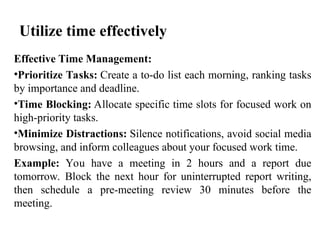
Utilize time effectively
Effective Time Management:
•Prioritize Tasks: Create a to-do list each morning, ranking tasks
by importance and deadline.
•Time Blocking: Allocate specific time slots for focused work on
high-priority tasks.
•Minimize Distractions: Silence notifications, avoid social media
browsing, and inform colleagues about your focused work time.
Example: You have a meeting in 2 hours and a report due
tomorrow. Block the next hour for uninterrupted report writing,
then schedule a pre-meeting review 30 minutes before the
meeting.
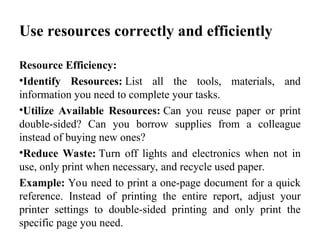
Use resources correctly and efficiently
Resource Efficiency:
•Identify Resources: List all the tools, materials, and
information you need to complete your tasks.
•Utilize Available Resources: Can you reuse paper or print
double-sided? Can you borrow supplies from a colleague
instead of buying new ones?
•Reduce Waste: Turn off lights and electronics when not in
use, only print when necessary, and recycle used paper.
Example: You need to print a one-page document for a quick
reference. Instead of printing the entire report, adjust your
printer settings to double-sided printing and only print the
specific page you need.
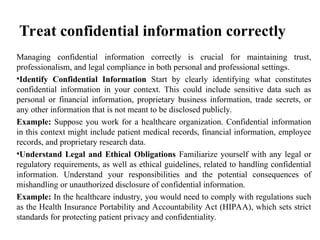
Treat confidential information correctly
Managing confidential information correctly is crucial for maintaining trust,
professionalism, and legal compliance in both personal and professional settings.
•Identify Confidential Information Start by clearly identifying what constitutes
confidential information in your context. This could include sensitive data such as
personal or financial information, proprietary business information, trade secrets, or
any other information that is not meant to be disclosed publicly.
Example: Suppose you work for a healthcare organization. Confidential information
in this context might include patient medical records, financial information, employee
records, and proprietary research data.
•Understand Legal and Ethical Obligations Familiarize yourself with any legal or
regulatory requirements, as well as ethical guidelines, related to handling confidential
information. Understand your responsibilities and the potential consequences of
mishandling or unauthorized disclosure of confidential information.
Example: In the healthcare industry, you would need to comply with regulations such
as the Health Insurance Portability and Accountability Act (HIPAA), which sets strict
standards for protecting patient privacy and confidentiality.
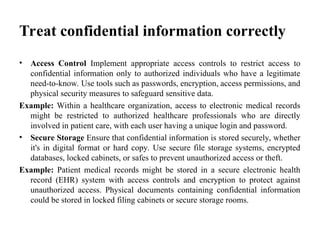
Treat confidential information correctly
• Access Control Implement appropriate access controls to restrict access to
confidential information only to authorized individuals who have a legitimate
need-to-know. Use tools such as passwords, encryption, access permissions, and
physical security measures to safeguard sensitive data.
Example: Within a healthcare organization, access to electronic medical records
might be restricted to authorized healthcare professionals who are directly
involved in patient care, with each user having a unique login and password.
• Secure Storage Ensure that confidential information is stored securely, whether
it's in digital format or hard copy. Use secure file storage systems, encrypted
databases, locked cabinets, or safes to prevent unauthorized access or theft.
Example: Patient medical records might be stored in a secure electronic health
record (EHR) system with access controls and encryption to protect against
unauthorized access. Physical documents containing confidential information
could be stored in locked filing cabinets or secure storage rooms.
Treat confidential information correctly
• Practice Discretion Exercise caution and discretion when handling confidential
information, both in electronic communications and in conversations. Avoid
discussing sensitive information in public places or with individuals who are not
authorized to access it.
Example: When discussing patient cases with colleagues, healthcare professionals
should do so in private areas such as consultation rooms or offices, ensuring that
conversations cannot be overheard by unauthorized individuals.
• Secure Transmission When transmitting confidential information electronically,
use secure channels such as encrypted email, secure file transfer protocols, or
password-protected documents to prevent interception or unauthorized access.
Example: Sending sensitive patient information to a specialist for consultation
might involve using a secure email system with end-to-end encryption or a
secure file transfer service to ensure that the information remains confidential
during transmission.
Treat confidential information correctly
• Regular Training and Awareness Provide regular training and awareness
programs to employees to educate them about the importance of confidentiality,
the proper handling of confidential information, and the potential consequences
of breaches.
Example: A healthcare organization might conduct annual training sessions for
employees on HIPAA regulations, patient privacy policies, and best practices for
safeguarding confidential information.
• Monitor and Audit Regularly monitor and audit access to confidential
information to detect any unauthorized access or breaches. Implement logging
and tracking mechanisms to record access activities and investigate any
suspicious or unauthorized activities.
Example: An organization might use audit trails in its electronic systems to track
who accessed confidential files, when they were accessed, and what actions were
taken. Regular audits of access logs can help identify and address any security
vulnerabilities or breaches.
Work in line with organization’s
policies and procedures
Working in line with an organization's policies and procedures is essential for maintaining
consistency, compliance, and alignment with organizational goals.
•Familiarize Yourself with Policies and Procedures Start by thoroughly familiarizing
yourself with your organization's policies and procedures. Review documents such as
employee handbooks, policy manuals, and procedure guides to understand the expectations and
requirements.
Example: Suppose you're a new employee at a financial institution. Take the time to read
through the organization's policies and procedures regarding client confidentiality, data
security, code of conduct, and compliance regulations such as Know Your Customer (KYC)
and Anti-Money Laundering (AML) policies.
•Identify Applicable Policies and Procedures Identify which specific policies and procedures
are relevant to your role and responsibilities within the organization. Focus on understanding
how these policies and procedures impact your day-to-day tasks and decision-making.
Example: As a customer service representative in the financial institution, you would need to
pay particular attention to policies related to handling customer inquiries, protecting sensitive
financial information, and following regulatory guidelines when processing transactions.
Work in line with organization’s
policies and procedures
• Incorporate Policies into Work Practices Integrate organizational policies and
procedures into your daily work practices and decision-making processes.
Ensure that your actions and behaviors align with the expectations outlined in
the policies and procedures.
Example: When assisting customers with account inquiries, always verify their
identity according to the organization's security procedures before providing
any sensitive information. Adhere to established protocols for handling
customer complaints or issues, following escalation procedures as necessary.
• Seek Clarification if Needed If you encounter any ambiguity or uncertainty
regarding a particular policy or procedure, don't hesitate to seek clarification
from your supervisor, HR department, or relevant subject matter experts.
Example: If you're unsure about the correct procedure for handling a specific type
of transaction, consult the organization's procedural manual or ask a senior
colleague for guidance to ensure that you're following the correct protocol.
Work within the limits of their job role
Working within the limits of your job role is essential for maintaining efficiency,
productivity, and organizational cohesion.
•Understand Your Job Description Start by thoroughly understanding your job
description, including your roles, responsibilities, and limitations. Review any
documentation provided by your employer, such as job contracts, position descriptions, or
organizational charts.
Example: Suppose you're hired as a customer service representative for an e-commerce
company. Your job description outlines responsibilities such as handling customer
inquiries, processing orders, and resolving customer issues within specified guidelines.
•Clarify Expectations Seek clarification from your supervisor or manager regarding any
uncertainties or ambiguities about your job role. Discuss expectations regarding your
duties, authority levels, and any restrictions or boundaries that apply to your position.
Example: Schedule a meeting with your supervisor to discuss specific scenarios or
situations where you're unsure about your authority or responsibilities. Seek guidance on
how to handle certain tasks within the scope of your job role.
Work within the limits of their job role
• Identify Boundaries Identify the boundaries and limitations of your job role,
including tasks or activities that fall outside of your responsibilities. Recognize
when it's appropriate to defer to others or escalate issues beyond your level of
authority.
Example: As a customer service representative, you may encounter complex
technical issues that require specialized expertise beyond your role. In such
cases, it's important to escalate the issue to the technical support team rather than
attempting to resolve it yourself.
• Prioritize Tasks Focus on tasks and responsibilities that align with your job role
and contribute to the achievement of organizational goals. Prioritize your
workload based on the importance, urgency, and relevance of each task to avoid
wasting time on non-essential activities.
Example: As a customer service representative, prioritize tasks such as responding
to customer inquiries, processing orders, and resolving customer complaints, as
these directly impact customer satisfaction and retention.
Work within the limits of their job role
• Communicate Effectively Communicate openly and transparently with your supervisor, colleagues,
and other stakeholders regarding your job role and any limitations or constraints you may encounter.
Keep everyone informed to avoid misunderstandings or conflicts.
Example: If you're unable to fulfill a request due to limitations within your job role, communicate this
clearly to the requester and offer alternative solutions or options. Be proactive in seeking support or
guidance when needed.
• Seek Growth Opportunities Identify opportunities for professional development and growth within the
confines of your job role. Take advantage of training programs, workshops, or mentorship opportunities
that can help you enhance your skills and knowledge within your current position.
Example: Participate in skill-building workshops or online courses related to customer service techniques,
problem-solving skills, or industry-specific knowledge to strengthen your capabilities as a customer
service representative.
• Review and Reflect Regularly review your performance within your job role and reflect on areas where
you can improve or excel. Seek feedback from supervisors, peers, or clients to identify strengths and
areas for development.
Example: Schedule regular performance reviews with your supervisor to discuss your job performance,
accomplishments, and areas for growth. Use feedback to adjust your approach and set goals for
continued improvement within your job role.

Information Security Analysis and Audit 1

  • 1.
    BCSE353E: Information Security Analysisand Audit A. Avinash, Ph.D. School of Computer Science and Engineering Vellore Institute of Technology (VIT), Chennai
  • 2.
    Establish and agreework requirements with appropriate people Establishing and agreeing on work requirements involves several steps to ensure clarity, alignment, and accountability. Step 1: Identify Stakeholders Identify all the individuals or groups who have a stake in the work being carried out. This may include team members, supervisors, clients, or any other relevant parties. Example: Suppose you're a project manager tasked with organizing a marketing campaign for a new product launch. Stakeholders may include the marketing team, product development team, sales team, senior management, and external clients. Step 2: Define Objectives and Scope Clearly articulate the objectives and scope of the work to be done. This helps ensure that everyone involved understands what needs to be achieved and what boundaries exist. Example: In our marketing campaign example, the objective might be to increase product awareness and generate leads within a specific target market. The scope could include the types of promotional materials to be created, the channels to be utilized, and the timeline for execution.
  • 3.
    Establish and agreework requirements with appropriate people Step 3: Communicate Expectations Communicate expectations regarding roles, responsibilities, timelines, and deliverables to all stakeholders. Ensure that everyone understands their role in achieving the objectives and what is expected of them. Example: You might communicate to the marketing team that they are responsible for designing the campaign materials, to the sales team that they need to follow up on leads generated, and to senior management that regular progress reports will be provided. Step 4: Gather Feedback and Input Encourage open communication and collaboration by seeking feedback and input from stakeholders. This helps ensure that everyone's perspectives and concerns are taken into account. Example: You could hold a meeting with all stakeholders to present the proposed marketing campaign plan and gather feedback on aspects such as messaging, design elements, and target audience. Step 5: Negotiate and Adjust Negotiate any differences or conflicting requirements among stakeholders and make adjustments to the plan as necessary to ensure alignment and consensus. Example: If the sales team expresses concerns about the timeline for lead follow-up conflicting with other priorities, you may need to adjust the campaign schedule or allocate additional resources to support them.
  • 4.
    Establish and agreework requirements with appropriate people Step 6: Document Agreements Document the agreed-upon work requirements, including objectives, scope, responsibilities, timelines, and any other pertinent details. This serves as a reference point and helps prevent misunderstandings later on. Example: Create a project charter or campaign brief document that outlines all the agreed- upon work requirements and distribute it to all stakeholders for reference. Step 7: Review and Confirm Review the documented agreements with all stakeholders to ensure mutual understanding and confirmation of commitment. Example: Schedule a final review meeting where all stakeholders can review the project charter or campaign brief document together, ask any final questions, and confirm their commitment to the agreed-upon work requirements. Step 8: Monitor and Adjust as Needed Continuously monitor progress against the agreed- upon work requirements and be prepared to make adjustments as needed to address changing circumstances or unforeseen challenges. Example: Throughout the campaign execution, regularly review key performance indicators (KPIs) such as website traffic, lead conversion rates, and sales figures. If certain tactics are not yielding the expected results, be prepared to adjust the strategy accordingly.
  • 5.
    Keep the immediatework area clean and tidy • Declutter Regularly: Schedule a quick 5-minute decluttering session at the end of each workday. Toss trash, put away supplies, and file completed documents. • Designated Zones: Assign specific areas for frequently used items - pen holder, stapler tray, note bin. This creates a system for easy access and return. • Deep Clean Weekly: Dedicate 10-15 minutes on a designated day (Friday afternoon?) for a more thorough cleaning. Wipe down surfaces, dust electronics, and vacuum under your desk. Example: You're wrapping up a report. Before leaving, toss used coffee cups and paper scraps. File the finished report electronically and put away any reference materials in your drawer.
  • 6.
    Utilize time effectively EffectiveTime Management: •Prioritize Tasks: Create a to-do list each morning, ranking tasks by importance and deadline. •Time Blocking: Allocate specific time slots for focused work on high-priority tasks. •Minimize Distractions: Silence notifications, avoid social media browsing, and inform colleagues about your focused work time. Example: You have a meeting in 2 hours and a report due tomorrow. Block the next hour for uninterrupted report writing, then schedule a pre-meeting review 30 minutes before the meeting.
  • 7.
    Use resources correctlyand efficiently Resource Efficiency: •Identify Resources: List all the tools, materials, and information you need to complete your tasks. •Utilize Available Resources: Can you reuse paper or print double-sided? Can you borrow supplies from a colleague instead of buying new ones? •Reduce Waste: Turn off lights and electronics when not in use, only print when necessary, and recycle used paper. Example: You need to print a one-page document for a quick reference. Instead of printing the entire report, adjust your printer settings to double-sided printing and only print the specific page you need.
  • 8.
    Treat confidential informationcorrectly Managing confidential information correctly is crucial for maintaining trust, professionalism, and legal compliance in both personal and professional settings. •Identify Confidential Information Start by clearly identifying what constitutes confidential information in your context. This could include sensitive data such as personal or financial information, proprietary business information, trade secrets, or any other information that is not meant to be disclosed publicly. Example: Suppose you work for a healthcare organization. Confidential information in this context might include patient medical records, financial information, employee records, and proprietary research data. •Understand Legal and Ethical Obligations Familiarize yourself with any legal or regulatory requirements, as well as ethical guidelines, related to handling confidential information. Understand your responsibilities and the potential consequences of mishandling or unauthorized disclosure of confidential information. Example: In the healthcare industry, you would need to comply with regulations such as the Health Insurance Portability and Accountability Act (HIPAA), which sets strict standards for protecting patient privacy and confidentiality.
  • 9.
    Treat confidential informationcorrectly • Access Control Implement appropriate access controls to restrict access to confidential information only to authorized individuals who have a legitimate need-to-know. Use tools such as passwords, encryption, access permissions, and physical security measures to safeguard sensitive data. Example: Within a healthcare organization, access to electronic medical records might be restricted to authorized healthcare professionals who are directly involved in patient care, with each user having a unique login and password. • Secure Storage Ensure that confidential information is stored securely, whether it's in digital format or hard copy. Use secure file storage systems, encrypted databases, locked cabinets, or safes to prevent unauthorized access or theft. Example: Patient medical records might be stored in a secure electronic health record (EHR) system with access controls and encryption to protect against unauthorized access. Physical documents containing confidential information could be stored in locked filing cabinets or secure storage rooms.
  • 10.
    Treat confidential informationcorrectly • Practice Discretion Exercise caution and discretion when handling confidential information, both in electronic communications and in conversations. Avoid discussing sensitive information in public places or with individuals who are not authorized to access it. Example: When discussing patient cases with colleagues, healthcare professionals should do so in private areas such as consultation rooms or offices, ensuring that conversations cannot be overheard by unauthorized individuals. • Secure Transmission When transmitting confidential information electronically, use secure channels such as encrypted email, secure file transfer protocols, or password-protected documents to prevent interception or unauthorized access. Example: Sending sensitive patient information to a specialist for consultation might involve using a secure email system with end-to-end encryption or a secure file transfer service to ensure that the information remains confidential during transmission.
  • 11.
    Treat confidential informationcorrectly • Regular Training and Awareness Provide regular training and awareness programs to employees to educate them about the importance of confidentiality, the proper handling of confidential information, and the potential consequences of breaches. Example: A healthcare organization might conduct annual training sessions for employees on HIPAA regulations, patient privacy policies, and best practices for safeguarding confidential information. • Monitor and Audit Regularly monitor and audit access to confidential information to detect any unauthorized access or breaches. Implement logging and tracking mechanisms to record access activities and investigate any suspicious or unauthorized activities. Example: An organization might use audit trails in its electronic systems to track who accessed confidential files, when they were accessed, and what actions were taken. Regular audits of access logs can help identify and address any security vulnerabilities or breaches.
  • 12.
    Work in linewith organization’s policies and procedures Working in line with an organization's policies and procedures is essential for maintaining consistency, compliance, and alignment with organizational goals. •Familiarize Yourself with Policies and Procedures Start by thoroughly familiarizing yourself with your organization's policies and procedures. Review documents such as employee handbooks, policy manuals, and procedure guides to understand the expectations and requirements. Example: Suppose you're a new employee at a financial institution. Take the time to read through the organization's policies and procedures regarding client confidentiality, data security, code of conduct, and compliance regulations such as Know Your Customer (KYC) and Anti-Money Laundering (AML) policies. •Identify Applicable Policies and Procedures Identify which specific policies and procedures are relevant to your role and responsibilities within the organization. Focus on understanding how these policies and procedures impact your day-to-day tasks and decision-making. Example: As a customer service representative in the financial institution, you would need to pay particular attention to policies related to handling customer inquiries, protecting sensitive financial information, and following regulatory guidelines when processing transactions.
  • 13.
    Work in linewith organization’s policies and procedures • Incorporate Policies into Work Practices Integrate organizational policies and procedures into your daily work practices and decision-making processes. Ensure that your actions and behaviors align with the expectations outlined in the policies and procedures. Example: When assisting customers with account inquiries, always verify their identity according to the organization's security procedures before providing any sensitive information. Adhere to established protocols for handling customer complaints or issues, following escalation procedures as necessary. • Seek Clarification if Needed If you encounter any ambiguity or uncertainty regarding a particular policy or procedure, don't hesitate to seek clarification from your supervisor, HR department, or relevant subject matter experts. Example: If you're unsure about the correct procedure for handling a specific type of transaction, consult the organization's procedural manual or ask a senior colleague for guidance to ensure that you're following the correct protocol.
  • 14.
    Work within thelimits of their job role Working within the limits of your job role is essential for maintaining efficiency, productivity, and organizational cohesion. •Understand Your Job Description Start by thoroughly understanding your job description, including your roles, responsibilities, and limitations. Review any documentation provided by your employer, such as job contracts, position descriptions, or organizational charts. Example: Suppose you're hired as a customer service representative for an e-commerce company. Your job description outlines responsibilities such as handling customer inquiries, processing orders, and resolving customer issues within specified guidelines. •Clarify Expectations Seek clarification from your supervisor or manager regarding any uncertainties or ambiguities about your job role. Discuss expectations regarding your duties, authority levels, and any restrictions or boundaries that apply to your position. Example: Schedule a meeting with your supervisor to discuss specific scenarios or situations where you're unsure about your authority or responsibilities. Seek guidance on how to handle certain tasks within the scope of your job role.
  • 15.
    Work within thelimits of their job role • Identify Boundaries Identify the boundaries and limitations of your job role, including tasks or activities that fall outside of your responsibilities. Recognize when it's appropriate to defer to others or escalate issues beyond your level of authority. Example: As a customer service representative, you may encounter complex technical issues that require specialized expertise beyond your role. In such cases, it's important to escalate the issue to the technical support team rather than attempting to resolve it yourself. • Prioritize Tasks Focus on tasks and responsibilities that align with your job role and contribute to the achievement of organizational goals. Prioritize your workload based on the importance, urgency, and relevance of each task to avoid wasting time on non-essential activities. Example: As a customer service representative, prioritize tasks such as responding to customer inquiries, processing orders, and resolving customer complaints, as these directly impact customer satisfaction and retention.
  • 16.
    Work within thelimits of their job role • Communicate Effectively Communicate openly and transparently with your supervisor, colleagues, and other stakeholders regarding your job role and any limitations or constraints you may encounter. Keep everyone informed to avoid misunderstandings or conflicts. Example: If you're unable to fulfill a request due to limitations within your job role, communicate this clearly to the requester and offer alternative solutions or options. Be proactive in seeking support or guidance when needed. • Seek Growth Opportunities Identify opportunities for professional development and growth within the confines of your job role. Take advantage of training programs, workshops, or mentorship opportunities that can help you enhance your skills and knowledge within your current position. Example: Participate in skill-building workshops or online courses related to customer service techniques, problem-solving skills, or industry-specific knowledge to strengthen your capabilities as a customer service representative. • Review and Reflect Regularly review your performance within your job role and reflect on areas where you can improve or excel. Seek feedback from supervisors, peers, or clients to identify strengths and areas for development. Example: Schedule regular performance reviews with your supervisor to discuss your job performance, accomplishments, and areas for growth. Use feedback to adjust your approach and set goals for continued improvement within your job role.