Module-8
Team Work and Communication
WORKING EFFECTIVELY
• Importance of establishing Good Working
Relationships
– The following are some benefits of developing
productive relationships with colleagues:
• Getting tasks done gets easier.
• Colleagues are more likely to go along with the changes that
you recommend.
• Instead of spending time and energy on negative
relationships, you can focus on opportunities.
• You can get ideas and feedback from others.
• You can take help in hours of need, if required.
• Your productivity increases.
• Your performance gets appraised better.
• You can learn from others and add to your existing skill-set.
WORKING EFFECTIVELY
• Some of the benefits of an environment of trust
and mutual respect are as follows:
– Getting tasks done gets easier.
– It encourages free flow of ideas.
– It saves time spent in gauging whether the other
person is speaking the truth, or is giving genuine
advice.
– Colleagues are more likely to go along with the
changes that you recommend.
– You can take help in hours of need, if required.
– Your productivity increases.
– Your performance gets appraised better.
Scope of Work
• Scope of work refers to the range of tasks and
activities to be performed or expected to be
performed by someone or within a project or
contract, as agreed.
• This is usually a result of division or defining
• and limiting of work and responsibilities.
• This usually is understood to be performed
within agreed timelines and rules or standards
of performance.
Scope of Work
• It is important to understand clearly one’s own
and others’ scope of work and responsibilities
clearly and commonly between co-workers for
the following reasons:
– Helps in planning and organizing work better
– Builds trust and reliability
– Reduces scope of conflict and confusion
– Helps optimize effort through reducing omissions
and overlaps
– Helps secure the right level of support from the
right people
Ways to clarify scope of work
• Job descriptions
• Seniors (Supervisors or managers)
• Job or duty assignment
sheet/document/roster
• Colleagues
• Policy and procedure documents
Organizations policies and procedures
• Why do companies have policies and
procedures?
– a. Ease of working and common understanding
– b. Regulatory and statutory compliance
– c. Optimizing performance and productivity
– d. Setting standards for performance and quality
– e. Reduction of errors, safety and security
Organizations policies and procedures
• Why is it important to follow policies and
procedures while working?
– a. To be safe, productive and maintain company
standards
– b. Reliability and trustworthiness
– c. To remain compliant with legal, regulatory and
statutory requirements
Seeking/Providing Clarity, Assistance
and Support
• The organization being divided into hierarchies,
departments, divisions and teams to use and
develop people’s expertise in accordance with
capability requirements of organizations.
• It is important to involve, seek assistance and
support from those who are designated in the
organizations as authorities for decision making
over their remit of work, where required.
• It is important that people respect other people’s
authority and expertise over their areas of work.
Seeking/Providing Clarity, Assistance
and Support
• There are various reasons why others need to
be involved:
– 1. To contribute their expertise
– 2. Complex work and interdependencies that
requires more people to complete tasks
– 3. Authority and remit of decision making
– 4. Stakeholders impacted by the actions
– 5. To generate more and diverse ideas
Seeking/Providing Clarity, Assistance
and Support
• When to keep others informed of progress
and problems?
– It is important in many contexts to inform others
of work related issues, problems and progress.
– Any work being assigned also comes with a set of
expectations of customers, co-workers,
supervisors or managers, other departments, etc.
– These expectations are around:
• volume of work,
• quality of work
• time within which the work needs to be completed.
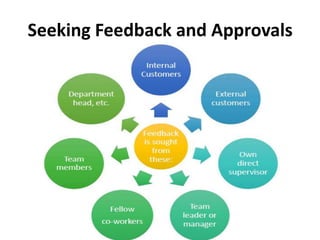
Seeking Feedback and Approvals
Change and flexibility
• Flexibility to change is required to:
– incorporate new and improved methods of
working
– adjusting to environmental changes
– supporting others
– refining goals and objectives
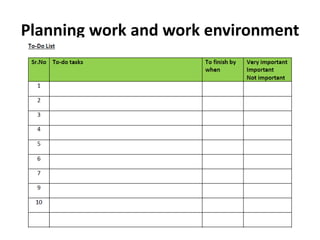
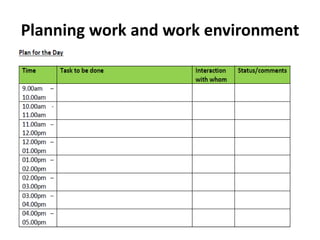
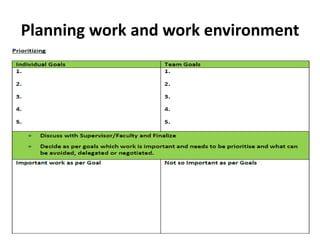
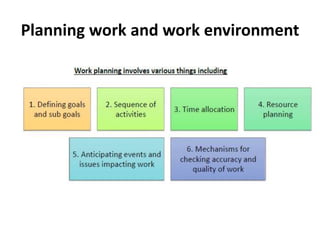
Planning work and work environment
• Defining goals and sub-goals includes breaking
the overall objective into measureable and well
defined constituent results, that can help in
planning, implementation and tracking
achievement and progress.
• It is important that these are further evaluated in
terms of realistic and required time frames and
time available is allocated in such a manner that
these goals are achieved within optimal time
frames.
Planning work and work environment
• Sequencing activities right is also of great
importance in efficient and effective working.
• Factors that need to be considered while
sequencing activities include:
– o Dependencies on interim outputs
– o Availability of resources
– o Space design
– o Schedule of deliverables and urgencies
– o Work styles, interests and preferences
– o Capabilities
Planning work and work environment
• Resources required can be identified by analysing the
work, tasks and sub-tasks involved and the volume of
work required.
• Most organizations have standard procedures for
requisitioning for resources. For eg. the IT supplies
team may have IT equipment that the user department
may requisition through a formal request approved by
a designated level of authority (authorized person).
• Organizations also have procedures to request for
purchase of new resources and materials that may not
be available within the organization.
• This has to be routed as per procedure through the
authorized department and personnel and requires
necessary approvals.
Planning the Work environment
• A place for everything and everything in its
place’ is a principle used by many to organize
their environment.
• One can contribute effectively towards making
one’s work environment conducive for
efficient working.
Planning the Work environment
• Some of the key requirements for this are
– cleanliness and tidiness,
– organizing the space layout for efficient working,
– ergonomic design, optimal space for people and
the work to be carried out,
– right ambient conditions (lighting, ventilation,
etc.).
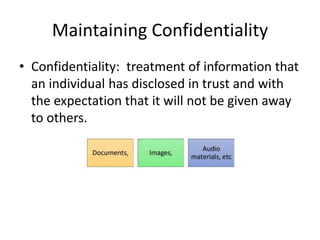
Maintaining Confidentiality
• Confidentiality: treatment of information that
an individual has disclosed in trust and with
the expectation that it will not be given away
to others.
Maintaining Confidentiality
Confidentiality is important for a host of
reasons:
- Sharing confidential information is often a
professional violation and a legal violation.
- Failure to properly secure and protect confidential
business information can lead to the loss of
business/clients.
- In the wrong hands, confidential information can be
misused to commit illegal activity,which can in turn
result in costly lawsuits for the employer.
Maintaining Confidentiality
- The disclosure of sensitive employee and
management information can lead to a loss of
employee trust, confidence and loyalty. This
will almost always result in a loss of
productivity.
What type of information must or should
be protected?
• Restricted Information or Data
- Example:
- Personal Identity Information (PII)
- Electronic protected health information (ePHI)
- Credit card data regulated by the Payment Card Industry
(PCI)
- Passwords providing access to restricted data or resources
- Information relating to an ongoing criminal investigation
- Court-ordered settlement agreements requiring non-
disclosure.
- Etc.
Non-Restricted, Confidential Information
• Home address or home telephone number
• Personal information protected by anti-discrimination and
information privacy laws
• Certain types of student records
• Exams, answer keys, and grade books
• Applicant information in a pending recruitment Information
subject to a non-disclosure agreement, including research
data, intellectual property (IP), patent information and other
proprietary data
• Academic evaluations and letters of recommendation
• Responses to a Request for Proposal (RFP) before a decision
has been reached.
• etc
Confidential workplace information
• Categories:
- employee information
- management information
- business information
Policies and procedures for
confidential information
• Procedures for protecting confidential
information:
- All confidential documents should be stored in locked file
cabinets or rooms accessible only to those who have a
business “need-to-know.”
- All electronic confidential information should be protected via
firewalls, encryption and passwords.
- Employees should clear their desks of any confidential
information before going home at the end of the day.
- Employees should refrain from leaving confidential
information visible on their computer monitors when they
leave their work stations.
Procedures for protecting
confidential information:
• All confidential information, whether contained on written
documents or electronically, should be marked as
“confidential.”
• All confidential information should be disposed of properly
• Employees should refrain from discussing confidential
information in public places.
• Employees should avoid using e-mail to transmit certain
sensitive or controversial information
• Etc.
Policies and procedures for
confidential information
• New and/or Current Employees Sign a “Non-
Disclosure” Agreement

20-MOD 8 Self and Work Management-20-07-2023.ppt

  • 1.
  • 2.
    WORKING EFFECTIVELY • Importanceof establishing Good Working Relationships – The following are some benefits of developing productive relationships with colleagues: • Getting tasks done gets easier. • Colleagues are more likely to go along with the changes that you recommend. • Instead of spending time and energy on negative relationships, you can focus on opportunities. • You can get ideas and feedback from others. • You can take help in hours of need, if required. • Your productivity increases. • Your performance gets appraised better. • You can learn from others and add to your existing skill-set.
  • 3.
    WORKING EFFECTIVELY • Someof the benefits of an environment of trust and mutual respect are as follows: – Getting tasks done gets easier. – It encourages free flow of ideas. – It saves time spent in gauging whether the other person is speaking the truth, or is giving genuine advice. – Colleagues are more likely to go along with the changes that you recommend. – You can take help in hours of need, if required. – Your productivity increases. – Your performance gets appraised better.
  • 4.
    Scope of Work •Scope of work refers to the range of tasks and activities to be performed or expected to be performed by someone or within a project or contract, as agreed. • This is usually a result of division or defining • and limiting of work and responsibilities. • This usually is understood to be performed within agreed timelines and rules or standards of performance.
  • 5.
    Scope of Work •It is important to understand clearly one’s own and others’ scope of work and responsibilities clearly and commonly between co-workers for the following reasons: – Helps in planning and organizing work better – Builds trust and reliability – Reduces scope of conflict and confusion – Helps optimize effort through reducing omissions and overlaps – Helps secure the right level of support from the right people
  • 6.
    Ways to clarifyscope of work • Job descriptions • Seniors (Supervisors or managers) • Job or duty assignment sheet/document/roster • Colleagues • Policy and procedure documents
  • 7.
    Organizations policies andprocedures • Why do companies have policies and procedures? – a. Ease of working and common understanding – b. Regulatory and statutory compliance – c. Optimizing performance and productivity – d. Setting standards for performance and quality – e. Reduction of errors, safety and security
  • 8.
    Organizations policies andprocedures • Why is it important to follow policies and procedures while working? – a. To be safe, productive and maintain company standards – b. Reliability and trustworthiness – c. To remain compliant with legal, regulatory and statutory requirements
  • 9.
    Seeking/Providing Clarity, Assistance andSupport • The organization being divided into hierarchies, departments, divisions and teams to use and develop people’s expertise in accordance with capability requirements of organizations. • It is important to involve, seek assistance and support from those who are designated in the organizations as authorities for decision making over their remit of work, where required. • It is important that people respect other people’s authority and expertise over their areas of work.
  • 10.
    Seeking/Providing Clarity, Assistance andSupport • There are various reasons why others need to be involved: – 1. To contribute their expertise – 2. Complex work and interdependencies that requires more people to complete tasks – 3. Authority and remit of decision making – 4. Stakeholders impacted by the actions – 5. To generate more and diverse ideas
  • 11.
    Seeking/Providing Clarity, Assistance andSupport • When to keep others informed of progress and problems? – It is important in many contexts to inform others of work related issues, problems and progress. – Any work being assigned also comes with a set of expectations of customers, co-workers, supervisors or managers, other departments, etc. – These expectations are around: • volume of work, • quality of work • time within which the work needs to be completed.
  • 12.
  • 13.
    Change and flexibility •Flexibility to change is required to: – incorporate new and improved methods of working – adjusting to environmental changes – supporting others – refining goals and objectives
  • 14.
    Planning work andwork environment
  • 15.
    Planning work andwork environment
  • 16.
    Planning work andwork environment
  • 17.
    Planning work andwork environment
  • 18.
    Planning work andwork environment • Defining goals and sub-goals includes breaking the overall objective into measureable and well defined constituent results, that can help in planning, implementation and tracking achievement and progress. • It is important that these are further evaluated in terms of realistic and required time frames and time available is allocated in such a manner that these goals are achieved within optimal time frames.
  • 19.
    Planning work andwork environment • Sequencing activities right is also of great importance in efficient and effective working. • Factors that need to be considered while sequencing activities include: – o Dependencies on interim outputs – o Availability of resources – o Space design – o Schedule of deliverables and urgencies – o Work styles, interests and preferences – o Capabilities
  • 20.
    Planning work andwork environment • Resources required can be identified by analysing the work, tasks and sub-tasks involved and the volume of work required. • Most organizations have standard procedures for requisitioning for resources. For eg. the IT supplies team may have IT equipment that the user department may requisition through a formal request approved by a designated level of authority (authorized person). • Organizations also have procedures to request for purchase of new resources and materials that may not be available within the organization. • This has to be routed as per procedure through the authorized department and personnel and requires necessary approvals.
  • 21.
    Planning the Workenvironment • A place for everything and everything in its place’ is a principle used by many to organize their environment. • One can contribute effectively towards making one’s work environment conducive for efficient working.
  • 22.
    Planning the Workenvironment • Some of the key requirements for this are – cleanliness and tidiness, – organizing the space layout for efficient working, – ergonomic design, optimal space for people and the work to be carried out, – right ambient conditions (lighting, ventilation, etc.).
  • 23.
    Maintaining Confidentiality • Confidentiality:treatment of information that an individual has disclosed in trust and with the expectation that it will not be given away to others.
  • 24.
    Maintaining Confidentiality Confidentiality isimportant for a host of reasons: - Sharing confidential information is often a professional violation and a legal violation. - Failure to properly secure and protect confidential business information can lead to the loss of business/clients. - In the wrong hands, confidential information can be misused to commit illegal activity,which can in turn result in costly lawsuits for the employer.
  • 25.
    Maintaining Confidentiality - Thedisclosure of sensitive employee and management information can lead to a loss of employee trust, confidence and loyalty. This will almost always result in a loss of productivity.
  • 26.
    What type ofinformation must or should be protected? • Restricted Information or Data - Example: - Personal Identity Information (PII) - Electronic protected health information (ePHI) - Credit card data regulated by the Payment Card Industry (PCI) - Passwords providing access to restricted data or resources - Information relating to an ongoing criminal investigation - Court-ordered settlement agreements requiring non- disclosure. - Etc.
  • 27.
    Non-Restricted, Confidential Information •Home address or home telephone number • Personal information protected by anti-discrimination and information privacy laws • Certain types of student records • Exams, answer keys, and grade books • Applicant information in a pending recruitment Information subject to a non-disclosure agreement, including research data, intellectual property (IP), patent information and other proprietary data • Academic evaluations and letters of recommendation • Responses to a Request for Proposal (RFP) before a decision has been reached. • etc
  • 28.
    Confidential workplace information •Categories: - employee information - management information - business information
  • 29.
    Policies and proceduresfor confidential information • Procedures for protecting confidential information: - All confidential documents should be stored in locked file cabinets or rooms accessible only to those who have a business “need-to-know.” - All electronic confidential information should be protected via firewalls, encryption and passwords. - Employees should clear their desks of any confidential information before going home at the end of the day. - Employees should refrain from leaving confidential information visible on their computer monitors when they leave their work stations.
  • 30.
    Procedures for protecting confidentialinformation: • All confidential information, whether contained on written documents or electronically, should be marked as “confidential.” • All confidential information should be disposed of properly • Employees should refrain from discussing confidential information in public places. • Employees should avoid using e-mail to transmit certain sensitive or controversial information • Etc.
  • 31.
    Policies and proceduresfor confidential information • New and/or Current Employees Sign a “Non- Disclosure” Agreement