Information Retrieval : 3
Query Search Interfaces
Prof Neeraj Bhargava
Vaibhav Khanna
Department of Computer Science
School of Engineering and Systems Sciences
Maharshi Dayanand Saraswati University Ajmer
Search Interfaces Today
How does an information seeking session begin in online
information systems?
The most common way is to use a Web search engine
Another method is to select a Web site from a personal collection of
already-visited sites which are typically stored in a browser’s
bookmark
Online bookmark systems are popular among a smaller segment of users
Ex: Delicious.com
Web directories are also used as a common starting point, but have
been largely replaced by search engines
Query Specification
The primary methods for a searcher to express
their information need are either
entering words into a search entry form
selecting links from a directory or other information organization
display
For Web search engines, the query is specified in
textual form
Typically, Web queries today are very short
consisting of one to three words
Short queries reflect the standard usage scenario
in which the user tests the waters:
If the results do not look relevant, then the user reformulates
their
query
If the results are promising, then the user navigates to the most
relevant-looking Web site
This search behavior is a demonstration of the
orienteering strategy of Web search
Query Specification
Query Specification
Before the Web, search systems regularly
supported Boolean operators and command-
based syntax
However, these are often difficult for most users to understand
Jansen et a/ conducted a study over a Web log
with 1.5M queries, and found that
2.1% of the queries contained Boolean operators
7.6% contained other query syntax, primarily double-quotation
marks for phrases
White et a/ examined interaction logs of nearly
600,000 users, and found that
1.1% of the queries contained one or more operators
a8.7% of the users used an operator at any time
Query Specification
Web ranking has gone through three major
phases
In the first phase, from approximately 1994—2000:
Since the Web was much smaller then, complex queries were
less likely to yield relevant information
Further, pages retrieved not necessarily contained all query
words
Around 1997, Google moved to conjunctive queries only
The other Web search engines followed, and conjunctive ranking
became the norm
Google also added term proximity information and page
importance scoring (PageRank)
As the Web grew, longer queries posed as phrases started
to produce highly relevant results
Interfaces
The standard interface for a textual query is a
search box entry form
Studies suggest a relationship between query
length and the width of the entry form
Results found that either small forms discourage long queries or
wide forms encourage longer queries
Specification Interfaces
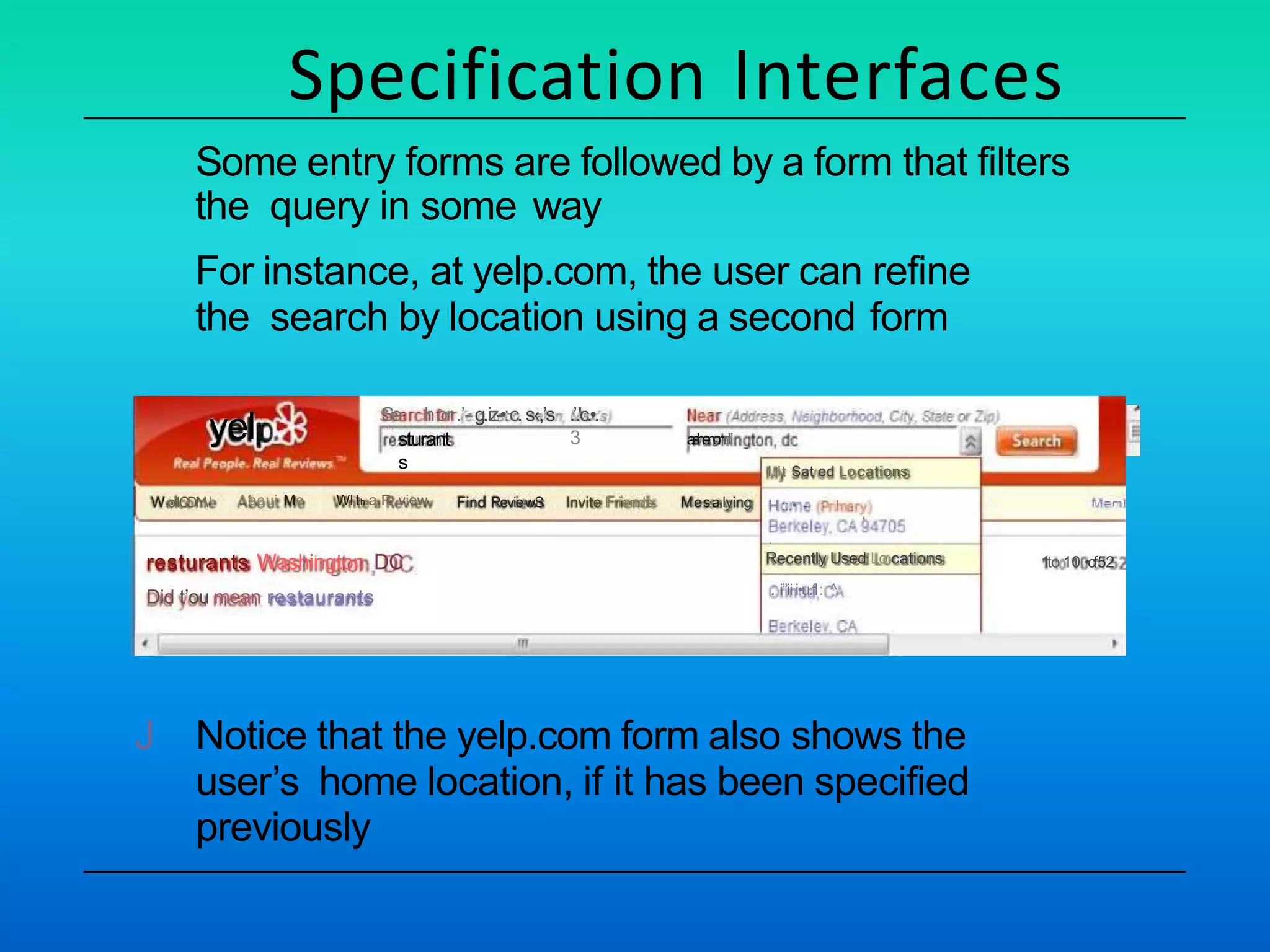
Some entry forms are followed by a form that filters
the query in some way
For instance, at yelp.com, the user can refine
the search by location using a second form
yel Se hor .’- g.iz-•:c. s‹,’s .’.'c.•.
3sturant
s
ashenonct”
I.It Sat ed Lo cations
W o1CDIY'
" ” ”
Aboui Me WIth a Re view Find ReviewS Invite Friends Mesa lying H ::.• - : !
'
.
resturants Washington DC
Did t’ou mean restaurants
Recently Used Lo cations
. i”iii•u.fl: ^.
1to 10 •cf52
J Notice that the yelp.com form also shows the
user’s home location, if it has been specified
previously
movies restau rants ven ues pe rformers
Specification Interfaces
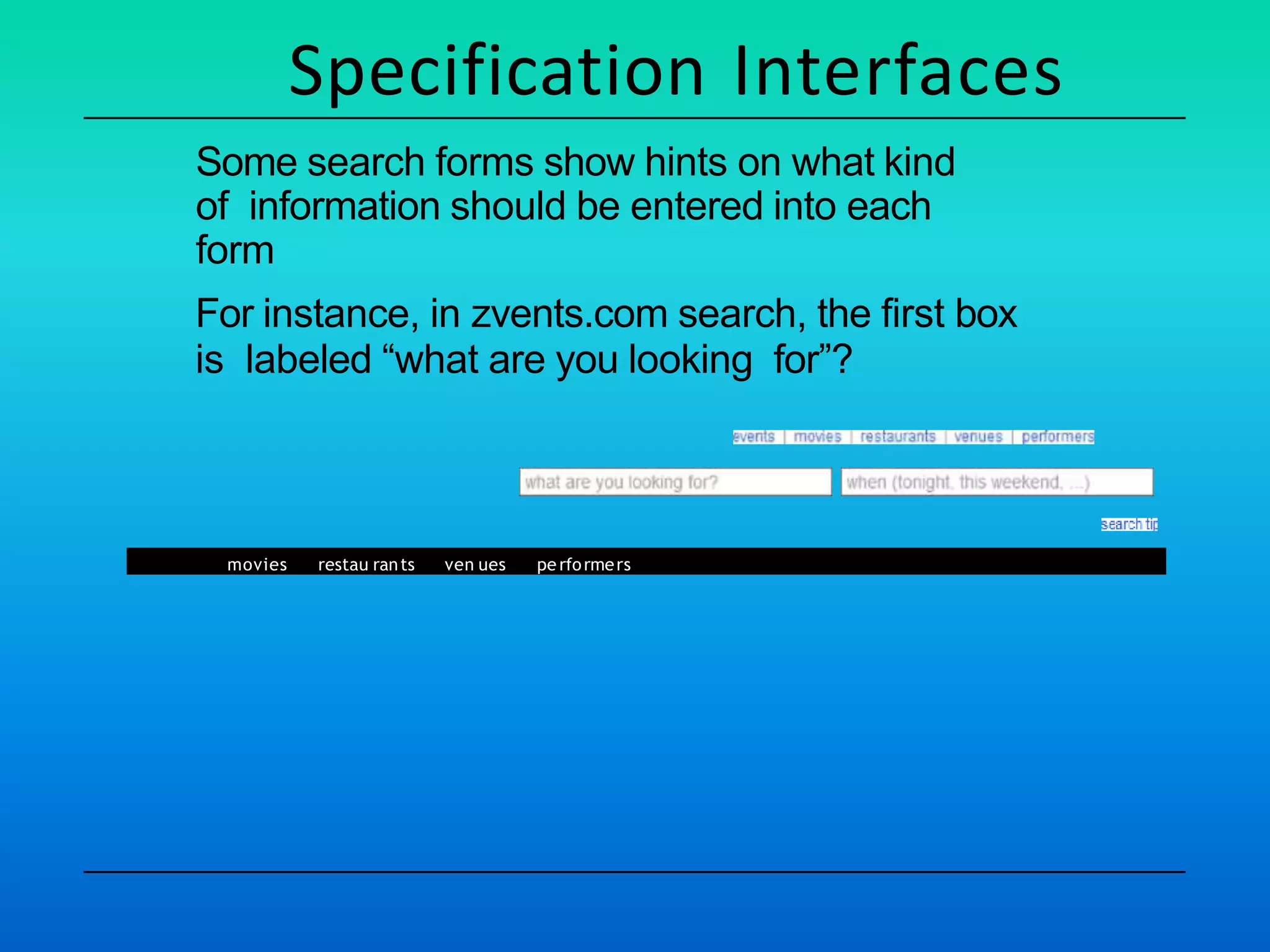
Some search forms show hints on what kind
of information should be entered into each
form
For instance, in zvents.com search, the first box
is labeled “what are you looking for”?
Specification Interfaces
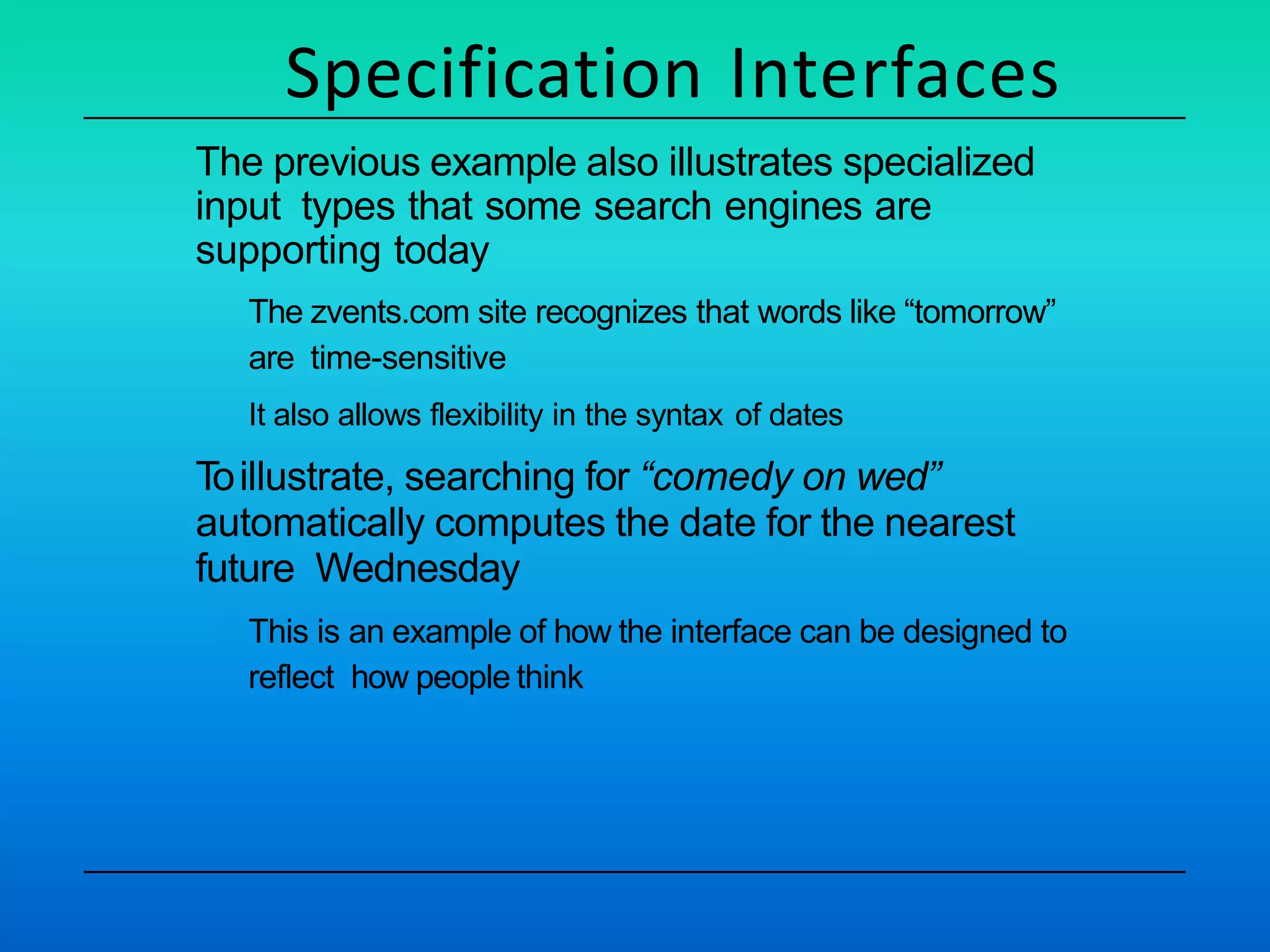
The previous example also illustrates specialized
input types that some search engines are
supporting today
The zvents.com site recognizes that words like “tomorrow”
are time-sensitive
It also allows flexibility in the syntax of dates
Toillustrate, searching for “comedy on wed”
automatically computes the date for the nearest
future Wednesday
This is an example of how the interface can be designed to
reflect how people think
Specification Interfaces
Some interfaces show a list of query suggestions as
the user types the query
This is referred to as auto-complete, auto-suggest, or dynamic
query suggestions
Anick et al found that users clicked on dynamic Yahoo
suggestions one third of the time
Often the suggestions shown are those whose
prefix matches the characters typed so far
However, in some cases, suggestions are shown that only have
interior letters matching
Further, suggestions may be shown that are
synonyms of the words typed so far
Specification Interfaces
The dynamic query suggestions can be derived
from several sources, including:
The user’s own query history
Aset of metadata that a Web site’s designer considers important
All of the text contained within a Web site
Assignment
• Briefly explain the central issues related to
Query Specifications and Interfaces

Information retrieval 3 query search interfaces

  • 1.
    Information Retrieval :3 Query Search Interfaces Prof Neeraj Bhargava Vaibhav Khanna Department of Computer Science School of Engineering and Systems Sciences Maharshi Dayanand Saraswati University Ajmer
  • 2.
    Search Interfaces Today Howdoes an information seeking session begin in online information systems? The most common way is to use a Web search engine Another method is to select a Web site from a personal collection of already-visited sites which are typically stored in a browser’s bookmark Online bookmark systems are popular among a smaller segment of users Ex: Delicious.com Web directories are also used as a common starting point, but have been largely replaced by search engines
  • 3.
    Query Specification The primarymethods for a searcher to express their information need are either entering words into a search entry form selecting links from a directory or other information organization display For Web search engines, the query is specified in textual form Typically, Web queries today are very short consisting of one to three words
  • 4.
    Short queries reflectthe standard usage scenario in which the user tests the waters: If the results do not look relevant, then the user reformulates their query If the results are promising, then the user navigates to the most relevant-looking Web site This search behavior is a demonstration of the orienteering strategy of Web search Query Specification
  • 5.
    Query Specification Before theWeb, search systems regularly supported Boolean operators and command- based syntax However, these are often difficult for most users to understand Jansen et a/ conducted a study over a Web log with 1.5M queries, and found that 2.1% of the queries contained Boolean operators 7.6% contained other query syntax, primarily double-quotation marks for phrases White et a/ examined interaction logs of nearly 600,000 users, and found that 1.1% of the queries contained one or more operators a8.7% of the users used an operator at any time
  • 6.
    Query Specification Web rankinghas gone through three major phases In the first phase, from approximately 1994—2000: Since the Web was much smaller then, complex queries were less likely to yield relevant information Further, pages retrieved not necessarily contained all query words Around 1997, Google moved to conjunctive queries only The other Web search engines followed, and conjunctive ranking became the norm Google also added term proximity information and page importance scoring (PageRank) As the Web grew, longer queries posed as phrases started to produce highly relevant results
  • 7.
    Interfaces The standard interfacefor a textual query is a search box entry form Studies suggest a relationship between query length and the width of the entry form Results found that either small forms discourage long queries or wide forms encourage longer queries
  • 8.
    Specification Interfaces Some entryforms are followed by a form that filters the query in some way For instance, at yelp.com, the user can refine the search by location using a second form yel Se hor .’- g.iz-•:c. s‹,’s .’.'c.•. 3sturant s ashenonct” I.It Sat ed Lo cations W o1CDIY' " ” ” Aboui Me WIth a Re view Find ReviewS Invite Friends Mesa lying H ::.• - : ! ' . resturants Washington DC Did t’ou mean restaurants Recently Used Lo cations . i”iii•u.fl: ^. 1to 10 •cf52 J Notice that the yelp.com form also shows the user’s home location, if it has been specified previously
  • 9.
    movies restau rantsven ues pe rformers Specification Interfaces Some search forms show hints on what kind of information should be entered into each form For instance, in zvents.com search, the first box is labeled “what are you looking for”?
  • 10.
    Specification Interfaces The previousexample also illustrates specialized input types that some search engines are supporting today The zvents.com site recognizes that words like “tomorrow” are time-sensitive It also allows flexibility in the syntax of dates Toillustrate, searching for “comedy on wed” automatically computes the date for the nearest future Wednesday This is an example of how the interface can be designed to reflect how people think
  • 11.
    Specification Interfaces Some interfacesshow a list of query suggestions as the user types the query This is referred to as auto-complete, auto-suggest, or dynamic query suggestions Anick et al found that users clicked on dynamic Yahoo suggestions one third of the time Often the suggestions shown are those whose prefix matches the characters typed so far However, in some cases, suggestions are shown that only have interior letters matching Further, suggestions may be shown that are synonyms of the words typed so far
  • 12.
    Specification Interfaces The dynamicquery suggestions can be derived from several sources, including: The user’s own query history Aset of metadata that a Web site’s designer considers important All of the text contained within a Web site
  • 13.
    Assignment • Briefly explainthe central issues related to Query Specifications and Interfaces