SUBJECT : INFORMATION AND COMMUNICATION
TECHNOLOGY AT SECONDARY EDUCATION
TOPIC : Browser, Web Search Engines, Web Page,
Internet Service Providers.
Submitted to,
Dr. Jagannath k. Dange
Professor
Department of Education Submitted by,
Kuvempu University Chaitra . H . V
M.Ed 2 semester
Dept of Education
Kuvempu University
SL NO INDEX
1 The world wide web
2 Browsers
3 Search Engines
4 Types of search engines
5 Internet Service Provider
6 Web site
7 Web page
8 Conclusion
9 Reference
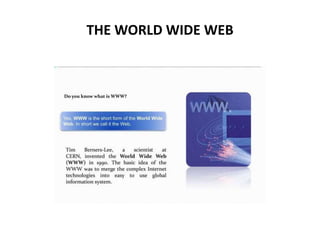
THE WORLD WIDE WEB
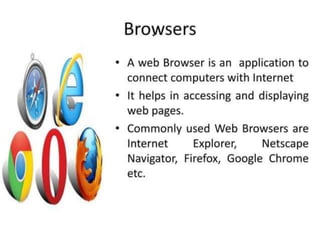
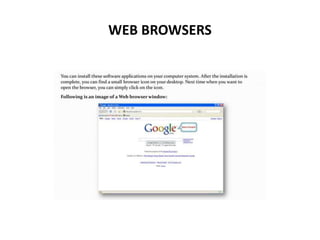
WEB BROWSERS
Types of search Engines
• Crawler-Based Search Engines
• Human-Powered Directories
• Hybrid Search Engines or Mixed Result
Crawler-based search engines
• E.g. Google, All The Web and AltaVista
• Create their listings automatically by using a piece of
software to “crawl” or “spider” the search base.
• Web page changes can be dynamically caught by
crawler-based search engines and will affect how
these web pages get listed in the search results.
• Good for specific search when topic is in mind.
• If search topic is general, crawler-base search engines
may return hundreds of thousands of irrelevant
responses to simple search requests.
Human-Powered Directories
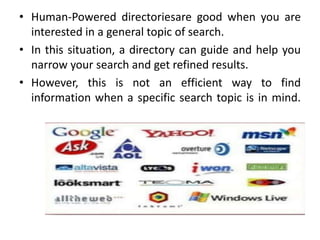
• Eg. Yahoo directory, Open Directory and LookSmart
• Depend on human editors to create their listings.
• Typically, webmasters submit a short description to the
directory for their websites.
• Or editors write one for the sites they review
• These manually edited descriptions will from the search
base.
• Therefore, changes made to individual web pages will
have no effect on how these pages get listed in the
search results.
• Human-Powered directoriesare good when you are
interested in a general topic of search.
• In this situation, a directory can guide and help you
narrow your search and get refined results.
• However, this is not an efficient way to find
information when a specific search topic is in mind.
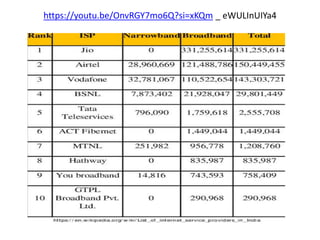
Internet Service Provider
The term “Internet Service Provider (ISP)” refers to a
company that provides access to the internet to both
personal and business customers. ISPs make it
possible for their customers to surf the web, shop
online, conduct business, and connect with family
and friends all for a free.
ISPs may also provide other services, including email
services, domain registration, wed hosting, and
browser packages. An ISP may also be referred to as
an information service provider, a storage service
provider, an internet network service provider
[INSP], or any combination of these three based on
the services offered by the company.`
https://youtu.be/OnvRGY7mo6Q?si=xKQm _ eWULInUIYa4
WEB SITE
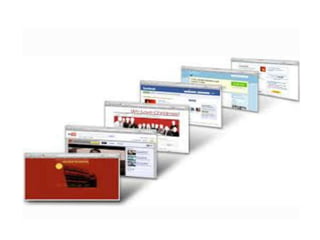
• A site or area on the www or world wide web that is
accessed by its own Internet address is called a
website.
• It can be a collection of related web pages.
• Each web site contains a home page and may also
contain additional pages.
• It is owned and updated by an individual, company,
or organization.
• The web is a dynamically moving and changing
entity, many web sites change on a daily or even
hourly basis.
web pages
• A web pages is a document which can display text,
graphics, audio, video and other elements through
a wed browser.
• Wed pages are document stored on wed servers.
• Wed pages contain instructionson how to display
content. The most common instructions are in
hypertext markup language [ HTML].
Conclusion
• Web services are one of the key elements of the so-
called programmable Web. They are extremely
versatile software elements that really have the
potential to open up a new era in sofware: the age of
interoperability. Web services can be effectively used
to participate in and set up business-to-business
(B2B) transactions. They are great at exposing
software functionality to customers and integrating
heterogeneous platforms.
References
• Aggarwal A.(2000) Web based Learning and Teaching
Technologies: Opportunities and Challenges. Hershey
PA: Idea Group Publising
• https://www.slideshare.net > browser
• https://kuvempu.ac.in > Admin
Information and communication technology

Information and communication technology

  • 1.
    SUBJECT : INFORMATIONAND COMMUNICATION TECHNOLOGY AT SECONDARY EDUCATION TOPIC : Browser, Web Search Engines, Web Page, Internet Service Providers. Submitted to, Dr. Jagannath k. Dange Professor Department of Education Submitted by, Kuvempu University Chaitra . H . V M.Ed 2 semester Dept of Education Kuvempu University
  • 2.
    SL NO INDEX 1The world wide web 2 Browsers 3 Search Engines 4 Types of search engines 5 Internet Service Provider 6 Web site 7 Web page 8 Conclusion 9 Reference
  • 3.
  • 5.
  • 7.
    Types of searchEngines • Crawler-Based Search Engines • Human-Powered Directories • Hybrid Search Engines or Mixed Result Crawler-based search engines • E.g. Google, All The Web and AltaVista • Create their listings automatically by using a piece of software to “crawl” or “spider” the search base. • Web page changes can be dynamically caught by crawler-based search engines and will affect how these web pages get listed in the search results.
  • 8.
    • Good forspecific search when topic is in mind. • If search topic is general, crawler-base search engines may return hundreds of thousands of irrelevant responses to simple search requests. Human-Powered Directories • Eg. Yahoo directory, Open Directory and LookSmart • Depend on human editors to create their listings. • Typically, webmasters submit a short description to the directory for their websites. • Or editors write one for the sites they review • These manually edited descriptions will from the search base. • Therefore, changes made to individual web pages will have no effect on how these pages get listed in the search results.
  • 9.
    • Human-Powered directoriesaregood when you are interested in a general topic of search. • In this situation, a directory can guide and help you narrow your search and get refined results. • However, this is not an efficient way to find information when a specific search topic is in mind.
  • 10.
    Internet Service Provider Theterm “Internet Service Provider (ISP)” refers to a company that provides access to the internet to both personal and business customers. ISPs make it possible for their customers to surf the web, shop online, conduct business, and connect with family and friends all for a free. ISPs may also provide other services, including email services, domain registration, wed hosting, and browser packages. An ISP may also be referred to as an information service provider, a storage service provider, an internet network service provider [INSP], or any combination of these three based on the services offered by the company.`
  • 11.
  • 12.
    WEB SITE • Asite or area on the www or world wide web that is accessed by its own Internet address is called a website. • It can be a collection of related web pages. • Each web site contains a home page and may also contain additional pages. • It is owned and updated by an individual, company, or organization. • The web is a dynamically moving and changing entity, many web sites change on a daily or even hourly basis.
  • 13.
    web pages • Aweb pages is a document which can display text, graphics, audio, video and other elements through a wed browser. • Wed pages are document stored on wed servers. • Wed pages contain instructionson how to display content. The most common instructions are in hypertext markup language [ HTML].
  • 15.
    Conclusion • Web servicesare one of the key elements of the so- called programmable Web. They are extremely versatile software elements that really have the potential to open up a new era in sofware: the age of interoperability. Web services can be effectively used to participate in and set up business-to-business (B2B) transactions. They are great at exposing software functionality to customers and integrating heterogeneous platforms.
  • 16.
    References • Aggarwal A.(2000)Web based Learning and Teaching Technologies: Opportunities and Challenges. Hershey PA: Idea Group Publising • https://www.slideshare.net > browser • https://kuvempu.ac.in > Admin