It occurs after:
The Verb Paradigm
To
Auxiliaries such as Can and Will
In the Present tense (except for the third – person singular)
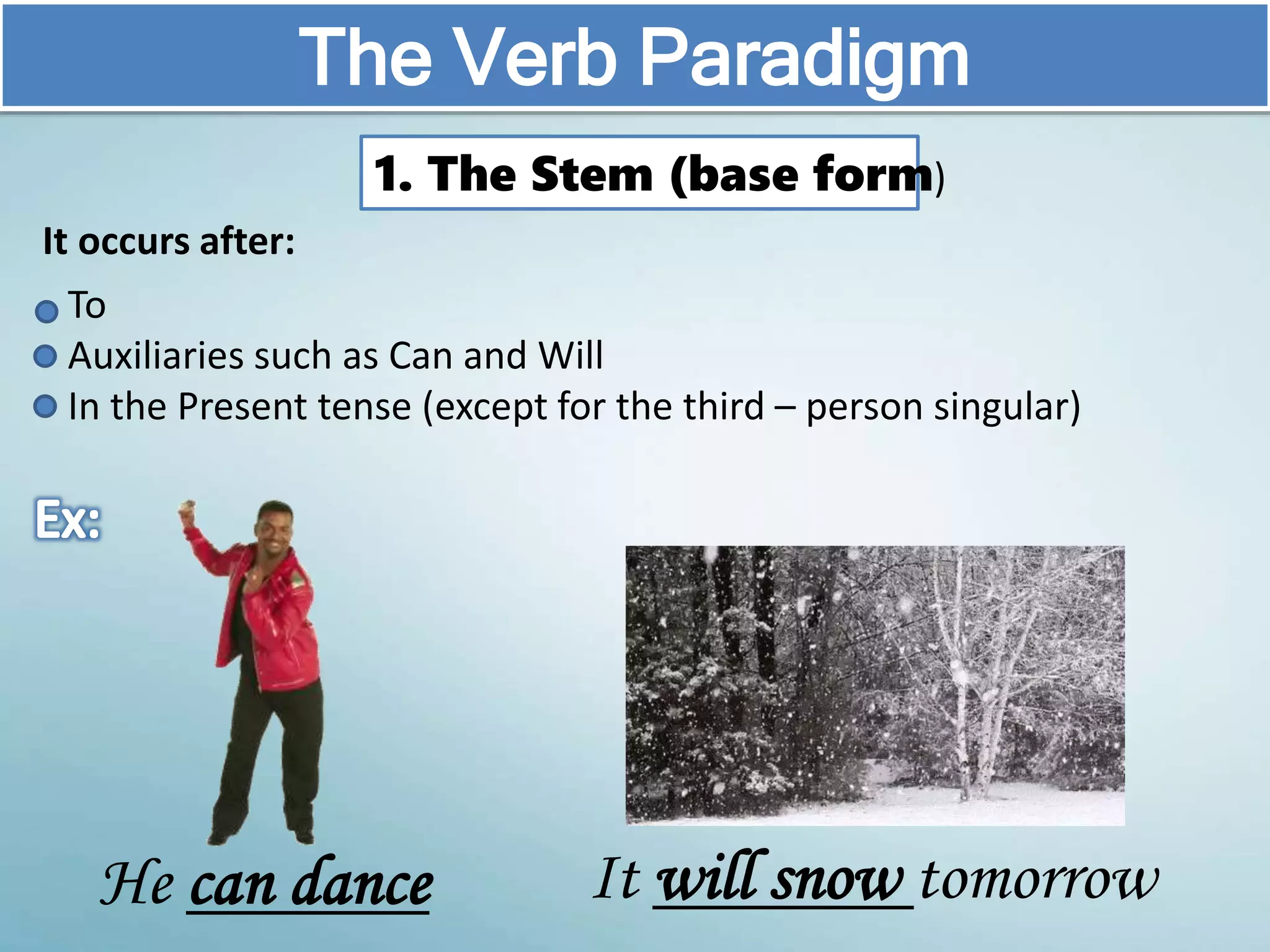
He can dance It will snow tomorrow
1. The Stem (base form)
It’s used with
The Verb Paradigm
Singular Nouns
He, She , It (or words which these pronouns will susbstitute)
2. The Present Third-person Singular { -s 3 d }
It’s used with
The Verb Paradigm
Singular Nouns
He, She , It (or words which these pronouns will susbstitute)
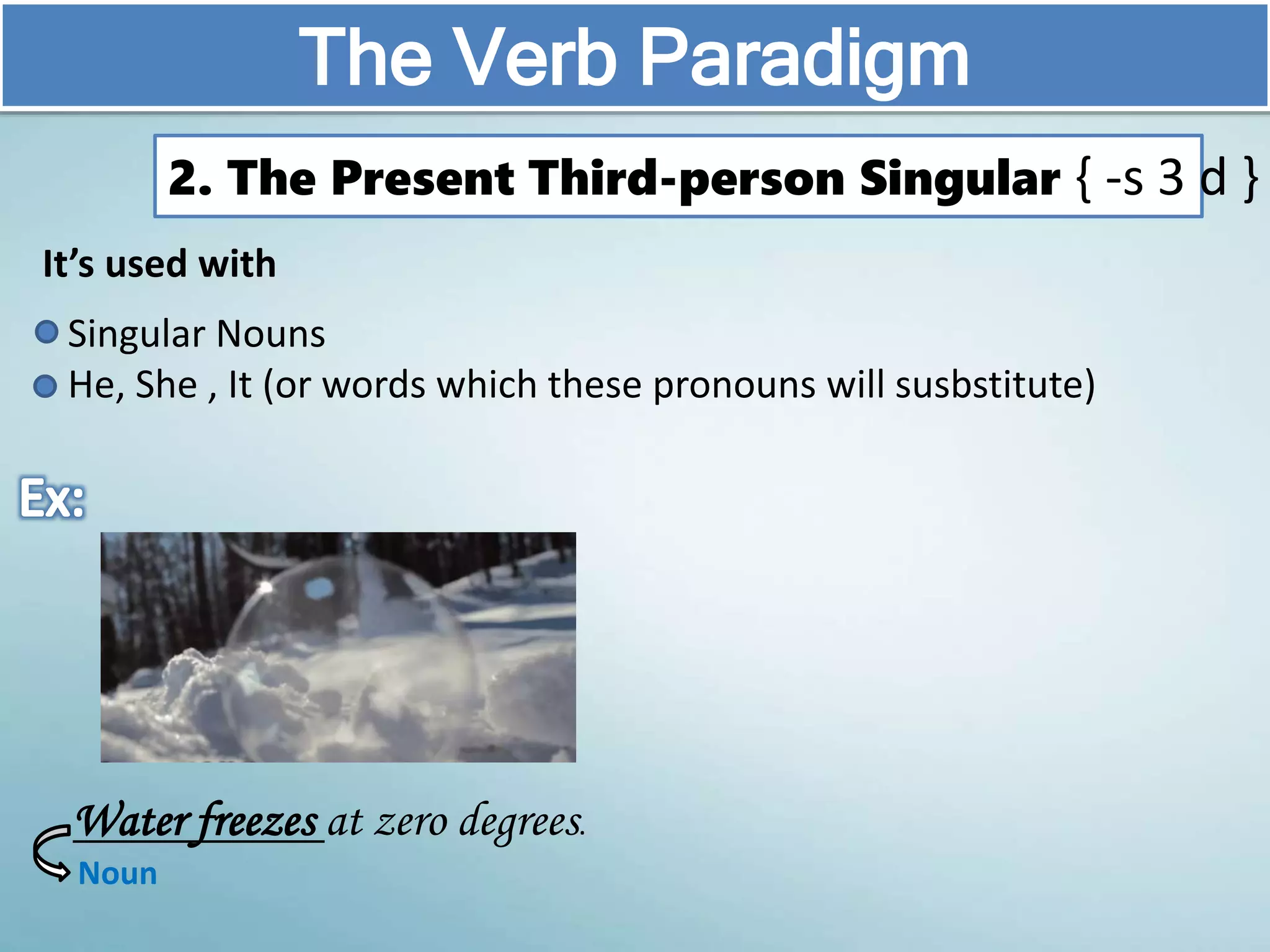
Water freezes at zero degrees.
Noun
2. The Present Third-person Singular { -s 3 d }
It’s used with
The Verb Paradigm
Singular Nouns
He, She, It (or words which these pronouns will susbstitute)
Water freezes at zero degrees.
Noun
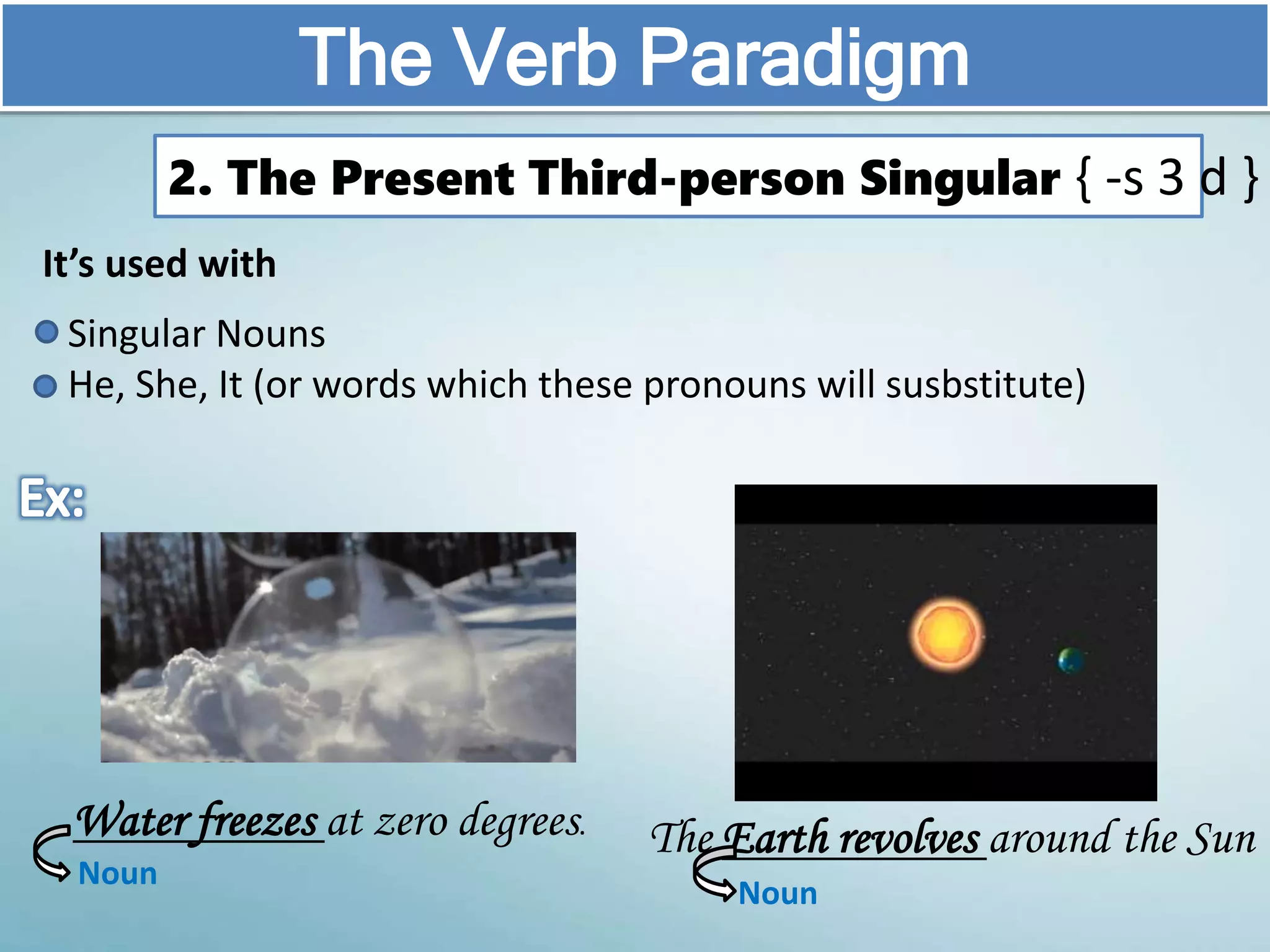
The Earth revolves around the Sun
Noun
2. The Present Third-person Singular { -s 3 d }
It’s used with
The Verb Paradigm
Singular Nouns
He, She, It (or words which these pronouns will susbstitute)
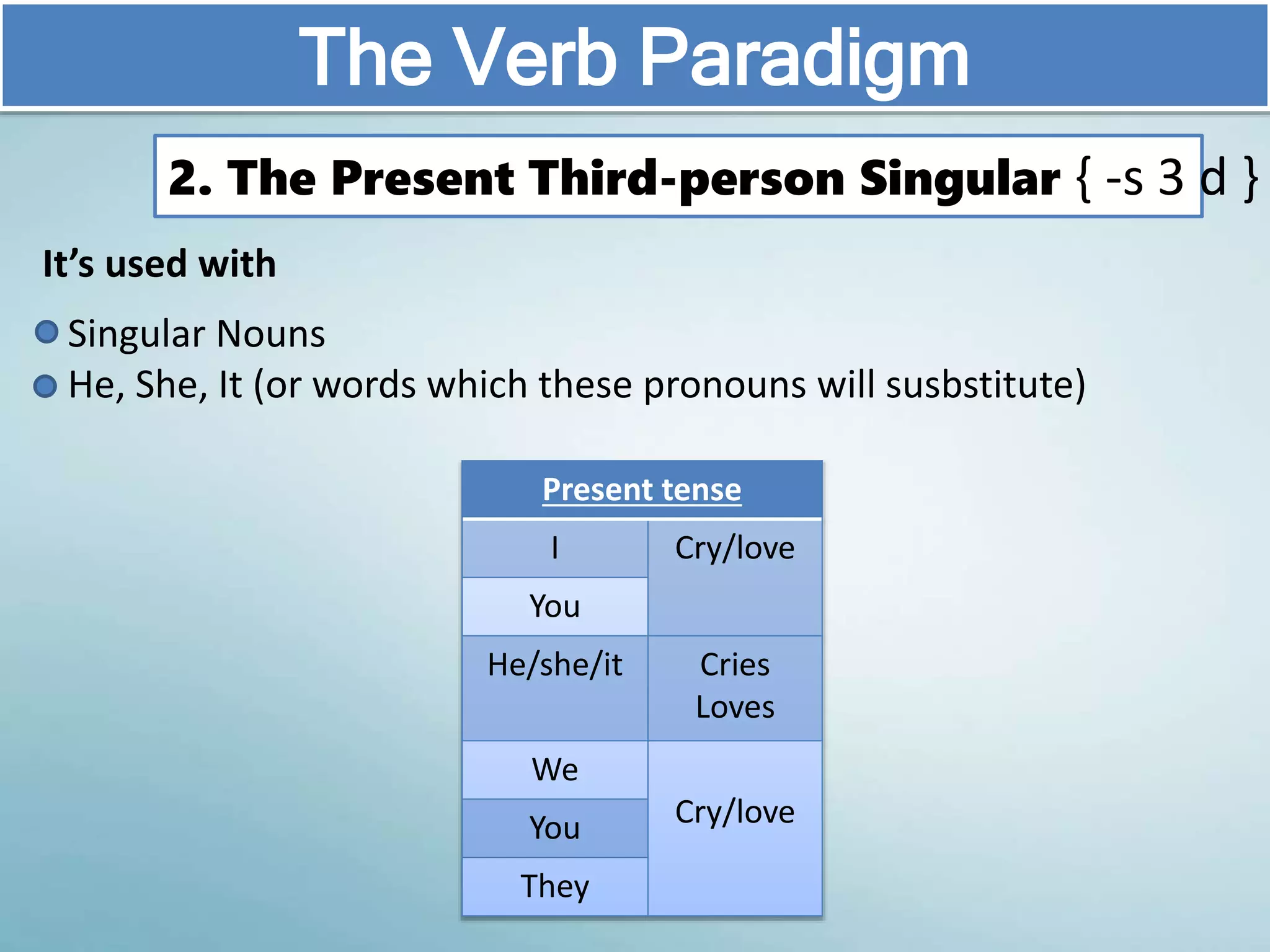
Present tense
I Cry/love
You
He/she/it Cries
Loves
We
Cry/loveYou
They
2. The Present Third-person Singular { -s 3 d }
It’s used with
The Verb Paradigm
2. The Present Third-person Singular { -s 3 d }
Singular Nouns
He, She , It (or words which these pronouns will susbstitute)
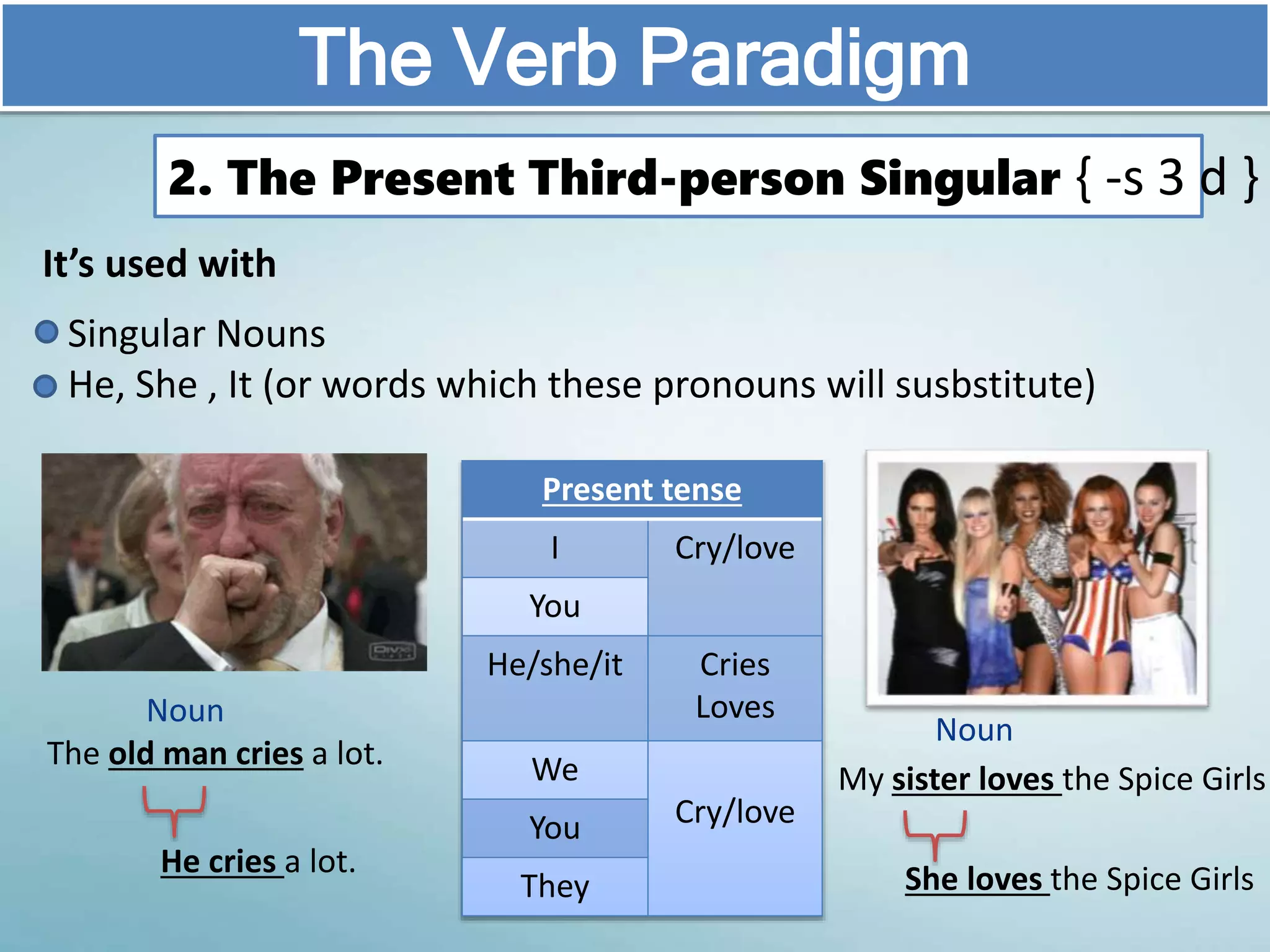
Present tense
I Cry/love
You
He/she/it Cries
Loves
We
Cry/loveYou
They
The old man cries a lot.
He cries a lot.
Noun
She loves the Spice Girls
My sister loves the Spice Girls
Noun
The Verb Paradigm
3. The Present Participle {-ING vb}
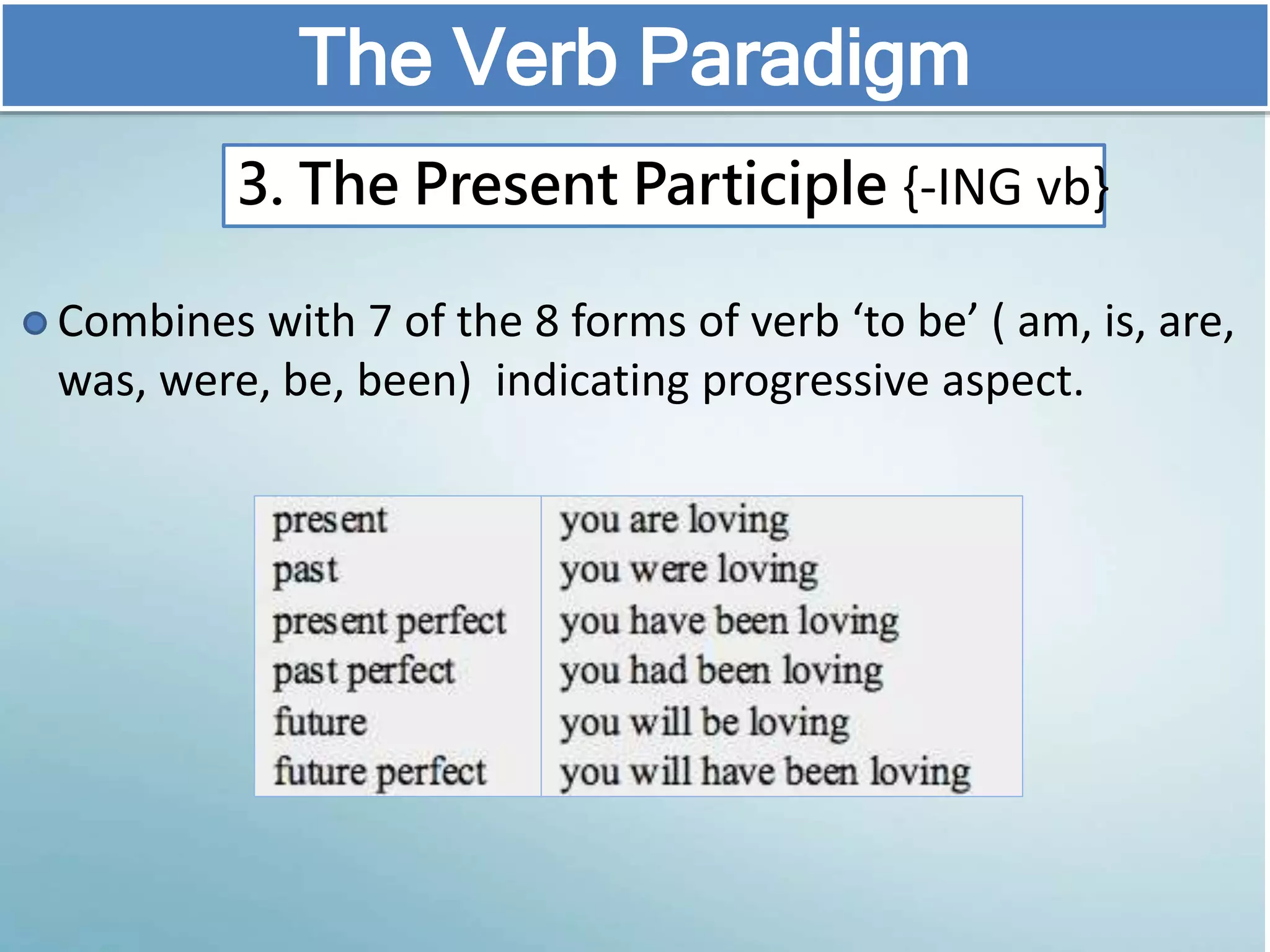
Combines with 7 of the 8 forms of verb ‘to be’ ( am, is, are,
was, were, be, been) indicating progressive aspect.
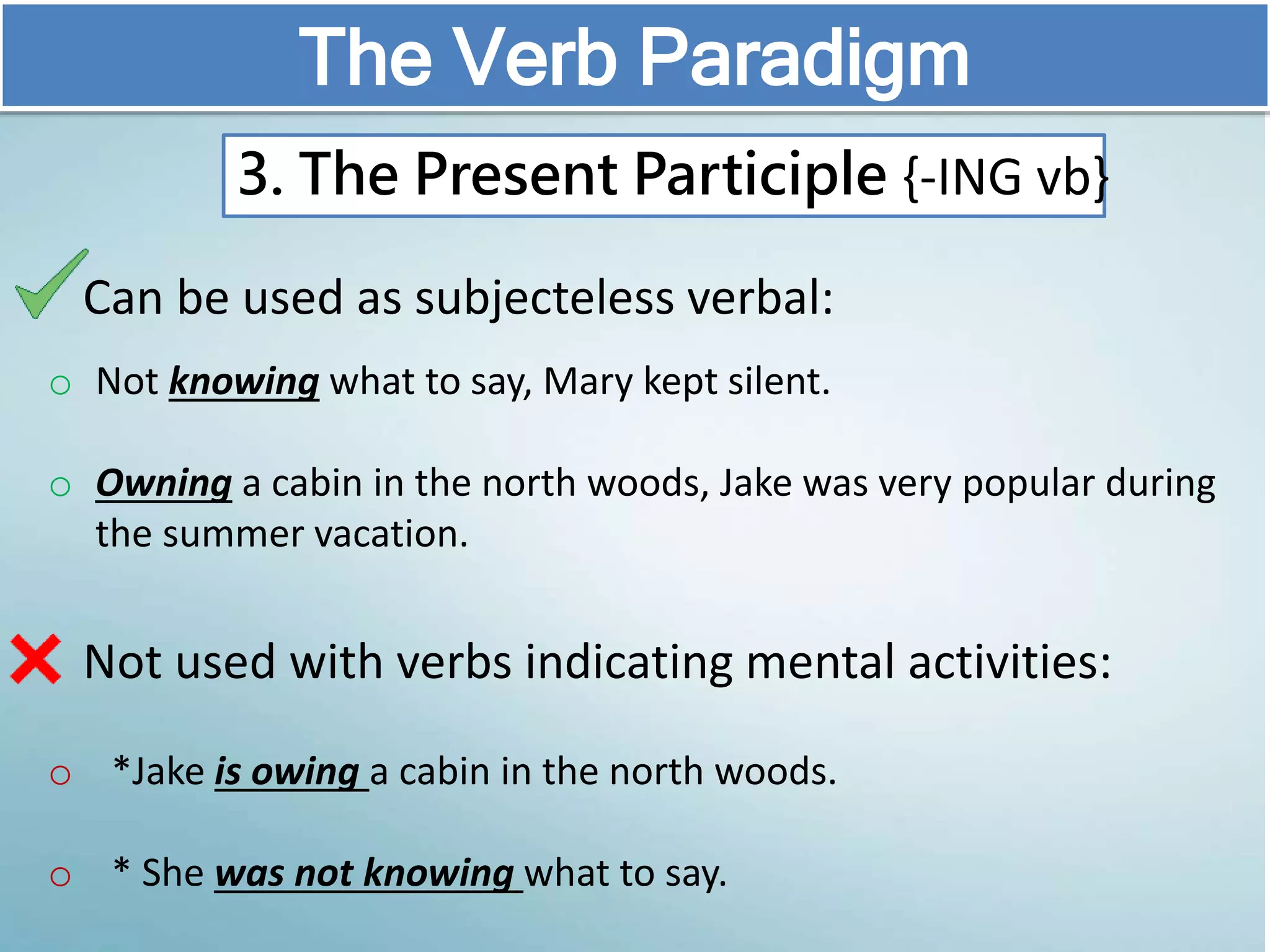
Can be used as subjecteless verbal:
o Not knowing what to say, Mary kept silent.
o Owning a cabin in the north woods, Jake was very popular during
the summer vacation.
Not used with verbs indicating mental activities:
o *Jake is owing a cabin in the north woods.
o * She was not knowing what to say.
The Verb Paradigm
3. The Present Participle {-ING vb}
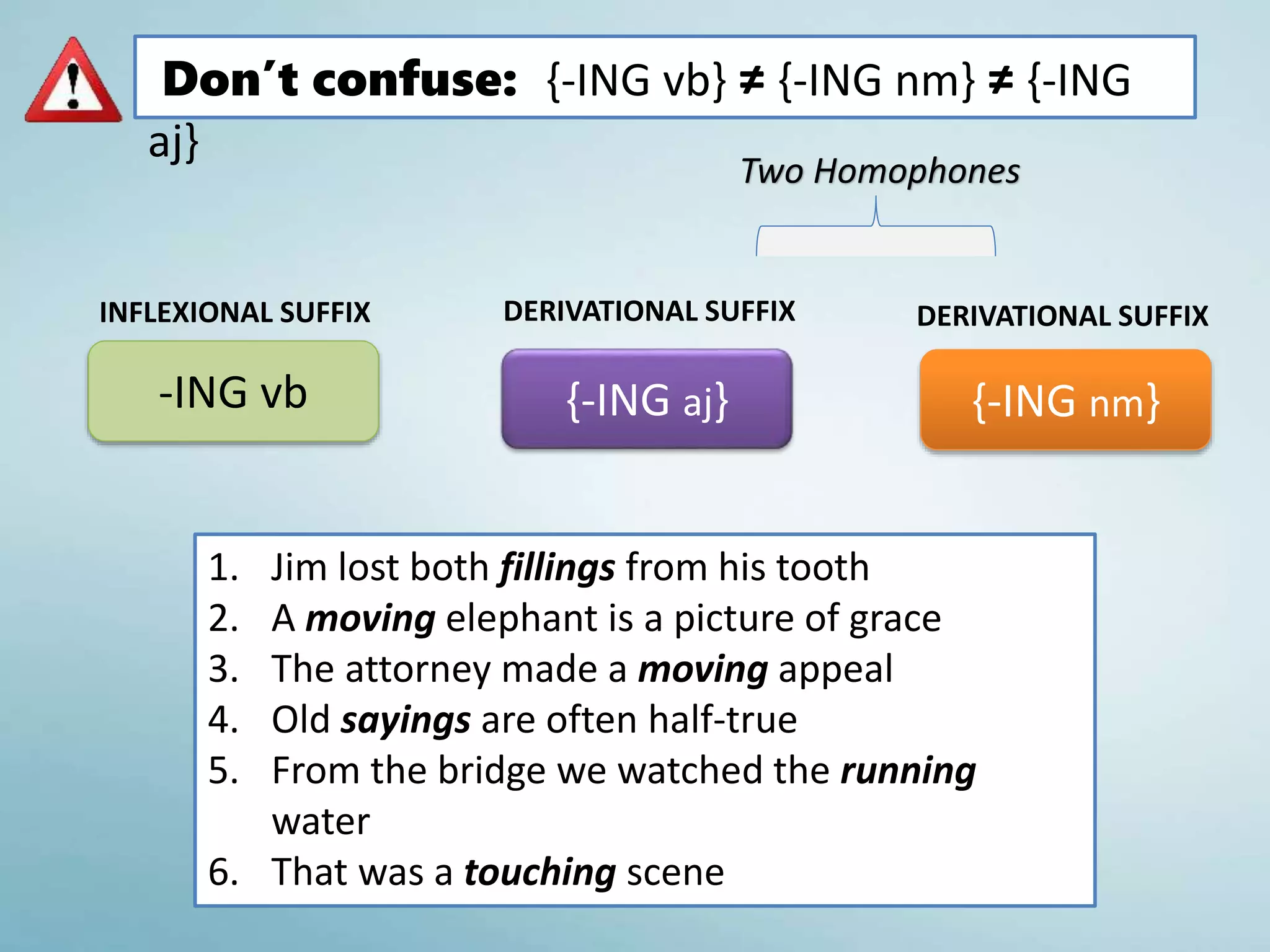
Two Homophones
INFLEXIONAL SUFFIX
Don’t confuse: {-ING vb} ≠ {-ING nm} ≠ {-ING
aj}
-ING vb {-ING nm}{-ING aj}
DERIVATIONAL SUFFIXDERIVATIONAL SUFFIX
1. Jim lost both fillings from his tooth
2. A moving elephant is a picture of grace
3. The attorney made a moving appeal
4. Old sayings are often half-true
5. From the bridge we watched the running
water
6. That was a touching scene
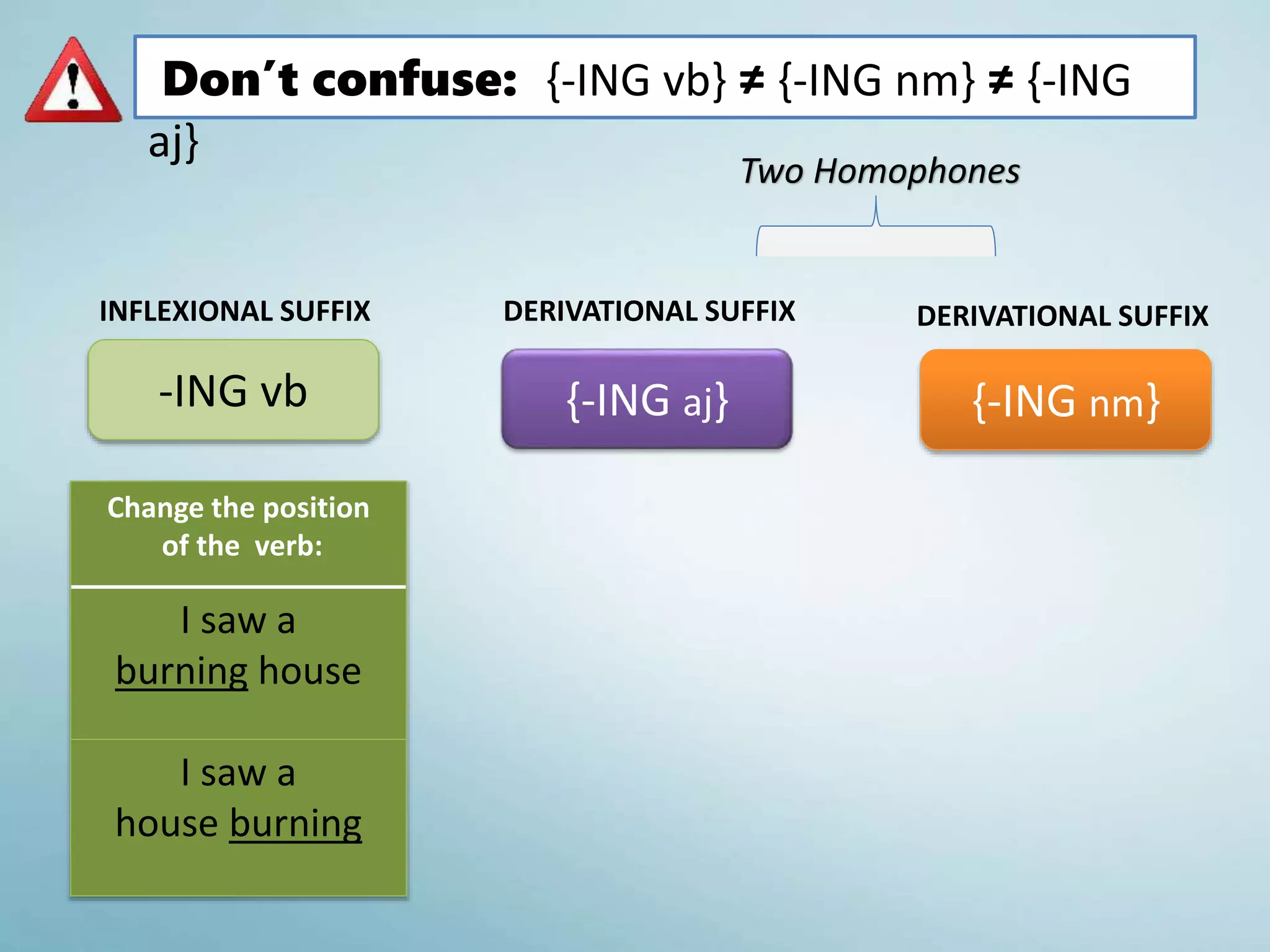
Two Homophones
INFLEXIONAL SUFFIX
Don’t confuse: {-ING vb} ≠ {-ING nm} ≠ {-ING
aj}
Change the position
of the verb:
I saw a
burning house
I saw a
house burning
-ING vb {-ING nm}{-ING aj}
DERIVATIONAL SUFFIXDERIVATIONAL SUFFIX
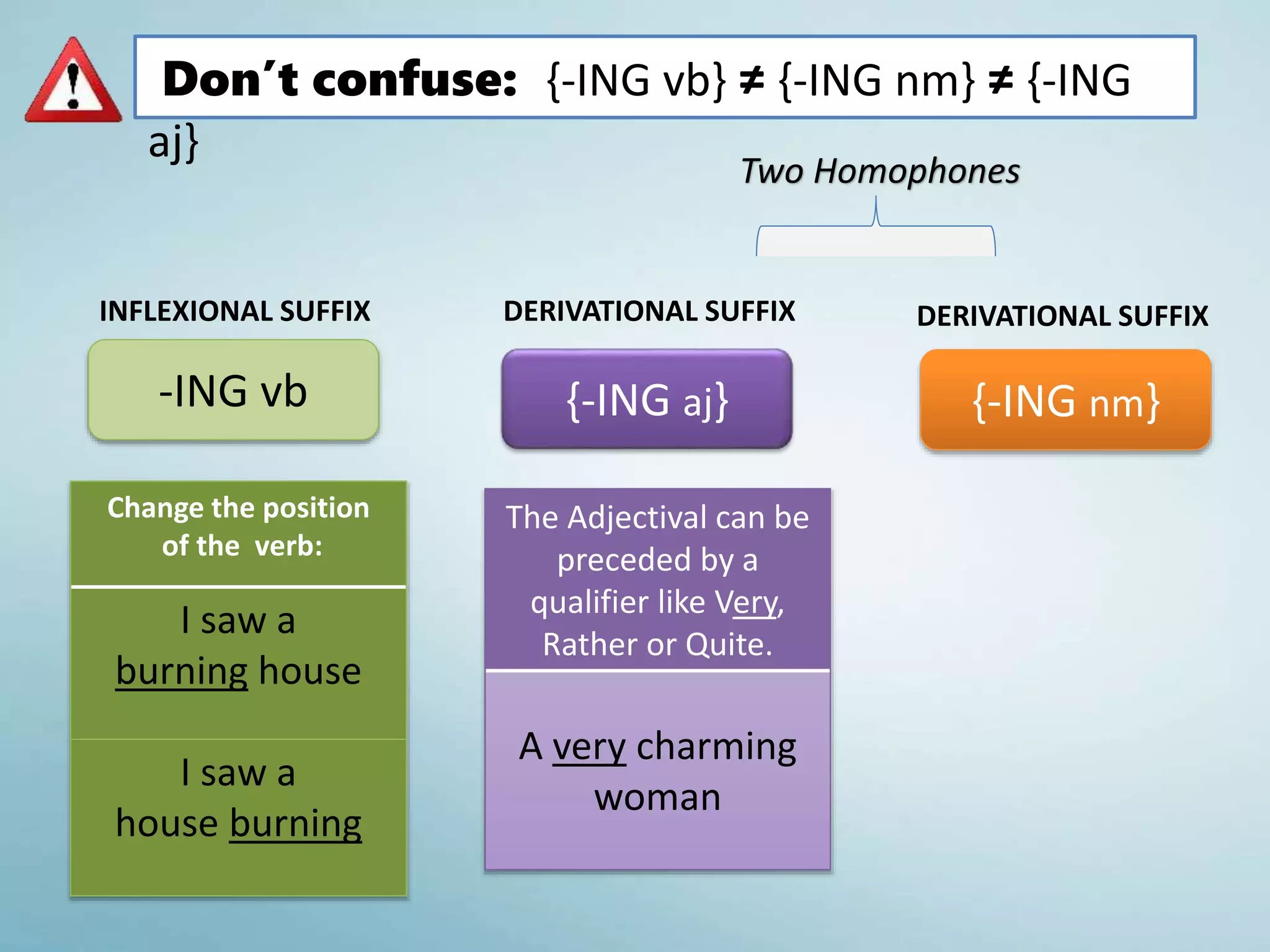
Two Homophones
INFLEXIONAL SUFFIX
Don’t confuse: {-ING vb} ≠ {-ING nm} ≠ {-ING
aj}
Change the position
of the verb:
I saw a
burning house
I saw a
house burning
-ING vb {-ING nm}{-ING aj}
DERIVATIONAL SUFFIXDERIVATIONAL SUFFIX
The Adjectival can be
preceded by a
qualifier like Very,
Rather or Quite.
A very charming
woman
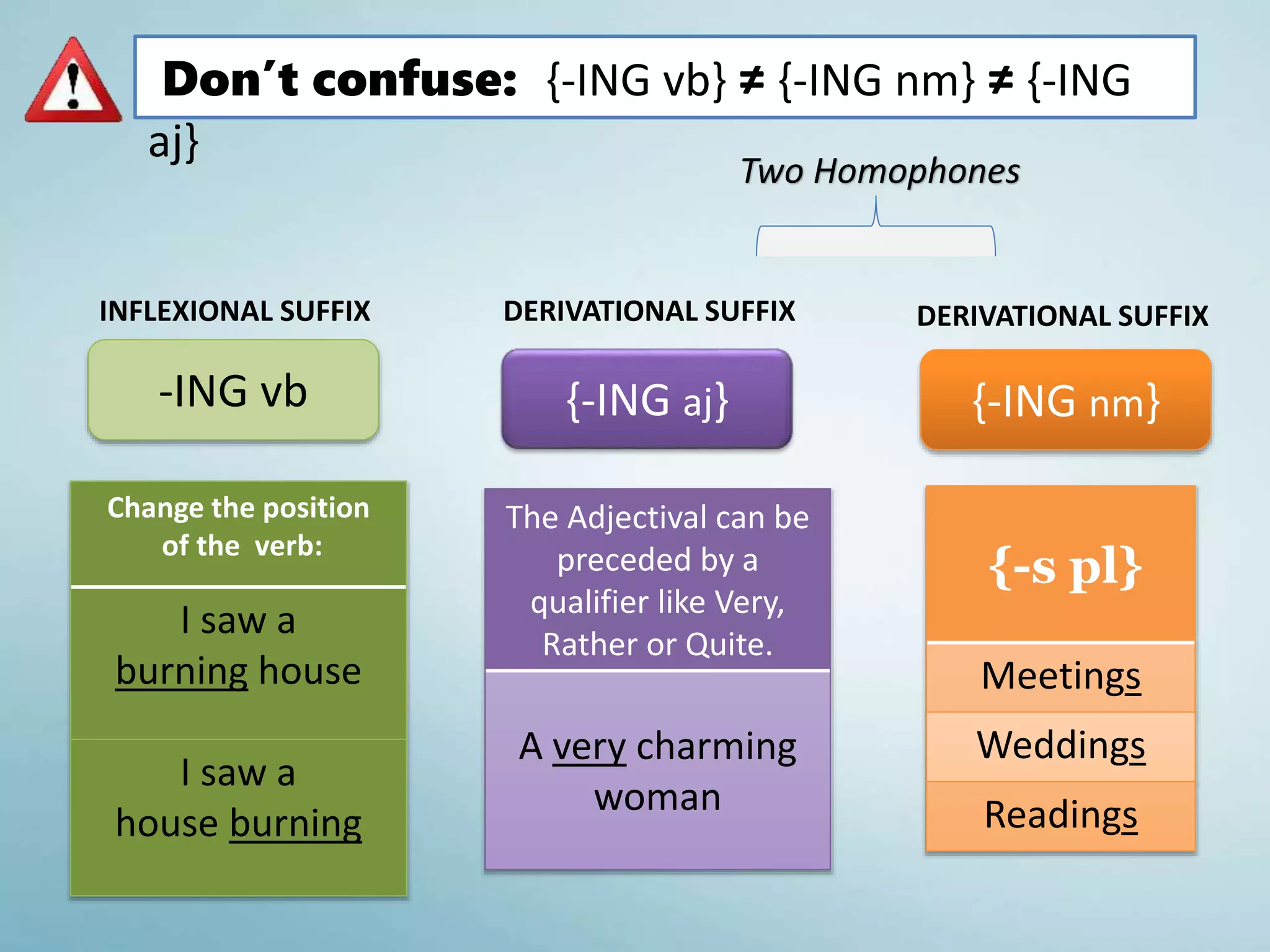
Two Homophones
INFLEXIONAL SUFFIX
Don’t confuse: {-ING vb} ≠ {-ING nm} ≠ {-ING
aj}
Change the position
of the verb:
I saw a
burning house
I saw a
house burning
-ING vb {-ING nm}{-ING aj}
DERIVATIONAL SUFFIXDERIVATIONAL SUFFIX
The Adjectival can be
preceded by a
qualifier like Very,
Rather or Quite.
A very charming
woman
{-s pl}
Meetings
Weddings
Readings
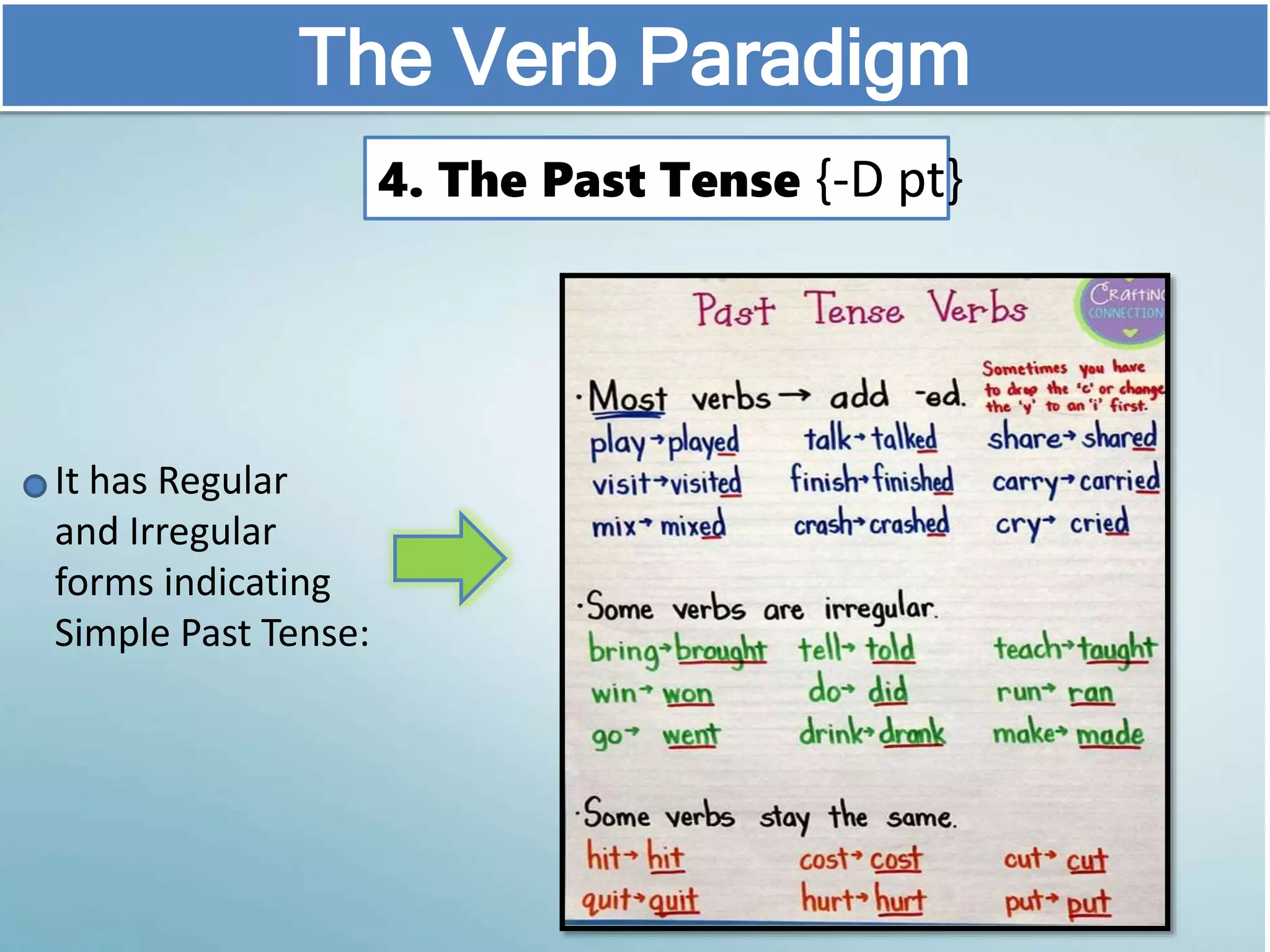
It has Regular
and Irregular
forms indicating
Simple Past Tense:
The Verb Paradigm
4. The Past Tense {-D pt}
It has regular and irregular forms.
It is used with verb ‘to have’ (have, has, had, having) to form verbal
phrases indicating PERFECTIVE ASPECT.
The Verb Paradigm
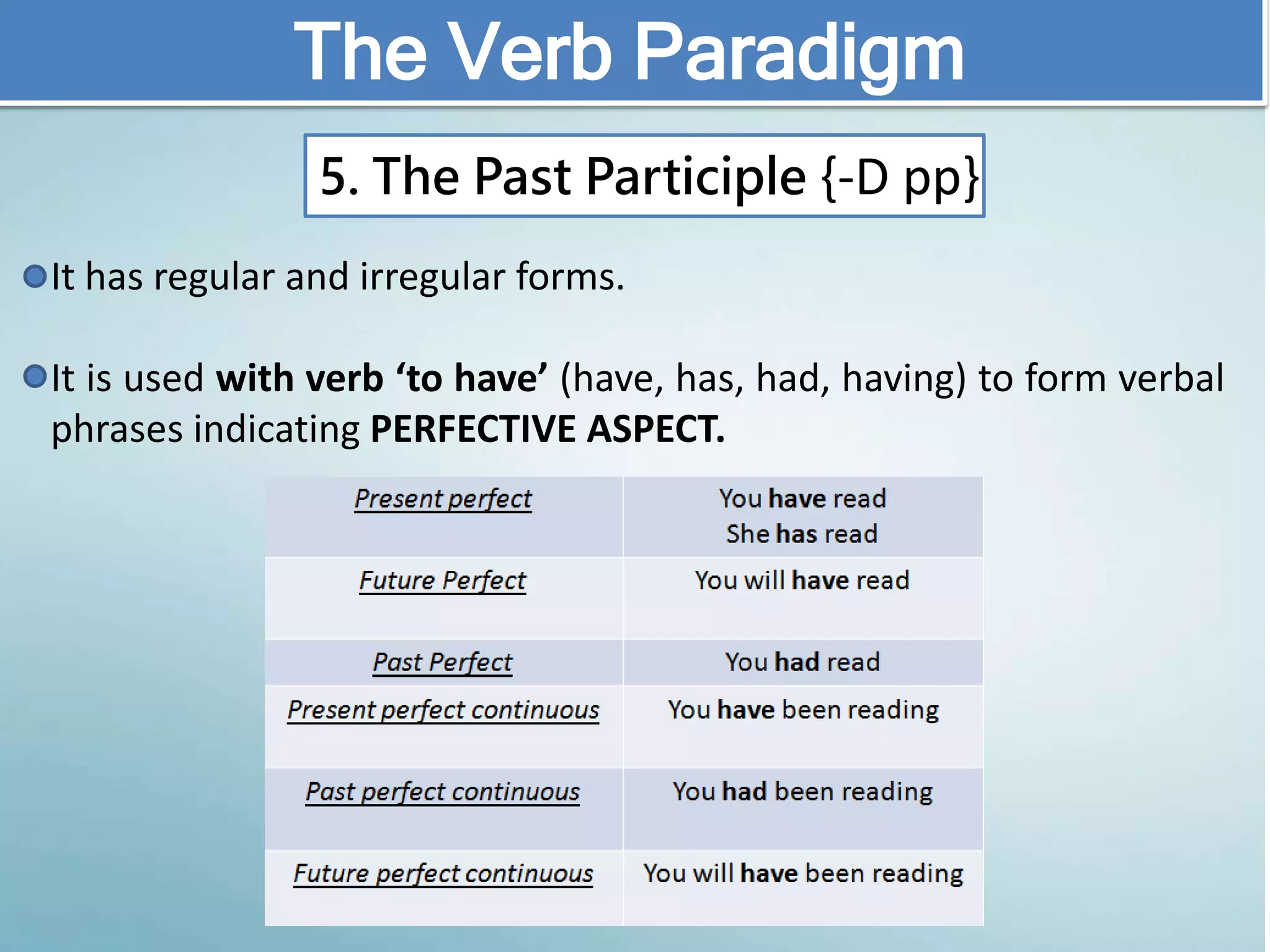
5. The Past Participle {-D pp}
It has regular and irregular forms.
It is used with verb ‘to have’ (have, has, had, having) to form verbal
phrases indicating PERFECTIVE ASPECT.
The Verb Paradigm
5. The Past Participle {-D pp}
[Thing receiving action] + [be] + [past participle of verb] + [by] + [thing doing action]
It can be used with verb ‘to be’ to form the passive form
indicating PASSIVE VOICE.
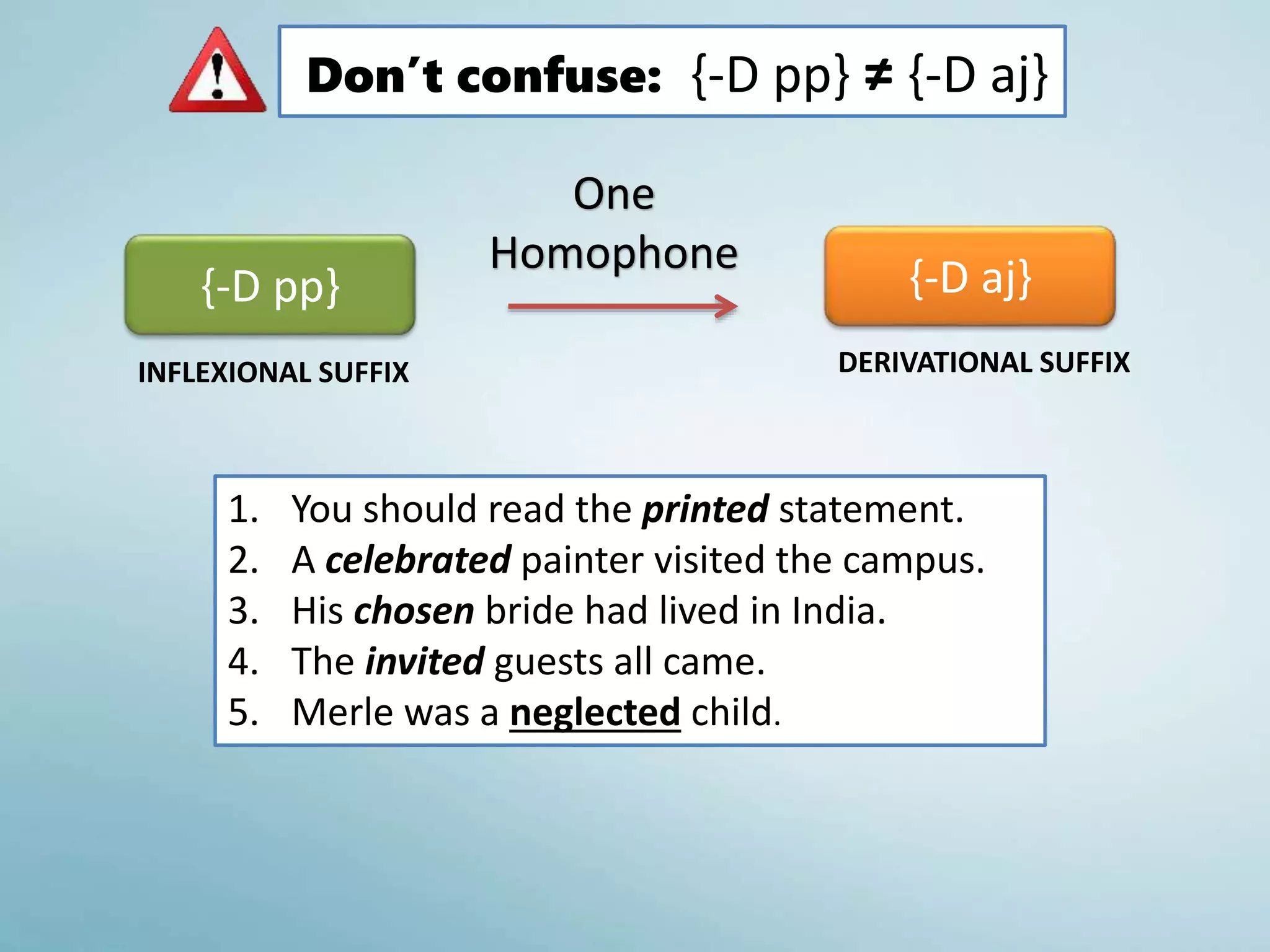
Don’t confuse: {-D pp} ≠ {-D aj}
DERIVATIONAL SUFFIXINFLEXIONAL SUFFIX
{-D aj}
One
Homophone
{-D pp}
1. You should read the printed statement.
2. A celebrated painter visited the campus.
3. His chosen bride had lived in India.
4. The invited guests all came.
5. Merle was a neglected child.
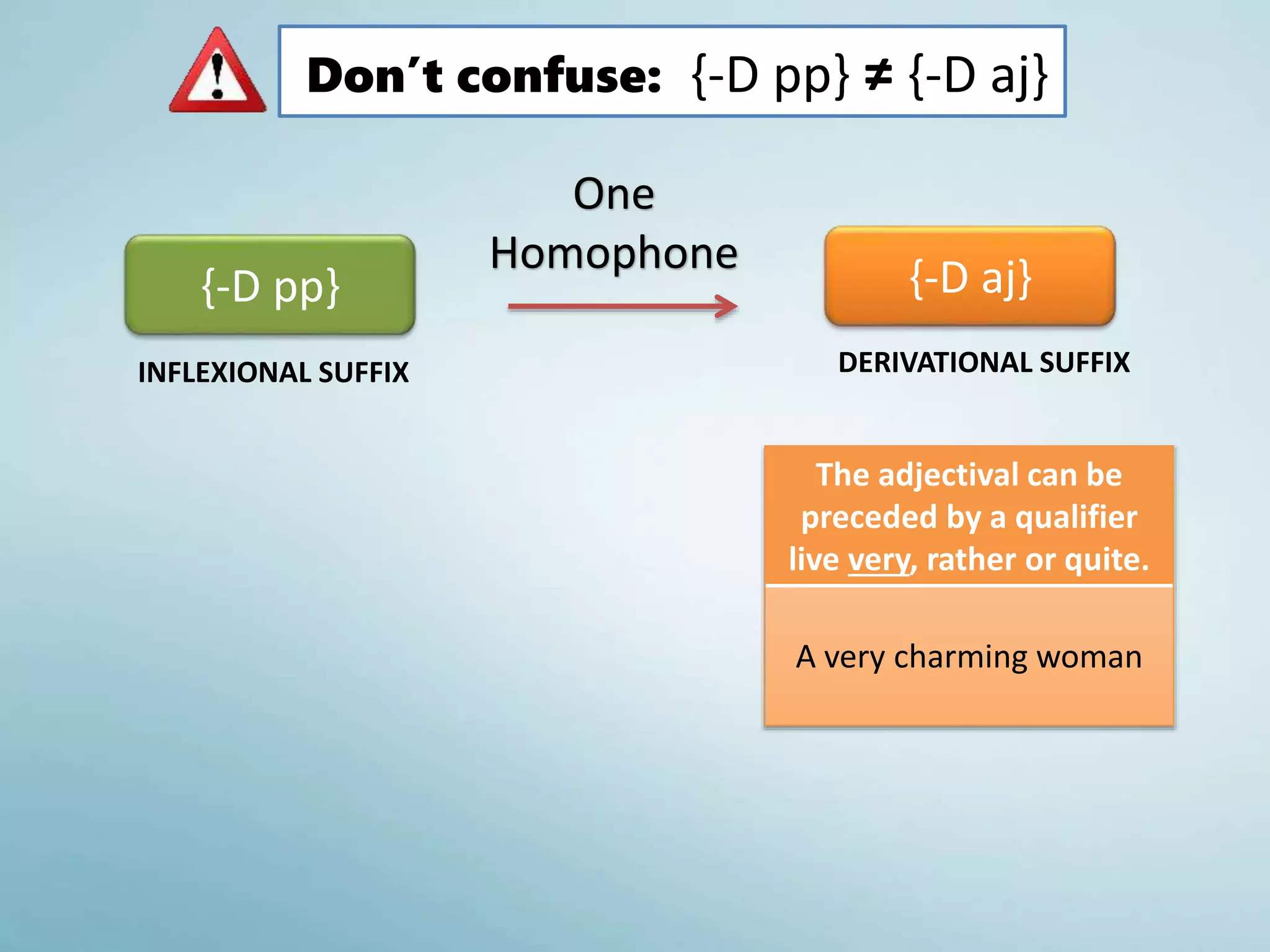
Don’t confuse: {-D pp} ≠ {-D aj}
DERIVATIONAL SUFFIXINFLEXIONAL SUFFIX
{-D aj}
One
Homophone
{-D pp}
The adjectival can be
preceded by a qualifier
live very, rather or quite.
A very charming woman
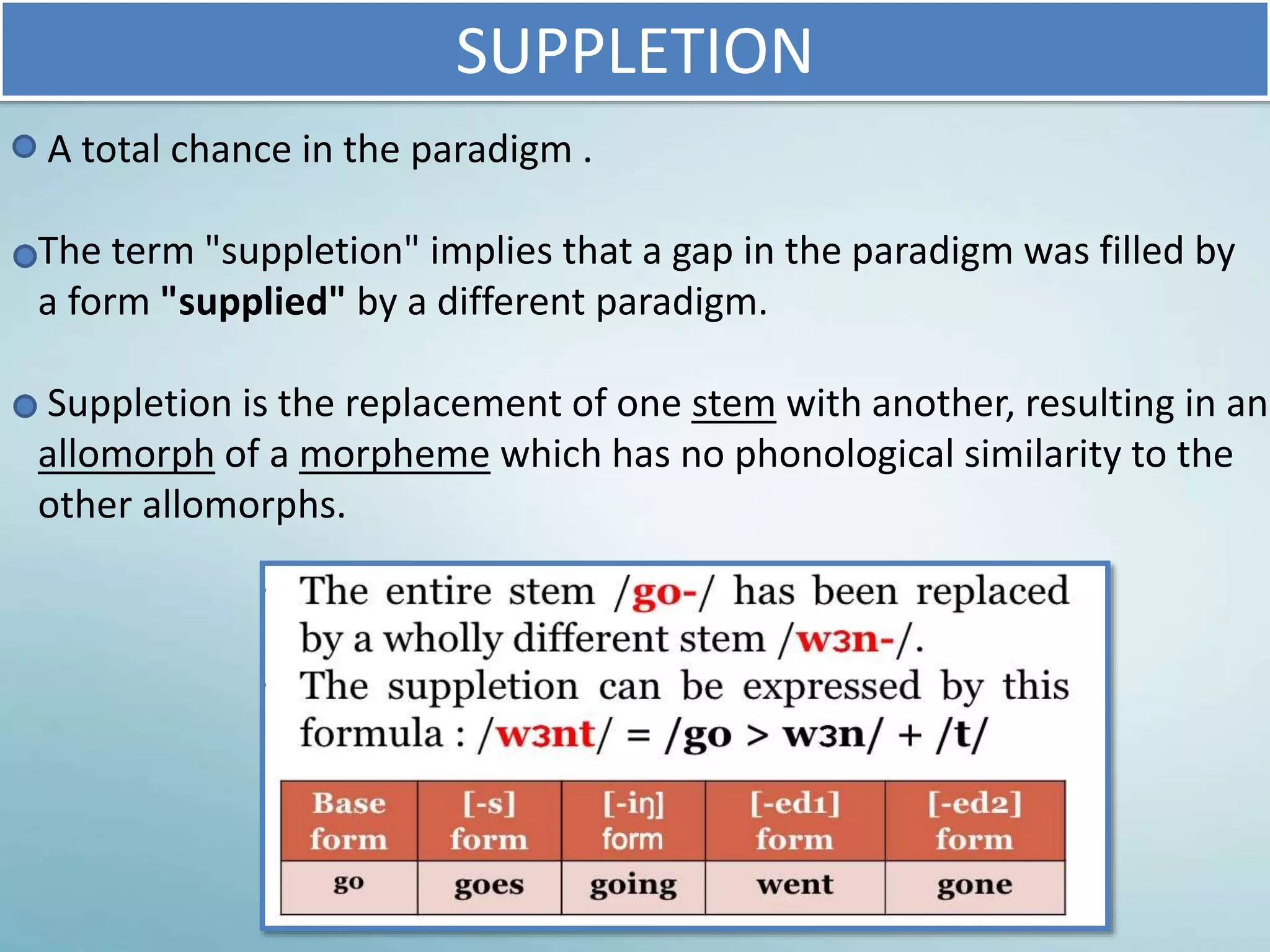
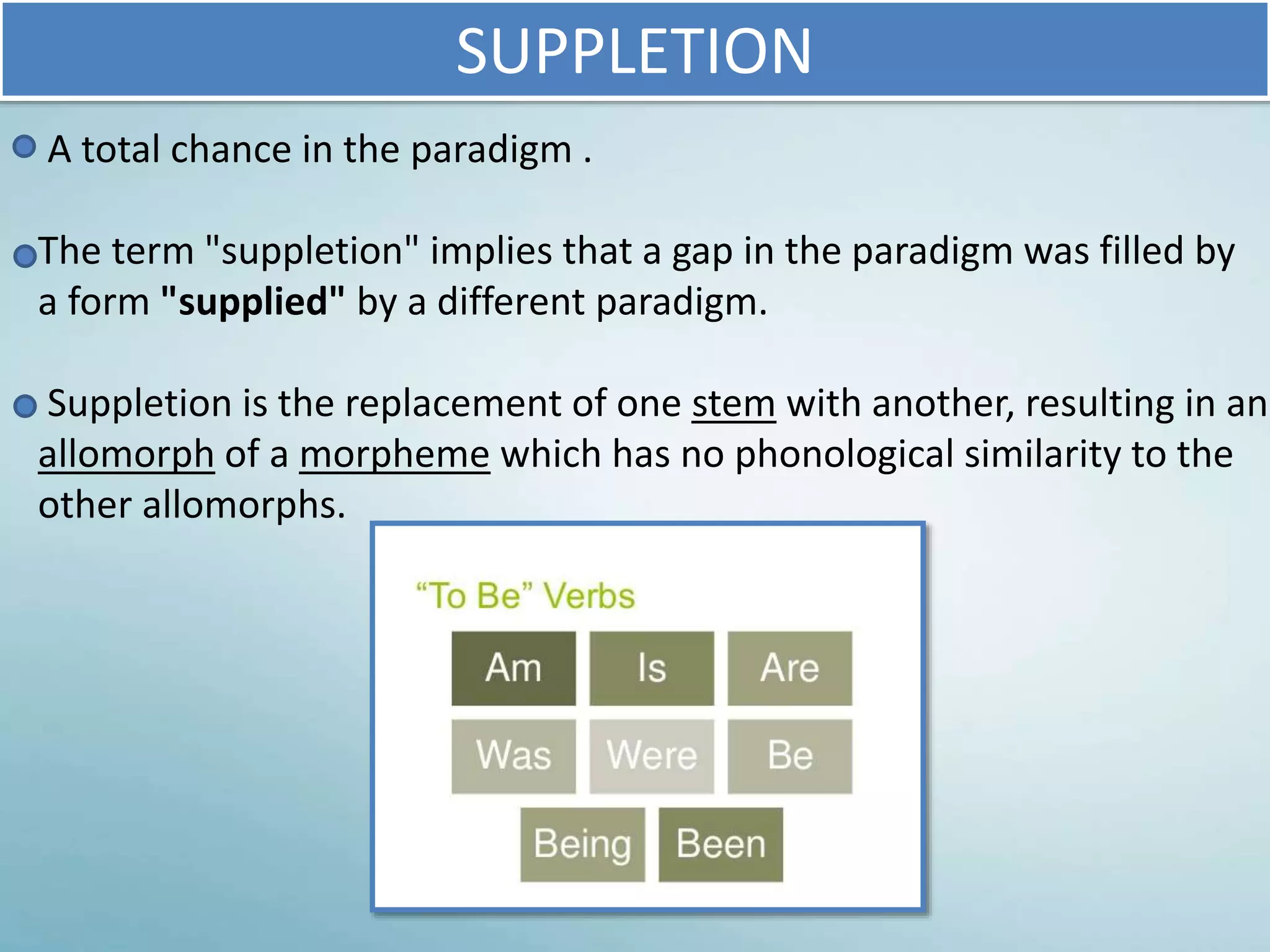
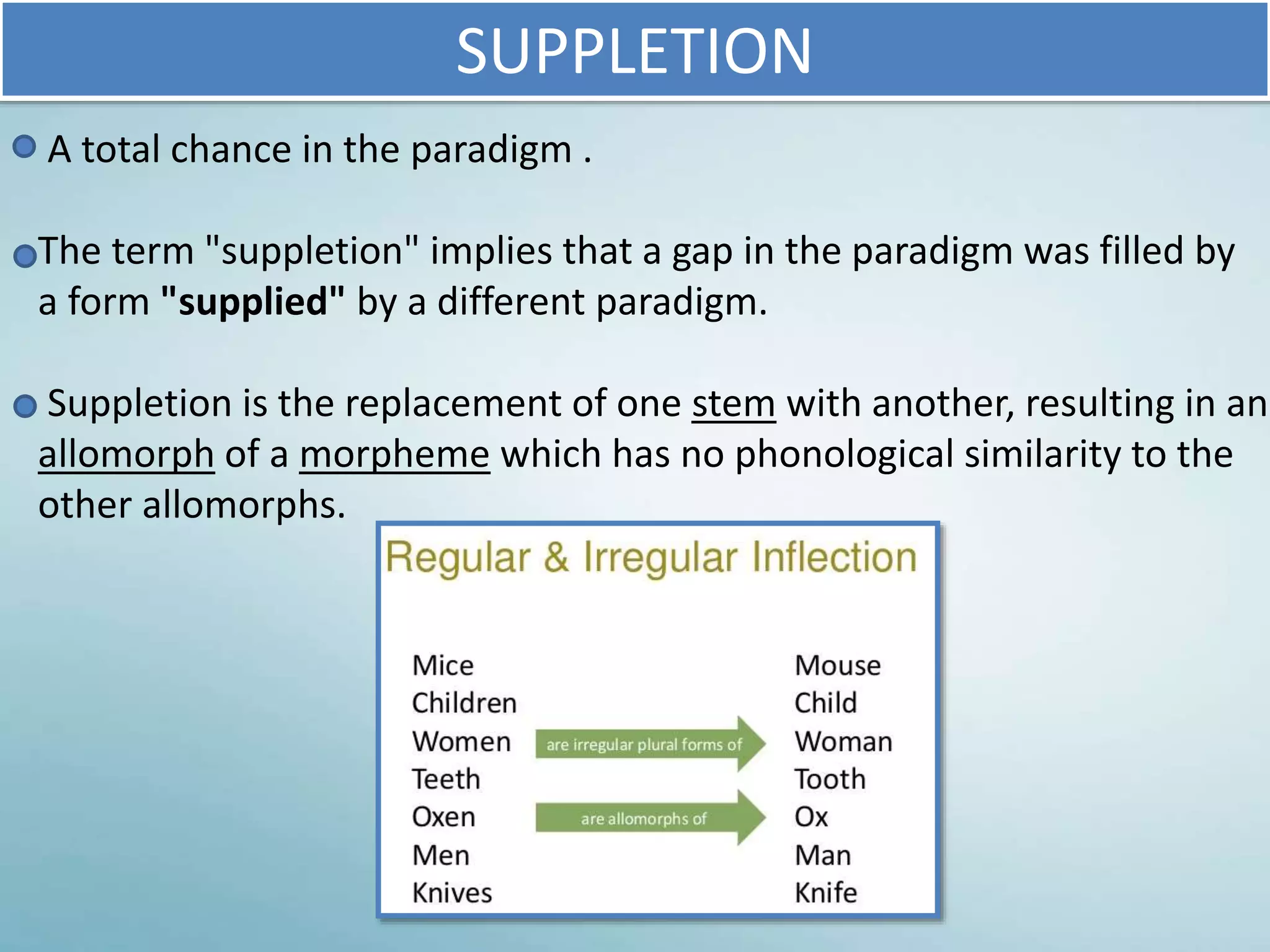
Suppletion
A total chance in the paradigm .
The term "suppletion" implies that a gap in the paradigm was filled by
a form "supplied" by a different paradigm.
Suppletion is the replacement of one stem with another, resulting in an
allomorph of a morpheme which has no phonological similarity to the
other allomorphs.
SUPPLETION
Suppletion
A total chance in the paradigm .
The term "suppletion" implies that a gap in the paradigm was filled by
a form "supplied" by a different paradigm.
Suppletion is the replacement of one stem with another, resulting in an
allomorph of a morpheme which has no phonological similarity to the
other allomorphs.
SUPPLETION
Suppletion
A total chance in the paradigm .
The term "suppletion" implies that a gap in the paradigm was filled by
a form "supplied" by a different paradigm.
Suppletion is the replacement of one stem with another, resulting in an
allomorph of a morpheme which has no phonological similarity to the
other allomorphs.
SUPPLETION
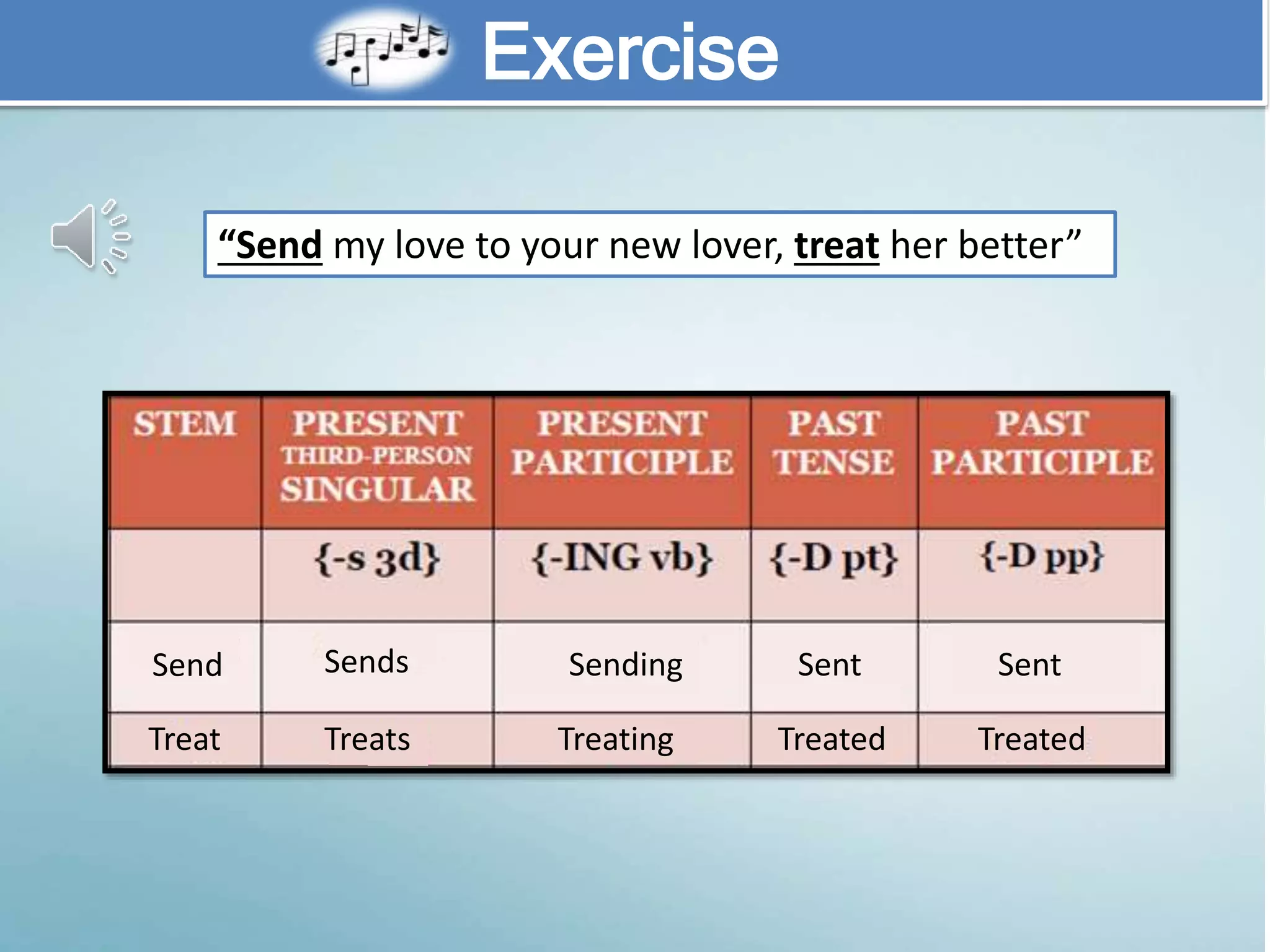
Exercise
“Send my love to your new lover, treat her better”
Send
Treat Treats Treating Treated Treated
Sends Sending SentSent
Exercise
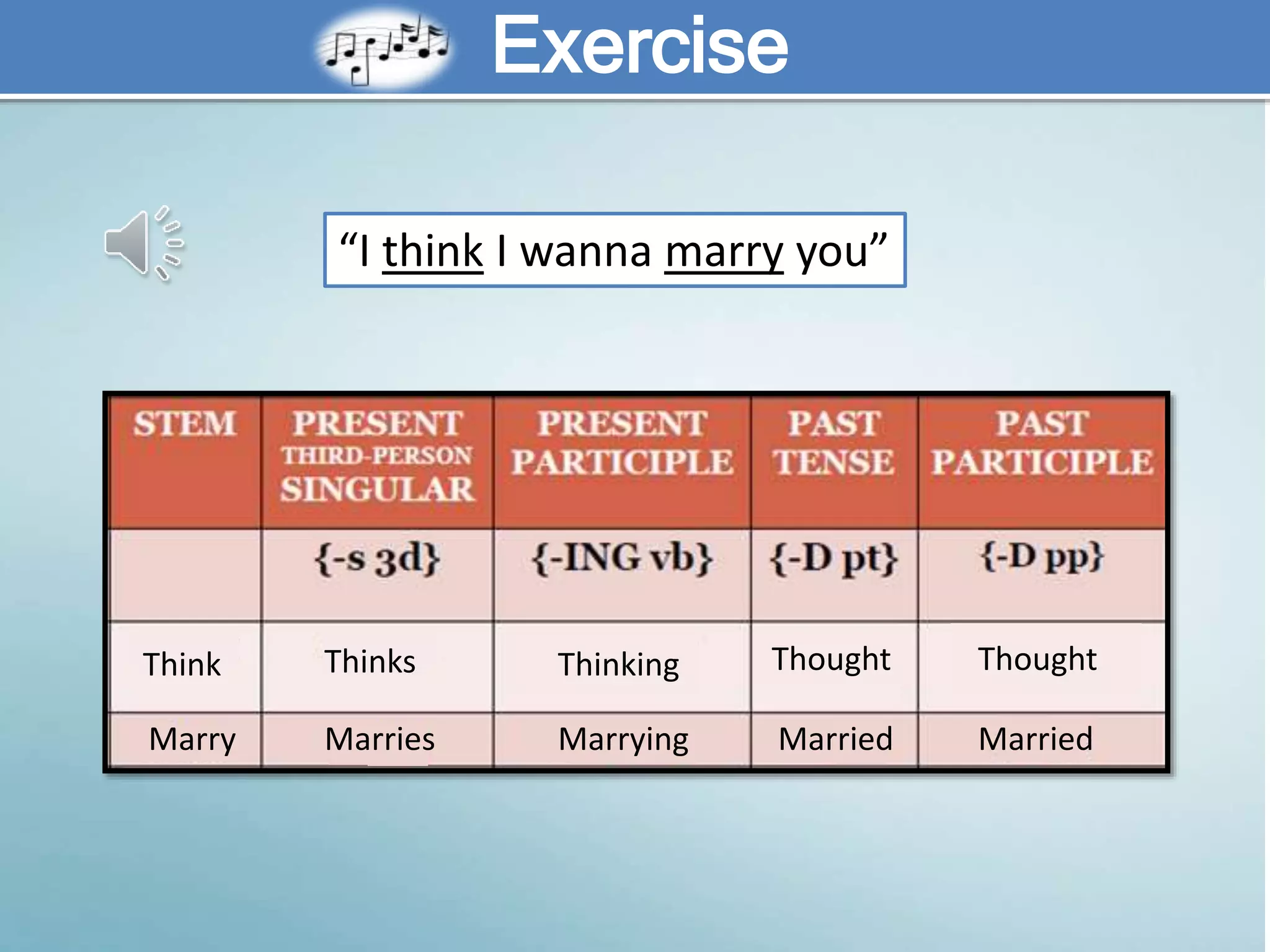
“I think I wanna marry you”
Thought
Marry Marries Marrying Married
Thinks Thinking ThoughtThink
Married
v
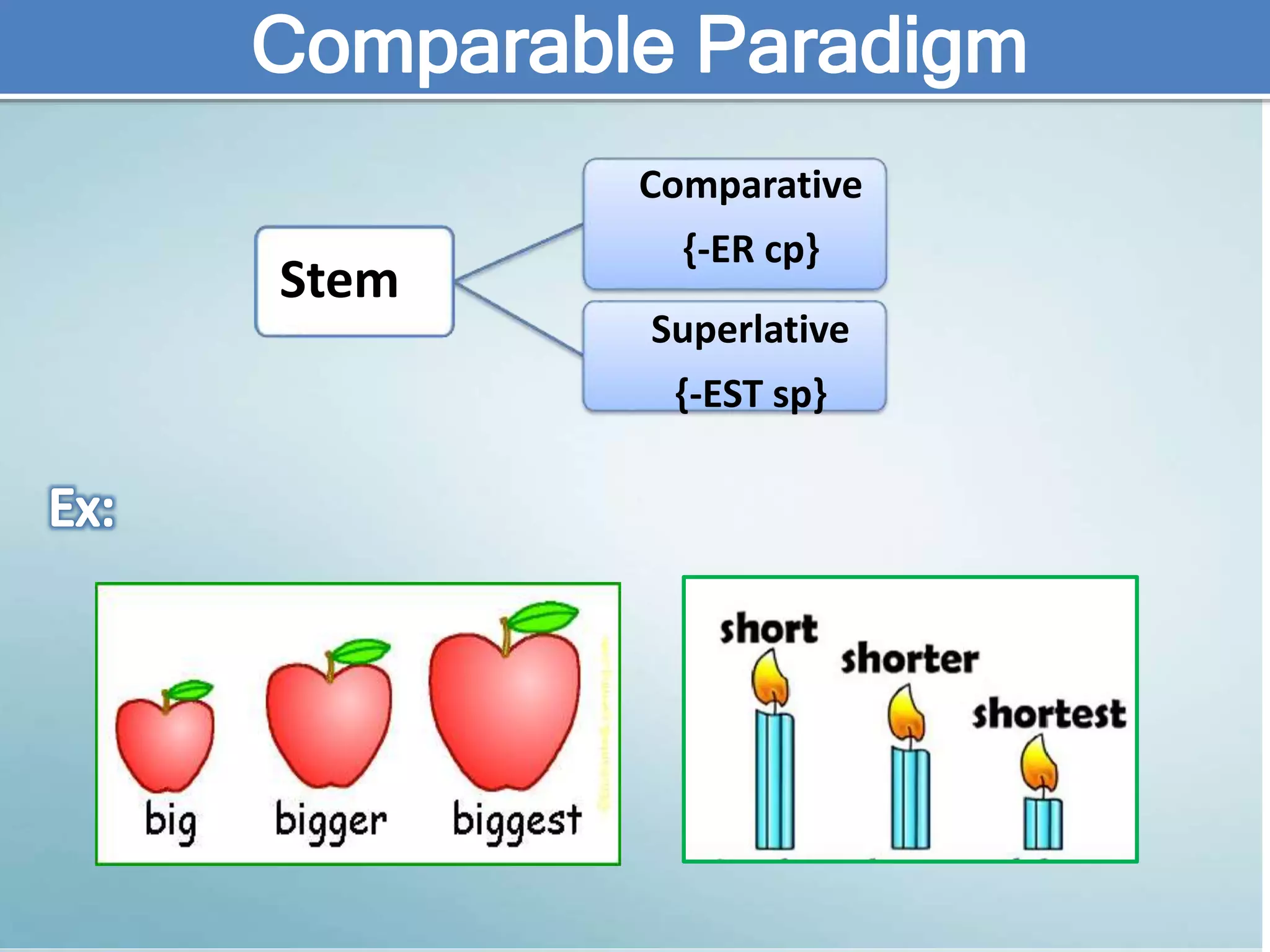
Stem
Comparative
{-ER cp}
Superlative
{-EST sp}
Comparable Paradigm
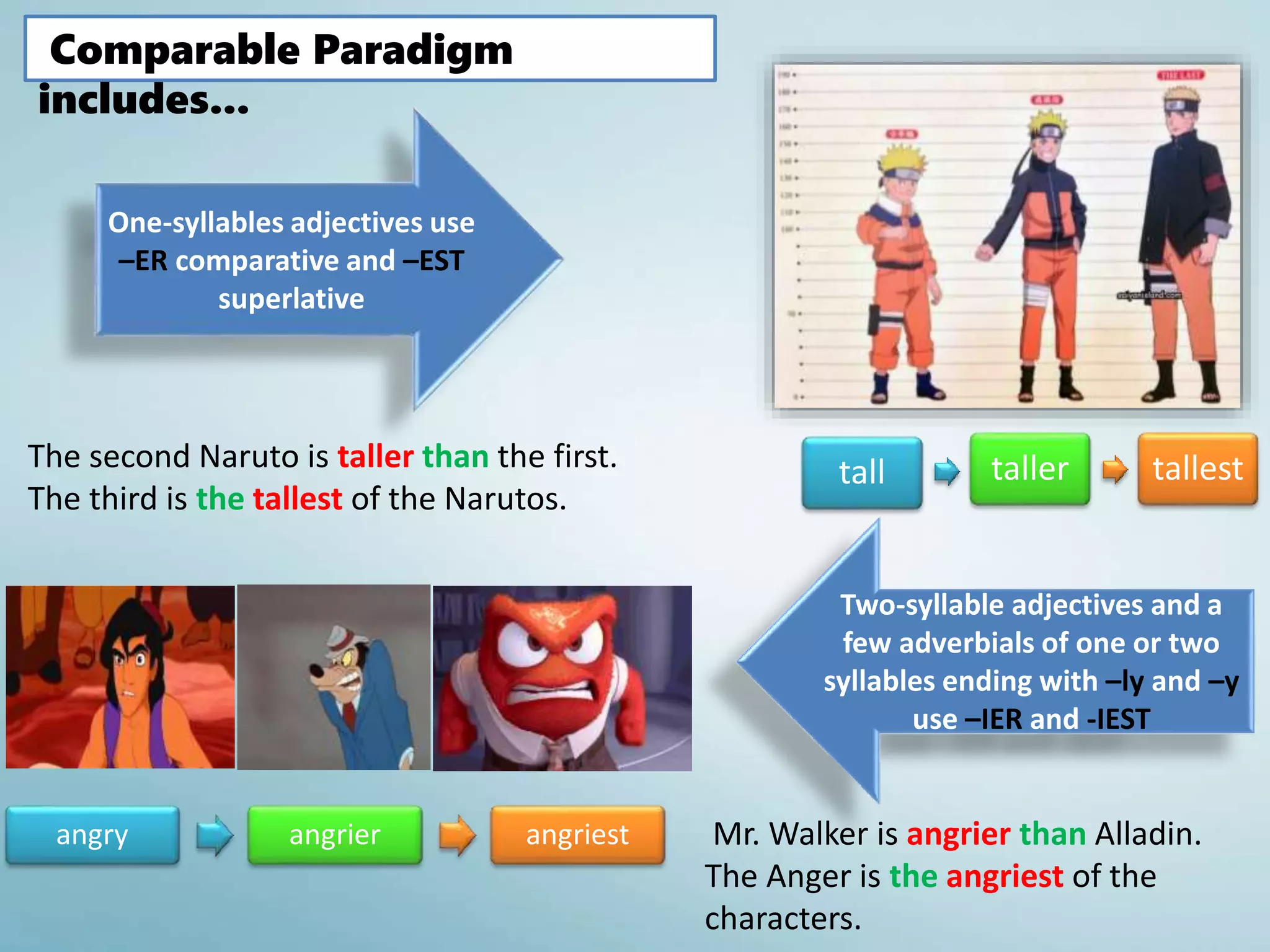
One-syllables adjectives use
–ER comparative and –EST
superlative
Two-syllable adjectives and a
few adverbials of one or two
syllables ending with –ly and –y
use –IER and -IEST
tall taller tallest
angry angrier angriest
The second Naruto is taller than the first.
The third is the tallest of the Narutos.
Mr. Walker is angrier than Alladin.
The Anger is the angriest of the
characters.
Comparable Paradigm
includes...
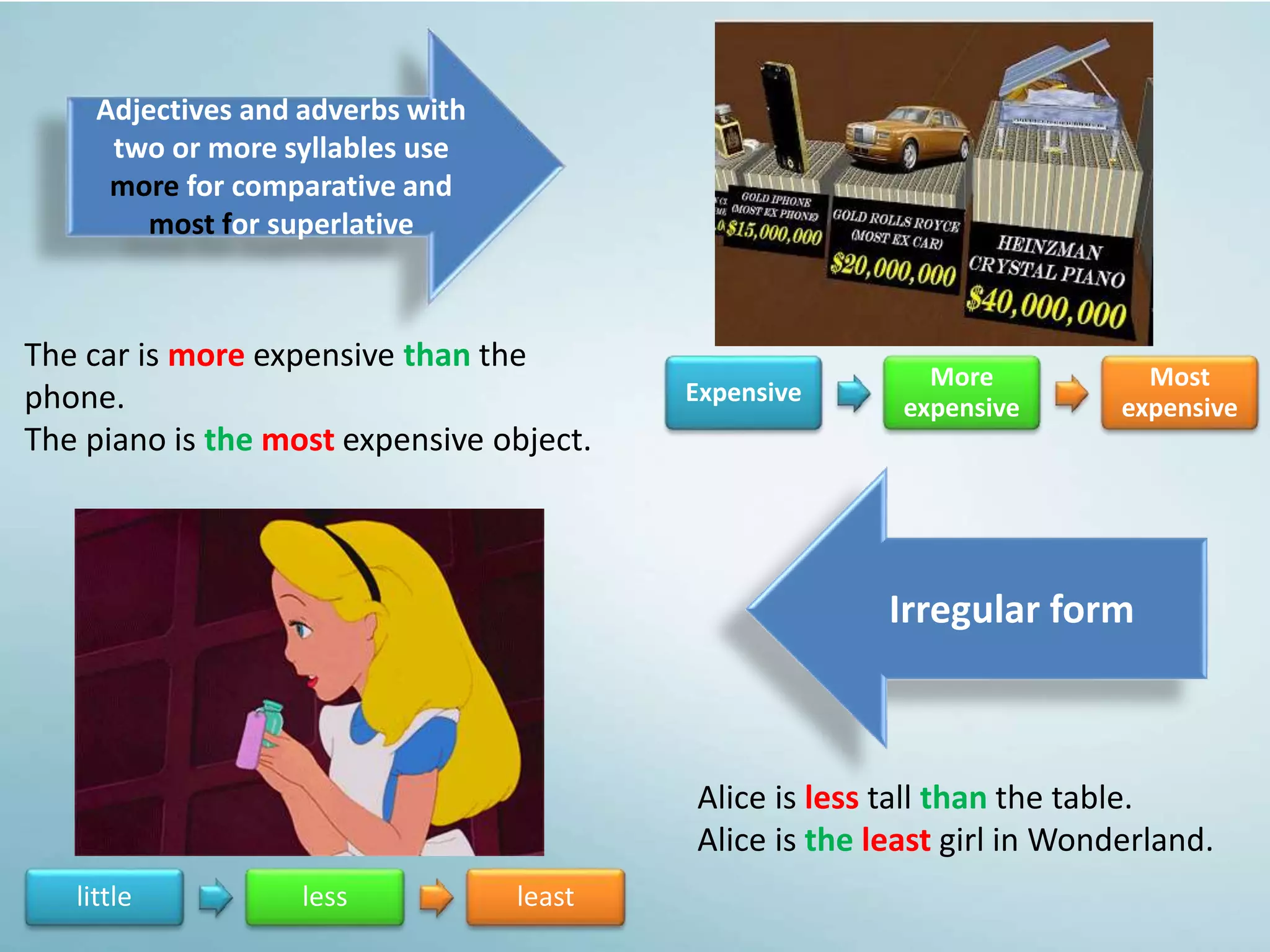
Irregular form
Adjectives and adverbs with
two or more syllables use
more for comparative and
most for superlative
little less least
Expensive
More
expensive
Most
expensive
The car is more expensive than the
phone.
The piano is the most expensive object.
Alice is less tall than the table.
Alice is the least girl in Wonderland.
Exercise
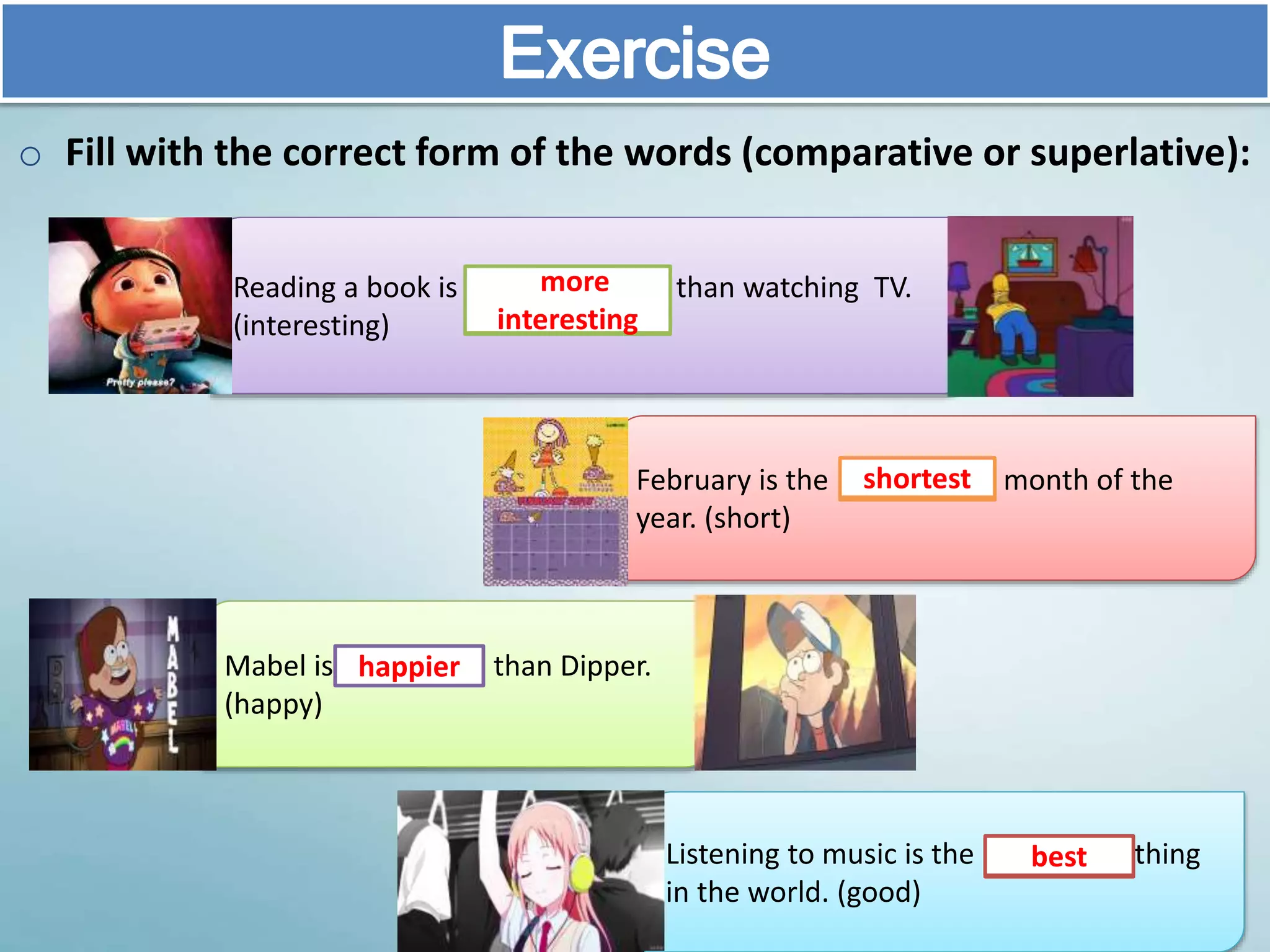
o Fill with the correct form of the words (comparative or superlative):
February is the month of the
year. (short)
Mabel is than Dipper.
(happy)
Listening to music is the thing
in the world. (good)
Reading a book is than watching TV.
(interesting)
more
interesting
shortest
happier
best
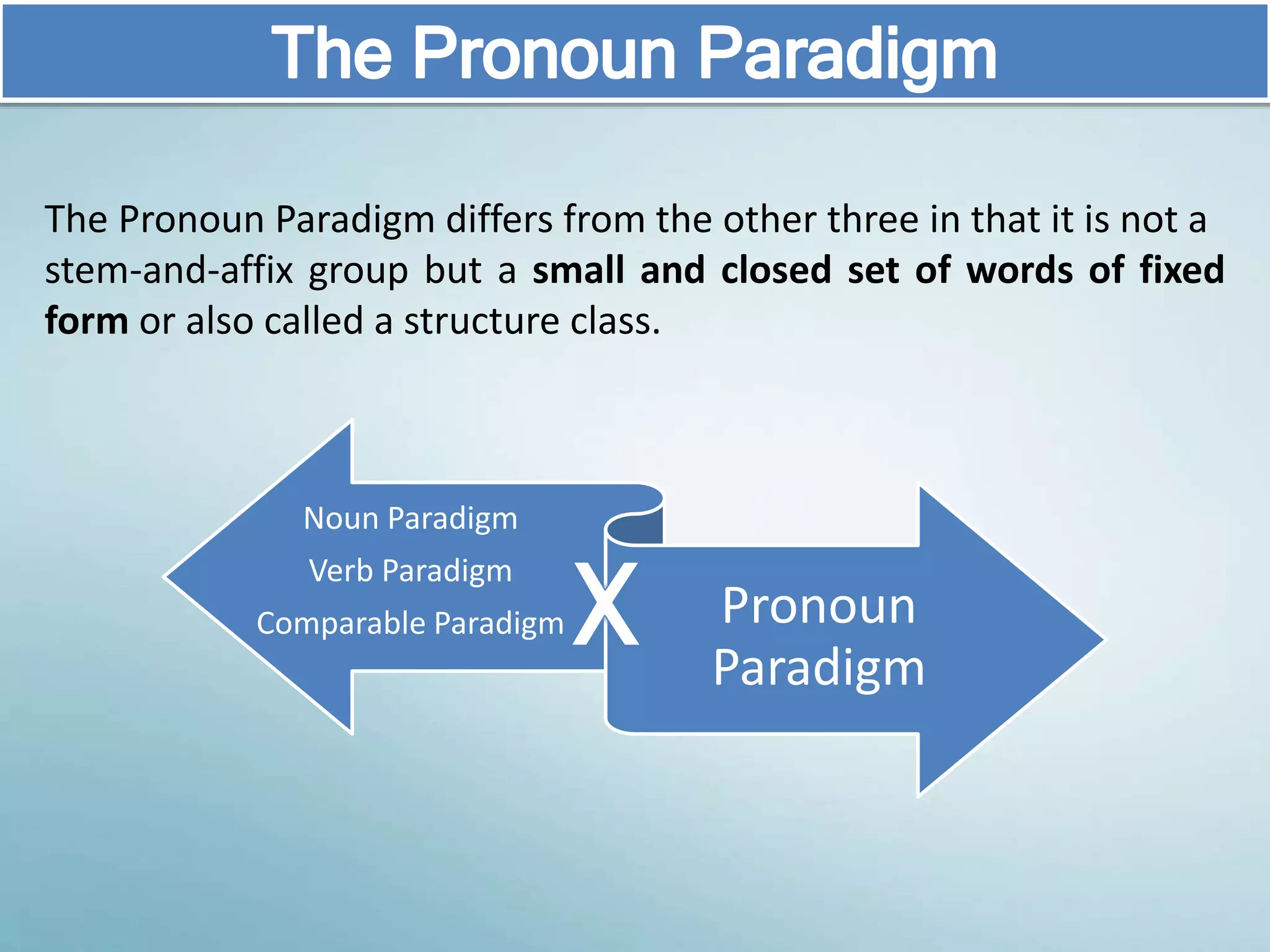
The Pronoun Paradigm differs from the other three in that it is not a
stem-and-affix group but a small and closed set of words of fixed
form or also called a structure class.
Noun Paradigm
Verb Paradigm
Comparable Paradigm Pronoun
Paradigm
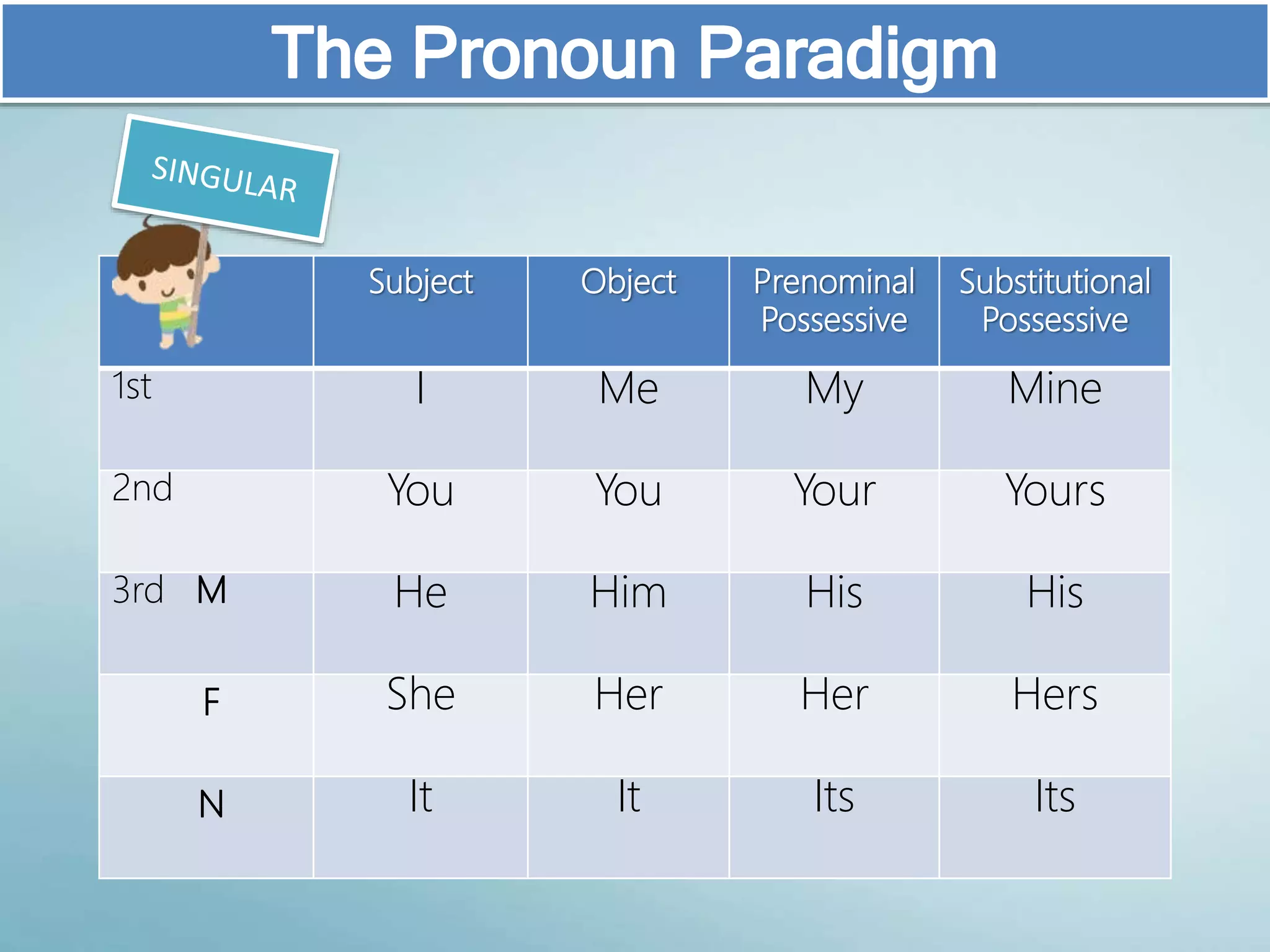
v
Subject Object Prenominal
Possessive
Substitutional
Possessive
1st I Me My Mine
2nd You You Your Yours
3rd M He Him His His
F She Her Her Hers
N It It Its Its
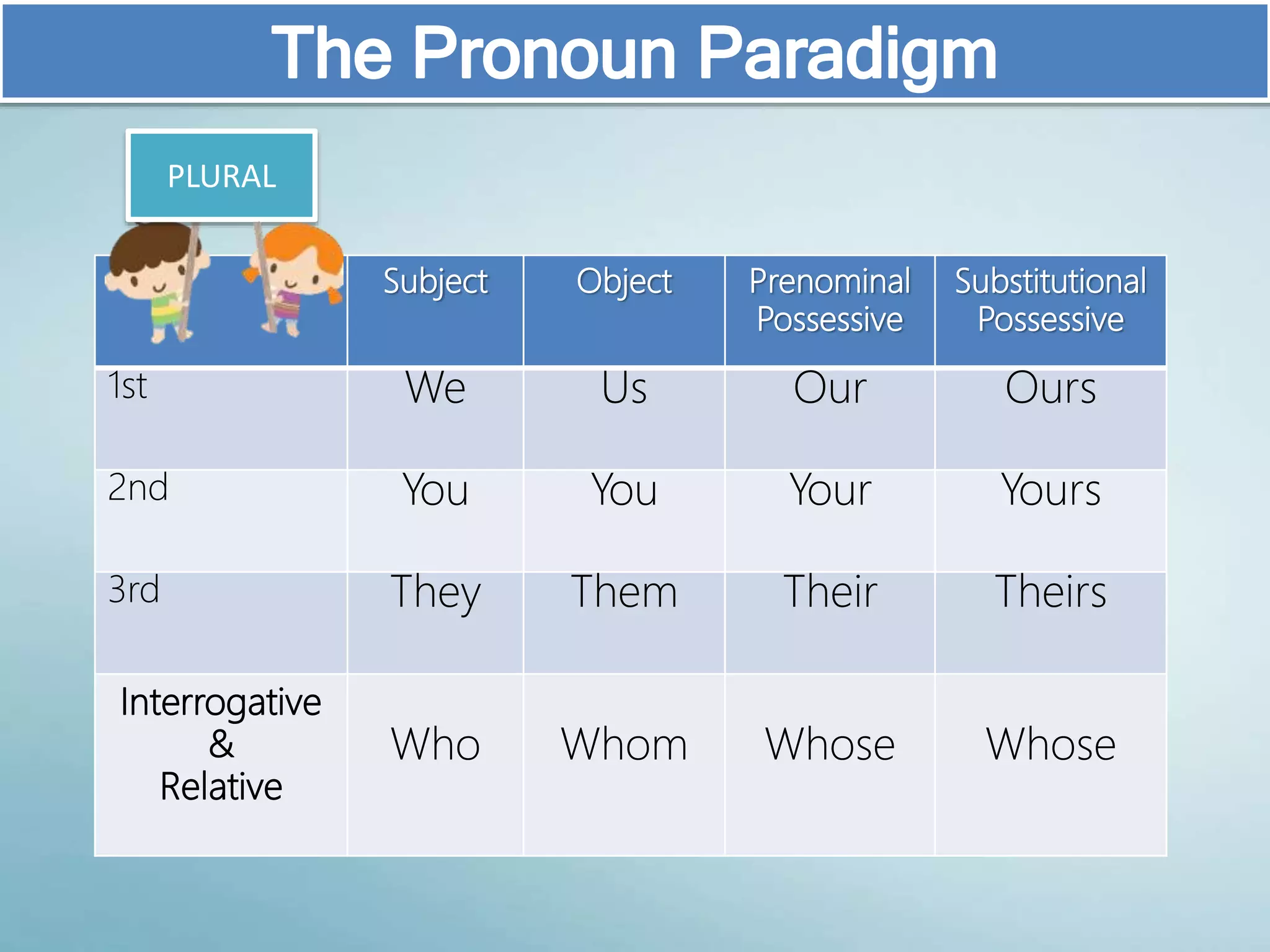
v
Subject Object Prenominal
Possessive
Substitutional
Possessive
1st We Us Our Ours
2nd You You Your Yours
3rd They Them Their Theirs
Interrogative
&
Relative
Who Whom Whose Whose
PLURAL
BANJAR, Shadia Y.. Inflectional paradigms. publicado em: 21 Out. 2011.
Disponivel em: https://pt.slideshare.net/dr.shadiabanjar/inflectional-paradigms-
morphology-dr-shadia-yousef-banjar> Acesso em: 19 Mar. 2017
MAGISTRA, Bayu J..Inflection in morphology (linguistics) publicado em: 20
Abr. 2014. Disponível em: <https://pt.slideshare.net/SilentUFO/morphology-
presentation-print> Acesso em: 17 Mar. 2017.
STAGEBERG, Norman C.; OAKS, Dallin D. An introductory English grammar.
5th ed. Forth Worth, TX: Harcourt College Publishers, 2000. p. 129-150.

Inflectional paradigm Parte 2

  • 1.
    It occurs after: TheVerb Paradigm To Auxiliaries such as Can and Will In the Present tense (except for the third – person singular) He can dance It will snow tomorrow 1. The Stem (base form)
  • 2.
    It’s used with TheVerb Paradigm Singular Nouns He, She , It (or words which these pronouns will susbstitute) 2. The Present Third-person Singular { -s 3 d }
  • 3.
    It’s used with TheVerb Paradigm Singular Nouns He, She , It (or words which these pronouns will susbstitute) Water freezes at zero degrees. Noun 2. The Present Third-person Singular { -s 3 d }
  • 4.
    It’s used with TheVerb Paradigm Singular Nouns He, She, It (or words which these pronouns will susbstitute) Water freezes at zero degrees. Noun The Earth revolves around the Sun Noun 2. The Present Third-person Singular { -s 3 d }
  • 5.
    It’s used with TheVerb Paradigm Singular Nouns He, She, It (or words which these pronouns will susbstitute) Present tense I Cry/love You He/she/it Cries Loves We Cry/loveYou They 2. The Present Third-person Singular { -s 3 d }
  • 6.
    It’s used with TheVerb Paradigm 2. The Present Third-person Singular { -s 3 d } Singular Nouns He, She , It (or words which these pronouns will susbstitute) Present tense I Cry/love You He/she/it Cries Loves We Cry/loveYou They The old man cries a lot. He cries a lot. Noun She loves the Spice Girls My sister loves the Spice Girls Noun
  • 7.
    The Verb Paradigm 3.The Present Participle {-ING vb} Combines with 7 of the 8 forms of verb ‘to be’ ( am, is, are, was, were, be, been) indicating progressive aspect.
  • 8.
    Can be usedas subjecteless verbal: o Not knowing what to say, Mary kept silent. o Owning a cabin in the north woods, Jake was very popular during the summer vacation. Not used with verbs indicating mental activities: o *Jake is owing a cabin in the north woods. o * She was not knowing what to say. The Verb Paradigm 3. The Present Participle {-ING vb}
  • 9.
    Two Homophones INFLEXIONAL SUFFIX Don’tconfuse: {-ING vb} ≠ {-ING nm} ≠ {-ING aj} -ING vb {-ING nm}{-ING aj} DERIVATIONAL SUFFIXDERIVATIONAL SUFFIX 1. Jim lost both fillings from his tooth 2. A moving elephant is a picture of grace 3. The attorney made a moving appeal 4. Old sayings are often half-true 5. From the bridge we watched the running water 6. That was a touching scene
  • 10.
    Two Homophones INFLEXIONAL SUFFIX Don’tconfuse: {-ING vb} ≠ {-ING nm} ≠ {-ING aj} Change the position of the verb: I saw a burning house I saw a house burning -ING vb {-ING nm}{-ING aj} DERIVATIONAL SUFFIXDERIVATIONAL SUFFIX
  • 11.
    Two Homophones INFLEXIONAL SUFFIX Don’tconfuse: {-ING vb} ≠ {-ING nm} ≠ {-ING aj} Change the position of the verb: I saw a burning house I saw a house burning -ING vb {-ING nm}{-ING aj} DERIVATIONAL SUFFIXDERIVATIONAL SUFFIX The Adjectival can be preceded by a qualifier like Very, Rather or Quite. A very charming woman
  • 12.
    Two Homophones INFLEXIONAL SUFFIX Don’tconfuse: {-ING vb} ≠ {-ING nm} ≠ {-ING aj} Change the position of the verb: I saw a burning house I saw a house burning -ING vb {-ING nm}{-ING aj} DERIVATIONAL SUFFIXDERIVATIONAL SUFFIX The Adjectival can be preceded by a qualifier like Very, Rather or Quite. A very charming woman {-s pl} Meetings Weddings Readings
  • 13.
    It has Regular andIrregular forms indicating Simple Past Tense: The Verb Paradigm 4. The Past Tense {-D pt}
  • 14.
    It has regularand irregular forms. It is used with verb ‘to have’ (have, has, had, having) to form verbal phrases indicating PERFECTIVE ASPECT. The Verb Paradigm 5. The Past Participle {-D pp}
  • 15.
    It has regularand irregular forms. It is used with verb ‘to have’ (have, has, had, having) to form verbal phrases indicating PERFECTIVE ASPECT. The Verb Paradigm 5. The Past Participle {-D pp} [Thing receiving action] + [be] + [past participle of verb] + [by] + [thing doing action] It can be used with verb ‘to be’ to form the passive form indicating PASSIVE VOICE.
  • 16.
    Don’t confuse: {-Dpp} ≠ {-D aj} DERIVATIONAL SUFFIXINFLEXIONAL SUFFIX {-D aj} One Homophone {-D pp} 1. You should read the printed statement. 2. A celebrated painter visited the campus. 3. His chosen bride had lived in India. 4. The invited guests all came. 5. Merle was a neglected child.
  • 17.
    Don’t confuse: {-Dpp} ≠ {-D aj} DERIVATIONAL SUFFIXINFLEXIONAL SUFFIX {-D aj} One Homophone {-D pp} The adjectival can be preceded by a qualifier live very, rather or quite. A very charming woman
  • 18.
    Suppletion A total chancein the paradigm . The term "suppletion" implies that a gap in the paradigm was filled by a form "supplied" by a different paradigm. Suppletion is the replacement of one stem with another, resulting in an allomorph of a morpheme which has no phonological similarity to the other allomorphs. SUPPLETION
  • 19.
    Suppletion A total chancein the paradigm . The term "suppletion" implies that a gap in the paradigm was filled by a form "supplied" by a different paradigm. Suppletion is the replacement of one stem with another, resulting in an allomorph of a morpheme which has no phonological similarity to the other allomorphs. SUPPLETION
  • 20.
    Suppletion A total chancein the paradigm . The term "suppletion" implies that a gap in the paradigm was filled by a form "supplied" by a different paradigm. Suppletion is the replacement of one stem with another, resulting in an allomorph of a morpheme which has no phonological similarity to the other allomorphs. SUPPLETION
  • 21.
    Exercise “Send my loveto your new lover, treat her better” Send Treat Treats Treating Treated Treated Sends Sending SentSent
  • 22.
    Exercise “I think Iwanna marry you” Thought Marry Marries Marrying Married Thinks Thinking ThoughtThink Married
  • 23.
  • 24.
    One-syllables adjectives use –ERcomparative and –EST superlative Two-syllable adjectives and a few adverbials of one or two syllables ending with –ly and –y use –IER and -IEST tall taller tallest angry angrier angriest The second Naruto is taller than the first. The third is the tallest of the Narutos. Mr. Walker is angrier than Alladin. The Anger is the angriest of the characters. Comparable Paradigm includes...
  • 25.
    Irregular form Adjectives andadverbs with two or more syllables use more for comparative and most for superlative little less least Expensive More expensive Most expensive The car is more expensive than the phone. The piano is the most expensive object. Alice is less tall than the table. Alice is the least girl in Wonderland.
  • 26.
    Exercise o Fill withthe correct form of the words (comparative or superlative): February is the month of the year. (short) Mabel is than Dipper. (happy) Listening to music is the thing in the world. (good) Reading a book is than watching TV. (interesting) more interesting shortest happier best
  • 27.
    The Pronoun Paradigmdiffers from the other three in that it is not a stem-and-affix group but a small and closed set of words of fixed form or also called a structure class. Noun Paradigm Verb Paradigm Comparable Paradigm Pronoun Paradigm
  • 28.
    v Subject Object Prenominal Possessive Substitutional Possessive 1stI Me My Mine 2nd You You Your Yours 3rd M He Him His His F She Her Her Hers N It It Its Its
  • 29.
    v Subject Object Prenominal Possessive Substitutional Possessive 1stWe Us Our Ours 2nd You You Your Yours 3rd They Them Their Theirs Interrogative & Relative Who Whom Whose Whose PLURAL
  • 30.
    BANJAR, Shadia Y..Inflectional paradigms. publicado em: 21 Out. 2011. Disponivel em: https://pt.slideshare.net/dr.shadiabanjar/inflectional-paradigms- morphology-dr-shadia-yousef-banjar> Acesso em: 19 Mar. 2017 MAGISTRA, Bayu J..Inflection in morphology (linguistics) publicado em: 20 Abr. 2014. Disponível em: <https://pt.slideshare.net/SilentUFO/morphology- presentation-print> Acesso em: 17 Mar. 2017. STAGEBERG, Norman C.; OAKS, Dallin D. An introductory English grammar. 5th ed. Forth Worth, TX: Harcourt College Publishers, 2000. p. 129-150.