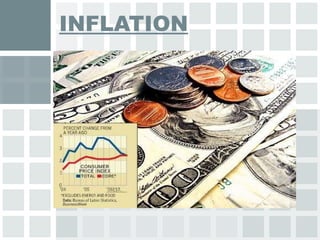
INFLATION
Definitions In economics,  inflation  is a rise in the general level of prices of goods and services in an economy over a period of time Inflation is a decline in the real value of money When the general price level rises, each unit of currency  buys fewer goods and services. Repetitive price increases, erode the purchasing power of money and other financial assets with fixed values, creating serious economic distortions and uncertainty According to Sir Ronald Reagan: “ Inflation is as violent as a mugger, as frightening as an armed robber, and as deadly as a hit man”.
That IS…. 1950’s 1 rupee = 2000 1 rupee =  Milky BAR Naranga Mittayi
Causes The expectation of a seller accepting currency to be able to exchange that currency at a later time for goods that are desirable as a buyer. The quantity equation of money, that relates the money supply, its velocity, and the nominal value of exchanges. This theory is widely accepted. QUALITY THEORY: QUANTITY THEORY :
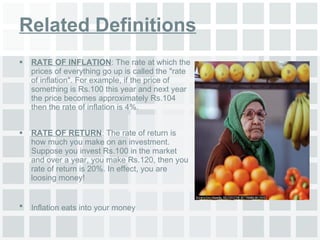
Related Definitions RATE OF INFLATION : The rate at which the prices of everything go up is called the "rate of inflation". For example, if the price of something is Rs.100 this year and next year the price becomes approximately Rs.104 then the rate of inflation is 4%. RATE OF RETURN : The rate of return is how much you make on an investment. Suppose you invest Rs.100 in the market and over a year, you make Rs.120, then you rate of return is 20%. In effect, you are loosing money! Inflation eats into your money
VIEWS DEMAND-PULL : Inflation occurs when aggregate demand exceeds existing supplies, forcing price increases and pulling up wages, materials, and operating and financing costs. COST-PUSH : Inflation occurs when prices rise to cover total expenses and preserve profit margins. Built-In Inflation : Induced by adaptive expectations, often linked to the “price spiral" because it involves workers trying to keep their wages up with prices and then employers passing higher costs on to consumers as higher prices as part of a "vicious circle." Built-in inflation reflects events in the past, and so might be seen as hangover inflation. Other than these there are several other views on Inflation namely  Monetarist View ,  Rational Expectation theory ,  Austrian Theory ,  Real Bill doctrine .
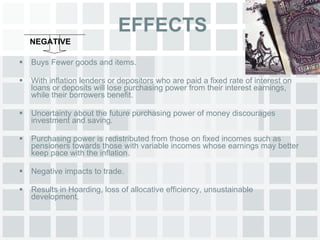
EFFECTS Buys Fewer goods and items. With inflation lenders or depositors who are paid a fixed rate of interest on loans or deposits will lose purchasing power from their interest earnings, while their borrowers benefit. Uncertainty about the future purchasing power of money discourages investment and saving. Purchasing power is redistributed from those on fixed incomes such as pensioners towards those with variable incomes whose earnings may better keep pace with the inflation. Negative impacts to trade. Results in Hoarding, loss of allocative efficiency, unsustainable development. NEGATIVE
EFFECTS Some inflation is good for the economy, as it would allow labor markets to reach equilibrium faster. DEBT Relief. The Nobel prize winning economist James Tobin had argued that a moderate level of inflation can increase investment in an economy leading to higher steady state level of income. POSITIVE
CONTROLLING INFLATION MONETARY POLICY : High Interest rates, slow growth of money supply. Emphasize the need to return to gold standards. FIXED EXCHANGE RATES : Controls inflation to great extent. WAGE AND PRICE CONTROL:  It was a temporary method. Is considered a failure in long run. COST OF LIVING ALLOWANCE:  Fixed Payments tied to cost-of-living-index. So the effect is reduced.
So, what should be done.. DO not keep your money stagnant. Always  INVEST . Or put it in a bank. When investing make sure the rate of inflation is grater than the rate of return. Try to follow the financial policies and keep at least a vague idea about this system. Because no matter how much we avoid, It Affects Us.
THANK YOU SHARAT KAREKATT S4 AEI PRESENTED BY

Inflation

  • 1.
  • 2.
    Definitions In economics, inflation is a rise in the general level of prices of goods and services in an economy over a period of time Inflation is a decline in the real value of money When the general price level rises, each unit of currency buys fewer goods and services. Repetitive price increases, erode the purchasing power of money and other financial assets with fixed values, creating serious economic distortions and uncertainty According to Sir Ronald Reagan: “ Inflation is as violent as a mugger, as frightening as an armed robber, and as deadly as a hit man”.
  • 3.
    That IS…. 1950’s1 rupee = 2000 1 rupee = Milky BAR Naranga Mittayi
  • 4.
    Causes The expectationof a seller accepting currency to be able to exchange that currency at a later time for goods that are desirable as a buyer. The quantity equation of money, that relates the money supply, its velocity, and the nominal value of exchanges. This theory is widely accepted. QUALITY THEORY: QUANTITY THEORY :
  • 5.
    Related Definitions RATEOF INFLATION : The rate at which the prices of everything go up is called the "rate of inflation". For example, if the price of something is Rs.100 this year and next year the price becomes approximately Rs.104 then the rate of inflation is 4%. RATE OF RETURN : The rate of return is how much you make on an investment. Suppose you invest Rs.100 in the market and over a year, you make Rs.120, then you rate of return is 20%. In effect, you are loosing money! Inflation eats into your money
  • 6.
    VIEWS DEMAND-PULL :Inflation occurs when aggregate demand exceeds existing supplies, forcing price increases and pulling up wages, materials, and operating and financing costs. COST-PUSH : Inflation occurs when prices rise to cover total expenses and preserve profit margins. Built-In Inflation : Induced by adaptive expectations, often linked to the “price spiral" because it involves workers trying to keep their wages up with prices and then employers passing higher costs on to consumers as higher prices as part of a "vicious circle." Built-in inflation reflects events in the past, and so might be seen as hangover inflation. Other than these there are several other views on Inflation namely Monetarist View , Rational Expectation theory , Austrian Theory , Real Bill doctrine .
  • 7.
    EFFECTS Buys Fewergoods and items. With inflation lenders or depositors who are paid a fixed rate of interest on loans or deposits will lose purchasing power from their interest earnings, while their borrowers benefit. Uncertainty about the future purchasing power of money discourages investment and saving. Purchasing power is redistributed from those on fixed incomes such as pensioners towards those with variable incomes whose earnings may better keep pace with the inflation. Negative impacts to trade. Results in Hoarding, loss of allocative efficiency, unsustainable development. NEGATIVE
  • 8.
    EFFECTS Some inflationis good for the economy, as it would allow labor markets to reach equilibrium faster. DEBT Relief. The Nobel prize winning economist James Tobin had argued that a moderate level of inflation can increase investment in an economy leading to higher steady state level of income. POSITIVE
  • 9.
    CONTROLLING INFLATION MONETARYPOLICY : High Interest rates, slow growth of money supply. Emphasize the need to return to gold standards. FIXED EXCHANGE RATES : Controls inflation to great extent. WAGE AND PRICE CONTROL: It was a temporary method. Is considered a failure in long run. COST OF LIVING ALLOWANCE: Fixed Payments tied to cost-of-living-index. So the effect is reduced.
  • 10.
    So, what shouldbe done.. DO not keep your money stagnant. Always INVEST . Or put it in a bank. When investing make sure the rate of inflation is grater than the rate of return. Try to follow the financial policies and keep at least a vague idea about this system. Because no matter how much we avoid, It Affects Us.
  • 11.
    THANK YOU SHARATKAREKATT S4 AEI PRESENTED BY