Infinit filesystem
Reactor reloaded
mefyl
quentin.hocquet@infinit.io
Version 1.2-5-g4a755e6
Infinit filesystem
Distributed filesystem in byzantine environment: aggregate multiple computers
into one storage.
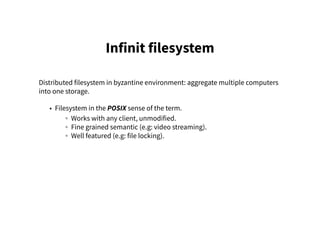
Infinit filesystem
Distributed filesystem in byzantine environment: aggregate multiple computers
into one storage.
• Filesystem in the POSIX sense of the term.
◦ Works with any client, unmodified.
◦ Fine grained semantic (e.g: video streaming).
◦ Well featured (e.g: file locking).
Infinit filesystem
Distributed filesystem in byzantine environment: aggregate multiple computers
into one storage.
• Filesystem in the POSIX sense of the term.
◦ Works with any client, unmodified.
◦ Fine grained semantic (e.g: video streaming).
◦ Well featured (e.g: file locking).
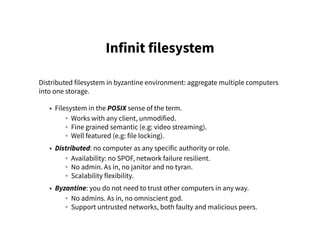
• Distributed: no computer as any specific authority or role.
◦ Availability: no SPOF, network failure resilient.
◦ No admin. As in, no janitor and no tyran.
◦ Scalability flexibility.
Infinit filesystem
Distributed filesystem in byzantine environment: aggregate multiple computers
into one storage.
• Filesystem in the POSIX sense of the term.
◦ Works with any client, unmodified.
◦ Fine grained semantic (e.g: video streaming).
◦ Well featured (e.g: file locking).
• Distributed: no computer as any specific authority or role.
◦ Availability: no SPOF, network failure resilient.
◦ No admin. As in, no janitor and no tyran.
◦ Scalability flexibility.
• Byzantine: you do not need to trust other computers in any way.
◦ No admins. As in, no omniscient god.
◦ Support untrusted networks, both faulty and malicious peers.
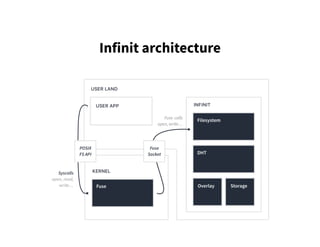
Infinit architecture
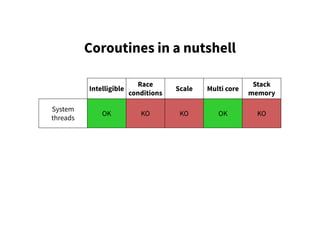
Coroutines in a nutshell
Intelligible
Race
conditions
Scale Multi core
Stack
memory
System
threads
OK KO KO OK KO
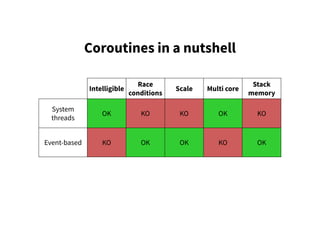
Coroutines in a nutshell
Intelligible
Race
conditions
Scale Multi core
Stack
memory
System
threads
OK KO KO OK KO
Event-based KO OK OK KO OK
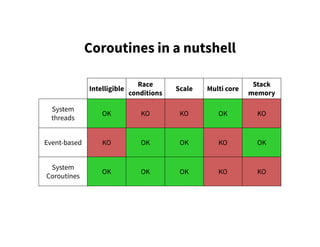
Coroutines in a nutshell
Intelligible
Race
conditions
Scale Multi core
Stack
memory
System
threads
OK KO KO OK KO
Event-based KO OK OK KO OK
System
Coroutines
OK OK OK KO KO
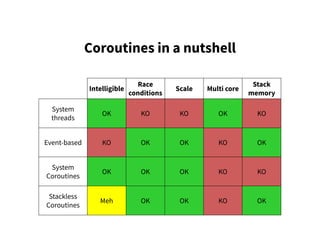
Coroutines in a nutshell
Intelligible
Race
conditions
Scale Multi core
Stack
memory
System
threads
OK KO KO OK KO
Event-based KO OK OK KO OK
System
Coroutines
OK OK OK KO KO
Stackless
Coroutines
Meh OK OK KO OK
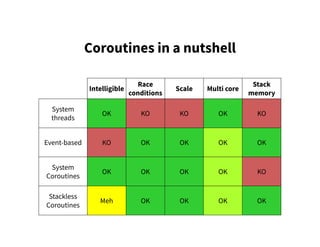
Coroutines in a nutshell
Intelligible
Race
conditions
Scale Multi core
Stack
memory
System
threads
OK KO KO OK KO
Event-based KO OK OK OK OK
System
Coroutines
OK OK OK OK KO
Stackless
Coroutines
Meh OK OK OK OK
Reactor in a nutshell
Reactor is a C++ library providing coroutines support, enabling simple and safe
imperative style concurrency.
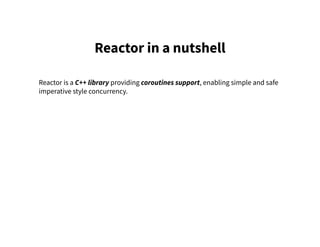
Reactor in a nutshell
Reactor is a C++ library providing coroutines support, enabling simple and safe
imperative style concurrency.
while (true)
{
auto socket = tcp_server.accept();
new Thread([socket] {
try
{
while (true)
socket->write(socket->read_until("n"));
}
catch (reactor::network::Error const&)
{}
});
}
Sugar for common pattern
Coroutines are mostly used in three patterns:
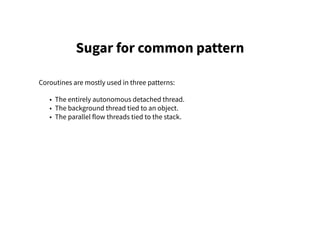
Sugar for common pattern
Coroutines are mostly used in three patterns:
• The entirely autonomous detached thread.
• The background thread tied to an object.
• The parallel flow threads tied to the stack.
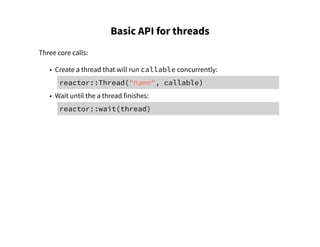
Basic API for threads
Three core calls:
• Create a thread that will run callable concurrently:
reactor::Thread("name", callable)
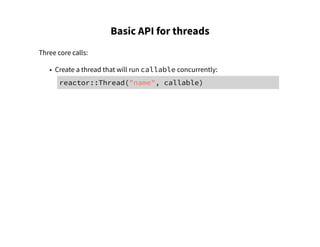
Basic API for threads
Three core calls:
• Create a thread that will run callable concurrently:
reactor::Thread("name", callable)
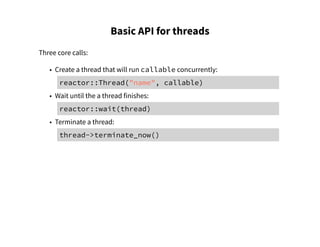
• Wait until the a thread finishes:
reactor::wait(thread)
Basic API for threads
Three core calls:
• Create a thread that will run callable concurrently:
reactor::Thread("name", callable)
• Wait until the a thread finishes:
reactor::wait(thread)
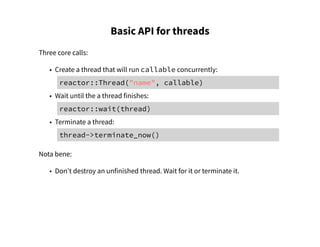
• Terminate a thread:
thread->terminate_now()
Basic API for threads
Three core calls:
• Create a thread that will run callable concurrently:
reactor::Thread("name", callable)
• Wait until the a thread finishes:
reactor::wait(thread)
• Terminate a thread:
thread->terminate_now()
Nota bene:
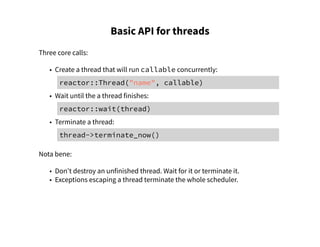
• Don't destroy an unfinished thread. Wait for it or terminate it.
Basic API for threads
Three core calls:
• Create a thread that will run callable concurrently:
reactor::Thread("name", callable)
• Wait until the a thread finishes:
reactor::wait(thread)
• Terminate a thread:
thread->terminate_now()
Nota bene:
• Don't destroy an unfinished thread. Wait for it or terminate it.
• Exceptions escaping a thread terminate the whole scheduler.
Basic API for reactor
reactor::Scheduler sched;
reactor::Thread main(
sched, "main",
[]
{
});
// Will execute until all threads are done.
sched.run();
Basic API for reactor
reactor::Scheduler sched;
reactor::Thread main(
sched, "main",
[]
{
reactor::Thread t("t", [] { print("world"); });
print("hello");
});
// Will execute until all threads are done.
sched.run();
Basic API for reactor
reactor::Scheduler sched;
reactor::Thread main(
sched, "main",
[]
{
reactor::Thread t("t", [] { print("world"); });
print("hello");
reactor::wait(t);
});
// Will execute until all threads are done.
sched.run();
The detached thread
The detached thread is a global background operation whose lifetime is tied to
the program only.
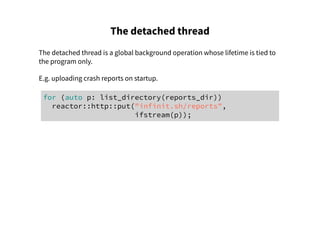
The detached thread
The detached thread is a global background operation whose lifetime is tied to
the program only.
E.g. uploading crash reports on startup.
for (auto p: list_directory(reports_dir))
reactor::http::put("infinit.sh/reports",
ifstream(p));
The detached thread
The detached thread is a global background operation whose lifetime is tied to
the program only.
E.g. uploading crash reports on startup.
new reactor::Thread(
[]
{
for (auto p: list_directory(reports_dir))
reactor::http::put("infinit.sh/reports",
ifstream(p));
});
The detached thread
The detached thread is a global background operation whose lifetime is tied to
the program only.
E.g. uploading crash reports on startup.
new reactor::Thread(
[]
{
for (auto p: list_directory(reports_dir))
reactor::http::put("infinit.sh/reports",
ifstream(p));
},
reactor::Thread::auto_dispose = true);
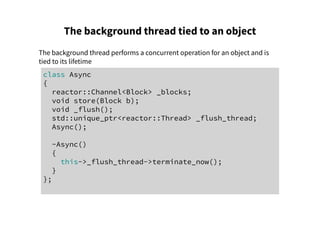
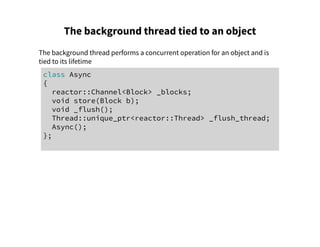
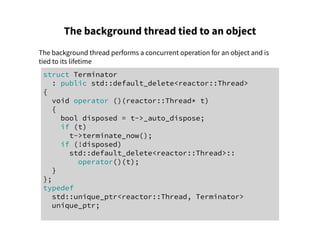
The background thread tied to an object
The background thread performs a concurrent operation for an object and is
tied to its lifetime
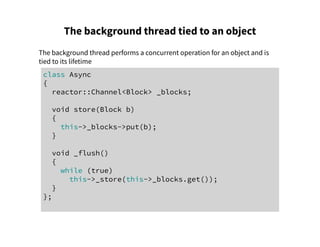
The background thread tied to an object
The background thread performs a concurrent operation for an object and is
tied to its lifetime
class Async
{
reactor::Channel<Block> _blocks;
void store(Block b)
{
this->_blocks->put(b);
}
void _flush()
{
while (true)
this->_store(this->_blocks.get());
}
};
The background thread tied to an object
The background thread performs a concurrent operation for an object and is
tied to its lifetime
class Async
{
reactor::Channel<Block> _blocks;
void store(Block b);
void _flush();
std::unique_ptr<reactor::Thread> _flush_thread;
Async()
: _flush_thread(new reactor::Thread(
[this] { this->_flush(); }))
{}
};
The background thread tied to an object
The background thread performs a concurrent operation for an object and is
tied to its lifetime
class Async
{
reactor::Channel<Block> _blocks;
void store(Block b);
void _flush();
std::unique_ptr<reactor::Thread> _flush_thread;
Async();
~Async()
{
this->_flush_thread->terminate_now();
}
};
The background thread tied to an object
The background thread performs a concurrent operation for an object and is
tied to its lifetime
class Async
{
reactor::Channel<Block> _blocks;
void store(Block b);
void _flush();
Thread::unique_ptr<reactor::Thread> _flush_thread;
Async();
};
The background thread tied to an object
The background thread performs a concurrent operation for an object and is
tied to its lifetime
struct Terminator
: public std::default_delete<reactor::Thread>
{
void operator ()(reactor::Thread* t)
{
bool disposed = t->_auto_dispose;
if (t)
t->terminate_now();
if (!disposed)
std::default_delete<reactor::Thread>::
operator()(t);
}
};
typedef
std::unique_ptr<reactor::Thread, Terminator>
unique_ptr;
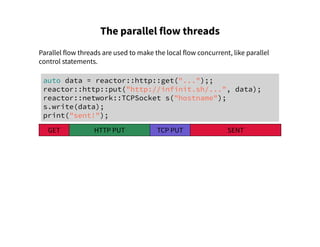
The parallel flow threads
Parallel flow threads are used to make the local flow concurrent, like parallel
control statements.
auto data = reactor::http::get("...");;
reactor::http::put("http://infinit.sh/...", data);
reactor::network::TCPSocket s("hostname");
s.write(data);
print("sent!");
GET HTTP PUT TCP PUT SENT
The parallel flow threads
auto data = reactor::http::get("...");
reactor::Thread http_put(
[&]
{
reactor::http::put("http://infinit.sh/...", data);
});
reactor::Thread tcp_put(
[&]
{
reactor::network::TCPSocket s("hostname");
s.write(data);
});
reactor::wait({http_put, tcp_put});
print("sent!");
GET SENT
HTTP PUT
TCP PUT
The parallel flow threads
auto data = reactor::http::get("...");
std::exception_ptr exn;
reactor::Thread http_put([&] {
try { reactor::http::put("http://...", data); }
catch (...) { exn = std::current_exception(); }
});
reactor::Thread tcp_put([&] {
try {
reactor::network::TCPSocket s("hostname");
s.write(data);
}
catch (...) { exn = std::current_exception(); }
});
reactor::wait({http_put, tcp_put});
if (exn)
std::rethrow_exception(exn);
print("sent!");
The parallel flow threads
auto data = reactor::http::get("...");
std::exception_ptr exn;
reactor::Thread http_put([&] {
try {
reactor::http::put("http://...", data);
} catch (reactor::Terminate const&) { throw; }
catch (...) { exn = std::current_exception(); }
});
reactor::Thread tcp_put([&] {
try {
reactor::network::TCPSocket s("hostname");
s.write(data);
} catch (reactor::Terminate const&) { throw; }
catch (...) { exn = std::current_exception(); }
});
reactor::wait({http_put, tcp_put});
if (exn) std::rethrow_exception(exn);
print("sent!");
The parallel flow threads
auto data = reactor::http::get("...");
reactor::Scope scope;
scope.run([&] {
reactor::http::put("http://infinit.sh/...", data);
});
scope.run([&] {
reactor::network::TCPSocket s("hostname");
s.write(data);
});
reactor::wait(scope);
print("sent!");
GET SENT
HTTP PUT
TCP PUT
Futures
auto data = reactor::http::get("...");
reactor::Scope scope;
scope.run([&] {
reactor::http::Request r("http://infinit.sh/...");
r.write(data);
});
scope.run([&] {
reactor::network::TCPSocket s("hostname");
s.write(data);
});
reactor::wait(scope);
print("sent!");
Futures
elle::Buffer data;
reactor::Thread fetcher(
[&] { data = reactor::http::get("..."); });
reactor::Scope scope;
scope.run([&] {
reactor::http::Request r("http://infinit.sh/...");
reactor::wait(fetcher);
r.write(data);
});
scope.run([&] {
reactor::network::TCPSocket s("hostname");
reactor::wait(fetcher);
s.write(data);
});
reactor::wait(scope);
print("sent!");
Futures
reactor::Future<elle::Buffer> data(
[&] { data = reactor::http::get("..."); });
reactor::Scope scope;
scope.run([&] {
reactor::http::Request r("http://infinit.sh/...");
r.write(data.get());
});
scope.run([&] {
reactor::network::TCPSocket s("hostname");
s.write(data.get());
});
reactor::wait(scope);
print("sent!");
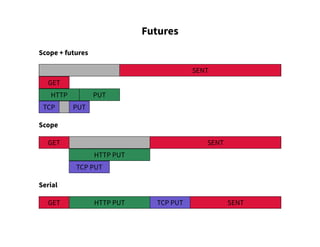
Futures
Scope + futures
SENT
GET
HTTP PUT
TCP PUT
Scope
GET SENT
HTTP PUT
TCP PUT
Serial
GET HTTP PUT TCP PUT SENT
Concurrent iteration
The final touch.
std::vector<Host> hosts;
reactor::Scope scope;
for (auto const& host: hosts)
scope.run([] (Host h) { h->send(block); });
reactor::wait(scope);
Concurrent iteration
The final touch.
std::vector<Host> hosts;
reactor::Scope scope;
for (auto const& host: hosts)
scope.run([] (Host h) { h->send(block); });
reactor::wait(scope);
Concurrent iteration:
std::vector<Host> hosts;
reactor::concurrent_for(
hosts, [] (Host h) { h->send(block); });
Concurrent iteration
The final touch.
std::vector<Host> hosts;
reactor::Scope scope;
for (auto const& host: hosts)
scope.run([] (Host h) { h->send(block); });
reactor::wait(scope);
Concurrent iteration:
std::vector<Host> hosts;
reactor::concurrent_for(
hosts, [] (Host h) { h->send(block); });
• Also available: reactor::concurrent_break().
• As for a concurrent continue, that's just return.
CPU bound operations
In the cases we are CPU bound, how to exploit multicore since coroutines are
concurrent but not parallel ?
CPU bound operations
In the cases we are CPU bound, how to exploit multicore since coroutines are
concurrent but not parallel ?
• Idea 1: schedule coroutines in parallel
◦ Pro: absolute best parallelism.
◦ Cons: race conditions.
CPU bound operations
In the cases we are CPU bound, how to exploit multicore since coroutines are
concurrent but not parallel ?
• Idea 1: schedule coroutines in parallel
◦ Pro: absolute best parallelism.
◦ Cons: race conditions.
• Idea 2: isolate CPU bound code in "monads" and run it in background.
◦ Pro: localized race conditions.
◦ Cons: only manually parallelized code exploits multiple cores.
reactor::background
reactor::background(callable): run callable in a system thread
and return its result.
reactor::background
reactor::background(callable): run callable in a system thread
and return its result.
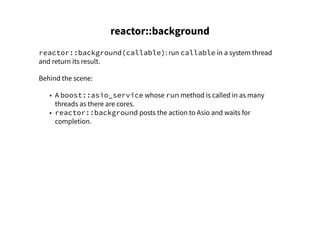
Behind the scene:
• A boost::asio_service whose run method is called in as many
threads as there are cores.
• reactor::background posts the action to Asio and waits for
completion.
reactor::background
reactor::background(callable): run callable in a system thread
and return its result.
Behind the scene:
• A boost::asio_service whose run method is called in as many
threads as there are cores.
• reactor::background posts the action to Asio and waits for
completion.
Block::seal(elle::Buffer data)
{
this->_data = reactor::background(
[data=std::move(data)] { return encrypt(data); });
}
reactor::background
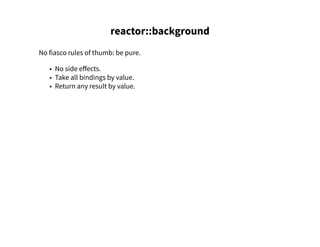
No fiasco rules of thumb: be pure.
• No side effects.
• Take all bindings by value.
• Return any result by value.
reactor::background
No fiasco rules of thumb: be pure.
• No side effects.
• Take all bindings by value.
• Return any result by value.
std::vector<int> ints;
int i = 0;
// Do not:
reactor::background([&] {ints.push_back(i+1);});
reactor::background([&] {ints.push_back(i+2);});
// Do:
ints.push_back(reactor::background([i] {return i+1;});
ints.push_back(reactor::background([i] {return i+2;});
Background pools
Infinit generates a lot of symmetric keys.
Let other syscall go through during generation with reactor::background:
Block::Block()
: _block_keys(reactor::background(
[] { return generate_keys(); }))
{}
Background pools
Infinit generates a lot of symmetric keys.
Let other syscall go through during generation with reactor::background:
Block::Block()
: _block_keys(reactor::background(
[] { return generate_keys(); }))
{}
Problem: because of usual on-disk filesystems, operations are often sequential.
$ time for i in $(seq 128); touch $i; done
The whole operation will still be delayed by 128 * generation_time.
Background pools
Solution: pregenerate keys in a background pool.
reactor::Channel<KeyPair> keys;
keys.max_size(64);
reactor::Thread keys_generator([&] {
reactor::Scope keys;
for (int i = 0; i < NCORES; ++i)
scope.run([] {
while (true)
keys.put(reactor::background(
[] { return generate_keys(); }));
});
reactor::wait(scope);
});
Block::Block()
: _block_keys(keys.get())
{}
Generators
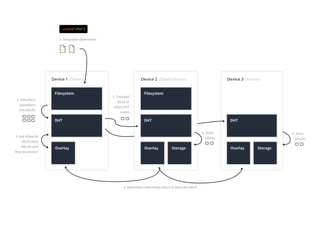
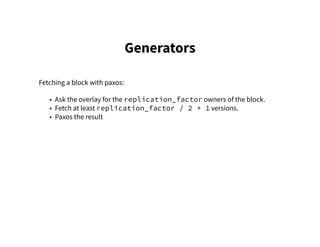
Fetching a block with paxos:
• Ask the overlay for the replication_factor owners of the block.
• Fetch at least replication_factor / 2 + 1 versions.
• Paxos the result
Generators
Fetching a block with paxos:
DHT::fetch(Address addr)
{
auto hosts = this->_overlay->lookup(addr, 3);
std::vector<Block> blocks;
reactor::concurrent_for(
hosts,
[&] (Host host)
{
blocks.push_back(host->fetch(addr));
if (blocks.size() >= 2)
reactor::concurrent_break();
});
return some_paxos_magic(blocks);
}
Generators
reactor::Generator<Host>
Kelips::lookup(Address addr, factor f)
{
return reactor::Generator<Host>(
[=] (reactor::Generator<Host>::Yield const& yield)
{
some_udp_socket.write(...);
while (f--)
yield(kelips_stuff(some_udp_socket.read()));
});
}
Generators
Behind the scene:
template <typename T>
class Generator
{
reactor::Channel<T> _values;
Generator(Callable call)
: _thread([this] {
call([this] (T e) {this->_values.put(e);});
})
{}
// Iterator interface calling _values.get()
};
• Similar to python generators
• Except generation starts right away and is not tied to iteration
Questions?

Infinit filesystem, Reactor reloaded

  • 1.
  • 2.
    Infinit filesystem Distributed filesystemin byzantine environment: aggregate multiple computers into one storage.
  • 3.
    Infinit filesystem Distributed filesystemin byzantine environment: aggregate multiple computers into one storage. • Filesystem in the POSIX sense of the term. ◦ Works with any client, unmodified. ◦ Fine grained semantic (e.g: video streaming). ◦ Well featured (e.g: file locking).
  • 4.
    Infinit filesystem Distributed filesystemin byzantine environment: aggregate multiple computers into one storage. • Filesystem in the POSIX sense of the term. ◦ Works with any client, unmodified. ◦ Fine grained semantic (e.g: video streaming). ◦ Well featured (e.g: file locking). • Distributed: no computer as any specific authority or role. ◦ Availability: no SPOF, network failure resilient. ◦ No admin. As in, no janitor and no tyran. ◦ Scalability flexibility.
  • 5.
    Infinit filesystem Distributed filesystemin byzantine environment: aggregate multiple computers into one storage. • Filesystem in the POSIX sense of the term. ◦ Works with any client, unmodified. ◦ Fine grained semantic (e.g: video streaming). ◦ Well featured (e.g: file locking). • Distributed: no computer as any specific authority or role. ◦ Availability: no SPOF, network failure resilient. ◦ No admin. As in, no janitor and no tyran. ◦ Scalability flexibility. • Byzantine: you do not need to trust other computers in any way. ◦ No admins. As in, no omniscient god. ◦ Support untrusted networks, both faulty and malicious peers.
  • 6.
  • 8.
  • 9.
    Coroutines in anutshell Intelligible Race conditions Scale Multi core Stack memory System threads OK KO KO OK KO
  • 10.
    Coroutines in anutshell Intelligible Race conditions Scale Multi core Stack memory System threads OK KO KO OK KO Event-based KO OK OK KO OK
  • 11.
    Coroutines in anutshell Intelligible Race conditions Scale Multi core Stack memory System threads OK KO KO OK KO Event-based KO OK OK KO OK System Coroutines OK OK OK KO KO
  • 12.
    Coroutines in anutshell Intelligible Race conditions Scale Multi core Stack memory System threads OK KO KO OK KO Event-based KO OK OK KO OK System Coroutines OK OK OK KO KO Stackless Coroutines Meh OK OK KO OK
  • 13.
    Coroutines in anutshell Intelligible Race conditions Scale Multi core Stack memory System threads OK KO KO OK KO Event-based KO OK OK OK OK System Coroutines OK OK OK OK KO Stackless Coroutines Meh OK OK OK OK
  • 14.
    Reactor in anutshell Reactor is a C++ library providing coroutines support, enabling simple and safe imperative style concurrency.
  • 15.
    Reactor in anutshell Reactor is a C++ library providing coroutines support, enabling simple and safe imperative style concurrency. while (true) { auto socket = tcp_server.accept(); new Thread([socket] { try { while (true) socket->write(socket->read_until("n")); } catch (reactor::network::Error const&) {} }); }
  • 16.
    Sugar for commonpattern Coroutines are mostly used in three patterns:
  • 17.
    Sugar for commonpattern Coroutines are mostly used in three patterns: • The entirely autonomous detached thread. • The background thread tied to an object. • The parallel flow threads tied to the stack.
  • 18.
    Basic API forthreads Three core calls: • Create a thread that will run callable concurrently: reactor::Thread("name", callable)
  • 19.
    Basic API forthreads Three core calls: • Create a thread that will run callable concurrently: reactor::Thread("name", callable) • Wait until the a thread finishes: reactor::wait(thread)
  • 20.
    Basic API forthreads Three core calls: • Create a thread that will run callable concurrently: reactor::Thread("name", callable) • Wait until the a thread finishes: reactor::wait(thread) • Terminate a thread: thread->terminate_now()
  • 21.
    Basic API forthreads Three core calls: • Create a thread that will run callable concurrently: reactor::Thread("name", callable) • Wait until the a thread finishes: reactor::wait(thread) • Terminate a thread: thread->terminate_now() Nota bene: • Don't destroy an unfinished thread. Wait for it or terminate it.
  • 22.
    Basic API forthreads Three core calls: • Create a thread that will run callable concurrently: reactor::Thread("name", callable) • Wait until the a thread finishes: reactor::wait(thread) • Terminate a thread: thread->terminate_now() Nota bene: • Don't destroy an unfinished thread. Wait for it or terminate it. • Exceptions escaping a thread terminate the whole scheduler.
  • 23.
    Basic API forreactor reactor::Scheduler sched; reactor::Thread main( sched, "main", [] { }); // Will execute until all threads are done. sched.run();
  • 24.
    Basic API forreactor reactor::Scheduler sched; reactor::Thread main( sched, "main", [] { reactor::Thread t("t", [] { print("world"); }); print("hello"); }); // Will execute until all threads are done. sched.run();
  • 25.
    Basic API forreactor reactor::Scheduler sched; reactor::Thread main( sched, "main", [] { reactor::Thread t("t", [] { print("world"); }); print("hello"); reactor::wait(t); }); // Will execute until all threads are done. sched.run();
  • 26.
    The detached thread Thedetached thread is a global background operation whose lifetime is tied to the program only.
  • 27.
    The detached thread Thedetached thread is a global background operation whose lifetime is tied to the program only. E.g. uploading crash reports on startup. for (auto p: list_directory(reports_dir)) reactor::http::put("infinit.sh/reports", ifstream(p));
  • 28.
    The detached thread Thedetached thread is a global background operation whose lifetime is tied to the program only. E.g. uploading crash reports on startup. new reactor::Thread( [] { for (auto p: list_directory(reports_dir)) reactor::http::put("infinit.sh/reports", ifstream(p)); });
  • 29.
    The detached thread Thedetached thread is a global background operation whose lifetime is tied to the program only. E.g. uploading crash reports on startup. new reactor::Thread( [] { for (auto p: list_directory(reports_dir)) reactor::http::put("infinit.sh/reports", ifstream(p)); }, reactor::Thread::auto_dispose = true);
  • 30.
    The background threadtied to an object The background thread performs a concurrent operation for an object and is tied to its lifetime
  • 31.
    The background threadtied to an object The background thread performs a concurrent operation for an object and is tied to its lifetime class Async { reactor::Channel<Block> _blocks; void store(Block b) { this->_blocks->put(b); } void _flush() { while (true) this->_store(this->_blocks.get()); } };
  • 32.
    The background threadtied to an object The background thread performs a concurrent operation for an object and is tied to its lifetime class Async { reactor::Channel<Block> _blocks; void store(Block b); void _flush(); std::unique_ptr<reactor::Thread> _flush_thread; Async() : _flush_thread(new reactor::Thread( [this] { this->_flush(); })) {} };
  • 33.
    The background threadtied to an object The background thread performs a concurrent operation for an object and is tied to its lifetime class Async { reactor::Channel<Block> _blocks; void store(Block b); void _flush(); std::unique_ptr<reactor::Thread> _flush_thread; Async(); ~Async() { this->_flush_thread->terminate_now(); } };
  • 34.
    The background threadtied to an object The background thread performs a concurrent operation for an object and is tied to its lifetime class Async { reactor::Channel<Block> _blocks; void store(Block b); void _flush(); Thread::unique_ptr<reactor::Thread> _flush_thread; Async(); };
  • 35.
    The background threadtied to an object The background thread performs a concurrent operation for an object and is tied to its lifetime struct Terminator : public std::default_delete<reactor::Thread> { void operator ()(reactor::Thread* t) { bool disposed = t->_auto_dispose; if (t) t->terminate_now(); if (!disposed) std::default_delete<reactor::Thread>:: operator()(t); } }; typedef std::unique_ptr<reactor::Thread, Terminator> unique_ptr;
  • 36.
    The parallel flowthreads Parallel flow threads are used to make the local flow concurrent, like parallel control statements. auto data = reactor::http::get("...");; reactor::http::put("http://infinit.sh/...", data); reactor::network::TCPSocket s("hostname"); s.write(data); print("sent!"); GET HTTP PUT TCP PUT SENT
  • 37.
    The parallel flowthreads auto data = reactor::http::get("..."); reactor::Thread http_put( [&] { reactor::http::put("http://infinit.sh/...", data); }); reactor::Thread tcp_put( [&] { reactor::network::TCPSocket s("hostname"); s.write(data); }); reactor::wait({http_put, tcp_put}); print("sent!"); GET SENT HTTP PUT TCP PUT
  • 38.
    The parallel flowthreads auto data = reactor::http::get("..."); std::exception_ptr exn; reactor::Thread http_put([&] { try { reactor::http::put("http://...", data); } catch (...) { exn = std::current_exception(); } }); reactor::Thread tcp_put([&] { try { reactor::network::TCPSocket s("hostname"); s.write(data); } catch (...) { exn = std::current_exception(); } }); reactor::wait({http_put, tcp_put}); if (exn) std::rethrow_exception(exn); print("sent!");
  • 39.
    The parallel flowthreads auto data = reactor::http::get("..."); std::exception_ptr exn; reactor::Thread http_put([&] { try { reactor::http::put("http://...", data); } catch (reactor::Terminate const&) { throw; } catch (...) { exn = std::current_exception(); } }); reactor::Thread tcp_put([&] { try { reactor::network::TCPSocket s("hostname"); s.write(data); } catch (reactor::Terminate const&) { throw; } catch (...) { exn = std::current_exception(); } }); reactor::wait({http_put, tcp_put}); if (exn) std::rethrow_exception(exn); print("sent!");
  • 40.
    The parallel flowthreads auto data = reactor::http::get("..."); reactor::Scope scope; scope.run([&] { reactor::http::put("http://infinit.sh/...", data); }); scope.run([&] { reactor::network::TCPSocket s("hostname"); s.write(data); }); reactor::wait(scope); print("sent!"); GET SENT HTTP PUT TCP PUT
  • 41.
    Futures auto data =reactor::http::get("..."); reactor::Scope scope; scope.run([&] { reactor::http::Request r("http://infinit.sh/..."); r.write(data); }); scope.run([&] { reactor::network::TCPSocket s("hostname"); s.write(data); }); reactor::wait(scope); print("sent!");
  • 42.
    Futures elle::Buffer data; reactor::Thread fetcher( [&]{ data = reactor::http::get("..."); }); reactor::Scope scope; scope.run([&] { reactor::http::Request r("http://infinit.sh/..."); reactor::wait(fetcher); r.write(data); }); scope.run([&] { reactor::network::TCPSocket s("hostname"); reactor::wait(fetcher); s.write(data); }); reactor::wait(scope); print("sent!");
  • 43.
    Futures reactor::Future<elle::Buffer> data( [&] {data = reactor::http::get("..."); }); reactor::Scope scope; scope.run([&] { reactor::http::Request r("http://infinit.sh/..."); r.write(data.get()); }); scope.run([&] { reactor::network::TCPSocket s("hostname"); s.write(data.get()); }); reactor::wait(scope); print("sent!");
  • 44.
    Futures Scope + futures SENT GET HTTPPUT TCP PUT Scope GET SENT HTTP PUT TCP PUT Serial GET HTTP PUT TCP PUT SENT
  • 45.
    Concurrent iteration The finaltouch. std::vector<Host> hosts; reactor::Scope scope; for (auto const& host: hosts) scope.run([] (Host h) { h->send(block); }); reactor::wait(scope);
  • 46.
    Concurrent iteration The finaltouch. std::vector<Host> hosts; reactor::Scope scope; for (auto const& host: hosts) scope.run([] (Host h) { h->send(block); }); reactor::wait(scope); Concurrent iteration: std::vector<Host> hosts; reactor::concurrent_for( hosts, [] (Host h) { h->send(block); });
  • 47.
    Concurrent iteration The finaltouch. std::vector<Host> hosts; reactor::Scope scope; for (auto const& host: hosts) scope.run([] (Host h) { h->send(block); }); reactor::wait(scope); Concurrent iteration: std::vector<Host> hosts; reactor::concurrent_for( hosts, [] (Host h) { h->send(block); }); • Also available: reactor::concurrent_break(). • As for a concurrent continue, that's just return.
  • 48.
    CPU bound operations Inthe cases we are CPU bound, how to exploit multicore since coroutines are concurrent but not parallel ?
  • 49.
    CPU bound operations Inthe cases we are CPU bound, how to exploit multicore since coroutines are concurrent but not parallel ? • Idea 1: schedule coroutines in parallel ◦ Pro: absolute best parallelism. ◦ Cons: race conditions.
  • 50.
    CPU bound operations Inthe cases we are CPU bound, how to exploit multicore since coroutines are concurrent but not parallel ? • Idea 1: schedule coroutines in parallel ◦ Pro: absolute best parallelism. ◦ Cons: race conditions. • Idea 2: isolate CPU bound code in "monads" and run it in background. ◦ Pro: localized race conditions. ◦ Cons: only manually parallelized code exploits multiple cores.
  • 51.
    reactor::background reactor::background(callable): run callablein a system thread and return its result.
  • 52.
    reactor::background reactor::background(callable): run callablein a system thread and return its result. Behind the scene: • A boost::asio_service whose run method is called in as many threads as there are cores. • reactor::background posts the action to Asio and waits for completion.
  • 53.
    reactor::background reactor::background(callable): run callablein a system thread and return its result. Behind the scene: • A boost::asio_service whose run method is called in as many threads as there are cores. • reactor::background posts the action to Asio and waits for completion. Block::seal(elle::Buffer data) { this->_data = reactor::background( [data=std::move(data)] { return encrypt(data); }); }
  • 54.
    reactor::background No fiasco rulesof thumb: be pure. • No side effects. • Take all bindings by value. • Return any result by value.
  • 55.
    reactor::background No fiasco rulesof thumb: be pure. • No side effects. • Take all bindings by value. • Return any result by value. std::vector<int> ints; int i = 0; // Do not: reactor::background([&] {ints.push_back(i+1);}); reactor::background([&] {ints.push_back(i+2);}); // Do: ints.push_back(reactor::background([i] {return i+1;}); ints.push_back(reactor::background([i] {return i+2;});
  • 56.
    Background pools Infinit generatesa lot of symmetric keys. Let other syscall go through during generation with reactor::background: Block::Block() : _block_keys(reactor::background( [] { return generate_keys(); })) {}
  • 57.
    Background pools Infinit generatesa lot of symmetric keys. Let other syscall go through during generation with reactor::background: Block::Block() : _block_keys(reactor::background( [] { return generate_keys(); })) {} Problem: because of usual on-disk filesystems, operations are often sequential. $ time for i in $(seq 128); touch $i; done The whole operation will still be delayed by 128 * generation_time.
  • 58.
    Background pools Solution: pregeneratekeys in a background pool. reactor::Channel<KeyPair> keys; keys.max_size(64); reactor::Thread keys_generator([&] { reactor::Scope keys; for (int i = 0; i < NCORES; ++i) scope.run([] { while (true) keys.put(reactor::background( [] { return generate_keys(); })); }); reactor::wait(scope); }); Block::Block() : _block_keys(keys.get()) {}
  • 59.
    Generators Fetching a blockwith paxos: • Ask the overlay for the replication_factor owners of the block. • Fetch at least replication_factor / 2 + 1 versions. • Paxos the result
  • 60.
    Generators Fetching a blockwith paxos: DHT::fetch(Address addr) { auto hosts = this->_overlay->lookup(addr, 3); std::vector<Block> blocks; reactor::concurrent_for( hosts, [&] (Host host) { blocks.push_back(host->fetch(addr)); if (blocks.size() >= 2) reactor::concurrent_break(); }); return some_paxos_magic(blocks); }
  • 61.
    Generators reactor::Generator<Host> Kelips::lookup(Address addr, factorf) { return reactor::Generator<Host>( [=] (reactor::Generator<Host>::Yield const& yield) { some_udp_socket.write(...); while (f--) yield(kelips_stuff(some_udp_socket.read())); }); }
  • 62.
    Generators Behind the scene: template<typename T> class Generator { reactor::Channel<T> _values; Generator(Callable call) : _thread([this] { call([this] (T e) {this->_values.put(e);}); }) {} // Iterator interface calling _values.get() }; • Similar to python generators • Except generation starts right away and is not tied to iteration
  • 63.