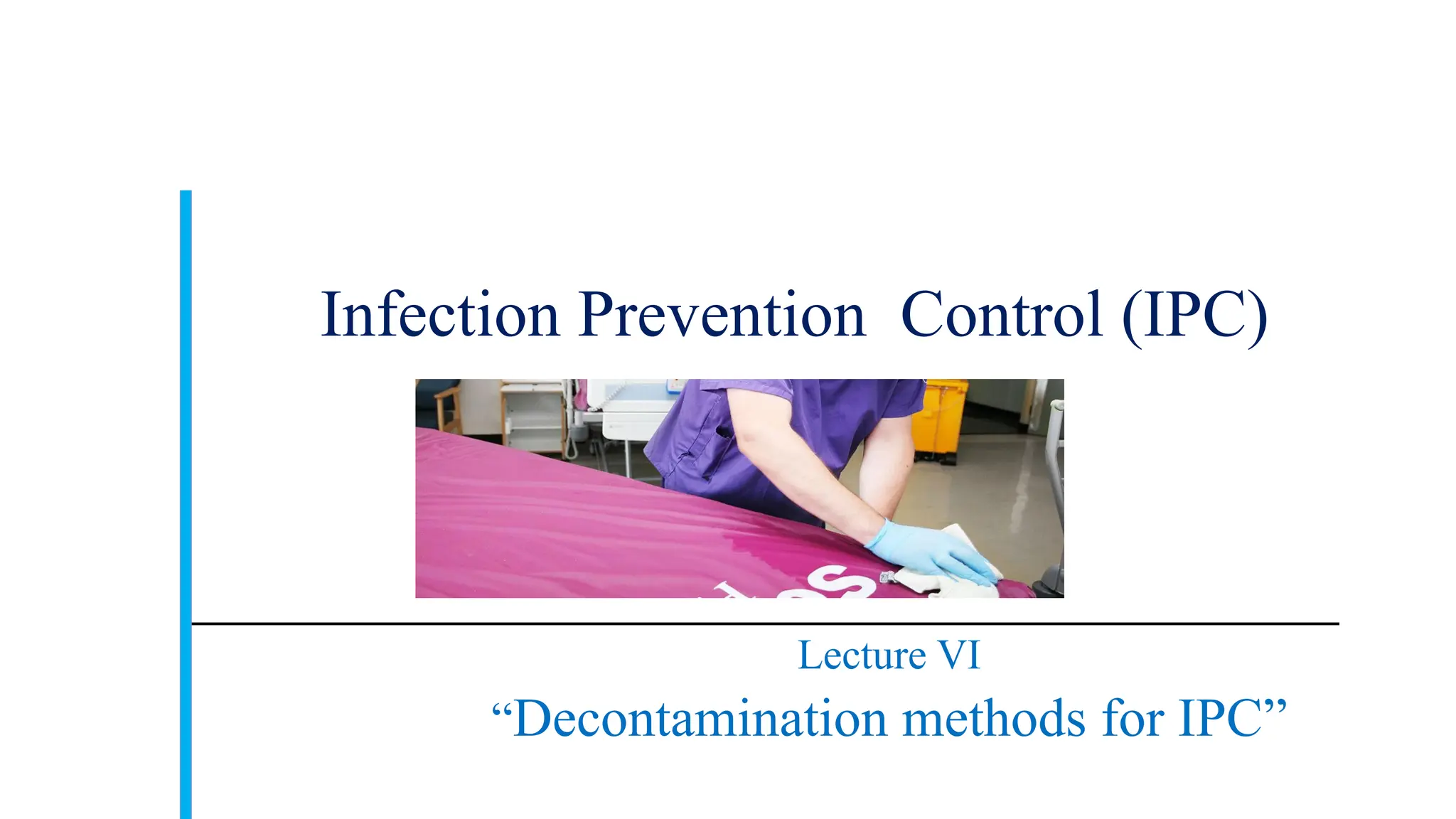
Infection Prevention Control (IPC)
Lecture VI
“Decontamination methods for IPC”
 Introduction
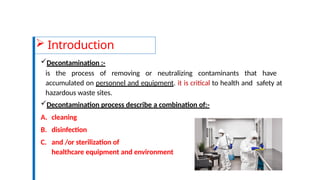
Decontamination :-
is the process of removing or neutralizing contaminants that have
accumulated on personnel and equipment. it is critical to health and safety at
hazardous waste sites.
Decontamination process describe a combination of:-
A. cleaning
B. disinfection
C. and /or sterilization of
healthcare equipment and environment
 Introduction
Make the item safe for staff
to handle without presenting
an infection hazard;
Make the item safe for use on a patient,
(after any additional processing)
including, when relevant, ensuring
freedom from contamination that could
lead to incorrect diagnosis
The decontamination process is intended to:
 Decontamination processes are:
1. Cleaning:
A process that removes dirt, dust, large numbers of micro-
organisms and the organic matter using detergent and warm
water or disposable detergent wipes, such as blood or
faeces that protects them.
Cleaning is a pre-requisite to disinfection or sterilization??
2. Disinfection:
The reduction of the number of viable microorganisms on a
product to appropriate level for its intended use, with the
exception of bacterial spores
3. Sterilization:
the process used to render an object free from viable
micro-organisms including viruses and bacterial spores.
Dr. Mohammed Salah, Ph D
86
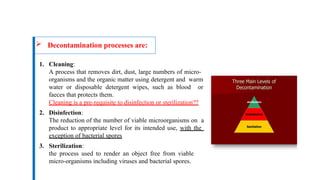
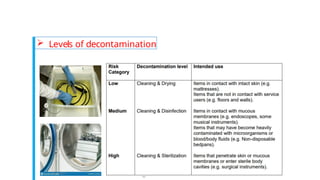
 Levels of decontamination
5/19/2023
 Choosing an appropriate method of decontamination
The appropriate method of decontamination, depends on a number of factors:-
1. The type of material to be treated
2. Device’s intended use
3. The organisms involved
4. How many times can it be re-processed?
5. Does processing constitute a hazard to patients and staff?
6. Degree of soilage
7. Process must not damage the device
I. Cleaning
Overview
1. Definition of cleaning
2. Importance of cleaning process
3. The five principles of cleaning
4. Pre-Cleaning/Cleaning personell
5. Cleaning the equipments/environment
6. Cleaning the specialist instruments
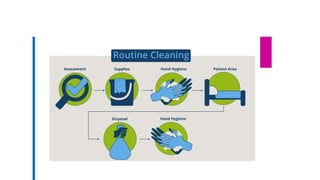
7. Routine cleaning
I. Cleaning
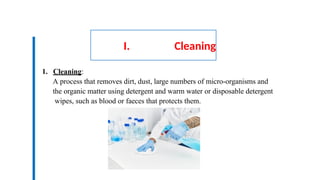
1. Cleaning:
A process that removes dirt, dust, large numbers of micro-organisms and
the organic matter using detergent and warm water or disposable detergent
wipes, such as blood or faeces that protects them.
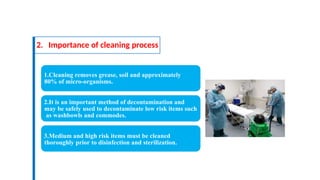
2. Importance of cleaning process
1.Cleaning removes grease, soil and approximately
80% of micro-organisms.
2.It is an important method of decontamination and
may be safely used to decontaminate low risk items such
as washbowls and commodes.
3.Medium and high risk items must be cleaned
thoroughly prior to disinfection and sterilization.
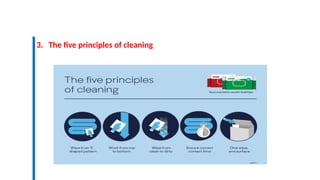
3. The five principles of cleaning
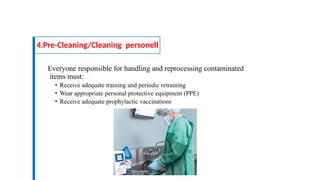
Everyone responsible for handling and reprocessing contaminated
items must:
• Receive adequate training and periodic retraining
• Wear appropriate personal protective equipment (PPE)
• Receive adequate prophylactic vaccinations
4.Pre-Cleaning/Cleaning personell
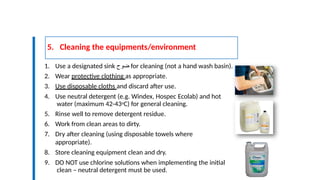
5. Cleaning the equipments/environment
9
3
1. Use a designated sink ‫ضوح‬ for cleaning (not a hand wash basin).
2. Wear protective clothing as appropriate.
3. Use disposable cloths and discard after use.
4. Use neutral detergent (e.g. Windex, Hospec Ecolab) and hot
water (maximum 42-43oC) for general cleaning.
5. Rinse well to remove detergent residue.
6. Work from clean areas to dirty.
7. Dry after cleaning (using disposable towels where
appropriate).
8. Store cleaning equipment clean and dry.
9. DO NOT use chlorine solutions when implementing the initial
clean – neutral detergent must be used.
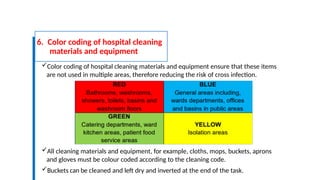
6. Color coding of hospital cleaning
materials and equipment
Color coding of hospital cleaning materials and equipment ensure that these items
are not used in multiple areas, therefore reducing the risk of cross infection.
All cleaning materials and equipment, for example, cloths, mops, buckets, aprons
and gloves must be colour coded according to the cleaning code.
Buckets can be cleaned and left dry and inverted at the end of the task.
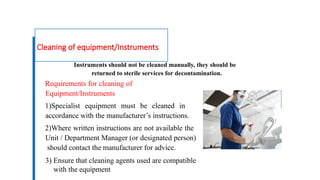
Cleaning of equipment/Instruments
Instruments should not be cleaned manually, they should be
returned to sterile services for decontamination.
Requirements for cleaning of
Equipment/Instruments
1)Specialist equipment must be cleaned in
accordance with the manufacturer’s instructions.
2)Where written instructions are not available the
Unit / Department Manager (or designated person)
should contact the manufacturer for advice.
3) Ensure that cleaning agents used are compatible
with the equipment
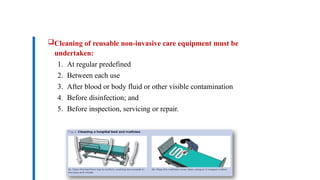
Cleaning of reusable non-invasive care equipment must be
undertaken:
1. At regular predefined
2. Between each use
3. After blood or body fluid or other visible contamination
4. Before disinfection; and
5. Before inspection, servicing or repair.
Dr. Mohammed Salah, Ph D
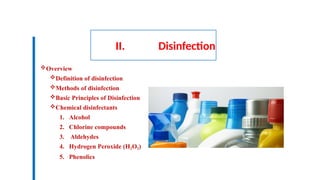
II. Disinfection
Overview
Definition of disinfection
Methods of disinfection
Basic Principles of Disinfection
Chemical disinfectants
1. Alcohol
2. Chlorine compounds
3. Aldehydes
4. Hydrogen Peroxide (H2O2)
5. Phenolics
Definition of Disinfection
Disinfection:
Is the reduction of the number of viable microorganisms on a product to
appropriate level for its intended use, with the exception of bacterial spores
Disinfection methods
Disinfection methods include thermal and chemical processes.
1. Moist heat may be used for items such as linen and bedpans e.g. automated
processes in a machine.
2. Specific chemical disinfectants can be used to decontaminate heat sensitive
equipment and the environment.
Disinfectants are not cleaning agents as they are generally inactivated by
organic material, therefore all items must be cleaned thoroughly prior to
disinfection.
Misuse and overuse of chemical disinfectants may result in damage to the user,
service user or equipment and may also result in the development of
anti5m/19i/2c02r3obial
Basic Principles of Disinfection
1. Do not use disinfection as a substitute for sterilization.
2. Only use chemical disinfectants if absolutely necessary. (Resistance)
3. Wear protective clothing (and respirators if required).
4. Ensure adequate ventilation.
5. Choose an appropriate disinfectant, compatible with the surface being disinfected
and approved by the Infection Prevention and Control Team.
6. Ensure that the correct dilution is used (check manufacturer’s instructions).
7. Discard disinfectant solution after use. Not reuse
8. Ensure that containers used for disinfection are stored clean, dry and inverted
between uses.
Chemical Disinfectants
Mode of Action:
The most feasible explanation for the antimicrobial action of alcohol is denaturation of proteins.
This mechanism is supported by the observation that absolute ethyl alcohol, a dehydrating agent, is
less bactericidal than mixtures of alcohol and water
Microbicidal Activity:
A) Methyl alcohol (methanol) has the weakest bactericidal action of the alcohols and thus seldom is
used in healthcare.
B) Ethyl alcohol
i. 30-80% bactericidal activity
ii. 60-80% virucidal activity
iii. 70% the most effective concentration
C) Isopropyl alcohol (20%) is effective
1. Alcohol
Uses of Alcohol
1. Alcohols are not recommended for sterilizing medical and surgical materials principally
because they lack sporicidal action and they cannot penetrate protein-rich materials.
2. Alcohols have been used effectively to disinfect:
1. oral and rectal thermometers
2. scissors and stethoscopes
3. used to disinfect endoscopes
4. used for disinfection of small surfaces such as rubber stoppers of multiple-dose medication vials
or vaccine bottles
Advantages
1. Fast acting.
4. Low cost.
Disadvantages
2. No residue. 3. Non-
staining.
5. Widely available.
1. No sporicidal action
2. Volatile, flammable, and an irritant to mucous membranes.
3. Inactivated by organic matter.
4. May harden rubber.
2. Chlorine and chlorine compounds
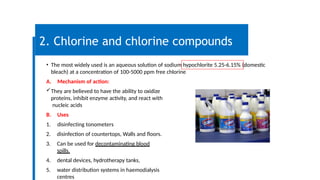
• The most widely used is an aqueous solution of sodium hypochlorite 5.25-6.15% (domestic
bleach) at a concentration of 100-5000 ppm free chlorine
A. Mechanism of action:
They are believed to have the ability to oxidize
proteins, inhibit enzyme activity, and react with
nucleic acids
B. Uses
1. disinfecting tonometers
2. disinfection of countertops, Walls and floors.
3. Can be used for decontaminating blood
spills.
4. dental devices, hydrotherapy tanks,
5. water distribution systems in haemodialysis
centres
C. Advantages
1.Low cost,
2. fast acting
3. Readily available
4. Available as liquid, tablets or powders.
D. Disadvantages
5. Corrosive to metals in high concentration (>500 ppm).
6. Irritant to skin and mucous membranes.
7. Decolorizes or bleaches fabrics.
8. Releases toxic chlorine gas when mixed with ammonia.
9. Inactivated by organic material.
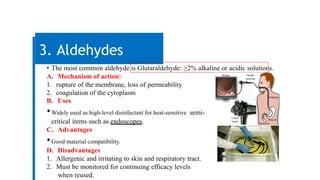
3. Aldehydes
• The most common aldehyde is Glutaraldehyde: ≥2% alkaline or acidic solutions.
A. Mechanism of action:
1. rupture of the membrane, loss of permeability
2. coagulation of the cytoplasm
B. Uses
•Widely used as high-level disinfectant for heat-sensitive semi-
critical items such as endoscopes.
C. Advantages
•Good material compatibility.
D. Disadvantages
1. Allergenic and irritating to skin and respiratory tract.
2. Must be monitored for continuing efficacy levels
when reused.
10
7
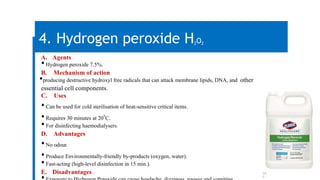
4. Hydrogen peroxide H2O2
A. Agents
•Hydrogen peroxide 7.5%.
B. Mechanism of action
•producing destructive hydroxyl free radicals that can attack membrane lipids, DNA, and other
essential cell components.
C. Uses
•Can be used for cold sterilisation of heat-sensitive critical items.
•Requires 30 minutes at 20
o
C.
•For disinfecting haemodialysers.
D. Advantages
•No odour.
•Produce Environmentally-friendly by-products (oxygen, water).
•Fast-acting (high-level disinfection in 15 min.).
E. Disadvantages
108
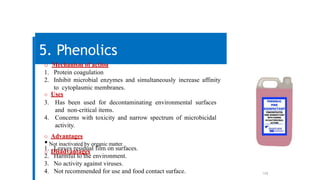
5. Phenolics
o Mechanism of action
1. Protein coagulation
2. Inhibit microbial enzymes and simultaneously increase affinity
to cytoplasmic membranes.
o Uses
3. Has been used for decontaminating environmental surfaces
and non-critical items.
4. Concerns with toxicity and narrow spectrum of microbicidal
activity.
o Advantages
•Not inactivated by organic matter.
o Disadvantages
1. Leaves residual film on surfaces.
2. Harmful to the environment.
3. No activity against viruses.
4. Not recommended for use and food contact surface.
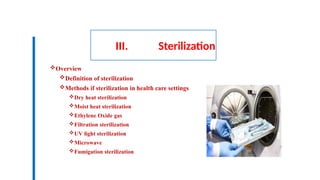
III. Sterilization
Overview
Definition of sterilization
Methods if sterilization in health care settings
Dry heat sterilization
Moist heat sterilization
Ethylene Oxide gas
Filtration sterilization
UV light sterilization
Microwave
Fumigation sterilization
 Definition of sterilization
 Sterilization:
it is the process used to render an object free from viable micro-organisms
including viruses and bacterial spores.
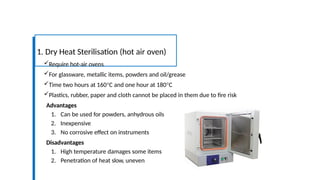
1. Dry Heat Sterilisation (hot air oven)
Require hot-air ovens
For glassware, metallic items, powders and oil/grease
Time two hours at 160°C and one hour at 180°C
Plastics, rubber, paper and cloth cannot be placed in them due to fire risk
Advantages
1. Can be used for powders, anhydrous oils
2. Inexpensive
3. No corrosive effect on instruments
Disadvantages
1. High temperature damages some items
2. Penetration of heat slow, uneven
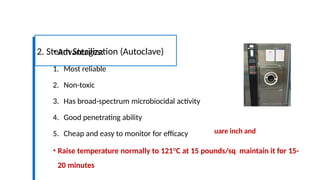
uare inch and
•Advantages:
1. Most reliable
2. Non-toxic
3. Has broad-spectrum microbiocidal activity
4. Good penetrating ability
5. Cheap and easy to monitor for efficacy
• Raise temperature normally to 121°C at 15 pounds/sq maintain it for 15-
20 minutes
2. Steam Sterilization (Autoclave)
• Colourless, flammable, explosive and toxic gas
• Used for heat or moisture sensitive items
• Prevents normal cellular metabolism and replication
3. Ethylene Oxide (EO)
Advantages
• Items not damaged by heat
or moisture
• Not corrosive,
• not damaging to
delicate instruments,
scopes
• Permeates porous
materials
Disadvantages
• Cost
• Toxic properties of ethylene oxide
• Aeration required
• Longer process
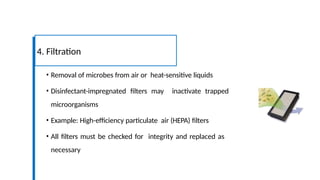
• Removal of microbes from air or heat-sensitive liquids
• Disinfectant-impregnated filters may inactivate trapped
microorganisms
• Example: High-efficiency particulate air (HEPA) filters
• All filters must be checked for integrity and replaced as
necessary
4. Filtration
• UV lamps useful for chemical-free disinfection of air and water and also
possibly for decontamination of environmental surfaces
• Broad-spectrum microbicidal action
• Require regular cleaning and periodic replacement
5. Ultraviolet (UV) Light
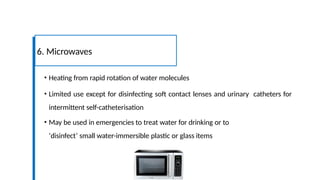
• Heating from rapid rotation of water molecules
• Limited use except for disinfecting soft contact lenses and urinary catheters for
intermittent self-catheterisation
• May be used in emergencies to treat water for drinking or to
‘disinfect’ small water-immersible plastic or glass items
6. Microwaves
• For rooms contaminated with some pathogens
• Such as MRSA and Clostridium difficile
• Release of hydrogen peroxide, chlorine dioxide gas or possibly ozone in sealed rooms
• Spore strips (biological indicators) placed strategically to monitor process
• Special equipment required
• Risk of damage to sensitive items
7. Fumigation
Decontamination methods for IPC.pptx communicable

Decontamination methods for IPC.pptx communicable

  • 1.
    Infection Prevention Control(IPC) Lecture VI “Decontamination methods for IPC”
  • 2.
     Introduction Decontamination :- isthe process of removing or neutralizing contaminants that have accumulated on personnel and equipment. it is critical to health and safety at hazardous waste sites. Decontamination process describe a combination of:- A. cleaning B. disinfection C. and /or sterilization of healthcare equipment and environment
  • 3.
     Introduction Make theitem safe for staff to handle without presenting an infection hazard; Make the item safe for use on a patient, (after any additional processing) including, when relevant, ensuring freedom from contamination that could lead to incorrect diagnosis The decontamination process is intended to:
  • 4.
     Decontamination processesare: 1. Cleaning: A process that removes dirt, dust, large numbers of micro- organisms and the organic matter using detergent and warm water or disposable detergent wipes, such as blood or faeces that protects them. Cleaning is a pre-requisite to disinfection or sterilization?? 2. Disinfection: The reduction of the number of viable microorganisms on a product to appropriate level for its intended use, with the exception of bacterial spores 3. Sterilization: the process used to render an object free from viable micro-organisms including viruses and bacterial spores.
  • 5.
    Dr. Mohammed Salah,Ph D 86  Levels of decontamination 5/19/2023
  • 6.
     Choosing anappropriate method of decontamination The appropriate method of decontamination, depends on a number of factors:- 1. The type of material to be treated 2. Device’s intended use 3. The organisms involved 4. How many times can it be re-processed? 5. Does processing constitute a hazard to patients and staff? 6. Degree of soilage 7. Process must not damage the device
  • 7.
    I. Cleaning Overview 1. Definitionof cleaning 2. Importance of cleaning process 3. The five principles of cleaning 4. Pre-Cleaning/Cleaning personell 5. Cleaning the equipments/environment 6. Cleaning the specialist instruments 7. Routine cleaning
  • 8.
    I. Cleaning 1. Cleaning: Aprocess that removes dirt, dust, large numbers of micro-organisms and the organic matter using detergent and warm water or disposable detergent wipes, such as blood or faeces that protects them.
  • 9.
    2. Importance ofcleaning process 1.Cleaning removes grease, soil and approximately 80% of micro-organisms. 2.It is an important method of decontamination and may be safely used to decontaminate low risk items such as washbowls and commodes. 3.Medium and high risk items must be cleaned thoroughly prior to disinfection and sterilization.
  • 10.
    3. The fiveprinciples of cleaning
  • 11.
    Everyone responsible forhandling and reprocessing contaminated items must: • Receive adequate training and periodic retraining • Wear appropriate personal protective equipment (PPE) • Receive adequate prophylactic vaccinations 4.Pre-Cleaning/Cleaning personell
  • 12.
    5. Cleaning theequipments/environment 9 3 1. Use a designated sink ‫ضوح‬ for cleaning (not a hand wash basin). 2. Wear protective clothing as appropriate. 3. Use disposable cloths and discard after use. 4. Use neutral detergent (e.g. Windex, Hospec Ecolab) and hot water (maximum 42-43oC) for general cleaning. 5. Rinse well to remove detergent residue. 6. Work from clean areas to dirty. 7. Dry after cleaning (using disposable towels where appropriate). 8. Store cleaning equipment clean and dry. 9. DO NOT use chlorine solutions when implementing the initial clean – neutral detergent must be used.
  • 13.
    6. Color codingof hospital cleaning materials and equipment Color coding of hospital cleaning materials and equipment ensure that these items are not used in multiple areas, therefore reducing the risk of cross infection. All cleaning materials and equipment, for example, cloths, mops, buckets, aprons and gloves must be colour coded according to the cleaning code. Buckets can be cleaned and left dry and inverted at the end of the task.
  • 14.
    Cleaning of equipment/Instruments Instrumentsshould not be cleaned manually, they should be returned to sterile services for decontamination. Requirements for cleaning of Equipment/Instruments 1)Specialist equipment must be cleaned in accordance with the manufacturer’s instructions. 2)Where written instructions are not available the Unit / Department Manager (or designated person) should contact the manufacturer for advice. 3) Ensure that cleaning agents used are compatible with the equipment
  • 15.
    Cleaning of reusablenon-invasive care equipment must be undertaken: 1. At regular predefined 2. Between each use 3. After blood or body fluid or other visible contamination 4. Before disinfection; and 5. Before inspection, servicing or repair. Dr. Mohammed Salah, Ph D
  • 17.
    II. Disinfection Overview Definition ofdisinfection Methods of disinfection Basic Principles of Disinfection Chemical disinfectants 1. Alcohol 2. Chlorine compounds 3. Aldehydes 4. Hydrogen Peroxide (H2O2) 5. Phenolics
  • 18.
    Definition of Disinfection Disinfection: Isthe reduction of the number of viable microorganisms on a product to appropriate level for its intended use, with the exception of bacterial spores
  • 19.
    Disinfection methods Disinfection methodsinclude thermal and chemical processes. 1. Moist heat may be used for items such as linen and bedpans e.g. automated processes in a machine. 2. Specific chemical disinfectants can be used to decontaminate heat sensitive equipment and the environment. Disinfectants are not cleaning agents as they are generally inactivated by organic material, therefore all items must be cleaned thoroughly prior to disinfection. Misuse and overuse of chemical disinfectants may result in damage to the user, service user or equipment and may also result in the development of anti5m/19i/2c02r3obial
  • 20.
    Basic Principles ofDisinfection 1. Do not use disinfection as a substitute for sterilization. 2. Only use chemical disinfectants if absolutely necessary. (Resistance) 3. Wear protective clothing (and respirators if required). 4. Ensure adequate ventilation. 5. Choose an appropriate disinfectant, compatible with the surface being disinfected and approved by the Infection Prevention and Control Team. 6. Ensure that the correct dilution is used (check manufacturer’s instructions). 7. Discard disinfectant solution after use. Not reuse 8. Ensure that containers used for disinfection are stored clean, dry and inverted between uses.
  • 21.
    Chemical Disinfectants Mode ofAction: The most feasible explanation for the antimicrobial action of alcohol is denaturation of proteins. This mechanism is supported by the observation that absolute ethyl alcohol, a dehydrating agent, is less bactericidal than mixtures of alcohol and water Microbicidal Activity: A) Methyl alcohol (methanol) has the weakest bactericidal action of the alcohols and thus seldom is used in healthcare. B) Ethyl alcohol i. 30-80% bactericidal activity ii. 60-80% virucidal activity iii. 70% the most effective concentration C) Isopropyl alcohol (20%) is effective 1. Alcohol
  • 22.
    Uses of Alcohol 1.Alcohols are not recommended for sterilizing medical and surgical materials principally because they lack sporicidal action and they cannot penetrate protein-rich materials. 2. Alcohols have been used effectively to disinfect: 1. oral and rectal thermometers 2. scissors and stethoscopes 3. used to disinfect endoscopes 4. used for disinfection of small surfaces such as rubber stoppers of multiple-dose medication vials or vaccine bottles Advantages 1. Fast acting. 4. Low cost. Disadvantages 2. No residue. 3. Non- staining. 5. Widely available. 1. No sporicidal action 2. Volatile, flammable, and an irritant to mucous membranes. 3. Inactivated by organic matter. 4. May harden rubber.
  • 23.
    2. Chlorine andchlorine compounds • The most widely used is an aqueous solution of sodium hypochlorite 5.25-6.15% (domestic bleach) at a concentration of 100-5000 ppm free chlorine A. Mechanism of action: They are believed to have the ability to oxidize proteins, inhibit enzyme activity, and react with nucleic acids B. Uses 1. disinfecting tonometers 2. disinfection of countertops, Walls and floors. 3. Can be used for decontaminating blood spills. 4. dental devices, hydrotherapy tanks, 5. water distribution systems in haemodialysis centres
  • 24.
    C. Advantages 1.Low cost, 2.fast acting 3. Readily available 4. Available as liquid, tablets or powders. D. Disadvantages 5. Corrosive to metals in high concentration (>500 ppm). 6. Irritant to skin and mucous membranes. 7. Decolorizes or bleaches fabrics. 8. Releases toxic chlorine gas when mixed with ammonia. 9. Inactivated by organic material.
  • 25.
    3. Aldehydes • Themost common aldehyde is Glutaraldehyde: ≥2% alkaline or acidic solutions. A. Mechanism of action: 1. rupture of the membrane, loss of permeability 2. coagulation of the cytoplasm B. Uses •Widely used as high-level disinfectant for heat-sensitive semi- critical items such as endoscopes. C. Advantages •Good material compatibility. D. Disadvantages 1. Allergenic and irritating to skin and respiratory tract. 2. Must be monitored for continuing efficacy levels when reused.
  • 26.
    10 7 4. Hydrogen peroxideH2O2 A. Agents •Hydrogen peroxide 7.5%. B. Mechanism of action •producing destructive hydroxyl free radicals that can attack membrane lipids, DNA, and other essential cell components. C. Uses •Can be used for cold sterilisation of heat-sensitive critical items. •Requires 30 minutes at 20 o C. •For disinfecting haemodialysers. D. Advantages •No odour. •Produce Environmentally-friendly by-products (oxygen, water). •Fast-acting (high-level disinfection in 15 min.). E. Disadvantages
  • 27.
    108 5. Phenolics o Mechanismof action 1. Protein coagulation 2. Inhibit microbial enzymes and simultaneously increase affinity to cytoplasmic membranes. o Uses 3. Has been used for decontaminating environmental surfaces and non-critical items. 4. Concerns with toxicity and narrow spectrum of microbicidal activity. o Advantages •Not inactivated by organic matter. o Disadvantages 1. Leaves residual film on surfaces. 2. Harmful to the environment. 3. No activity against viruses. 4. Not recommended for use and food contact surface.
  • 28.
    III. Sterilization Overview Definition ofsterilization Methods if sterilization in health care settings Dry heat sterilization Moist heat sterilization Ethylene Oxide gas Filtration sterilization UV light sterilization Microwave Fumigation sterilization
  • 29.
     Definition ofsterilization  Sterilization: it is the process used to render an object free from viable micro-organisms including viruses and bacterial spores.
  • 30.
    1. Dry HeatSterilisation (hot air oven) Require hot-air ovens For glassware, metallic items, powders and oil/grease Time two hours at 160°C and one hour at 180°C Plastics, rubber, paper and cloth cannot be placed in them due to fire risk Advantages 1. Can be used for powders, anhydrous oils 2. Inexpensive 3. No corrosive effect on instruments Disadvantages 1. High temperature damages some items 2. Penetration of heat slow, uneven
  • 31.
    uare inch and •Advantages: 1.Most reliable 2. Non-toxic 3. Has broad-spectrum microbiocidal activity 4. Good penetrating ability 5. Cheap and easy to monitor for efficacy • Raise temperature normally to 121°C at 15 pounds/sq maintain it for 15- 20 minutes 2. Steam Sterilization (Autoclave)
  • 32.
    • Colourless, flammable,explosive and toxic gas • Used for heat or moisture sensitive items • Prevents normal cellular metabolism and replication 3. Ethylene Oxide (EO) Advantages • Items not damaged by heat or moisture • Not corrosive, • not damaging to delicate instruments, scopes • Permeates porous materials Disadvantages • Cost • Toxic properties of ethylene oxide • Aeration required • Longer process
  • 33.
    • Removal ofmicrobes from air or heat-sensitive liquids • Disinfectant-impregnated filters may inactivate trapped microorganisms • Example: High-efficiency particulate air (HEPA) filters • All filters must be checked for integrity and replaced as necessary 4. Filtration
  • 34.
    • UV lampsuseful for chemical-free disinfection of air and water and also possibly for decontamination of environmental surfaces • Broad-spectrum microbicidal action • Require regular cleaning and periodic replacement 5. Ultraviolet (UV) Light
  • 35.
    • Heating fromrapid rotation of water molecules • Limited use except for disinfecting soft contact lenses and urinary catheters for intermittent self-catheterisation • May be used in emergencies to treat water for drinking or to ‘disinfect’ small water-immersible plastic or glass items 6. Microwaves
  • 36.
    • For roomscontaminated with some pathogens • Such as MRSA and Clostridium difficile • Release of hydrogen peroxide, chlorine dioxide gas or possibly ozone in sealed rooms • Spore strips (biological indicators) placed strategically to monitor process • Special equipment required • Risk of damage to sensitive items 7. Fumigation