15.1 Industrial Products and the
Microorganisms That Make Them
• Industrial microbiology
– Uses microorganisms, typically grown on a large
scale, to produce products or carry out chemical
transformation
– Originated with alcoholic fermentation processes
• Later on, processes such as production of
pharmaceuticals, food additives, enzymes, and
chemicals were developed
– Major organisms used are fungi and Streptomyces
– Classic methods are used to select for high-
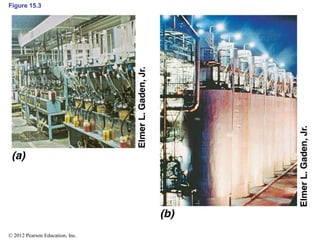
yielding microbial variants
© 2012 Pearson Education, Inc.
15.1 Industrial Products and the
Microorganisms That Make Them
• Properties of a useful industrial microbe include
– Produces spores or can be easily inoculated
– Grows rapidly on a large scale in inexpensive
medium
– Produces desired product quickly
– Should not be pathogenic
– Amenable to genetic manipulation
© 2012 Pearson Education, Inc.
15.1 Industrial Products and the
Microorganisms That Make Them
• Microbial products of industrial interest include
– Microbial cells
– Enzymes
– Antibiotics, steroids, alkaloids
– Food additives
– Commodity chemicals
• Inexpensive chemicals produced in bulk
• Include ethanol, citric acid, and many others
© 2012 Pearson Education, Inc.
15.2 Production and Scale
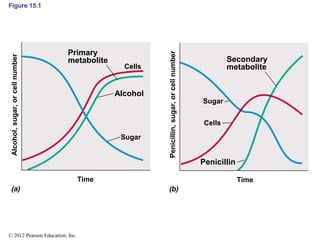
• Primary metabolite
– Produced during exponential growth
– Example: alcohol
• Secondary metabolite
– Produced during stationary phase
© 2012 Pearson Education, Inc.
15.2 Production and Scale
• Secondary metabolites
– Not essential for growth
– Formation depends on growth conditions
– Produced as a group of related compounds
– Often significantly overproduced
– Often produced by spore-forming microbes
during sporulation
© 2012 Pearson Education, Inc.
Figure 15.1
Primary
metabolite Secondary
metabolite
Alcohol
Penicillin
Cells
Sugar
Cells
Sugar
Time Time
Alcohol,
sugar,
or
cell
number
Penicillin,
sugar,
or
cell
number
© 2012 Pearson Education, Inc.
15.2 Production and Scale
• Secondary metabolites are often large
organic molecules that require a large
number of specific enzymatic steps for
production
– Synthesis of tetracycline requires at least 72
separate enzymatic steps
– Starting materials arise from major
biosynthetic pathways
© 2012 Pearson Education, Inc.
15.2 Production and Scale
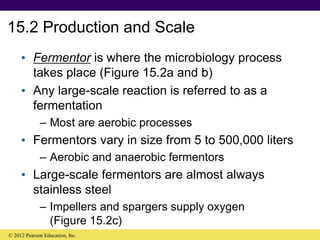
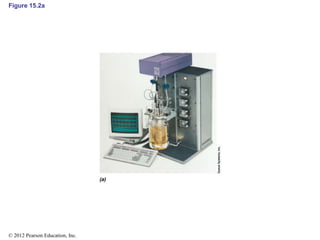
• Fermentor is where the microbiology process
takes place (Figure 15.2a and b)
• Any large-scale reaction is referred to as a
fermentation
– Most are aerobic processes
• Fermentors vary in size from 5 to 500,000 liters
– Aerobic and anaerobic fermentors
• Large-scale fermentors are almost always
stainless steel
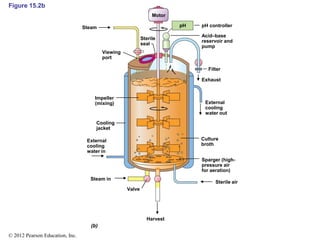
– Impellers and spargers supply oxygen
(Figure 15.2c)
© 2012 Pearson Education, Inc.
Figure 15.2a
© 2012 Pearson Education, Inc.
Figure 15.2b
Steam
Sterile
seal
Motor
pH pH controller
Acid–base
reservoir and
pump
Viewing
port
Filter
Exhaust
Impeller
(mixing)
Cooling
jacket
External
cooling
water in
External
cooling
water out
Culture
broth
Steam in
Valve
Harvest
Sparger (high-
pressure air
for aeration)
Sterile air
© 2012 Pearson Education, Inc.
Figure 15.2c
© 2012 Pearson Education, Inc.
Figure 15.3
© 2012 Pearson Education, Inc.
15.3 Antibiotics: Isolation, Yield, and
Purification
• Antibiotics
– Compounds that kill or inhibit the growth of other
microbes
– Typically secondary metabolites
– Most antibiotics in clinical use are produced by
filamentous fungi or actinomycetes
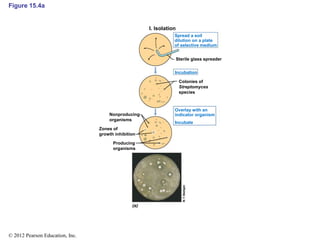
– Still discovered by laboratory screening
(Figure 15.4a)
• Microbes are obtained from nature in pure culture
• Assayed for products that inhibit growth of test
bacteria
© 2012 Pearson Education, Inc.
Animation: Isolation and Screening
of Antibiotic Producers
Figure 15.4a
I. Isolation
Sterile glass spreader
Colonies of
Streptomyces
species
Nonproducing
organisms
Zones of
growth inhibition
Producing
organisms
Spread a soil
dilution on a plate
of selective medium
Incubation
Overlay with an
indicator organism
Incubate
© 2012 Pearson Education, Inc.
15.3 Antibiotics: Isolation, Yield, and
Purification
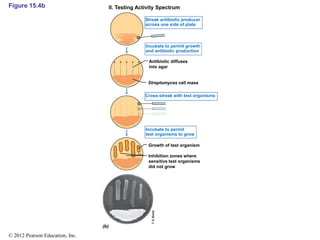
• Cross-streak method (Figure 15.4b)
– Used to test new microbial isolates for
antibiotic production
– Most isolates produce known antibiotics
– Most antibiotics fail toxicity and therapeutic
tests in animals
– Time and cost of developing a new antibiotic
is approximately 15 years and $1 billion
• Involves clinical trials and U.S. FDA approval
• Antibiotic purification and extraction often
involves elaborate methods
© 2012 Pearson Education, Inc.
Figure 15.4b II. Testing Activity Spectrum
Streak antibiotic producer
across one side of plate
Incubate to permit growth
and antibiotic production
Cross-streak with test organisms
Incubate to permit
test organisms to grow
Antibiotic diffuses
into agar
Streptomyces cell mass
Growth of test organism
Inhibition zones where
sensitive test organisms
did not grow
© 2012 Pearson Education, Inc.
15.4 Industrial Production of Penicillins
and Tetracyclines
• Penicillins are -lactam antibiotics
– Natural and biosynthetic penicillins (Figure 15.5)
– Semisynthetic penicillins
• Broad spectrum of activity
• Penicillin production is typical of a secondary
metabolite
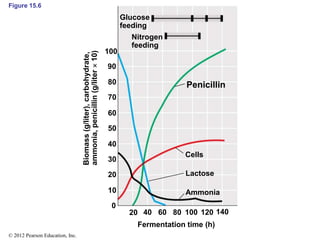
– Production only begins after near-exhaustion of
carbon source (Figure 15.6)
– High levels of glucose repress penicillin
production
© 2012 Pearson Education, Inc.
Figure 15.6
Glucose
feeding
Nitrogen
feeding
Cells
Lactose
Ammonia
Penicillin
Fermentation time (h)
Biomass
(g/liter),
carbohydrate,
ammonia,
penicillin
(g/liter

10)
100
90
80
70
60
50
40
30
20
10
0
20 40 60 80 100 120 140
© 2012 Pearson Education, Inc.
15.4 Industrial Production of Penicillins
and Tetracyclines
• Biosynthesis of tetracycline has a large
number of enzymatic steps
– More than 72 intermediates
– More than 300 genes involved!
– Complex biosynthetic regulation (Figure 15.7)
© 2012 Pearson Education, Inc.
15.5 Vitamins and Amino Acids
• Production of vitamins is second only to
antibiotics in terms of total pharmaceutical
sales
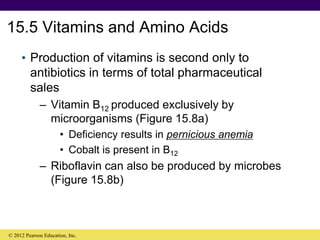
– Vitamin B12 produced exclusively by
microorganisms (Figure 15.8a)
• Deficiency results in pernicious anemia
• Cobalt is present in B12
– Riboflavin can also be produced by microbes
(Figure 15.8b)
© 2012 Pearson Education, Inc.
15.5 Vitamins and Amino Acids
• Amino acids
– Used as feed additives in the food industry
– Used as nutritional supplements in
nutraceutical industry
– Used as starting materials in the chemical
industry
– Examples include
• Glutamic acid (MSG)
• Aspartic acid and phenylalanine (aspartame
[NutraSweet])
• Lysine (food additives; Figure 15.9)
© 2012 Pearson Education, Inc.
15.6 Enzymes as Industrial Products
• Exoenzymes
– Enzymes that are excreted into the medium
instead of being held within the cell; they are
extracellular
– Can digest insoluble polymers such as cellulose,
protein, and starch
• Enzymes are useful as industrial catalysts
– Produce only one stereoisomer
– High substrate specificity
© 2012 Pearson Education, Inc.
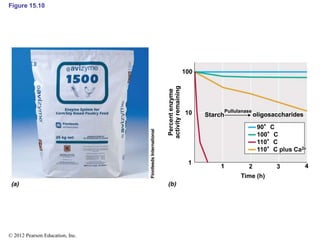
Figure 15.10
Starch oligosaccharides
Time (h)
Percent
enzyme
activity
remaining
Pullulanase
90°C
100°C
110°C
110°C plus Ca2
100
10
1
1 2 3 4
© 2012 Pearson Education, Inc.
III. Alcoholic Beverages and Biofuels
• 15.7 Wine
• 15.8 Brewing and Distilling
• 15.9 Biofuels
© 2012 Pearson Education, Inc.
15.10 Wine
• Most wine is made from grapes
• Wine fermentation occurs in fermentors
ranging in size from 200 to 200,000 liters
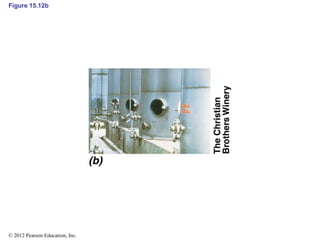
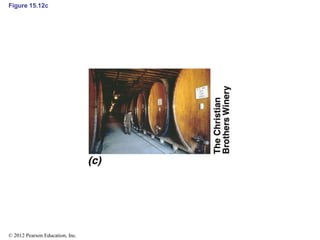
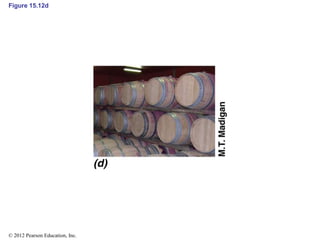
– Fermentors are made of oak, cement, glass-
lined steel, or stone (Figure 15.12b, c, and d)
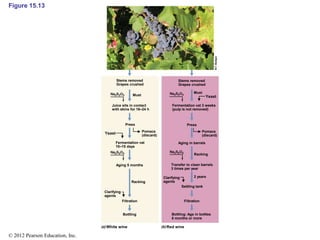
• White wine is made from white grapes or red
grapes that have had their skin removed
(Figure 15.13)
• Red wine is aged for months or years
• White wine is often sold without aging
© 2012 Pearson Education, Inc.
Figure 15.12b
© 2012 Pearson Education, Inc.
Figure 15.12c
© 2012 Pearson Education, Inc.
Figure 15.12d
© 2012 Pearson Education, Inc.
Figure 15.13
Stems removed
Grapes crushed
Must
Juice sits in contact
with skins for 16–24 h
Press
Yeast
White wine Red wine
Pomace
(discard)
Yeast
Fermentation vat
10–15 days
Aging 5 months
Racking
Clarifying
agents
Filtration
Bottling
Stems removed
Grapes crushed
Must
Fermentation vat 3 weeks
(pulp is not removed)
Press
Pomace
(discard)
Aging in barrels
Racking
Transfer to clean barrels
3 times per year
Clarifying
agents
2 years
Settling tank
Filtration
Bottling: Age in bottles
6 months or more
© 2012 Pearson Education, Inc.
15.8 Brewing and Distilling
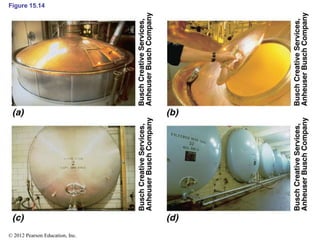
• Brewing is the term used to describe the
manufacture of alcoholic beverages from malted
grains (Figure 15.14)
• Yeast is used to produce beer
• Two main types of brewery yeast strains
– Top fermenting — ales
– Bottom fermenting — lagers
© 2012 Pearson Education, Inc.
Figure 15.14
© 2012 Pearson Education, Inc.
15.8 Brewing and Distilling
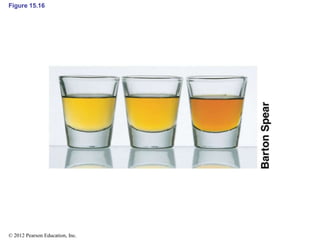
• Distilled alcoholic beverages are made by
heating previously fermented liquid to a
temperature that volatilizes most of the
alcohol (Figure 15.16)
– Whiskey, rum, brandy, vodka, gin
• >50,000,000,000 liters of ethanol are
produced yearly for industrial purposes
– Used as an industrial solvent and gasoline
supplement
© 2012 Pearson Education, Inc.
Figure 15.16
© 2012 Pearson Education, Inc.
15.9 Biofuels
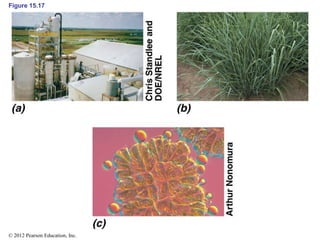
• Ethanol Biofuels
– Ethanol is a major industrial commodity chemical
– Over 60 billion liters of alcohol are produced
yearly from the fermentation of feedstocks
(Figure 15.17a and b)
– Gasohol and E-85
• Petroleum Biofuels
– Production of butanol
– Synthesis of petroleum from green algae
(Figure 15.17c)
© 2012 Pearson Education, Inc.
Figure 15.17
© 2012 Pearson Education, Inc.
IV. Products from Genetically Engineered
Microorganisms
• 15.10 Expressing Mammalian Genes in Bacteria
• 15.11 Production of Genetically Engineered
Somatotropin
• 15.12 Other Mammalian Proteins and Products
• 15.13 Genetically Engineered Vaccines
• 15.14 Mining Genomes
• 15.15 Engineering Metabolic Pathways
© 2012 Pearson Education, Inc.
15.10 Expressing Mammalian Genes
in Bacteria
• Biotechnology
– Use of living organisms for industrial or
commercial applications
• Genetically modified organism (GMO)
– An organism whose genome has been altered
• Genetic engineering allows expression of
eukaryotic genes in prokaryotes (e.g., insulin)
• This is achieved by
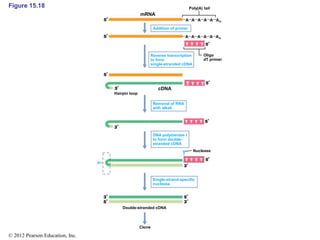
– Cloning the gene via mRNA (Figure 15.18)
– Finding the gene via the protein (Figure 15.19)
© 2012 Pearson Education, Inc.
Figure 15.18
mRNA
cDNA
Addition of primer
Reverse transcription
to form
single-stranded cDNA
Removal of RNA
with alkali
DNA polymerase I
to form double-
stranded cDNA
Single-strand-specific
nuclease
Poly(A) tail
Oligo
dT primer
Hairpin loop
Double-stranded cDNA
Clone
Nuclease
© 2012 Pearson Education, Inc.

industrialmicro.ppt

  • 1.
    15.1 Industrial Productsand the Microorganisms That Make Them • Industrial microbiology – Uses microorganisms, typically grown on a large scale, to produce products or carry out chemical transformation – Originated with alcoholic fermentation processes • Later on, processes such as production of pharmaceuticals, food additives, enzymes, and chemicals were developed – Major organisms used are fungi and Streptomyces – Classic methods are used to select for high- yielding microbial variants © 2012 Pearson Education, Inc.
  • 2.
    15.1 Industrial Productsand the Microorganisms That Make Them • Properties of a useful industrial microbe include – Produces spores or can be easily inoculated – Grows rapidly on a large scale in inexpensive medium – Produces desired product quickly – Should not be pathogenic – Amenable to genetic manipulation © 2012 Pearson Education, Inc.
  • 3.
    15.1 Industrial Productsand the Microorganisms That Make Them • Microbial products of industrial interest include – Microbial cells – Enzymes – Antibiotics, steroids, alkaloids – Food additives – Commodity chemicals • Inexpensive chemicals produced in bulk • Include ethanol, citric acid, and many others © 2012 Pearson Education, Inc.
  • 4.
    15.2 Production andScale • Primary metabolite – Produced during exponential growth – Example: alcohol • Secondary metabolite – Produced during stationary phase © 2012 Pearson Education, Inc.
  • 5.
    15.2 Production andScale • Secondary metabolites – Not essential for growth – Formation depends on growth conditions – Produced as a group of related compounds – Often significantly overproduced – Often produced by spore-forming microbes during sporulation © 2012 Pearson Education, Inc.
  • 6.
    Figure 15.1 Primary metabolite Secondary metabolite Alcohol Penicillin Cells Sugar Cells Sugar TimeTime Alcohol, sugar, or cell number Penicillin, sugar, or cell number © 2012 Pearson Education, Inc.
  • 7.
    15.2 Production andScale • Secondary metabolites are often large organic molecules that require a large number of specific enzymatic steps for production – Synthesis of tetracycline requires at least 72 separate enzymatic steps – Starting materials arise from major biosynthetic pathways © 2012 Pearson Education, Inc.
  • 8.
    15.2 Production andScale • Fermentor is where the microbiology process takes place (Figure 15.2a and b) • Any large-scale reaction is referred to as a fermentation – Most are aerobic processes • Fermentors vary in size from 5 to 500,000 liters – Aerobic and anaerobic fermentors • Large-scale fermentors are almost always stainless steel – Impellers and spargers supply oxygen (Figure 15.2c) © 2012 Pearson Education, Inc.
  • 9.
    Figure 15.2a © 2012Pearson Education, Inc.
  • 10.
    Figure 15.2b Steam Sterile seal Motor pH pHcontroller Acid–base reservoir and pump Viewing port Filter Exhaust Impeller (mixing) Cooling jacket External cooling water in External cooling water out Culture broth Steam in Valve Harvest Sparger (high- pressure air for aeration) Sterile air © 2012 Pearson Education, Inc.
  • 11.
    Figure 15.2c © 2012Pearson Education, Inc.
  • 12.
    Figure 15.3 © 2012Pearson Education, Inc.
  • 13.
    15.3 Antibiotics: Isolation,Yield, and Purification • Antibiotics – Compounds that kill or inhibit the growth of other microbes – Typically secondary metabolites – Most antibiotics in clinical use are produced by filamentous fungi or actinomycetes – Still discovered by laboratory screening (Figure 15.4a) • Microbes are obtained from nature in pure culture • Assayed for products that inhibit growth of test bacteria © 2012 Pearson Education, Inc. Animation: Isolation and Screening of Antibiotic Producers
  • 14.
    Figure 15.4a I. Isolation Sterileglass spreader Colonies of Streptomyces species Nonproducing organisms Zones of growth inhibition Producing organisms Spread a soil dilution on a plate of selective medium Incubation Overlay with an indicator organism Incubate © 2012 Pearson Education, Inc.
  • 15.
    15.3 Antibiotics: Isolation,Yield, and Purification • Cross-streak method (Figure 15.4b) – Used to test new microbial isolates for antibiotic production – Most isolates produce known antibiotics – Most antibiotics fail toxicity and therapeutic tests in animals – Time and cost of developing a new antibiotic is approximately 15 years and $1 billion • Involves clinical trials and U.S. FDA approval • Antibiotic purification and extraction often involves elaborate methods © 2012 Pearson Education, Inc.
  • 16.
    Figure 15.4b II.Testing Activity Spectrum Streak antibiotic producer across one side of plate Incubate to permit growth and antibiotic production Cross-streak with test organisms Incubate to permit test organisms to grow Antibiotic diffuses into agar Streptomyces cell mass Growth of test organism Inhibition zones where sensitive test organisms did not grow © 2012 Pearson Education, Inc.
  • 17.
    15.4 Industrial Productionof Penicillins and Tetracyclines • Penicillins are -lactam antibiotics – Natural and biosynthetic penicillins (Figure 15.5) – Semisynthetic penicillins • Broad spectrum of activity • Penicillin production is typical of a secondary metabolite – Production only begins after near-exhaustion of carbon source (Figure 15.6) – High levels of glucose repress penicillin production © 2012 Pearson Education, Inc.
  • 18.
    Figure 15.6 Glucose feeding Nitrogen feeding Cells Lactose Ammonia Penicillin Fermentation time(h) Biomass (g/liter), carbohydrate, ammonia, penicillin (g/liter  10) 100 90 80 70 60 50 40 30 20 10 0 20 40 60 80 100 120 140 © 2012 Pearson Education, Inc.
  • 19.
    15.4 Industrial Productionof Penicillins and Tetracyclines • Biosynthesis of tetracycline has a large number of enzymatic steps – More than 72 intermediates – More than 300 genes involved! – Complex biosynthetic regulation (Figure 15.7) © 2012 Pearson Education, Inc.
  • 20.
    15.5 Vitamins andAmino Acids • Production of vitamins is second only to antibiotics in terms of total pharmaceutical sales – Vitamin B12 produced exclusively by microorganisms (Figure 15.8a) • Deficiency results in pernicious anemia • Cobalt is present in B12 – Riboflavin can also be produced by microbes (Figure 15.8b) © 2012 Pearson Education, Inc.
  • 21.
    15.5 Vitamins andAmino Acids • Amino acids – Used as feed additives in the food industry – Used as nutritional supplements in nutraceutical industry – Used as starting materials in the chemical industry – Examples include • Glutamic acid (MSG) • Aspartic acid and phenylalanine (aspartame [NutraSweet]) • Lysine (food additives; Figure 15.9) © 2012 Pearson Education, Inc.
  • 22.
    15.6 Enzymes asIndustrial Products • Exoenzymes – Enzymes that are excreted into the medium instead of being held within the cell; they are extracellular – Can digest insoluble polymers such as cellulose, protein, and starch • Enzymes are useful as industrial catalysts – Produce only one stereoisomer – High substrate specificity © 2012 Pearson Education, Inc.
  • 23.
    Figure 15.10 Starch oligosaccharides Time(h) Percent enzyme activity remaining Pullulanase 90°C 100°C 110°C 110°C plus Ca2 100 10 1 1 2 3 4 © 2012 Pearson Education, Inc.
  • 24.
    III. Alcoholic Beveragesand Biofuels • 15.7 Wine • 15.8 Brewing and Distilling • 15.9 Biofuels © 2012 Pearson Education, Inc.
  • 25.
    15.10 Wine • Mostwine is made from grapes • Wine fermentation occurs in fermentors ranging in size from 200 to 200,000 liters – Fermentors are made of oak, cement, glass- lined steel, or stone (Figure 15.12b, c, and d) • White wine is made from white grapes or red grapes that have had their skin removed (Figure 15.13) • Red wine is aged for months or years • White wine is often sold without aging © 2012 Pearson Education, Inc.
  • 26.
    Figure 15.12b © 2012Pearson Education, Inc.
  • 27.
    Figure 15.12c © 2012Pearson Education, Inc.
  • 28.
    Figure 15.12d © 2012Pearson Education, Inc.
  • 29.
    Figure 15.13 Stems removed Grapescrushed Must Juice sits in contact with skins for 16–24 h Press Yeast White wine Red wine Pomace (discard) Yeast Fermentation vat 10–15 days Aging 5 months Racking Clarifying agents Filtration Bottling Stems removed Grapes crushed Must Fermentation vat 3 weeks (pulp is not removed) Press Pomace (discard) Aging in barrels Racking Transfer to clean barrels 3 times per year Clarifying agents 2 years Settling tank Filtration Bottling: Age in bottles 6 months or more © 2012 Pearson Education, Inc.
  • 30.
    15.8 Brewing andDistilling • Brewing is the term used to describe the manufacture of alcoholic beverages from malted grains (Figure 15.14) • Yeast is used to produce beer • Two main types of brewery yeast strains – Top fermenting — ales – Bottom fermenting — lagers © 2012 Pearson Education, Inc.
  • 31.
    Figure 15.14 © 2012Pearson Education, Inc.
  • 32.
    15.8 Brewing andDistilling • Distilled alcoholic beverages are made by heating previously fermented liquid to a temperature that volatilizes most of the alcohol (Figure 15.16) – Whiskey, rum, brandy, vodka, gin • >50,000,000,000 liters of ethanol are produced yearly for industrial purposes – Used as an industrial solvent and gasoline supplement © 2012 Pearson Education, Inc.
  • 33.
    Figure 15.16 © 2012Pearson Education, Inc.
  • 34.
    15.9 Biofuels • EthanolBiofuels – Ethanol is a major industrial commodity chemical – Over 60 billion liters of alcohol are produced yearly from the fermentation of feedstocks (Figure 15.17a and b) – Gasohol and E-85 • Petroleum Biofuels – Production of butanol – Synthesis of petroleum from green algae (Figure 15.17c) © 2012 Pearson Education, Inc.
  • 35.
    Figure 15.17 © 2012Pearson Education, Inc.
  • 36.
    IV. Products fromGenetically Engineered Microorganisms • 15.10 Expressing Mammalian Genes in Bacteria • 15.11 Production of Genetically Engineered Somatotropin • 15.12 Other Mammalian Proteins and Products • 15.13 Genetically Engineered Vaccines • 15.14 Mining Genomes • 15.15 Engineering Metabolic Pathways © 2012 Pearson Education, Inc.
  • 37.
    15.10 Expressing MammalianGenes in Bacteria • Biotechnology – Use of living organisms for industrial or commercial applications • Genetically modified organism (GMO) – An organism whose genome has been altered • Genetic engineering allows expression of eukaryotic genes in prokaryotes (e.g., insulin) • This is achieved by – Cloning the gene via mRNA (Figure 15.18) – Finding the gene via the protein (Figure 15.19) © 2012 Pearson Education, Inc.
  • 38.
    Figure 15.18 mRNA cDNA Addition ofprimer Reverse transcription to form single-stranded cDNA Removal of RNA with alkali DNA polymerase I to form double- stranded cDNA Single-strand-specific nuclease Poly(A) tail Oligo dT primer Hairpin loop Double-stranded cDNA Clone Nuclease © 2012 Pearson Education, Inc.

Editor's Notes

  • #7 Figure 15.1 Contrast between production of primary and secondary metabolites.
  • #10 Figure 15.2 Fermentors.
  • #11 Figure 15.2 Fermentors.
  • #12 Figure 15.2 Fermentors.
  • #13 Figure 15.3 Research and production fermentors.
  • #17 Figure 15.4 Isolation and screening of antibiotic producers.
  • #19 Figure 15.6 Kinetics of the penicillin fermentation with Penicillium chrysogenum.
  • #24 Figure 15.10 Examples of extremozymes, enzymes which function under environmentally extreme conditions.
  • #27 Figure 15.12 Commercial wine making.
  • #28 Figure 15.12 Commercial wine making.
  • #29 Figure 15.12 Commercial wine making.
  • #30 Figure 15.13 Wine production.
  • #32 Figure 15.14 Brewing beer in a large commercial brewery.
  • #34 Figure 15.16 Distilled spirits.
  • #36 Figure 15.17 Biofuels.
  • #39 Figure 15.18 Complementary DNA (cDNA).