Cell to Cell Communication
2
Cell to Cell Communication
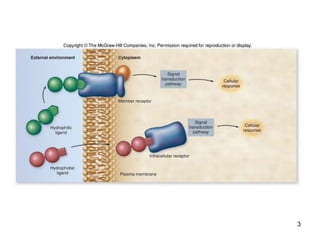
Communication between cells requires:
ligand: the signaling molecule
receptor protein: the molecule to which the
receptor binds
-may be on the plasma membrane or
within the cell
3
4
Cell Communication
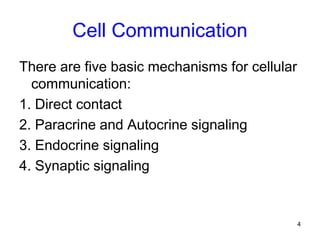
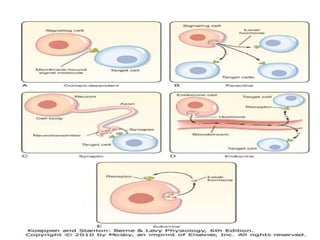
There are five basic mechanisms for cellular
communication:
1. Direct contact
2. Paracrine and Autocrine signaling
3. Endocrine signaling
4. Synaptic signaling
5
6
Cell Communication
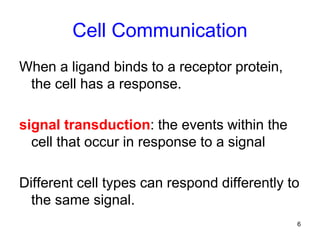
When a ligand binds to a receptor protein,
the cell has a response.
signal transduction: the events within the
cell that occur in response to a signal
Different cell types can respond differently to
the same signal.
7
Cell Communication
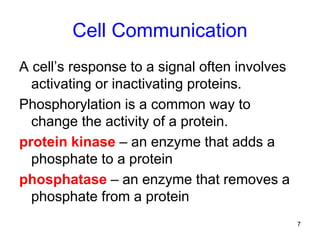
A cell’s response to a signal often involves
activating or inactivating proteins.
Phosphorylation is a common way to
change the activity of a protein.
protein kinase – an enzyme that adds a
phosphate to a protein
phosphatase – an enzyme that removes a
phosphate from a protein
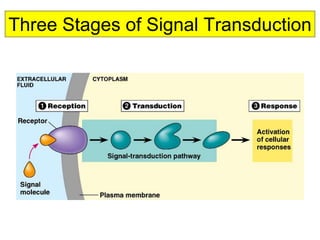
Three Stages of Signal Transduction
1. Reception of extracellular signal by cell
2. Transduction of signal from outside of cell
to inside of cell—often multi-stepped
Note not necessarily transduction of ligand
3. Cellular Response
Response is inititiated and/or occurs
entirely within receiving cell
Three Stages of Signal Transduction
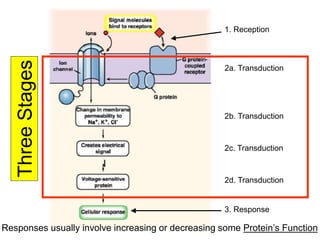
Three
Stages
2a. Transduction
2b. Transduction
2c. Transduction
2d. Transduction
1. Reception
3. Response
Responses usually involve increasing or decreasing some Protein’s Function
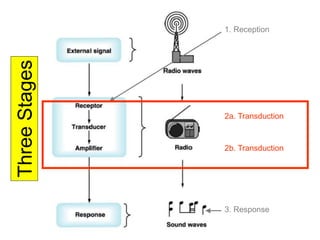
Three
Stages
2a. Transduction
2b. Transduction
1. Reception
3. Response
12
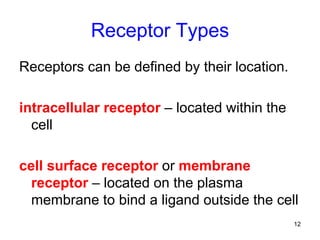
Receptor Types
Receptors can be defined by their location.
intracellular receptor – located within the
cell
cell surface receptor or membrane
receptor – located on the plasma
membrane to bind a ligand outside the cell
13
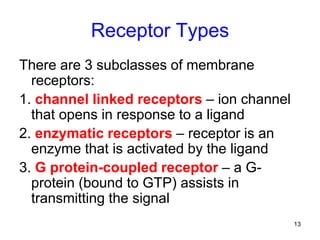
Receptor Types
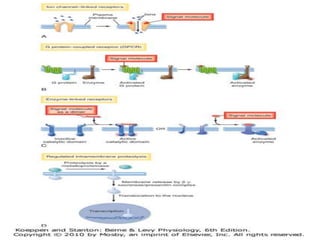
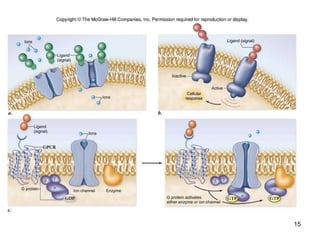
There are 3 subclasses of membrane
receptors:
1. channel linked receptors – ion channel
that opens in response to a ligand
2. enzymatic receptors – receptor is an
enzyme that is activated by the ligand
3. G protein-coupled receptor – a G-
protein (bound to GTP) assists in
transmitting the signal
14
15
16
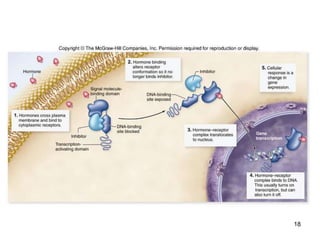
Intracellular Receptors
steroid hormones
-have a nonpolar, lipid-soluble structure
-can cross the plasma membrane to a
steroid receptor
-usually affect regulation of gene expression
An inhibitor blocks the receptor from binding
to DNA until the hormone is present.
17
Intracellular Receptors
A steroid receptor has 3 functional domains:
1. hormone-binding domain
2. DNA binding domain
3. domain that interacts with coactivators to
affect gene expression
18
19
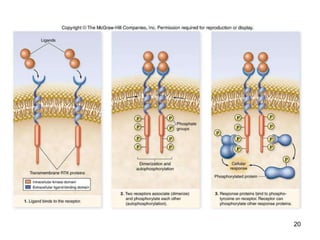
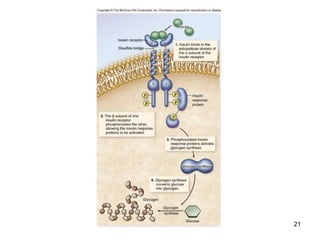
Receptor Kinases
Receptor tyrosine kinases
-membrane receptor
-when bound by a ligand, the receptor is
activated by dimerization and
autophosphorylation
-activated receptor adds a phosphate to
tyrosine on a response protein
-an example is the insulin receptor
20
21
22
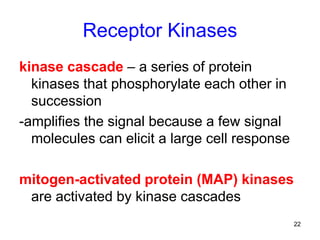
Receptor Kinases
kinase cascade – a series of protein
kinases that phosphorylate each other in
succession
-amplifies the signal because a few signal
molecules can elicit a large cell response
mitogen-activated protein (MAP) kinases
are activated by kinase cascades
23
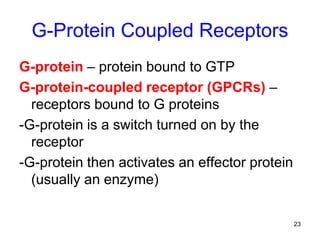
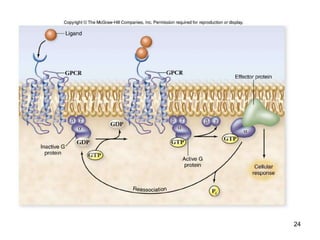
G-Protein Coupled Receptors
G-protein – protein bound to GTP
G-protein-coupled receptor (GPCRs) –
receptors bound to G proteins
-G-protein is a switch turned on by the
receptor
-G-protein then activates an effector protein
(usually an enzyme)
24
25
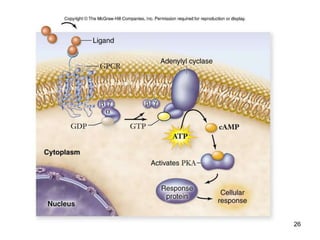
G-Protein Coupled Receptors
Once activated, the effector protein
produces a second messenger.
-second messenger generates the cellular
response to the original signal
For example – one common effector protein
is adenylyl cyclase which produces
cAMP as a second messenger.
Other second messengers: inositol
phosphates, calcium ions (Ca2+)
26
27
Cell-to-Cell Interactions
Cells can identify each other by cell surface
markers.
-glycolipids are commonly used as tissue-
specific markers
-major histocompatibility complex (MHC)
proteins are used by cells to distinguish
“self” from “non-self”
28
Cell-to-Cell Interactions
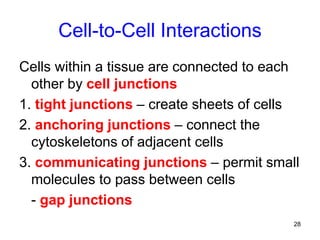
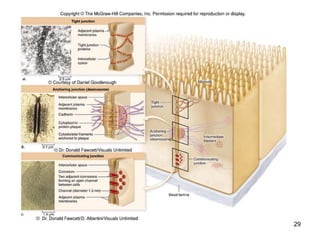
Cells within a tissue are connected to each
other by cell junctions
1. tight junctions – create sheets of cells
2. anchoring junctions – connect the
cytoskeletons of adjacent cells
3. communicating junctions – permit small
molecules to pass between cells
- gap junctions
29

celltocellcommunication-101021235148-phpapp01.ppt

  • 1.
    Cell to CellCommunication
  • 2.
    2 Cell to CellCommunication Communication between cells requires: ligand: the signaling molecule receptor protein: the molecule to which the receptor binds -may be on the plasma membrane or within the cell
  • 3.
  • 4.
    4 Cell Communication There arefive basic mechanisms for cellular communication: 1. Direct contact 2. Paracrine and Autocrine signaling 3. Endocrine signaling 4. Synaptic signaling
  • 5.
  • 6.
    6 Cell Communication When aligand binds to a receptor protein, the cell has a response. signal transduction: the events within the cell that occur in response to a signal Different cell types can respond differently to the same signal.
  • 7.
    7 Cell Communication A cell’sresponse to a signal often involves activating or inactivating proteins. Phosphorylation is a common way to change the activity of a protein. protein kinase – an enzyme that adds a phosphate to a protein phosphatase – an enzyme that removes a phosphate from a protein
  • 8.
    Three Stages ofSignal Transduction 1. Reception of extracellular signal by cell 2. Transduction of signal from outside of cell to inside of cell—often multi-stepped Note not necessarily transduction of ligand 3. Cellular Response Response is inititiated and/or occurs entirely within receiving cell
  • 9.
    Three Stages ofSignal Transduction
  • 10.
    Three Stages 2a. Transduction 2b. Transduction 2c.Transduction 2d. Transduction 1. Reception 3. Response Responses usually involve increasing or decreasing some Protein’s Function
  • 11.
  • 12.
    12 Receptor Types Receptors canbe defined by their location. intracellular receptor – located within the cell cell surface receptor or membrane receptor – located on the plasma membrane to bind a ligand outside the cell
  • 13.
    13 Receptor Types There are3 subclasses of membrane receptors: 1. channel linked receptors – ion channel that opens in response to a ligand 2. enzymatic receptors – receptor is an enzyme that is activated by the ligand 3. G protein-coupled receptor – a G- protein (bound to GTP) assists in transmitting the signal
  • 14.
  • 15.
  • 16.
    16 Intracellular Receptors steroid hormones -havea nonpolar, lipid-soluble structure -can cross the plasma membrane to a steroid receptor -usually affect regulation of gene expression An inhibitor blocks the receptor from binding to DNA until the hormone is present.
  • 17.
    17 Intracellular Receptors A steroidreceptor has 3 functional domains: 1. hormone-binding domain 2. DNA binding domain 3. domain that interacts with coactivators to affect gene expression
  • 18.
  • 19.
    19 Receptor Kinases Receptor tyrosinekinases -membrane receptor -when bound by a ligand, the receptor is activated by dimerization and autophosphorylation -activated receptor adds a phosphate to tyrosine on a response protein -an example is the insulin receptor
  • 20.
  • 21.
  • 22.
    22 Receptor Kinases kinase cascade– a series of protein kinases that phosphorylate each other in succession -amplifies the signal because a few signal molecules can elicit a large cell response mitogen-activated protein (MAP) kinases are activated by kinase cascades
  • 23.
    23 G-Protein Coupled Receptors G-protein– protein bound to GTP G-protein-coupled receptor (GPCRs) – receptors bound to G proteins -G-protein is a switch turned on by the receptor -G-protein then activates an effector protein (usually an enzyme)
  • 24.
  • 25.
    25 G-Protein Coupled Receptors Onceactivated, the effector protein produces a second messenger. -second messenger generates the cellular response to the original signal For example – one common effector protein is adenylyl cyclase which produces cAMP as a second messenger. Other second messengers: inositol phosphates, calcium ions (Ca2+)
  • 26.
  • 27.
    27 Cell-to-Cell Interactions Cells canidentify each other by cell surface markers. -glycolipids are commonly used as tissue- specific markers -major histocompatibility complex (MHC) proteins are used by cells to distinguish “self” from “non-self”
  • 28.
    28 Cell-to-Cell Interactions Cells withina tissue are connected to each other by cell junctions 1. tight junctions – create sheets of cells 2. anchoring junctions – connect the cytoskeletons of adjacent cells 3. communicating junctions – permit small molecules to pass between cells - gap junctions
  • 29.