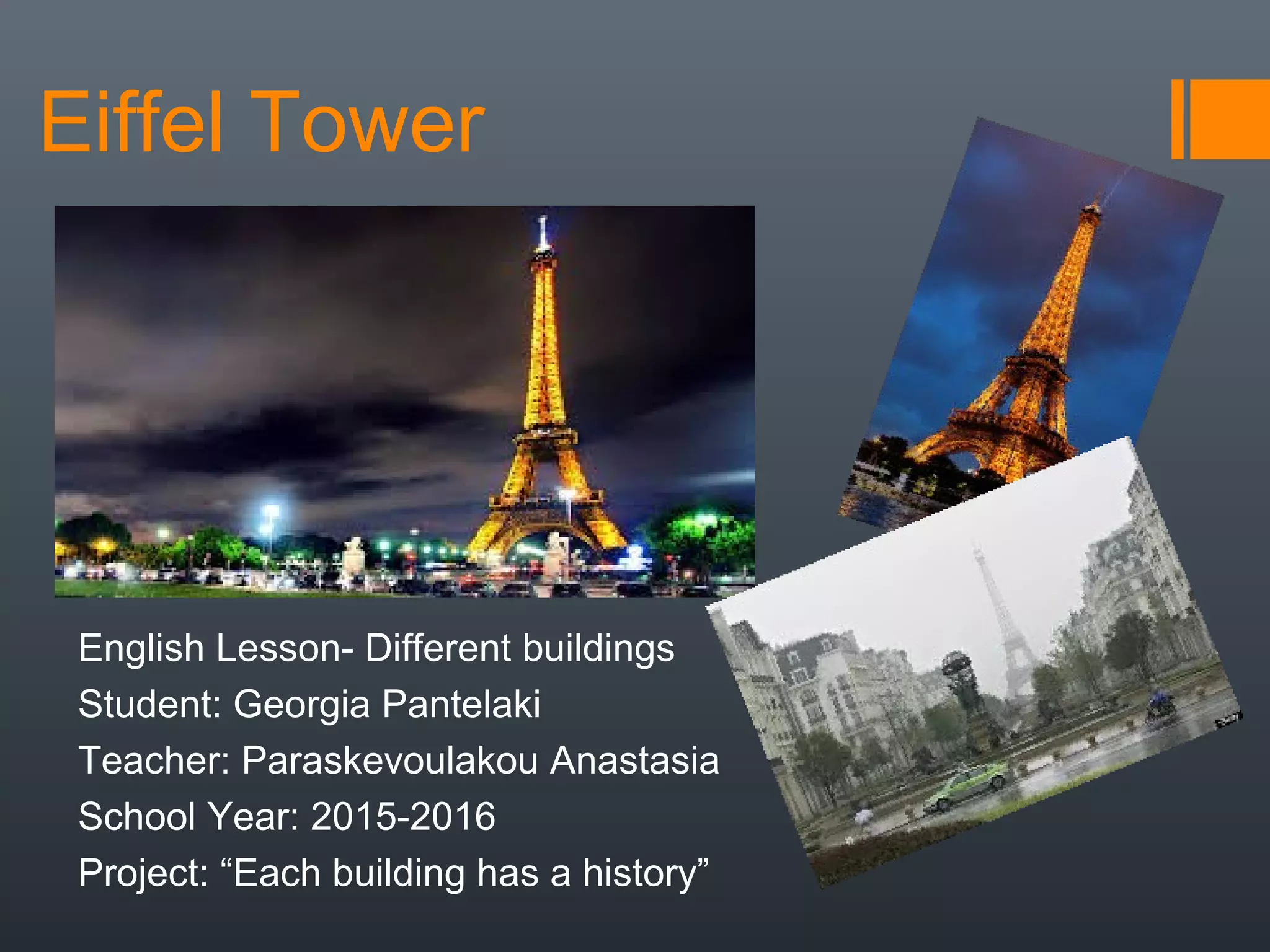
Eiffel Tower
English Lesson- Different buildings
Student: Georgia Pantelaki
Teacher: Paraskevoulakou Anastasia
School Year: 2015-2016
Project: “Each building has a history”
Eiffel Tower
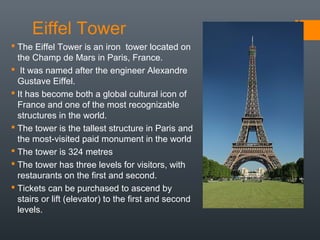
 The Eiffel Tower is an iron tower located on
the Champ de Mars in Paris, France.
 It was named after the engineer Alexandre
Gustave Eiffel.
 It has become both a global cultural icon of
France and one of the most recognizable
structures in the world.
 The tower is the tallest structure in Paris and
the most-visited paid monument in the world
 The tower is 324 metres
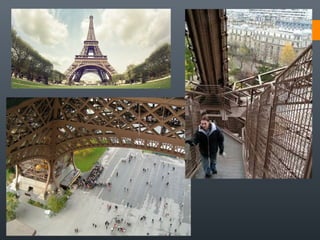
 The tower has three levels for visitors, with
restaurants on the first and second.
 Tickets can be purchased to ascend by
stairs or lift (elevator) to the first and second
levels.
 The design of the Eiffel Tower was originated by Maurice Koechlin
and Émile Nouguier, two senior engineers
 It gained Eiffel's support: he bought the rights to the patent on the
design and the design was exhibited at the Exhibition of Decorative
Arts in 1884
 . On 30 March 1885 Eiffel presented a paper after discussing the
technical problems and emphasising the practical uses of the tower.
 He said that the tower would symbolise not only the art of the
modern engineer, but also the century of Industry and Science in
which they were living.
 After some debate about the exact site for the tower, a contract was
finally signed on 8 January 1887. This was signed by Eiffel
 Eiffel later established a separate company to manage the tower,
putting up half the necessary capital himself.
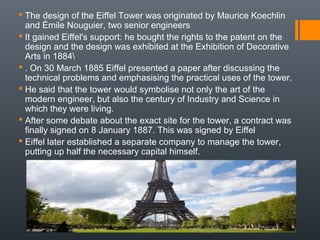
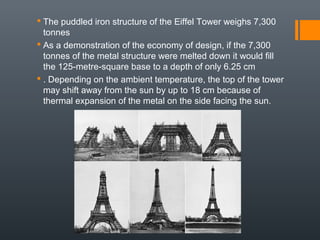
 The puddled iron structure of the Eiffel Tower weighs 7,300
tonnes
 As a demonstration of the economy of design, if the 7,300
tonnes of the metal structure were melted down it would fill
the 125-metre-square base to a depth of only 6.25 cm
 . Depending on the ambient temperature, the top of the tower
may shift away from the sun by up to 18 cm because of
thermal expansion of the metal on the side facing the sun.
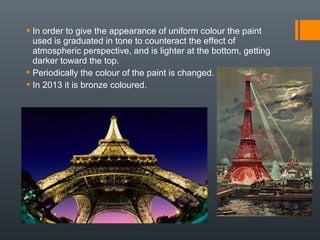
 In order to give the appearance of uniform colour the paint
used is graduated in tone to counteract the effect of
atmospheric perspective, and is lighter at the bottom, getting
darker toward the top.
 Periodically the colour of the paint is changed.
 In 2013 it is bronze coloured.
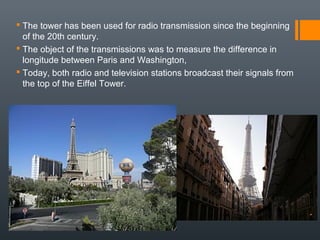
 The tower has been used for radio transmission since the beginning
of the 20th century.
 The object of the transmissions was to measure the difference in
longitude between Paris and Washington,
 Today, both radio and television stations broadcast their signals from
the top of the Eiffel Tower.
 The tower and its representations have long been in the
public domain.
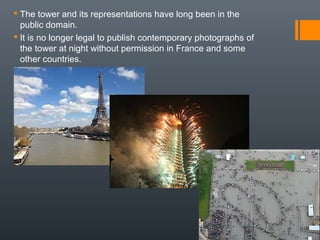
 It is no longer legal to publish contemporary photographs of
the tower at night without permission in France and some
other countries.
SOURCESSOURCES
 https://en.wikipedia.org/wiki/Eiffel_Tower
 https://www.google.gr/search?
q=eiffel+tower&espv=2&biw=1280&bih=629&source=lnms&t
bm=isch&sa=X&ved=0CAYQ_AUoAWoVChMIkMykmI-
ayAIVyKsaCh3gwQAE#imgrc=u5FgrEuDyo5bMM%3A
 https://www.google.gr/search?
q=eiffel+tower+3+levels&espv=2&biw=1280&bih=585&sourc
e=lnms&tbm=isch&sa=X&ved=0CAYQ_AUoAWoVChMI2sy-
o5aayAIVwlcaCh3Ozwrg#tbm=isch&q=eiffel+tower+3+levels
+inside&imgrc=xRjGVU7ykCXcmM%3A
THE END!THE END!
 THANKS FOR WATCHING

Each building has a history!

  • 1.
    Eiffel Tower English Lesson-Different buildings Student: Georgia Pantelaki Teacher: Paraskevoulakou Anastasia School Year: 2015-2016 Project: “Each building has a history”
  • 2.
    Eiffel Tower  TheEiffel Tower is an iron tower located on the Champ de Mars in Paris, France.  It was named after the engineer Alexandre Gustave Eiffel.  It has become both a global cultural icon of France and one of the most recognizable structures in the world.  The tower is the tallest structure in Paris and the most-visited paid monument in the world  The tower is 324 metres  The tower has three levels for visitors, with restaurants on the first and second.  Tickets can be purchased to ascend by stairs or lift (elevator) to the first and second levels.
  • 4.
     The designof the Eiffel Tower was originated by Maurice Koechlin and Émile Nouguier, two senior engineers  It gained Eiffel's support: he bought the rights to the patent on the design and the design was exhibited at the Exhibition of Decorative Arts in 1884  . On 30 March 1885 Eiffel presented a paper after discussing the technical problems and emphasising the practical uses of the tower.  He said that the tower would symbolise not only the art of the modern engineer, but also the century of Industry and Science in which they were living.  After some debate about the exact site for the tower, a contract was finally signed on 8 January 1887. This was signed by Eiffel  Eiffel later established a separate company to manage the tower, putting up half the necessary capital himself.
  • 5.
     The puddlediron structure of the Eiffel Tower weighs 7,300 tonnes  As a demonstration of the economy of design, if the 7,300 tonnes of the metal structure were melted down it would fill the 125-metre-square base to a depth of only 6.25 cm  . Depending on the ambient temperature, the top of the tower may shift away from the sun by up to 18 cm because of thermal expansion of the metal on the side facing the sun.
  • 6.
     In orderto give the appearance of uniform colour the paint used is graduated in tone to counteract the effect of atmospheric perspective, and is lighter at the bottom, getting darker toward the top.  Periodically the colour of the paint is changed.  In 2013 it is bronze coloured.
  • 7.
     The towerhas been used for radio transmission since the beginning of the 20th century.  The object of the transmissions was to measure the difference in longitude between Paris and Washington,  Today, both radio and television stations broadcast their signals from the top of the Eiffel Tower.
  • 8.
     The towerand its representations have long been in the public domain.  It is no longer legal to publish contemporary photographs of the tower at night without permission in France and some other countries.
  • 9.
    SOURCESSOURCES  https://en.wikipedia.org/wiki/Eiffel_Tower  https://www.google.gr/search? q=eiffel+tower&espv=2&biw=1280&bih=629&source=lnms&t bm=isch&sa=X&ved=0CAYQ_AUoAWoVChMIkMykmI- ayAIVyKsaCh3gwQAE#imgrc=u5FgrEuDyo5bMM%3A https://www.google.gr/search? q=eiffel+tower+3+levels&espv=2&biw=1280&bih=585&sourc e=lnms&tbm=isch&sa=X&ved=0CAYQ_AUoAWoVChMI2sy- o5aayAIVwlcaCh3Ozwrg#tbm=isch&q=eiffel+tower+3+levels +inside&imgrc=xRjGVU7ykCXcmM%3A
  • 10.
    THE END!THE END! THANKS FOR WATCHING