CS Meenakshi Jayaraman
The Code on Wages, 2019
Part III
2
Credits and Acknowledgments
Iswariya BS
3
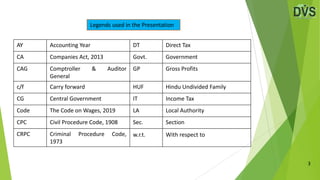
Legends used in the Presentation
AY Accounting Year DT Direct Tax
CA Companies Act, 2013 Govt. Government
CAG Comptroller & Auditor
General
GP Gross Profits
c/f Carry forward HUF Hindu Undivided Family
CG Central Government IT Income Tax
Code The Code on Wages, 2019 LA Local Authority
CPC Civil Procedure Code, 1908 Sec. Section
CRPC Criminal Procedure Code,
1973
w.r.t. With respect to
4
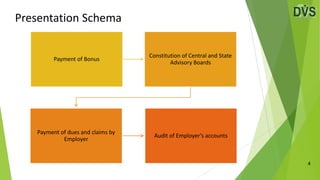
Presentation Schema
Payment of Bonus
Constitution of Central and State
Advisory Boards
Payment of dues and claims by
Employer
Audit of Employer’s accounts
Definition
5
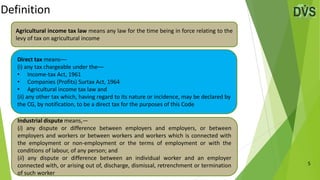
Direct tax means––
(i) any tax chargeable under the––
• Income-tax Act, 1961
• Companies (Profits) Surtax Act, 1964
• Agricultural income tax law and
(ii) any other tax which, having regard to its nature or incidence, may be declared by
the CG, by notification, to be a direct tax for the purposes of this Code
Industrial dispute means,—
(i) any dispute or difference between employers and employers, or between
employers and workers or between workers and workers which is connected with
the employment or non-employment or the terms of employment or with the
conditions of labour, of any person; and
(ii) any dispute or difference between an individual worker and an employer
connected with, or arising out of, discharge, dismissal, retrenchment or termination
of such worker
Agricultural income tax law means any law for the time being in force relating to the
levy of tax on agricultural income
Chapter IV- Payment of Bonus
6
7
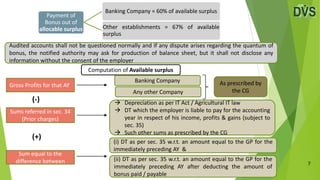
Payment of
Bonus out of
allocable surplus
Banking Company = 60% of available surplus
Other establishments = 67% of available
surplus
Gross Profits for that AY
Computation of Available surplus
Sums referred in sec. 34
(Prior charges)
Banking Company As prescribed by
the CG
Any other Company
 Depreciation as per IT Act / Agricultural IT law
 DT which the employer is liable to pay for the accounting
year in respect of his income, profits & gains (subject to
sec. 35)
 Such other sums as prescribed by the CG
Sum equal to the
difference between
(i) DT as per sec. 35 w.r.t. an amount equal to the GP for the
immediately preceding AY &
(ii) DT as per sec. 35 w.r.t. an amount equal to the GP for the
immediately preceding AY after deducting the amount of
bonus paid / payable
Audited accounts shall not be questioned normally and if any dispute arises regarding the quantum of
bonus, the notified authority may ask for production of balance sheet, but it shall not disclose any
information without the consent of the employer
(-)
(+)
8
Illustration 1:
a GP for AY 2019-2020 Rs.20,00,000
b Bonus paid for AY 2019-
2020
Rs.1,10,000
c GP for AY 2020-2021 Rs.25,00,000
d Sums referred in sec. 34 Rs.3,50,000
e DT as per sec. 35 (a *
25%) (assume the
company’s turnover is
less than Rs. 400 Crore
during the previous year
2017-18)
Rs.5,00,000
f DT on GP – bonus paid
( [a – b] * 25% )
Rs.4,72,500
g Difference (e – f) Rs.27,500
(i)
(ii)
(iii)
(i) – (ii) + (iii) = Rs.21,77,500  Available Surplus
Allocable surplus:
Banking Company = 60% of
Rs.21,77,500 = Rs.13,06,500
Other establishments = 67% of
Rs.21,77,500 = Rs.14,58,925
Allocable Surplus forms part of
Available Surplus
Allocable Surplus < Available
Surplus
ABC Company Limited / Bank Limited
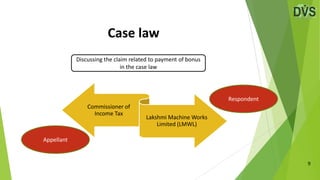
Case law
9
Discussing the claim related to payment of bonus
in the case law
Commissioner of
Income Tax
Lakshmi Machine Works
Limited (LMWL)
Respondent
Appellant
10
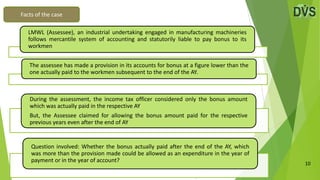
Facts of the case
During the assessment, the income tax officer considered only the bonus amount
which was actually paid in the respective AY
But, the Assessee claimed for allowing the bonus amount paid for the respective
previous years even after the end of AY
Question involved: Whether the bonus actually paid after the end of the AY, which
was more than the provision made could be allowed as an expenditure in the year of
payment or in the year of account?
LMWL (Assessee), an industrial undertaking engaged in manufacturing machineries
follows mercantile system of accounting and statutorily liable to pay bonus to its
workmen
The assessee has made a provision in its accounts for bonus at a figure lower than the
one actually paid to the workmen subsequent to the end of the AY.
11
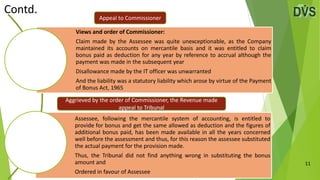
Views and order of Commissioner:
Claim made by the Assessee was quite unexceptionable, as the Company
maintained its accounts on mercantile basis and it was entitled to claim
bonus paid as deduction for any year by reference to accrual although the
payment was made in the subsequent year
Disallowance made by the IT officer was unwarranted
And the liability was a statutory liability which arose by virtue of the Payment
of Bonus Act, 1965
Assessee, following the mercantile system of accounting, is entitled to
provide for bonus and get the same allowed as deduction and the figures of
additional bonus paid, has been made available in all the years concerned
well before the assessment and thus, for this reason the assessee substituted
the actual payment for the provision made.
Thus, the Tribunal did not find anything wrong in substituting the bonus
amount and
Ordered in favour of Assessee
Contd.
Appeal to Commissioner
Aggrieved by the order of Commissioner, the Revenue made
appeal to Tribunal
12
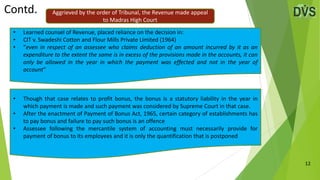
• Learned counsel of Revenue, placed reliance on the decision in:
• CIT v. Swadeshi Cotton and Flour Mills Private Limited (1964)
• “even in respect of an assessee who claims deduction of an amount incurred by it as an
expenditure to the extent the same is in excess of the provisions made in the accounts, it can
only be allowed in the year in which the payment was effected and not in the year of
account”
• Though that case relates to profit bonus, the bonus is a statutory liability in the year in
which payment is made and such payment was considered by Supreme Court in that case.
• After the enactment of Payment of Bonus Act, 1965, certain category of establishments has
to pay bonus and failure to pay such bonus is an offence
• Assessee following the mercantile system of accounting must necessarily provide for
payment of bonus to its employees and it is only the quantification that is postponed
Contd. Aggrieved by the order of Tribunal, the Revenue made appeal
to Madras High Court
13
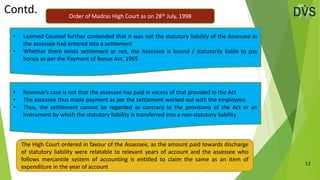
• Learned Counsel further contended that it was not the statutory liability of the Assessee as
the assessee had entered into a settlement
• Whether there exists settlement or not, the Assessee is bound / statutorily liable to pay
bonus as per the Payment of Bonus Act, 1965
• Revenue’s case is not that the assessee has paid in excess of that provided in the Act
• The assessee thus made payment as per the settlement worked out with the employees
• Thus, the settlement cannot be regarded as contrary to the provisions of the Act or an
instrument by which the statutory liability is transferred into a non-statutory liability
Contd.
The High Court ordered in favour of the Assessee, as the amount paid towards discharge
of statutory liability were relatable to relevant years of account and the assessee who
follows mercantile system of accounting is entitled to claim the same as an item of
expenditure in the year of account
Order of Madras High Court as on 28th July, 1998
14
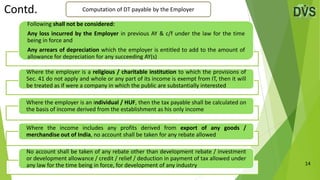
Computation of DT payable by the Employer
Contd.
Following shall not be considered:
Any loss incurred by the Employer in previous AY & c/f under the law for the time
being in force and
Any arrears of depreciation which the employer is entitled to add to the amount of
allowance for depreciation for any succeeding AY(s)
Where the employer is a religious / charitable institution to which the provisions of
Sec. 41 do not apply and whole or any part of its income is exempt from IT, then it will
be treated as if were a company in which the public are substantially interested
Where the employer is an individual / HUF, then the tax payable shall be calculated on
the basis of income derived from the establishment as his only income
Where the income includes any profits derived from export of any goods /
merchandise out of India, no account shall be taken for any rebate allowed
No account shall be taken of any rebate other than development rebate / investment
or development allowance / credit / relief / deduction in payment of tax allowed under
any law for the time being in force, for development of any industry
15
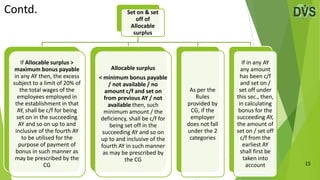
Set on & set
off of
Allocable
surplus
If Allocable surplus >
maximum bonus payable
in any AY then, the excess
subject to a limit of 20% of
the total wages of the
employees employed in
the establishment in that
AY, shall be c/f for being
set on in the succeeding
AY and so on up to and
inclusive of the fourth AY
to be utilised for the
purpose of payment of
bonus in such manner as
may be prescribed by the
CG
Allocable surplus
< minimum bonus payable
/ not available / no
amount c/f and set on
from previous AY / not
available then, such
minimum amount / the
deficiency, shall be c/f for
being set off in the
succeeding AY and so on
up to and inclusive of the
fourth AY in such manner
as may be prescribed by
the CG
As per the
Rules
provided by
CG, if the
employer
does not fall
under the 2
categories
If in any AY
any amount
has been c/f
and set on /
set off under
this sec., then,
in calculating
bonus for the
succeeding AY,
the amount of
set on / set off
c/f from the
earliest AY
shall first be
taken into
account
Contd.
16
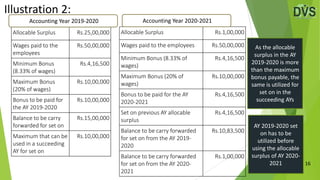
Illustration 2:
Allocable Surplus Rs.25,00,000
Wages paid to the
employees
Rs.50,00,000
Minimum Bonus
(8.33% of wages)
Rs.4,16,500
Maximum Bonus
(20% of wages)
Rs.10,00,000
Bonus to be paid for
the AY 2019-2020
Rs.10,00,000
Balance to be carry
forwarded for set on
Rs.15,00,000
Maximum that can be
used in a succeeding
AY for set on
Rs.10,00,000
Accounting Year 2019-2020
Allocable Surplus Rs.1,00,000
Wages paid to the employees Rs.50,00,000
Minimum Bonus (8.33% of
wages)
Rs.4,16,500
Maximum Bonus (20% of
wages)
Rs.10,00,000
Bonus to be paid for the AY
2020-2021
Rs.4,16,500
Set on previous AY allocable
surplus
Rs.4,16,500
Balance to be carry forwarded
for set on from the AY 2019-
2020
Rs.10,83,500
Balance to be carry forwarded
for set on from the AY 2020-
2021
Rs.1,00,000
Accounting Year 2020-2021
As the allocable
surplus in the AY
2019-2020 is more
than the maximum
bonus payable, the
same is utilized for
set on in the
succeeding AYs
AY 2019-2020 set
on has to be
utilized before
using the allocable
surplus of AY 2020-
2021
17
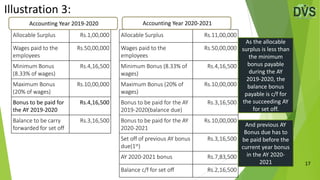
Illustration 3:
Allocable Surplus Rs.1,00,000
Wages paid to the
employees
Rs.50,00,000
Minimum Bonus
(8.33% of wages)
Rs.4,16,500
Maximum Bonus
(20% of wages)
Rs.10,00,000
Bonus to be paid for
the AY 2019-2020
Rs.4,16,500
Balance to be carry
forwarded for set off
Rs.3,16,500
Accounting Year 2019-2020
Allocable Surplus Rs.11,00,000
Wages paid to the
employees
Rs.50,00,000
Minimum Bonus (8.33% of
wages)
Rs.4,16,500
Maximum Bonus (20% of
wages)
Rs.10,00,000
Bonus to be paid for the AY
2019-2020(balance due)
Rs.3,16,500
Bonus to be paid for the AY
2020-2021
Rs.10,00,000
Set off of previous AY bonus
due(1st)
Rs.3,16,500
AY 2020-2021 bonus Rs.7,83,500
Balance c/f for set off Rs.2,16,500
Accounting Year 2020-2021
As the allocable
surplus is less than
the minimum
bonus payable
during the AY
2019-2020, the
balance bonus
payable is c/f for
the succeeding AY
for set off.
And previous AY
Bonus due has to
be paid before the
current year bonus
in the AY 2020-
2021
18
Contd.
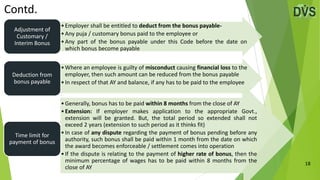
•Employer shall be entitled to deduct from the bonus payable-
•Any puja / customary bonus paid to the employee or
•Any part of the bonus payable under this Code before the date on
which bonus become payable
Adjustment of
Customary /
Interim Bonus
•Where an employee is guilty of misconduct causing financial loss to the
employer, then such amount can be reduced from the bonus payable
•In respect of that AY and balance, if any has to be paid to the employee
Deduction from
bonus payable
•Generally, bonus has to be paid within 8 months from the close of AY
•Extension: If employer makes application to the appropriate Govt.,
extension will be granted. But, the total period so extended shall not
exceed 2 years (extension to such period as it thinks fit)
•In case of any dispute regarding the payment of bonus pending before any
authority, such bonus shall be paid within 1 month from the date on which
the award becomes enforceable / settlement comes into operation
•If the dispute is relating to the payment of higher rate of bonus, then the
minimum percentage of wages has to be paid within 8 months from the
close of AY
Time limit for
payment of bonus
Contd.
19
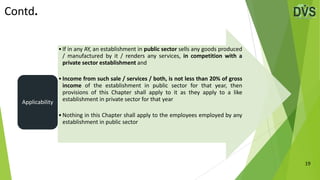
•If in any AY, an establishment in public sector sells any goods produced
/ manufactured by it / renders any services, in competition with a
private sector establishment and
•Income from such sale / services / both, is not less than 20% of gross
income of the establishment in public sector for that year, then
provisions of this Chapter shall apply to it as they apply to a like
establishment in private sector for that year
•Nothing in this Chapter shall apply to the employees employed by any
establishment in public sector
Applicability
20
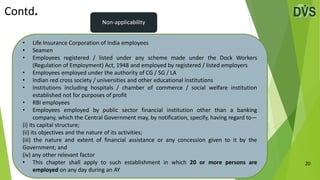
• Life Insurance Corporation of India employees
• Seamen
• Employees registered / listed under any scheme made under the Dock Workers
(Regulation of Employment) Act, 1948 and employed by registered / listed employers
• Employees employed under the authority of CG / SG / LA
• Indian red cross society / universities and other educational institutions
• Institutions including hospitals / chamber of commerce / social welfare institution
established not for purposes of profit
• RBI employees
• Employees employed by public sector financial institution other than a banking
company, which the Central Government may, by notification, specify, having regard to—
(i) its capital structure;
(ii) its objectives and the nature of its activities;
(iii) the nature and extent of financial assistance or any concession given to it by the
Government; and
(iv) any other relevant factor
• This chapter shall apply to such establishment in which 20 or more persons are
employed on any day during an AY
Contd.
Non-applicability
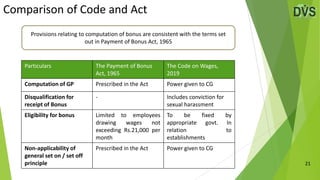
Comparison of Code and Act
21
Particulars The Payment of Bonus
Act, 1965
The Code on Wages,
2019
Computation of GP Prescribed in the Act Power given to CG
Disqualification for
receipt of Bonus
- Includes conviction for
sexual harassment
Eligibility for bonus Limited to employees
drawing wages not
exceeding Rs.21,000 per
month
To be fixed by
appropriate govt. In
relation to
establishments
Non-applicability of
general set on / set off
principle
Prescribed in the Act Power given to CG
Provisions relating to computation of bonus are consistent with the terms set
out in Payment of Bonus Act, 1965
Chapter V- Advisory Board
22
23
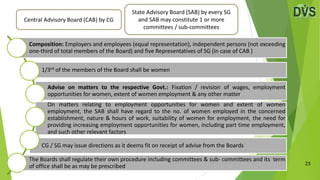
Central Advisory Board (CAB) by CG
State Advisory Board (SAB) by every SG
and SAB may constitute 1 or more
committees / sub-committees
Composition: Employers and employees (equal representation), independent persons (not exceeding
one-third of total members of the Board) and five Representatives of SG (in case of CAB )
1/3rd of the members of the Board shall be women
Advise on matters to the respective Govt.: Fixation / revision of wages, employment
opportunities for women, extent of women employment & any other matter
On matters relating to employment opportunities for women and extent of women
employment, the SAB shall have regard to the no. of women employed in the concerned
establishment, nature & hours of work, suitability of women for employment, the need for
providing increasing employment opportunities for women, including part time employment,
and such other relevant factors
CG / SG may issue directions as it deems fit on receipt of advise from the Boards
The Boards shall regulate their own procedure including committees & sub- committees and its term
of office shall be as may be prescribed
Chapter VI- Payment of dues,
claims & audit
24
25
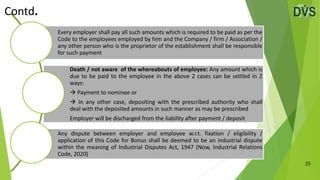
Every employer shall pay all such amounts which is required to be paid as per the
Code to the employees employed by him and the Company / firm / Association /
any other person who is the proprietor of the establishment shall be responsible
for such payment
Death / not aware of the whereabouts of employee: Any amount which is
due to be paid to the employee in the above 2 cases can be settled in 2
ways:
 Payment to nominee or
 In any other case, depositing with the prescribed authority who shall
deal with the deposited amounts in such manner as may be prescribed
Employer will be discharged from the liability after payment / deposit
Any dispute between employer and employee w.r.t. fixation / eligibility /
application of this Code for Bonus shall be deemed to be an industrial dispute
within the meaning of Industrial Disputes Act, 1947 (Now, Industrial Relations
Code, 2020)
Contd.
26
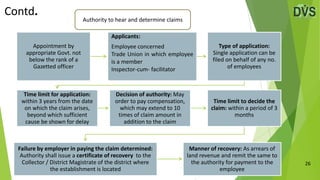
Appointment by
appropriate Govt. not
below the rank of a
Gazetted officer
Applicants:
Employee concerned
Trade Union in which employee
is a member
Inspector-cum- facilitator
Type of application:
Single application can be
filed on behalf of any no.
of employees
Time limit for application:
within 3 years from the date
on which the claim arises,
beyond which sufficient
cause be shown for delay
Decision of authority: May
order to pay compensation,
which may extend to 10
times of claim amount in
addition to the claim
Time limit to decide the
claim: within a period of 3
months
Failure by employer in paying the claim determined:
Authority shall issue a certificate of recovery to the
Collector / District Magistrate of the district where
the establishment is located
Manner of recovery: As arrears of
land revenue and remit the same to
the authority for payment to the
employee
Authority to hear and determine claims
Contd.
27
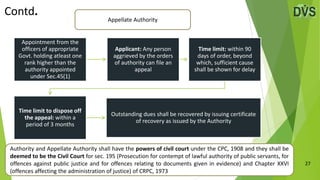
Appointment from the
officers of appropriate
Govt. holding atleast one
rank higher than the
authority appointed
under Sec.45(1)
Applicant: Any person
aggrieved by the orders
of authority can file an
appeal
Time limit: within 90
days of order, beyond
which, sufficient cause
shall be shown for delay
Time limit to dispose off
the appeal: within a
period of 3 months
Outstanding dues shall be recovered by issuing certificate
of recovery as issued by the Authority
Appellate Authority
Authority and Appellate Authority shall have the powers of civil court under the CPC, 1908 and they shall be
deemed to be the Civil Court for sec. 195 (Prosecution for contempt of lawful authority of public servants, for
offences against public justice and for offences relating to documents given in evidence) and Chapter XXVI
(offences affecting the administration of justice) of CRPC, 1973
Contd.
28
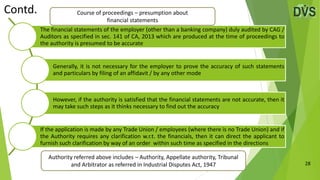
The financial statements of the employer (other than a banking company) duly audited by CAG /
Auditors as specified in sec. 141 of CA, 2013 which are produced at the time of proceedings to
the authority is presumed to be accurate
Generally, it is not necessary for the employer to prove the accuracy of such statements
and particulars by filing of an affidavit / by any other mode
However, if the authority is satisfied that the financial statements are not accurate, then it
may take such steps as it thinks necessary to find out the accuracy
If the application is made by any Trade Union / employees (where there is no Trade Union) and if
the Authority requires any clarification w.r.t. the financials, then it can direct the applicant to
furnish such clarification by way of an order within such time as specified in the directions
Contd.
Authority referred above includes – Authority, Appellate authority, Tribunal
and Arbitrator as referred in Industrial Disputes Act, 1947
Course of proceedings – presumption about
financial statements
Contd.
29
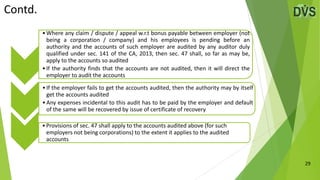
•Where any claim / dispute / appeal w.r.t bonus payable between employer (not
being a corporation / company) and his employees is pending before an
authority and the accounts of such employer are audited by any auditor duly
qualified under sec. 141 of the CA, 2013, then sec. 47 shall, so far as may be,
apply to the accounts so audited
•If the authority finds that the accounts are not audited, then it will direct the
employer to audit the accounts
•If the employer fails to get the accounts audited, then the authority may by itself
get the accounts audited
•Any expenses incidental to this audit has to be paid by the employer and default
of the same will be recovered by issue of certificate of recovery
•Provisions of sec. 47 shall apply to the accounts audited above (for such
employers not being corporations) to the extent it applies to the audited
accounts
30
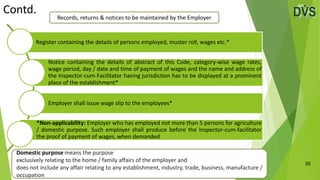
Register containing the details of persons employed, muster roll, wages etc.*
Notice containing the details of abstract of this Code, category-wise wage rates,
wage period, day / date and time of payment of wages and the name and address of
the Inspector-cum-Facilitator having jurisdiction has to be displayed at a prominent
place of the establishment*
Employer shall issue wage slip to the employees*
*Non-applicability: Employer who has employed not more than 5 persons for agriculture
/ domestic purpose. Such employer shall produce before the Inspector-cum-facilitator
the proof of payment of wages, when demanded
Contd.
Records, returns & notices to be maintained by the Employer
Domestic purpose means the purpose
exclusively relating to the home / family affairs of the employer and
does not include any affair relating to any establishment, industry, trade, business, manufacture /
occupation
31
Thank You!
Scan the QR Code to Join our
Research Group on WhatsApp
Scan the QR Code to explore more
Research from our Website
DVS Advisors LLP
India-Singapore-London-Dubai-Malaysia-Africa
www.dvsca.com
Copyrights © 2020 DVS Advisors LLP

The Code on Wages, 2019 - Part III

  • 1.
    CS Meenakshi Jayaraman TheCode on Wages, 2019 Part III
  • 2.
  • 3.
    3 Legends used inthe Presentation AY Accounting Year DT Direct Tax CA Companies Act, 2013 Govt. Government CAG Comptroller & Auditor General GP Gross Profits c/f Carry forward HUF Hindu Undivided Family CG Central Government IT Income Tax Code The Code on Wages, 2019 LA Local Authority CPC Civil Procedure Code, 1908 Sec. Section CRPC Criminal Procedure Code, 1973 w.r.t. With respect to
  • 4.
    4 Presentation Schema Payment ofBonus Constitution of Central and State Advisory Boards Payment of dues and claims by Employer Audit of Employer’s accounts
  • 5.
    Definition 5 Direct tax means–– (i)any tax chargeable under the–– • Income-tax Act, 1961 • Companies (Profits) Surtax Act, 1964 • Agricultural income tax law and (ii) any other tax which, having regard to its nature or incidence, may be declared by the CG, by notification, to be a direct tax for the purposes of this Code Industrial dispute means,— (i) any dispute or difference between employers and employers, or between employers and workers or between workers and workers which is connected with the employment or non-employment or the terms of employment or with the conditions of labour, of any person; and (ii) any dispute or difference between an individual worker and an employer connected with, or arising out of, discharge, dismissal, retrenchment or termination of such worker Agricultural income tax law means any law for the time being in force relating to the levy of tax on agricultural income
  • 6.
  • 7.
    7 Payment of Bonus outof allocable surplus Banking Company = 60% of available surplus Other establishments = 67% of available surplus Gross Profits for that AY Computation of Available surplus Sums referred in sec. 34 (Prior charges) Banking Company As prescribed by the CG Any other Company  Depreciation as per IT Act / Agricultural IT law  DT which the employer is liable to pay for the accounting year in respect of his income, profits & gains (subject to sec. 35)  Such other sums as prescribed by the CG Sum equal to the difference between (i) DT as per sec. 35 w.r.t. an amount equal to the GP for the immediately preceding AY & (ii) DT as per sec. 35 w.r.t. an amount equal to the GP for the immediately preceding AY after deducting the amount of bonus paid / payable Audited accounts shall not be questioned normally and if any dispute arises regarding the quantum of bonus, the notified authority may ask for production of balance sheet, but it shall not disclose any information without the consent of the employer (-) (+)
  • 8.
    8 Illustration 1: a GPfor AY 2019-2020 Rs.20,00,000 b Bonus paid for AY 2019- 2020 Rs.1,10,000 c GP for AY 2020-2021 Rs.25,00,000 d Sums referred in sec. 34 Rs.3,50,000 e DT as per sec. 35 (a * 25%) (assume the company’s turnover is less than Rs. 400 Crore during the previous year 2017-18) Rs.5,00,000 f DT on GP – bonus paid ( [a – b] * 25% ) Rs.4,72,500 g Difference (e – f) Rs.27,500 (i) (ii) (iii) (i) – (ii) + (iii) = Rs.21,77,500  Available Surplus Allocable surplus: Banking Company = 60% of Rs.21,77,500 = Rs.13,06,500 Other establishments = 67% of Rs.21,77,500 = Rs.14,58,925 Allocable Surplus forms part of Available Surplus Allocable Surplus < Available Surplus ABC Company Limited / Bank Limited
  • 9.
    Case law 9 Discussing theclaim related to payment of bonus in the case law Commissioner of Income Tax Lakshmi Machine Works Limited (LMWL) Respondent Appellant
  • 10.
    10 Facts of thecase During the assessment, the income tax officer considered only the bonus amount which was actually paid in the respective AY But, the Assessee claimed for allowing the bonus amount paid for the respective previous years even after the end of AY Question involved: Whether the bonus actually paid after the end of the AY, which was more than the provision made could be allowed as an expenditure in the year of payment or in the year of account? LMWL (Assessee), an industrial undertaking engaged in manufacturing machineries follows mercantile system of accounting and statutorily liable to pay bonus to its workmen The assessee has made a provision in its accounts for bonus at a figure lower than the one actually paid to the workmen subsequent to the end of the AY.
  • 11.
    11 Views and orderof Commissioner: Claim made by the Assessee was quite unexceptionable, as the Company maintained its accounts on mercantile basis and it was entitled to claim bonus paid as deduction for any year by reference to accrual although the payment was made in the subsequent year Disallowance made by the IT officer was unwarranted And the liability was a statutory liability which arose by virtue of the Payment of Bonus Act, 1965 Assessee, following the mercantile system of accounting, is entitled to provide for bonus and get the same allowed as deduction and the figures of additional bonus paid, has been made available in all the years concerned well before the assessment and thus, for this reason the assessee substituted the actual payment for the provision made. Thus, the Tribunal did not find anything wrong in substituting the bonus amount and Ordered in favour of Assessee Contd. Appeal to Commissioner Aggrieved by the order of Commissioner, the Revenue made appeal to Tribunal
  • 12.
    12 • Learned counselof Revenue, placed reliance on the decision in: • CIT v. Swadeshi Cotton and Flour Mills Private Limited (1964) • “even in respect of an assessee who claims deduction of an amount incurred by it as an expenditure to the extent the same is in excess of the provisions made in the accounts, it can only be allowed in the year in which the payment was effected and not in the year of account” • Though that case relates to profit bonus, the bonus is a statutory liability in the year in which payment is made and such payment was considered by Supreme Court in that case. • After the enactment of Payment of Bonus Act, 1965, certain category of establishments has to pay bonus and failure to pay such bonus is an offence • Assessee following the mercantile system of accounting must necessarily provide for payment of bonus to its employees and it is only the quantification that is postponed Contd. Aggrieved by the order of Tribunal, the Revenue made appeal to Madras High Court
  • 13.
    13 • Learned Counselfurther contended that it was not the statutory liability of the Assessee as the assessee had entered into a settlement • Whether there exists settlement or not, the Assessee is bound / statutorily liable to pay bonus as per the Payment of Bonus Act, 1965 • Revenue’s case is not that the assessee has paid in excess of that provided in the Act • The assessee thus made payment as per the settlement worked out with the employees • Thus, the settlement cannot be regarded as contrary to the provisions of the Act or an instrument by which the statutory liability is transferred into a non-statutory liability Contd. The High Court ordered in favour of the Assessee, as the amount paid towards discharge of statutory liability were relatable to relevant years of account and the assessee who follows mercantile system of accounting is entitled to claim the same as an item of expenditure in the year of account Order of Madras High Court as on 28th July, 1998
  • 14.
    14 Computation of DTpayable by the Employer Contd. Following shall not be considered: Any loss incurred by the Employer in previous AY & c/f under the law for the time being in force and Any arrears of depreciation which the employer is entitled to add to the amount of allowance for depreciation for any succeeding AY(s) Where the employer is a religious / charitable institution to which the provisions of Sec. 41 do not apply and whole or any part of its income is exempt from IT, then it will be treated as if were a company in which the public are substantially interested Where the employer is an individual / HUF, then the tax payable shall be calculated on the basis of income derived from the establishment as his only income Where the income includes any profits derived from export of any goods / merchandise out of India, no account shall be taken for any rebate allowed No account shall be taken of any rebate other than development rebate / investment or development allowance / credit / relief / deduction in payment of tax allowed under any law for the time being in force, for development of any industry
  • 15.
    15 Set on &set off of Allocable surplus If Allocable surplus > maximum bonus payable in any AY then, the excess subject to a limit of 20% of the total wages of the employees employed in the establishment in that AY, shall be c/f for being set on in the succeeding AY and so on up to and inclusive of the fourth AY to be utilised for the purpose of payment of bonus in such manner as may be prescribed by the CG Allocable surplus < minimum bonus payable / not available / no amount c/f and set on from previous AY / not available then, such minimum amount / the deficiency, shall be c/f for being set off in the succeeding AY and so on up to and inclusive of the fourth AY in such manner as may be prescribed by the CG As per the Rules provided by CG, if the employer does not fall under the 2 categories If in any AY any amount has been c/f and set on / set off under this sec., then, in calculating bonus for the succeeding AY, the amount of set on / set off c/f from the earliest AY shall first be taken into account Contd.
  • 16.
    16 Illustration 2: Allocable SurplusRs.25,00,000 Wages paid to the employees Rs.50,00,000 Minimum Bonus (8.33% of wages) Rs.4,16,500 Maximum Bonus (20% of wages) Rs.10,00,000 Bonus to be paid for the AY 2019-2020 Rs.10,00,000 Balance to be carry forwarded for set on Rs.15,00,000 Maximum that can be used in a succeeding AY for set on Rs.10,00,000 Accounting Year 2019-2020 Allocable Surplus Rs.1,00,000 Wages paid to the employees Rs.50,00,000 Minimum Bonus (8.33% of wages) Rs.4,16,500 Maximum Bonus (20% of wages) Rs.10,00,000 Bonus to be paid for the AY 2020-2021 Rs.4,16,500 Set on previous AY allocable surplus Rs.4,16,500 Balance to be carry forwarded for set on from the AY 2019- 2020 Rs.10,83,500 Balance to be carry forwarded for set on from the AY 2020- 2021 Rs.1,00,000 Accounting Year 2020-2021 As the allocable surplus in the AY 2019-2020 is more than the maximum bonus payable, the same is utilized for set on in the succeeding AYs AY 2019-2020 set on has to be utilized before using the allocable surplus of AY 2020- 2021
  • 17.
    17 Illustration 3: Allocable SurplusRs.1,00,000 Wages paid to the employees Rs.50,00,000 Minimum Bonus (8.33% of wages) Rs.4,16,500 Maximum Bonus (20% of wages) Rs.10,00,000 Bonus to be paid for the AY 2019-2020 Rs.4,16,500 Balance to be carry forwarded for set off Rs.3,16,500 Accounting Year 2019-2020 Allocable Surplus Rs.11,00,000 Wages paid to the employees Rs.50,00,000 Minimum Bonus (8.33% of wages) Rs.4,16,500 Maximum Bonus (20% of wages) Rs.10,00,000 Bonus to be paid for the AY 2019-2020(balance due) Rs.3,16,500 Bonus to be paid for the AY 2020-2021 Rs.10,00,000 Set off of previous AY bonus due(1st) Rs.3,16,500 AY 2020-2021 bonus Rs.7,83,500 Balance c/f for set off Rs.2,16,500 Accounting Year 2020-2021 As the allocable surplus is less than the minimum bonus payable during the AY 2019-2020, the balance bonus payable is c/f for the succeeding AY for set off. And previous AY Bonus due has to be paid before the current year bonus in the AY 2020- 2021
  • 18.
    18 Contd. •Employer shall beentitled to deduct from the bonus payable- •Any puja / customary bonus paid to the employee or •Any part of the bonus payable under this Code before the date on which bonus become payable Adjustment of Customary / Interim Bonus •Where an employee is guilty of misconduct causing financial loss to the employer, then such amount can be reduced from the bonus payable •In respect of that AY and balance, if any has to be paid to the employee Deduction from bonus payable •Generally, bonus has to be paid within 8 months from the close of AY •Extension: If employer makes application to the appropriate Govt., extension will be granted. But, the total period so extended shall not exceed 2 years (extension to such period as it thinks fit) •In case of any dispute regarding the payment of bonus pending before any authority, such bonus shall be paid within 1 month from the date on which the award becomes enforceable / settlement comes into operation •If the dispute is relating to the payment of higher rate of bonus, then the minimum percentage of wages has to be paid within 8 months from the close of AY Time limit for payment of bonus
  • 19.
    Contd. 19 •If in anyAY, an establishment in public sector sells any goods produced / manufactured by it / renders any services, in competition with a private sector establishment and •Income from such sale / services / both, is not less than 20% of gross income of the establishment in public sector for that year, then provisions of this Chapter shall apply to it as they apply to a like establishment in private sector for that year •Nothing in this Chapter shall apply to the employees employed by any establishment in public sector Applicability
  • 20.
    20 • Life InsuranceCorporation of India employees • Seamen • Employees registered / listed under any scheme made under the Dock Workers (Regulation of Employment) Act, 1948 and employed by registered / listed employers • Employees employed under the authority of CG / SG / LA • Indian red cross society / universities and other educational institutions • Institutions including hospitals / chamber of commerce / social welfare institution established not for purposes of profit • RBI employees • Employees employed by public sector financial institution other than a banking company, which the Central Government may, by notification, specify, having regard to— (i) its capital structure; (ii) its objectives and the nature of its activities; (iii) the nature and extent of financial assistance or any concession given to it by the Government; and (iv) any other relevant factor • This chapter shall apply to such establishment in which 20 or more persons are employed on any day during an AY Contd. Non-applicability
  • 21.
    Comparison of Codeand Act 21 Particulars The Payment of Bonus Act, 1965 The Code on Wages, 2019 Computation of GP Prescribed in the Act Power given to CG Disqualification for receipt of Bonus - Includes conviction for sexual harassment Eligibility for bonus Limited to employees drawing wages not exceeding Rs.21,000 per month To be fixed by appropriate govt. In relation to establishments Non-applicability of general set on / set off principle Prescribed in the Act Power given to CG Provisions relating to computation of bonus are consistent with the terms set out in Payment of Bonus Act, 1965
  • 22.
  • 23.
    23 Central Advisory Board(CAB) by CG State Advisory Board (SAB) by every SG and SAB may constitute 1 or more committees / sub-committees Composition: Employers and employees (equal representation), independent persons (not exceeding one-third of total members of the Board) and five Representatives of SG (in case of CAB ) 1/3rd of the members of the Board shall be women Advise on matters to the respective Govt.: Fixation / revision of wages, employment opportunities for women, extent of women employment & any other matter On matters relating to employment opportunities for women and extent of women employment, the SAB shall have regard to the no. of women employed in the concerned establishment, nature & hours of work, suitability of women for employment, the need for providing increasing employment opportunities for women, including part time employment, and such other relevant factors CG / SG may issue directions as it deems fit on receipt of advise from the Boards The Boards shall regulate their own procedure including committees & sub- committees and its term of office shall be as may be prescribed
  • 24.
    Chapter VI- Paymentof dues, claims & audit 24
  • 25.
    25 Every employer shallpay all such amounts which is required to be paid as per the Code to the employees employed by him and the Company / firm / Association / any other person who is the proprietor of the establishment shall be responsible for such payment Death / not aware of the whereabouts of employee: Any amount which is due to be paid to the employee in the above 2 cases can be settled in 2 ways:  Payment to nominee or  In any other case, depositing with the prescribed authority who shall deal with the deposited amounts in such manner as may be prescribed Employer will be discharged from the liability after payment / deposit Any dispute between employer and employee w.r.t. fixation / eligibility / application of this Code for Bonus shall be deemed to be an industrial dispute within the meaning of Industrial Disputes Act, 1947 (Now, Industrial Relations Code, 2020) Contd.
  • 26.
    26 Appointment by appropriate Govt.not below the rank of a Gazetted officer Applicants: Employee concerned Trade Union in which employee is a member Inspector-cum- facilitator Type of application: Single application can be filed on behalf of any no. of employees Time limit for application: within 3 years from the date on which the claim arises, beyond which sufficient cause be shown for delay Decision of authority: May order to pay compensation, which may extend to 10 times of claim amount in addition to the claim Time limit to decide the claim: within a period of 3 months Failure by employer in paying the claim determined: Authority shall issue a certificate of recovery to the Collector / District Magistrate of the district where the establishment is located Manner of recovery: As arrears of land revenue and remit the same to the authority for payment to the employee Authority to hear and determine claims Contd.
  • 27.
    27 Appointment from the officersof appropriate Govt. holding atleast one rank higher than the authority appointed under Sec.45(1) Applicant: Any person aggrieved by the orders of authority can file an appeal Time limit: within 90 days of order, beyond which, sufficient cause shall be shown for delay Time limit to dispose off the appeal: within a period of 3 months Outstanding dues shall be recovered by issuing certificate of recovery as issued by the Authority Appellate Authority Authority and Appellate Authority shall have the powers of civil court under the CPC, 1908 and they shall be deemed to be the Civil Court for sec. 195 (Prosecution for contempt of lawful authority of public servants, for offences against public justice and for offences relating to documents given in evidence) and Chapter XXVI (offences affecting the administration of justice) of CRPC, 1973 Contd.
  • 28.
    28 The financial statementsof the employer (other than a banking company) duly audited by CAG / Auditors as specified in sec. 141 of CA, 2013 which are produced at the time of proceedings to the authority is presumed to be accurate Generally, it is not necessary for the employer to prove the accuracy of such statements and particulars by filing of an affidavit / by any other mode However, if the authority is satisfied that the financial statements are not accurate, then it may take such steps as it thinks necessary to find out the accuracy If the application is made by any Trade Union / employees (where there is no Trade Union) and if the Authority requires any clarification w.r.t. the financials, then it can direct the applicant to furnish such clarification by way of an order within such time as specified in the directions Contd. Authority referred above includes – Authority, Appellate authority, Tribunal and Arbitrator as referred in Industrial Disputes Act, 1947 Course of proceedings – presumption about financial statements
  • 29.
    Contd. 29 •Where any claim/ dispute / appeal w.r.t bonus payable between employer (not being a corporation / company) and his employees is pending before an authority and the accounts of such employer are audited by any auditor duly qualified under sec. 141 of the CA, 2013, then sec. 47 shall, so far as may be, apply to the accounts so audited •If the authority finds that the accounts are not audited, then it will direct the employer to audit the accounts •If the employer fails to get the accounts audited, then the authority may by itself get the accounts audited •Any expenses incidental to this audit has to be paid by the employer and default of the same will be recovered by issue of certificate of recovery •Provisions of sec. 47 shall apply to the accounts audited above (for such employers not being corporations) to the extent it applies to the audited accounts
  • 30.
    30 Register containing thedetails of persons employed, muster roll, wages etc.* Notice containing the details of abstract of this Code, category-wise wage rates, wage period, day / date and time of payment of wages and the name and address of the Inspector-cum-Facilitator having jurisdiction has to be displayed at a prominent place of the establishment* Employer shall issue wage slip to the employees* *Non-applicability: Employer who has employed not more than 5 persons for agriculture / domestic purpose. Such employer shall produce before the Inspector-cum-facilitator the proof of payment of wages, when demanded Contd. Records, returns & notices to be maintained by the Employer Domestic purpose means the purpose exclusively relating to the home / family affairs of the employer and does not include any affair relating to any establishment, industry, trade, business, manufacture / occupation
  • 31.
    31 Thank You! Scan theQR Code to Join our Research Group on WhatsApp Scan the QR Code to explore more Research from our Website DVS Advisors LLP India-Singapore-London-Dubai-Malaysia-Africa www.dvsca.com Copyrights © 2020 DVS Advisors LLP