Scale-up of Industrial Microbial Processes
Jason S. Crater1
*
Jefferson C. Lievense1
1. Process Deployment, Genomatica Inc – Process Technology, San Diego, USA
*
Corresponding Author:
Mr. Jason S. Crater
Genomatica, Inc.
4757 Nexus Center Drive, San Diego, CA 92121, USA
+1 858 210 4426
jcrater@genomatica.com
Keywords
Scale-up, Scale-down, Fermentation, Bioprocessing, Piloting, Large-scale
Summary
Scaling up industrial microbial processes is a costly, high-stakes endeavor that can be executed
successfully if approached properly.
Abstract
Scaling up industrial microbial processes for commercial production is a high-stakes endeavor, requiring
time and investment often exceeding that for laboratory microbe and process development. Omissions,
oversights, and errors can be costly, even fatal to the program. Approached properly, scale-up can be
executed successfully. Three guiding principles are provided as a basis: begin with the end in mind; be
diligent in the details; prepare for the unexpected. A detailed roadmap builds on these principles. There is
a special emphasis on the fermentation step, which is usually the costliest and also impacts downstream
processing. Examples of common scale-up mistakes and the recommended approaches are given. It is
advised that engineering resources skilled in integrated process development and scale-up be engaged
from the very beginning of microbe and process development to guide ongoing R&D, thus ensuring a
smooth and profitable path to the large-scale commercial end.
What is scale-up and why does it matter?
Cambridge Dictionary defines scale-up as increasing something in size, amount, or production. Microbial
processes involve cultivation of microbes in bioreactors (also referred to as fermentors) to produce a
product, as well as the subsequent recovery and purification of the product and disposal of associated
wastes. Scale-up of microbial processes is undertaken typically for a commercial purpose, specifically to
provide product benefits to customers and to generate a financial return for investors. A process
developed in a laboratory (e.g. 0.5-10 L fermentors) must be translated into a full manufacturing scale
Downloaded from https://academic.oup.com/femsle/advance-article-abstract/doi/10.1093/femsle/fny138/5026621
by guest
on 04 June 2018
process (e.g. 20,000-2,000,000 L fermentors), with scale factors ranging anywhere from thousands to
millions.
Scale-up of large industrial processes is preferably done in two stages if there is a high degree of novelty
in the process and/or the commercial product. The first stage is a pilot plant (pilot scale) with 100-10,000
L fermentors and matched downstream equipment. Its purpose is to translate the lab-scale process into a
realistic scaled-down version of the manufacturing process. In most cases, the process is not fully
integrated; i.e. each individual unit operation is operated batch-wise. The selected pilot scale is a
judgment based on the size, availability, and cost of representative scaled-down equipment and required
product sample sizes. The second stage of scale-up is a demonstration plant (demo scale) with 10,000-
100,000 L fermentors and matched downstream. It serves to minimize the risk of a large capital
investment in the full-scale manufacturing plant by further validating the process, the supply chain (from
raw materials to commercial product application), and market demand. The demo process is run
continuously and with recycle streams. If the degree of novelty is low, then the demonstration plant may
be skipped. For the remainder of the article, we will use “pilot” in reference to both pilot and demo scales.
The financial investment to scale up a microbial process to manufacturing scale is usually greater than the
cost to develop the production microbe and lab-scale process. This can be on the order of US $100
million to $1 billion, including intermediate process validation (pilot and demo scales) and construction
and start-up of the manufacturing plant. The annual operating cost of the manufacturing plant is on the
same order. The time required to transition from lab-scale to manufacturing is typically 3-10 years. Under
these circumstances, the financial risk is high, so deterioration in process performance during scale-up
will be costly and disruptive, potentially even leading to project failure. Short of failure, even incremental
(5-10%) under-performance and/or delays (3-12 months) during scale-up will substantially reduce
financial returns to investors and undermine stakeholder and customer confidence. So, in scaling up
microbial processes, it is clearly impactful to get it right and to get it right the first time.
Guiding principles for process scale-up
The authors have contributed to the commercialization of a variety of industrial microbial processes,
including first-of-a-kind projects, from early stage R&D to scale-up to manufacturing support (Chem
Process 2018; Culler 2016; Kennedy 2017; Ondrey 2013; Weiss 2016). Based on our experiences, here
are three guiding principles that are critical to the successful scale-up of industrial microbial processes.
Begin with the end in mind
Why wouldn‟t you, regardless of the endeavor? The challenge is having a realistic and accurate view of
what the end looks like – especially when it‟s a first-of-a-kind process. One cannot simply enlarge lab-
scale equipment and duplicate lab-scale conditions at large-scale (Weiss 2016; Noorman 2017). Without
an understanding of large-scale equipment and how scale-dependent parameters change, a project is likely
to get into big trouble.
Instead, beginning with the end in mind, a skilled project team that really understands large-scale
processes prepares a detailed conceptual design of the envisioned manufacturing process and plant before
the first lab experiments are done. Based on realistic biology, chemistry, and engineering assumptions, the
team builds process flow diagrams, material and energy balances, unit operation designs, and techno-
economic models. This initial investment is negligible compared to the total project cost, and it is the
smartest investment you can make. Use the conceptual design to provide early guidance to the
experimental R&D program on process viability and key scale and economic parameters. Then regularly
update the design as your experimental program produces new learnings.
Be diligent in the details
Unfortunately, we‟ve seen all kinds of oversights and shortcuts during process scale-up, with
consequences ranging from disruptive to catastrophic. On the other hand, with close attention given to
Downloaded from https://academic.oup.com/femsle/advance-article-abstract/doi/10.1093/femsle/fny138/5026621
by guest
on 04 June 2018
critical details, microbial processes can be scaled up with minimal unpleasant surprises. Ultimately, this
will reward stakeholders with a safe, reliable manufacturing plant that meets or exceeds its financial
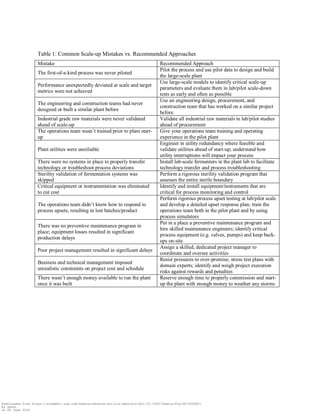
objectives. Table 1 highlights some common mistakes and provides guidance on how to properly
approach process scale-up.
Prepare for the unexpected
Regardless of how well you prepare, there will be issues that arise during scale-up. Common examples
include utility interruptions, microbial contamination, variable raw material quality, fouling of process
equipment, equipment failure, and unexpected poor process performance at scale. This is where formal
risk assessment and mitigation planning pays off. Spend the time and effort with your team to brainstorm
all conceivable risks, and for each risk rate the probability of occurrence and severity if it does occur.
Prioritize based on risk magnitude (probability x severity) and prepare a detailed risk mitigation plan. For
high magnitude risks relating to process upsets, design lab/pilot studies to assess the impact on process
performance and develop a detailed process upset response plan to inform the plant operations team of the
proper mode of action if an upset does occur (Martinez 2010-18).
Key considerations for fermentation scale-up
Poor fermentation performance at large-scale is almost always considered a priority scale-up risk. This is
because fermentation is usually the costliest process step, both in terms of variable costs (raw materials
and utilities) and capital investment. In addition, fermentation performance impacts the performance of all
downstream unit operations and the amount/nature of process wastes.
Fermentation is also a complex unit operation (Yang 2010). There are many parameters that impact
performance, and most of these are subject to change during scale-up. Table 2 describes performance
related parameters that are scale dependent. These parameters change either due to cost constraints or
equipment design and scale, and can negatively impact process performance and overall plant economics.
Recognition of and attention to scale-dependent fermentation parameters is fundamental to reducing –
even eliminating – fermentation as a scale-up risk. Those who take a systematic approach will be
rewarded with a consistent large-scale fermentation that meets performance expectations and enables
good downstream performance as well. In fact, a well-designed, scalable fermentation should ultimately
perform better in the manufacturing plant than in the lab due to continuous in-plant learning from years of
operating experience.
A road map for successful scale-up
The scale-up journey starts by envisioning the desired outcome: a robust full-scale manufacturing plant
that meets its commercial objectives (schedule, cost, and quality); i.e. begin with the end in mind. All of
this is memorialized at the beginning of a project in the form of a detailed, written charter that is updated
as the program progresses from R&D proof-of-concept through process development and eventually
deployment.
Lab-scale process development must be conducted under conditions that mimic, as close as possible, the
intended large-scale manufacturing process. If the process is properly scaled-down, it stands to reason that
it is more likely to properly scale-up (Yang 2010; Noorman 2017). There are limits in scale-down for
some process unit operations because representative small-scale equipment is not available. But in the
case of fermentation, large-scale conditions can usually be adequately simulated in stirred lab fermentors
with the implementation of some custom control hardware and software. Custom control algorithms can
be used to elicit oscillatory behavior in critical scale-up parameters. Some examples include: oscillating
agitation rate to mimic kLa heterogeneity; blending enriched gases with dynamic oscillations in flow rate
ratio to mimic gas phase heterogeneity and higher gas partial pressures; and pulsing or oscillating
substrate feed rate to mimic substrate concentration gradients. Conditions, timescales, and magnitudes for
Downloaded from https://academic.oup.com/femsle/advance-article-abstract/doi/10.1093/femsle/fny138/5026621
by guest
on 04 June 2018
testing should be determined using large-scale fermentor models that combine bioreactor hydrodynamics
with fermentation process kinetics.
A properly scaled-down lab process reduces the risk of performance degradation during scale-up, but it
does not, particularly in the case of a first-of-a-kind process, eliminate the need for an intermediate scale
process validation. Piloting, usually at 1 to 10% of full manufacturing scale, provides unique benefits and
further risk reduction:
 A fully integrated process, including recycle streams, can be operated for an extended period with
fully representative industrial equipment and materials.
 Alternative equipment designs and suppliers can be evaluated.
 The future large-scale plant operating team can be trained; from the team‟s pilot experience, they
will know the process works and will log valuable experience in addressing process upsets.
 Pilot plant data and operating know-how are used to improve the large-scale plant design.
 Large quantities of product can be produced for customer evaluation in the end-use applications,
which builds customer relationships, confidence, and demand for the commercial plant output.
Piloting may require 6 months to 3 years, depending on whether a facility exists or must be built, the
availability and novelty of equipment required, and the need to resolve issues that arise during the project.
Piloting cost is significant as well, approximately 5 to 20% of the total project cost. As a result, it can be
tempting to skip this step or to pilot only selected unit operations for a short time. Experience has proven
this to be unwise; the downside far outweighs the modest upside.
Design of the large-scale manufacturing plant should be based on data generated in the pilot plant. It is
also important to factor in the outlook for future technology improvements. But avoid the temptation to
design the large-scale plant for a process that has not been validated at pilot scale.
Whether you intend to build, own, and operate your own plant or license your technology, it is crucial to
provide technical support during all phases of the project, including engineering design, construction,
commissioning, and start-up. To facilitate a smooth plant start-up, critical instrumentation for process
control and analytics must be installed. Satellite lab equipment located at the plant for technology transfer
validation and process troubleshooting support is also important. During start-up, process specialists
should be on-site with shift coverage to provide critical feedback to shift leaders regarding technology
performance. A separate troubleshooting taskforce of cross-functional technology specialists should be on
call 24/7 in case any significant problems arise that require more rigorous troubleshooting.
Key challenges and improvement opportunities
It can be challenging to follow the three key principles. Frankly, many R&D projects we have
encountered fail to begin with the end in mind or at least have an insufficient or inaccurate vision of the
commercial end result. A common fundamental error is to select the microbial host strain and develop it
without regard for its suitability for large-scale production. Why? Often, new opportunities are conceived
by laboratory scientists and engineers and business people who have no relevant technology
commercialization experience. They don‟t know what the end looks like or what it takes to get there.
They may realize that commercial engineering input is needed, but believe it is something to be addressed
later. This serial approach is a big mistake, and these projects are destined for trouble during scale-up.
Even with an enlightened approach, it is challenging to execute at a high level during scale-up. The real
world is awash with non-idealities in human resources, skillsets, facilities, financing, and unknowables.
We have found skilled project management in many cases to be an undervalued aspect. The best scientists
and engineers, including the R&D project leader, won‟t necessarily make the best project managers
during scale-up. World-class project managers are not necessarily world-class technology experts. But
they are dedicated, organized, detail-oriented, integrative, communicative, adaptive, realistic, and
Downloaded from https://academic.oup.com/femsle/advance-article-abstract/doi/10.1093/femsle/fny138/5026621
by guest
on 04 June 2018
experienced. They know what the end looks like. They plan for success, but anticipate problems (Aston
2017). They embrace and embody the three key principles.
You might have heard this saying: „the early bird may get the worm, but the second mouse gets the
cheese‟; i.e. it is advised to learn from others who have gone before you. Some of the smartest people we
know are early birds. They are brilliant and driven, convinced they can do it alone and faster, cheaper, and
better than anyone else, even though they‟ve never done it before. They underestimate – and sometimes
even ignore – the challenges of scale-up. They over-promise, forcing ill-advised shortcuts and leaps of
faith. Their audacity may occasionally earn them the worm, but more likely, they will earn the fate of the
first mouse. Instead, be the second mouse. Use the skilled engineering resources around you to evaluate
new opportunities, to provide guidance to ongoing R&D, to set realistic expectations, and to successfully
scale up your process without surprises.
References
Aston B. Why is project management important? The Digital Project Manager 2017,
www.thedigitalprojectmanager.com.
Chem Process staff. Genomatica‟s Lievense receives prestigious biotechnology award. Chem Process
2018, www.chemicalprocessing.com.
Culler S. A bioengineering platform to industrialize biotechnology. Chem Eng Prog 2016;112:42-51.
Kennedy HT. Genomatica goes big with Bio-BG. Biofuels Digest 2017, www.biofuelsdigest.com.
Martinez M. Project risk management basics. Project Management Skills 2010-18, www.project-
management-skills.com.
Noorman HJ, Heijnen JJ. Biochemical engineering‟s grand adventure. Chem Eng Sci 2017:170,677-93.
Ondrey G. 42nd
Kirkpatrick award announced. Chem Eng (New York) 2013;120:15-19.
Weiss, A. Harnessing biotechnology: a practical guide. Chem Eng (New York) 2016;123;38-43.
Yang X. Scale-up of microbial fermentation process. In: Baltz RH, Davies JE, Demain AL (ed.). Manual
of Industrial Microbiology and Biotechnology, 3rd
Edition. Washington: ASM Press, 2010, 669-75.
Downloaded from https://academic.oup.com/femsle/advance-article-abstract/doi/10.1093/femsle/fny138/5026621
by guest
on 04 June 2018
Table 1: Common Scale-up Mistakes vs. Recommended Approaches
Mistake Recommended Approach
The first-of-a-kind process was never piloted
Pilot the process and use pilot data to design and build
the large-scale plant
Performance unexpectedly deviated at scale and target
metrics were not achieved
Use large-scale models to identify critical scale-up
parameters and evaluate them in lab/pilot scale-down
tests as early and often as possible
The engineering and construction teams had never
designed or built a similar plant before
Use an engineering design, procurement, and
construction team that has worked on a similar project
before
Industrial grade raw materials were never validated
ahead of scale-up
Validate all industrial raw materials in lab/pilot studies
ahead of procurement
The operations team wasn‟t trained prior to plant start-
up
Give your operations team training and operating
experience in the pilot plant
Plant utilities were unreliable
Engineer in utility redundancy where feasible and
validate utilities ahead of start-up; understand how
utility interruptions will impact your process
There were no systems in place to properly transfer
technology or troubleshoot process deviations
Install lab-scale fermentors in the plant lab to facilitate
technology transfer and process troubleshooting
Sterility validation of fermentation systems was
skipped
Perform a rigorous sterility validation program that
assesses the entire sterile boundary
Critical equipment or instrumentation was eliminated
to cut cost
Identify and install equipment/instruments that are
critical for process monitoring and control
The operations team didn‟t know how to respond to
process upsets, resulting in lost batches/product
Perform rigorous process upset testing at lab/pilot scale
and develop a detailed upset response plan; train the
operations team both in the pilot plant and by using
process simulators
There was no preventive maintenance program in
place; equipment losses resulted in significant
production delays
Put in a place a preventive maintenance program and
hire skilled maintenance engineers; identify critical
process equipment (e.g. valves, pumps) and keep back-
ups on-site
Poor project management resulted in significant delays
Assign a skilled, dedicated project manager to
coordinate and oversee activities
Business and technical management imposed
unrealistic constraints on project cost and schedule
Resist pressures to over-promise; stress test plans with
domain experts; identify and weigh project execution
risks against rewards and penalties
There wasn‟t enough money available to run the plant
once it was built
Reserve enough time to properly commission and start-
up the plant with enough money to weather any storms
Downloaded from https://academic.oup.com/femsle/advance-article-abstract/doi/10.1093/femsle/fny138/5026621
by guest
on 04 June 2018
Table 2: Scale-Dependent Fermentation Parameters
Parameter Deviation Impact
Raw material grade
Industrial vs. reagent grade,
purity, concentration, lot-to-
lot variability
Accumulation of inhibitors and unfermentable
components can negatively impact fermentation,
downstream processing (DSP), and waste water
treatment (WWT); differences in concentration
can impact water balance and time course
dynamics for fed-batch processes
Raw material sterilization
Batch vs. continuous
sterilization, temperature and
residence time profiles
Component degradation and/or inhibitor
formation can negatively impact fermentation,
DSP, and WWT
Fermentor mixing time Increase in magnitude
Gradients in critical process control parameters
(e.g. temperature, pH, substrate or nutrient
concentration) can negatively impact
fermentation performance
Gas-liquid volumetric mass
transfer coefficient (kLa)
Gradient due to power
dissipation; upper limitation
due to equipment design
Both limitations and gradients in mass transfer
rates can negatively impact fermentation
performance
Broth hydrostatic pressure
Increase in magnitude with
gradient along vertical axis
Elevated gas partial pressures (e.g. pO2, pCO2)
and gradients in partial pressures and dissolved
gases can impact fermentation performance
Shear stress Increase in magnitude
Higher shear stress can cause cell damage,
affecting fermentation and/or DSP performance
Broth handling
Extended broth holds and
harvest times
Residence time and conditions (temperature,
aerobicity, product concentration) can impact
cell lysis and broth chemistry, which can
negatively impact DSP and WWT
Broth deactivation
Batch vs. continuous
deactivation, temperature and
residence time profiles
Deactivation conditions (time, temperature) can
impact cell lysis and broth chemistry, which can
negatively impact DSP and WWT
Downloaded from https://academic.oup.com/femsle/advance-article-abstract/doi/10.1093/femsle/fny138/5026621
by guest
on 04 June 2018

industrial microbial culture (1).pdf

  • 1.
    Scale-up of IndustrialMicrobial Processes Jason S. Crater1 * Jefferson C. Lievense1 1. Process Deployment, Genomatica Inc – Process Technology, San Diego, USA * Corresponding Author: Mr. Jason S. Crater Genomatica, Inc. 4757 Nexus Center Drive, San Diego, CA 92121, USA +1 858 210 4426 jcrater@genomatica.com Keywords Scale-up, Scale-down, Fermentation, Bioprocessing, Piloting, Large-scale Summary Scaling up industrial microbial processes is a costly, high-stakes endeavor that can be executed successfully if approached properly. Abstract Scaling up industrial microbial processes for commercial production is a high-stakes endeavor, requiring time and investment often exceeding that for laboratory microbe and process development. Omissions, oversights, and errors can be costly, even fatal to the program. Approached properly, scale-up can be executed successfully. Three guiding principles are provided as a basis: begin with the end in mind; be diligent in the details; prepare for the unexpected. A detailed roadmap builds on these principles. There is a special emphasis on the fermentation step, which is usually the costliest and also impacts downstream processing. Examples of common scale-up mistakes and the recommended approaches are given. It is advised that engineering resources skilled in integrated process development and scale-up be engaged from the very beginning of microbe and process development to guide ongoing R&D, thus ensuring a smooth and profitable path to the large-scale commercial end. What is scale-up and why does it matter? Cambridge Dictionary defines scale-up as increasing something in size, amount, or production. Microbial processes involve cultivation of microbes in bioreactors (also referred to as fermentors) to produce a product, as well as the subsequent recovery and purification of the product and disposal of associated wastes. Scale-up of microbial processes is undertaken typically for a commercial purpose, specifically to provide product benefits to customers and to generate a financial return for investors. A process developed in a laboratory (e.g. 0.5-10 L fermentors) must be translated into a full manufacturing scale Downloaded from https://academic.oup.com/femsle/advance-article-abstract/doi/10.1093/femsle/fny138/5026621 by guest on 04 June 2018
  • 2.
    process (e.g. 20,000-2,000,000L fermentors), with scale factors ranging anywhere from thousands to millions. Scale-up of large industrial processes is preferably done in two stages if there is a high degree of novelty in the process and/or the commercial product. The first stage is a pilot plant (pilot scale) with 100-10,000 L fermentors and matched downstream equipment. Its purpose is to translate the lab-scale process into a realistic scaled-down version of the manufacturing process. In most cases, the process is not fully integrated; i.e. each individual unit operation is operated batch-wise. The selected pilot scale is a judgment based on the size, availability, and cost of representative scaled-down equipment and required product sample sizes. The second stage of scale-up is a demonstration plant (demo scale) with 10,000- 100,000 L fermentors and matched downstream. It serves to minimize the risk of a large capital investment in the full-scale manufacturing plant by further validating the process, the supply chain (from raw materials to commercial product application), and market demand. The demo process is run continuously and with recycle streams. If the degree of novelty is low, then the demonstration plant may be skipped. For the remainder of the article, we will use “pilot” in reference to both pilot and demo scales. The financial investment to scale up a microbial process to manufacturing scale is usually greater than the cost to develop the production microbe and lab-scale process. This can be on the order of US $100 million to $1 billion, including intermediate process validation (pilot and demo scales) and construction and start-up of the manufacturing plant. The annual operating cost of the manufacturing plant is on the same order. The time required to transition from lab-scale to manufacturing is typically 3-10 years. Under these circumstances, the financial risk is high, so deterioration in process performance during scale-up will be costly and disruptive, potentially even leading to project failure. Short of failure, even incremental (5-10%) under-performance and/or delays (3-12 months) during scale-up will substantially reduce financial returns to investors and undermine stakeholder and customer confidence. So, in scaling up microbial processes, it is clearly impactful to get it right and to get it right the first time. Guiding principles for process scale-up The authors have contributed to the commercialization of a variety of industrial microbial processes, including first-of-a-kind projects, from early stage R&D to scale-up to manufacturing support (Chem Process 2018; Culler 2016; Kennedy 2017; Ondrey 2013; Weiss 2016). Based on our experiences, here are three guiding principles that are critical to the successful scale-up of industrial microbial processes. Begin with the end in mind Why wouldn‟t you, regardless of the endeavor? The challenge is having a realistic and accurate view of what the end looks like – especially when it‟s a first-of-a-kind process. One cannot simply enlarge lab- scale equipment and duplicate lab-scale conditions at large-scale (Weiss 2016; Noorman 2017). Without an understanding of large-scale equipment and how scale-dependent parameters change, a project is likely to get into big trouble. Instead, beginning with the end in mind, a skilled project team that really understands large-scale processes prepares a detailed conceptual design of the envisioned manufacturing process and plant before the first lab experiments are done. Based on realistic biology, chemistry, and engineering assumptions, the team builds process flow diagrams, material and energy balances, unit operation designs, and techno- economic models. This initial investment is negligible compared to the total project cost, and it is the smartest investment you can make. Use the conceptual design to provide early guidance to the experimental R&D program on process viability and key scale and economic parameters. Then regularly update the design as your experimental program produces new learnings. Be diligent in the details Unfortunately, we‟ve seen all kinds of oversights and shortcuts during process scale-up, with consequences ranging from disruptive to catastrophic. On the other hand, with close attention given to Downloaded from https://academic.oup.com/femsle/advance-article-abstract/doi/10.1093/femsle/fny138/5026621 by guest on 04 June 2018
  • 3.
    critical details, microbialprocesses can be scaled up with minimal unpleasant surprises. Ultimately, this will reward stakeholders with a safe, reliable manufacturing plant that meets or exceeds its financial objectives. Table 1 highlights some common mistakes and provides guidance on how to properly approach process scale-up. Prepare for the unexpected Regardless of how well you prepare, there will be issues that arise during scale-up. Common examples include utility interruptions, microbial contamination, variable raw material quality, fouling of process equipment, equipment failure, and unexpected poor process performance at scale. This is where formal risk assessment and mitigation planning pays off. Spend the time and effort with your team to brainstorm all conceivable risks, and for each risk rate the probability of occurrence and severity if it does occur. Prioritize based on risk magnitude (probability x severity) and prepare a detailed risk mitigation plan. For high magnitude risks relating to process upsets, design lab/pilot studies to assess the impact on process performance and develop a detailed process upset response plan to inform the plant operations team of the proper mode of action if an upset does occur (Martinez 2010-18). Key considerations for fermentation scale-up Poor fermentation performance at large-scale is almost always considered a priority scale-up risk. This is because fermentation is usually the costliest process step, both in terms of variable costs (raw materials and utilities) and capital investment. In addition, fermentation performance impacts the performance of all downstream unit operations and the amount/nature of process wastes. Fermentation is also a complex unit operation (Yang 2010). There are many parameters that impact performance, and most of these are subject to change during scale-up. Table 2 describes performance related parameters that are scale dependent. These parameters change either due to cost constraints or equipment design and scale, and can negatively impact process performance and overall plant economics. Recognition of and attention to scale-dependent fermentation parameters is fundamental to reducing – even eliminating – fermentation as a scale-up risk. Those who take a systematic approach will be rewarded with a consistent large-scale fermentation that meets performance expectations and enables good downstream performance as well. In fact, a well-designed, scalable fermentation should ultimately perform better in the manufacturing plant than in the lab due to continuous in-plant learning from years of operating experience. A road map for successful scale-up The scale-up journey starts by envisioning the desired outcome: a robust full-scale manufacturing plant that meets its commercial objectives (schedule, cost, and quality); i.e. begin with the end in mind. All of this is memorialized at the beginning of a project in the form of a detailed, written charter that is updated as the program progresses from R&D proof-of-concept through process development and eventually deployment. Lab-scale process development must be conducted under conditions that mimic, as close as possible, the intended large-scale manufacturing process. If the process is properly scaled-down, it stands to reason that it is more likely to properly scale-up (Yang 2010; Noorman 2017). There are limits in scale-down for some process unit operations because representative small-scale equipment is not available. But in the case of fermentation, large-scale conditions can usually be adequately simulated in stirred lab fermentors with the implementation of some custom control hardware and software. Custom control algorithms can be used to elicit oscillatory behavior in critical scale-up parameters. Some examples include: oscillating agitation rate to mimic kLa heterogeneity; blending enriched gases with dynamic oscillations in flow rate ratio to mimic gas phase heterogeneity and higher gas partial pressures; and pulsing or oscillating substrate feed rate to mimic substrate concentration gradients. Conditions, timescales, and magnitudes for Downloaded from https://academic.oup.com/femsle/advance-article-abstract/doi/10.1093/femsle/fny138/5026621 by guest on 04 June 2018
  • 4.
    testing should bedetermined using large-scale fermentor models that combine bioreactor hydrodynamics with fermentation process kinetics. A properly scaled-down lab process reduces the risk of performance degradation during scale-up, but it does not, particularly in the case of a first-of-a-kind process, eliminate the need for an intermediate scale process validation. Piloting, usually at 1 to 10% of full manufacturing scale, provides unique benefits and further risk reduction:  A fully integrated process, including recycle streams, can be operated for an extended period with fully representative industrial equipment and materials.  Alternative equipment designs and suppliers can be evaluated.  The future large-scale plant operating team can be trained; from the team‟s pilot experience, they will know the process works and will log valuable experience in addressing process upsets.  Pilot plant data and operating know-how are used to improve the large-scale plant design.  Large quantities of product can be produced for customer evaluation in the end-use applications, which builds customer relationships, confidence, and demand for the commercial plant output. Piloting may require 6 months to 3 years, depending on whether a facility exists or must be built, the availability and novelty of equipment required, and the need to resolve issues that arise during the project. Piloting cost is significant as well, approximately 5 to 20% of the total project cost. As a result, it can be tempting to skip this step or to pilot only selected unit operations for a short time. Experience has proven this to be unwise; the downside far outweighs the modest upside. Design of the large-scale manufacturing plant should be based on data generated in the pilot plant. It is also important to factor in the outlook for future technology improvements. But avoid the temptation to design the large-scale plant for a process that has not been validated at pilot scale. Whether you intend to build, own, and operate your own plant or license your technology, it is crucial to provide technical support during all phases of the project, including engineering design, construction, commissioning, and start-up. To facilitate a smooth plant start-up, critical instrumentation for process control and analytics must be installed. Satellite lab equipment located at the plant for technology transfer validation and process troubleshooting support is also important. During start-up, process specialists should be on-site with shift coverage to provide critical feedback to shift leaders regarding technology performance. A separate troubleshooting taskforce of cross-functional technology specialists should be on call 24/7 in case any significant problems arise that require more rigorous troubleshooting. Key challenges and improvement opportunities It can be challenging to follow the three key principles. Frankly, many R&D projects we have encountered fail to begin with the end in mind or at least have an insufficient or inaccurate vision of the commercial end result. A common fundamental error is to select the microbial host strain and develop it without regard for its suitability for large-scale production. Why? Often, new opportunities are conceived by laboratory scientists and engineers and business people who have no relevant technology commercialization experience. They don‟t know what the end looks like or what it takes to get there. They may realize that commercial engineering input is needed, but believe it is something to be addressed later. This serial approach is a big mistake, and these projects are destined for trouble during scale-up. Even with an enlightened approach, it is challenging to execute at a high level during scale-up. The real world is awash with non-idealities in human resources, skillsets, facilities, financing, and unknowables. We have found skilled project management in many cases to be an undervalued aspect. The best scientists and engineers, including the R&D project leader, won‟t necessarily make the best project managers during scale-up. World-class project managers are not necessarily world-class technology experts. But they are dedicated, organized, detail-oriented, integrative, communicative, adaptive, realistic, and Downloaded from https://academic.oup.com/femsle/advance-article-abstract/doi/10.1093/femsle/fny138/5026621 by guest on 04 June 2018
  • 5.
    experienced. They knowwhat the end looks like. They plan for success, but anticipate problems (Aston 2017). They embrace and embody the three key principles. You might have heard this saying: „the early bird may get the worm, but the second mouse gets the cheese‟; i.e. it is advised to learn from others who have gone before you. Some of the smartest people we know are early birds. They are brilliant and driven, convinced they can do it alone and faster, cheaper, and better than anyone else, even though they‟ve never done it before. They underestimate – and sometimes even ignore – the challenges of scale-up. They over-promise, forcing ill-advised shortcuts and leaps of faith. Their audacity may occasionally earn them the worm, but more likely, they will earn the fate of the first mouse. Instead, be the second mouse. Use the skilled engineering resources around you to evaluate new opportunities, to provide guidance to ongoing R&D, to set realistic expectations, and to successfully scale up your process without surprises. References Aston B. Why is project management important? The Digital Project Manager 2017, www.thedigitalprojectmanager.com. Chem Process staff. Genomatica‟s Lievense receives prestigious biotechnology award. Chem Process 2018, www.chemicalprocessing.com. Culler S. A bioengineering platform to industrialize biotechnology. Chem Eng Prog 2016;112:42-51. Kennedy HT. Genomatica goes big with Bio-BG. Biofuels Digest 2017, www.biofuelsdigest.com. Martinez M. Project risk management basics. Project Management Skills 2010-18, www.project- management-skills.com. Noorman HJ, Heijnen JJ. Biochemical engineering‟s grand adventure. Chem Eng Sci 2017:170,677-93. Ondrey G. 42nd Kirkpatrick award announced. Chem Eng (New York) 2013;120:15-19. Weiss, A. Harnessing biotechnology: a practical guide. Chem Eng (New York) 2016;123;38-43. Yang X. Scale-up of microbial fermentation process. In: Baltz RH, Davies JE, Demain AL (ed.). Manual of Industrial Microbiology and Biotechnology, 3rd Edition. Washington: ASM Press, 2010, 669-75. Downloaded from https://academic.oup.com/femsle/advance-article-abstract/doi/10.1093/femsle/fny138/5026621 by guest on 04 June 2018
  • 6.
    Table 1: CommonScale-up Mistakes vs. Recommended Approaches Mistake Recommended Approach The first-of-a-kind process was never piloted Pilot the process and use pilot data to design and build the large-scale plant Performance unexpectedly deviated at scale and target metrics were not achieved Use large-scale models to identify critical scale-up parameters and evaluate them in lab/pilot scale-down tests as early and often as possible The engineering and construction teams had never designed or built a similar plant before Use an engineering design, procurement, and construction team that has worked on a similar project before Industrial grade raw materials were never validated ahead of scale-up Validate all industrial raw materials in lab/pilot studies ahead of procurement The operations team wasn‟t trained prior to plant start- up Give your operations team training and operating experience in the pilot plant Plant utilities were unreliable Engineer in utility redundancy where feasible and validate utilities ahead of start-up; understand how utility interruptions will impact your process There were no systems in place to properly transfer technology or troubleshoot process deviations Install lab-scale fermentors in the plant lab to facilitate technology transfer and process troubleshooting Sterility validation of fermentation systems was skipped Perform a rigorous sterility validation program that assesses the entire sterile boundary Critical equipment or instrumentation was eliminated to cut cost Identify and install equipment/instruments that are critical for process monitoring and control The operations team didn‟t know how to respond to process upsets, resulting in lost batches/product Perform rigorous process upset testing at lab/pilot scale and develop a detailed upset response plan; train the operations team both in the pilot plant and by using process simulators There was no preventive maintenance program in place; equipment losses resulted in significant production delays Put in a place a preventive maintenance program and hire skilled maintenance engineers; identify critical process equipment (e.g. valves, pumps) and keep back- ups on-site Poor project management resulted in significant delays Assign a skilled, dedicated project manager to coordinate and oversee activities Business and technical management imposed unrealistic constraints on project cost and schedule Resist pressures to over-promise; stress test plans with domain experts; identify and weigh project execution risks against rewards and penalties There wasn‟t enough money available to run the plant once it was built Reserve enough time to properly commission and start- up the plant with enough money to weather any storms Downloaded from https://academic.oup.com/femsle/advance-article-abstract/doi/10.1093/femsle/fny138/5026621 by guest on 04 June 2018
  • 7.
    Table 2: Scale-DependentFermentation Parameters Parameter Deviation Impact Raw material grade Industrial vs. reagent grade, purity, concentration, lot-to- lot variability Accumulation of inhibitors and unfermentable components can negatively impact fermentation, downstream processing (DSP), and waste water treatment (WWT); differences in concentration can impact water balance and time course dynamics for fed-batch processes Raw material sterilization Batch vs. continuous sterilization, temperature and residence time profiles Component degradation and/or inhibitor formation can negatively impact fermentation, DSP, and WWT Fermentor mixing time Increase in magnitude Gradients in critical process control parameters (e.g. temperature, pH, substrate or nutrient concentration) can negatively impact fermentation performance Gas-liquid volumetric mass transfer coefficient (kLa) Gradient due to power dissipation; upper limitation due to equipment design Both limitations and gradients in mass transfer rates can negatively impact fermentation performance Broth hydrostatic pressure Increase in magnitude with gradient along vertical axis Elevated gas partial pressures (e.g. pO2, pCO2) and gradients in partial pressures and dissolved gases can impact fermentation performance Shear stress Increase in magnitude Higher shear stress can cause cell damage, affecting fermentation and/or DSP performance Broth handling Extended broth holds and harvest times Residence time and conditions (temperature, aerobicity, product concentration) can impact cell lysis and broth chemistry, which can negatively impact DSP and WWT Broth deactivation Batch vs. continuous deactivation, temperature and residence time profiles Deactivation conditions (time, temperature) can impact cell lysis and broth chemistry, which can negatively impact DSP and WWT Downloaded from https://academic.oup.com/femsle/advance-article-abstract/doi/10.1093/femsle/fny138/5026621 by guest on 04 June 2018