UNIT I: DEVELOPING A BUSINESS
PLAN
Module 2: Recognizing the Potential Market
Learning Outcomes:
At the end of this module, the learners can:
 Identify the market problem to be solved or the market to be
met.
 Propose solutions in terms of products and services that will
meet the need using techniques on seeking, screening, and
seizing opportunities.
a. Analyze the market need.
b. Determine the possible products or services that will meet
the need.
c. Screen the proposed solutions based on viability,
profitability, and customer requirements.
d. Select the best products or service that will meet the
market need.
This module will:
 Discuss the proper and efficient ways of starting a business.
 Introduce the entrepreneurial process.
 Familiarize with the marketing environment.
 Teach you to apply the techniques of seeking, screening, and
seizing opportunities.
 Let you deal with analyzing the need of the market, think of
the potential set of products or services that will meet the
need, assess the feasibility of the solution, and select the best
product or service that will address the need.
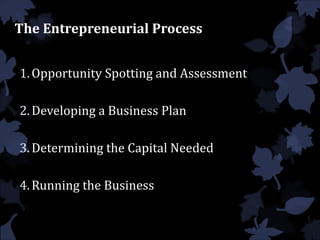
The Entrepreneurial Process
1.Opportunity Spotting and Assessment
2.Developing a Business Plan
3.Determining the Capital Needed
4.Running the Business
SCANNING THE MARKETING ENVIRONMENT
It is the starting point of any venture that involves
understanding and knowing the intricacies of the
whole environment.
Through environmental scanning, entrepreneur
can recognize various opportunities and at the
same time understand thoroughly the arena
where the future business will operate.
IMPORTANCE OF ENVIRONMENTAL
SCANNING
 It clearly portrays the trends, activities, and development
happening both in the macro and micro environment
including the interrelated relationships between the
various forces in the environment.
 It identifies the expected threats and opportunities
existing in the environment.
 It points out the possible factors that will determine the
success of the business venture.
 It helps define the future path of the business.
 It assists in the formulation of the most appropriate
business strategies.
General Rule:
“Find the opportunity first before coming up
with a new product or service in the future”.
SEEKING, SCREENING, and SEIZING
3S of Opportunity Spotting and Assessment
is the framework that most of the promising
entrepreneurs use to finally come up with the
ultimate product or service suited for specific
opportunity.
Opportunity
is an entrepreneur’s business idea that can potentially
become a commercial product or service in the future.
S1: SEEKING THE OPPORTUNITY
Opportunity Seeking
is the first step and is the most difficult process of
all due to the number of options that the
entrepreneur will have to choose from.
S1: SEEKING THE OPPORTUNITY
 it involves the development of new ideas from various
sources as follows:
Changes in the environment
External/Macroenvironment
Internal/Microenvironment
Technological discovery and advancement
Government’s thrust, programs, and policies
People’s interests
Past experiences
S1: SEEKING THE OPPORTUNITY
External / Macroenvironment
 it involves the larger societal forces that influence the
microenvironment.
a. PESTEL – Political, Economic, Socio-cultural,
Technological, Ecological, Legal
b. Industry Environment -- Government, Suppliers,
Customers, Competitors, Employees, Creditors
S1: SEEKING THE OPPORTUNITY
PESTEL
a1. Political Factors
are mostly induced by government policies and
administrations, which can have a strong effect in the
entrepreneur’s business.
 a2. Economic Factors
are factors which are primarily caused by changes or
movements in the Philippine economy that have direct or
indirect effects on the entrepreneurial venture.
S1: SEEKING THE OPPORTUNITY
a3. Socio-cultural Factors
represent a general view of a locality’s traditions,
customs, beliefs, norms, and perceptions.
a4. Technological Factors
basically refer to the trends and developments in
computer and information technology that have impact
on business.
S1: SEEKING THE OPPORTUNITY
a5. Environmental/Ecological Factors
should be given much importance especially when the
world has already suffered severely from human-
induced calamities.
a6. Legal Factors
are the elements and bodies that are directly involved
in the legislation and interpretation of laws and
ordinances directly affecting the business.
S1: SEEKING THE OPPORTUNITY
Industry Environment
 b1. Government
refers to the system or institution that handles the affairs of
a particular country.
Five Types/Classifications of Government:
democracy
autocracy
republic
monarchy
dictatorship
S1: SEEKING THE OPPORTUNITY
b2. Suppliers
refer to individual persons or companies that provide the
required materials, parts, or services to the business.
Criteria of Selecting the Supplier:
quality of the goods or services
terms of payment
stability
ability to respond to urgent needs
proximity of the location
S1: SEEKING THE OPPORTUNITY
b3. Customers
 are the buyers of goods or services produced or rendered by the
business.
 it must constantly evaluate and study the behavior, tastes,
preferences, inclinations, and even future activities of the
customers.
b4. Competitors
 are the forces existing in the industry environment that produce,
sell, or render products or services which are similar to those of the
business.
 Direct Competitors – produce and sell similar products or services.
 Indirect Competitors – produce and sell substitute products.
S1: SEEKING THE OPPORTUNITY
b5. Employees
are the workers of the business who are highly responsible
for the production of goods or delivery or services to the
customers.
They help ensure the quality and quantity of products or
services provided to the customers.
They are the backbone of the business
b6. Creditors
refer to banks, financial institutions, and financial
intermediaries engaged in the lending of money to the
borrower usually for a fee or charge in the form of interest.
S1: SEEKING THE OPPORTUNITY
Internal / Microenvironment
 refers to the environment within the business.
a. Business Resources
 are assets or properties owned or controlled by the business.
 can either be tangible or intangible.
Tangible Resources – are assets of the business that have
physical appearance and form.
Current Resources – are used, applied, or consumed
within a short period or one year.
Noncurrent or fixed Resources – are properties whose
usefulness or benefits extend beyond one year.
S1: SEEKING THE OPPORTUNITY
 Intangible Resources – are assets of the business that do not
have physical appearance of form.
 A business without resources cannot exist and a business with
insufficient resources cannot sustain the operation.
b. Business Culture
 is a collection of values, beliefs, principles, and expectations
learned and shared by employees, founders, stakeholders, and
members of the management.
 reflects the overall image of the business to the community.
 reflects the identity of the employees but not dependent on
the culture of dominant employees in the business.
S1: SEEKING THE OPPORTUNITY
• Types of Cultures operating in the Internal Environment:
 Culture of the Business or Organization
 Individual Culture of the Employees
• The entrepreneur has the primary responsibility to handle the
level of cultural acceptance and cultural integration among
Filipino workers in the business.
 Cultural Acceptance – refers to the degree by which the
employees accept the culture of the unit or business.
 Cultural Integration – refers to the degree by which all
units across the business accept and share a common
culture.
S1: SEEKING THE OPPORTUNITY
c. Business Structure
• refers to the formal organizational arrangement of the
business in terms of hierarchy of positions, flow of
communication, relationship of functional areas, and
production and marketing processes
• the complexity of the business structure depends on the
type of business, nature of operation, capital base
requirement, leadership style, and scope of operation.
S1: SEEKING THE OPPORTUNITY
METHODS OFGENERATING IDEAS
1. Focused Group Discussion (FGD)
 is conducted by an entrepreneur with the assistance of a
moderator to gather the views of selected consumers on
certain issues related to their buying behavior.
2. Brainstorming
 is an activity similar to an FGD, that allows the participants
to share creative ideas using the following rules: (a) no
destructive criticism or judgement is allowed; (b) wider
ideas are accepted; (c) more ideas are preferred; and (d)
improvement of others’ ideas is allowed. In short,
brainstorming is a fun discussion with lenient rules.
S1: SEEKING THE OPPORTUNITY
3. Brainwriting or Internet brainstorming
 is exactly the same as brainstorming except that the channel
used is not face-to-face, but in writing or online.
4. Problem inventory analysis
 is similar to the FGD except that the participants are already
given an inventory of product or service problems.
 participants will just identify from the list given the
compelling problem(s) of a potential product or service
instead of generating the ideas from them.
S2: SCREENING THE OPPORTUNITY
Opportunity Screening
• is the process of cautiously selecting the best opportunity.
 the selection will depend on the entrepreneur’s internal
intent and the external intent which will address the
compelling needs of the target market.
 Risk Appetite – refers to the entrepreneur’s tolerance of
business risks.
 The crafting of a business plan starts only when
entrepreneurs already said no to many opportunities and
said yes to one forceful opportunity, to which they will
devote their time and resources.
S2: SCREENING THE OPPORTUNITY
The entrepreneur should say no to an opportunity if it does
not contain any of these business opportunity elements:
 Has superior value to customers
 Solves a compelling problem, issue, a need, or a want
 Is a potential cash cow
 Matches with the entrepreneur’s skills, resources, and risk
appetite
 Opportunity Screening Matrix (OSM) aims to assist
entrepreneur concretize the evidence that the chosen
opportunity (or opportunities) is well worth pursuing.
The 12 Rs of Opportunity Screening
 Relevance to vision, mission, and objectives of the
entrepreneur.
 Resonance to values.
 Reinforcement of Entrepreneurial Interests
 Revenues – determine the sales potential of the products or
services you want to offer.
S2: SCREENING THE OPPORTUNITY
 Responsiveness to customer needs and wants.
 Reach – attainment of rapid growth
 Range – potentially lead to a wide range of possible product
or service offerings
 Revolutionary Impact – “next big thing” or a game-changer
that will revolutionize the industry
 Returns – high returns on investment
 Relative Ease of Implementation – easy to implement
 Resources Required – fewer resources is better than those
requiring more resources
 Risks
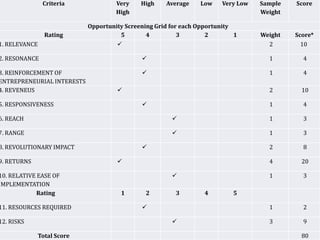
Criteria Very
High
High Average Low Very Low Sample
Weight
Score
Opportunity Screening Grid for each Opportunity
Rating 5 4 3 2 1 Weight Score*
1. RELEVANCE  2 10
2. RESONANCE  1 4
3. REINFORCEMENT OF
ENTREPRENEURIAL INTERESTS
 1 4
4. REVENEUS  2 10
5. RESPONSIVENESS  1 4
6. REACH  1 3
7. RANGE  1 3
8. REVOLUTIONARY IMPACT  2 8
9. RETURNS  4 20
10. RELATIVE EASE OF
IMPLEMENTATION
 1 3
Rating 1 2 3 4 5
11. RESOURCES REQUIRED  1 2
12. RISKS  3 9
Total Score 80
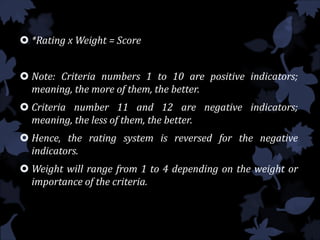
 *Rating x Weight = Score
 Note: Criteria numbers 1 to 10 are positive indicators;
meaning, the more of them, the better.
 Criteria number 11 and 12 are negative indicators;
meaning, the less of them, the better.
 Hence, the rating system is reversed for the negative
indicators.
 Weight will range from 1 to 4 depending on the weight or
importance of the criteria.
S3: SEIZING THE OPPORTUNITY
Opportunity Seizing
 is the last step in opportunity spotting and assessment.
 the “pushing through” with the chosen opportunity.
Innovation
 is the process of positively improving an existing product or
service.
 it is a key driver for economic growth.
S3: SEIZING THE OPPORTUNITY
 Three (3) types of Innovations according to the degree
of distinctiveness:
1. Breakthrough innovation
 may also include inventions, occur infrequently as these
establish the platform on which future innovations in an
area are developed.
 must be protected by patent, a trade secret, or a copyright.
 Examples: Internet, computer, or airplane
2. Technological innovation
 occur more frequently than breakthrough innovations.
 are technological advancements of an existing product or
service. These innovations need to be protected too.
 Examples: wireless fidelity or Wi-Fi, laptop, and jet
airplane.
S3: SEIZING THE OPPORTUNITY
3. Ordinary innovations
 occur ordinarily as the name implies.
 are commonly originating from market analysis and
technology pull instead of a technology push.
 This means that the market has a strong influence in the
implementation of an innovation.
 Examples: unlimited Internet plans of telecommunications
companies, a wireless mouse, and airbus for economical
travellers.
S3: SEIZING THE OPPORTUNITY
 The last process, called the seizing process, involves
refining and developing this opportunity. The refining
process is called product or service planning and
development process.
Four (4) stages:
 Idea stage – in this stage, the entrepreneur determines what are
the feasible products and/or services that will perfectly suit the
opportunity.
 Market evaluation
 Assessment of the value of new products/services
 Elimination of unappealing products/services
 Concept stage – the developed idea will undergo a consumer
acceptance test. This test includes getting the initial reactions of
the primary target market and the distribution channel.
 Conversational interviews
S3: SEIZING THE OPPORTUNITY
 Product development stage – in this stage, the
entrepreneur leverages on the information generated from
the prospective customers via the concept stage.
Determine actual reactions from prospective customers
Conduct consumer panel
 Test marketing stage – this stage validates the work done
from the first three stages to measure success in the
commercialization of the product or service.
Actual sales results
S3: SEIZING THE OPPORTUNITY
Once the 3S of opportunity spotting and
assessment have been diligently done, the
entrepreneur should now be ready to prepare a
comprehensive business plan that covers
marketing, operations, and financial plans.

Entrep2 pp

  • 1.
    UNIT I: DEVELOPINGA BUSINESS PLAN Module 2: Recognizing the Potential Market
  • 2.
    Learning Outcomes: At theend of this module, the learners can:  Identify the market problem to be solved or the market to be met.  Propose solutions in terms of products and services that will meet the need using techniques on seeking, screening, and seizing opportunities. a. Analyze the market need. b. Determine the possible products or services that will meet the need. c. Screen the proposed solutions based on viability, profitability, and customer requirements. d. Select the best products or service that will meet the market need.
  • 3.
    This module will: Discuss the proper and efficient ways of starting a business.  Introduce the entrepreneurial process.  Familiarize with the marketing environment.  Teach you to apply the techniques of seeking, screening, and seizing opportunities.  Let you deal with analyzing the need of the market, think of the potential set of products or services that will meet the need, assess the feasibility of the solution, and select the best product or service that will address the need.
  • 4.
    The Entrepreneurial Process 1.OpportunitySpotting and Assessment 2.Developing a Business Plan 3.Determining the Capital Needed 4.Running the Business
  • 5.
    SCANNING THE MARKETINGENVIRONMENT It is the starting point of any venture that involves understanding and knowing the intricacies of the whole environment. Through environmental scanning, entrepreneur can recognize various opportunities and at the same time understand thoroughly the arena where the future business will operate.
  • 6.
    IMPORTANCE OF ENVIRONMENTAL SCANNING It clearly portrays the trends, activities, and development happening both in the macro and micro environment including the interrelated relationships between the various forces in the environment.  It identifies the expected threats and opportunities existing in the environment.  It points out the possible factors that will determine the success of the business venture.  It helps define the future path of the business.  It assists in the formulation of the most appropriate business strategies.
  • 7.
    General Rule: “Find theopportunity first before coming up with a new product or service in the future”.
  • 8.
    SEEKING, SCREENING, andSEIZING 3S of Opportunity Spotting and Assessment is the framework that most of the promising entrepreneurs use to finally come up with the ultimate product or service suited for specific opportunity. Opportunity is an entrepreneur’s business idea that can potentially become a commercial product or service in the future.
  • 9.
    S1: SEEKING THEOPPORTUNITY Opportunity Seeking is the first step and is the most difficult process of all due to the number of options that the entrepreneur will have to choose from.
  • 10.
    S1: SEEKING THEOPPORTUNITY  it involves the development of new ideas from various sources as follows: Changes in the environment External/Macroenvironment Internal/Microenvironment Technological discovery and advancement Government’s thrust, programs, and policies People’s interests Past experiences
  • 11.
    S1: SEEKING THEOPPORTUNITY External / Macroenvironment  it involves the larger societal forces that influence the microenvironment. a. PESTEL – Political, Economic, Socio-cultural, Technological, Ecological, Legal b. Industry Environment -- Government, Suppliers, Customers, Competitors, Employees, Creditors
  • 12.
    S1: SEEKING THEOPPORTUNITY PESTEL a1. Political Factors are mostly induced by government policies and administrations, which can have a strong effect in the entrepreneur’s business.  a2. Economic Factors are factors which are primarily caused by changes or movements in the Philippine economy that have direct or indirect effects on the entrepreneurial venture.
  • 13.
    S1: SEEKING THEOPPORTUNITY a3. Socio-cultural Factors represent a general view of a locality’s traditions, customs, beliefs, norms, and perceptions. a4. Technological Factors basically refer to the trends and developments in computer and information technology that have impact on business.
  • 14.
    S1: SEEKING THEOPPORTUNITY a5. Environmental/Ecological Factors should be given much importance especially when the world has already suffered severely from human- induced calamities. a6. Legal Factors are the elements and bodies that are directly involved in the legislation and interpretation of laws and ordinances directly affecting the business.
  • 15.
    S1: SEEKING THEOPPORTUNITY Industry Environment  b1. Government refers to the system or institution that handles the affairs of a particular country. Five Types/Classifications of Government: democracy autocracy republic monarchy dictatorship
  • 16.
    S1: SEEKING THEOPPORTUNITY b2. Suppliers refer to individual persons or companies that provide the required materials, parts, or services to the business. Criteria of Selecting the Supplier: quality of the goods or services terms of payment stability ability to respond to urgent needs proximity of the location
  • 17.
    S1: SEEKING THEOPPORTUNITY b3. Customers  are the buyers of goods or services produced or rendered by the business.  it must constantly evaluate and study the behavior, tastes, preferences, inclinations, and even future activities of the customers. b4. Competitors  are the forces existing in the industry environment that produce, sell, or render products or services which are similar to those of the business.  Direct Competitors – produce and sell similar products or services.  Indirect Competitors – produce and sell substitute products.
  • 18.
    S1: SEEKING THEOPPORTUNITY b5. Employees are the workers of the business who are highly responsible for the production of goods or delivery or services to the customers. They help ensure the quality and quantity of products or services provided to the customers. They are the backbone of the business b6. Creditors refer to banks, financial institutions, and financial intermediaries engaged in the lending of money to the borrower usually for a fee or charge in the form of interest.
  • 19.
    S1: SEEKING THEOPPORTUNITY Internal / Microenvironment  refers to the environment within the business. a. Business Resources  are assets or properties owned or controlled by the business.  can either be tangible or intangible. Tangible Resources – are assets of the business that have physical appearance and form. Current Resources – are used, applied, or consumed within a short period or one year. Noncurrent or fixed Resources – are properties whose usefulness or benefits extend beyond one year.
  • 20.
    S1: SEEKING THEOPPORTUNITY  Intangible Resources – are assets of the business that do not have physical appearance of form.  A business without resources cannot exist and a business with insufficient resources cannot sustain the operation. b. Business Culture  is a collection of values, beliefs, principles, and expectations learned and shared by employees, founders, stakeholders, and members of the management.  reflects the overall image of the business to the community.  reflects the identity of the employees but not dependent on the culture of dominant employees in the business.
  • 21.
    S1: SEEKING THEOPPORTUNITY • Types of Cultures operating in the Internal Environment:  Culture of the Business or Organization  Individual Culture of the Employees • The entrepreneur has the primary responsibility to handle the level of cultural acceptance and cultural integration among Filipino workers in the business.  Cultural Acceptance – refers to the degree by which the employees accept the culture of the unit or business.  Cultural Integration – refers to the degree by which all units across the business accept and share a common culture.
  • 22.
    S1: SEEKING THEOPPORTUNITY c. Business Structure • refers to the formal organizational arrangement of the business in terms of hierarchy of positions, flow of communication, relationship of functional areas, and production and marketing processes • the complexity of the business structure depends on the type of business, nature of operation, capital base requirement, leadership style, and scope of operation.
  • 23.
    S1: SEEKING THEOPPORTUNITY METHODS OFGENERATING IDEAS 1. Focused Group Discussion (FGD)  is conducted by an entrepreneur with the assistance of a moderator to gather the views of selected consumers on certain issues related to their buying behavior. 2. Brainstorming  is an activity similar to an FGD, that allows the participants to share creative ideas using the following rules: (a) no destructive criticism or judgement is allowed; (b) wider ideas are accepted; (c) more ideas are preferred; and (d) improvement of others’ ideas is allowed. In short, brainstorming is a fun discussion with lenient rules.
  • 24.
    S1: SEEKING THEOPPORTUNITY 3. Brainwriting or Internet brainstorming  is exactly the same as brainstorming except that the channel used is not face-to-face, but in writing or online. 4. Problem inventory analysis  is similar to the FGD except that the participants are already given an inventory of product or service problems.  participants will just identify from the list given the compelling problem(s) of a potential product or service instead of generating the ideas from them.
  • 25.
    S2: SCREENING THEOPPORTUNITY Opportunity Screening • is the process of cautiously selecting the best opportunity.  the selection will depend on the entrepreneur’s internal intent and the external intent which will address the compelling needs of the target market.  Risk Appetite – refers to the entrepreneur’s tolerance of business risks.  The crafting of a business plan starts only when entrepreneurs already said no to many opportunities and said yes to one forceful opportunity, to which they will devote their time and resources.
  • 26.
    S2: SCREENING THEOPPORTUNITY The entrepreneur should say no to an opportunity if it does not contain any of these business opportunity elements:  Has superior value to customers  Solves a compelling problem, issue, a need, or a want  Is a potential cash cow  Matches with the entrepreneur’s skills, resources, and risk appetite
  • 27.
     Opportunity ScreeningMatrix (OSM) aims to assist entrepreneur concretize the evidence that the chosen opportunity (or opportunities) is well worth pursuing. The 12 Rs of Opportunity Screening  Relevance to vision, mission, and objectives of the entrepreneur.  Resonance to values.  Reinforcement of Entrepreneurial Interests  Revenues – determine the sales potential of the products or services you want to offer. S2: SCREENING THE OPPORTUNITY
  • 28.
    S2: SCREENING THEOPPORTUNITY  Responsiveness to customer needs and wants.  Reach – attainment of rapid growth  Range – potentially lead to a wide range of possible product or service offerings  Revolutionary Impact – “next big thing” or a game-changer that will revolutionize the industry  Returns – high returns on investment  Relative Ease of Implementation – easy to implement  Resources Required – fewer resources is better than those requiring more resources  Risks
  • 29.
    Criteria Very High High AverageLow Very Low Sample Weight Score Opportunity Screening Grid for each Opportunity Rating 5 4 3 2 1 Weight Score* 1. RELEVANCE  2 10 2. RESONANCE  1 4 3. REINFORCEMENT OF ENTREPRENEURIAL INTERESTS  1 4 4. REVENEUS  2 10 5. RESPONSIVENESS  1 4 6. REACH  1 3 7. RANGE  1 3 8. REVOLUTIONARY IMPACT  2 8 9. RETURNS  4 20 10. RELATIVE EASE OF IMPLEMENTATION  1 3 Rating 1 2 3 4 5 11. RESOURCES REQUIRED  1 2 12. RISKS  3 9 Total Score 80
  • 30.
     *Rating xWeight = Score  Note: Criteria numbers 1 to 10 are positive indicators; meaning, the more of them, the better.  Criteria number 11 and 12 are negative indicators; meaning, the less of them, the better.  Hence, the rating system is reversed for the negative indicators.  Weight will range from 1 to 4 depending on the weight or importance of the criteria.
  • 31.
    S3: SEIZING THEOPPORTUNITY Opportunity Seizing  is the last step in opportunity spotting and assessment.  the “pushing through” with the chosen opportunity. Innovation  is the process of positively improving an existing product or service.  it is a key driver for economic growth.
  • 32.
    S3: SEIZING THEOPPORTUNITY  Three (3) types of Innovations according to the degree of distinctiveness: 1. Breakthrough innovation  may also include inventions, occur infrequently as these establish the platform on which future innovations in an area are developed.  must be protected by patent, a trade secret, or a copyright.  Examples: Internet, computer, or airplane
  • 33.
    2. Technological innovation occur more frequently than breakthrough innovations.  are technological advancements of an existing product or service. These innovations need to be protected too.  Examples: wireless fidelity or Wi-Fi, laptop, and jet airplane. S3: SEIZING THE OPPORTUNITY
  • 34.
    S3: SEIZING THEOPPORTUNITY 3. Ordinary innovations  occur ordinarily as the name implies.  are commonly originating from market analysis and technology pull instead of a technology push.  This means that the market has a strong influence in the implementation of an innovation.  Examples: unlimited Internet plans of telecommunications companies, a wireless mouse, and airbus for economical travellers.
  • 35.
    S3: SEIZING THEOPPORTUNITY  The last process, called the seizing process, involves refining and developing this opportunity. The refining process is called product or service planning and development process.
  • 36.
    Four (4) stages: Idea stage – in this stage, the entrepreneur determines what are the feasible products and/or services that will perfectly suit the opportunity.  Market evaluation  Assessment of the value of new products/services  Elimination of unappealing products/services  Concept stage – the developed idea will undergo a consumer acceptance test. This test includes getting the initial reactions of the primary target market and the distribution channel.  Conversational interviews S3: SEIZING THE OPPORTUNITY
  • 37.
     Product developmentstage – in this stage, the entrepreneur leverages on the information generated from the prospective customers via the concept stage. Determine actual reactions from prospective customers Conduct consumer panel  Test marketing stage – this stage validates the work done from the first three stages to measure success in the commercialization of the product or service. Actual sales results S3: SEIZING THE OPPORTUNITY
  • 38.
    Once the 3Sof opportunity spotting and assessment have been diligently done, the entrepreneur should now be ready to prepare a comprehensive business plan that covers marketing, operations, and financial plans.