How The Indonesian Civil Society Organizations (CSOs)
Formulate 7 Key Issues and 3 Alternative Main Themes
                    for #IGF2013

                       facilitated by: ID-CONFIG


       email: info@id-config.org | web: www.id-config.org

            This is a living document. Version 6 / February 21st, 2013
• The Internet Governance Forum (IGF) is a multi-
  stakeholder forum for policy dialogue on issues of
  Internet governance. It brings together all
  stakeholders in the Internet governance debate,
  whether they represent governments, the private
  sector or civil society, including the technical and
  academic community, on an equal basis and through
  an open and inclusive process. The establishment of
  the IGF was formally announced by the United
  Nations Secretary-General in July 2006 and it was
  first convened in October–November 2006. *


                   *) http://en.wikipedia.org/wiki/Internet_Governance_Forum
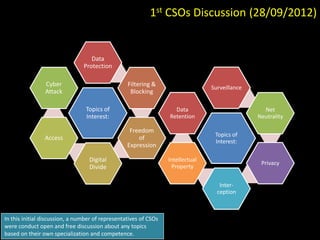
1st CSOs Discussion (28/09/2012)


                                   Data
                                Protection

                Cyber                             Filtering &                    Surveillance
                Attack                             Blocking

                                 Topics of                          Data                          Net
                                 Interest:                        Retention                     Neutrality

                                                   Freedom
                                                                                  Topics of
                Access                                of
                                                                                  Interest:
                                                  Expression

                                  Digital                         Intellectual
                                                                                                 Privacy
                                  Divide                           Property

                                                                                    Inter-
                                                                                   ception


In this initial discussion, a number of representatives of CSOs
were conduct open and free discussion about any topics
based on their own specialization and competence.
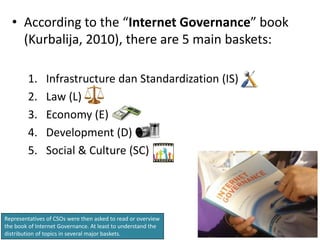
• According to the “Internet Governance” book
    (Kurbalija, 2010), there are 5 main baskets:

        1.     Infrastructure dan Standardization (IS)
        2.     Law (L)
        3.     Economy (E)
        4.     Development (D)
        5.     Social & Culture (SC)


Representatives of CSOs were then asked to read or overview
the book of Internet Governance. At least to understand the
distribution of topics in several major baskets.
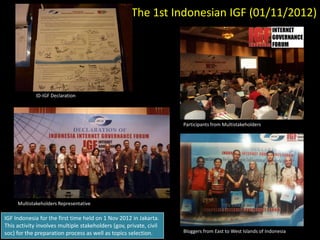
The 1st Indonesian IGF (01/11/2012)


             ID-IGF Declaration


                                                                    Participants from Multistakeholders


     Multistakeholders Representative

IGF Indonesia for the first time held on 1 Nov 2012 in Jakarta.
This activity involves multiple stakeholders (gov, private, civil
soc) for the preparation process as well as topics selection.       Bloggers from East to West Islands of Indonesia
Indonesian CSOs Network for Internet Governance
             (ID-CONFIG) launched at 12/12/12
ID-CONFIG is a forum in Indonesia on Internet Governance which aims to facilitate
information exchange among its members. ID-CONFIG's main perspectives are freedom of
online expression and human rights. One of the short term goals for ID-CONFIG is to
facilitate and take an active part in communication, collaboration and communication with
other related stakeholders as mandated in IGF which consists of civil society, private sector
and government. ID-CONFIG is proactively exert the effort to drive transparent and
accountable dialogue among related stakeholders. The overall goal of ID-CONFIG is to
improve Internet Governance in Indonesia with substantial involvement of all the
stakeholders. The establishment of ID-CONFIG as a forum was initiated by ELSAM, ICT Watch,
CIPG and Hivos with the mandate to include civil society organizations that have interest to
be involved substantially in the internet governance process. Right after its establishment,
ID-CONFIG engaged other relevant civil society organizations to take a part to join this forum.
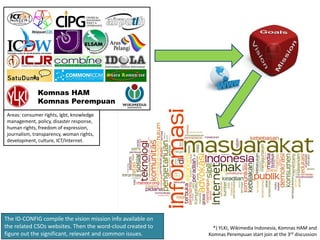
Komnas HAM
             Komnas Perempuan
Areas: consumer rights, lgbt, knowledge
management, policy, disaster response,
human rights, freedom of expression,
journalism, transparency, woman rights,
development, culture, ICT/Internet.


The ID-CONFIG compile the vision mission info available on
the related CSOs websites. Then the word-cloud created to      *) YLKI, Wikimedia Indonesia, Komnas HAM and
figure out the significant, relevant and common issues.      Komnas Perempuan start join at the 3rd discussion
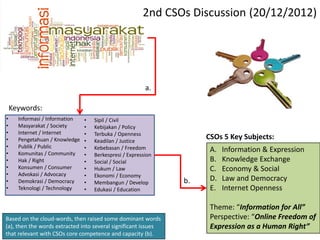
2nd CSOs Discussion (20/12/2012)


                                                         a.

    Keywords:
•     Informasi / Information   •   Sipil / Civil
•     Masyarakat / Society      •   Kebijakan / Policy
•     Internet / Internet       •   Terbuka / Openness
•     Pengetahuan / Knowledge   •   Keadilan / Justice
                                                                     CSOs 5 Key Subjects:
•     Publik / Public           •   Kebebasan / Freedom
•     Komunitas / Community
                                                                      A.   Information & Expression
                                •   Berkespresi / Expression
•     Hak / Right               •   Social / Social                   B.   Knowledge Exchange
•     Konsumen / Consumer       •   Hukum / Law                       C.   Economy & Social
•     Advokasi / Advocacy       •   Ekonomi / Economy
•     Demokrasi / Democracy     •   Membangun / Develop         b.    D.   Law and Democracy
•     Teknologi / Technology    •   Edukasi / Education               E.   Internet Openness

                                                                      Theme: “Information for All”
Based on the cloud-words, then raised some dominant words             Perspective: “Online Freedom of
(a), then the words extracted into several significant issues         Expression as a Human Right”
that relevant with CSOs core competence and capacity (b).
CSOs 5 Key Subjects:
       A.   Information & Expression
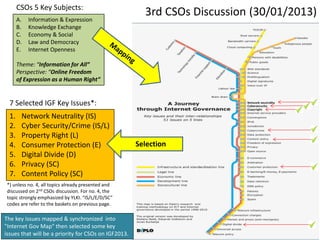
                                                        3rd CSOs Discussion (30/01/2013)
       B.   Knowledge Exchange
       C.   Economy & Social
       D.   Law and Democracy
       E.   Internet Openness

       Theme: “Information for All”
       Perspective: “Online Freedom
       of Expression as a Human Right”


  7 Selected IGF Key Issues*:
  1.    Network Neutrality (IS)
  2.    Cyber Security/Crime (IS/L)
  3.    Property Right (L)
  4.    Consumer Protection (E)                       Selection
  5.    Digital Divide (D)
  6.    Privacy (SC)
  7.    Content Policy (SC)
 *) unless no. 4, all topics already presented and
 discussed on 2nd CSOs discussion. For no. 4, the
 topic strongly emphasized by YLKI. “IS/L/E/D/SC”
 codes are refer to the baskets on previous page.

The key issues mapped & synchronized into
"Internet Gov Map" then selected some key
issues that will be a priority for CSOs on IGF2013.
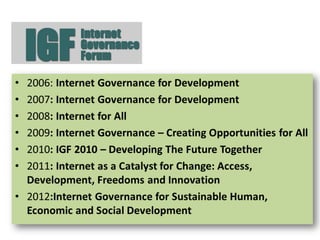
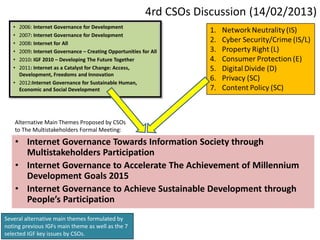
4rd CSOs Discussion (14/02/2013)


    Alternative Main Themes Proposed by CSOs
    to The Multistakeholders Formal Meeting:

    • Internet Governance Towards Information Society through
      Multistakeholders Participation
    • Internet Governance to Accelerate The Achievement of Millennium
      Development Goals 2015
    • Internet Governance to Achieve Sustainable Development through
      People’s Participation
Several alternative main themes formulated by
noting previous IGFs main theme as well as the 7
selected IGF key issues by CSOs.
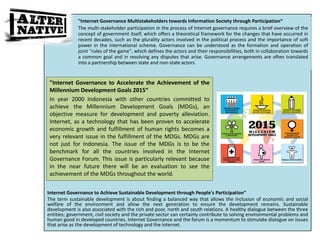
"Internet Governance Multistakeholders towards Information Society through Participation“
              The multi-stakeholder participation in the process of Internet governance requires a brief overview of the
              concept of government itself, which offers a theoretical framework for the changes that have occurred in
              recent decades, such as the plurality actors involved in the political process and the importance of soft
              power in the international scheme. Governance can be understood as the formation and operation of
              joint "rules of the game", which defines the actors and their responsibilities, both in collaboration towards
              a common goal and in resolving any disputes that arise. Governance arrangements are often translated
              into a partnership between state and non-state actors.


 "Internet Governance to Accelerate the Achievement of the
 Millennium Development Goals 2015“
 In year 2000 Indonesia with other countries committed to
 achieve the Millennium Development Goals (MDGs), an
 objective measure for development and poverty alleviation.
 Internet, as a technology that has been proven to accelerate
 economic growth and fulfillment of human rights becomes a
 very relevant issue in the fulfillment of the MDGs. MDGs are
 not just for Indonesia. The issue of the MDGs is to be the
 benchmark for all the countries involved in the Internet
 Governance Forum. This issue is particularly relevant because
 in the near future there will be an evaluation to see the
“achievement of the MDGs throughout the world.


Internet Governance to Achieve Sustainable Development through People's Participation"
The term sustainable development is about finding a balanced way that allows the inclusion of economic and social
welfare of the environment and allow the next generation to ensure the development remains. Sustainable
development is also associated with the rich and poor, north and south relations. A healthy dialogue between the three
entities; government, civil society and the private sector can certainly contribute to solving environmental problems and
human good in developed countries. Internet Governance and the forum is a momentum to stimulate dialogue on issues
that arise as the development of technology and the internet.
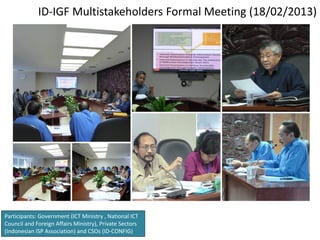
ID-IGF Multistakeholders Formal Meeting (18/02/2013)


Participants: Government (ICT Ministry , National ICT
Council and Foreign Affairs Ministry), Private Sectors
(Indonesian ISP Association) and CSOs (ID-CONFIG)
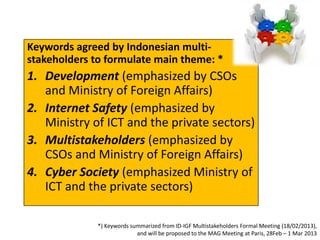
Keywords agreed by Indonesian multi-
stakeholders to formulate main theme: *
1. Development (emphasized by CSOs
   and Ministry of Foreign Affairs)
2. Internet Safety (emphasized by
   Ministry of ICT and the private sectors)
3. Multistakeholders (emphasized by
   CSOs and Ministry of Foreign Affairs)
4. Cyber Society (emphasized Ministry of
   ICT and the private sectors)

              *) Keywords summarized from ID-IGF Multistakeholders Formal Meeting (18/02/2013),
                            and will be proposed to the MAG Meeting at Paris, 28Feb – 1 Mar 2013
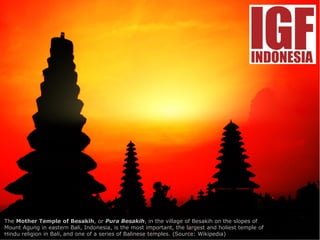
The Mother Temple of Besakih, or Pura Besakih, in the village of Besakih on the slopes of
Mount Agung in eastern Bali, Indonesia, is the most important, the largest and holiest temple of
Hindu religion in Bali, and one of a series of Balinese temples. (Source: Wikipedia)

Indonesian CSOs for IGF2013

  • 1.
    How The IndonesianCivil Society Organizations (CSOs) Formulate 7 Key Issues and 3 Alternative Main Themes for #IGF2013 facilitated by: ID-CONFIG email: info@id-config.org | web: www.id-config.org This is a living document. Version 6 / February 21st, 2013
  • 2.
    • The InternetGovernance Forum (IGF) is a multi- stakeholder forum for policy dialogue on issues of Internet governance. It brings together all stakeholders in the Internet governance debate, whether they represent governments, the private sector or civil society, including the technical and academic community, on an equal basis and through an open and inclusive process. The establishment of the IGF was formally announced by the United Nations Secretary-General in July 2006 and it was first convened in October–November 2006. * *) http://en.wikipedia.org/wiki/Internet_Governance_Forum
  • 3.
    1st CSOs Discussion(28/09/2012) Data Protection Cyber Filtering & Surveillance Attack Blocking Topics of Data Net Interest: Retention Neutrality Freedom Topics of Access of Interest: Expression Digital Intellectual Privacy Divide Property Inter- ception In this initial discussion, a number of representatives of CSOs were conduct open and free discussion about any topics based on their own specialization and competence.
  • 4.
    • According tothe “Internet Governance” book (Kurbalija, 2010), there are 5 main baskets: 1. Infrastructure dan Standardization (IS) 2. Law (L) 3. Economy (E) 4. Development (D) 5. Social & Culture (SC) Representatives of CSOs were then asked to read or overview the book of Internet Governance. At least to understand the distribution of topics in several major baskets.
  • 5.
    The 1st IndonesianIGF (01/11/2012) ID-IGF Declaration Participants from Multistakeholders Multistakeholders Representative IGF Indonesia for the first time held on 1 Nov 2012 in Jakarta. This activity involves multiple stakeholders (gov, private, civil soc) for the preparation process as well as topics selection. Bloggers from East to West Islands of Indonesia
  • 6.
    Indonesian CSOs Networkfor Internet Governance (ID-CONFIG) launched at 12/12/12 ID-CONFIG is a forum in Indonesia on Internet Governance which aims to facilitate information exchange among its members. ID-CONFIG's main perspectives are freedom of online expression and human rights. One of the short term goals for ID-CONFIG is to facilitate and take an active part in communication, collaboration and communication with other related stakeholders as mandated in IGF which consists of civil society, private sector and government. ID-CONFIG is proactively exert the effort to drive transparent and accountable dialogue among related stakeholders. The overall goal of ID-CONFIG is to improve Internet Governance in Indonesia with substantial involvement of all the stakeholders. The establishment of ID-CONFIG as a forum was initiated by ELSAM, ICT Watch, CIPG and Hivos with the mandate to include civil society organizations that have interest to be involved substantially in the internet governance process. Right after its establishment, ID-CONFIG engaged other relevant civil society organizations to take a part to join this forum.
  • 7.
    Komnas HAM Komnas Perempuan Areas: consumer rights, lgbt, knowledge management, policy, disaster response, human rights, freedom of expression, journalism, transparency, woman rights, development, culture, ICT/Internet. The ID-CONFIG compile the vision mission info available on the related CSOs websites. Then the word-cloud created to *) YLKI, Wikimedia Indonesia, Komnas HAM and figure out the significant, relevant and common issues. Komnas Perempuan start join at the 3rd discussion
  • 8.
    2nd CSOs Discussion(20/12/2012) a. Keywords: • Informasi / Information • Sipil / Civil • Masyarakat / Society • Kebijakan / Policy • Internet / Internet • Terbuka / Openness • Pengetahuan / Knowledge • Keadilan / Justice CSOs 5 Key Subjects: • Publik / Public • Kebebasan / Freedom • Komunitas / Community A. Information & Expression • Berkespresi / Expression • Hak / Right • Social / Social B. Knowledge Exchange • Konsumen / Consumer • Hukum / Law C. Economy & Social • Advokasi / Advocacy • Ekonomi / Economy • Demokrasi / Democracy • Membangun / Develop b. D. Law and Democracy • Teknologi / Technology • Edukasi / Education E. Internet Openness Theme: “Information for All” Based on the cloud-words, then raised some dominant words Perspective: “Online Freedom of (a), then the words extracted into several significant issues Expression as a Human Right” that relevant with CSOs core competence and capacity (b).
  • 9.
    CSOs 5 KeySubjects: A. Information & Expression 3rd CSOs Discussion (30/01/2013) B. Knowledge Exchange C. Economy & Social D. Law and Democracy E. Internet Openness Theme: “Information for All” Perspective: “Online Freedom of Expression as a Human Right” 7 Selected IGF Key Issues*: 1. Network Neutrality (IS) 2. Cyber Security/Crime (IS/L) 3. Property Right (L) 4. Consumer Protection (E) Selection 5. Digital Divide (D) 6. Privacy (SC) 7. Content Policy (SC) *) unless no. 4, all topics already presented and discussed on 2nd CSOs discussion. For no. 4, the topic strongly emphasized by YLKI. “IS/L/E/D/SC” codes are refer to the baskets on previous page. The key issues mapped & synchronized into "Internet Gov Map" then selected some key issues that will be a priority for CSOs on IGF2013.
  • 11.
    4rd CSOs Discussion(14/02/2013) Alternative Main Themes Proposed by CSOs to The Multistakeholders Formal Meeting: • Internet Governance Towards Information Society through Multistakeholders Participation • Internet Governance to Accelerate The Achievement of Millennium Development Goals 2015 • Internet Governance to Achieve Sustainable Development through People’s Participation Several alternative main themes formulated by noting previous IGFs main theme as well as the 7 selected IGF key issues by CSOs.
  • 12.
    "Internet Governance Multistakeholderstowards Information Society through Participation“ The multi-stakeholder participation in the process of Internet governance requires a brief overview of the concept of government itself, which offers a theoretical framework for the changes that have occurred in recent decades, such as the plurality actors involved in the political process and the importance of soft power in the international scheme. Governance can be understood as the formation and operation of joint "rules of the game", which defines the actors and their responsibilities, both in collaboration towards a common goal and in resolving any disputes that arise. Governance arrangements are often translated into a partnership between state and non-state actors. "Internet Governance to Accelerate the Achievement of the Millennium Development Goals 2015“ In year 2000 Indonesia with other countries committed to achieve the Millennium Development Goals (MDGs), an objective measure for development and poverty alleviation. Internet, as a technology that has been proven to accelerate economic growth and fulfillment of human rights becomes a very relevant issue in the fulfillment of the MDGs. MDGs are not just for Indonesia. The issue of the MDGs is to be the benchmark for all the countries involved in the Internet Governance Forum. This issue is particularly relevant because in the near future there will be an evaluation to see the “achievement of the MDGs throughout the world. Internet Governance to Achieve Sustainable Development through People's Participation" The term sustainable development is about finding a balanced way that allows the inclusion of economic and social welfare of the environment and allow the next generation to ensure the development remains. Sustainable development is also associated with the rich and poor, north and south relations. A healthy dialogue between the three entities; government, civil society and the private sector can certainly contribute to solving environmental problems and human good in developed countries. Internet Governance and the forum is a momentum to stimulate dialogue on issues that arise as the development of technology and the internet.
  • 13.
    ID-IGF Multistakeholders FormalMeeting (18/02/2013) Participants: Government (ICT Ministry , National ICT Council and Foreign Affairs Ministry), Private Sectors (Indonesian ISP Association) and CSOs (ID-CONFIG)
  • 14.
    Keywords agreed byIndonesian multi- stakeholders to formulate main theme: * 1. Development (emphasized by CSOs and Ministry of Foreign Affairs) 2. Internet Safety (emphasized by Ministry of ICT and the private sectors) 3. Multistakeholders (emphasized by CSOs and Ministry of Foreign Affairs) 4. Cyber Society (emphasized Ministry of ICT and the private sectors) *) Keywords summarized from ID-IGF Multistakeholders Formal Meeting (18/02/2013), and will be proposed to the MAG Meeting at Paris, 28Feb – 1 Mar 2013
  • 15.
    The Mother Templeof Besakih, or Pura Besakih, in the village of Besakih on the slopes of Mount Agung in eastern Bali, Indonesia, is the most important, the largest and holiest temple of Hindu religion in Bali, and one of a series of Balinese temples. (Source: Wikipedia)