Timothy Holborn
3 February 2018
Committee Secretary
Parliamentary Joint Committee on Law Enforcement
Parliament House, Canberra. Australia.
To Whom it may concern;
The committee has asked for input pursuant to the impact of new and emerging information and
communications technology; and has made particular references thereafter, inclusive to additional
documents whereby a focus of considerations pursuant to terrorism and ‘the dark web’, are well highlighted.
I have been working within the ‘Semantic Web’ communities, led by W3C (WebScience, and others), with
those such as Tim Berners Lee, for several years; developing means to ‘fix the web’ via ‘social web’, A.I. and
‘digital identity’ related open-standards technologies. I first started in on this body of work from 2000,
2
seeking to define the tools for a knowledge banking industry. Works include modern & innovative ways of
developing decentralised applications & infrastructure , support ‘data retention’ and the means to
34
rationalise ‘social contracts’ alongside other ‘tamper evident’, ‘digital personhood’ related electronic
instruments and contracts; We seek to sig animarum (to “sign souls”) with data; as to maintaining our means to
be consistent with local and international principles defined by way of AU Law, UN Charters, OECD, etc.
With respect to the nature and importance of this public forum; In-part (as a citizen), I consider topics that
include but are not limited to,
• Our domestic ICT foundations for National Security
• Socio-Economic Governance policies (inclusive to taxation & ‘knowledge economy’)
• Infrastructure; both domestically and abroad
• Cooperative arrangements with Foreign Security Services, Governments and their contractors
As Australians; We celebrate and seek to protect many domestic, cultural values; such as, Universal Access to
Education, Medical Care and Social Security. Our system of democracy, and the characteristics provided by
it are often different to the lives and environments of foreign nationals. Yet as our borders become porous in
the advent of a revolution by way of an ‘info sphere’ our society faces many challenges and indeed also;
opportunities, as our system of law furnishes opportunity for, and in the interest of our community. Whereas
our system of democracy has developed the notions pertaining to the application of our system of
http://www.wired.co.uk/article/the-webs-greatest-minds-on-how-to-fix-it
1
https://www.w3.org/Consortium/Patent-Policy/
2
dig.csail.mit.edu/2014/Papers/presbrey/thesis.pdf
3
https://solid.mit.edu/
4
Page 1
The impact of new and emerging information and communications technology
Submission 22
democracy, bringing with it virtues such as ‘rule of law ’ at its foundations; as to provide our sense of ‘legal
5
personhood’, the means in which this has been provided support and apparatus as to extend into the digital
domain, the info sphere; and the means in which these unmet challenges are subsequently the subject of
appropriations as to seek redress, brings with it many significant challenges.
Whilst it may be the case that our Federal Government may enter into ‘intelligence related’ agreements with
foreign governments to address their ‘high level’ needs, it seems to me that these arrangements do poorly,
and perhaps cost-prohibitively serve the needs of Australian Citizens for an ever increasing fray of use-cases;
linking the needs of ‘digital personhood’ unto law, with the means to enforce its prescribed values.
These characteristics; in addition to circumstances in which ‘white collar crimes’ are on the increase, are
often known to have solutions; such as, the issue of access to corporate information not being as accessible as
demonstrated by New Zealand . Yet illustratively in another example, even though an investigation into the
6
Victorian Police’s ‘LEAP’ platform was undertaken by the OPI more than a decade ago making various
7
recommendations that may, perhaps, be reasonably summarised as a recommendation to have this platform
replaced; it is still in operation, providing false statements about important circumstances pertaining to the
lives of citizens in a manner that may well lead to substantive damage. When paired with legal aid policies
(access to justice) the threat becomes means in which crime (particularly “white collar crime”) may be
rendered meaningful assistance, on a systemic basis, in which victims are punished for seeking help, their
records sullied with false statements, all without available remedy; whilst the future of law enforcement may
in-turn seek to link records of poor hygiene with Artificial Intelligence capabilities; this in-turn bring with it,
significant grounds for concern; and overwhelmingly also, socio-economic risk.
Whilst it is the case that various law-enforcement agencies provide community service upon applied
specialised territories of jurisdictional responsibility; the means for each of these services to communicate
with one-another when a ‘first responder’ is notified of a circumstance that may pertain to unlawful conduct;
but not within the purview of the specified agency of law-enforcement; or indeed the role of a specified
officer, it has been shown to require significant improvement and innovation as to ensure persons seeking law
enforcement and means for assistance to be rendered for vulnerable persons; is provided service that ensures
it is with good judgement, a person seeking safety be encouraged to seek assistance from law-enforcement.
As there is already a clear mandate to update platforms relied upon by law enforcement services, the clear
opportunity present is to incorporate the needs of broader civil society, in the means for which Law
Enforcement Agencies set-about defining their own ‘knowledge banks’, and the means in which the
production of these modern platforms provide maximum socioeconomic through the design and use of ICT
by the law enforcement community and towards the Australian interest, more generally.
https://www.gizmodo.com.au/2017/07/everything-that-went-down-at-malcolm-turnbulls-encryption-law-announcement/
5
https://companies-register.companiesoffice.govt.nz/
6
http://www.ibac.vic.gov.au/docs/default-source/reviews/opi-investigations/investigation-into-victoria-police-management-of-leap
7
Page 2
The impact of new and emerging information and communications technology
Submission 22
CONSIDERATIONS RE: CRYPTOGRAPHY
I am significantly concerned by the apparent lack of domestic strong cryptography services. Cryptography
may be used in many ways; the most important application, being the means to improve ‘tamper evidence’
and attribution, to communications activities and any data created in relation to computational events.
Without strong cryptography, the means to know ‘who did what’, is lost. This consideration is in-turn related
to the means in which to form sovereign, trusted web-services, built upon cryptography enabled services at
multiple layers of the ISO Model that include; but are not limited to, the elements involved in managing
8
connectivity to web-services in addition to the means in which to trust the information services themselves,
9
via works illustrated from semantic web references dating back to 2003 through to more modern examples,
0
such as HTTPA and HTTP Signatures , which consistently seek to relate an actors ‘web-id ’s’, to trusted
2 3
verifiable claims made in relation to them. Sovereign Cryptography services are an essential ingredient to
4
the means in which society and law-enforcement is made capable of trusting machine-readable records.
RDF , IDENTIFIERS, VERIFIABLE CLAIMS AND DIGITAL ACCOUNTABILITY
15
Whilst public discourse about the role of cryptography is often overly simplified, leading to the underlying
intent or consideration, becoming lost; similarly, to the representations of ‘digital identity’ where the
principles solutions being promoted; are rather, ‘digital identifiers’; and related ‘digital instruments’,
produced for the purpose of replacing industrial era alternatives. The industrialised age (pre-computing era
relational databases) were characterised by the means in which former ‘print’ (ie: licenses, certifications,
deeds, etc.) and ‘minting’ (ie: currencies, keys & seals) industries provided legal instruments; later, provided
organisational support through the development of database technologies used, internally, by various ‘persona
ficta’ to store, access and make accounts by way of internal ledgers; affairs pertaining to that particular legal
entity; now therefore, i would argue, the basis to all emerging issues pertaining to ICT is the means in which
modern systems are produced in consideration to the modern context of trusted and ‘tamper evident’
records and context of fiduciary responsibilities for all those whom any such records pertain.
Article 27 of the UDHR brings consideration to the responsibility of government to ensure technological
6
advancements do not asymmetrically benefit any particular community ordinance; where viable alternatives
may exist to do so in the interests of the public good. Amongst the more easily understood illustrations of
where government has been unable to address enormous opportunity; can illustrated by presenting use-cases.
https://www.webopedia.com/quick_ref/OSI_Layers.asp
8
http://www.internetsociety.org/articles/dane-taking-tls-authentication-next-level-using-dnssec
9
https://www.w3.org/2000/10/swap/doc/Trust
10
http://news.mit.edu/2014/whos-using-your-data-httpa-0613
11
https://tools.ietf.org/html/draft-cavage-http-signatures-09
12
https://www.w3.org/wiki/WebID
13
https://www.w3.org/2017/vc/WG/
14
https://www.w3.org/RDF/
15
http://www.un.org/en/universal-declaration-human-rights/
16
Page 3
The impact of new and emerging information and communications technology
Submission 22
LAW ENFORCEMENT: FINANCIAL AFFAIRS & A BUSINESS CASE FOR MACHINE READABLE DOCUMENTS
The means in which receipts and taxation records (such as payroll) are still provided via printed products;
whether they be thermally printed (susceptible to fading) or otherwise; rather than by way of a machine-
readable output, produced by database powered computational systems that internally storing records
digitally for internal use; which by implications, has led to the underlying circumstance in which public
monies have been unnecessarily spent in relation to the lifecycle of problems illustrated in the press and the
subject of otherwise unnecessary efforts by those involved in https://www.notmydebt.com.au/ . If citizens
maintained machine readable records, this problem would never had occurred, the expenditure never made;
much better circumstances ‘all round’, by seeking use of technology for; socioeconomic benefit, and the
means to significantly enhance our Law Enforcement, rapid and low-cost investigative capacities overall.
IMPROVING THE PERFORMANCE OF LAW ENFORCEMENT AGENCIES
Issues exhibited by the means in which law-enforcement systems and platforms fail to take advantage of Web
Technology Techniques, leading to problems that are means for reason for concern; such concerns include,
• The quality of the records produced by agents with the right to produce records on those systems; and,
• The means in which the subject of the records may contribute information they may have on-hand, in a
tamper-evident manner, from their electronic systems and accounts.
These issues threaten to simultaneously cause undue harm and significant expense to the law-abiding public,
whilst diminishing the capacity of law enforcement to be better equipped by law, to respond in a timely
manner to issues of a true and factual nature, facing citizens, whilst ensuring no matters are made worse.
CONSIDERATIONS OF FAMILY LAW
The socio-economic influence of family and domestic violence related law matters is known to be extensive,
and intergenerational significant. Whilst statistics in many of these areas are either untrustworthy and
otherwise unavailable; It is often the case that involved parties exhibit treatable mental health conditions.
Where otherwise ‘good people’, require government intervention and assistance; mistakes and failures can
diminish the means in which citizens economically participates, in a manner consistent with their capacity to
contribute to our society; on an inter generational scale, as would otherwise have been the case. Also
important, are considerations with respect to other forms of criminal activity are also likely to be first
identifiable by persons relating to those engaged in criminal activity; and making matters more interesting, is
the introduction of virtual assistance, listening for commands, in-turn become virtual witnesses to crime
7
being committed; whether or not the data is available to the device manufacturer, owner, or law
enforcement; extending the already widespread recording of data by way of smart devices (ie: phones).
http://edition.cnn.com/2016/12/28/tech/amazon-echo-alexa-bentonville-arkansas-murder-case-trnd/
17
Page 4
The impact of new and emerging information and communications technology
Submission 22
Therein; amongst our most humane duties, is the protection of (law abiding) women, children and men,
whose ancient role has been as a provider and protector; it is known that significant challenges exist in our
means to render meaningful support for ensuring the means for ‘wellness’ within the domestic realm of our
society, particularly those involving children and that policies pertaining to the means of doing so, is a
8
significant economic influence on government budgets and socio-economic health. Where ‘things are
wrong’, the sooner intervention and assistance can be appropriately and proportionately rendered, the better
the outcomes. Thereby ensuring our necessary foundations for making use of legal personhood; good mental
health and safety, alongside a behaviourally civic commitment to seek the same for others.
9
Now therefore; Whereas, It is currently the case that even emergency mental health services refer matters
pertaining to a volatile person to law enforcement for safety purposes; It is increasingly the case that law
enforcement are first responders and that the legal implications of these difficult circumstance is not in-
substantive in nature; as any such call for help, may have life threatening and/or life-long consequences.
Issues such as these are often not simply ‘instance based’, but rather long-term issues that bring with it, the
challenge of how to manage what should become a case-file; and the means in which ‘custodians’ manage
information from an array of sources (for an array of specified purpose); in the best interests of citizens.
• How can medical information (or lack thereof) be presented for appropriate consideration by law
enforcement workers? if misunderstandings / wrongful (inept) assumptions are stored, what is the impact?
• How can ‘digital evidence’, such as photos & metadata (ie: Timestamps & GPS coordinates, for safety
orders); If it is difficult to provide this directly via police; should a website service be available to report?
In most circumstances; whilst police may be called, when these events happen, police are unlikely to be there.
Without making use of data that is available; or providing the means for citizens to do so of their own free
will, in a manner that supports the means for any such data to be considered ‘evidence’; data still exists,
• How can telecommunications data be made available; whereas, it is capable of providing information as to
the whereabouts and activity of a device in connection to the device owner and/or others.
Where circumstances are misunderstood; leading to a failure to obtain proper and reasonable care when
seeking law enforcement assistance; how can matters be ‘cleared up’ as to quickly, reduce harm; where,
• A person is considered to exhibit symptoms of a mental health issue that it is known, they do not have
• Important issues not investigated. misunderstandings, incorrectly acted upon & recorded as ‘trusted’ info.
Claims considered false, later proven to be true, but no amendment to records made; or erroneously so.
digital records provided to (and from) citizens about a matter, improves the means in which the public can be
assured, the public expense of law enforcement services is not rendering meaningful assistance to criminals.
https://www.legislation.gov.au/Details/C2011A00189
18
https://en.wikipedia.org/wiki/Maslow%27s_hierarchy_of_needs
19
Page 5
The impact of new and emerging information and communications technology
Submission 22
IN CIVICS, THERE IS NO SUCH THING AS “TOO GOOD”
Whereas; the crimes act in Victoria considers many of the harmful outcomes that may be born by a lack of
diligence; including but not exclusive to, the considerations of negligence whereby, ’A person who by
negligence doing or omitting to do an act’ and that where systems are seemingly failing to provide sufficient
20
reporting to government as a result, which in-turn leads to circumstances such as a lack of access to justice
via legal aid or similar; which whilst perhaps reasonably unavailable due to statistically evaluated lack of
demand, that facts, are indeed facts; as such, Given the heavy burdens put upon law enforcement services,
That through the use of linked-data systems in relation these issues would dramatically improve civilian
outcomes; as may provide a well attributed, multi-stakeholder (‘claim authorities’) contributions, increasingly
overtime as to ensure civilians are supported in their means to participate in our system of democracy.
Rule of law; and related considerations needs law-enforcement officers specifically, to be supported,
2
cooperatively, collaboratively and with accountability as to ensure their actions render support towards our
safe and prosperous nation, that supports the growth and development of law abiding citizens to their fullest
capacity. Therein; It is equally the responsibility of the role of law enforcement, to be best equipped as to
provide service to citizens towards such ends; in a manner that is, accountable and free from all forms of
discrimination, alongside other manifest considerations as ascribed by law. Yet poor ICT investment brings
with it illustrated consideration, that without accessibility to law in an non-discriminatory fashion, the means
for law enforcement to; in association with their powers, accept the provision of data from citizens, and the
means for law enforcement is therefore able to protect the wellbeing of children and their future means, is
diminished. ICT provides enhanced means in which to better understand a circumstance; and where, this is
beyond the realm of jurisdiction for one organisation; Dismissal, upon that basis, needs to be discouraged.
As the facts of a matter may not be clear in the first instance; It is important ICT supports manifest ‘cases’.
This is particularly true for issues pertaining to ‘psychotic domestic violence’ perpetrators who should
reasonably be restricted from an array of professional and perhaps personal civil opportunities afforded to
those who do not display such forms of anti-social behaviour; yet if ICT does not tell the ‘truth’, the means
to protect persons from harm, whether it be a person with false records seeking help; or a person who
needed help in circumstances of false records being created, subsequently harming themselves and others.
EMERGING ISSUE: ‘WORLD SIDE WEBS’ & IOT
The concept of the ‘world side web’, is a term illustrated to me by David Lorenzini , Underpinning the
22
nuances brought about by advancements of capabilities by ‘internet connected things’ (“IoT”), ‘Artificial
Intelligence’ and related processing capabilities that are easily and readily accessible via API services made
available through international investments, in our local markets; by way of services that through the use of
http://classic.austlii.edu.au/au/legis/vic/consol_act/ca195882/s24.html
20
https://www.ruleoflaw.org.au/principles/
21
https://en.wikipedia.org/w/index.php?title=Keyhole,_Inc&oldid=733479836
22
Page 6
The impact of new and emerging information and communications technology
Submission 22
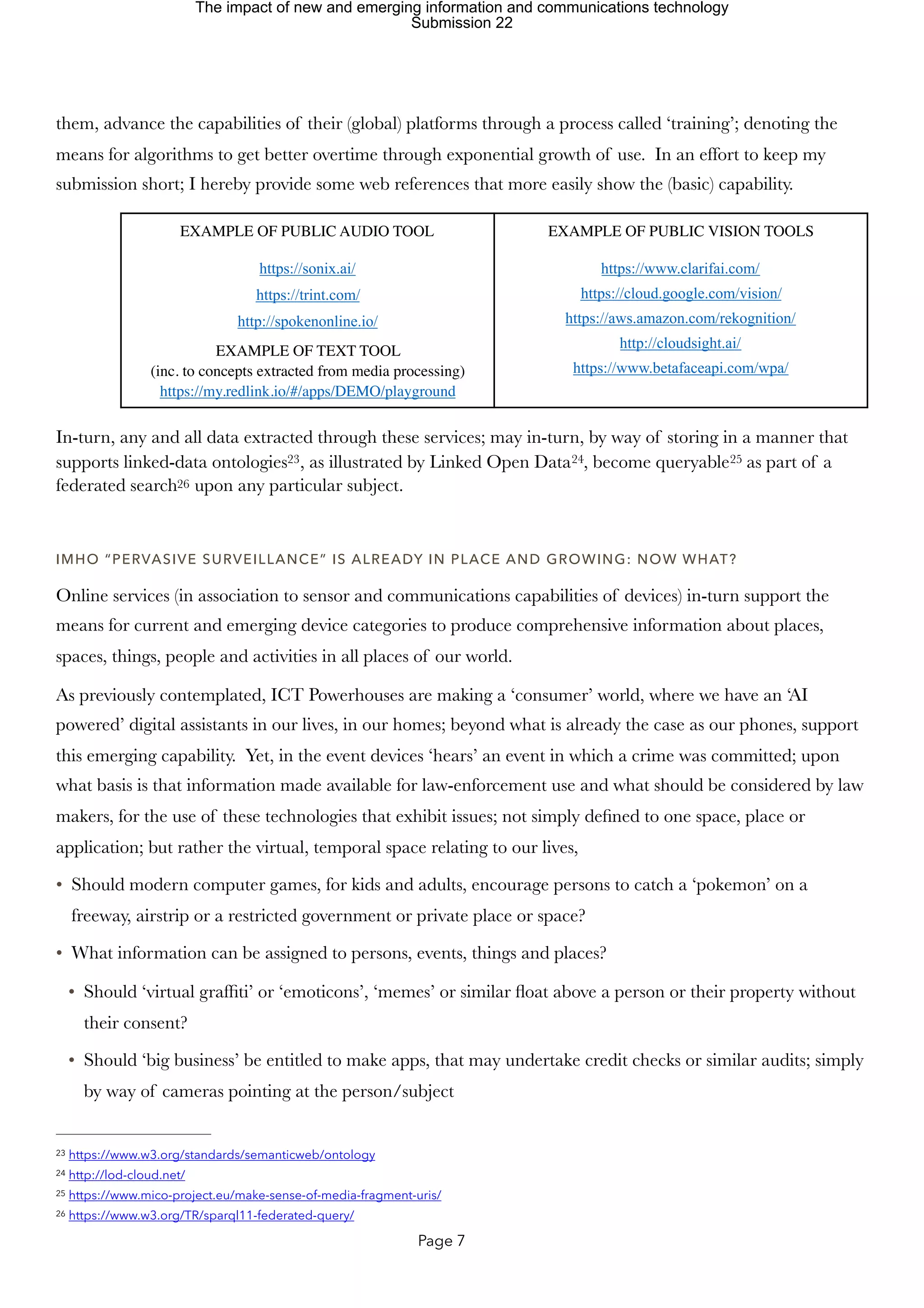
them, advance the capabilities of their (global) platforms through a process called ‘training’; denoting the
means for algorithms to get better overtime through exponential growth of use. In an effort to keep my
submission short; I hereby provide some web references that more easily show the (basic) capability.
In-turn, any and all data extracted through these services; may in-turn, by way of storing in a manner that
supports linked-data ontologies , as illustrated by Linked Open Data , become queryable as part of a
23 24 25
federated search upon any particular subject.
26
IMHO “PERVASIVE SURVEILLANCE” IS ALREADY IN PLACE AND GROWING: NOW WHAT?
Online services (in association to sensor and communications capabilities of devices) in-turn support the
means for current and emerging device categories to produce comprehensive information about places,
spaces, things, people and activities in all places of our world.
As previously contemplated, ICT Powerhouses are making a ‘consumer’ world, where we have an ‘AI
powered’ digital assistants in our lives, in our homes; beyond what is already the case as our phones, support
this emerging capability. Yet, in the event devices ‘hears’ an event in which a crime was committed; upon
what basis is that information made available for law-enforcement use and what should be considered by law
makers, for the use of these technologies that exhibit issues; not simply defined to one space, place or
application; but rather the virtual, temporal space relating to our lives,
• Should modern computer games, for kids and adults, encourage persons to catch a ‘pokemon’ on a
freeway, airstrip or a restricted government or private place or space?
• What information can be assigned to persons, events, things and places?
• Should ‘virtual graffiti’ or ‘emoticons’, ‘memes’ or similar float above a person or their property without
their consent?
• Should ‘big business’ be entitled to make apps, that may undertake credit checks or similar audits; simply
by way of cameras pointing at the person/subject
EXAMPLE OF PUBLIC AUDIO TOOL
https://sonix.ai/
https://trint.com/
http://spokenonline.io/
EXAMPLE OF TEXT TOOL
(inc. to concepts extracted from media processing)
https://my.redlink.io/#/apps/DEMO/playground
EXAMPLE OF PUBLIC VISION TOOLS
https://www.clarifai.com/
https://cloud.google.com/vision/
https://aws.amazon.com/rekognition/
http://cloudsight.ai/
https://www.betafaceapi.com/wpa/
https://www.w3.org/standards/semanticweb/ontology
23
http://lod-cloud.net/
24
https://www.mico-project.eu/make-sense-of-media-fragment-uris/
25
https://www.w3.org/TR/sparql11-federated-query/
26
Page 7
The impact of new and emerging information and communications technology
Submission 22
• Is the digital identification of things/places/spaces/persons, a commercial asset that may be
commercialised by an (international) commercial data controller in all instances?
• If organisations are recording phone-calls, for ‘quality assurance purposes’, is it reasonable that if this
forms a constituent of a legally relevent interaction (ie: commercial) that the means for consumers to
record, and produce transcripts be provided?
• Will sensors always track compliance with road rules; and if so, what by way of our laws needs to be
remodelled for non-autonomous vehicles which may be designed comply with this need, automatically.
• Under the relevent confidentiality related requirements of law in various fields, inclusive to that of
intellectual property; upon what basis is an agreement considered to have been maintained as to warrant
compliance to any such agreement; Are those in Executive Roles & Politics, Law, Military and their
families; required to abstain from both obtaining any such technology and denied the use of other things
in public alongside the implications for friends & family, where it is built into; homes, vehicles and cars?
Whereby the concept of ‘law enforcement’ may be considered in context that is provided sufficiently broad
definition; as to illustrate the machinations for ‘rule of law’, The considerations of concern with respect to
the ‘dark web’ and the means for an actor to successfully retain a life that is sufficiently ‘air-gapped’27
becomes increasingly, prohibitively expensive; the bigger issue, is upon what law is data provided governance.
A previous and non-exhaustive study showed , that overwhelmingly the ‘status quo’ is not Australia.
28
HOW CAN .AU LAW ENFORCEMENT ASSIST IN SEPARATING ‘DATA’ FROM ‘APPLICATIONS’?
Modern applications (ie: google docs or Microsoft word) rely upon an underlying storage service (ie:
documents stored by; google drive or similar). The opportunity that i have discussed with ‘internet elders’, is
to consider the 'terms of service agreements’, as to bind the agreements that pertain to ‘user data’, to the
users domicile; by which means issues may be addressed by Australian Law without significant expense.
Prior to the age of ‘cloud services’; the application (ie: Microsoft word) was distributed with its own
international ‘choice of law’ as to protect the application product itself by law; yet, the application of this
contract did not reasonably apply to the documents produced with the application. Thereafter, a lack of
clarity has developed as to comprehend whether, how and where a purchase is considered to be for a
product, rather than a sophisticated service-key as might distinguish a mobile phone (or IoT device), from its
operating system and any software based requirements put upon its use. Whilst an array of implications
may be considered thereafter; amongst the most important, is whether any act done in relation to that device
is considered to be done by way of international law, or local law. Are we Australian Citizens, with rights
and responsibilities as citizens; or are we simply ‘alien’ human resources for emerging knowledge economies.
https://en.wikipedia.org/wiki/Air_gap_(networking)
27
https://www.google.com/maps/d/edit?mid=1bHmB8_f7ASRHm97TwhZmmEQnTKU
28
Page 8
The impact of new and emerging information and communications technology
Submission 22
CONSIDERATION: THE CASE FOR EMPLOYING ELECTRONIC CONTRACTS
Therein; Systems currently used in relation to the practice of law and its enforcement, often do not explicitly
involve the ‘subject’ in the process of forging, storing and maintaining records pertaining a circumstance in
the need for law and its enforcement is involved. The result of this contractually overlooked series of
matters; means, The Additional expense incurred due to the ‘view’ being provided to our system of justice,
inclusive to law enforcement; data creation officers, who are not being furnished the benefits of review and
contribution by the subject/s of reports is considered to be significant; in both financial and outcome related,
forms of evaluation. As such, the threat is that our ‘law enforcement’ may form an unnecessarily narrow
view based upon poor use of ICT as to address any considerations either internally or by way of our courts
systems, and that issues that may otherwise be evaluated through the full an unencumbered use of
technology, become more costly; and that the practice of law enforcement may in-turn unnecessarily
transpose cost upon victims. Should the means to address ‘digital citizenship’ be established;
• The means for citizens to participate in law-enforcement improves in a manner consistent with our
technological capacities as a community; and,
• The means to rapidly clarify a basis for consensus, without further burdens upon the courts; is therefore,
significantly improved and in-so-doing, furnishing meaningful benefit to those requiring timely intervention
by the courts where it is imperative for the safety, health and wellbeing of citizens.
THE ROLE OF LAW ENFORCEMENT TECHNOLOGY FOR INNOVATION AND ECONOMIC DEVELOPMENT.
Throughout my document, i have provided reference to issues; that include,
• Accessibility and means for law-enforcement community to provide available remedy for criminal activity.
• Means to enhance our national capacity for sustainable economic (GDP) growth
• Relationships between law enforcement and mental health for those who required emergency medical care
• Economic consequence of leaving persons without access to justice as to diminish their economic capacity.
• Corporate malfeasance, (‘white collar crime’) whilst only somewhat reference, is a significant criminal issue.
therein; as may be found via semantics, the mix of crypto-currencies & online communities; where work too
often underpaid and where complex corporate structures can be established internationally, whilst some
regions are forming frameworks for ‘e-residency ’; Consideration that include ‘upon which system of law, is
29
a crime committed online?’, As ‘economically capable’ actors exploit our ‘online’ presence; as to exploit
outmoded policies operated in Australia; can in-effect be remedied by a relatively simple idea.
Update our trusted framework of being Australian, to support online ‘knowledge banking’ (and ‘bankers”);
so that we, as citizens, are encouraged by law, to participate & share in the responsibilities of maintaining our
‘rule of law’ and the means in which we go about forming our ledgers of ‘lived experience’, as Australians.
https://e-resident.gov.ee/
29
Page 9
The impact of new and emerging information and communications technology
Submission 22
g
The impact of new and emerging information and communications technology
Submission 22

feb 2018 - Sub22 - The impact of new and emerging information and communications technology

  • 1.
    Timothy Holborn 3 February2018 Committee Secretary Parliamentary Joint Committee on Law Enforcement Parliament House, Canberra. Australia. To Whom it may concern; The committee has asked for input pursuant to the impact of new and emerging information and communications technology; and has made particular references thereafter, inclusive to additional documents whereby a focus of considerations pursuant to terrorism and ‘the dark web’, are well highlighted. I have been working within the ‘Semantic Web’ communities, led by W3C (WebScience, and others), with those such as Tim Berners Lee, for several years; developing means to ‘fix the web’ via ‘social web’, A.I. and ‘digital identity’ related open-standards technologies. I first started in on this body of work from 2000, 2 seeking to define the tools for a knowledge banking industry. Works include modern & innovative ways of developing decentralised applications & infrastructure , support ‘data retention’ and the means to 34 rationalise ‘social contracts’ alongside other ‘tamper evident’, ‘digital personhood’ related electronic instruments and contracts; We seek to sig animarum (to “sign souls”) with data; as to maintaining our means to be consistent with local and international principles defined by way of AU Law, UN Charters, OECD, etc. With respect to the nature and importance of this public forum; In-part (as a citizen), I consider topics that include but are not limited to, • Our domestic ICT foundations for National Security • Socio-Economic Governance policies (inclusive to taxation & ‘knowledge economy’) • Infrastructure; both domestically and abroad • Cooperative arrangements with Foreign Security Services, Governments and their contractors As Australians; We celebrate and seek to protect many domestic, cultural values; such as, Universal Access to Education, Medical Care and Social Security. Our system of democracy, and the characteristics provided by it are often different to the lives and environments of foreign nationals. Yet as our borders become porous in the advent of a revolution by way of an ‘info sphere’ our society faces many challenges and indeed also; opportunities, as our system of law furnishes opportunity for, and in the interest of our community. Whereas our system of democracy has developed the notions pertaining to the application of our system of http://www.wired.co.uk/article/the-webs-greatest-minds-on-how-to-fix-it 1 https://www.w3.org/Consortium/Patent-Policy/ 2 dig.csail.mit.edu/2014/Papers/presbrey/thesis.pdf 3 https://solid.mit.edu/ 4 Page 1 The impact of new and emerging information and communications technology Submission 22
  • 2.
    democracy, bringing withit virtues such as ‘rule of law ’ at its foundations; as to provide our sense of ‘legal 5 personhood’, the means in which this has been provided support and apparatus as to extend into the digital domain, the info sphere; and the means in which these unmet challenges are subsequently the subject of appropriations as to seek redress, brings with it many significant challenges. Whilst it may be the case that our Federal Government may enter into ‘intelligence related’ agreements with foreign governments to address their ‘high level’ needs, it seems to me that these arrangements do poorly, and perhaps cost-prohibitively serve the needs of Australian Citizens for an ever increasing fray of use-cases; linking the needs of ‘digital personhood’ unto law, with the means to enforce its prescribed values. These characteristics; in addition to circumstances in which ‘white collar crimes’ are on the increase, are often known to have solutions; such as, the issue of access to corporate information not being as accessible as demonstrated by New Zealand . Yet illustratively in another example, even though an investigation into the 6 Victorian Police’s ‘LEAP’ platform was undertaken by the OPI more than a decade ago making various 7 recommendations that may, perhaps, be reasonably summarised as a recommendation to have this platform replaced; it is still in operation, providing false statements about important circumstances pertaining to the lives of citizens in a manner that may well lead to substantive damage. When paired with legal aid policies (access to justice) the threat becomes means in which crime (particularly “white collar crime”) may be rendered meaningful assistance, on a systemic basis, in which victims are punished for seeking help, their records sullied with false statements, all without available remedy; whilst the future of law enforcement may in-turn seek to link records of poor hygiene with Artificial Intelligence capabilities; this in-turn bring with it, significant grounds for concern; and overwhelmingly also, socio-economic risk. Whilst it is the case that various law-enforcement agencies provide community service upon applied specialised territories of jurisdictional responsibility; the means for each of these services to communicate with one-another when a ‘first responder’ is notified of a circumstance that may pertain to unlawful conduct; but not within the purview of the specified agency of law-enforcement; or indeed the role of a specified officer, it has been shown to require significant improvement and innovation as to ensure persons seeking law enforcement and means for assistance to be rendered for vulnerable persons; is provided service that ensures it is with good judgement, a person seeking safety be encouraged to seek assistance from law-enforcement. As there is already a clear mandate to update platforms relied upon by law enforcement services, the clear opportunity present is to incorporate the needs of broader civil society, in the means for which Law Enforcement Agencies set-about defining their own ‘knowledge banks’, and the means in which the production of these modern platforms provide maximum socioeconomic through the design and use of ICT by the law enforcement community and towards the Australian interest, more generally. https://www.gizmodo.com.au/2017/07/everything-that-went-down-at-malcolm-turnbulls-encryption-law-announcement/ 5 https://companies-register.companiesoffice.govt.nz/ 6 http://www.ibac.vic.gov.au/docs/default-source/reviews/opi-investigations/investigation-into-victoria-police-management-of-leap 7 Page 2 The impact of new and emerging information and communications technology Submission 22
  • 3.
    CONSIDERATIONS RE: CRYPTOGRAPHY Iam significantly concerned by the apparent lack of domestic strong cryptography services. Cryptography may be used in many ways; the most important application, being the means to improve ‘tamper evidence’ and attribution, to communications activities and any data created in relation to computational events. Without strong cryptography, the means to know ‘who did what’, is lost. This consideration is in-turn related to the means in which to form sovereign, trusted web-services, built upon cryptography enabled services at multiple layers of the ISO Model that include; but are not limited to, the elements involved in managing 8 connectivity to web-services in addition to the means in which to trust the information services themselves, 9 via works illustrated from semantic web references dating back to 2003 through to more modern examples, 0 such as HTTPA and HTTP Signatures , which consistently seek to relate an actors ‘web-id ’s’, to trusted 2 3 verifiable claims made in relation to them. Sovereign Cryptography services are an essential ingredient to 4 the means in which society and law-enforcement is made capable of trusting machine-readable records. RDF , IDENTIFIERS, VERIFIABLE CLAIMS AND DIGITAL ACCOUNTABILITY 15 Whilst public discourse about the role of cryptography is often overly simplified, leading to the underlying intent or consideration, becoming lost; similarly, to the representations of ‘digital identity’ where the principles solutions being promoted; are rather, ‘digital identifiers’; and related ‘digital instruments’, produced for the purpose of replacing industrial era alternatives. The industrialised age (pre-computing era relational databases) were characterised by the means in which former ‘print’ (ie: licenses, certifications, deeds, etc.) and ‘minting’ (ie: currencies, keys & seals) industries provided legal instruments; later, provided organisational support through the development of database technologies used, internally, by various ‘persona ficta’ to store, access and make accounts by way of internal ledgers; affairs pertaining to that particular legal entity; now therefore, i would argue, the basis to all emerging issues pertaining to ICT is the means in which modern systems are produced in consideration to the modern context of trusted and ‘tamper evident’ records and context of fiduciary responsibilities for all those whom any such records pertain. Article 27 of the UDHR brings consideration to the responsibility of government to ensure technological 6 advancements do not asymmetrically benefit any particular community ordinance; where viable alternatives may exist to do so in the interests of the public good. Amongst the more easily understood illustrations of where government has been unable to address enormous opportunity; can illustrated by presenting use-cases. https://www.webopedia.com/quick_ref/OSI_Layers.asp 8 http://www.internetsociety.org/articles/dane-taking-tls-authentication-next-level-using-dnssec 9 https://www.w3.org/2000/10/swap/doc/Trust 10 http://news.mit.edu/2014/whos-using-your-data-httpa-0613 11 https://tools.ietf.org/html/draft-cavage-http-signatures-09 12 https://www.w3.org/wiki/WebID 13 https://www.w3.org/2017/vc/WG/ 14 https://www.w3.org/RDF/ 15 http://www.un.org/en/universal-declaration-human-rights/ 16 Page 3 The impact of new and emerging information and communications technology Submission 22
  • 4.
    LAW ENFORCEMENT: FINANCIALAFFAIRS & A BUSINESS CASE FOR MACHINE READABLE DOCUMENTS The means in which receipts and taxation records (such as payroll) are still provided via printed products; whether they be thermally printed (susceptible to fading) or otherwise; rather than by way of a machine- readable output, produced by database powered computational systems that internally storing records digitally for internal use; which by implications, has led to the underlying circumstance in which public monies have been unnecessarily spent in relation to the lifecycle of problems illustrated in the press and the subject of otherwise unnecessary efforts by those involved in https://www.notmydebt.com.au/ . If citizens maintained machine readable records, this problem would never had occurred, the expenditure never made; much better circumstances ‘all round’, by seeking use of technology for; socioeconomic benefit, and the means to significantly enhance our Law Enforcement, rapid and low-cost investigative capacities overall. IMPROVING THE PERFORMANCE OF LAW ENFORCEMENT AGENCIES Issues exhibited by the means in which law-enforcement systems and platforms fail to take advantage of Web Technology Techniques, leading to problems that are means for reason for concern; such concerns include, • The quality of the records produced by agents with the right to produce records on those systems; and, • The means in which the subject of the records may contribute information they may have on-hand, in a tamper-evident manner, from their electronic systems and accounts. These issues threaten to simultaneously cause undue harm and significant expense to the law-abiding public, whilst diminishing the capacity of law enforcement to be better equipped by law, to respond in a timely manner to issues of a true and factual nature, facing citizens, whilst ensuring no matters are made worse. CONSIDERATIONS OF FAMILY LAW The socio-economic influence of family and domestic violence related law matters is known to be extensive, and intergenerational significant. Whilst statistics in many of these areas are either untrustworthy and otherwise unavailable; It is often the case that involved parties exhibit treatable mental health conditions. Where otherwise ‘good people’, require government intervention and assistance; mistakes and failures can diminish the means in which citizens economically participates, in a manner consistent with their capacity to contribute to our society; on an inter generational scale, as would otherwise have been the case. Also important, are considerations with respect to other forms of criminal activity are also likely to be first identifiable by persons relating to those engaged in criminal activity; and making matters more interesting, is the introduction of virtual assistance, listening for commands, in-turn become virtual witnesses to crime 7 being committed; whether or not the data is available to the device manufacturer, owner, or law enforcement; extending the already widespread recording of data by way of smart devices (ie: phones). http://edition.cnn.com/2016/12/28/tech/amazon-echo-alexa-bentonville-arkansas-murder-case-trnd/ 17 Page 4 The impact of new and emerging information and communications technology Submission 22
  • 5.
    Therein; amongst ourmost humane duties, is the protection of (law abiding) women, children and men, whose ancient role has been as a provider and protector; it is known that significant challenges exist in our means to render meaningful support for ensuring the means for ‘wellness’ within the domestic realm of our society, particularly those involving children and that policies pertaining to the means of doing so, is a 8 significant economic influence on government budgets and socio-economic health. Where ‘things are wrong’, the sooner intervention and assistance can be appropriately and proportionately rendered, the better the outcomes. Thereby ensuring our necessary foundations for making use of legal personhood; good mental health and safety, alongside a behaviourally civic commitment to seek the same for others. 9 Now therefore; Whereas, It is currently the case that even emergency mental health services refer matters pertaining to a volatile person to law enforcement for safety purposes; It is increasingly the case that law enforcement are first responders and that the legal implications of these difficult circumstance is not in- substantive in nature; as any such call for help, may have life threatening and/or life-long consequences. Issues such as these are often not simply ‘instance based’, but rather long-term issues that bring with it, the challenge of how to manage what should become a case-file; and the means in which ‘custodians’ manage information from an array of sources (for an array of specified purpose); in the best interests of citizens. • How can medical information (or lack thereof) be presented for appropriate consideration by law enforcement workers? if misunderstandings / wrongful (inept) assumptions are stored, what is the impact? • How can ‘digital evidence’, such as photos & metadata (ie: Timestamps & GPS coordinates, for safety orders); If it is difficult to provide this directly via police; should a website service be available to report? In most circumstances; whilst police may be called, when these events happen, police are unlikely to be there. Without making use of data that is available; or providing the means for citizens to do so of their own free will, in a manner that supports the means for any such data to be considered ‘evidence’; data still exists, • How can telecommunications data be made available; whereas, it is capable of providing information as to the whereabouts and activity of a device in connection to the device owner and/or others. Where circumstances are misunderstood; leading to a failure to obtain proper and reasonable care when seeking law enforcement assistance; how can matters be ‘cleared up’ as to quickly, reduce harm; where, • A person is considered to exhibit symptoms of a mental health issue that it is known, they do not have • Important issues not investigated. misunderstandings, incorrectly acted upon & recorded as ‘trusted’ info. Claims considered false, later proven to be true, but no amendment to records made; or erroneously so. digital records provided to (and from) citizens about a matter, improves the means in which the public can be assured, the public expense of law enforcement services is not rendering meaningful assistance to criminals. https://www.legislation.gov.au/Details/C2011A00189 18 https://en.wikipedia.org/wiki/Maslow%27s_hierarchy_of_needs 19 Page 5 The impact of new and emerging information and communications technology Submission 22
  • 6.
    IN CIVICS, THEREIS NO SUCH THING AS “TOO GOOD” Whereas; the crimes act in Victoria considers many of the harmful outcomes that may be born by a lack of diligence; including but not exclusive to, the considerations of negligence whereby, ’A person who by negligence doing or omitting to do an act’ and that where systems are seemingly failing to provide sufficient 20 reporting to government as a result, which in-turn leads to circumstances such as a lack of access to justice via legal aid or similar; which whilst perhaps reasonably unavailable due to statistically evaluated lack of demand, that facts, are indeed facts; as such, Given the heavy burdens put upon law enforcement services, That through the use of linked-data systems in relation these issues would dramatically improve civilian outcomes; as may provide a well attributed, multi-stakeholder (‘claim authorities’) contributions, increasingly overtime as to ensure civilians are supported in their means to participate in our system of democracy. Rule of law; and related considerations needs law-enforcement officers specifically, to be supported, 2 cooperatively, collaboratively and with accountability as to ensure their actions render support towards our safe and prosperous nation, that supports the growth and development of law abiding citizens to their fullest capacity. Therein; It is equally the responsibility of the role of law enforcement, to be best equipped as to provide service to citizens towards such ends; in a manner that is, accountable and free from all forms of discrimination, alongside other manifest considerations as ascribed by law. Yet poor ICT investment brings with it illustrated consideration, that without accessibility to law in an non-discriminatory fashion, the means for law enforcement to; in association with their powers, accept the provision of data from citizens, and the means for law enforcement is therefore able to protect the wellbeing of children and their future means, is diminished. ICT provides enhanced means in which to better understand a circumstance; and where, this is beyond the realm of jurisdiction for one organisation; Dismissal, upon that basis, needs to be discouraged. As the facts of a matter may not be clear in the first instance; It is important ICT supports manifest ‘cases’. This is particularly true for issues pertaining to ‘psychotic domestic violence’ perpetrators who should reasonably be restricted from an array of professional and perhaps personal civil opportunities afforded to those who do not display such forms of anti-social behaviour; yet if ICT does not tell the ‘truth’, the means to protect persons from harm, whether it be a person with false records seeking help; or a person who needed help in circumstances of false records being created, subsequently harming themselves and others. EMERGING ISSUE: ‘WORLD SIDE WEBS’ & IOT The concept of the ‘world side web’, is a term illustrated to me by David Lorenzini , Underpinning the 22 nuances brought about by advancements of capabilities by ‘internet connected things’ (“IoT”), ‘Artificial Intelligence’ and related processing capabilities that are easily and readily accessible via API services made available through international investments, in our local markets; by way of services that through the use of http://classic.austlii.edu.au/au/legis/vic/consol_act/ca195882/s24.html 20 https://www.ruleoflaw.org.au/principles/ 21 https://en.wikipedia.org/w/index.php?title=Keyhole,_Inc&oldid=733479836 22 Page 6 The impact of new and emerging information and communications technology Submission 22
  • 7.
    them, advance thecapabilities of their (global) platforms through a process called ‘training’; denoting the means for algorithms to get better overtime through exponential growth of use. In an effort to keep my submission short; I hereby provide some web references that more easily show the (basic) capability. In-turn, any and all data extracted through these services; may in-turn, by way of storing in a manner that supports linked-data ontologies , as illustrated by Linked Open Data , become queryable as part of a 23 24 25 federated search upon any particular subject. 26 IMHO “PERVASIVE SURVEILLANCE” IS ALREADY IN PLACE AND GROWING: NOW WHAT? Online services (in association to sensor and communications capabilities of devices) in-turn support the means for current and emerging device categories to produce comprehensive information about places, spaces, things, people and activities in all places of our world. As previously contemplated, ICT Powerhouses are making a ‘consumer’ world, where we have an ‘AI powered’ digital assistants in our lives, in our homes; beyond what is already the case as our phones, support this emerging capability. Yet, in the event devices ‘hears’ an event in which a crime was committed; upon what basis is that information made available for law-enforcement use and what should be considered by law makers, for the use of these technologies that exhibit issues; not simply defined to one space, place or application; but rather the virtual, temporal space relating to our lives, • Should modern computer games, for kids and adults, encourage persons to catch a ‘pokemon’ on a freeway, airstrip or a restricted government or private place or space? • What information can be assigned to persons, events, things and places? • Should ‘virtual graffiti’ or ‘emoticons’, ‘memes’ or similar float above a person or their property without their consent? • Should ‘big business’ be entitled to make apps, that may undertake credit checks or similar audits; simply by way of cameras pointing at the person/subject EXAMPLE OF PUBLIC AUDIO TOOL https://sonix.ai/ https://trint.com/ http://spokenonline.io/ EXAMPLE OF TEXT TOOL (inc. to concepts extracted from media processing) https://my.redlink.io/#/apps/DEMO/playground EXAMPLE OF PUBLIC VISION TOOLS https://www.clarifai.com/ https://cloud.google.com/vision/ https://aws.amazon.com/rekognition/ http://cloudsight.ai/ https://www.betafaceapi.com/wpa/ https://www.w3.org/standards/semanticweb/ontology 23 http://lod-cloud.net/ 24 https://www.mico-project.eu/make-sense-of-media-fragment-uris/ 25 https://www.w3.org/TR/sparql11-federated-query/ 26 Page 7 The impact of new and emerging information and communications technology Submission 22
  • 8.
    • Is thedigital identification of things/places/spaces/persons, a commercial asset that may be commercialised by an (international) commercial data controller in all instances? • If organisations are recording phone-calls, for ‘quality assurance purposes’, is it reasonable that if this forms a constituent of a legally relevent interaction (ie: commercial) that the means for consumers to record, and produce transcripts be provided? • Will sensors always track compliance with road rules; and if so, what by way of our laws needs to be remodelled for non-autonomous vehicles which may be designed comply with this need, automatically. • Under the relevent confidentiality related requirements of law in various fields, inclusive to that of intellectual property; upon what basis is an agreement considered to have been maintained as to warrant compliance to any such agreement; Are those in Executive Roles & Politics, Law, Military and their families; required to abstain from both obtaining any such technology and denied the use of other things in public alongside the implications for friends & family, where it is built into; homes, vehicles and cars? Whereby the concept of ‘law enforcement’ may be considered in context that is provided sufficiently broad definition; as to illustrate the machinations for ‘rule of law’, The considerations of concern with respect to the ‘dark web’ and the means for an actor to successfully retain a life that is sufficiently ‘air-gapped’27 becomes increasingly, prohibitively expensive; the bigger issue, is upon what law is data provided governance. A previous and non-exhaustive study showed , that overwhelmingly the ‘status quo’ is not Australia. 28 HOW CAN .AU LAW ENFORCEMENT ASSIST IN SEPARATING ‘DATA’ FROM ‘APPLICATIONS’? Modern applications (ie: google docs or Microsoft word) rely upon an underlying storage service (ie: documents stored by; google drive or similar). The opportunity that i have discussed with ‘internet elders’, is to consider the 'terms of service agreements’, as to bind the agreements that pertain to ‘user data’, to the users domicile; by which means issues may be addressed by Australian Law without significant expense. Prior to the age of ‘cloud services’; the application (ie: Microsoft word) was distributed with its own international ‘choice of law’ as to protect the application product itself by law; yet, the application of this contract did not reasonably apply to the documents produced with the application. Thereafter, a lack of clarity has developed as to comprehend whether, how and where a purchase is considered to be for a product, rather than a sophisticated service-key as might distinguish a mobile phone (or IoT device), from its operating system and any software based requirements put upon its use. Whilst an array of implications may be considered thereafter; amongst the most important, is whether any act done in relation to that device is considered to be done by way of international law, or local law. Are we Australian Citizens, with rights and responsibilities as citizens; or are we simply ‘alien’ human resources for emerging knowledge economies. https://en.wikipedia.org/wiki/Air_gap_(networking) 27 https://www.google.com/maps/d/edit?mid=1bHmB8_f7ASRHm97TwhZmmEQnTKU 28 Page 8 The impact of new and emerging information and communications technology Submission 22
  • 9.
    CONSIDERATION: THE CASEFOR EMPLOYING ELECTRONIC CONTRACTS Therein; Systems currently used in relation to the practice of law and its enforcement, often do not explicitly involve the ‘subject’ in the process of forging, storing and maintaining records pertaining a circumstance in the need for law and its enforcement is involved. The result of this contractually overlooked series of matters; means, The Additional expense incurred due to the ‘view’ being provided to our system of justice, inclusive to law enforcement; data creation officers, who are not being furnished the benefits of review and contribution by the subject/s of reports is considered to be significant; in both financial and outcome related, forms of evaluation. As such, the threat is that our ‘law enforcement’ may form an unnecessarily narrow view based upon poor use of ICT as to address any considerations either internally or by way of our courts systems, and that issues that may otherwise be evaluated through the full an unencumbered use of technology, become more costly; and that the practice of law enforcement may in-turn unnecessarily transpose cost upon victims. Should the means to address ‘digital citizenship’ be established; • The means for citizens to participate in law-enforcement improves in a manner consistent with our technological capacities as a community; and, • The means to rapidly clarify a basis for consensus, without further burdens upon the courts; is therefore, significantly improved and in-so-doing, furnishing meaningful benefit to those requiring timely intervention by the courts where it is imperative for the safety, health and wellbeing of citizens. THE ROLE OF LAW ENFORCEMENT TECHNOLOGY FOR INNOVATION AND ECONOMIC DEVELOPMENT. Throughout my document, i have provided reference to issues; that include, • Accessibility and means for law-enforcement community to provide available remedy for criminal activity. • Means to enhance our national capacity for sustainable economic (GDP) growth • Relationships between law enforcement and mental health for those who required emergency medical care • Economic consequence of leaving persons without access to justice as to diminish their economic capacity. • Corporate malfeasance, (‘white collar crime’) whilst only somewhat reference, is a significant criminal issue. therein; as may be found via semantics, the mix of crypto-currencies & online communities; where work too often underpaid and where complex corporate structures can be established internationally, whilst some regions are forming frameworks for ‘e-residency ’; Consideration that include ‘upon which system of law, is 29 a crime committed online?’, As ‘economically capable’ actors exploit our ‘online’ presence; as to exploit outmoded policies operated in Australia; can in-effect be remedied by a relatively simple idea. Update our trusted framework of being Australian, to support online ‘knowledge banking’ (and ‘bankers”); so that we, as citizens, are encouraged by law, to participate & share in the responsibilities of maintaining our ‘rule of law’ and the means in which we go about forming our ledgers of ‘lived experience’, as Australians. https://e-resident.gov.ee/ 29 Page 9 The impact of new and emerging information and communications technology Submission 22
  • 10.
    g The impact ofnew and emerging information and communications technology Submission 22