Practžcal 3
Miss R. Flores
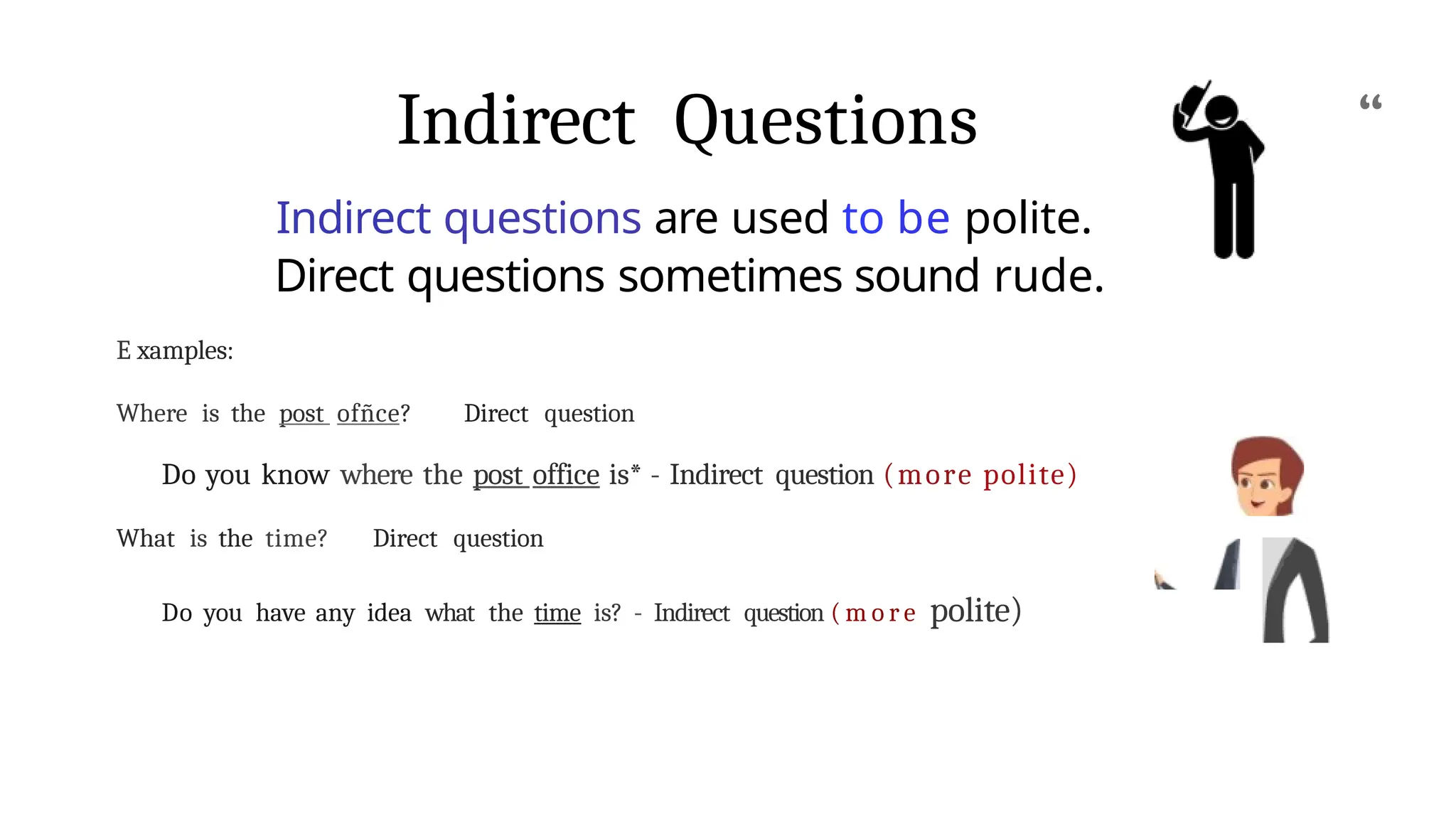
E xamples:
Where is the post ofñce? Direct question
Do you know where the post office is* - Indirect question (more polite)
What is the time? Direct question
Do you have any idea what the time is? - Indirect question ( m o r e polite)
Indirect Questions “
Indirect questions are used to be polite.
Direct questions sometimes sound rude.
° Important: The word order °
Forming Indirect Questions
Information quesNons are posed using the question words "where," "what," "when,"
"hone," "why," and "which." In order to form an indirect question, use an introductory
phrase followed by the question itself in positire sentence structure:
In od to ph e u tion d s e ente
Could you tell me where bt h er a k e is?
Can you tell me how she can get there? ...
° Examples: Indirect Questions °
• i4here is Jack? > I was monderinp if you know where Jack is.
• Gle n does Alice usually arrive? Do you know when Alice usually arrives?
• VMat have you done fhfs week? > Can you feff me icfinf JOLi're done fhis iceek?
• 7J’ozo must does it cost? > I’d /tke to know flow much it costs.
• 41y did be leave hisyob? > w/iy he lefi: hisyob.
Common Phrases (polite expression)
• Do you Wom ... ?
• I wonder/ was wondering ....
• Can you tetl me ... ?
• Do you happen to know ...?
• I have no idea ...
• I'm nor sure ...
• I'd ldc to lmor ...
Grammar: do, does, did “
Indirect questions do not use the auxiliary verbs 'do', 'does' or 'did'.
Examples:
When dens the next tra in arrive? - Direct question
Do you know when the next train arrives? - Indirect question
Do you know when the next train arrive? - Incorrect
When b t h e cinema close down? - Direct questiDn
Could you tell me when the cinema closed down? - Indirect question
Could you tell me when the cinema close down? — Incorrect
Wh en e
d
t
S S
, we us and the word order of a normal
Question Word + if + subject + verb phrase
Is the restaurant closing now? ire que ion
/..p Can you tell m he estau nt is closing now?
Does Sophia live in New York? - Direct question
Indirect question
: .
Do you known Sophia lives in New York? - Indirect question “
More examples:
Co n ¡you tell me where Tondu street is?
Whist tions tIJ6fi t Us *i 6rnz‹zi hfi( 
i{i0n ’
Ou you know whQ I time the Sup5rmor@et up6ns’
Could you tell me how much you eo› rt’
Med I •
s
h w)iot he is doing?
•‘ lay I k»ow s h o t you› lost nome is?
I'd !ika to know i} you ore Tiuing in London.
I’m not s«re i# she wee t shopping.
Ckin 9ou tell we whether she was o teacher'*
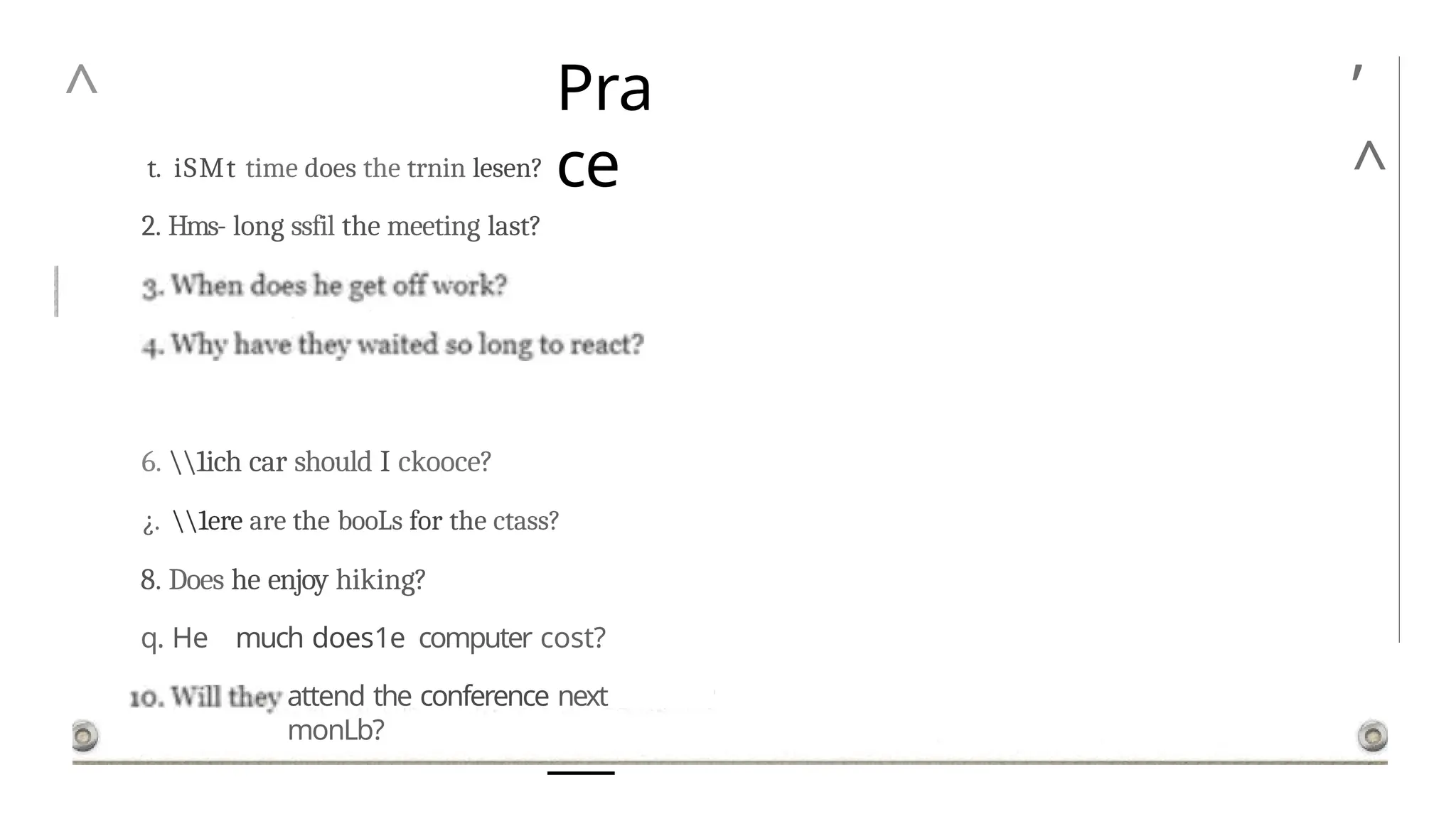
^ Pra
ce
’
^
t. iSMt time does the trnin lesen?
2. Hms- long ssfil the meeting last?
6. 1ich car should I ckooce?
¿. 1ere are the booLs for the ctass?
8. Does he enjoy hiking?
q. He much does1e computer cost?
attend the conference next
monLb?
Interactive Practice
Homework:
Page 20 (Act. 2, 3).
Page 2 (Act. 4,
See you Next Class!
PASS R. Flores

Indirect and Direct questionsreview.pptx

  • 1.
  • 2.
    E xamples: Where isthe post ofñce? Direct question Do you know where the post office is* - Indirect question (more polite) What is the time? Direct question Do you have any idea what the time is? - Indirect question ( m o r e polite) Indirect Questions “ Indirect questions are used to be polite. Direct questions sometimes sound rude.
  • 3.
    ° Important: Theword order ° Forming Indirect Questions Information quesNons are posed using the question words "where," "what," "when," "hone," "why," and "which." In order to form an indirect question, use an introductory phrase followed by the question itself in positire sentence structure: In od to ph e u tion d s e ente Could you tell me where bt h er a k e is? Can you tell me how she can get there? ...
  • 4.
    ° Examples: IndirectQuestions ° • i4here is Jack? > I was monderinp if you know where Jack is. • Gle n does Alice usually arrive? Do you know when Alice usually arrives? • VMat have you done fhfs week? > Can you feff me icfinf JOLi're done fhis iceek? • 7J’ozo must does it cost? > I’d /tke to know flow much it costs. • 41y did be leave hisyob? > w/iy he lefi: hisyob.
  • 5.
    Common Phrases (politeexpression) • Do you Wom ... ? • I wonder/ was wondering .... • Can you tetl me ... ? • Do you happen to know ...? • I have no idea ... • I'm nor sure ... • I'd ldc to lmor ...
  • 6.
    Grammar: do, does,did “ Indirect questions do not use the auxiliary verbs 'do', 'does' or 'did'. Examples: When dens the next tra in arrive? - Direct question Do you know when the next train arrives? - Indirect question Do you know when the next train arrive? - Incorrect When b t h e cinema close down? - Direct questiDn Could you tell me when the cinema closed down? - Indirect question Could you tell me when the cinema close down? — Incorrect
  • 7.
    Wh en e d t SS , we us and the word order of a normal Question Word + if + subject + verb phrase Is the restaurant closing now? ire que ion /..p Can you tell m he estau nt is closing now? Does Sophia live in New York? - Direct question Indirect question : . Do you known Sophia lives in New York? - Indirect question “
  • 8.
    More examples: Co n¡you tell me where Tondu street is? Whist tions tIJ6fi t Us *i 6rnz‹zi hfi( i{i0n ’ Ou you know whQ I time the Sup5rmor@et up6ns’ Could you tell me how much you eo› rt’ Med I • s h w)iot he is doing? •‘ lay I k»ow s h o t you› lost nome is? I'd !ika to know i} you ore Tiuing in London. I’m not s«re i# she wee t shopping. Ckin 9ou tell we whether she was o teacher'*
  • 9.
    ^ Pra ce ’ ^ t. iSMttime does the trnin lesen? 2. Hms- long ssfil the meeting last? 6. 1ich car should I ckooce? ¿. 1ere are the booLs for the ctass? 8. Does he enjoy hiking? q. He much does1e computer cost? attend the conference next monLb?
  • 10.
    Interactive Practice Homework: Page 20(Act. 2, 3). Page 2 (Act. 4,
  • 11.
    See you NextClass! PASS R. Flores