IES Rafael Reyes Maths 1º ESO Standard Index Form José Antonio Sayago
Standard Index form Objective: To convert numbers into standard index form
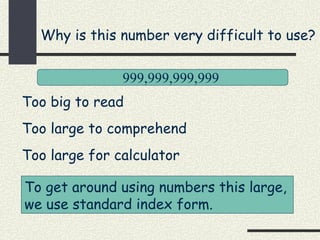
999,999,999,999 Why is this number very difficult to use? Too big to read Too large to comprehend Too large for calculator To get around using numbers this large, we use standard index form.
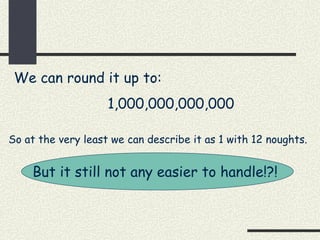
We can round it up to: 1,000,000,000,000 So at the very least we can describe it as 1 with 12 noughts. But it still not any easier to handle!?!
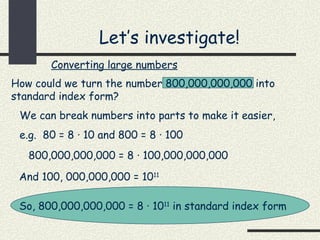
Let’s investigate! Converting large numbers 800,000,000,000 = 8 · 100,000,000,000 We can break numbers into parts to make it easier, e.g.  80 = 8 · 10 and 800 = 8 · 100 And 100, 000,000,000 = 10 11 How could we turn the number 800,000,000,000 into standard index form? So, 800,000,000,000 = 8 · 10 11  in standard index form
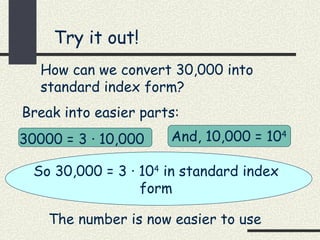
Try it out! How can we convert 30,000 into standard index form? Break into easier parts: The number is now easier to use 30000 = 3 · 10,000 And, 10,000 = 10 4 So 30,000 = 3 · 10 4  in standard index form
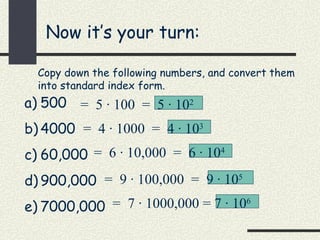
Now it’s your turn: Copy down the following numbers, and convert them into standard index form. 500 4000 60,000 900,000 7000,000 =  9 · 100,000  =  9 · 10 5 =  5 · 100  =  5 · 10 2 =  4 · 1000  =  4 · 10 3 =  6 · 10,000  =  6 · 10 4 =  7 · 1000,000 = 7 · 10 6
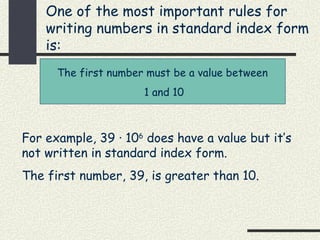
One of the most important rules for writing numbers in standard index form is:  For example, 39 · 10 6  does have a value but it’s not written in standard index form. The first number, 39, is greater than 10. The first number must be a value between  1 and 10
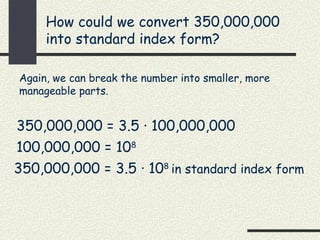
How could we convert 350,000,000 into standard index form? Again, we can break the number into smaller, more manageable parts. 350,000,000 = 3.5 · 100,000,000 100,000,000 = 10 8 350,000,000 = 3.5 · 10 8  in standard index form
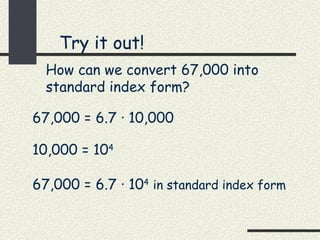
Try it out! How can we convert 67,000 into standard index form? 67,000 = 6.7 · 10,000 10,000 = 10 4 67,000 = 6.7 · 10 4   in standard index form
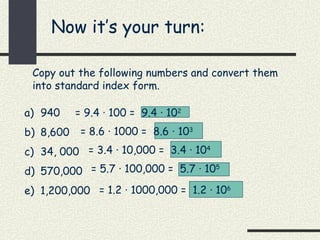
Now it’s your turn: Copy out the following numbers and convert them into standard index form.  940 8,600 34, 000 570,000 1,200,000 = 9.4 · 100 =  9.4 · 10 2 = 8.6 · 1000 =  8.6 · 10 3 = 3.4 · 10,000 =  3.4 · 10 4 = 5.7 · 100,000 =  5.7 · 10 5 = 1.2 · 1000,000 =  1.2 · 10 6
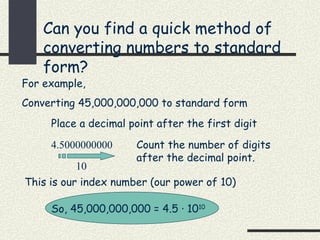
Can you find a quick method of converting numbers to standard form? For example, Converting 45,000,000,000 to standard form Place a decimal point after the first digit 4.5000000000 Count the number of digits after the decimal point. This is our index number (our power of 10) 10 So, 45,000,000,000 = 4.5 · 10 10

Index Form

  • 1.
    IES Rafael ReyesMaths 1º ESO Standard Index Form José Antonio Sayago
  • 2.
    Standard Index formObjective: To convert numbers into standard index form
  • 3.
    999,999,999,999 Why isthis number very difficult to use? Too big to read Too large to comprehend Too large for calculator To get around using numbers this large, we use standard index form.
  • 4.
    We can roundit up to: 1,000,000,000,000 So at the very least we can describe it as 1 with 12 noughts. But it still not any easier to handle!?!
  • 5.
    Let’s investigate! Convertinglarge numbers 800,000,000,000 = 8 · 100,000,000,000 We can break numbers into parts to make it easier, e.g. 80 = 8 · 10 and 800 = 8 · 100 And 100, 000,000,000 = 10 11 How could we turn the number 800,000,000,000 into standard index form? So, 800,000,000,000 = 8 · 10 11 in standard index form
  • 6.
    Try it out!How can we convert 30,000 into standard index form? Break into easier parts: The number is now easier to use 30000 = 3 · 10,000 And, 10,000 = 10 4 So 30,000 = 3 · 10 4 in standard index form
  • 7.
    Now it’s yourturn: Copy down the following numbers, and convert them into standard index form. 500 4000 60,000 900,000 7000,000 = 9 · 100,000 = 9 · 10 5 = 5 · 100 = 5 · 10 2 = 4 · 1000 = 4 · 10 3 = 6 · 10,000 = 6 · 10 4 = 7 · 1000,000 = 7 · 10 6
  • 8.
    One of themost important rules for writing numbers in standard index form is: For example, 39 · 10 6 does have a value but it’s not written in standard index form. The first number, 39, is greater than 10. The first number must be a value between 1 and 10
  • 9.
    How could weconvert 350,000,000 into standard index form? Again, we can break the number into smaller, more manageable parts. 350,000,000 = 3.5 · 100,000,000 100,000,000 = 10 8 350,000,000 = 3.5 · 10 8 in standard index form
  • 10.
    Try it out!How can we convert 67,000 into standard index form? 67,000 = 6.7 · 10,000 10,000 = 10 4 67,000 = 6.7 · 10 4 in standard index form
  • 11.
    Now it’s yourturn: Copy out the following numbers and convert them into standard index form. 940 8,600 34, 000 570,000 1,200,000 = 9.4 · 100 = 9.4 · 10 2 = 8.6 · 1000 = 8.6 · 10 3 = 3.4 · 10,000 = 3.4 · 10 4 = 5.7 · 100,000 = 5.7 · 10 5 = 1.2 · 1000,000 = 1.2 · 10 6
  • 12.
    Can you finda quick method of converting numbers to standard form? For example, Converting 45,000,000,000 to standard form Place a decimal point after the first digit 4.5000000000 Count the number of digits after the decimal point. This is our index number (our power of 10) 10 So, 45,000,000,000 = 4.5 · 10 10

Editor's Notes

  • #6 Size given by first number 8 and the index 11
  • #9 Pupils should copy down rule in green
  • #10 3.5 x 100 = 350, x by 1,000,000 makes 350,000,000
  • #13 Pupil book G3 page 137