ENERGY REQUIREMENT
IN
TELECOM SECTOR
INDIA’S TELECOM SECTOR
 India is currently the second-largest
telecommunication market and has the third highest
number of internet users in the world.
 India's telephone subscriber base expanded at a CAGR
of 19.22 % to 1,002 million over FY07–15.
 Teledensity (defined as the number of telephone
connections for every hundred individuals) increased
from 18.3 in FY2007 to 79.67 in FY 2015nbsp.
 The total, urban and rural teledensity as of March 31,
2014 were 75.2%, 145.8%, 44.0% respectively ,
showing a phenomenal growth over the last 15 years.
TELECOM TOWERS IN INDIA
 Over 4,40,000 telecom towers form the backbone of the
wireless telecom sector in India. The mobile subscriber base is
expected to hit one billion or more by 2014-15 which would
require more than 1,00,000 additionally towers to support
this capacity.
 Operation of these telecom towers requires electrical energy
which accounts for a significant share of the operational cost
of these towers.
 The sector annually consumes around 3 billion litres of diesel
to power its network towers. This results in an annual loss of
around INR 26 billion to the state by way of diesel subsidy.
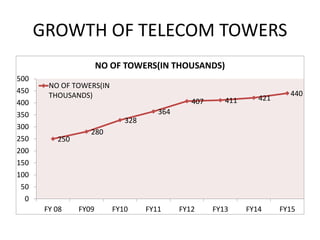
GROWTH OF TELECOM TOWERS
250
280
328
364
407 411 421
440
0
50
100
150
200
250
300
350
400
450
500
FY 08 FY09 FY10 FY11 FY12 FY13 FY14 FY15
NO OF TOWERS(IN THOUSANDS)
NO OF TOWERS(IN
THOUSANDS)
ENERGY REQUIRED BY TELCOM
TOWER
 The power demand of a telecom tower is determined by the
configuration of number of Base Transceiver Stations (BTS) in
the cell tower.
 The power requirement of a tower varies from 1 kW to 8.5
kW, where more than 80% of these configurations have a
power demand less than 3.5 kW. To ensure 100% power
availability to the tower, it is backed up by a combination of
batteries and diesel generator to supplement the grid supply.
 At majority sites, diesel generators of 10kVA to 15kVA capacity
supplemented with a battery bank of 300Ahr to 900Ahr
capacities is installed.
FINDINGS
 The total cost of diesel incurred per year by the telecom
tower companies is INR150 billion IN 2015, the railways
being the top consumer.
 A Per day consumption of electricity by towers all over
India is 47520MWHr.
 With an average 12 hours operation the total electricity
produced by diesel generator is 23760MWHr,which goes
unaccounted for.
 So on an average the electricity department is loosing
INR120 millions per day. Approx. INR44 billion per year.
FINDINGS
• Total electricity production capacity is 7000MW
can power all the north eastern part of the
country where consumption is 3510MW, and we
can power Delhi.
• Cost of 1 gen set 1.5lac, total cost of all genset is
6600crore, 600crore more than budget allocated
to swach bharat avhiyan.
• In Delhi total no. of towers is 11000, total diesel
consumed is 11% of the annual diesel
consumption of Delhi.
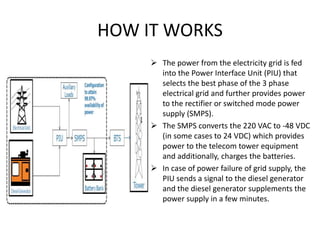
HOW IT WORKS
 The power from the electricity grid is fed
into the Power Interface Unit (PIU) that
selects the best phase of the 3 phase
electrical grid and further provides power
to the rectifier or switched mode power
supply (SMPS).
 The SMPS converts the 220 VAC to -48 VDC
(in some cases to 24 VDC) which provides
power to the telecom tower equipment
and additionally, charges the batteries.
 In case of power failure of grid supply, the
PIU sends a signal to the diesel generator
and the diesel generator supplements the
power supply in a few minutes.
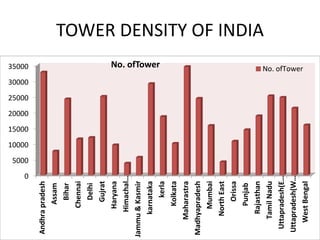
TOWER DENSITY OF INDIA
0
5000
10000
15000
20000
25000
30000
35000
Andhrapradesh
Assam
Bihar
Chennai
Delhi
Gujrat
Haryana
Himachal…
Jammu&Kasmir
karnataka
kerla
Kolkata
Maharastra
Madhyapradesh
Mumbai
NorthEast
Orissa
Punjab
Rajasthan
TamilNadu
Uttapradesh(E…
Uttapradesh(W…
WestBengal
No. ofTower No. ofTower
REASON FOR DIESEL GENERATOR
 The electricity available in different states varies from 7 to 21
hours a day in India. Most of the telecom towers are located
in rural and semi-urban areas where electricity supply is
irregular.
 Solar PV cell is unreliable due to limited hours of sunshine,
not feasible for high energy requirement of the telecom
towers.
 Wind energy is more unreliable as it is confined to states of
Maharashtra, Tamil Nadu, Gujarat, Karnataka, Andhra
Pradesh, Madhya Pradesh and parts of Orissa .
 The fuel cells are evolving and may be used in the future as a
source of energy.
GRID AVAILABITY IN INDIA
19.1
13.8
7.4
18.9
21.5
13.8
19.1
17.2
7.2
18.5
20.7
19.5
12.7
18.1
20.7
13.8
18.419.3
16.7
20.3
8.8
10.4
0
5
10
15
20
25
Andhrapradesh
Assam
Bihar
Chennai
Delhi
Gujrat
Haryana
Himachal…
Jammu&…
karnataka
kerla
WestBengal
Maharastra
Madhyapradesh
Mumbai
NorthEast
Orissa
Punjab
Rajasthan
TamilNadu
Uttapradesh(E…
Uttapradesh(…
AVAILABILTY FOR DAY(HOURS)
AVAILABILTY FOR
DAY(HOURS)
CHALLENGES TO GO GREEN
 Telecom operators claims the
capex cost of putting up a
solar unit ranges from 11lac to
15lac and would burden the
industry by INR 660billion.
 The telecom industry is
already stretched and reeling
under INR2,70,000crore so it is
not in a postion.
 India,s telecom sector,
including independent tower
operators, have huge debt on
their books, due to expensive
spectrum options and roll out
costs.
IMPACT ON ENVIRONMENT
 The rise of wireless telecommunication has not come without
concerns. The exact impact of Electro-Magnetic Field (EMF)
emissions from towers is yet to be confirmed despite several
scientific studies
 The use of diesel generator has a disadvantage of increasing
carbon emission, which has a negative impact on the
environment. The diesel generators also emit 6.6 million
metric tons of CO2 annually.
 The diesel generators are of 10-15 kVA capacity consume 2
litres of diesel per hour and produce 2.63 kg of CO2 per litre.
GOVERNMENT REGULATIONS
 At least 50% of all rural towers and 33% of the urban towers are to
be powered by hybrid power (Renewable Energy Technologies
(RET) + Grid power) by 2015, while all rural towers and 50% of
urban towers are to be hybrid powered by 2020.
 All service providers to declare the carbon footprint of their
network operations twice a year to TRAI.
 Sharing of the infrastructure using passive as well active
methodologies should be done to minimize the eventuality of
locating new sites within the vicinity of existing towers.
 The total power consumption of each BTS should not exceed 500W
by the year 2020.
 Energy efficient radio networks that reduce overall power and
energy consumption should be designed by the network operators.
RECOMMENDATION
 By modifying networks to enable turning off extra TRXs of BTS
during off‐peak periods or night hours of low traffic.
 Fuel Cell: The fuel cells use Hydrogen and some other
hydrocarbons to generate energy. There is no emission of
carbon from these cells.
 Operators plan networks to optimise cost. Wherever possible
and viable, energy efficient equipment is installed.
 The Telecom Engineering Centre (TEC), which is the technical
body for telecom for government of India, should be fully
involved in the standardization of energy efficient
technologies.
RECOMMENDATION
 Designing low energy base station sites which do not require
air-conditioning
 Deploying base‐stations powered by renewable energy
 Reducing mobile device life cycle emissions through design
and recycling.
 Government in the initial stages needs to support adoption of
renewable sources of energy in forms like capital expenditure
subsidy, concessional rates for various Government
levies/taxes etc.
 Soft loans for setting up renewable energy enterprises need
to be available.
GO GREEN
THANK YOU
QUESTIONS?

Indian telecom towers

  • 1.
  • 2.
    INDIA’S TELECOM SECTOR India is currently the second-largest telecommunication market and has the third highest number of internet users in the world.  India's telephone subscriber base expanded at a CAGR of 19.22 % to 1,002 million over FY07–15.  Teledensity (defined as the number of telephone connections for every hundred individuals) increased from 18.3 in FY2007 to 79.67 in FY 2015nbsp.  The total, urban and rural teledensity as of March 31, 2014 were 75.2%, 145.8%, 44.0% respectively , showing a phenomenal growth over the last 15 years.
  • 6.
    TELECOM TOWERS ININDIA  Over 4,40,000 telecom towers form the backbone of the wireless telecom sector in India. The mobile subscriber base is expected to hit one billion or more by 2014-15 which would require more than 1,00,000 additionally towers to support this capacity.  Operation of these telecom towers requires electrical energy which accounts for a significant share of the operational cost of these towers.  The sector annually consumes around 3 billion litres of diesel to power its network towers. This results in an annual loss of around INR 26 billion to the state by way of diesel subsidy.
  • 7.
    GROWTH OF TELECOMTOWERS 250 280 328 364 407 411 421 440 0 50 100 150 200 250 300 350 400 450 500 FY 08 FY09 FY10 FY11 FY12 FY13 FY14 FY15 NO OF TOWERS(IN THOUSANDS) NO OF TOWERS(IN THOUSANDS)
  • 8.
    ENERGY REQUIRED BYTELCOM TOWER  The power demand of a telecom tower is determined by the configuration of number of Base Transceiver Stations (BTS) in the cell tower.  The power requirement of a tower varies from 1 kW to 8.5 kW, where more than 80% of these configurations have a power demand less than 3.5 kW. To ensure 100% power availability to the tower, it is backed up by a combination of batteries and diesel generator to supplement the grid supply.  At majority sites, diesel generators of 10kVA to 15kVA capacity supplemented with a battery bank of 300Ahr to 900Ahr capacities is installed.
  • 9.
    FINDINGS  The totalcost of diesel incurred per year by the telecom tower companies is INR150 billion IN 2015, the railways being the top consumer.  A Per day consumption of electricity by towers all over India is 47520MWHr.  With an average 12 hours operation the total electricity produced by diesel generator is 23760MWHr,which goes unaccounted for.  So on an average the electricity department is loosing INR120 millions per day. Approx. INR44 billion per year.
  • 10.
    FINDINGS • Total electricityproduction capacity is 7000MW can power all the north eastern part of the country where consumption is 3510MW, and we can power Delhi. • Cost of 1 gen set 1.5lac, total cost of all genset is 6600crore, 600crore more than budget allocated to swach bharat avhiyan. • In Delhi total no. of towers is 11000, total diesel consumed is 11% of the annual diesel consumption of Delhi.
  • 11.
    HOW IT WORKS The power from the electricity grid is fed into the Power Interface Unit (PIU) that selects the best phase of the 3 phase electrical grid and further provides power to the rectifier or switched mode power supply (SMPS).  The SMPS converts the 220 VAC to -48 VDC (in some cases to 24 VDC) which provides power to the telecom tower equipment and additionally, charges the batteries.  In case of power failure of grid supply, the PIU sends a signal to the diesel generator and the diesel generator supplements the power supply in a few minutes.
  • 12.
    TOWER DENSITY OFINDIA 0 5000 10000 15000 20000 25000 30000 35000 Andhrapradesh Assam Bihar Chennai Delhi Gujrat Haryana Himachal… Jammu&Kasmir karnataka kerla Kolkata Maharastra Madhyapradesh Mumbai NorthEast Orissa Punjab Rajasthan TamilNadu Uttapradesh(E… Uttapradesh(W… WestBengal No. ofTower No. ofTower
  • 13.
    REASON FOR DIESELGENERATOR  The electricity available in different states varies from 7 to 21 hours a day in India. Most of the telecom towers are located in rural and semi-urban areas where electricity supply is irregular.  Solar PV cell is unreliable due to limited hours of sunshine, not feasible for high energy requirement of the telecom towers.  Wind energy is more unreliable as it is confined to states of Maharashtra, Tamil Nadu, Gujarat, Karnataka, Andhra Pradesh, Madhya Pradesh and parts of Orissa .  The fuel cells are evolving and may be used in the future as a source of energy.
  • 14.
    GRID AVAILABITY ININDIA 19.1 13.8 7.4 18.9 21.5 13.8 19.1 17.2 7.2 18.5 20.7 19.5 12.7 18.1 20.7 13.8 18.419.3 16.7 20.3 8.8 10.4 0 5 10 15 20 25 Andhrapradesh Assam Bihar Chennai Delhi Gujrat Haryana Himachal… Jammu&… karnataka kerla WestBengal Maharastra Madhyapradesh Mumbai NorthEast Orissa Punjab Rajasthan TamilNadu Uttapradesh(E… Uttapradesh(… AVAILABILTY FOR DAY(HOURS) AVAILABILTY FOR DAY(HOURS)
  • 15.
    CHALLENGES TO GOGREEN  Telecom operators claims the capex cost of putting up a solar unit ranges from 11lac to 15lac and would burden the industry by INR 660billion.  The telecom industry is already stretched and reeling under INR2,70,000crore so it is not in a postion.  India,s telecom sector, including independent tower operators, have huge debt on their books, due to expensive spectrum options and roll out costs.
  • 17.
    IMPACT ON ENVIRONMENT The rise of wireless telecommunication has not come without concerns. The exact impact of Electro-Magnetic Field (EMF) emissions from towers is yet to be confirmed despite several scientific studies  The use of diesel generator has a disadvantage of increasing carbon emission, which has a negative impact on the environment. The diesel generators also emit 6.6 million metric tons of CO2 annually.  The diesel generators are of 10-15 kVA capacity consume 2 litres of diesel per hour and produce 2.63 kg of CO2 per litre.
  • 19.
    GOVERNMENT REGULATIONS  Atleast 50% of all rural towers and 33% of the urban towers are to be powered by hybrid power (Renewable Energy Technologies (RET) + Grid power) by 2015, while all rural towers and 50% of urban towers are to be hybrid powered by 2020.  All service providers to declare the carbon footprint of their network operations twice a year to TRAI.  Sharing of the infrastructure using passive as well active methodologies should be done to minimize the eventuality of locating new sites within the vicinity of existing towers.  The total power consumption of each BTS should not exceed 500W by the year 2020.  Energy efficient radio networks that reduce overall power and energy consumption should be designed by the network operators.
  • 20.
    RECOMMENDATION  By modifyingnetworks to enable turning off extra TRXs of BTS during off‐peak periods or night hours of low traffic.  Fuel Cell: The fuel cells use Hydrogen and some other hydrocarbons to generate energy. There is no emission of carbon from these cells.  Operators plan networks to optimise cost. Wherever possible and viable, energy efficient equipment is installed.  The Telecom Engineering Centre (TEC), which is the technical body for telecom for government of India, should be fully involved in the standardization of energy efficient technologies.
  • 21.
    RECOMMENDATION  Designing lowenergy base station sites which do not require air-conditioning  Deploying base‐stations powered by renewable energy  Reducing mobile device life cycle emissions through design and recycling.  Government in the initial stages needs to support adoption of renewable sources of energy in forms like capital expenditure subsidy, concessional rates for various Government levies/taxes etc.  Soft loans for setting up renewable energy enterprises need to be available.
  • 22.
  • 23.