Aim: Should the American
tycoons of the late 1800s be
remembered as “robber
barons” or “captains of
industry”?
Trust: a large business that controls industry. Ex: oil
trust
Monopoly: having complete control of an industry.
Ex: monopoly on steel
Industry: the business or manufacturing of a good.
Ex: oil industry
NEW WAYS OF DOING BUSINESS
▪ HOW DID THE GOVERNMENT
RESPOND TO THE NEW WAYS
OF DOING BUSINESS?
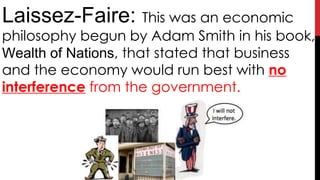
Laissez-Faire: This was an economic
philosophy begun by Adam Smith in his book,
Wealth of Nations, that stated that business
and the economy would run best with no
interference from the government.
▪ HOW DID THE AMERICAN
SOCIETY RESPOND TO THE
NEW WAYS OF DOING
BUSINESS?
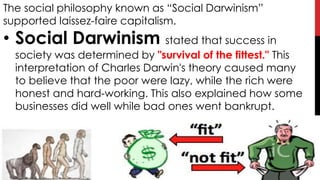
The social philosophy known as “Social Darwinism”
supported laissez-faire capitalism.
• Social Darwinism stated that success in
society was determined by "survival of the fittest." This
interpretation of Charles Darwin's theory caused many
to believe that the poor were lazy, while the rich were
honest and hard-working. This also explained how some
businesses did well while bad ones went bankrupt.
• As the rich became
wealthier, and the poor
more so, people began to
question these philosophies,
and some even attacked
leading industrialists calling
them Robber Barons, while
others maintained that they
were Captains of Industry.
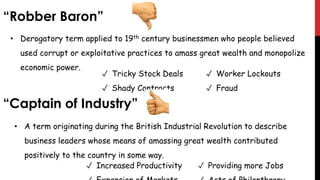
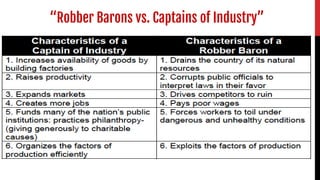
• Derogatory term applied to 19th century businessmen who people believed
used corrupt or exploitative practices to amass great wealth and monopolize
economic power.
✓ Tricky Stock Deals
✓ Shady Contracts
• A term originating during the British Industrial Revolution to describe
business leaders whose means of amassing great wealth contributed
positively to the country in some way.
✓ Worker Lockouts
✓ Fraud
✓ Increased Productivity ✓ Providing more Jobs
“Robber Baron”
“Captain of Industry”
“Robber Barons vs. Captains of Industry”
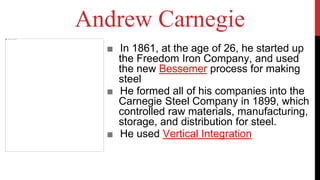
Andrew Carnegie
■ In 1861, at the age of 26, he started up
the Freedom Iron Company, and used
the new Bessemer process for making
steel
■ He formed all of his companies into the
Carnegie Steel Company in 1899, which
controlled raw materials, manufacturing,
storage, and distribution for steel.
■ He used Vertical Integration
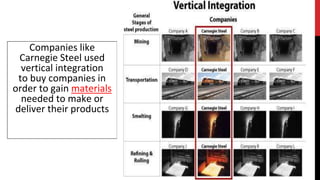
Companies like
Carnegie Steel used
vertical integration
to buy companies in
order to gain materials
needed to make or
deliver their products
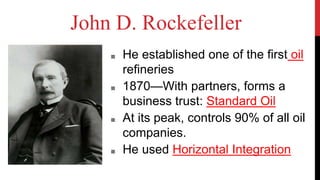
John D. Rockefeller
■ He established one of the first oil
refineries
■ 1870—With partners, forms a
business trust: Standard Oil
■ At its peak, controls 90% of all oil
companies.
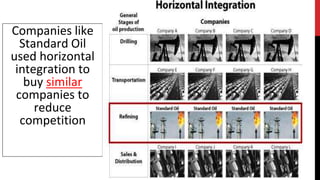
■ He used Horizontal Integration
Companies like
Standard Oil
used horizontal
integration to
buy similar
companies to
reduce
competition
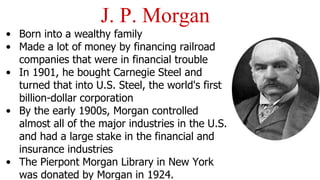
• Born into a wealthy family
• Made a lot of money by financing railroad
companies that were in financial trouble
• In 1901, he bought Carnegie Steel and
turned that into U.S. Steel, the world's first
billion-dollar corporation
• By the early 1900s, Morgan controlled
almost all of the major industries in the U.S.
and had a large stake in the financial and
insurance industries
• The Pierpont Morgan Library in New York
was donated by Morgan in 1924.
J. P. Morgan
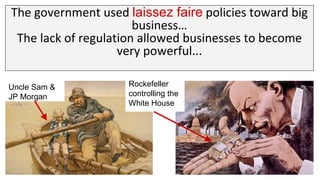
The government used laissez faire policies toward big
business…
The lack of regulation allowed businesses to become
very powerful...
Uncle Sam &
JP Morgan
Rockefeller
controlling the
White House

Hw#28

  • 1.
    Aim: Should theAmerican tycoons of the late 1800s be remembered as “robber barons” or “captains of industry”?
  • 2.
    Trust: a largebusiness that controls industry. Ex: oil trust Monopoly: having complete control of an industry. Ex: monopoly on steel Industry: the business or manufacturing of a good. Ex: oil industry NEW WAYS OF DOING BUSINESS
  • 3.
    ▪ HOW DIDTHE GOVERNMENT RESPOND TO THE NEW WAYS OF DOING BUSINESS?
  • 4.
    Laissez-Faire: This wasan economic philosophy begun by Adam Smith in his book, Wealth of Nations, that stated that business and the economy would run best with no interference from the government.
  • 5.
    ▪ HOW DIDTHE AMERICAN SOCIETY RESPOND TO THE NEW WAYS OF DOING BUSINESS?
  • 6.
    The social philosophyknown as “Social Darwinism” supported laissez-faire capitalism. • Social Darwinism stated that success in society was determined by "survival of the fittest." This interpretation of Charles Darwin's theory caused many to believe that the poor were lazy, while the rich were honest and hard-working. This also explained how some businesses did well while bad ones went bankrupt.
  • 7.
    • As therich became wealthier, and the poor more so, people began to question these philosophies, and some even attacked leading industrialists calling them Robber Barons, while others maintained that they were Captains of Industry.
  • 8.
    • Derogatory termapplied to 19th century businessmen who people believed used corrupt or exploitative practices to amass great wealth and monopolize economic power. ✓ Tricky Stock Deals ✓ Shady Contracts • A term originating during the British Industrial Revolution to describe business leaders whose means of amassing great wealth contributed positively to the country in some way. ✓ Worker Lockouts ✓ Fraud ✓ Increased Productivity ✓ Providing more Jobs “Robber Baron” “Captain of Industry”
  • 9.
    “Robber Barons vs.Captains of Industry”
  • 10.
    Andrew Carnegie ■ In1861, at the age of 26, he started up the Freedom Iron Company, and used the new Bessemer process for making steel ■ He formed all of his companies into the Carnegie Steel Company in 1899, which controlled raw materials, manufacturing, storage, and distribution for steel. ■ He used Vertical Integration
  • 11.
    Companies like Carnegie Steelused vertical integration to buy companies in order to gain materials needed to make or deliver their products
  • 12.
    John D. Rockefeller ■He established one of the first oil refineries ■ 1870—With partners, forms a business trust: Standard Oil ■ At its peak, controls 90% of all oil companies. ■ He used Horizontal Integration
  • 13.
    Companies like Standard Oil usedhorizontal integration to buy similar companies to reduce competition
  • 14.
    • Born intoa wealthy family • Made a lot of money by financing railroad companies that were in financial trouble • In 1901, he bought Carnegie Steel and turned that into U.S. Steel, the world's first billion-dollar corporation • By the early 1900s, Morgan controlled almost all of the major industries in the U.S. and had a large stake in the financial and insurance industries • The Pierpont Morgan Library in New York was donated by Morgan in 1924. J. P. Morgan
  • 15.
    The government usedlaissez faire policies toward big business… The lack of regulation allowed businesses to become very powerful... Uncle Sam & JP Morgan Rockefeller controlling the White House