Sagar Chowdhury
M.Tech in Science commuication
Bits Pilani, 2016
About ‘Indian Railways’
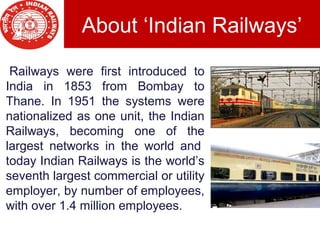
 Railways were first introduced to
India in 1853 from Bombay to
Thane. In 1951 the systems were
nationalized as one unit, the Indian
Railways, becoming one of the
largest networks in the world and
today Indian Railways is the world’s
seventh largest commercial or utility
employer, by number of employees,
with over 1.4 million employees.
Service provided
• Passenger  services -: Indian Railways operates 14,702
passenger trains and transports around Nine billion people
annually across twenty-seven states and three union territories
(Delhi, Pondicherry and Chandigarh). Sikkim is the only state
not connected
• Metro  rail  -: Many cities have their own dedicated suburban
networks to cater to commuters. Currently, suburban networks
operate in Mumbai, Chennai, Kolkata, Delhi.
• Freight -: IR carry a huge variety of goods ranging from mineral
ores, agricultural produce, petroleum, milk and vehicles. Ports
and major urban areas have their own dedicated freight lines
and yards.
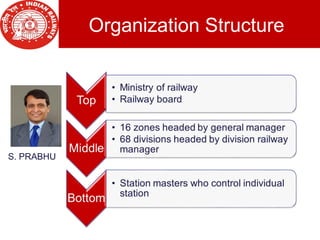
Organization Structure
S. PRABHU
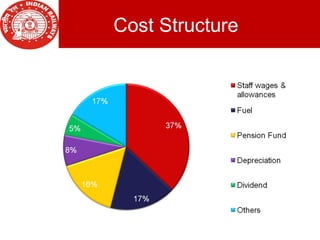
Cost Structure
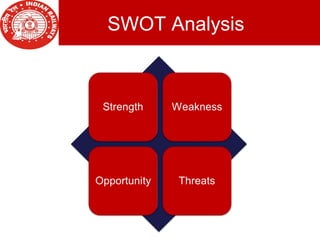
SWOT Analysis
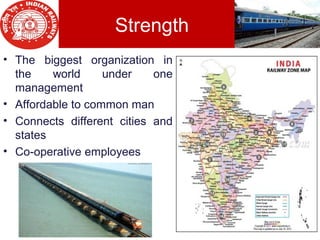
Strength
• The biggest organization in
the world under one
management
• Affordable to common man
• Connects different cities and
states
• Co-operative employees
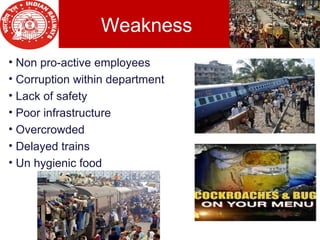
Weakness
• Non pro-active employees
• Corruption within department
• Lack of safety
• Poor infrastructure
• Overcrowded
• Delayed trains
• Un hygienic food
Opportunity
• Metro in commercial cities like
Hydrabad, Ahmedabad etc.
• Development in small cities
• Profit through privatization
• Technological advancement
Threats
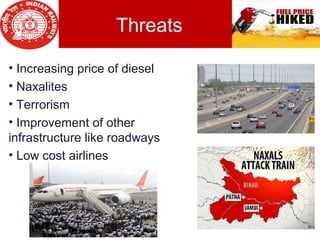
• Increasing price of diesel
• Naxalites
• Terrorism
• Improvement of other
infrastructure like roadways
• Low cost airlines
Notable Trains
• Samjhauta Express is a train that runs between India and Pak .
• Lifeline Express is a special train popularly known as the "Hospital-
on-Wheels" which provides healthcare to the rural areas.
• Vivek Express, between Dibrugarh and Kanyakumari, has the longest
run in terms of distance and time on Indian Railways network. It
covers 4,286 km in about 82 hours and 30 minutes.
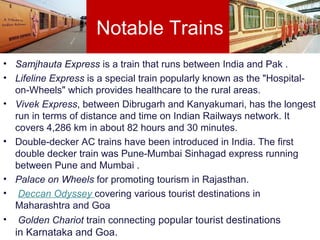
• Double-decker AC trains have been introduced in India. The first
double decker train was Pune-Mumbai Sinhagad express running
between Pune and Mumbai .
• Palace on Wheels for promoting tourism in Rajasthan.
• Deccan Odyssey covering various tourist destinations in
Maharashtra and Goa
• Golden Chariot train connecting popular tourist destinations
in Karnataka and Goa.
• Railway Network: India comes fourth with approx. 64,000 km of
railroad after US, Russia, and China.
• Distance Covered: The total distance covered by the 14,300
trains daily on the Indian Railways daily equals three & half times
the distance to moon.
• Passenger Load: The IR carries over 25 million passengers daily.
Annually Indian Railways ferries 9 billion passenger.
• There are two UNESCO world heritage sites on IR the
Chatrapati Shivaji Terminus and the Mountain Railways of India.
• Longest Platform: Indian Railways owns the longest railway
platform in the world at Kharagpur ,West Bengal with a length of
2,733 ft (1072.5 m).
• Fastest train in India: New Delhi-Bhopal Shatabdi Express is the
fastest train in India.
Facts
At last..
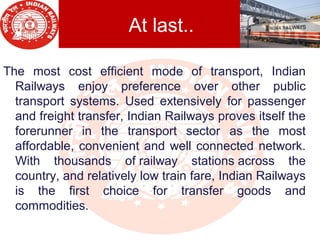
The most cost efficient mode of transport, Indian
Railways enjoy preference over other public
transport systems. Used extensively for passenger
and freight transfer, Indian Railways proves itself the
forerunner in the transport sector as the most
affordable, convenient and well connected network.
With thousands of railway stations across the
country, and relatively low train fare, Indian Railways
is the first choice for transfer goods and
commodities.
`
THANK YOU
FOR WATCHING
MY PRESENTATION

Indian Railway

  • 1.
    Sagar Chowdhury M.Tech inScience commuication Bits Pilani, 2016
  • 2.
    About ‘Indian Railways’  Railwayswere first introduced to India in 1853 from Bombay to Thane. In 1951 the systems were nationalized as one unit, the Indian Railways, becoming one of the largest networks in the world and today Indian Railways is the world’s seventh largest commercial or utility employer, by number of employees, with over 1.4 million employees.
  • 3.
    Service provided • Passenger services -: Indian Railways operates 14,702 passenger trains and transports around Nine billion people annually across twenty-seven states and three union territories (Delhi, Pondicherry and Chandigarh). Sikkim is the only state not connected • Metro  rail  -: Many cities have their own dedicated suburban networks to cater to commuters. Currently, suburban networks operate in Mumbai, Chennai, Kolkata, Delhi. • Freight -: IR carry a huge variety of goods ranging from mineral ores, agricultural produce, petroleum, milk and vehicles. Ports and major urban areas have their own dedicated freight lines and yards.
  • 4.
  • 5.
  • 6.
  • 7.
    Strength • The biggestorganization in the world under one management • Affordable to common man • Connects different cities and states • Co-operative employees
  • 8.
    Weakness • Non pro-activeemployees • Corruption within department • Lack of safety • Poor infrastructure • Overcrowded • Delayed trains • Un hygienic food
  • 9.
    Opportunity • Metro incommercial cities like Hydrabad, Ahmedabad etc. • Development in small cities • Profit through privatization • Technological advancement
  • 10.
    Threats • Increasing priceof diesel • Naxalites • Terrorism • Improvement of other infrastructure like roadways • Low cost airlines
  • 11.
    Notable Trains • SamjhautaExpress is a train that runs between India and Pak . • Lifeline Express is a special train popularly known as the "Hospital- on-Wheels" which provides healthcare to the rural areas. • Vivek Express, between Dibrugarh and Kanyakumari, has the longest run in terms of distance and time on Indian Railways network. It covers 4,286 km in about 82 hours and 30 minutes. • Double-decker AC trains have been introduced in India. The first double decker train was Pune-Mumbai Sinhagad express running between Pune and Mumbai . • Palace on Wheels for promoting tourism in Rajasthan. • Deccan Odyssey covering various tourist destinations in Maharashtra and Goa • Golden Chariot train connecting popular tourist destinations in Karnataka and Goa.
  • 12.
    • Railway Network:India comes fourth with approx. 64,000 km of railroad after US, Russia, and China. • Distance Covered: The total distance covered by the 14,300 trains daily on the Indian Railways daily equals three & half times the distance to moon. • Passenger Load: The IR carries over 25 million passengers daily. Annually Indian Railways ferries 9 billion passenger. • There are two UNESCO world heritage sites on IR the Chatrapati Shivaji Terminus and the Mountain Railways of India. • Longest Platform: Indian Railways owns the longest railway platform in the world at Kharagpur ,West Bengal with a length of 2,733 ft (1072.5 m). • Fastest train in India: New Delhi-Bhopal Shatabdi Express is the fastest train in India. Facts
  • 13.
    At last.. The mostcost efficient mode of transport, Indian Railways enjoy preference over other public transport systems. Used extensively for passenger and freight transfer, Indian Railways proves itself the forerunner in the transport sector as the most affordable, convenient and well connected network. With thousands of railway stations across the country, and relatively low train fare, Indian Railways is the first choice for transfer goods and commodities.
  • 14.