PRASHANT SHARMA (12MEU064)
PRATEEK MAHAJAN(12MEU065)
OBJECTIVE
• The objective of this project is to make you familiar with this
intellectual property .
• To develop a
What is a patent ?
• A patent is a grant from the government which
confers on the guarantee for a limited period of time
the exclusive privilege of making, selling and using
the invention for which a patent has been granted.
• Acts as a incentives for the development of new
products .
• In india patents are governed by patents act 1970
Types Of Patents
• Three types of patent are granted under the
provisions of the act, namely:
• An Ordinary Patent
• A Patent Of Addition
• A Patent Of Convention
• A second type of classification of patent is:
1. Product Patent
2. Process Patent
Purpose of getting a patent
• To enjoy the exclusive rights over the invention.
• The patent is to ensure commercial returns to the
inventor for the time and money spend in generating
a new product.
What can be patented?
• In order to be patentable , an invention must pass
four tests;
• The invention must fall into one of the five “statutory
classes’: Processes, Machines , Manufactures
Compositions of matter, and New uses of any of the
above
• The invention must be “novel”
• The invention must be “useful”
• The invention must be “nonobvious
Non Patentable Inventions
• Inventions falling within Section 20(1) of the Atomic Energy
Act, 1962 are not patentable.
• . Inventions relating to compounds of Uranium, Beryllium,
Thorium, Plutonium, Radium, Graphite, Lithium and more as
notified by Central govt.
• Causes harm to humans or environment.
• New use of existing product.
• Mere discovery of a scientific principle without manifesting
it in a product.
• Inventions that are contrary to established natural laws.
• A new method of agriculture.
Salient features of patent law
• Both product and process patent provided.
• Term of patent – 20 years.
• Examination on request.
• Both pre-grant and post-grant opposition .
• Fast track mechanism for disposal of appeals.
• Publication of applications after 18 months with
facility for early publication.
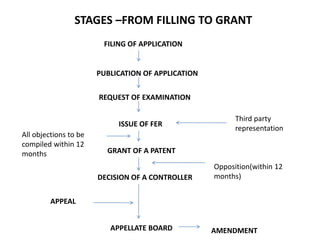
FILING OF APPLICATION
PUBLICATION OF APPLICATION
REQUEST OF EXAMINATION
ISSUE OF FER
GRANT OF A PATENT
DECISION OF A CONTROLLER
APPELLATE BOARD
Third party
representation
Opposition(within 12
months)
AMENDMENT
APPEAL
All objections to be
compiled within 12
months
STAGES –FROM FILLING TO GRANT
Obtaining A Patent
In India patents are granted on a first to apply basis
• File an application for patent
 With one of the patent offices based on territorial jurisdiction
of the place of office or residence of the applicant /agent.
 Pay the required fee.
• Formality check and issue of application number
PUBLICATION
 Application is kept secret for a period of 18 months from the
date of filing.
 In 19th month, the application is published in the official
journal – this journal is made available on the website weekly.
 Applicant has an option to get his application published
before 18 months also
Request for Examination
• Application is examined on request.
• Request for examination can be made either by the
applicant or by a third party.
• A period of 48 months, from the date of filing, is
available for making request for examination.
Examination
• Application is sent to an Examiner within 1 month from the
date of request for examination.
• Examiner undertakes examination w.r.t.
– whether the claimed invention is not prohibited for grant
of patent .
– whether the invention meets the criteria of patentability.
Issue of FER
• A period of 1 to 3 months is available to Examiner to submit
the report to the Controller.
• 1 month’s time available to Controller to vet the Examiner’s
report .
• First Examination Report (FER) containing list of the objections
is issued within 6 months from the date of filing of request.
Response from the Applicant
• 12 months’ time, from the date of issue of
FER, is available to the applicant to meet the
objections.
• If objections are met, grant of patent is
approved by the Controller – within a period
of 1 month.
Pre-grant Opposition
• After publication, an opposition can be filed within a
period of 6 months
• Opportunity of hearing the opponent is also
available
Examination of Pre-grant Opposition
• Opposition (documents) is sent to the applicant.
• A period of 3 months is allowed for receipt of response
• After examining the opposition and the submissions made during
the hearing, Controller may
– Either reject the opposition and grant the patent
– Or accept the opposition and modify/reject the patent
application
• This is to be done within a period of 1 month from the date of
completion of opposition proceedings
Grant of a Patent
• A certificate of patent is issued within 7 days.
• Grant of patent is published in the official journal.
Post grant opposition
• Any interested person can file opposition ,within one year of
the date of publication of grant of a patent.
• Indians cannot file for patents application abroad unless any
of the following conditions are met.
 Written permission has to be obtained from the controller of
patents
 A patent for the same invention has been filed in india at least
six weeks prior to filing it abroad
Renewal Fee
• To be paid within 3+6 months from date of recording in the register.
• No fee for 1st and 2nd year.
• Renewal fee, on yearly basis, is required to be paid for 3rd to 20th for
keeping the patent in force.
• Delay upto six months from due date permissible on payment of fee
for extension of time .
• Patent lapses if renewal fee is not paid within the prescribed period.
Rights of a patentee
1. Right to exploit the patent.
 The patentee has a right to prevent 3rd parties, from exploiting the
patented invention.
2. Right to grant license.
 The patentee has a power to assign rights or grant license.
3. Right to surrender.
 The patentee is given the right to surrender the patent by giving notice in
prescribed manner to the controller.
4. Right to sue for infringement.
 A patentee is given the right to institute proceeding for infringement of
the patent in a district court .
INFRINGEMENT
• Infringement of patent rights can result from making using,selling, or
importing for these purposes, the products in india without the
permission of patent holder.
• A patent holder can file for injuction of for damages on accounts of
profit lost.
• Infringement in india does not lead to filing of criminal charges.
• In case the defendant proves that he/she was not aware of the
existence of a patent, the patentee is not awarded any damages.
• Only the infringing goods are destroyed and handed over to the
patentee.
Licencing of patents
• In case you don’t have any financial strength or the
oraganizational reach to do justice to your own invention,it is
good to licence to other company.
• Share in patent is valid under following conditions
 Written agreement between the parties containing all agreed
terms and conditions.
 An application for the registration of agreement must be filed
within six months of the execution of agreement.
Benefits an entrepreneurial venture gain from patents
• Used to secure a technological lead.
• The technological lead provided by the patent can be
used by the entrepreneur to establish trademarks.
• Venture can extend the protection given by the
applicant by marketing complementary products
protected by different patents.
• By licencing patents to the suppliers, it is possible to
create power chains by tying with the suppliers.
• It can be used by an entrepreneur to create industry
standards.
how to file patents?

how to file patents?

  • 1.
  • 2.
    OBJECTIVE • The objectiveof this project is to make you familiar with this intellectual property . • To develop a
  • 3.
    What is apatent ? • A patent is a grant from the government which confers on the guarantee for a limited period of time the exclusive privilege of making, selling and using the invention for which a patent has been granted. • Acts as a incentives for the development of new products . • In india patents are governed by patents act 1970
  • 4.
    Types Of Patents •Three types of patent are granted under the provisions of the act, namely: • An Ordinary Patent • A Patent Of Addition • A Patent Of Convention • A second type of classification of patent is: 1. Product Patent 2. Process Patent
  • 5.
    Purpose of gettinga patent • To enjoy the exclusive rights over the invention. • The patent is to ensure commercial returns to the inventor for the time and money spend in generating a new product.
  • 6.
    What can bepatented? • In order to be patentable , an invention must pass four tests; • The invention must fall into one of the five “statutory classes’: Processes, Machines , Manufactures Compositions of matter, and New uses of any of the above • The invention must be “novel” • The invention must be “useful” • The invention must be “nonobvious
  • 7.
    Non Patentable Inventions •Inventions falling within Section 20(1) of the Atomic Energy Act, 1962 are not patentable. • . Inventions relating to compounds of Uranium, Beryllium, Thorium, Plutonium, Radium, Graphite, Lithium and more as notified by Central govt. • Causes harm to humans or environment. • New use of existing product. • Mere discovery of a scientific principle without manifesting it in a product. • Inventions that are contrary to established natural laws. • A new method of agriculture.
  • 8.
    Salient features ofpatent law • Both product and process patent provided. • Term of patent – 20 years. • Examination on request. • Both pre-grant and post-grant opposition . • Fast track mechanism for disposal of appeals. • Publication of applications after 18 months with facility for early publication.
  • 9.
    FILING OF APPLICATION PUBLICATIONOF APPLICATION REQUEST OF EXAMINATION ISSUE OF FER GRANT OF A PATENT DECISION OF A CONTROLLER APPELLATE BOARD Third party representation Opposition(within 12 months) AMENDMENT APPEAL All objections to be compiled within 12 months STAGES –FROM FILLING TO GRANT
  • 10.
    Obtaining A Patent InIndia patents are granted on a first to apply basis • File an application for patent  With one of the patent offices based on territorial jurisdiction of the place of office or residence of the applicant /agent.  Pay the required fee. • Formality check and issue of application number
  • 11.
    PUBLICATION  Application iskept secret for a period of 18 months from the date of filing.  In 19th month, the application is published in the official journal – this journal is made available on the website weekly.  Applicant has an option to get his application published before 18 months also
  • 12.
    Request for Examination •Application is examined on request. • Request for examination can be made either by the applicant or by a third party. • A period of 48 months, from the date of filing, is available for making request for examination.
  • 13.
    Examination • Application issent to an Examiner within 1 month from the date of request for examination. • Examiner undertakes examination w.r.t. – whether the claimed invention is not prohibited for grant of patent . – whether the invention meets the criteria of patentability.
  • 14.
    Issue of FER •A period of 1 to 3 months is available to Examiner to submit the report to the Controller. • 1 month’s time available to Controller to vet the Examiner’s report . • First Examination Report (FER) containing list of the objections is issued within 6 months from the date of filing of request.
  • 15.
    Response from theApplicant • 12 months’ time, from the date of issue of FER, is available to the applicant to meet the objections. • If objections are met, grant of patent is approved by the Controller – within a period of 1 month.
  • 16.
    Pre-grant Opposition • Afterpublication, an opposition can be filed within a period of 6 months • Opportunity of hearing the opponent is also available
  • 17.
    Examination of Pre-grantOpposition • Opposition (documents) is sent to the applicant. • A period of 3 months is allowed for receipt of response • After examining the opposition and the submissions made during the hearing, Controller may – Either reject the opposition and grant the patent – Or accept the opposition and modify/reject the patent application • This is to be done within a period of 1 month from the date of completion of opposition proceedings
  • 18.
    Grant of aPatent • A certificate of patent is issued within 7 days. • Grant of patent is published in the official journal.
  • 19.
    Post grant opposition •Any interested person can file opposition ,within one year of the date of publication of grant of a patent. • Indians cannot file for patents application abroad unless any of the following conditions are met.  Written permission has to be obtained from the controller of patents  A patent for the same invention has been filed in india at least six weeks prior to filing it abroad
  • 20.
    Renewal Fee • Tobe paid within 3+6 months from date of recording in the register. • No fee for 1st and 2nd year. • Renewal fee, on yearly basis, is required to be paid for 3rd to 20th for keeping the patent in force. • Delay upto six months from due date permissible on payment of fee for extension of time . • Patent lapses if renewal fee is not paid within the prescribed period.
  • 21.
    Rights of apatentee 1. Right to exploit the patent.  The patentee has a right to prevent 3rd parties, from exploiting the patented invention. 2. Right to grant license.  The patentee has a power to assign rights or grant license. 3. Right to surrender.  The patentee is given the right to surrender the patent by giving notice in prescribed manner to the controller. 4. Right to sue for infringement.  A patentee is given the right to institute proceeding for infringement of the patent in a district court .
  • 22.
    INFRINGEMENT • Infringement ofpatent rights can result from making using,selling, or importing for these purposes, the products in india without the permission of patent holder. • A patent holder can file for injuction of for damages on accounts of profit lost. • Infringement in india does not lead to filing of criminal charges. • In case the defendant proves that he/she was not aware of the existence of a patent, the patentee is not awarded any damages. • Only the infringing goods are destroyed and handed over to the patentee.
  • 23.
    Licencing of patents •In case you don’t have any financial strength or the oraganizational reach to do justice to your own invention,it is good to licence to other company. • Share in patent is valid under following conditions  Written agreement between the parties containing all agreed terms and conditions.  An application for the registration of agreement must be filed within six months of the execution of agreement.
  • 24.
    Benefits an entrepreneurialventure gain from patents • Used to secure a technological lead. • The technological lead provided by the patent can be used by the entrepreneur to establish trademarks. • Venture can extend the protection given by the applicant by marketing complementary products protected by different patents. • By licencing patents to the suppliers, it is possible to create power chains by tying with the suppliers. • It can be used by an entrepreneur to create industry standards.