Presented by
© 2012 ISACA. All rights reserved. No part of this
publication may be used, copied, reproduced,
modified, distributed, displayed, stored in a retrieval
system or transmitted in any form by any means
(electronic, mechanical, photocopying, recording or
otherwise) without the prior written authorisation of
ISACA. Use of this publication is permitted solely for
personal use and must include full attribution of the
material’s source. No other right or permission is
granted with respect to this work.
2
Information!
Information is a key resource for all enterprises.
Information is created, used, retained, disclosed and
destroyed.
Technology plays a key role in these actions.
Technology is becoming pervasive in all aspects of
business and personal life.
What benefits do information and technology bring to
enterprises?
4
Enterprise Benefits
Enterprises and their executives strive to:
Maintain quality information to support business
decisions.
Generate business value from IT-enabled investments,
i.e., achieve strategic goals and realise business benefits
through effective and innovative use of IT.
Achieve operational excellence through reliable and
efficient application of technology.
Maintain IT-related risk at an acceptable level.
Optimise the cost of IT services and technology.
How can these benefits be realised to create enterprise
stakeholder value?
5
Stakeholder Value
Delivering enterprise stakeholder value requires good
governance and management of information and
technology (IT) assets.
Enterprise boards, executives and management have to
embrace IT like any other significant part of the business.
External legal, regulatory and contractual compliance
requirements related to enterprise use of information and
technology are increasing, threatening value if breached.
COBIT 5 provides a comprehensive framework that
assists enterprises to achieve their goals and deliver
value through effective governance and management
of enterprise IT.
6
The COBIT 5 Framework
Simply stated, COBIT 5 helps enterprises create optimal
value from IT by maintaining a balance between
realising benefits and optimising risk levels and resource
use.
COBIT 5 enables information and related technology to
be governed and managed in a holistic manner for the
entire enterprise, taking in the full end-to-end business
and functional areas of responsibility, considering the
IT-related interests of internal and external stakeholders.
The COBIT 5 principles and enablers are generic and
useful for enterprises of all sizes, whether commercial,
not-for-profit or in the public sector.
7
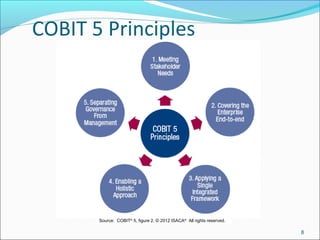
COBIT 5 Principles
8
Source:  COBIT®
 5, figure 2. © 2012 ISACA®
  All rights reserved.
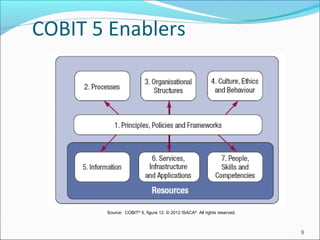
COBIT 5 Enablers
9
Source:  COBIT®
 5, figure 12. © 2012 ISACA®
  All rights reserved.
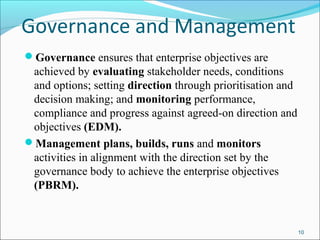
Governance and Management
Governance ensures that enterprise objectives are
achieved by evaluating stakeholder needs, conditions
and options; setting direction through prioritisation and
decision making; and monitoring performance,
compliance and progress against agreed-on direction and
objectives (EDM).
Management plans, builds, runs and monitors
activities in alignment with the direction set by the
governance body to achieve the enterprise objectives
(PBRM).
10
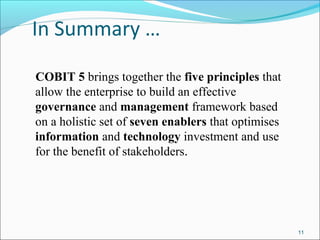
In Summary …
COBIT 5 brings together the five principles that
allow the enterprise to build an effective
governance and management framework based
on a holistic set of seven enablers that optimises
information and technology investment and use
for the benefit of stakeholders.
11
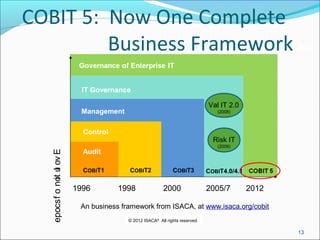
IT Governance
COBIT4.0/4.1
Management
COBIT3
Control
COBIT2
An business framework from ISACA, at www.isaca.org/cobit
Audit
COBIT1
COBIT 5: Now One Complete
Business Framework for
2005/720001998
Evolutionofscope
1996 2012
Val IT 2.0
(2008)
Risk IT
(2009)
13
© 2012 ISACA®
All rights reserved.
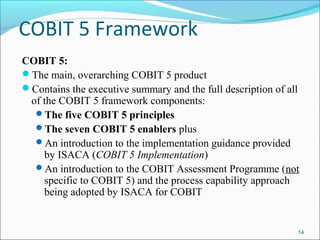
COBIT 5 Framework
COBIT 5:
The main, overarching COBIT 5 product
Contains the executive summary and the full description of all
of the COBIT 5 framework components:
The five COBIT 5 principles
The seven COBIT 5 enablers plus
An introduction to the implementation guidance provided
by ISACA (COBIT 5 Implementation)
An introduction to the COBIT Assessment Programme (not
specific to COBIT 5) and the process capability approach
being adopted by ISACA for COBIT
14
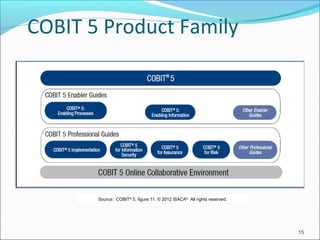
15
COBIT 5 Product Family
Source: COBIT®
5, figure 11. © 2012 ISACA®
All rights reserved.
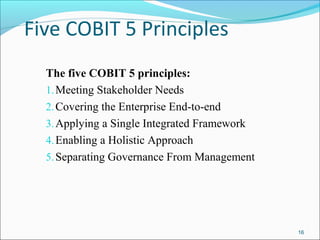
Five COBIT 5 Principles
The five COBIT 5 principles:
1.Meeting Stakeholder Needs
2.Covering the Enterprise End-to-end
3.Applying a Single Integrated Framework
4.Enabling a Holistic Approach
5.Separating Governance From Management
16
1. Meeting Stakeholder Needs
Principle 1. Meeting Stakeholder Needs
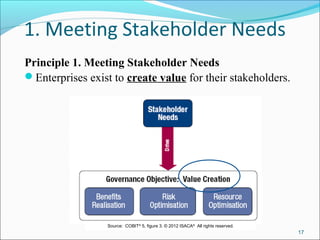
Enterprises exist to create value for their stakeholders.
17
Source: COBIT®
5, figure 3. © 2012 ISACA®
All rights reserved.
1. Meeting Stakeholder Needs (cont.)
Principle 1. Meeting Stakeholder Needs:
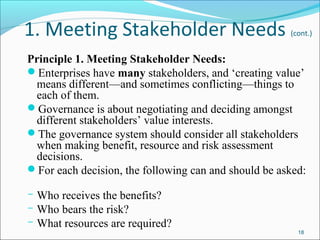
Enterprises have many stakeholders, and ‘creating value’
means different—and sometimes conflicting—things to
each of them.
Governance is about negotiating and deciding amongst
different stakeholders’ value interests.
The governance system should consider all stakeholders
when making benefit, resource and risk assessment
decisions.
For each decision, the following can and should be asked:
­ Who receives the benefits?
­ Who bears the risk?
­ What resources are required?
18
1. Meeting Stakeholder Needs (cont.)
Principle 1. Meeting
Stakeholder Needs:
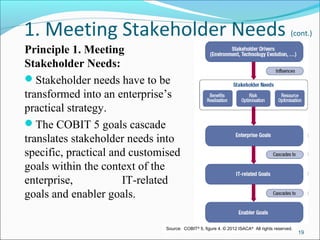
Stakeholder needs have to be
transformed into an enterprise’s
practical strategy.
The COBIT 5 goals cascade
translates stakeholder needs into
specific, practical and customised
goals within the context of the
enterprise, IT-related
goals and enabler goals.
19
Source: COBIT®
5, figure 4. © 2012 ISACA®
All rights reserved.
1. Meeting Stakeholder Needs (cont.)
Principle 1. Meeting Stakeholder Needs:
Benefits of the COBIT 5 goals cascade:
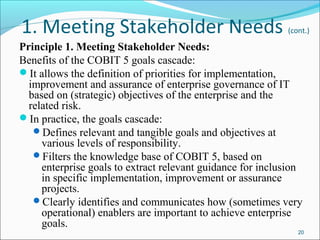
It allows the definition of priorities for implementation,
improvement and assurance of enterprise governance of IT
based on (strategic) objectives of the enterprise and the
related risk.
In practice, the goals cascade:
Defines relevant and tangible goals and objectives at
various levels of responsibility.
Filters the knowledge base of COBIT 5, based on
enterprise goals to extract relevant guidance for inclusion
in specific implementation, improvement or assurance
projects.
Clearly identifies and communicates how (sometimes very
operational) enablers are important to achieve enterprise
goals.
20
2. Covering the Enterprise End-to-end
Principle 2. Covering the Enterprise End-to-end:
COBIT 5 addresses the governance and management of
information and related technology from an enterprisewide,
end-to-end perspective.
This means that COBIT 5:
Integrates governance of enterprise IT into enterprise
governance, i.e., the governance system for enterprise IT
proposed by COBIT 5 integrates seamlessly in any
governance system because COBIT 5 aligns with the
latest views on governance.
Covers all functions and processes within the enterprise;
COBIT 5 does not focus only on the ‘IT function’, but
treats information and related technologies as assets that
need to be dealt with just like any other asset by everyone
in the enterprise.
21
2. Covering the Enterprise End-to-end (cont.)
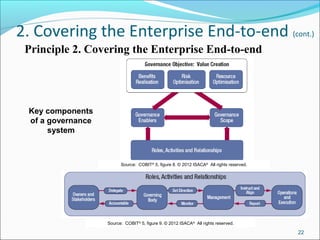
Principle 2. Covering the Enterprise End-to-end
Key components
of a governance
system
22
Source: COBIT®
5, figure 9. © 2012 ISACA®
All rights reserved.
Source: COBIT®
5, figure 8. © 2012 ISACA®
All rights reserved.
3. Applying a Single Integrated Framework
Principle 3. Applying a Single Integrated Framework:
COBIT 5 aligns with the latest relevant other standards and
frameworks used by enterprises:
Enterprise: COSO, COSO ERM, ISO/IEC 9000,
ISO/IEC 31000
IT-related: ISO/IEC 38500, ITIL, ISO/IEC 27000 series,
TOGAF, PMBOK/PRINCE2, CMMI
This allows the enterprise to use COBIT 5 as the
overarching governance and management framework
integrator.
ISACA plans a capability to facilitate COBIT user mapping
of practices and activities to third-party references.
23
4. Enabling a Holistic Approach
Principle 4. Enabling a Holistic Approach
COBIT 5 enablers are:
Factors that, individually and collectively, influence
whether something will work—in the case of COBIT,
governance and management over enterprise IT
Driven by the goals cascade, i.e., higher-level IT-related
goals define what the different enablers should achieve
Described by the COBIT 5 framework in seven
categories
24
4. Enabling a Holistic Approach (cont.)
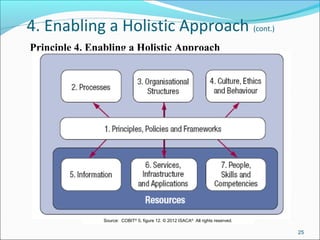
Principle 4. Enabling a Holistic Approach
25
Source:  COBIT®
 5, figure 12. © 2012 ISACA®
  All rights reserved.
4. Enabling a Holistic Approach (cont.)
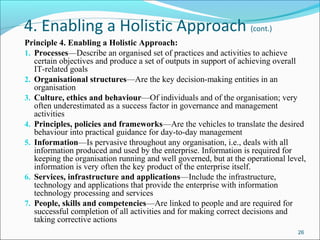
Principle 4. Enabling a Holistic Approach:
1. Processes—Describe an organised set of practices and activities to achieve
certain objectives and produce a set of outputs in support of achieving overall
IT-related goals
2. Organisational structures—Are the key decision-making entities in an
organisation
3. Culture, ethics and behaviour—Of individuals and of the organisation; very
often underestimated as a success factor in governance and management
activities
4. Principles, policies and frameworks—Are the vehicles to translate the desired
behaviour into practical guidance for day-to-day management
5. Information—Is pervasive throughout any organisation, i.e., deals with all
information produced and used by the enterprise. Information is required for
keeping the organisation running and well governed, but at the operational level,
information is very often the key product of the enterprise itself.
6. Services, infrastructure and applications—Include the infrastructure,
technology and applications that provide the enterprise with information
technology processing and services
7. People, skills and competencies—Are linked to people and are required for
successful completion of all activities and for making correct decisions and
taking corrective actions
26
4. Enabling a Holistic Approach (cont).
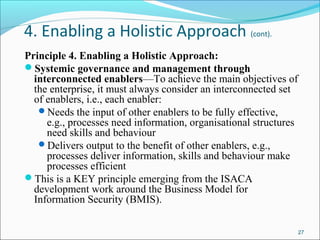
Principle 4. Enabling a Holistic Approach:
Systemic governance and management through
interconnected enablers—To achieve the main objectives of
the enterprise, it must always consider an interconnected set
of enablers, i.e., each enabler:
Needs the input of other enablers to be fully effective,
e.g., processes need information, organisational structures
need skills and behaviour
Delivers output to the benefit of other enablers, e.g.,
processes deliver information, skills and behaviour make
processes efficient
This is a KEY principle emerging from the ISACA
development work around the Business Model for
Information Security (BMIS).
27
4. Enabling a Holistic Approach (cont).
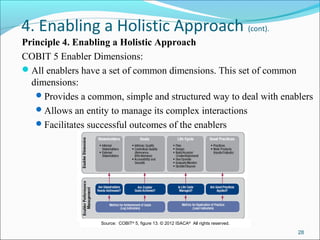
Principle 4. Enabling a Holistic Approach
COBIT 5 Enabler Dimensions:
All enablers have a set of common dimensions. This set of common
dimensions:
Provides a common, simple and structured way to deal with enablers
Allows an entity to manage its complex interactions
Facilitates successful outcomes of the enablers
28
Source:  COBIT®
 5, figure 13. © 2012 ISACA®
  All rights reserved.
5. Separating Governance From Management
Principle 5. Separating Governance From Management:
The COBIT 5 framework makes a clear distinction
between governance and management.
These two disciplines:
Encompass different types of activities
Require different organisational structures
Serve different purposes
Governance—In most enterprises, governance is the
responsibility of the board of directors under the
leadership of the chairperson.
Management—In most enterprises, management is the
responsibility of the executive management under the
leadership of the CEO.
29
5. Separating Governance From Management (cont.)
Principle 5. Separating Governance From
Management:
•Governance ensures that stakeholders needs, conditions
and options are evaluated to determine balanced, agreed-
on enterprise objectives to be achieved; setting direction
through prioritisation and decision making; and
monitoring performance and compliance against agreed-
on direction and objectives (EDM).
•Management plans, builds, runs and monitors
activities in alignment with the direction set by the
governance body to achieve the enterprise objectives
(PBRM).
30
5. Separating Governance From Management (cont.)
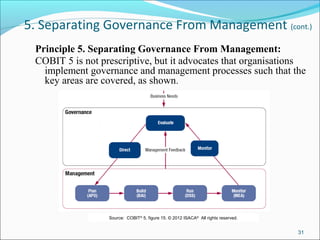
Principle 5. Separating Governance From Management:
COBIT 5 is not prescriptive, but it advocates that organisations
implement governance and management processes such that the
key areas are covered, as shown.
31
Source:  COBIT®
 5, figure 15. © 2012 ISACA®
  All rights reserved.
5. Separating Governance From Management (cont.)
Principle 5. Separating Governance from Management:
The COBIT 5 framework describes seven categories of
enablers (Principle 4). Processes are one category.
An enterprise can organise its processes as it sees fit, as
long as all necessary governance and management
objectives are covered. Smaller enterprises may have
fewer processes; larger and more complex enterprises
may have many processes, all to cover the same
objectives.
COBIT 5 includes a process reference model (PRM),
which defines and describes in detail a number of
governance and management processes. The details of
this specific enabler model can be found in the COBIT 5:
Enabling Processes volume.
32
COBIT 5: Enabling Processes
COBIT 5: Enabling Processes complements COBIT 5
and contains a detailed reference guide to the processes
that are defined in the COBIT 5 process reference model:
In Chapter 2, the COBIT 5 goals cascade is
recapitulated and complemented with a set of example
metrics for the enterprise goals and the IT-related goals.
In Chapter 3, the COBIT 5 process model is explained
and its components defined.
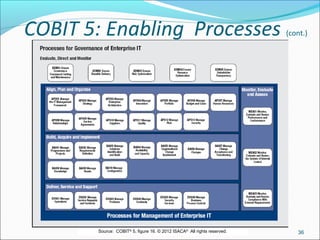
Chapter 4 shows the diagram of this process reference
model.
Chapter 5 contains the detailed process information for
all 37 COBIT 5 processes in the process reference
model.
34
COBIT 5: Enabling Processes (cont.)
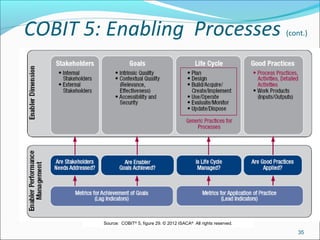
35
Source:  COBIT®
 5, figure 29. © 2012 ISACA®
  All rights reserved.
COBIT 5: Enabling Processes (cont.)
36Source:  COBIT®
 5, figure 16. © 2012 ISACA®
  All rights reserved.
COBIT 5: Enabling Processes (Cont.)
COBIT 5: Enabling Processes:
• The COBIT 5 process reference model subdivides the IT-
related practices and activities of the enterprise into two
main areas—governance and management— with
management further divided into domains of processes:
• The GOVERNANCE domain contains five
governance processes; within each process, evaluate,
direct and monitor (EDM) practices are defined.
• The four MANAGEMENT domains are in line with
the responsibility areas of plan, build, run and monitor
(PBRM).
37
COBIT 5 Implementation
• The improvement of the governance of enterprise IT
(GEIT) is widely recognised by top management as an
essential part of enterprise governance.
• Information and the pervasiveness of information
technology are increasingly part of every aspect of
business and public life.
• The need to drive more value from IT investments and
manage an increasing array of IT-related risk has never
been greater.
• Increasing regulation and legislation over business use of
information is also driving heightened awareness of the
importance of a well-governed and managed IT
environment.
39
COBIT 5 Implementation (cont.)
• ISACA has developed the COBIT 5 framework to help
enterprises implement sound governance enablers.
Indeed, implementing good GEIT is almost impossible
without engaging an effective governance framework.
Best practices and standards are also available to underpin
COBIT 5.
• Frameworks, best practices and standards are useful only
if they are adopted and adapted effectively. There are
challenges that need to be overcome and issues that need
to be addressed if GEIT is to be implemented
successfully.
• COBIT 5: Implementation provides guidance on how
to do this.
40
COBIT 5 Implementation (cont.)
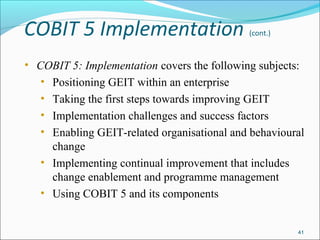
• COBIT 5: Implementation covers the following subjects:
• Positioning GEIT within an enterprise
• Taking the first steps towards improving GEIT
• Implementation challenges and success factors
• Enabling GEIT-related organisational and behavioural
change
• Implementing continual improvement that includes
change enablement and programme management
• Using COBIT 5 and its components
41
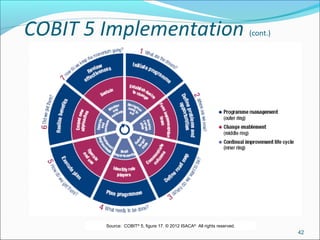
COBIT 5 Implementation (cont.)
42
Source: COBIT®
5, figure 17. © 2012 ISACA®
All rights reserved.
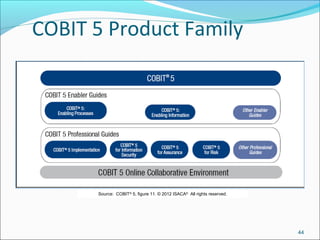
COBIT 5 Product Family
44
Source: COBIT®
5, figure 11. © 2012 ISACA®
All rights reserved.
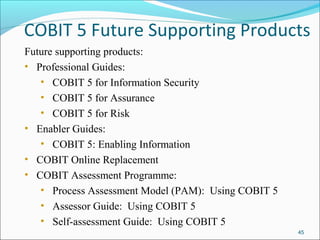
COBIT 5 Future Supporting Products
Future supporting products:
• Professional Guides:
• COBIT 5 for Information Security
• COBIT 5 for Assurance
• COBIT 5 for Risk
• Enabler Guides:
• COBIT 5: Enabling Information
• COBIT Online Replacement
• COBIT Assessment Programme:
• Process Assessment Model (PAM): Using COBIT 5
• Assessor Guide: Using COBIT 5
• Self-assessment Guide: Using COBIT 5
45

Cobit5 introduction

  • 1.
  • 2.
    © 2012 ISACA.All rights reserved. No part of this publication may be used, copied, reproduced, modified, distributed, displayed, stored in a retrieval system or transmitted in any form by any means (electronic, mechanical, photocopying, recording or otherwise) without the prior written authorisation of ISACA. Use of this publication is permitted solely for personal use and must include full attribution of the material’s source. No other right or permission is granted with respect to this work. 2
  • 4.
    Information! Information is akey resource for all enterprises. Information is created, used, retained, disclosed and destroyed. Technology plays a key role in these actions. Technology is becoming pervasive in all aspects of business and personal life. What benefits do information and technology bring to enterprises? 4
  • 5.
    Enterprise Benefits Enterprises andtheir executives strive to: Maintain quality information to support business decisions. Generate business value from IT-enabled investments, i.e., achieve strategic goals and realise business benefits through effective and innovative use of IT. Achieve operational excellence through reliable and efficient application of technology. Maintain IT-related risk at an acceptable level. Optimise the cost of IT services and technology. How can these benefits be realised to create enterprise stakeholder value? 5
  • 6.
    Stakeholder Value Delivering enterprisestakeholder value requires good governance and management of information and technology (IT) assets. Enterprise boards, executives and management have to embrace IT like any other significant part of the business. External legal, regulatory and contractual compliance requirements related to enterprise use of information and technology are increasing, threatening value if breached. COBIT 5 provides a comprehensive framework that assists enterprises to achieve their goals and deliver value through effective governance and management of enterprise IT. 6
  • 7.
    The COBIT 5Framework Simply stated, COBIT 5 helps enterprises create optimal value from IT by maintaining a balance between realising benefits and optimising risk levels and resource use. COBIT 5 enables information and related technology to be governed and managed in a holistic manner for the entire enterprise, taking in the full end-to-end business and functional areas of responsibility, considering the IT-related interests of internal and external stakeholders. The COBIT 5 principles and enablers are generic and useful for enterprises of all sizes, whether commercial, not-for-profit or in the public sector. 7
  • 8.
  • 9.
  • 10.
    Governance and Management Governanceensures that enterprise objectives are achieved by evaluating stakeholder needs, conditions and options; setting direction through prioritisation and decision making; and monitoring performance, compliance and progress against agreed-on direction and objectives (EDM). Management plans, builds, runs and monitors activities in alignment with the direction set by the governance body to achieve the enterprise objectives (PBRM). 10
  • 11.
    In Summary … COBIT5 brings together the five principles that allow the enterprise to build an effective governance and management framework based on a holistic set of seven enablers that optimises information and technology investment and use for the benefit of stakeholders. 11
  • 13.
    IT Governance COBIT4.0/4.1 Management COBIT3 Control COBIT2 An businessframework from ISACA, at www.isaca.org/cobit Audit COBIT1 COBIT 5: Now One Complete Business Framework for 2005/720001998 Evolutionofscope 1996 2012 Val IT 2.0 (2008) Risk IT (2009) 13 © 2012 ISACA® All rights reserved.
  • 14.
    COBIT 5 Framework COBIT5: The main, overarching COBIT 5 product Contains the executive summary and the full description of all of the COBIT 5 framework components: The five COBIT 5 principles The seven COBIT 5 enablers plus An introduction to the implementation guidance provided by ISACA (COBIT 5 Implementation) An introduction to the COBIT Assessment Programme (not specific to COBIT 5) and the process capability approach being adopted by ISACA for COBIT 14
  • 15.
    15 COBIT 5 ProductFamily Source: COBIT® 5, figure 11. © 2012 ISACA® All rights reserved.
  • 16.
    Five COBIT 5Principles The five COBIT 5 principles: 1.Meeting Stakeholder Needs 2.Covering the Enterprise End-to-end 3.Applying a Single Integrated Framework 4.Enabling a Holistic Approach 5.Separating Governance From Management 16
  • 17.
    1. Meeting StakeholderNeeds Principle 1. Meeting Stakeholder Needs Enterprises exist to create value for their stakeholders. 17 Source: COBIT® 5, figure 3. © 2012 ISACA® All rights reserved.
  • 18.
    1. Meeting StakeholderNeeds (cont.) Principle 1. Meeting Stakeholder Needs: Enterprises have many stakeholders, and ‘creating value’ means different—and sometimes conflicting—things to each of them. Governance is about negotiating and deciding amongst different stakeholders’ value interests. The governance system should consider all stakeholders when making benefit, resource and risk assessment decisions. For each decision, the following can and should be asked: ­ Who receives the benefits? ­ Who bears the risk? ­ What resources are required? 18
  • 19.
    1. Meeting StakeholderNeeds (cont.) Principle 1. Meeting Stakeholder Needs: Stakeholder needs have to be transformed into an enterprise’s practical strategy. The COBIT 5 goals cascade translates stakeholder needs into specific, practical and customised goals within the context of the enterprise, IT-related goals and enabler goals. 19 Source: COBIT® 5, figure 4. © 2012 ISACA® All rights reserved.
  • 20.
    1. Meeting StakeholderNeeds (cont.) Principle 1. Meeting Stakeholder Needs: Benefits of the COBIT 5 goals cascade: It allows the definition of priorities for implementation, improvement and assurance of enterprise governance of IT based on (strategic) objectives of the enterprise and the related risk. In practice, the goals cascade: Defines relevant and tangible goals and objectives at various levels of responsibility. Filters the knowledge base of COBIT 5, based on enterprise goals to extract relevant guidance for inclusion in specific implementation, improvement or assurance projects. Clearly identifies and communicates how (sometimes very operational) enablers are important to achieve enterprise goals. 20
  • 21.
    2. Covering theEnterprise End-to-end Principle 2. Covering the Enterprise End-to-end: COBIT 5 addresses the governance and management of information and related technology from an enterprisewide, end-to-end perspective. This means that COBIT 5: Integrates governance of enterprise IT into enterprise governance, i.e., the governance system for enterprise IT proposed by COBIT 5 integrates seamlessly in any governance system because COBIT 5 aligns with the latest views on governance. Covers all functions and processes within the enterprise; COBIT 5 does not focus only on the ‘IT function’, but treats information and related technologies as assets that need to be dealt with just like any other asset by everyone in the enterprise. 21
  • 22.
    2. Covering theEnterprise End-to-end (cont.) Principle 2. Covering the Enterprise End-to-end Key components of a governance system 22 Source: COBIT® 5, figure 9. © 2012 ISACA® All rights reserved. Source: COBIT® 5, figure 8. © 2012 ISACA® All rights reserved.
  • 23.
    3. Applying aSingle Integrated Framework Principle 3. Applying a Single Integrated Framework: COBIT 5 aligns with the latest relevant other standards and frameworks used by enterprises: Enterprise: COSO, COSO ERM, ISO/IEC 9000, ISO/IEC 31000 IT-related: ISO/IEC 38500, ITIL, ISO/IEC 27000 series, TOGAF, PMBOK/PRINCE2, CMMI This allows the enterprise to use COBIT 5 as the overarching governance and management framework integrator. ISACA plans a capability to facilitate COBIT user mapping of practices and activities to third-party references. 23
  • 24.
    4. Enabling aHolistic Approach Principle 4. Enabling a Holistic Approach COBIT 5 enablers are: Factors that, individually and collectively, influence whether something will work—in the case of COBIT, governance and management over enterprise IT Driven by the goals cascade, i.e., higher-level IT-related goals define what the different enablers should achieve Described by the COBIT 5 framework in seven categories 24
  • 25.
    4. Enabling aHolistic Approach (cont.) Principle 4. Enabling a Holistic Approach 25 Source:  COBIT®  5, figure 12. © 2012 ISACA®   All rights reserved.
  • 26.
    4. Enabling aHolistic Approach (cont.) Principle 4. Enabling a Holistic Approach: 1. Processes—Describe an organised set of practices and activities to achieve certain objectives and produce a set of outputs in support of achieving overall IT-related goals 2. Organisational structures—Are the key decision-making entities in an organisation 3. Culture, ethics and behaviour—Of individuals and of the organisation; very often underestimated as a success factor in governance and management activities 4. Principles, policies and frameworks—Are the vehicles to translate the desired behaviour into practical guidance for day-to-day management 5. Information—Is pervasive throughout any organisation, i.e., deals with all information produced and used by the enterprise. Information is required for keeping the organisation running and well governed, but at the operational level, information is very often the key product of the enterprise itself. 6. Services, infrastructure and applications—Include the infrastructure, technology and applications that provide the enterprise with information technology processing and services 7. People, skills and competencies—Are linked to people and are required for successful completion of all activities and for making correct decisions and taking corrective actions 26
  • 27.
    4. Enabling aHolistic Approach (cont). Principle 4. Enabling a Holistic Approach: Systemic governance and management through interconnected enablers—To achieve the main objectives of the enterprise, it must always consider an interconnected set of enablers, i.e., each enabler: Needs the input of other enablers to be fully effective, e.g., processes need information, organisational structures need skills and behaviour Delivers output to the benefit of other enablers, e.g., processes deliver information, skills and behaviour make processes efficient This is a KEY principle emerging from the ISACA development work around the Business Model for Information Security (BMIS). 27
  • 28.
    4. Enabling aHolistic Approach (cont). Principle 4. Enabling a Holistic Approach COBIT 5 Enabler Dimensions: All enablers have a set of common dimensions. This set of common dimensions: Provides a common, simple and structured way to deal with enablers Allows an entity to manage its complex interactions Facilitates successful outcomes of the enablers 28 Source:  COBIT®  5, figure 13. © 2012 ISACA®   All rights reserved.
  • 29.
    5. Separating GovernanceFrom Management Principle 5. Separating Governance From Management: The COBIT 5 framework makes a clear distinction between governance and management. These two disciplines: Encompass different types of activities Require different organisational structures Serve different purposes Governance—In most enterprises, governance is the responsibility of the board of directors under the leadership of the chairperson. Management—In most enterprises, management is the responsibility of the executive management under the leadership of the CEO. 29
  • 30.
    5. Separating GovernanceFrom Management (cont.) Principle 5. Separating Governance From Management: •Governance ensures that stakeholders needs, conditions and options are evaluated to determine balanced, agreed- on enterprise objectives to be achieved; setting direction through prioritisation and decision making; and monitoring performance and compliance against agreed- on direction and objectives (EDM). •Management plans, builds, runs and monitors activities in alignment with the direction set by the governance body to achieve the enterprise objectives (PBRM). 30
  • 31.
    5. Separating GovernanceFrom Management (cont.) Principle 5. Separating Governance From Management: COBIT 5 is not prescriptive, but it advocates that organisations implement governance and management processes such that the key areas are covered, as shown. 31 Source:  COBIT®  5, figure 15. © 2012 ISACA®   All rights reserved.
  • 32.
    5. Separating GovernanceFrom Management (cont.) Principle 5. Separating Governance from Management: The COBIT 5 framework describes seven categories of enablers (Principle 4). Processes are one category. An enterprise can organise its processes as it sees fit, as long as all necessary governance and management objectives are covered. Smaller enterprises may have fewer processes; larger and more complex enterprises may have many processes, all to cover the same objectives. COBIT 5 includes a process reference model (PRM), which defines and describes in detail a number of governance and management processes. The details of this specific enabler model can be found in the COBIT 5: Enabling Processes volume. 32
  • 34.
    COBIT 5: EnablingProcesses COBIT 5: Enabling Processes complements COBIT 5 and contains a detailed reference guide to the processes that are defined in the COBIT 5 process reference model: In Chapter 2, the COBIT 5 goals cascade is recapitulated and complemented with a set of example metrics for the enterprise goals and the IT-related goals. In Chapter 3, the COBIT 5 process model is explained and its components defined. Chapter 4 shows the diagram of this process reference model. Chapter 5 contains the detailed process information for all 37 COBIT 5 processes in the process reference model. 34
  • 35.
    COBIT 5: EnablingProcesses (cont.) 35 Source:  COBIT®  5, figure 29. © 2012 ISACA®   All rights reserved.
  • 36.
    COBIT 5: EnablingProcesses (cont.) 36Source:  COBIT®  5, figure 16. © 2012 ISACA®   All rights reserved.
  • 37.
    COBIT 5: EnablingProcesses (Cont.) COBIT 5: Enabling Processes: • The COBIT 5 process reference model subdivides the IT- related practices and activities of the enterprise into two main areas—governance and management— with management further divided into domains of processes: • The GOVERNANCE domain contains five governance processes; within each process, evaluate, direct and monitor (EDM) practices are defined. • The four MANAGEMENT domains are in line with the responsibility areas of plan, build, run and monitor (PBRM). 37
  • 39.
    COBIT 5 Implementation •The improvement of the governance of enterprise IT (GEIT) is widely recognised by top management as an essential part of enterprise governance. • Information and the pervasiveness of information technology are increasingly part of every aspect of business and public life. • The need to drive more value from IT investments and manage an increasing array of IT-related risk has never been greater. • Increasing regulation and legislation over business use of information is also driving heightened awareness of the importance of a well-governed and managed IT environment. 39
  • 40.
    COBIT 5 Implementation(cont.) • ISACA has developed the COBIT 5 framework to help enterprises implement sound governance enablers. Indeed, implementing good GEIT is almost impossible without engaging an effective governance framework. Best practices and standards are also available to underpin COBIT 5. • Frameworks, best practices and standards are useful only if they are adopted and adapted effectively. There are challenges that need to be overcome and issues that need to be addressed if GEIT is to be implemented successfully. • COBIT 5: Implementation provides guidance on how to do this. 40
  • 41.
    COBIT 5 Implementation(cont.) • COBIT 5: Implementation covers the following subjects: • Positioning GEIT within an enterprise • Taking the first steps towards improving GEIT • Implementation challenges and success factors • Enabling GEIT-related organisational and behavioural change • Implementing continual improvement that includes change enablement and programme management • Using COBIT 5 and its components 41
  • 42.
    COBIT 5 Implementation(cont.) 42 Source: COBIT® 5, figure 17. © 2012 ISACA® All rights reserved.
  • 44.
    COBIT 5 ProductFamily 44 Source: COBIT® 5, figure 11. © 2012 ISACA® All rights reserved.
  • 45.
    COBIT 5 FutureSupporting Products Future supporting products: • Professional Guides: • COBIT 5 for Information Security • COBIT 5 for Assurance • COBIT 5 for Risk • Enabler Guides: • COBIT 5: Enabling Information • COBIT Online Replacement • COBIT Assessment Programme: • Process Assessment Model (PAM): Using COBIT 5 • Assessor Guide: Using COBIT 5 • Self-assessment Guide: Using COBIT 5 45