UNIT-8: Incompatibilities In
Formulation
1
BY: FM
FANTAHUN M.
Contents
2
BY: FM
 Introduction
 Types of incompatibilities
 Physical incompatibilities
 Chemical incompatibilities
 Therapeutic
incompatibilities
 Correction of incompatibilities
Introduction
3
BY: FM
 Incompatibility is defined as a result of mixing of two or
more
antagonistic substances and undesirable product is formed,
 which may affect the safety
, efficacy
, appearance and stability
of the pharmaceutical product.
 Incompatibilities may be detected by changes in
 the physical, chemical and therapeutic qualities of the medicine.
 Incompatibility arise during
 compounding, manufacturing, packaging, dispensing, storage or
administration.
Types of Incompatibilities
4
BY: FM
1. Physical Incompatibilities
2. Chemical Incompatibilities
3. Therapeutic
Incompatibilities
1. Physical Incompatibilities
5
BY: FM
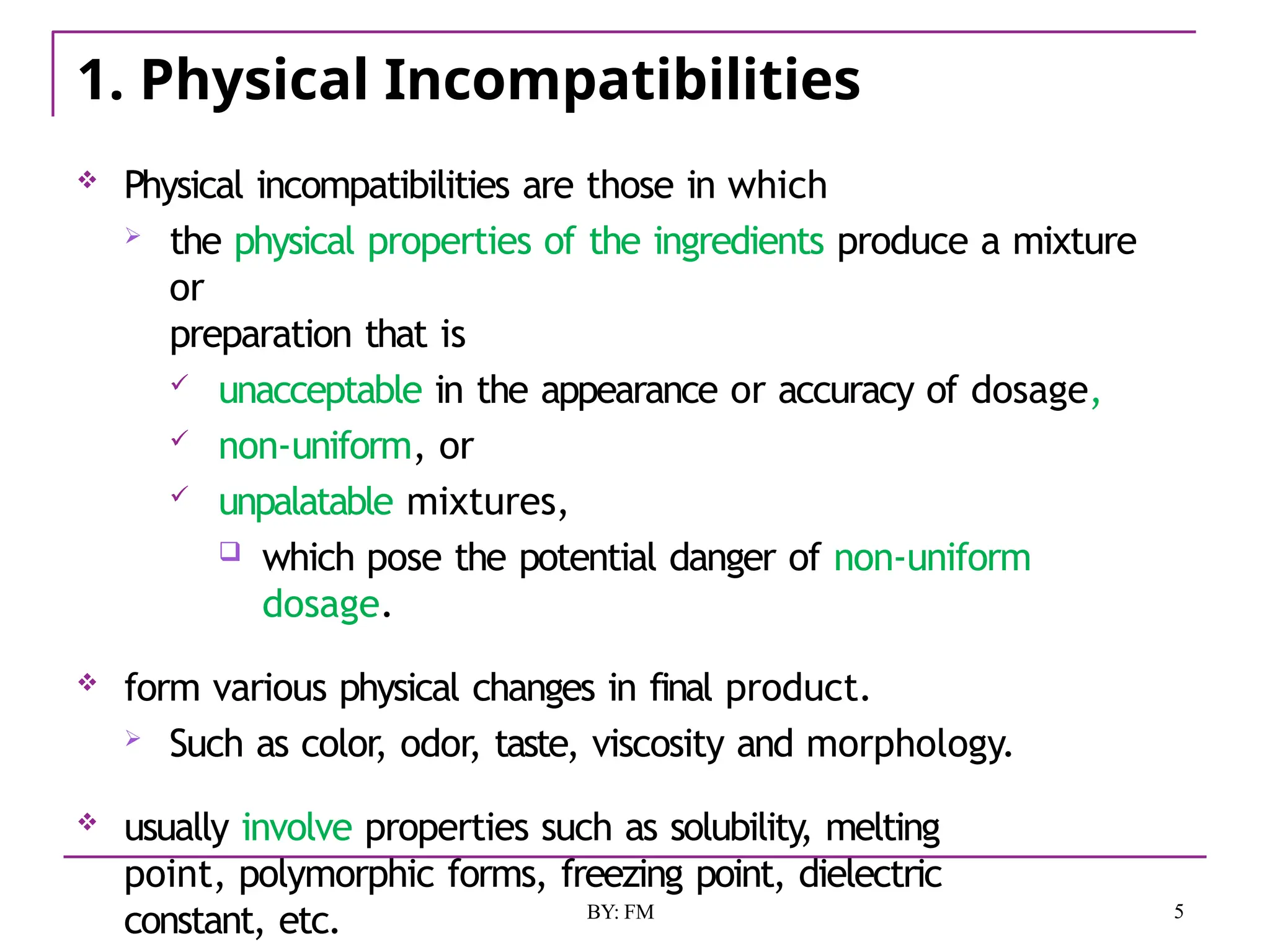
 Physical incompatibilities are those in which
 the physical properties of the ingredients produce a mixture
or
preparation that is
 unacceptable in the appearance or accuracy of dosage,
 non-uniform, or
 unpalatable mixtures,
 which pose the potential danger of non-uniform
dosage.
 form various physical changes in final product.
 Such as color, odor, taste, viscosity and morphology.
 usually involve properties such as solubility, melting
point, polymorphic forms, freezing point, dielectric
constant, etc.
Cont. . .
6
BY: FM
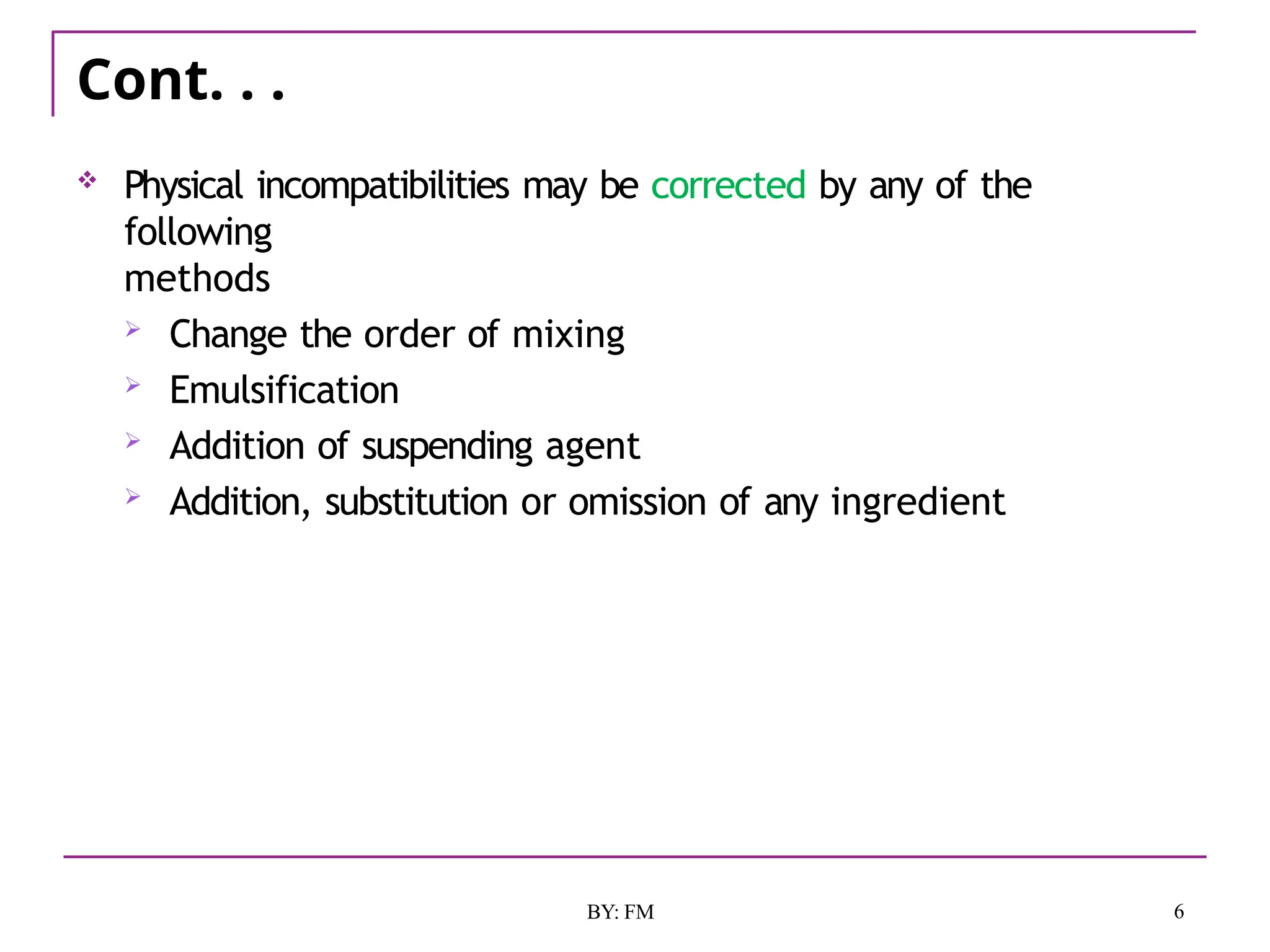
 Physical incompatibilities may be corrected by any of the
following
methods
 Change the order of mixing
 Emulsification
 Addition of suspending agent
 Addition, substitution or omission of any ingredient
Cont. . .
7
BY: FM
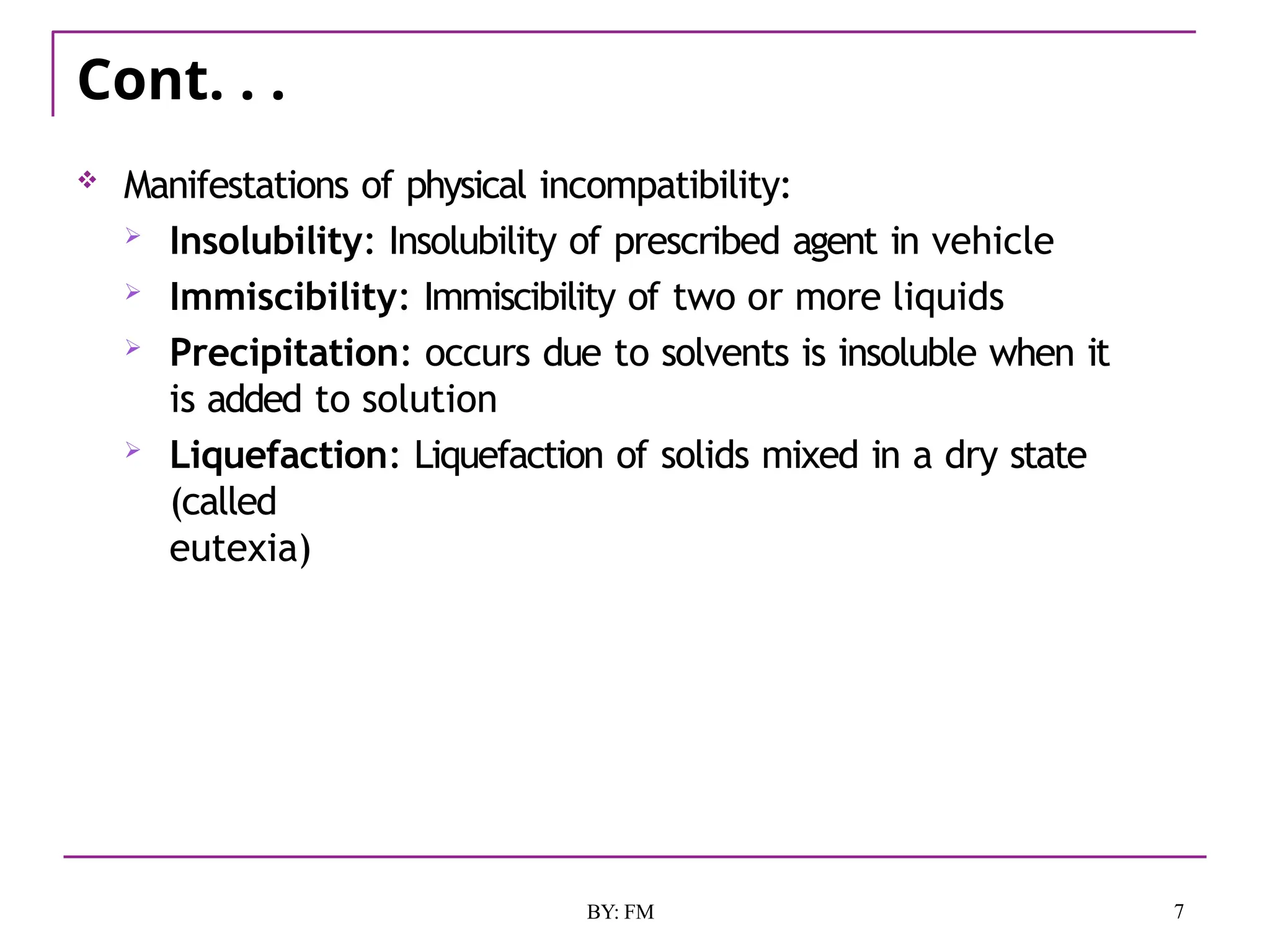
 Manifestations of physical incompatibility:
 Insolubility: Insolubility of prescribed agent in vehicle
 Immiscibility: Immiscibility of two or more liquids
 Precipitation: occurs due to solvents is insoluble when it
is added to solution
 Liquefaction: Liquefaction of solids mixed in a dry state
(called
eutexia)
Cont. . .
8
BY: FM
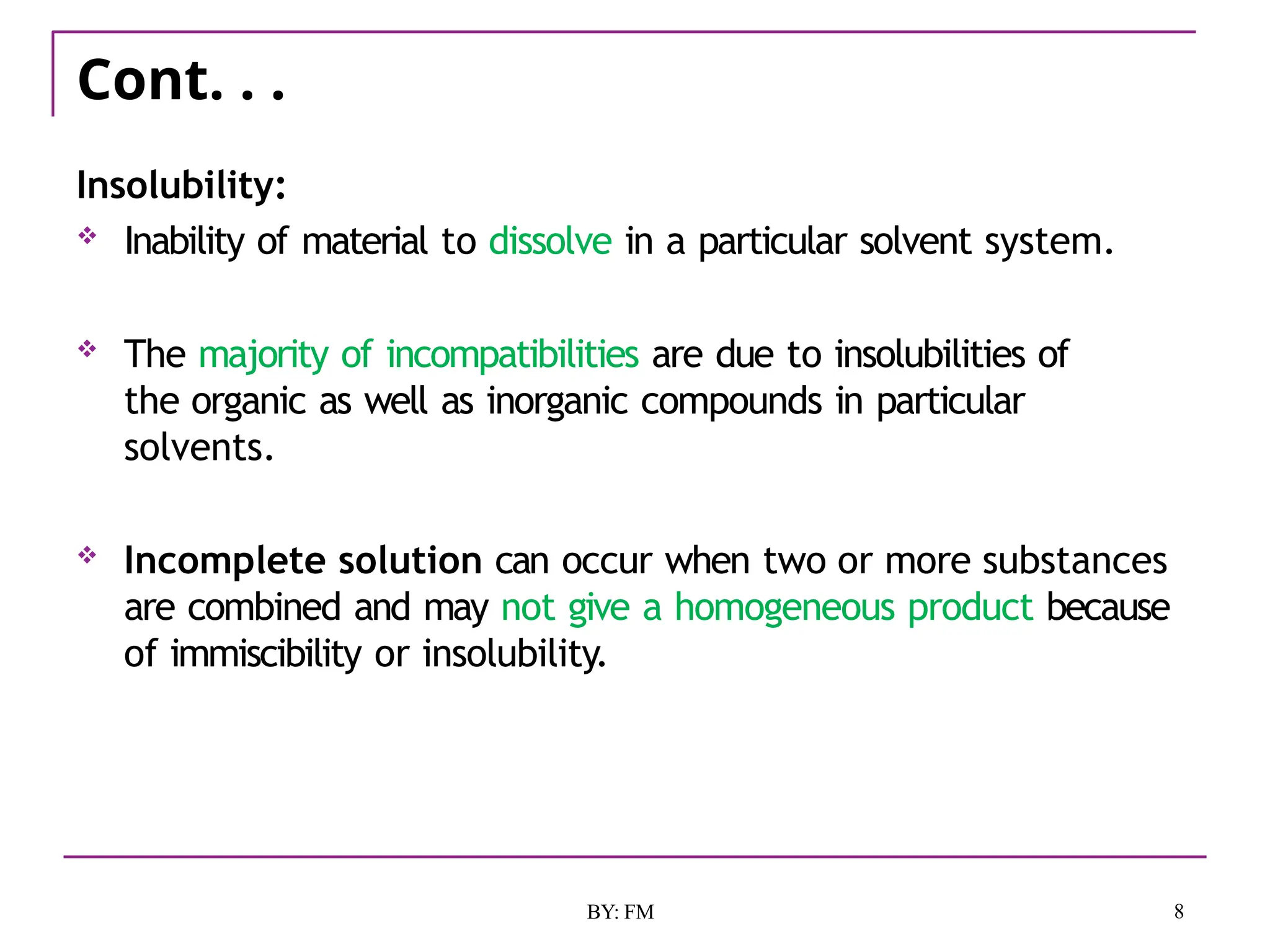
Insolubility:
 Inability of material to dissolve in a particular solvent system.
 The majority of incompatibilities are due to insolubilities of
the organic as well as inorganic compounds in particular
solvents.
 Incomplete solution can occur when two or more substances
are combined and may not give a homogeneous product because
of immiscibility or insolubility.
Cont. . .
9
BY: FM
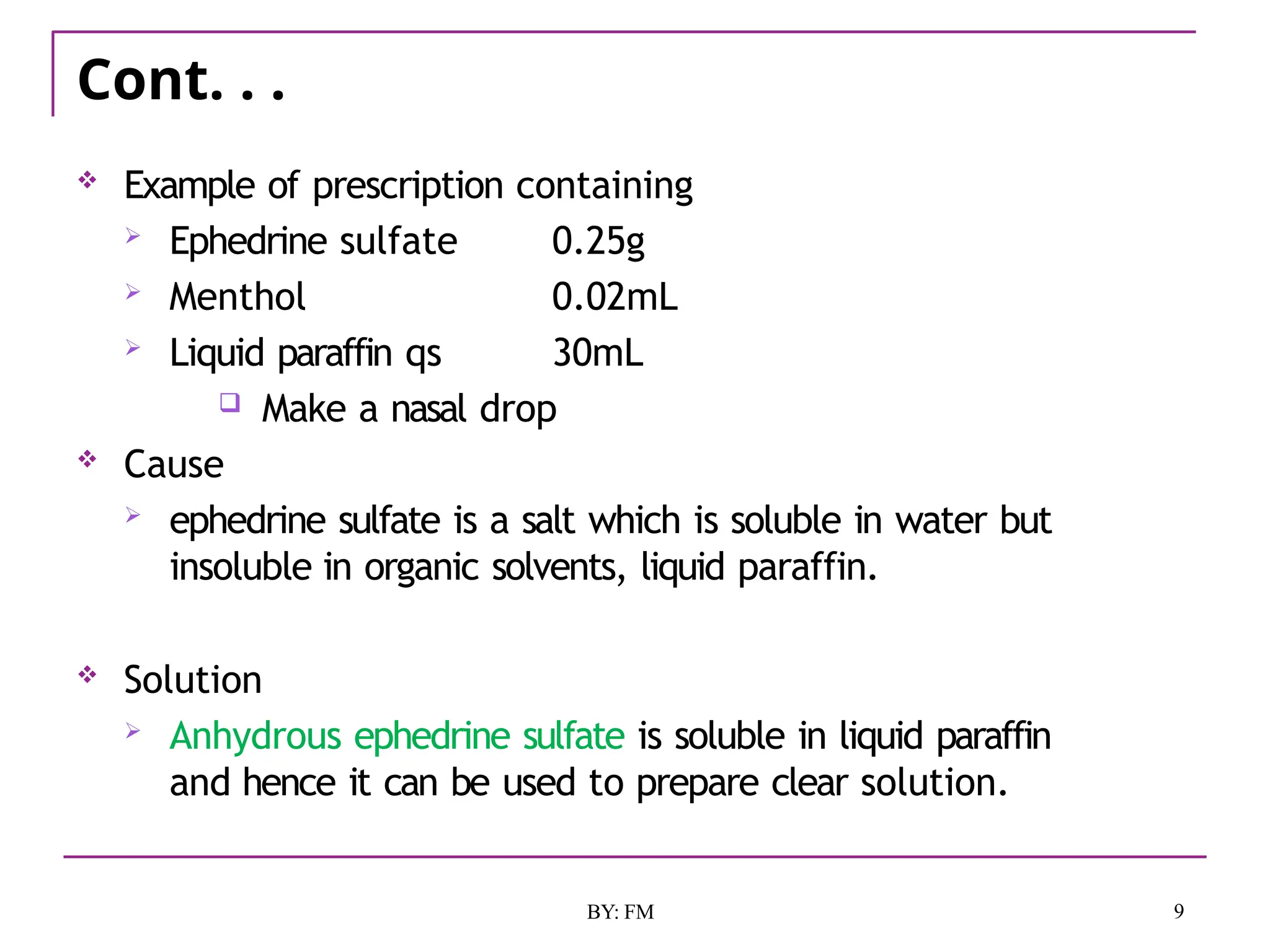
 Example of prescription containing
 Ephedrine sulfate 0.25g
 Menthol 0.02mL
 Liquid paraffin qs 30mL
 Make a nasal drop
 Cause
 ephedrine sulfate is a salt which is soluble in water but
insoluble in organic solvents, liquid paraffin.
 Solution
 Anhydrous ephedrine sulfate is soluble in liquid paraffin
and hence it can be used to prepare clear solution.
Cont. . .
10
BY: FM
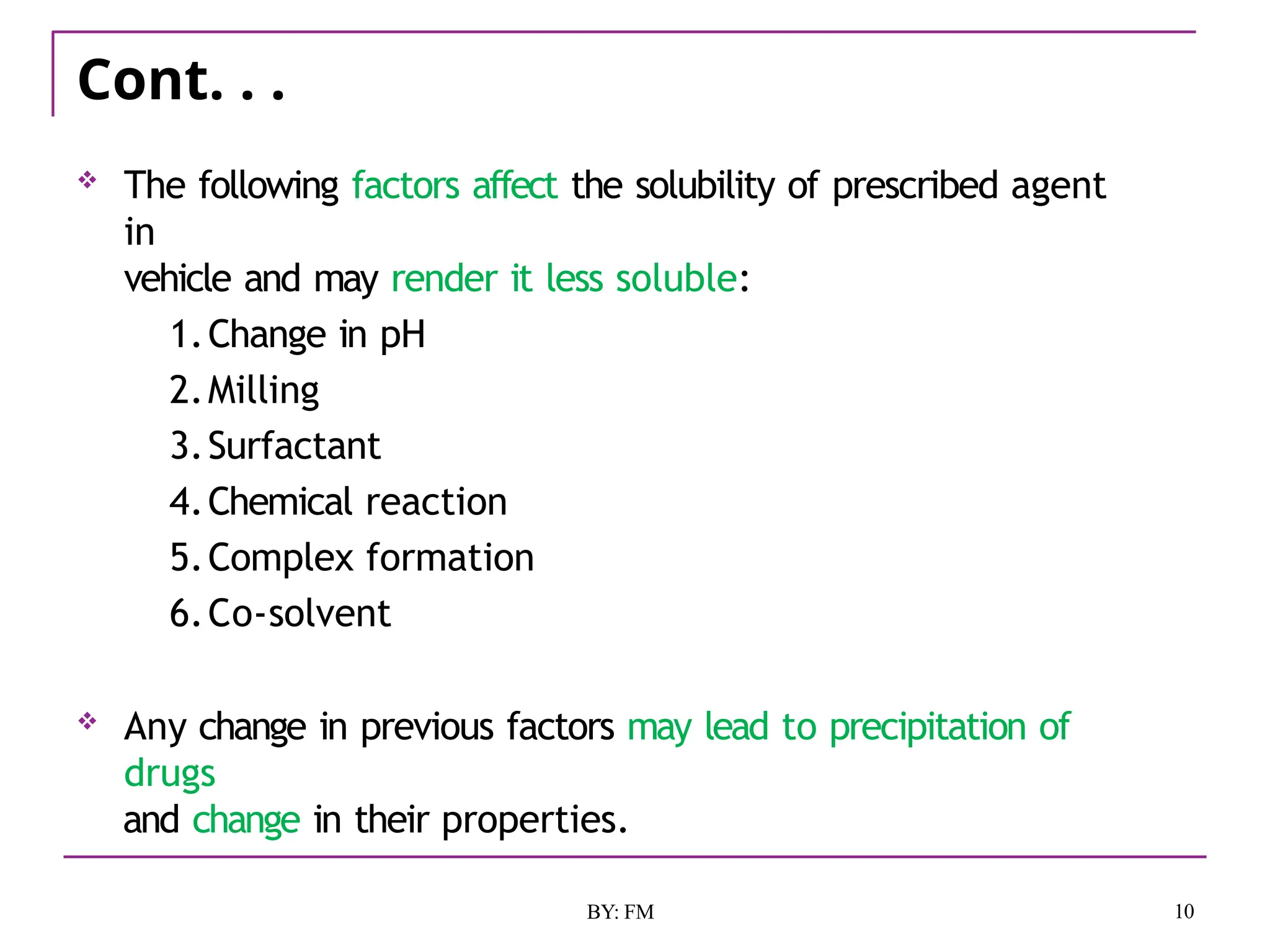
 The following factors affect the solubility of prescribed agent
in
vehicle and may render it less soluble:
1.Change in pH
2.Milling
3.Surfactant
4.Chemical reaction
5.Complex formation
6.Co-solvent
 Any change in previous factors may lead to precipitation of
drugs
and change in their properties.
Cont. . .
11
BY: FM
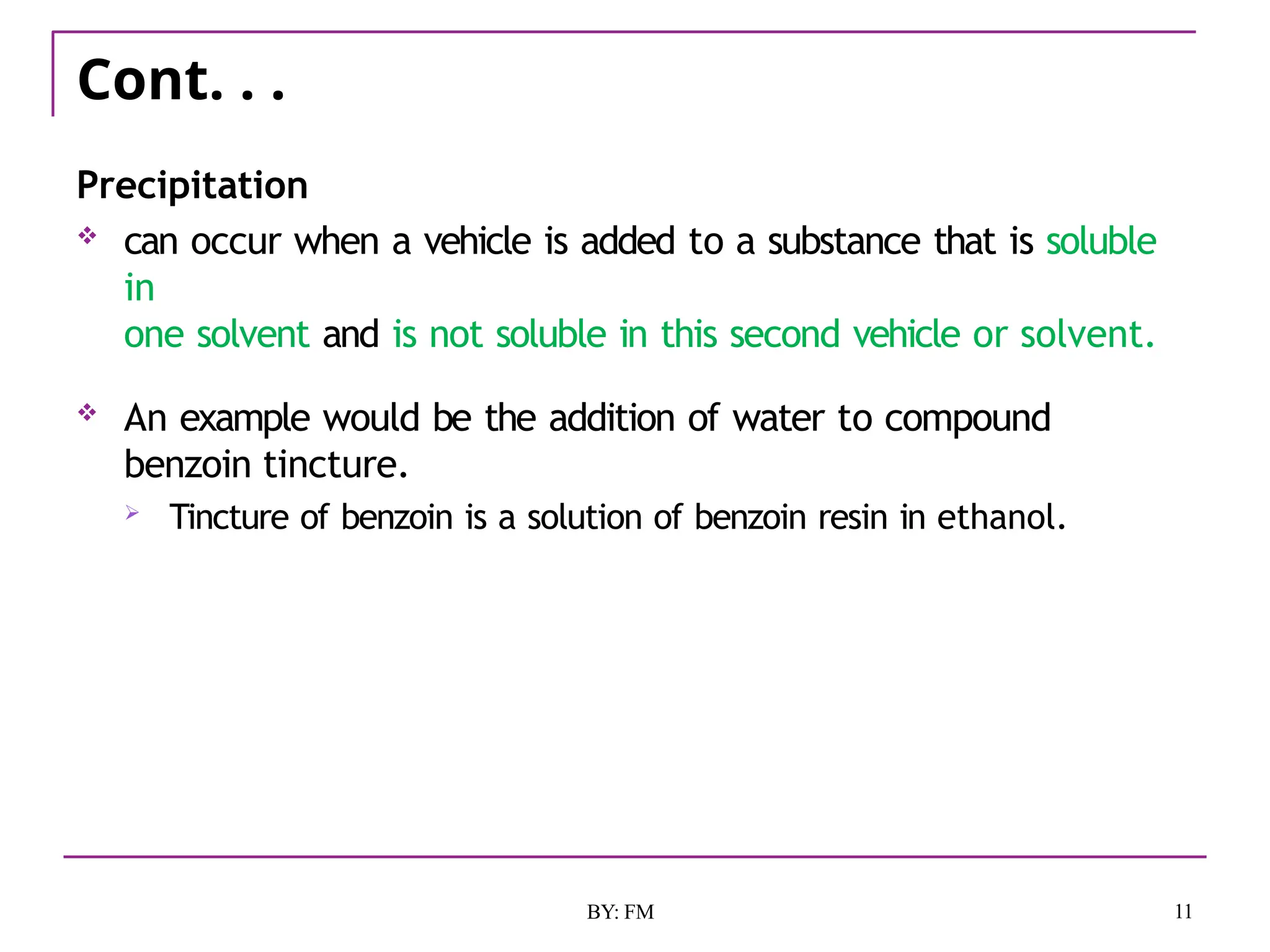
Precipitation
 can occur when a vehicle is added to a substance that is soluble
in
one solvent and is not soluble in this second vehicle or solvent.
 An example would be the addition of water to compound
benzoin tincture.
 Tincture of benzoin is a solution of benzoin resin in ethanol.
Cont. . .
12
BY: FM
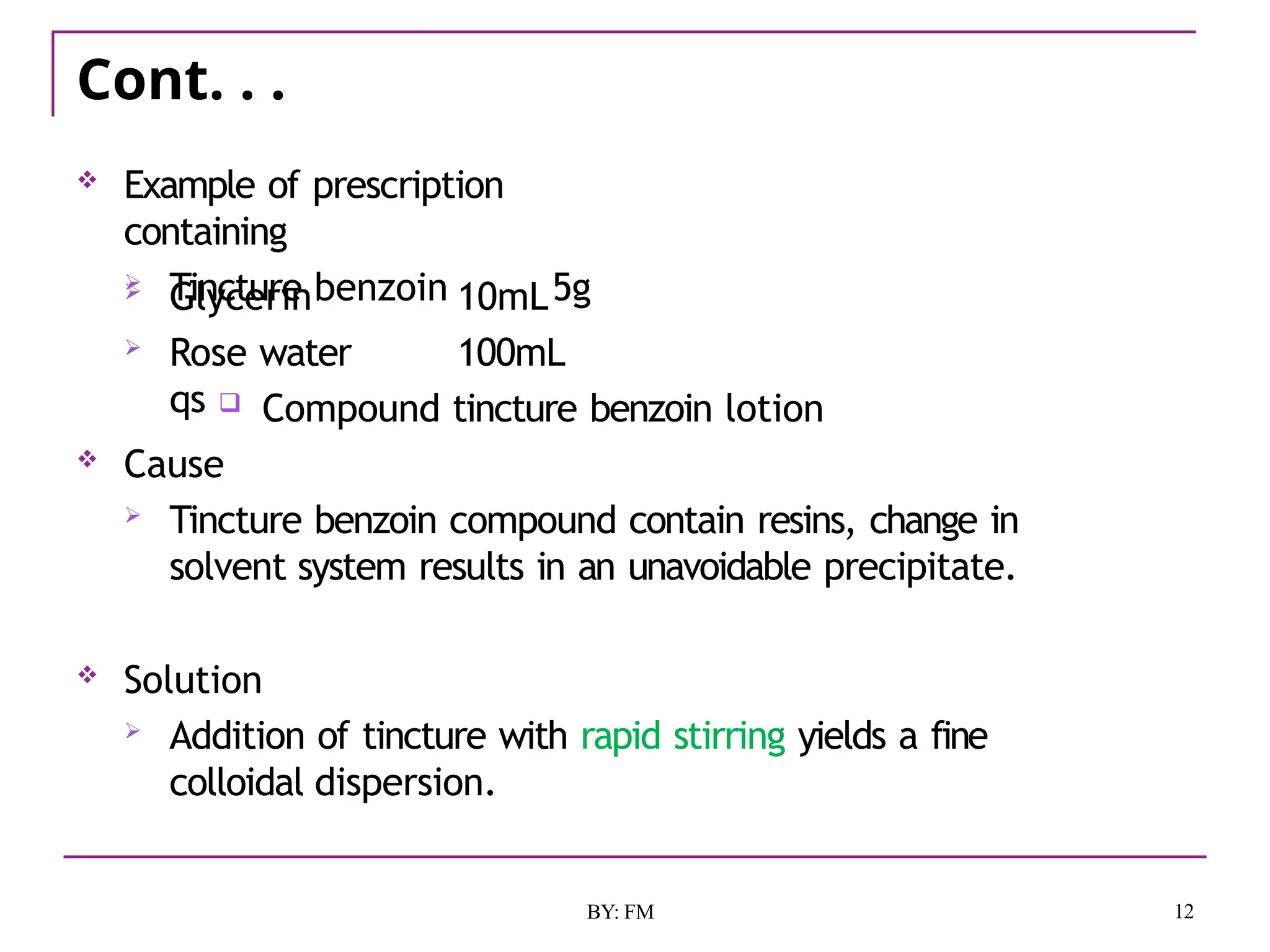
 Example of prescription
containing
 Tincture benzoin 5g
 Glycerin
 Rose water
qs
10mL
100mL
 Compound tincture benzoin lotion
 Cause
 Tincture benzoin compound contain resins, change in
solvent system results in an unavoidable precipitate.
 Solution
 Addition of tincture with rapid stirring yields a fine
colloidal dispersion.
Cont. . .
13
BY: FM
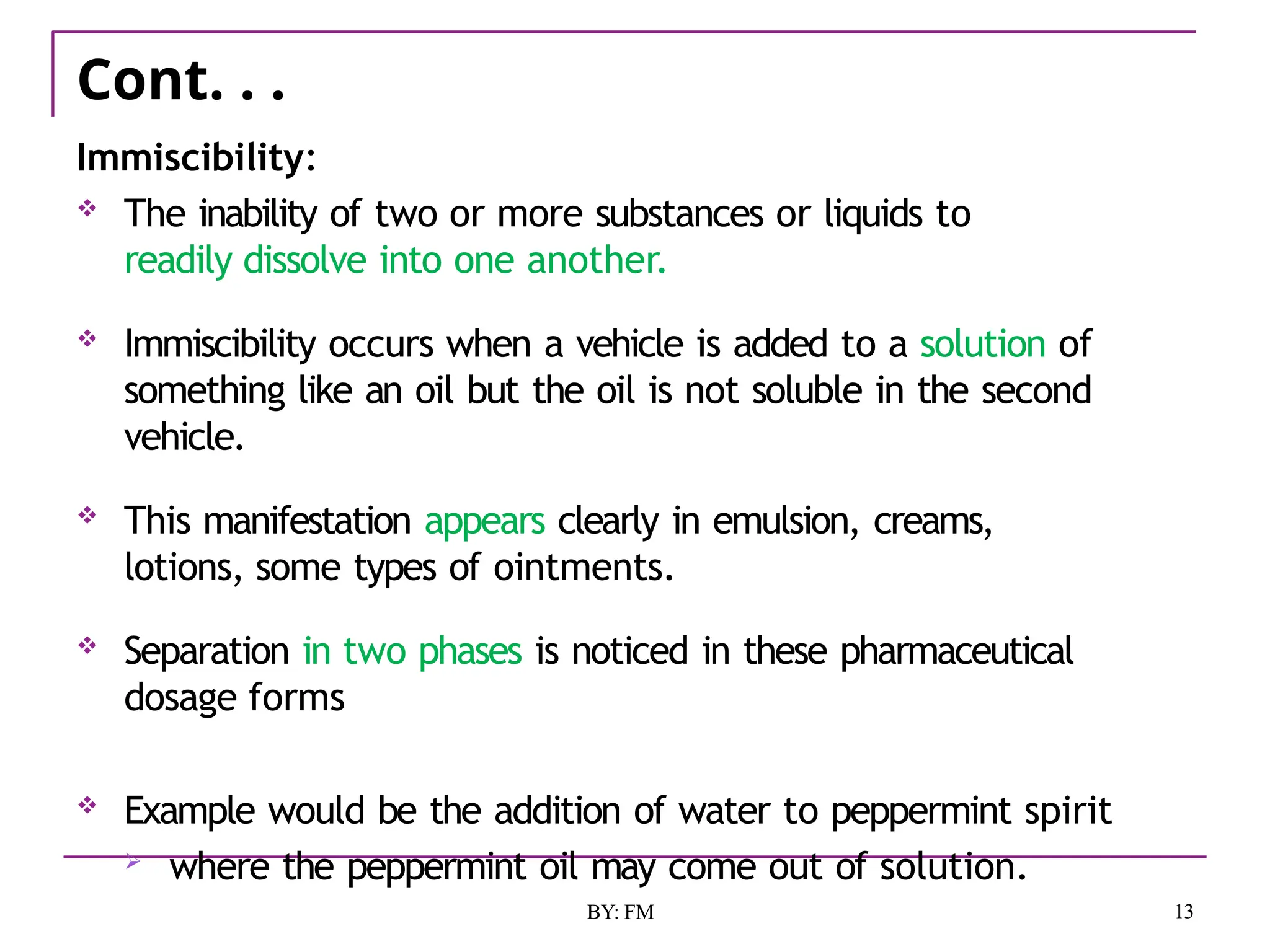
Immiscibility:
 The inability of two or more substances or liquids to
readily dissolve into one another.
 Immiscibility occurs when a vehicle is added to a solution of
something like an oil but the oil is not soluble in the second
vehicle.
 This manifestation appears clearly in emulsion, creams,
lotions, some types of ointments.
 Separation in two phases is noticed in these pharmaceutical
dosage forms
 Example would be the addition of water to peppermint spirit
 where the peppermint oil may come out of solution.
Cont. . .
14
BY: FM
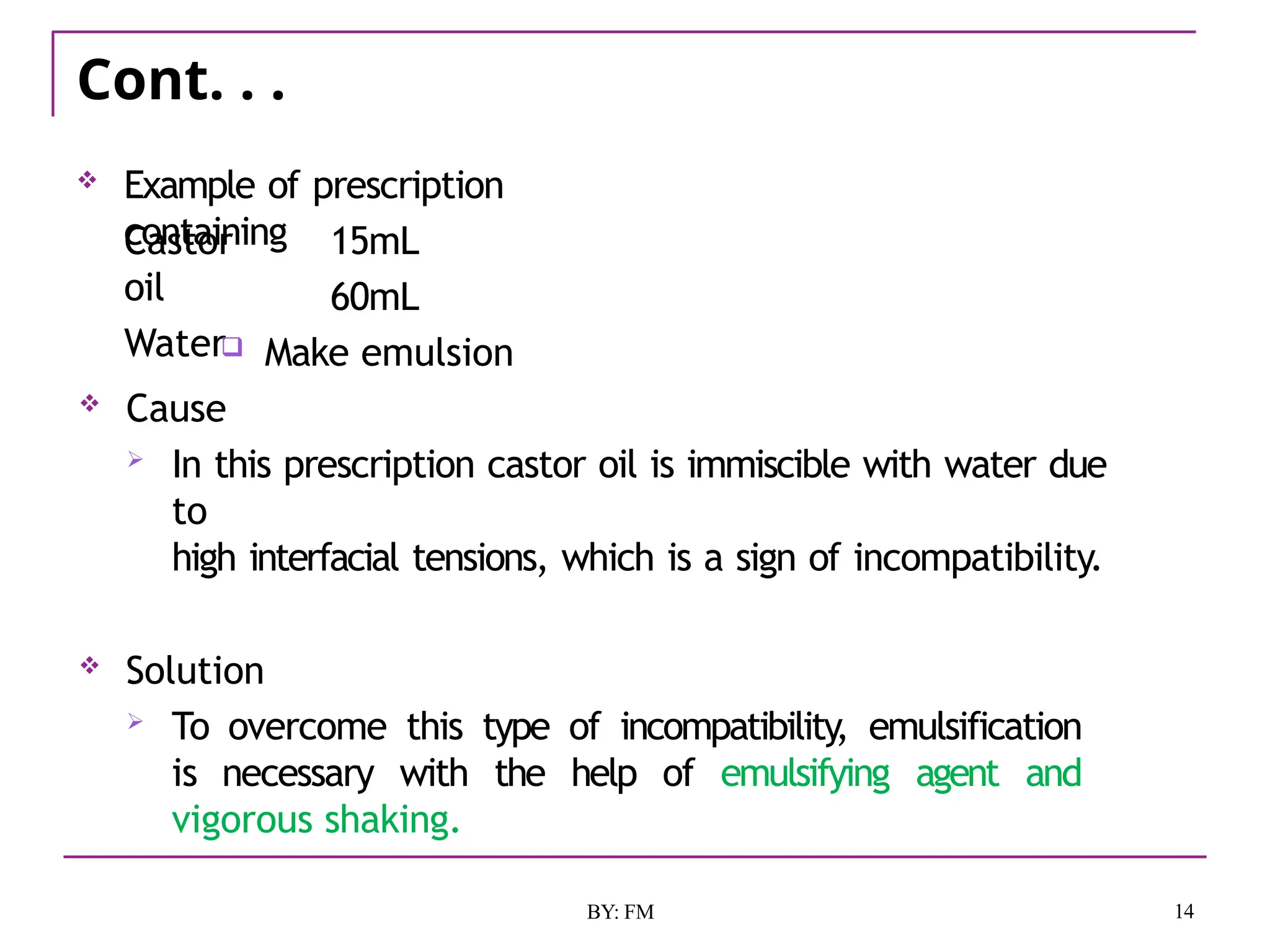
 Example of prescription
containing
Castor
oil
Water
15mL
60mL
 Make emulsion
 Cause
 In this prescription castor oil is immiscible with water due
to
high interfacial tensions, which is a sign of incompatibility.
 Solution
 To overcome this type of incompatibility, emulsification
is necessary with the help of emulsifying agent and
vigorous shaking.
Cont. . .
15
BY: FM
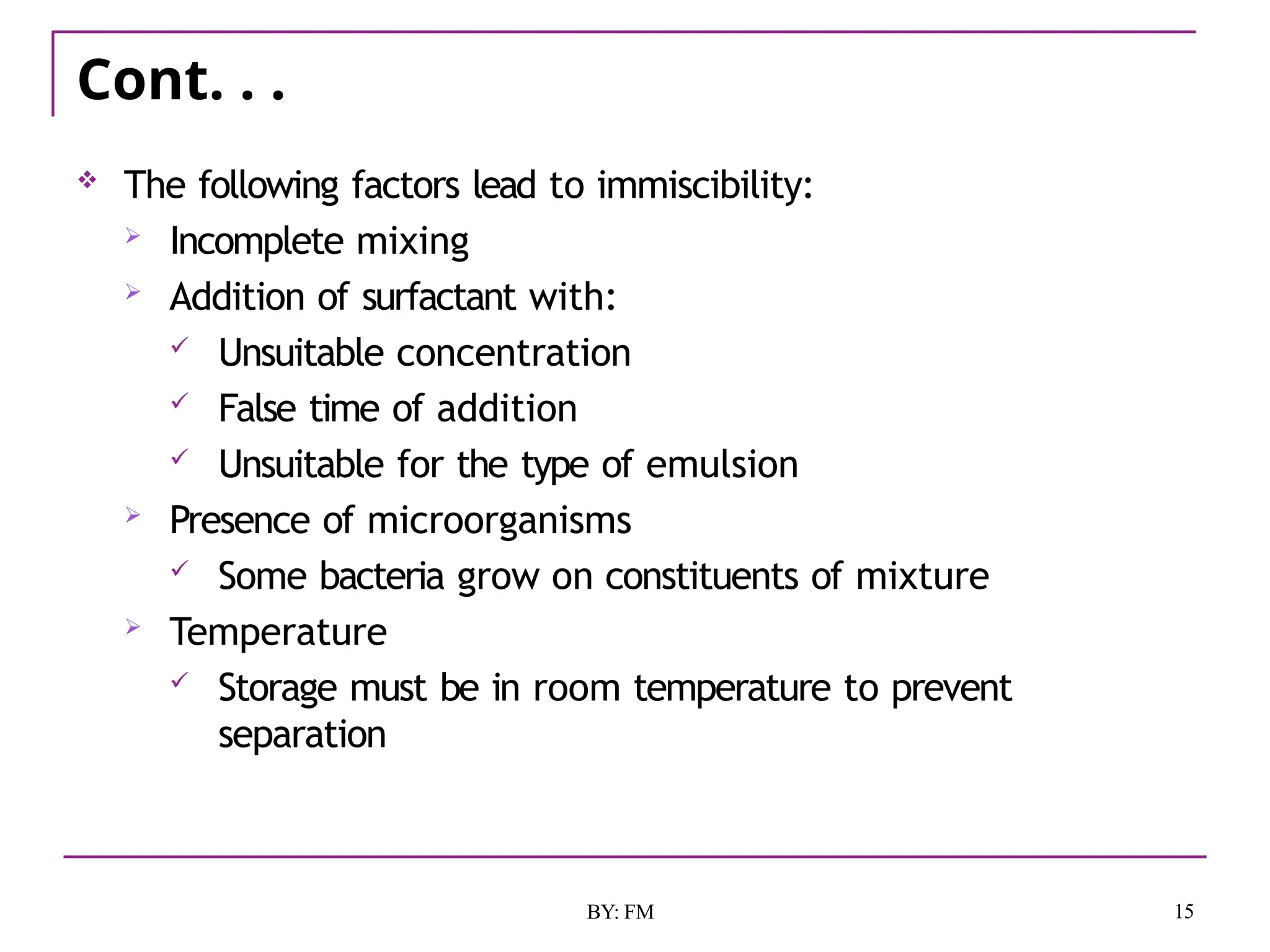
 The following factors lead to immiscibility:
 Incomplete mixing
 Addition of surfactant with:
 Unsuitable concentration
 False time of addition
 Unsuitable for the type of emulsion
 Presence of microorganisms
 Some bacteria grow on constituents of mixture
 Temperature
 Storage must be in room temperature to prevent
separation
Cont. . .
16
BY: FM
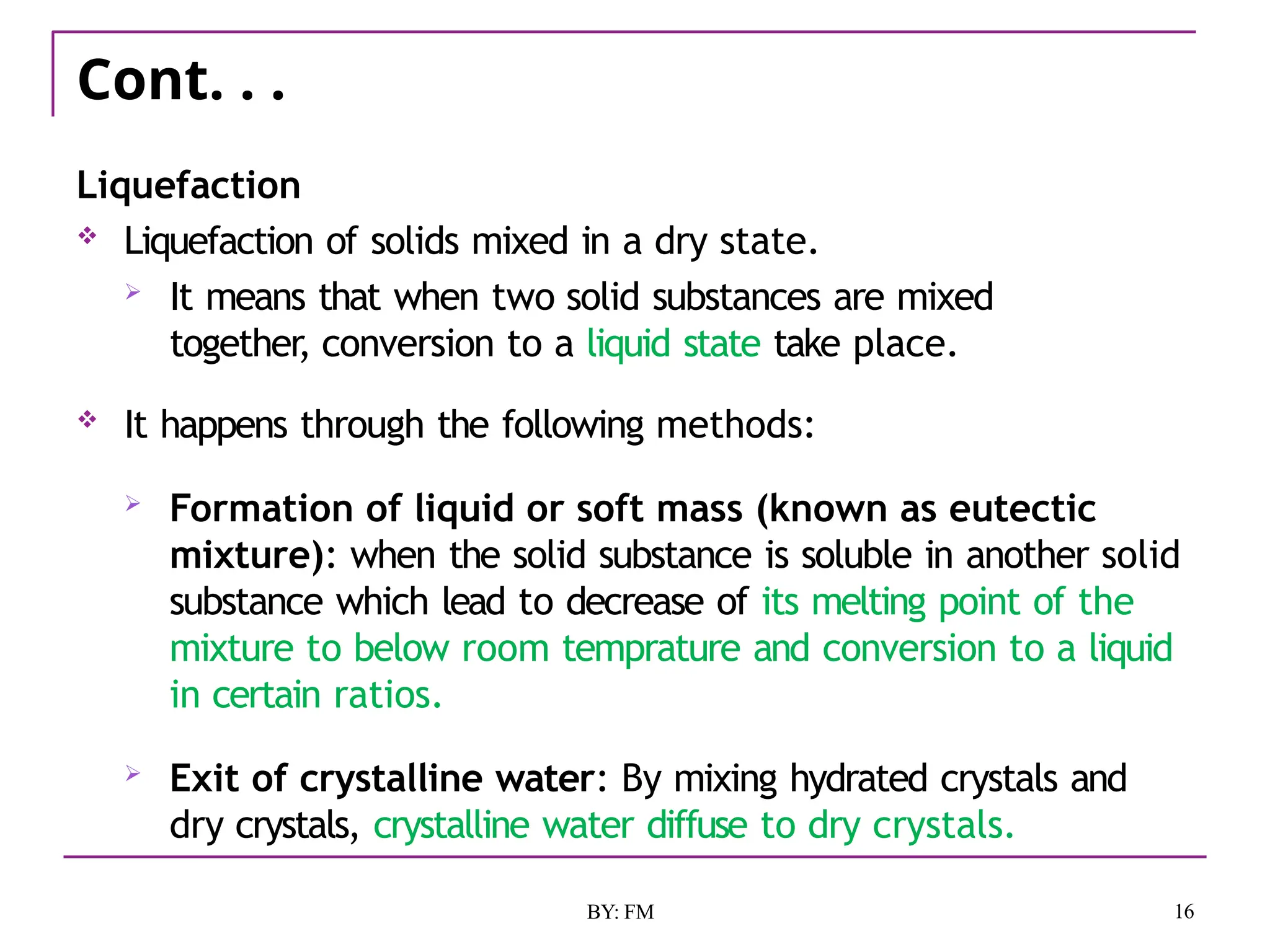
Liquefaction
 Liquefaction of solids mixed in a dry state.
 It means that when two solid substances are mixed
together, conversion to a liquid state take place.
 It happens through the following methods:
 Formation of liquid or soft mass (known as eutectic
mixture): when the solid substance is soluble in another solid
substance which lead to decrease of its melting point of the
mixture to below room temprature and conversion to a liquid
in certain ratios.
 Exit of crystalline water: By mixing hydrated crystals and
dry crystals, crystalline water diffuse to dry crystals.
Cont. . .
17
BY: FM
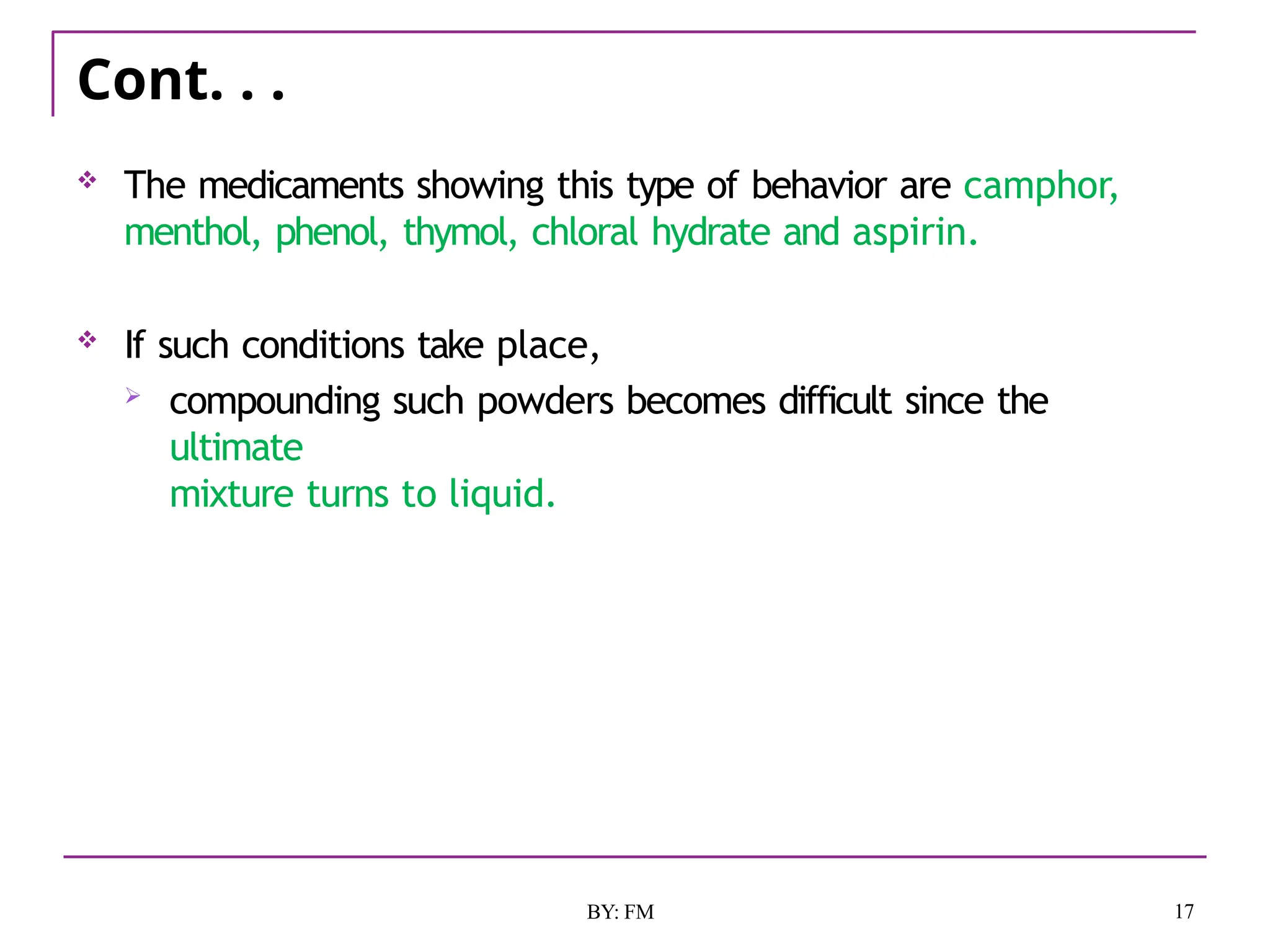
 The medicaments showing this type of behavior are camphor,
menthol, phenol, thymol, chloral hydrate and aspirin.
 If such conditions take place,
 compounding such powders becomes difficult since the
ultimate
mixture turns to liquid.
Cont. . .
18
BY: FM
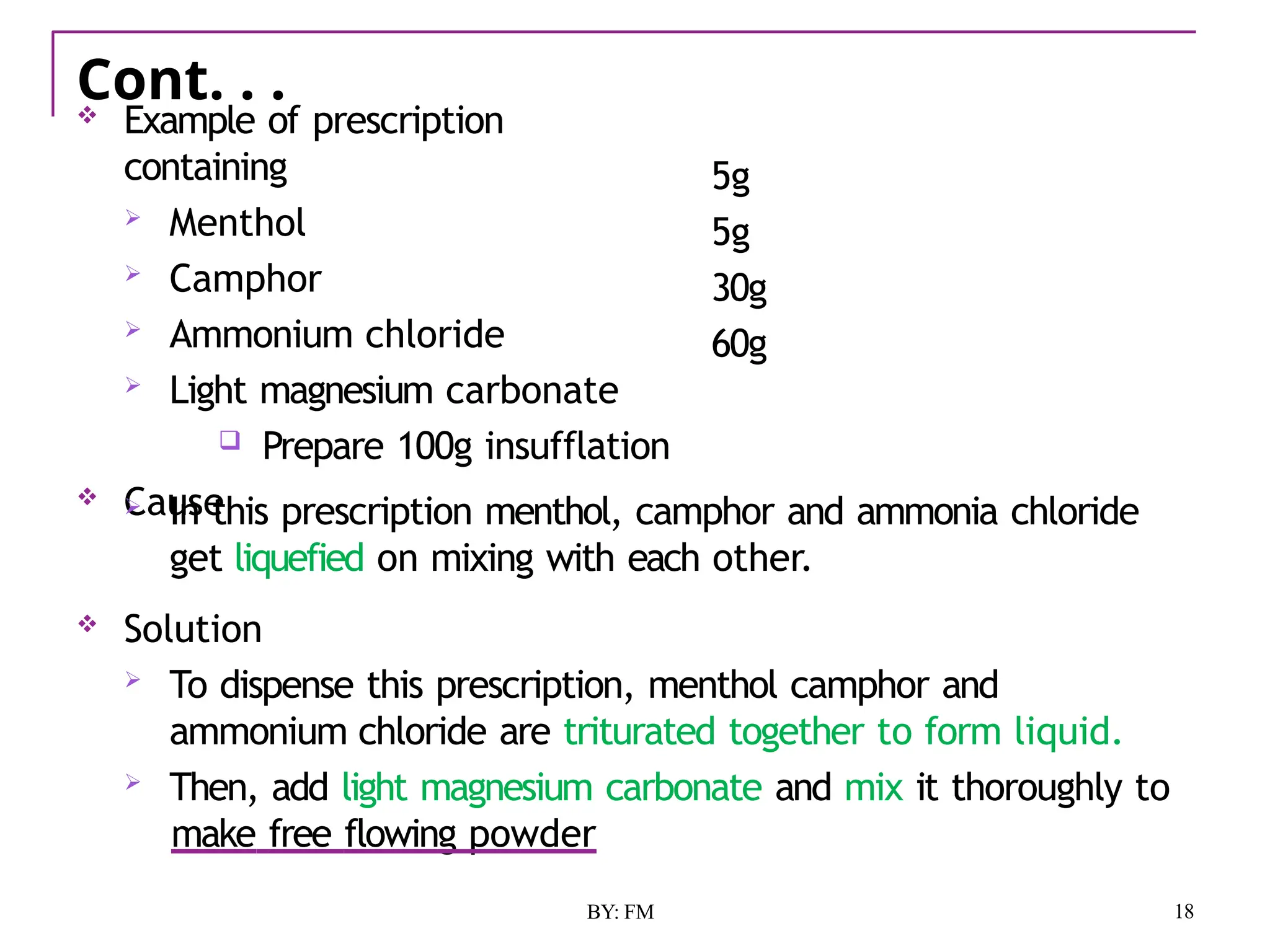
 Example of prescription
containing
 Menthol
 Camphor
 Ammonium chloride
 Light magnesium carbonate
 Prepare 100g insufflation
 Cause
5g
5g
30g
60g
 In this prescription menthol, camphor and ammonia chloride
get liquefied on mixing with each other.
 Solution
 To dispense this prescription, menthol camphor and
ammonium chloride are triturated together to form liquid.
 Then, add light magnesium carbonate and mix it thoroughly to
make free flowing powder
2. Chemical Incompatibilities
19
BY: FM
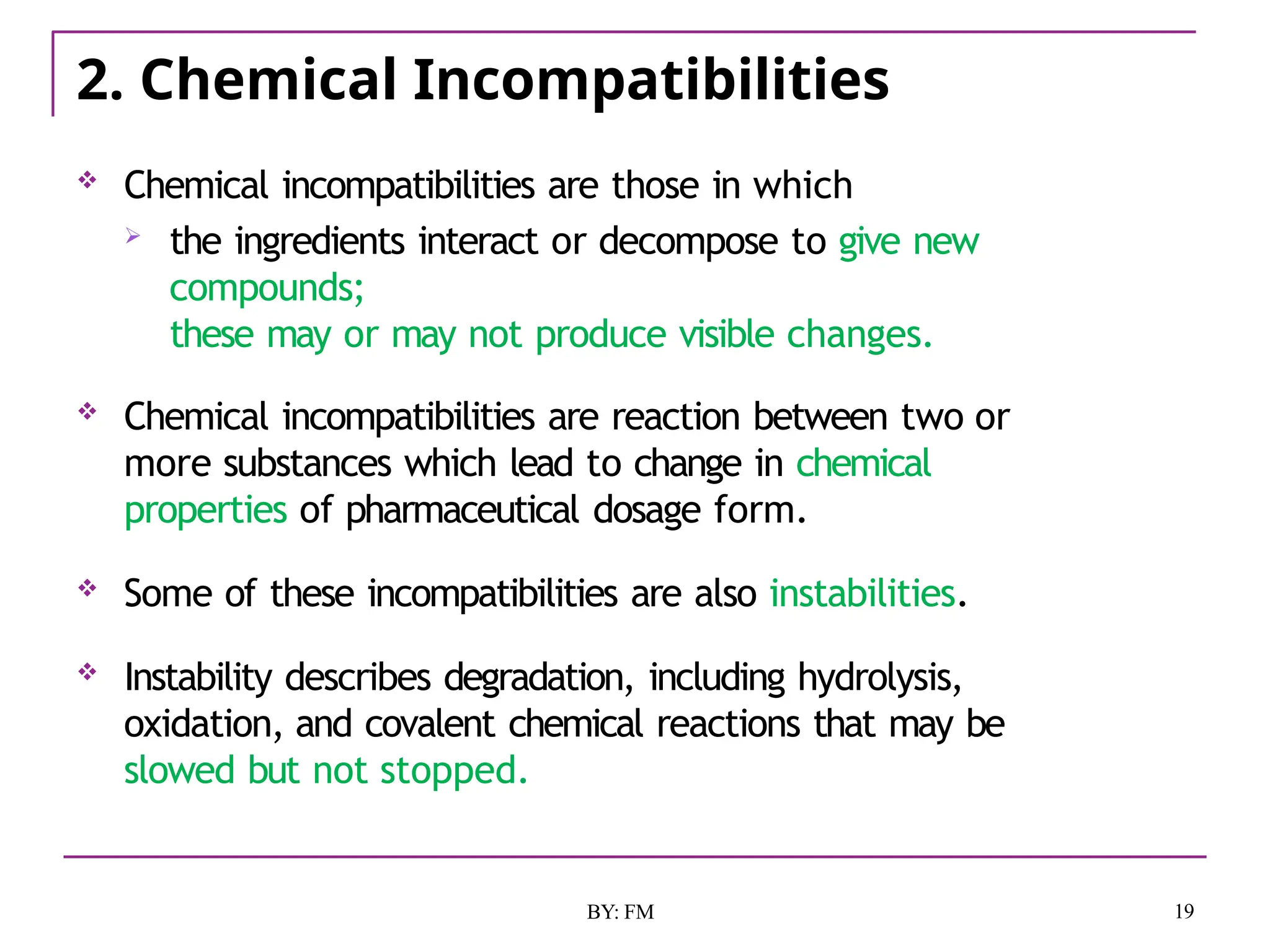
 Chemical incompatibilities are those in which
 the ingredients interact or decompose to give new
compounds;
these may or may not produce visible changes.
 Chemical incompatibilities are reaction between two or
more substances which lead to change in chemical
properties of pharmaceutical dosage form.
 Some of these incompatibilities are also instabilities.
 Instability describes degradation, including hydrolysis,
oxidation, and covalent chemical reactions that may be
slowed but not stopped.
Cont. . .
20
BY: FM
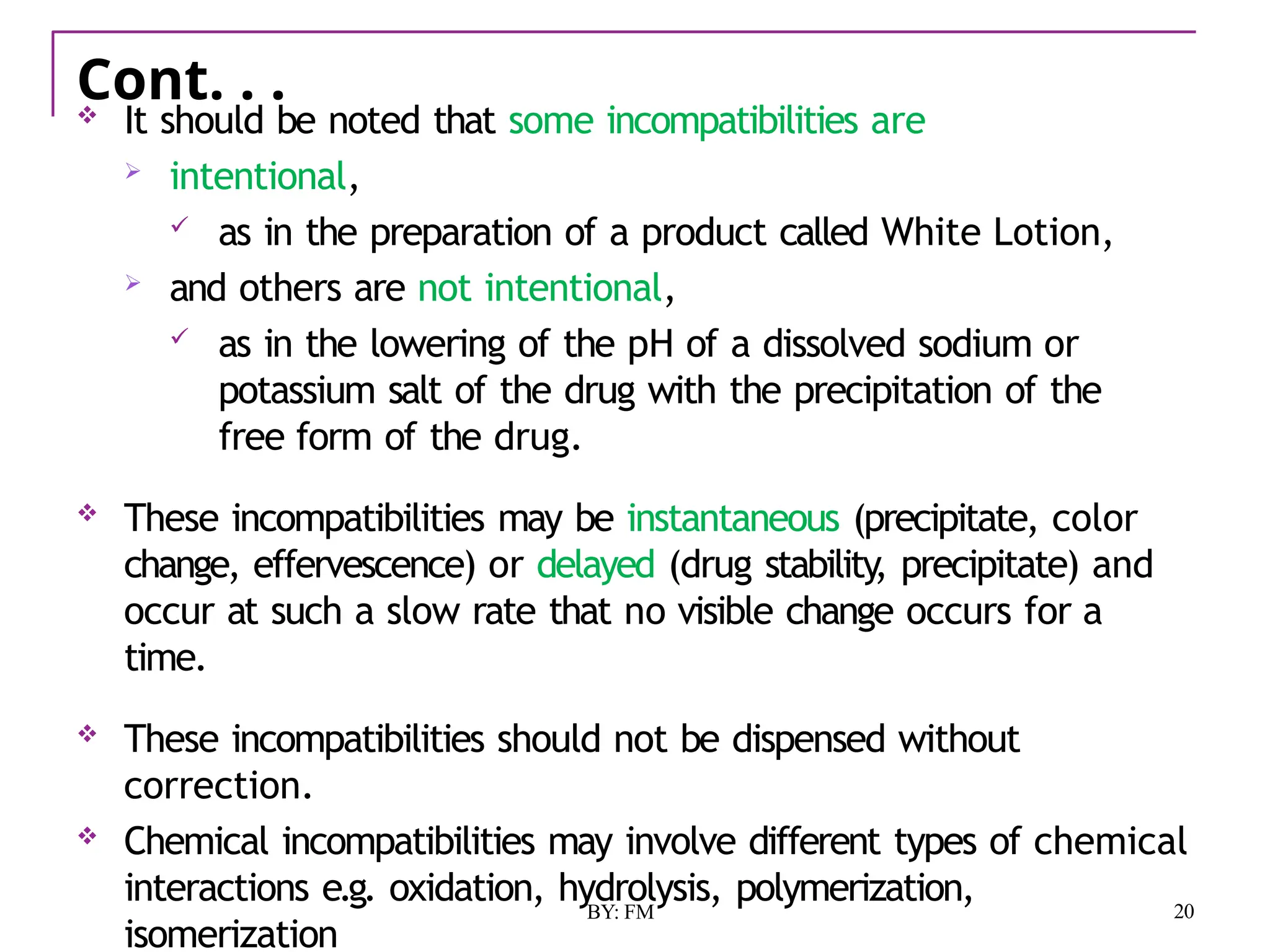
 It should be noted that some incompatibilities are
 intentional,
 as in the preparation of a product called White Lotion,
 and others are not intentional,
 as in the lowering of the pH of a dissolved sodium or
potassium salt of the drug with the precipitation of the
free form of the drug.
 These incompatibilities may be instantaneous (precipitate, color
change, effervescence) or delayed (drug stability, precipitate) and
occur at such a slow rate that no visible change occurs for a
time.
 These incompatibilities should not be dispensed without
correction.
 Chemical incompatibilities may involve different types of chemical
interactions e.g. oxidation, hydrolysis, polymerization,
isomerization
Cont. . .
21
BY: FM
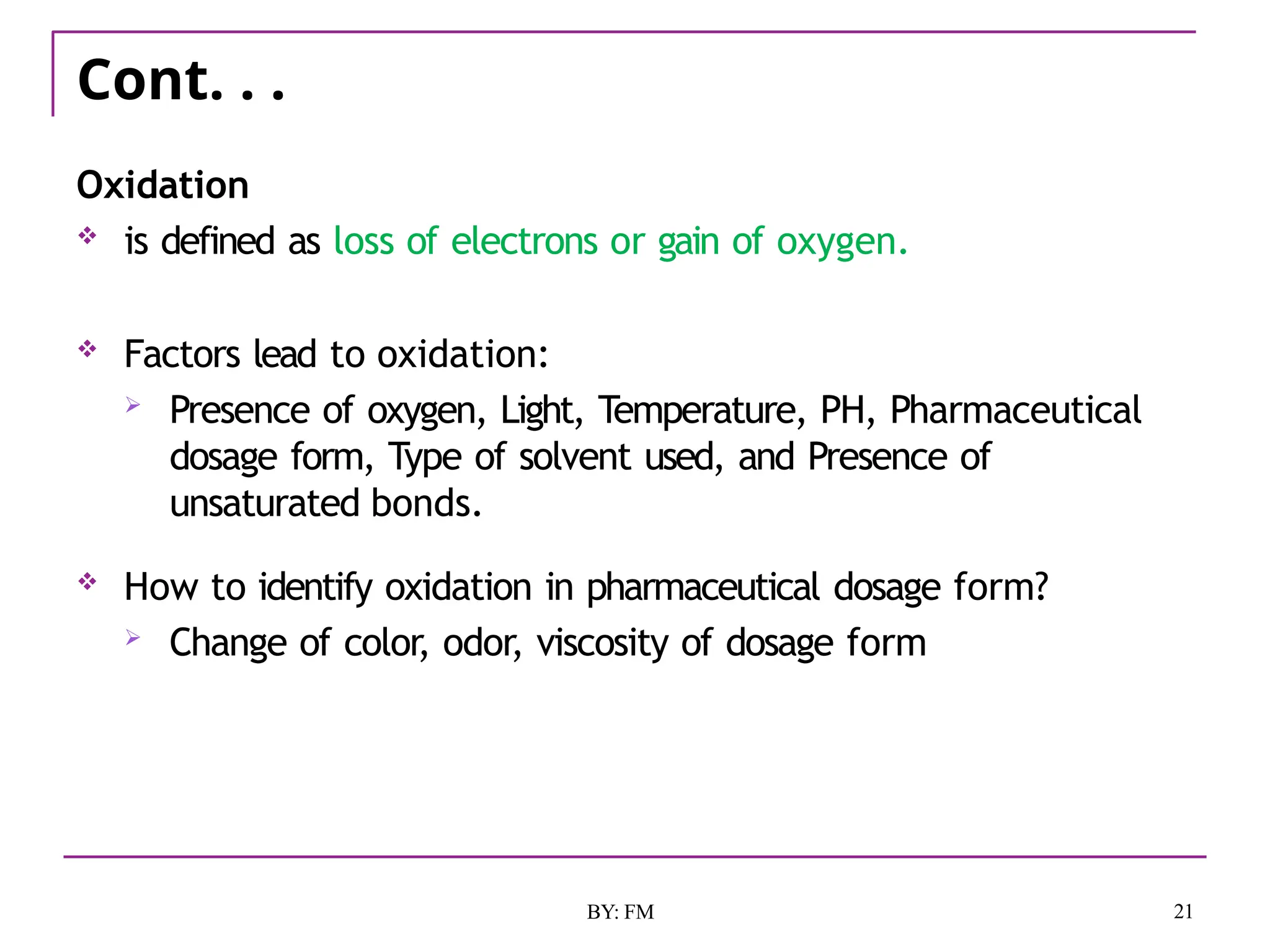
Oxidation
 is defined as loss of electrons or gain of oxygen.
 Factors lead to oxidation:
 Presence of oxygen, Light, Temperature, PH, Pharmaceutical
dosage form, Type of solvent used, and Presence of
unsaturated bonds.
 How to identify oxidation in pharmaceutical dosage form?
 Change of color, odor, viscosity of dosage form
Cont. . .
22
BY: FM
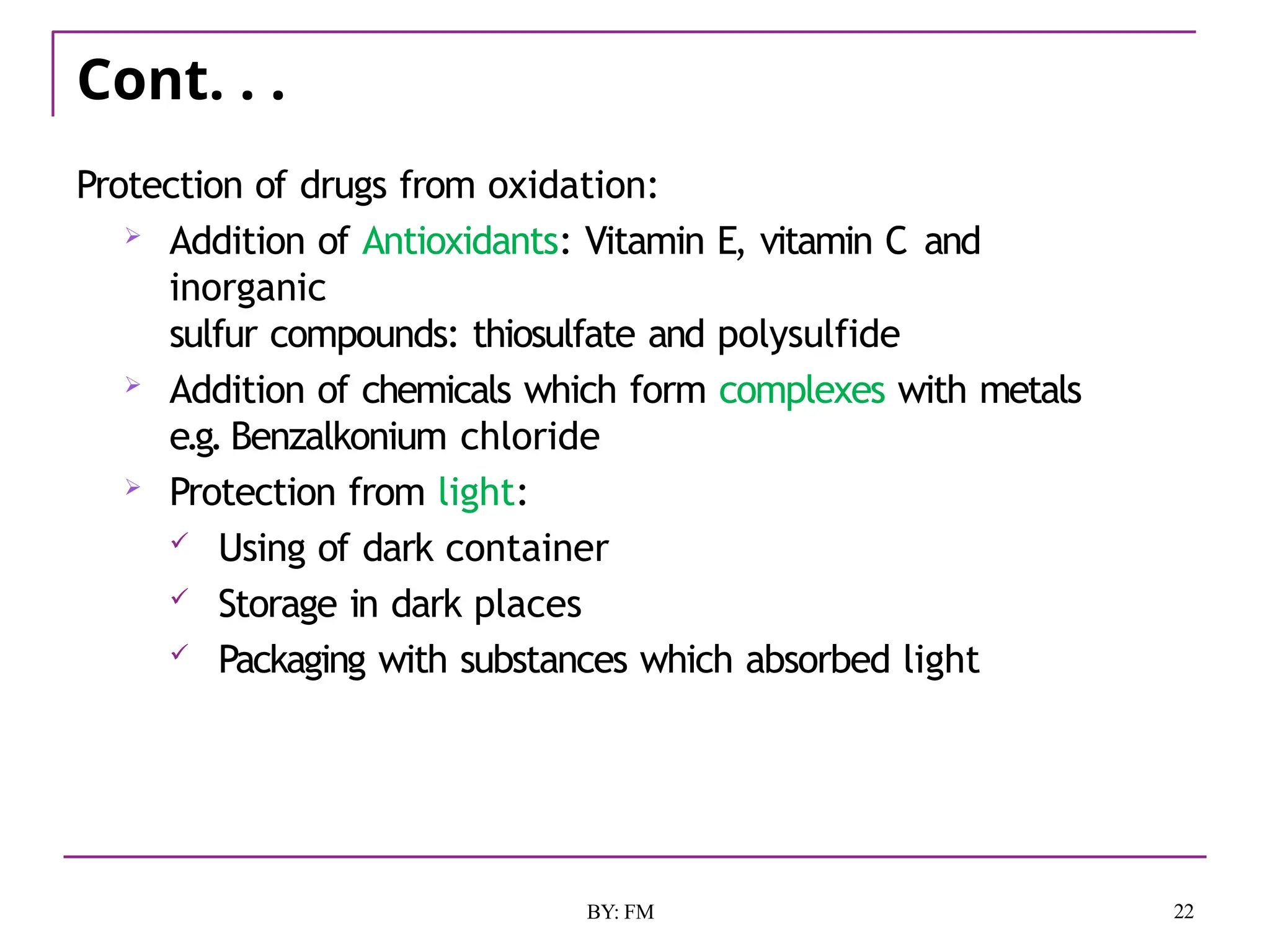
Protection of drugs from oxidation:
 Addition of Antioxidants: Vitamin E, vitamin C and
inorganic
sulfur compounds: thiosulfate and polysulfide
 Addition of chemicals which form complexes with metals
e.g. Benzalkonium chloride
 Protection from light:
 Using of dark container
 Storage in dark places
 Packaging with substances which absorbed light
Cont. . .
23
BY: FM
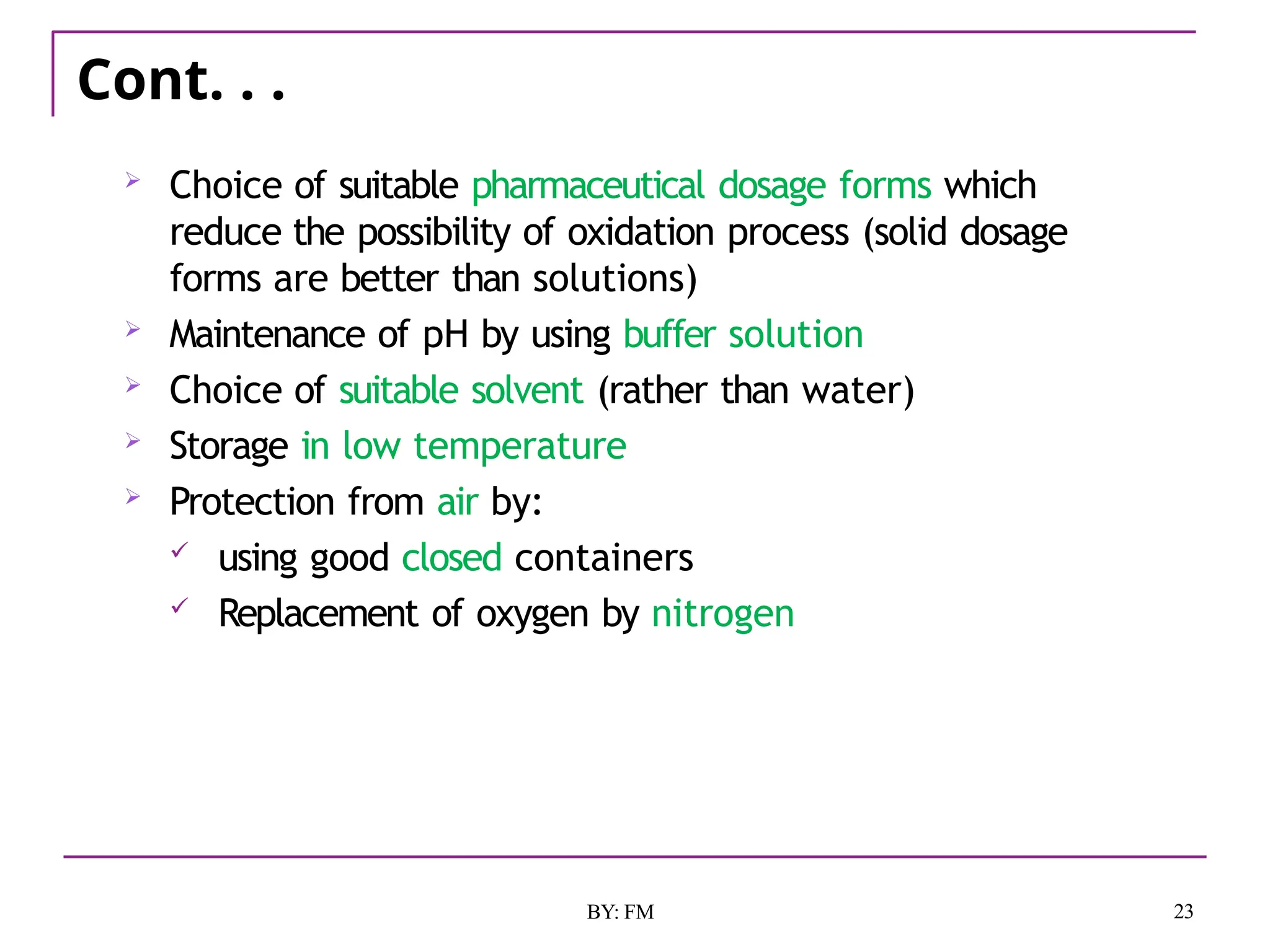
 Choice of suitable pharmaceutical dosage forms which
reduce the possibility of oxidation process (solid dosage
forms are better than solutions)
 Maintenance of pH by using buffer solution
 Choice of suitable solvent (rather than water)
 Storage in low temperature
 Protection from air by:
 using good closed containers
 Replacement of oxygen by nitrogen
Cont. . .
24
BY: FM
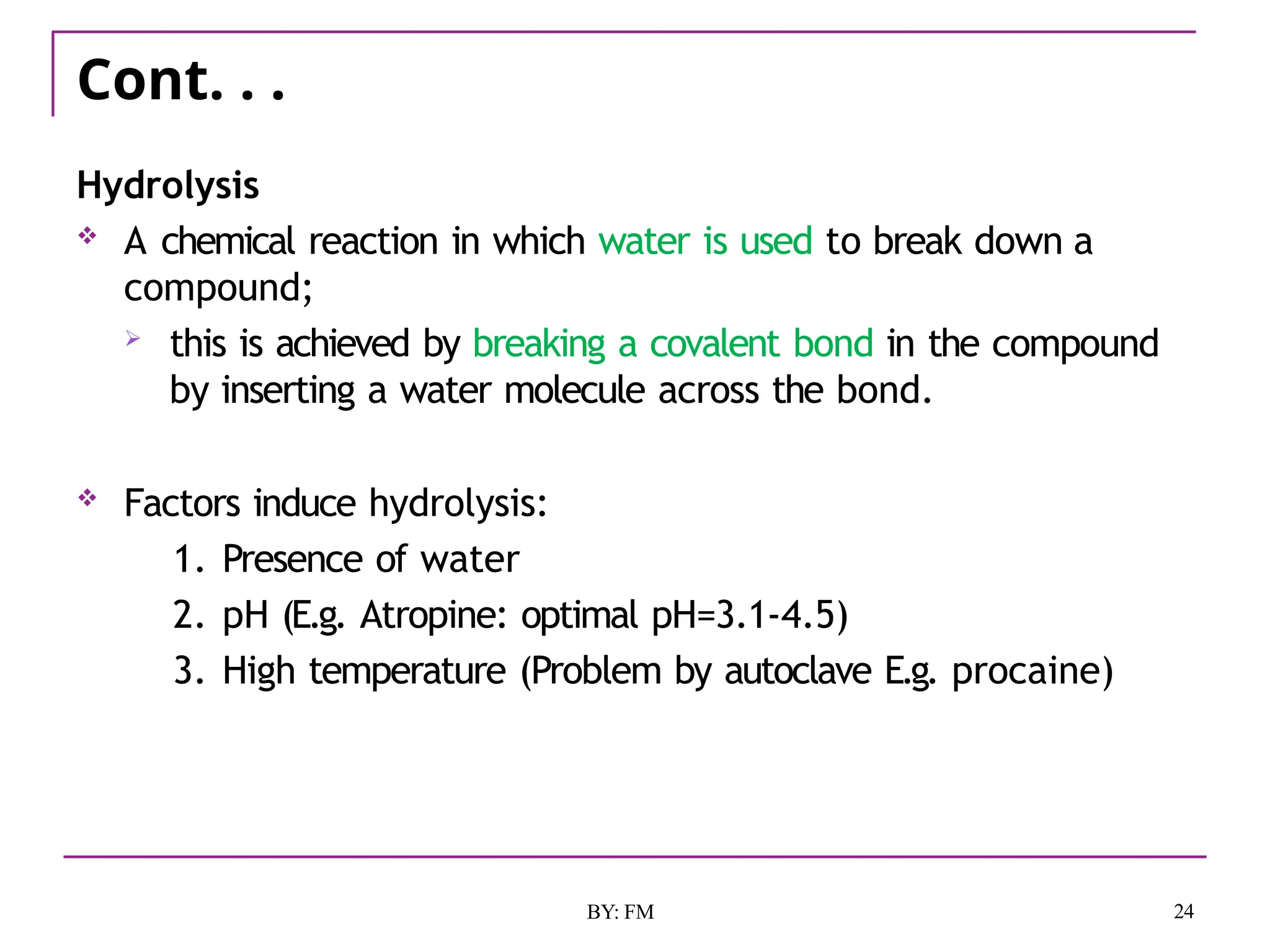
Hydrolysis
 A chemical reaction in which water is used to break down a
compound;
 this is achieved by breaking a covalent bond in the compound
by inserting a water molecule across the bond.
 Factors induce hydrolysis:
1. Presence of water
2. pH (E.g. Atropine: optimal pH=3.1-4.5)
3. High temperature (Problem by autoclave E.g. procaine)
Cont. . .
25
BY: FM
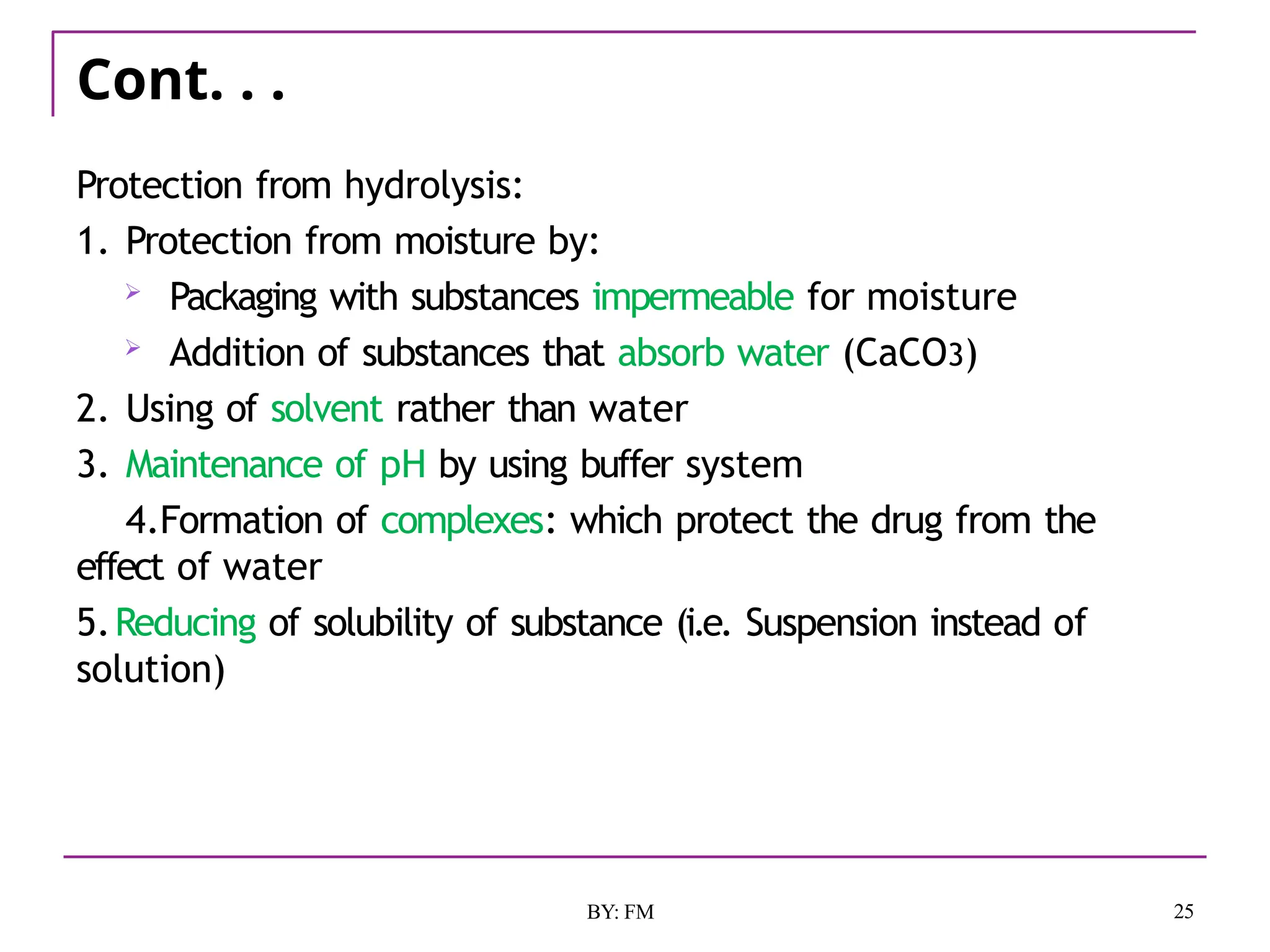
Protection from hydrolysis:
1. Protection from moisture by:
 Packaging with substances impermeable for moisture
 Addition of substances that absorb water (CaCO3)
2. Using of solvent rather than water
3. Maintenance of pH by using buffer system
4.Formation of complexes: which protect the drug from the
effect of water
5.Reducing of solubility of substance (i.e. Suspension instead of
solution)
Cont. . .
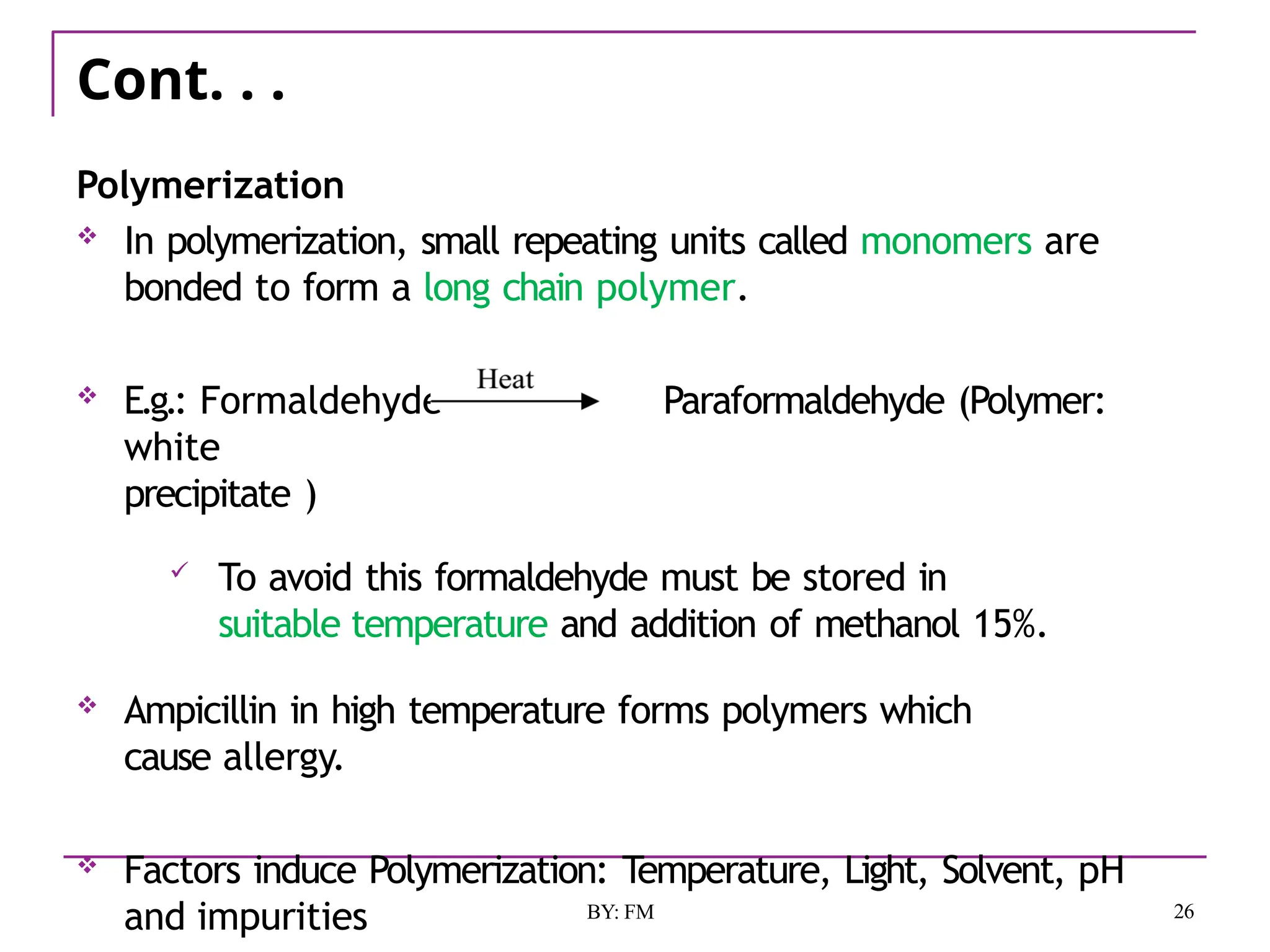
Polymerization
 In polymerization, small repeating units called monomers are
bonded to form a long chain polymer.
 E.g.: Formaldehyde Paraformaldehyde (Polymer:
white
precipitate )
 To avoid this formaldehyde must be stored in
suitable temperature and addition of methanol 15%.
 Ampicillin in high temperature forms polymers which
cause allergy.
 Factors induce Polymerization: Temperature, Light, Solvent, pH
and impurities 26
BY: FM
Cont. . .
27
BY: FM
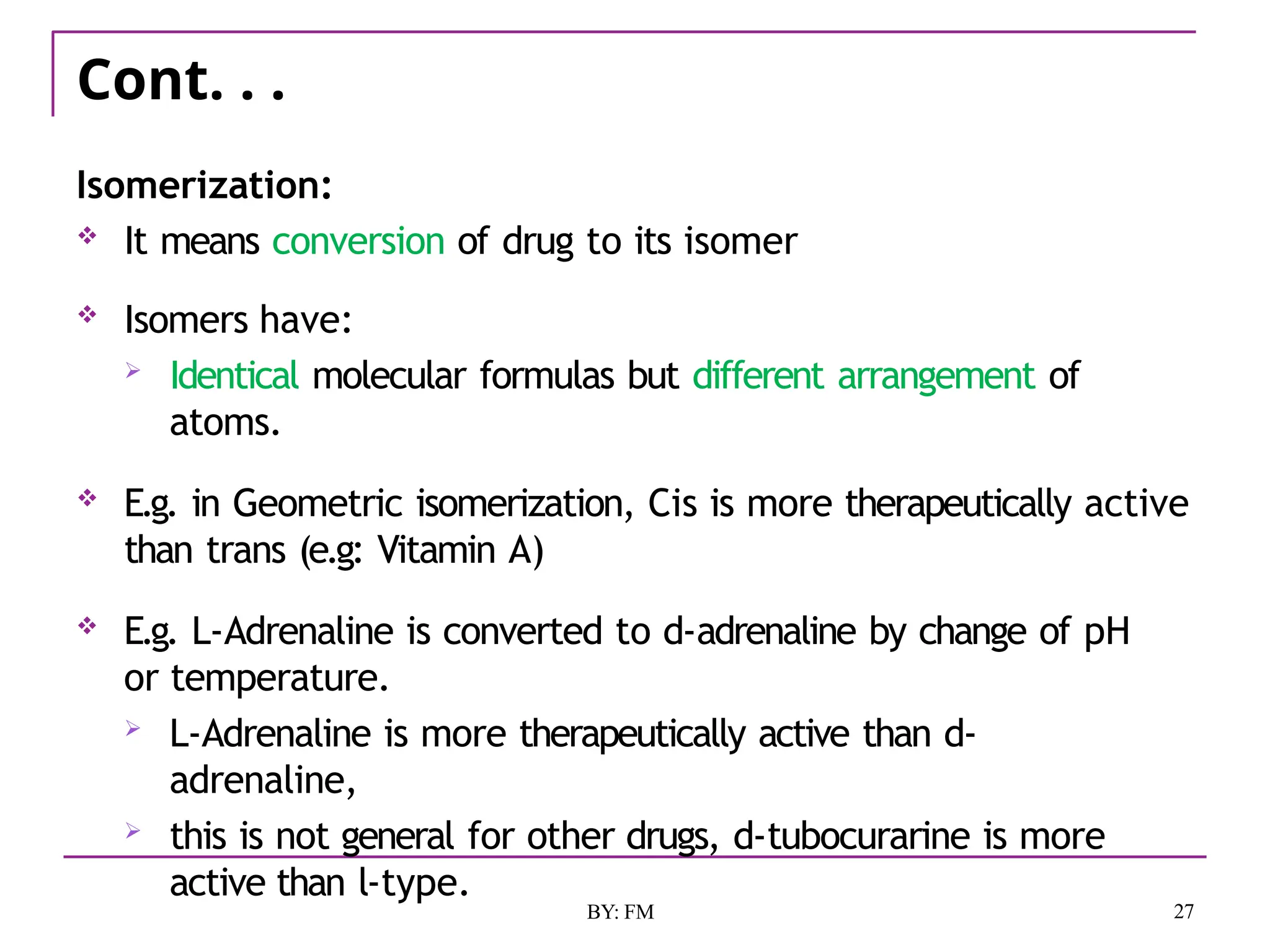
Isomerization:
 It means conversion of drug to its isomer
 Isomers have:
 Identical molecular formulas but different arrangement of
atoms.
 E.g. in Geometric isomerization, Cis is more therapeutically active
than trans (e.g: Vitamin A)
 E.g. L-Adrenaline is converted to d-adrenaline by change of pH
or temperature.
 L-Adrenaline is more therapeutically active than d-
adrenaline,
 this is not general for other drugs, d-tubocurarine is more
active than l-type.
3. Therapeutic incompatibilities
28
BY: FM
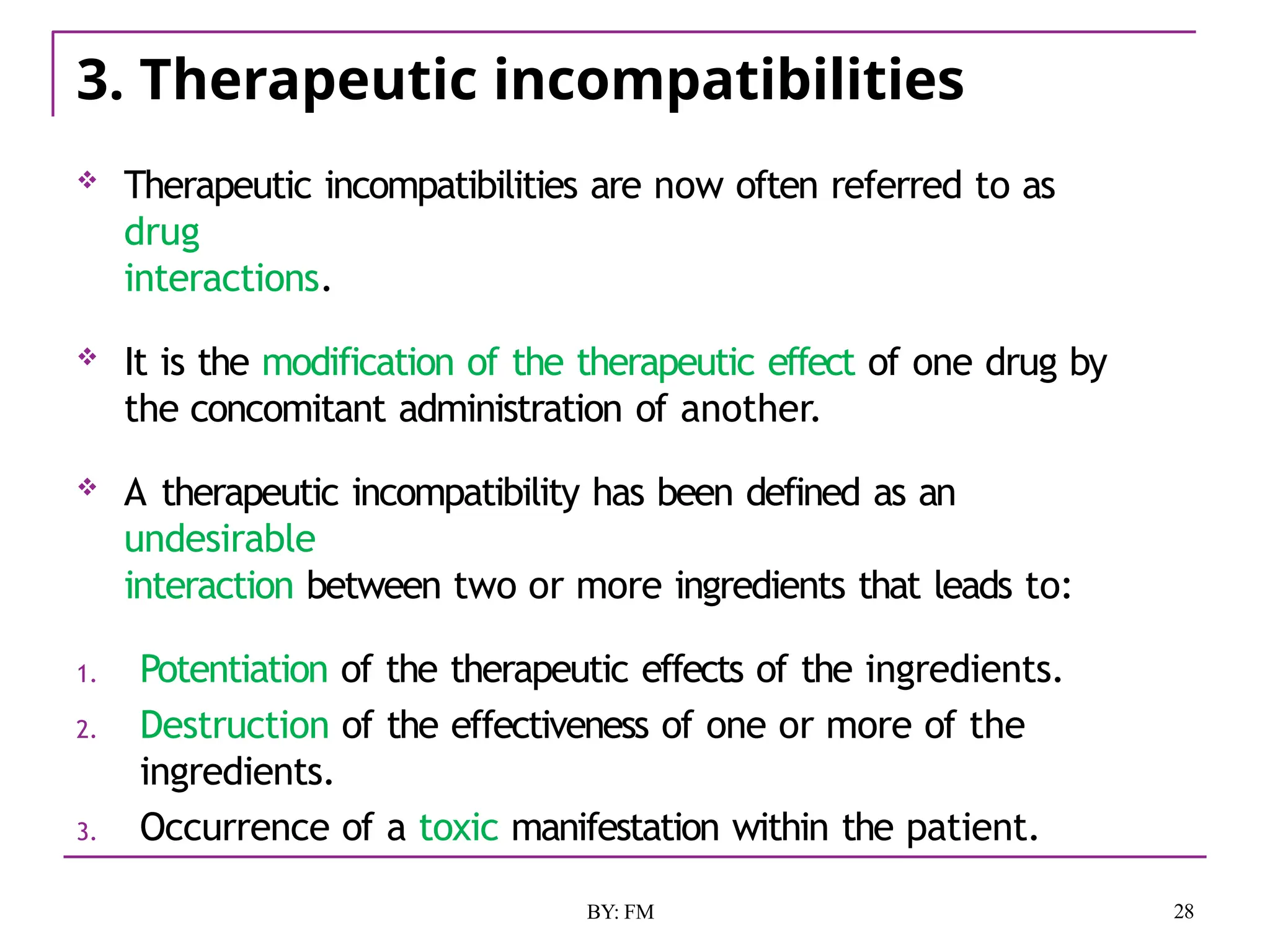
 Therapeutic incompatibilities are now often referred to as
drug
interactions.
 It is the modification of the therapeutic effect of one drug by
the concomitant administration of another.
 A therapeutic incompatibility has been defined as an
undesirable
interaction between two or more ingredients that leads to:
1. Potentiation of the therapeutic effects of the ingredients.
2. Destruction of the effectiveness of one or more of the
ingredients.
3. Occurrence of a toxic manifestation within the patient.
Cont. . .
29
BY: FM
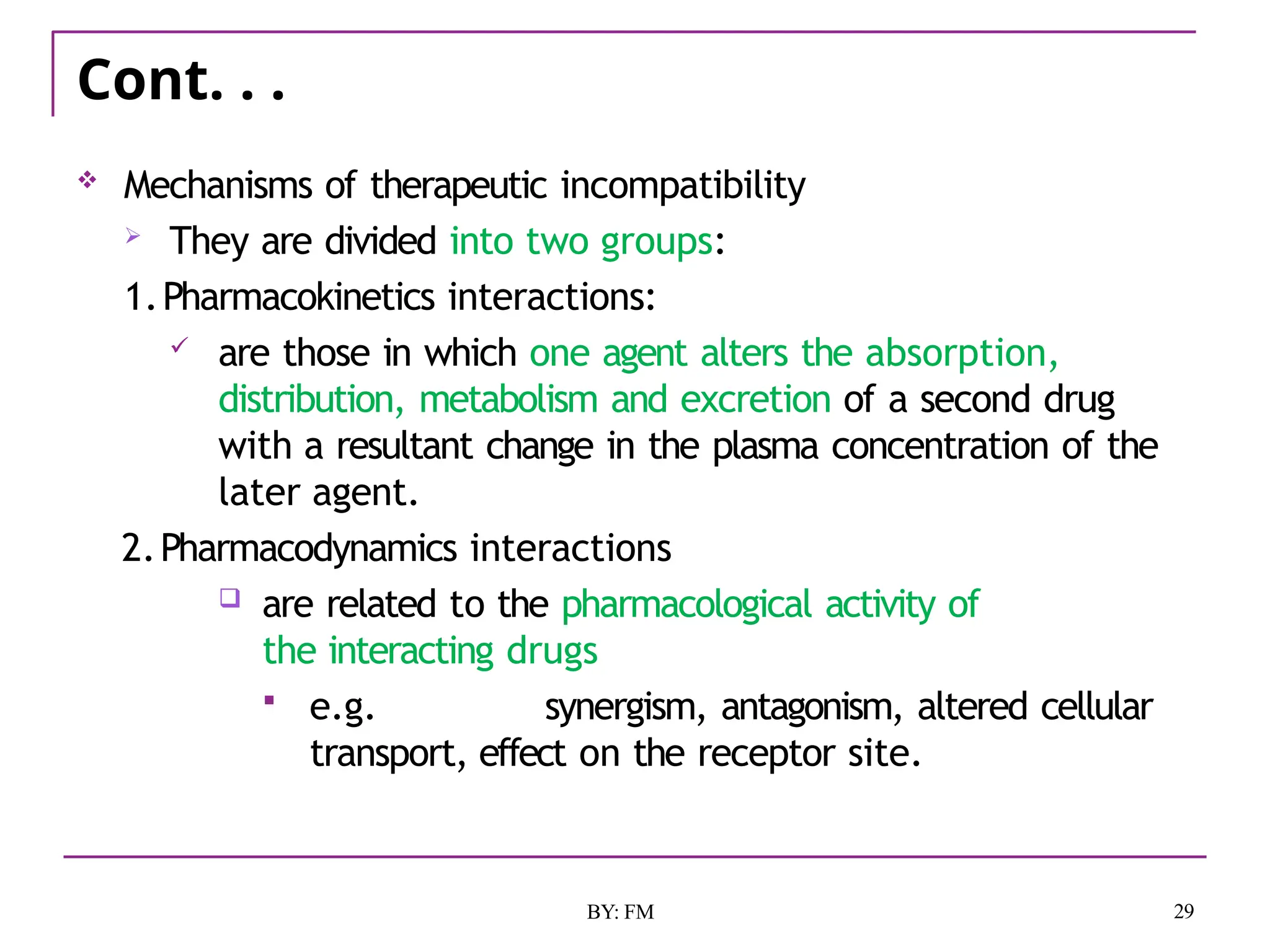
 Mechanisms of therapeutic incompatibility
 They are divided into two groups:
1.Pharmacokinetics interactions:
 are those in which one agent alters the absorption,
distribution, metabolism and excretion of a second drug
with a resultant change in the plasma concentration of the
later agent.
2.Pharmacodynamics interactions
 are related to the pharmacological activity of
the interacting drugs
 e.g. synergism, antagonism, altered cellular
transport, effect on the receptor site.
Cont. . .
30
BY: FM
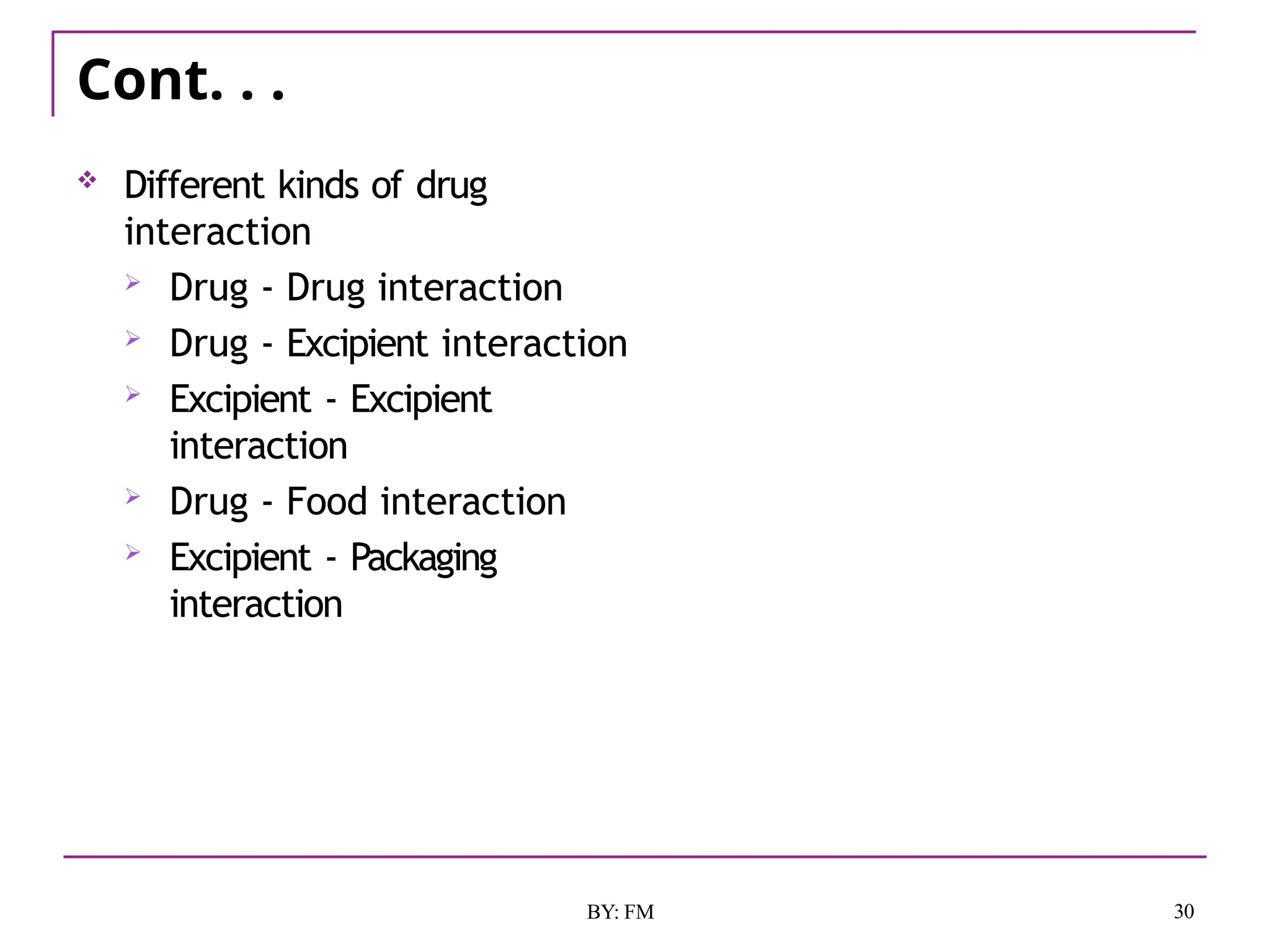
 Different kinds of drug
interaction
 Drug - Drug interaction
 Drug - Excipient interaction
 Excipient - Excipient
interaction
 Drug - Food interaction
 Excipient - Packaging
interaction
Cont. . .
31
BY: FM
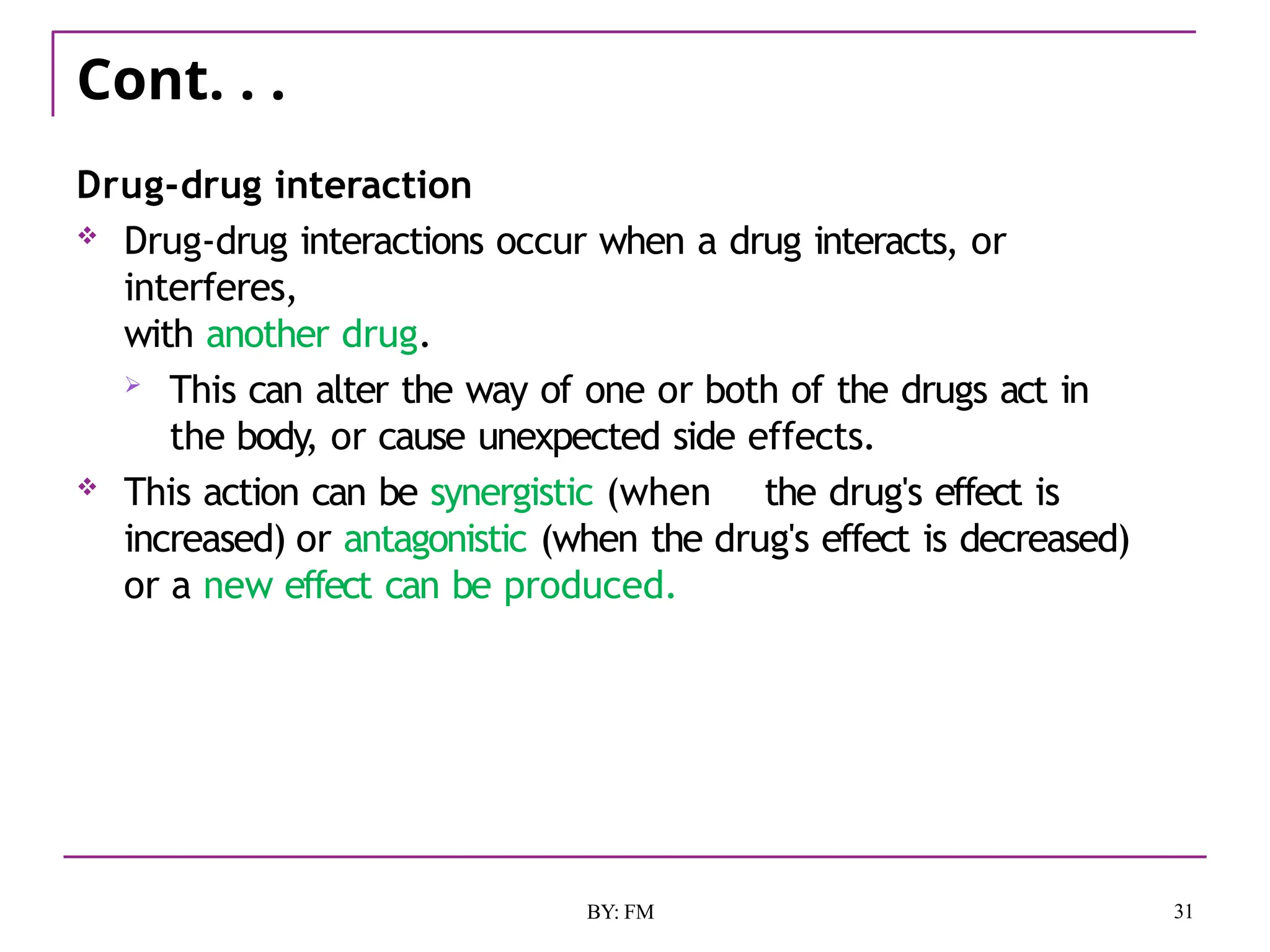
Drug-drug interaction
 Drug-drug interactions occur when a drug interacts, or
interferes,
with another drug.
 This can alter the way of one or both of the drugs act in
the body, or cause unexpected side effects.
 This action can be synergistic (when the drug's effect is
increased) or antagonistic (when the drug's effect is decreased)
or a new effect can be produced.
Ont. . .
32
BY: FM
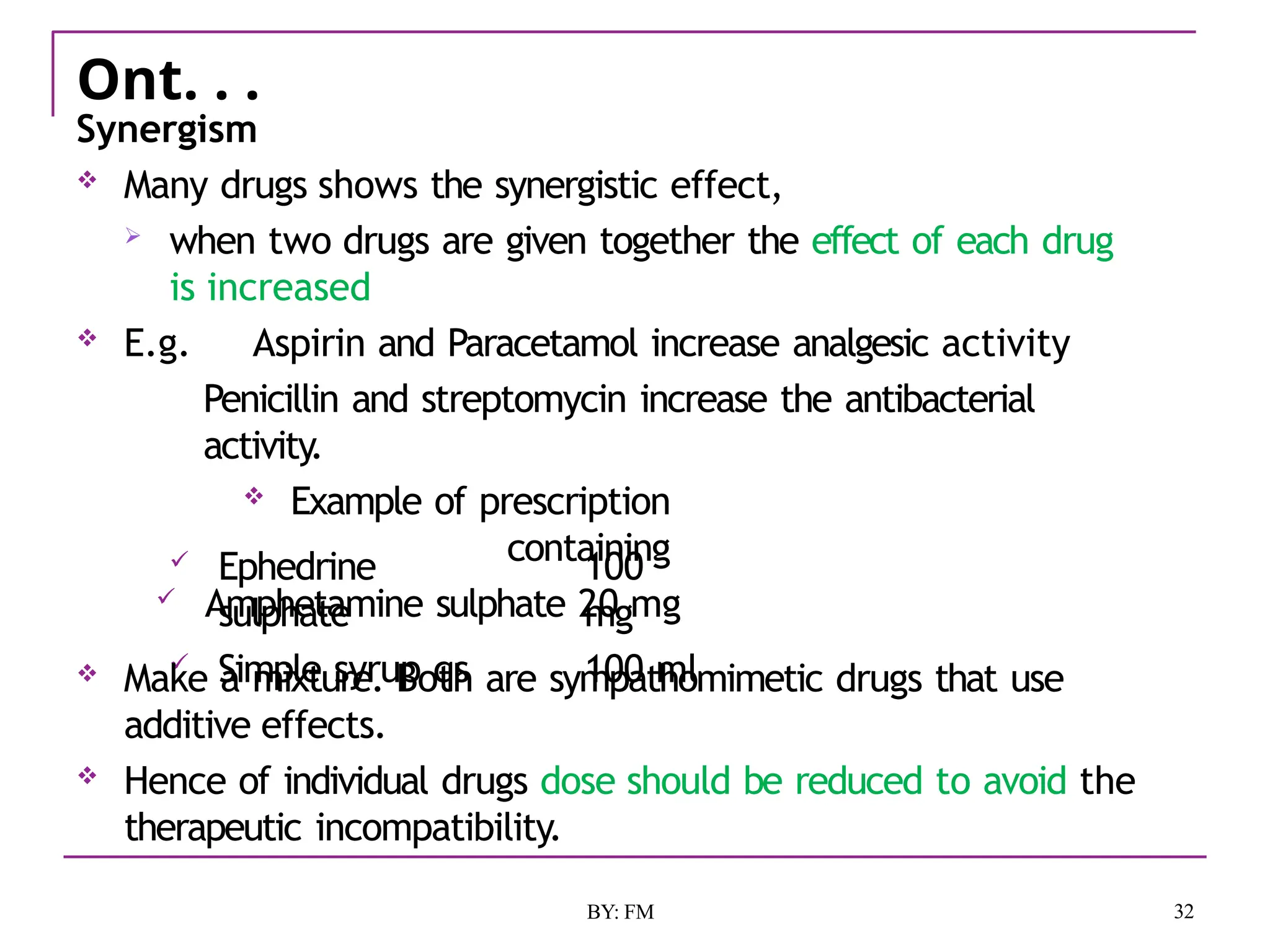
Synergism
 Many drugs shows the synergistic effect,
 when two drugs are given together the effect of each drug
is increased
 E.g. Aspirin and Paracetamol increase analgesic activity
Penicillin and streptomycin increase the antibacterial
activity.
 Example of prescription
containing
 Amphetamine sulphate 20 mg
 Ephedrine
sulphate
 Simple syrup qs
100
mg
100 ml
 Make a mixture. Both are sympathomimetic drugs that use
additive effects.
 Hence of individual drugs dose should be reduced to avoid the
therapeutic incompatibility.
Cont. . .
33
BY: FM
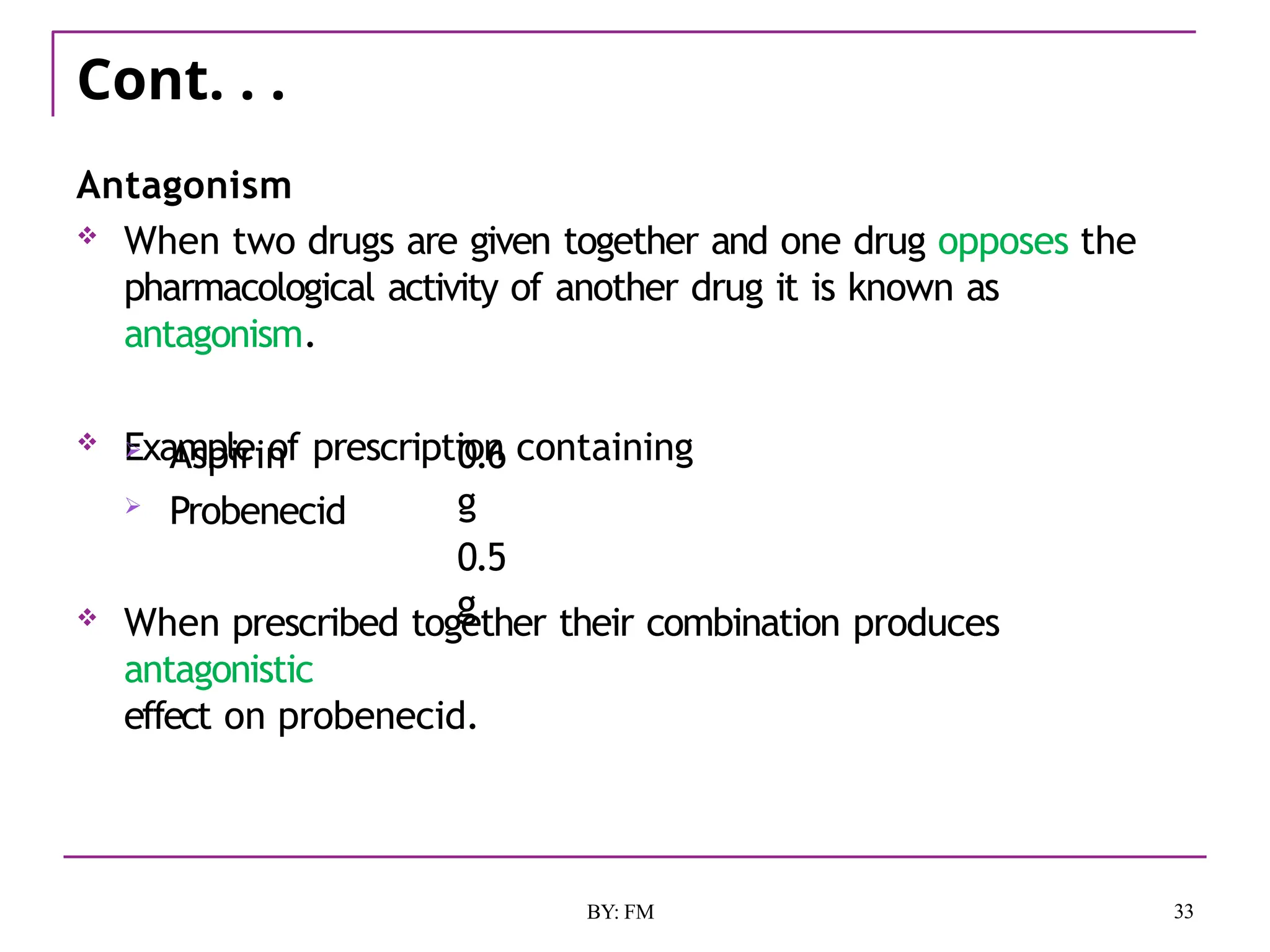
Antagonism
 When two drugs are given together and one drug opposes the
pharmacological activity of another drug it is known as
antagonism.
 Example of prescription containing
 Aspirin
 Probenecid
0.6
g
0.5
g
 When prescribed together their combination produces
antagonistic
effect on probenecid.
Cont. . .
34
BY: FM
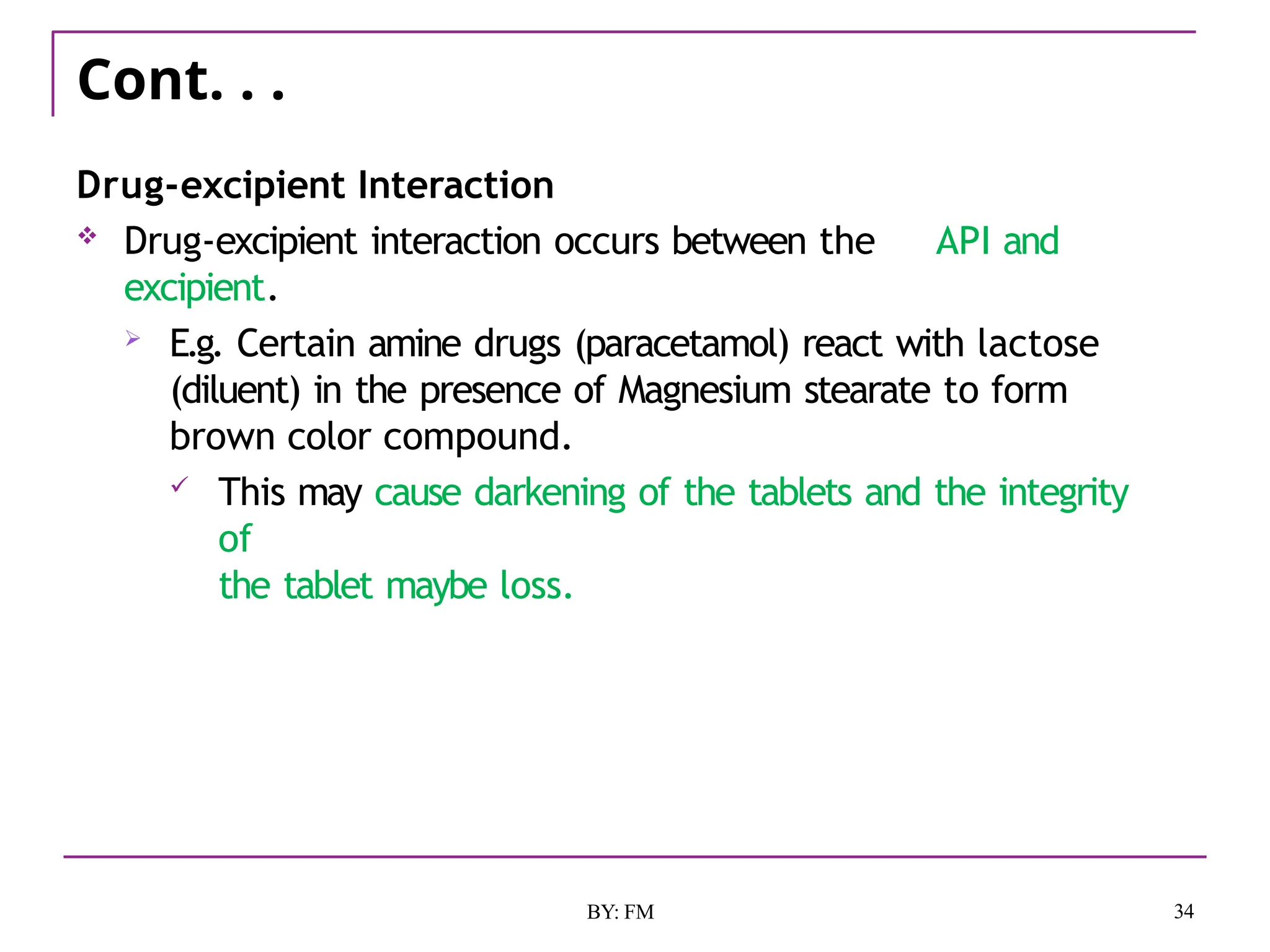
Drug-excipient Interaction
 Drug-excipient interaction occurs between the API and
excipient.
 E.g. Certain amine drugs (paracetamol) react with lactose
(diluent) in the presence of Magnesium stearate to form
brown color compound.
 This may cause darkening of the tablets and the integrity
of
the tablet maybe loss.
Cont. . .
35
BY: FM
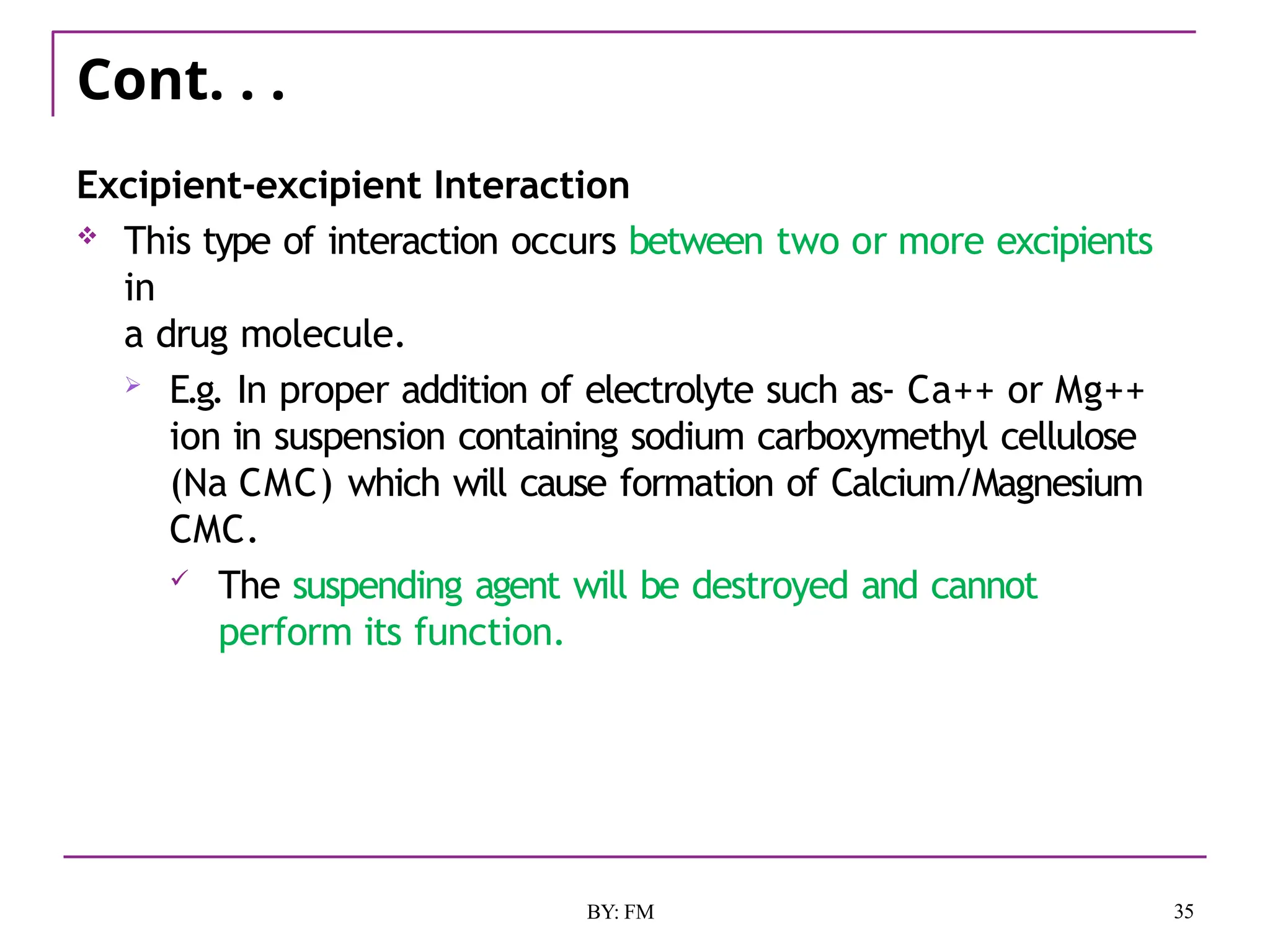
Excipient-excipient Interaction
 This type of interaction occurs between two or more excipients
in
a drug molecule.
 E.g. In proper addition of electrolyte such as- Ca++ or Mg++
ion in suspension containing sodium carboxymethyl cellulose
(Na CMC) which will cause formation of Calcium/Magnesium
CMC.
 The suspending agent will be destroyed and cannot
perform its function.
Cont. . .
36
BY: FM
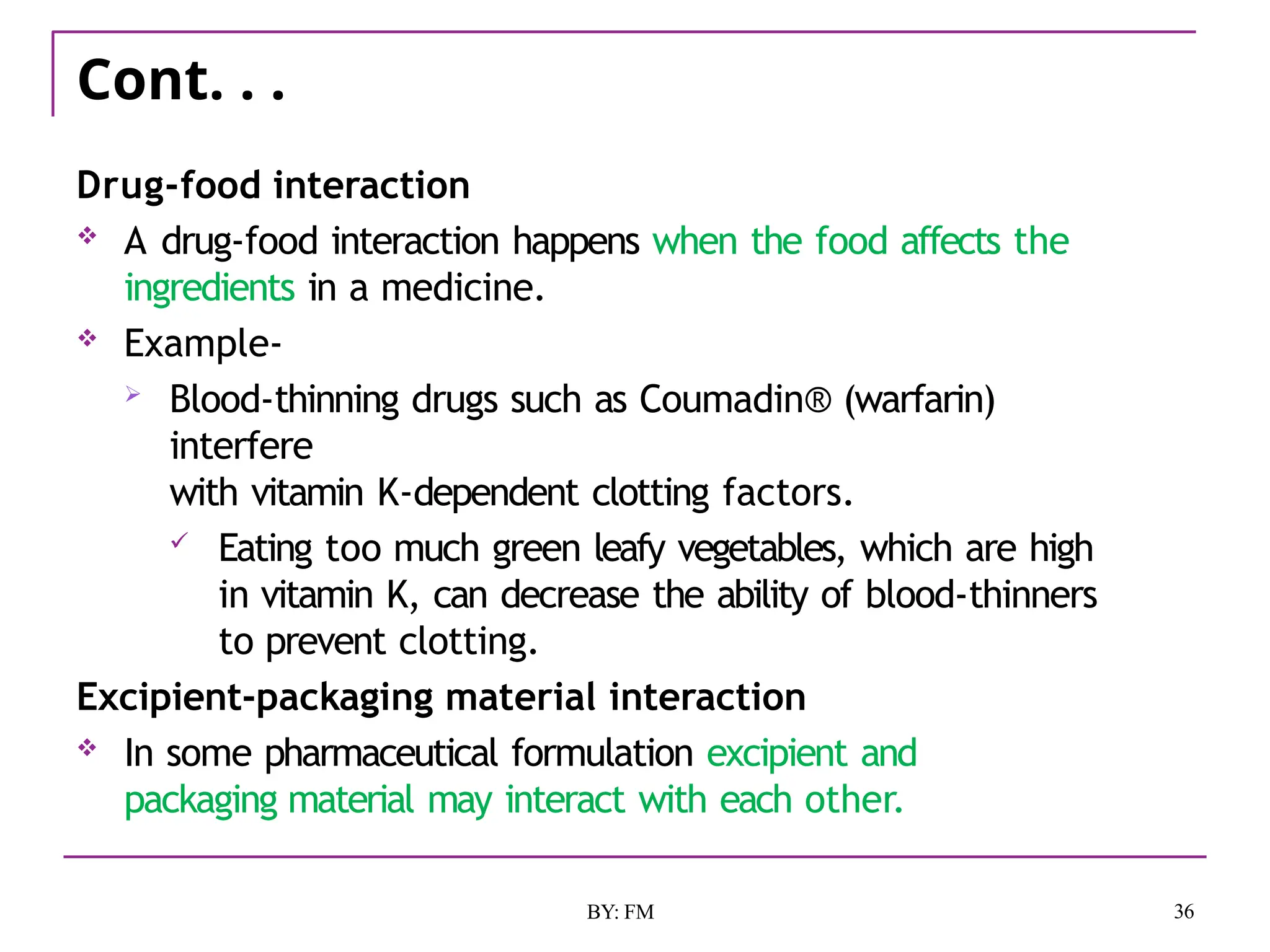
Drug-food interaction
 A drug-food interaction happens when the food affects the
ingredients in a medicine.
 Example-
 Blood-thinning drugs such as Coumadin® (warfarin)
interfere
with vitamin K-dependent clotting factors.
 Eating too much green leafy vegetables, which are high
in vitamin K, can decrease the ability of blood-thinners
to prevent clotting.
Excipient-packaging material interaction
 In some pharmaceutical formulation excipient and
packaging material may interact with each other.
Correction of Incompatibilities
37
BY: FM
 Incompatibilities are easier to prevent than to correct.
 If one can recognize a potential incompatibility and correct it,
then it can save time, materials, and money.
 One must be cautious to not "imagine" incompatibilities
where
they may not exist.
 If one cannot be certain,
 it may be beneficial to prepare a small quantity of a
preparation for observation.
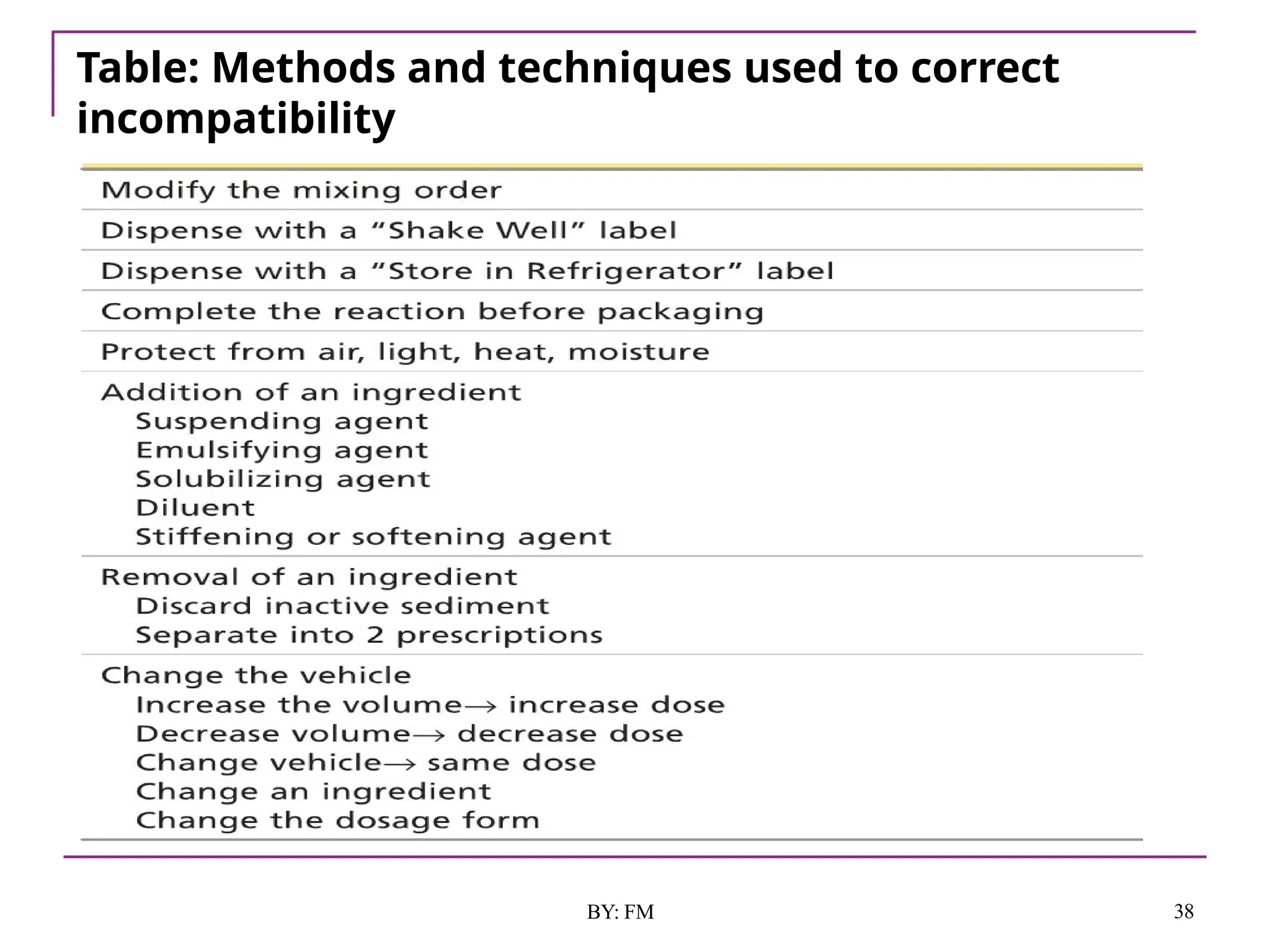
Table: Methods and techniques used to correct
incompatibility
38
BY: FM
Cont. . .
39
BY: FM
 Typically, physicochemical stability is assessed at the pre-
formulation stage of development.
 A drug substance candidate is treated with acid, base, heat,
light, and oxidative conditions to assess its inherent chemical
stability.
 Binary mixtures of the drug substance with individual
excipients are also investigated at the pre-formulation stage.
 These tests are performed to determine the drug substance
sensitivity to degrade or reactivity with common
pharmaceutical excipients.
 With an understanding of the stability/reactivity of a drug
substance in the preformulation stage, it is possible to formulate
the drug product to minimize drug decomposition.
40
BY: FM

incompatiblities in formulation.pptx.....

  • 1.
  • 2.
    Contents 2 BY: FM  Introduction Types of incompatibilities  Physical incompatibilities  Chemical incompatibilities  Therapeutic incompatibilities  Correction of incompatibilities
  • 3.
    Introduction 3 BY: FM  Incompatibilityis defined as a result of mixing of two or more antagonistic substances and undesirable product is formed,  which may affect the safety , efficacy , appearance and stability of the pharmaceutical product.  Incompatibilities may be detected by changes in  the physical, chemical and therapeutic qualities of the medicine.  Incompatibility arise during  compounding, manufacturing, packaging, dispensing, storage or administration.
  • 4.
    Types of Incompatibilities 4 BY:FM 1. Physical Incompatibilities 2. Chemical Incompatibilities 3. Therapeutic Incompatibilities
  • 5.
    1. Physical Incompatibilities 5 BY:FM  Physical incompatibilities are those in which  the physical properties of the ingredients produce a mixture or preparation that is  unacceptable in the appearance or accuracy of dosage,  non-uniform, or  unpalatable mixtures,  which pose the potential danger of non-uniform dosage.  form various physical changes in final product.  Such as color, odor, taste, viscosity and morphology.  usually involve properties such as solubility, melting point, polymorphic forms, freezing point, dielectric constant, etc.
  • 6.
    Cont. . . 6 BY:FM  Physical incompatibilities may be corrected by any of the following methods  Change the order of mixing  Emulsification  Addition of suspending agent  Addition, substitution or omission of any ingredient
  • 7.
    Cont. . . 7 BY:FM  Manifestations of physical incompatibility:  Insolubility: Insolubility of prescribed agent in vehicle  Immiscibility: Immiscibility of two or more liquids  Precipitation: occurs due to solvents is insoluble when it is added to solution  Liquefaction: Liquefaction of solids mixed in a dry state (called eutexia)
  • 8.
    Cont. . . 8 BY:FM Insolubility:  Inability of material to dissolve in a particular solvent system.  The majority of incompatibilities are due to insolubilities of the organic as well as inorganic compounds in particular solvents.  Incomplete solution can occur when two or more substances are combined and may not give a homogeneous product because of immiscibility or insolubility.
  • 9.
    Cont. . . 9 BY:FM  Example of prescription containing  Ephedrine sulfate 0.25g  Menthol 0.02mL  Liquid paraffin qs 30mL  Make a nasal drop  Cause  ephedrine sulfate is a salt which is soluble in water but insoluble in organic solvents, liquid paraffin.  Solution  Anhydrous ephedrine sulfate is soluble in liquid paraffin and hence it can be used to prepare clear solution.
  • 10.
    Cont. . . 10 BY:FM  The following factors affect the solubility of prescribed agent in vehicle and may render it less soluble: 1.Change in pH 2.Milling 3.Surfactant 4.Chemical reaction 5.Complex formation 6.Co-solvent  Any change in previous factors may lead to precipitation of drugs and change in their properties.
  • 11.
    Cont. . . 11 BY:FM Precipitation  can occur when a vehicle is added to a substance that is soluble in one solvent and is not soluble in this second vehicle or solvent.  An example would be the addition of water to compound benzoin tincture.  Tincture of benzoin is a solution of benzoin resin in ethanol.
  • 12.
    Cont. . . 12 BY:FM  Example of prescription containing  Tincture benzoin 5g  Glycerin  Rose water qs 10mL 100mL  Compound tincture benzoin lotion  Cause  Tincture benzoin compound contain resins, change in solvent system results in an unavoidable precipitate.  Solution  Addition of tincture with rapid stirring yields a fine colloidal dispersion.
  • 13.
    Cont. . . 13 BY:FM Immiscibility:  The inability of two or more substances or liquids to readily dissolve into one another.  Immiscibility occurs when a vehicle is added to a solution of something like an oil but the oil is not soluble in the second vehicle.  This manifestation appears clearly in emulsion, creams, lotions, some types of ointments.  Separation in two phases is noticed in these pharmaceutical dosage forms  Example would be the addition of water to peppermint spirit  where the peppermint oil may come out of solution.
  • 14.
    Cont. . . 14 BY:FM  Example of prescription containing Castor oil Water 15mL 60mL  Make emulsion  Cause  In this prescription castor oil is immiscible with water due to high interfacial tensions, which is a sign of incompatibility.  Solution  To overcome this type of incompatibility, emulsification is necessary with the help of emulsifying agent and vigorous shaking.
  • 15.
    Cont. . . 15 BY:FM  The following factors lead to immiscibility:  Incomplete mixing  Addition of surfactant with:  Unsuitable concentration  False time of addition  Unsuitable for the type of emulsion  Presence of microorganisms  Some bacteria grow on constituents of mixture  Temperature  Storage must be in room temperature to prevent separation
  • 16.
    Cont. . . 16 BY:FM Liquefaction  Liquefaction of solids mixed in a dry state.  It means that when two solid substances are mixed together, conversion to a liquid state take place.  It happens through the following methods:  Formation of liquid or soft mass (known as eutectic mixture): when the solid substance is soluble in another solid substance which lead to decrease of its melting point of the mixture to below room temprature and conversion to a liquid in certain ratios.  Exit of crystalline water: By mixing hydrated crystals and dry crystals, crystalline water diffuse to dry crystals.
  • 17.
    Cont. . . 17 BY:FM  The medicaments showing this type of behavior are camphor, menthol, phenol, thymol, chloral hydrate and aspirin.  If such conditions take place,  compounding such powders becomes difficult since the ultimate mixture turns to liquid.
  • 18.
    Cont. . . 18 BY:FM  Example of prescription containing  Menthol  Camphor  Ammonium chloride  Light magnesium carbonate  Prepare 100g insufflation  Cause 5g 5g 30g 60g  In this prescription menthol, camphor and ammonia chloride get liquefied on mixing with each other.  Solution  To dispense this prescription, menthol camphor and ammonium chloride are triturated together to form liquid.  Then, add light magnesium carbonate and mix it thoroughly to make free flowing powder
  • 19.
    2. Chemical Incompatibilities 19 BY:FM  Chemical incompatibilities are those in which  the ingredients interact or decompose to give new compounds; these may or may not produce visible changes.  Chemical incompatibilities are reaction between two or more substances which lead to change in chemical properties of pharmaceutical dosage form.  Some of these incompatibilities are also instabilities.  Instability describes degradation, including hydrolysis, oxidation, and covalent chemical reactions that may be slowed but not stopped.
  • 20.
    Cont. . . 20 BY:FM  It should be noted that some incompatibilities are  intentional,  as in the preparation of a product called White Lotion,  and others are not intentional,  as in the lowering of the pH of a dissolved sodium or potassium salt of the drug with the precipitation of the free form of the drug.  These incompatibilities may be instantaneous (precipitate, color change, effervescence) or delayed (drug stability, precipitate) and occur at such a slow rate that no visible change occurs for a time.  These incompatibilities should not be dispensed without correction.  Chemical incompatibilities may involve different types of chemical interactions e.g. oxidation, hydrolysis, polymerization, isomerization
  • 21.
    Cont. . . 21 BY:FM Oxidation  is defined as loss of electrons or gain of oxygen.  Factors lead to oxidation:  Presence of oxygen, Light, Temperature, PH, Pharmaceutical dosage form, Type of solvent used, and Presence of unsaturated bonds.  How to identify oxidation in pharmaceutical dosage form?  Change of color, odor, viscosity of dosage form
  • 22.
    Cont. . . 22 BY:FM Protection of drugs from oxidation:  Addition of Antioxidants: Vitamin E, vitamin C and inorganic sulfur compounds: thiosulfate and polysulfide  Addition of chemicals which form complexes with metals e.g. Benzalkonium chloride  Protection from light:  Using of dark container  Storage in dark places  Packaging with substances which absorbed light
  • 23.
    Cont. . . 23 BY:FM  Choice of suitable pharmaceutical dosage forms which reduce the possibility of oxidation process (solid dosage forms are better than solutions)  Maintenance of pH by using buffer solution  Choice of suitable solvent (rather than water)  Storage in low temperature  Protection from air by:  using good closed containers  Replacement of oxygen by nitrogen
  • 24.
    Cont. . . 24 BY:FM Hydrolysis  A chemical reaction in which water is used to break down a compound;  this is achieved by breaking a covalent bond in the compound by inserting a water molecule across the bond.  Factors induce hydrolysis: 1. Presence of water 2. pH (E.g. Atropine: optimal pH=3.1-4.5) 3. High temperature (Problem by autoclave E.g. procaine)
  • 25.
    Cont. . . 25 BY:FM Protection from hydrolysis: 1. Protection from moisture by:  Packaging with substances impermeable for moisture  Addition of substances that absorb water (CaCO3) 2. Using of solvent rather than water 3. Maintenance of pH by using buffer system 4.Formation of complexes: which protect the drug from the effect of water 5.Reducing of solubility of substance (i.e. Suspension instead of solution)
  • 26.
    Cont. . . Polymerization In polymerization, small repeating units called monomers are bonded to form a long chain polymer.  E.g.: Formaldehyde Paraformaldehyde (Polymer: white precipitate )  To avoid this formaldehyde must be stored in suitable temperature and addition of methanol 15%.  Ampicillin in high temperature forms polymers which cause allergy.  Factors induce Polymerization: Temperature, Light, Solvent, pH and impurities 26 BY: FM
  • 27.
    Cont. . . 27 BY:FM Isomerization:  It means conversion of drug to its isomer  Isomers have:  Identical molecular formulas but different arrangement of atoms.  E.g. in Geometric isomerization, Cis is more therapeutically active than trans (e.g: Vitamin A)  E.g. L-Adrenaline is converted to d-adrenaline by change of pH or temperature.  L-Adrenaline is more therapeutically active than d- adrenaline,  this is not general for other drugs, d-tubocurarine is more active than l-type.
  • 28.
    3. Therapeutic incompatibilities 28 BY:FM  Therapeutic incompatibilities are now often referred to as drug interactions.  It is the modification of the therapeutic effect of one drug by the concomitant administration of another.  A therapeutic incompatibility has been defined as an undesirable interaction between two or more ingredients that leads to: 1. Potentiation of the therapeutic effects of the ingredients. 2. Destruction of the effectiveness of one or more of the ingredients. 3. Occurrence of a toxic manifestation within the patient.
  • 29.
    Cont. . . 29 BY:FM  Mechanisms of therapeutic incompatibility  They are divided into two groups: 1.Pharmacokinetics interactions:  are those in which one agent alters the absorption, distribution, metabolism and excretion of a second drug with a resultant change in the plasma concentration of the later agent. 2.Pharmacodynamics interactions  are related to the pharmacological activity of the interacting drugs  e.g. synergism, antagonism, altered cellular transport, effect on the receptor site.
  • 30.
    Cont. . . 30 BY:FM  Different kinds of drug interaction  Drug - Drug interaction  Drug - Excipient interaction  Excipient - Excipient interaction  Drug - Food interaction  Excipient - Packaging interaction
  • 31.
    Cont. . . 31 BY:FM Drug-drug interaction  Drug-drug interactions occur when a drug interacts, or interferes, with another drug.  This can alter the way of one or both of the drugs act in the body, or cause unexpected side effects.  This action can be synergistic (when the drug's effect is increased) or antagonistic (when the drug's effect is decreased) or a new effect can be produced.
  • 32.
    Ont. . . 32 BY:FM Synergism  Many drugs shows the synergistic effect,  when two drugs are given together the effect of each drug is increased  E.g. Aspirin and Paracetamol increase analgesic activity Penicillin and streptomycin increase the antibacterial activity.  Example of prescription containing  Amphetamine sulphate 20 mg  Ephedrine sulphate  Simple syrup qs 100 mg 100 ml  Make a mixture. Both are sympathomimetic drugs that use additive effects.  Hence of individual drugs dose should be reduced to avoid the therapeutic incompatibility.
  • 33.
    Cont. . . 33 BY:FM Antagonism  When two drugs are given together and one drug opposes the pharmacological activity of another drug it is known as antagonism.  Example of prescription containing  Aspirin  Probenecid 0.6 g 0.5 g  When prescribed together their combination produces antagonistic effect on probenecid.
  • 34.
    Cont. . . 34 BY:FM Drug-excipient Interaction  Drug-excipient interaction occurs between the API and excipient.  E.g. Certain amine drugs (paracetamol) react with lactose (diluent) in the presence of Magnesium stearate to form brown color compound.  This may cause darkening of the tablets and the integrity of the tablet maybe loss.
  • 35.
    Cont. . . 35 BY:FM Excipient-excipient Interaction  This type of interaction occurs between two or more excipients in a drug molecule.  E.g. In proper addition of electrolyte such as- Ca++ or Mg++ ion in suspension containing sodium carboxymethyl cellulose (Na CMC) which will cause formation of Calcium/Magnesium CMC.  The suspending agent will be destroyed and cannot perform its function.
  • 36.
    Cont. . . 36 BY:FM Drug-food interaction  A drug-food interaction happens when the food affects the ingredients in a medicine.  Example-  Blood-thinning drugs such as Coumadin® (warfarin) interfere with vitamin K-dependent clotting factors.  Eating too much green leafy vegetables, which are high in vitamin K, can decrease the ability of blood-thinners to prevent clotting. Excipient-packaging material interaction  In some pharmaceutical formulation excipient and packaging material may interact with each other.
  • 37.
    Correction of Incompatibilities 37 BY:FM  Incompatibilities are easier to prevent than to correct.  If one can recognize a potential incompatibility and correct it, then it can save time, materials, and money.  One must be cautious to not "imagine" incompatibilities where they may not exist.  If one cannot be certain,  it may be beneficial to prepare a small quantity of a preparation for observation.
  • 38.
    Table: Methods andtechniques used to correct incompatibility 38 BY: FM
  • 39.
    Cont. . . 39 BY:FM  Typically, physicochemical stability is assessed at the pre- formulation stage of development.  A drug substance candidate is treated with acid, base, heat, light, and oxidative conditions to assess its inherent chemical stability.  Binary mixtures of the drug substance with individual excipients are also investigated at the pre-formulation stage.  These tests are performed to determine the drug substance sensitivity to degrade or reactivity with common pharmaceutical excipients.  With an understanding of the stability/reactivity of a drug substance in the preformulation stage, it is possible to formulate the drug product to minimize drug decomposition.
  • 40.