Project Report of Financial Statements on Google
Submitted To:
 Prof. Imran Aslam
Submitted By:
 Muhammad Faisal Yar Thaheem
 Muhammad Mujtaba Khan Baloch
 Muhammad Arslan Arshad
 Muhammad Bilal Ahmed Bhachar
National College of Business Administration & Economics
Financial statement
A financial statement (or financial report) is a formal record of the financial activities and
position of a business, person, or other entity.
Relevant financial information is presented in a structured manner and in a form easy to
understand. They typically include basic financial statements, accompanied by a management
discussion and analysis.
Types of Financial Statements:
 Balance Sheet:
A Balance Sheet is also referred to as a statement of financial position, reports on a
company's assets,liabilities, and ownership equity at a given point in time.
 Income Statement:
An income statement, also known as a statement of comprehensive income, statement of
revenue & expense, P&L or profit and loss report, reports on a
company's income, expenses, and profits over a period of time. A profit and loss
statement provides information on the operation of the enterprise. These include sales and
the various expenses incurred during the stated period.
 Statement of changes in equity:
A statement of changes in equity, also known as equity statement or statement of retained
earnings, reports on the changes in equity of the company during the stated period.
 Statement of Cash Flows:
A statement of cash flows reports on a company's cash flow activities, particularly its
operating, investing andfinancing activities.
For large corporations, these statements may be complex and may include an extensive set
of footnotes to the financial statements and management discussion and analysis. The notes
typically describe each item on the balance sheet, income statement and cash flow statement in
further detail. Notes to financial statements are considered an integral part of the financial
statements.
Annual Income Statements
Fiscal year is January-December. All values
USD millions.
2010 2011 2012 2013 2014
Sales/Revenue 29.12M 37.86M 49.96M 59.73M 65.83M
Cost of Goods Sold (COGS) 10.42M 13.19M 20.51M 25.82M 25.31M
Depreciation 1.07M 1.4M 1.99M 2.78M 3.52M
Gross Income 17.63M 23.27M 27.46M 31.13M 37.0M
2010 2011 2012 2013 2014
Unusual Expense 1.3M 8.3M 4.1M
4.2M
2.5M
Non Operating Income/Expense 2.5M 2.5M 1.7M 2.9M 2.3M
Non-Operating Interest Income 5.5M 2.3M 3.1M 7.2M 7.3M
Interest Expense - 3.1M 1.5M 8.2M 1.34M
Pretax Income 1.8M 1.1M 2.4.M 1.5M 1.3M
Net Income 6.53M 5.97M 14.66M 7.13M 22.26M
Annual Balance Sheet
Assets
Fiscal year is January-December. All values
USD millions.
2010 2011 2012 2013 2014
Short-Term Investments 30.32M 39.91M 40.02M 48.81M 48.36M
Total Accounts Receivable 5M 6.17M 8.59M 9.39M 11.56M
Inventories 2.3M 1.2M 5.5M 4.6M 2.1M
Finished Goods 2.6M 2.3M 4.8M 3.1M 1.4M
Work in Progress 5.2M 2.2M 2.5M 1.2M 1.7M
Raw Materials 1.7M 1.5M 2.7M 1.5M 1.3M
Other Current Assets 1.59M 1.96M 3.28M 4.35M 4.73M
Fiscal year is January-December. All values
USD millions.
2010 2011 2012 2013 2014
Miscellaneous Current Assets 1.59M 1.96M 3.28M 4.35M 4.73M
Total Current Assets 50.3M 57.2M 70.67M 77.3M 75.88M
2010 2011 2012 2013 2014
Plant & Equipment 7.76M 9.6M 11.85M 16.52M 23.88M
Property 11.77M 14.4M 17.7M 23.84M 32.75M
Buildings 3.97M 5.23M 6.26M 7.49M 13.33M
Computer Software and Equipment 4.67M 6.06M 7.72M 9.09M 10.92M
Accumulated Depreciation 4.01M 4.8M 5.84M 7.31M 8.86M
Total Investments and Advances 5.3M 7.0M 1.47M 1.98M 3.08M
Net Goodwill 6.26M 7.35M 10.54M 11.49M 15.6M
Total Assets 94.04M 111.64M 132.05M 155.02M 184.3M
Liabilities & Shareholders' Equity
2010 2011 2012 2013 2014
Accounts Payable 4.3M 5.8M 2.01M 2.45M 1.72M
Income Tax Payable 3.7M 19.7M 2.40M 2.4M 9.6M
Other Current Liabilities 6.01M 6.91M 9.54M 10.42M 12.99M
Accrued Payroll 1.41M 1.82M 2.24M 2.5M 3.07M
Miscellaneous Current Liabilities 4.6M 5.09M 7.3M 7.92M 9.92M
Total Current Liabilities 20.02M 39.32M 23.49M 25.69M 37.3M
Long-Term Debt 2.3M 2.99M 2.99M 2.24M 3.23M
Other Liabilities 1.61M 2.24M 2.89M 3.52M 4.63M
Total Liabilities 23.93M 44.55M 29.37M 31.45M 45.16M
Shareholder’s Equity 70.11M 67.09M 102.68M 123.57M 139.14M
Liabilities & Shareholders' Equity 94.04M 111.64M 132.05M 155.02M 184.3M
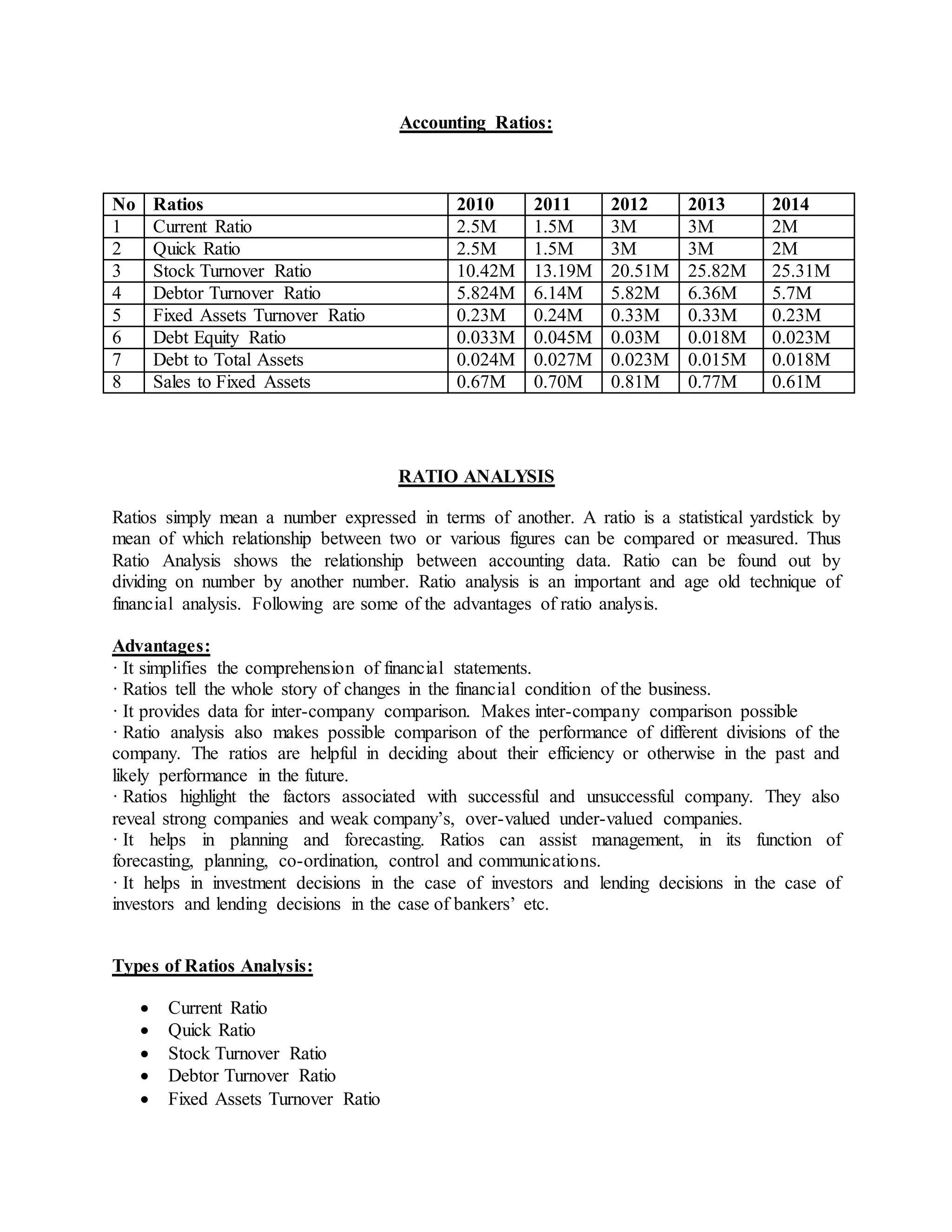
Accounting Ratios:
No Ratios 2010 2011 2012 2013 2014
1 Current Ratio 2.5M 1.5M 3M 3M 2M
2 Quick Ratio 2.5M 1.5M 3M 3M 2M
3 Stock Turnover Ratio 10.42M 13.19M 20.51M 25.82M 25.31M
4 Debtor Turnover Ratio 5.824M 6.14M 5.82M 6.36M 5.7M
5 Fixed Assets Turnover Ratio 0.23M 0.24M 0.33M 0.33M 0.23M
6 Debt Equity Ratio 0.033M 0.045M 0.03M 0.018M 0.023M
7 Debt to Total Assets 0.024M 0.027M 0.023M 0.015M 0.018M
8 Sales to Fixed Assets 0.67M 0.70M 0.81M 0.77M 0.61M
RATIO ANALYSIS
Ratios simply mean a number expressed in terms of another. A ratio is a statistical yardstick by
mean of which relationship between two or various figures can be compared or measured. Thus
Ratio Analysis shows the relationship between accounting data. Ratio can be found out by
dividing on number by another number. Ratio analysis is an important and age old technique of
financial analysis. Following are some of the advantages of ratio analysis.
Advantages:
· It simplifies the comprehension of financial statements.
· Ratios tell the whole story of changes in the financial condition of the business.
· It provides data for inter-company comparison. Makes inter-company comparison possible
· Ratio analysis also makes possible comparison of the performance of different divisions of the
company. The ratios are helpful in deciding about their efficiency or otherwise in the past and
likely performance in the future.
· Ratios highlight the factors associated with successful and unsuccessful company. They also
reveal strong companies and weak company’s, over-valued under-valued companies.
· It helps in planning and forecasting. Ratios can assist management, in its function of
forecasting, planning, co-ordination, control and communications.
· It helps in investment decisions in the case of investors and lending decisions in the case of
investors and lending decisions in the case of bankers’ etc.
Types of Ratios Analysis:
 Current Ratio
 Quick Ratio
 Stock Turnover Ratio
 Debtor Turnover Ratio
 Fixed Assets Turnover Ratio
 Debt Equity Ratio
 Debt to Total Assets
 Sales to Fixed Assets
Comparison of Ratio Analysis:
Current ratio is a general and quick measured of liquidity of company. It represents the margin of
safety or cushion available to the auditor. It is the index of the company’s financial stability. It is
also an index of the financial solvency and index of strength of working capital.
The current ratio of the company of 2010 is exceeded from 2011 because current assets are more
than the liabilities to pay the liabilities and the current ratio of 2011 is less than 2010 because
there are less assets to satisfy the liabilities.
Acid Test (Quick) Ratio:
Acid Test (Quick) ratio is equal to Current assets fewer inventories divided by current liabilities.
It gives more liquid amount of assets to cover your liabilities.
The quick test ratio is a very useful measuring of the liquidity position of the company. It means
that company’s ability to pay its short-term obligations or current liabilities immediately and is a
more rigorous test of liquidity than the current ratio.
The quick ratio of the company as is shown by the above calculations is not consistent, and
decreasing with large percentage that is, the company is getting lesser and lesser liquid current
assets to cover its current liabilities.

Income StatementBalance SheetCash Flow Statement

  • 1.
    Project Report ofFinancial Statements on Google Submitted To:  Prof. Imran Aslam Submitted By:  Muhammad Faisal Yar Thaheem  Muhammad Mujtaba Khan Baloch  Muhammad Arslan Arshad  Muhammad Bilal Ahmed Bhachar National College of Business Administration & Economics
  • 2.
    Financial statement A financialstatement (or financial report) is a formal record of the financial activities and position of a business, person, or other entity. Relevant financial information is presented in a structured manner and in a form easy to understand. They typically include basic financial statements, accompanied by a management discussion and analysis. Types of Financial Statements:  Balance Sheet: A Balance Sheet is also referred to as a statement of financial position, reports on a company's assets,liabilities, and ownership equity at a given point in time.  Income Statement: An income statement, also known as a statement of comprehensive income, statement of revenue & expense, P&L or profit and loss report, reports on a company's income, expenses, and profits over a period of time. A profit and loss statement provides information on the operation of the enterprise. These include sales and the various expenses incurred during the stated period.  Statement of changes in equity: A statement of changes in equity, also known as equity statement or statement of retained earnings, reports on the changes in equity of the company during the stated period.  Statement of Cash Flows: A statement of cash flows reports on a company's cash flow activities, particularly its operating, investing andfinancing activities. For large corporations, these statements may be complex and may include an extensive set of footnotes to the financial statements and management discussion and analysis. The notes typically describe each item on the balance sheet, income statement and cash flow statement in further detail. Notes to financial statements are considered an integral part of the financial statements.
  • 3.
    Annual Income Statements Fiscalyear is January-December. All values USD millions. 2010 2011 2012 2013 2014 Sales/Revenue 29.12M 37.86M 49.96M 59.73M 65.83M Cost of Goods Sold (COGS) 10.42M 13.19M 20.51M 25.82M 25.31M Depreciation 1.07M 1.4M 1.99M 2.78M 3.52M Gross Income 17.63M 23.27M 27.46M 31.13M 37.0M 2010 2011 2012 2013 2014 Unusual Expense 1.3M 8.3M 4.1M 4.2M 2.5M Non Operating Income/Expense 2.5M 2.5M 1.7M 2.9M 2.3M Non-Operating Interest Income 5.5M 2.3M 3.1M 7.2M 7.3M Interest Expense - 3.1M 1.5M 8.2M 1.34M Pretax Income 1.8M 1.1M 2.4.M 1.5M 1.3M Net Income 6.53M 5.97M 14.66M 7.13M 22.26M Annual Balance Sheet Assets Fiscal year is January-December. All values USD millions. 2010 2011 2012 2013 2014 Short-Term Investments 30.32M 39.91M 40.02M 48.81M 48.36M Total Accounts Receivable 5M 6.17M 8.59M 9.39M 11.56M Inventories 2.3M 1.2M 5.5M 4.6M 2.1M Finished Goods 2.6M 2.3M 4.8M 3.1M 1.4M Work in Progress 5.2M 2.2M 2.5M 1.2M 1.7M Raw Materials 1.7M 1.5M 2.7M 1.5M 1.3M Other Current Assets 1.59M 1.96M 3.28M 4.35M 4.73M
  • 4.
    Fiscal year isJanuary-December. All values USD millions. 2010 2011 2012 2013 2014 Miscellaneous Current Assets 1.59M 1.96M 3.28M 4.35M 4.73M Total Current Assets 50.3M 57.2M 70.67M 77.3M 75.88M 2010 2011 2012 2013 2014 Plant & Equipment 7.76M 9.6M 11.85M 16.52M 23.88M Property 11.77M 14.4M 17.7M 23.84M 32.75M Buildings 3.97M 5.23M 6.26M 7.49M 13.33M Computer Software and Equipment 4.67M 6.06M 7.72M 9.09M 10.92M Accumulated Depreciation 4.01M 4.8M 5.84M 7.31M 8.86M Total Investments and Advances 5.3M 7.0M 1.47M 1.98M 3.08M Net Goodwill 6.26M 7.35M 10.54M 11.49M 15.6M Total Assets 94.04M 111.64M 132.05M 155.02M 184.3M Liabilities & Shareholders' Equity 2010 2011 2012 2013 2014 Accounts Payable 4.3M 5.8M 2.01M 2.45M 1.72M Income Tax Payable 3.7M 19.7M 2.40M 2.4M 9.6M Other Current Liabilities 6.01M 6.91M 9.54M 10.42M 12.99M Accrued Payroll 1.41M 1.82M 2.24M 2.5M 3.07M Miscellaneous Current Liabilities 4.6M 5.09M 7.3M 7.92M 9.92M Total Current Liabilities 20.02M 39.32M 23.49M 25.69M 37.3M Long-Term Debt 2.3M 2.99M 2.99M 2.24M 3.23M Other Liabilities 1.61M 2.24M 2.89M 3.52M 4.63M Total Liabilities 23.93M 44.55M 29.37M 31.45M 45.16M Shareholder’s Equity 70.11M 67.09M 102.68M 123.57M 139.14M Liabilities & Shareholders' Equity 94.04M 111.64M 132.05M 155.02M 184.3M
  • 5.
    Accounting Ratios: No Ratios2010 2011 2012 2013 2014 1 Current Ratio 2.5M 1.5M 3M 3M 2M 2 Quick Ratio 2.5M 1.5M 3M 3M 2M 3 Stock Turnover Ratio 10.42M 13.19M 20.51M 25.82M 25.31M 4 Debtor Turnover Ratio 5.824M 6.14M 5.82M 6.36M 5.7M 5 Fixed Assets Turnover Ratio 0.23M 0.24M 0.33M 0.33M 0.23M 6 Debt Equity Ratio 0.033M 0.045M 0.03M 0.018M 0.023M 7 Debt to Total Assets 0.024M 0.027M 0.023M 0.015M 0.018M 8 Sales to Fixed Assets 0.67M 0.70M 0.81M 0.77M 0.61M RATIO ANALYSIS Ratios simply mean a number expressed in terms of another. A ratio is a statistical yardstick by mean of which relationship between two or various figures can be compared or measured. Thus Ratio Analysis shows the relationship between accounting data. Ratio can be found out by dividing on number by another number. Ratio analysis is an important and age old technique of financial analysis. Following are some of the advantages of ratio analysis. Advantages: · It simplifies the comprehension of financial statements. · Ratios tell the whole story of changes in the financial condition of the business. · It provides data for inter-company comparison. Makes inter-company comparison possible · Ratio analysis also makes possible comparison of the performance of different divisions of the company. The ratios are helpful in deciding about their efficiency or otherwise in the past and likely performance in the future. · Ratios highlight the factors associated with successful and unsuccessful company. They also reveal strong companies and weak company’s, over-valued under-valued companies. · It helps in planning and forecasting. Ratios can assist management, in its function of forecasting, planning, co-ordination, control and communications. · It helps in investment decisions in the case of investors and lending decisions in the case of investors and lending decisions in the case of bankers’ etc. Types of Ratios Analysis:  Current Ratio  Quick Ratio  Stock Turnover Ratio  Debtor Turnover Ratio  Fixed Assets Turnover Ratio
  • 6.
     Debt EquityRatio  Debt to Total Assets  Sales to Fixed Assets Comparison of Ratio Analysis: Current ratio is a general and quick measured of liquidity of company. It represents the margin of safety or cushion available to the auditor. It is the index of the company’s financial stability. It is also an index of the financial solvency and index of strength of working capital. The current ratio of the company of 2010 is exceeded from 2011 because current assets are more than the liabilities to pay the liabilities and the current ratio of 2011 is less than 2010 because there are less assets to satisfy the liabilities. Acid Test (Quick) Ratio: Acid Test (Quick) ratio is equal to Current assets fewer inventories divided by current liabilities. It gives more liquid amount of assets to cover your liabilities. The quick test ratio is a very useful measuring of the liquidity position of the company. It means that company’s ability to pay its short-term obligations or current liabilities immediately and is a more rigorous test of liquidity than the current ratio. The quick ratio of the company as is shown by the above calculations is not consistent, and decreasing with large percentage that is, the company is getting lesser and lesser liquid current assets to cover its current liabilities.