Let’s take a look at the instructional strategies we typically
use in our classrooms and see how they affect our
students’ memory retention rates.
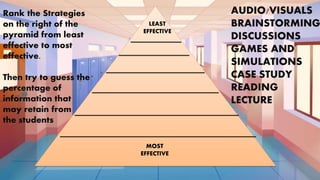
LEAST
EFFECTIVE
MOST
EFFECTIVE
AUDIO/VISUALS
BRAINSTORMING
DISCUSSIONS
GAMES AND
SIMULATIONS
CASE STUDY
READING
LECTURE
Rank the Strategies
on the right of the
pyramid from least
effective to most
effective.
Then try to guess the
percentage of
information that
may retain from
the students
Students come
to our
classrooms with
a variety
of?
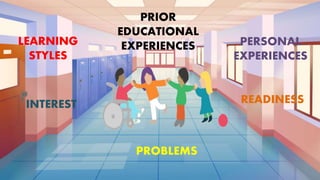
PRIOR
EDUCATIONAL
EXPERIENCES
LEARNING
STYLES
READINESS
INTEREST
PERSONAL
EXPERIENCES
PROBLEMS
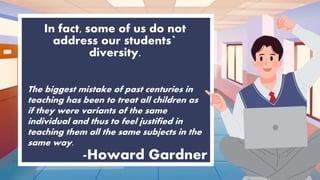
In fact, some of us do not
address our students`
diversity.
-Howard Gardner
The biggest mistake of past centuries in
teaching has been to treat all children as
if they were variants of the same
individual and thus to feel justified in
teaching them all the same subjects in the
same way.
WHEN YOU
HEAR THE WORD
DIVERSITY,
WHAT COMES
UP TO YOUR
MIND?
• The practice or quality of
including or involving
people from a range of
different social and ethnic
backgrounds and of
different genders,
sexual orientations, etc.
• is a wide array of people
that come from different
backgrounds, lifestyles,
social experiences, races,
and religions.
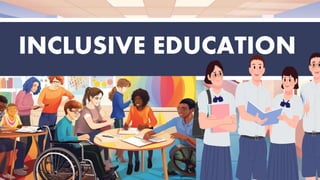
INCLUSIVE EDUCATION
Learner Objectives:
Participants will…
• Become familiar with vocabulary related to
INCLUSIVE EDUCATION.
• Understand basic principles of inclusive education in
an academically diverse classroom.
• Be able to implement one or more instructional
strategies that support Inclusive education.
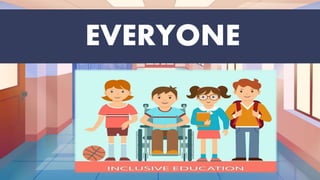
EVERYONE
INCLUSIONS
According to Alur (2002),
“Inclusion is about
minimizing exclusion and
fostering participation for
all students in the culture
within the wider framework
of support for all children in
ordinary schools.”
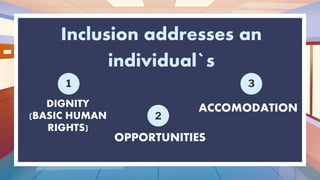
Inclusion addresses an
individual`s
OPPORTUNITIES
ACCOMODATION
1
2
3
DIGNITY
(BASIC HUMAN
RIGHTS)
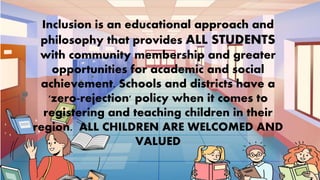
Inclusion is an educational approach and
philosophy that provides ALL STUDENTS
with community membership and greater
opportunities for academic and social
achievement. Schools and districts have a
'zero-rejection' policy when it comes to
registering and teaching children in their
region. ALL CHILDREN ARE WELCOMED AND
VALUED
Inclusion encompasses curriculum
flexibility, pedagogy, infrastructural
changes, sensitization of parents and peers
are the integral components of the
accommodations that schools must make.
Initiative and commitment on part of a
school must be viewed as imperative to the
successful implementation of an inclusive
education program. Unless a school
wholeheartedly embraces the ideology of
inclusion in principle and in practice, there
are no guarantees for its success.
Inclusive Education is
defined as a learning
environment that promotes
the full personal, academic
and professional
development of all learners
irrespective of race, class,
color, gender, disability,
sexual preference, learning
styles.
Describes the process by which a school
accepts children with special needs for
enrollment in regular classes where they can
learn side by side with their peers. The school
organizes its special education program
includes a special education teacher in its
faculty. The school provides the mainstream
where regular teachers and special education
teachers organize and implement
appropriate programs for both special and
regular students.
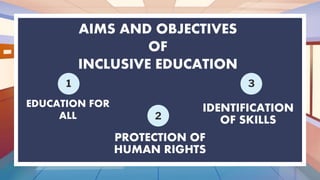
AIMS AND OBJECTIVES
OF
INCLUSIVE EDUCATION
PROTECTION OF
HUMAN RIGHTS
IDENTIFICATION
OF SKILLS
1
2
3
EDUCATION FOR
ALL
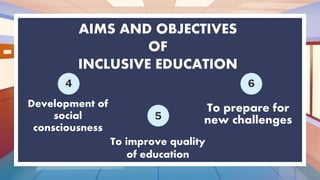
AIMS AND OBJECTIVES
OF
INCLUSIVE EDUCATION
To prepare for
new challenges
4
5
6
Development of
social
consciousness
To improve quality
of education
The Legal Bases of
Inclusive Education
 1935. Articles 356 and 259 of
Commonwealth Act No. 3203 asserted
“the right of every child to live in an
atmosphere conducive to his physical,
moral and intellectual development
“and the concomitant duty of the
government. “To promote the full
growth of the faculties of every child.”
The Legal Bases of
Inclusive Education
 The 1987 Constitution of the Philippines cites the rights of
exceptional children to education in Article XIV. Section 1
declares the State shall protect and promote the right of
all citizens to quality education at all levels and shall
take appropriate steps to make such education
accessible to all. Section 2 emphasizes that “the State
shall provide adult citizens, the disabled and out of
school youth with training in civics, vocational efficiency
and other skills.”
The Legal Bases of
Inclusive Education
 In 1992, R.A. No. 7610 was enacted. The law
is “An Act Providing for Strong Deterrence
and Special Protection against Child
Abuse, Exploitation and Discrimination,
Providing Penalties for its Violation and
Other Purposes.”
BARRIERS IN INCLUSIVE EDUCATION
• Negative approach
• Lack of physical facilities
• Lack of funds
• Lack of trained teachers
• Social discrimination
• Emotional problems
• Educational problems
PRINCIPLES OF
INCLUSIVE EDUCATION
• No discrimination with students
• Equal educational opportunity to all
• School adapt to the need of student
• Equal educational benefits for all students
• The student's views are listened to and taken
seriously
• Individual differences between students are a
source of richness and diversity, and not a problem
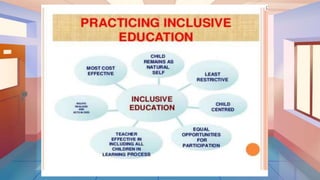
PRACTICE OF INCLUSIVE
EDUCATION
• Understanding Inclusion as a continuing
process, not a one time event.
• Strengthening and sustaining the participation
of all students, teachers, parents and
community members in the work of the school.
• Restructuring the cultures, policies and practices
in schools to respond to the diversity of pupils
within their locality.
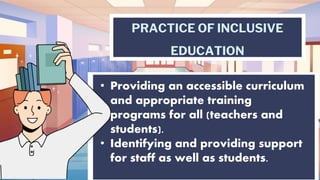
PRACTICE OF INCLUSIVE
EDUCATION
• Providing an accessible curriculum
and appropriate training
programs for all (teachers and
students).
• Identifying and providing support
for staff as well as students.
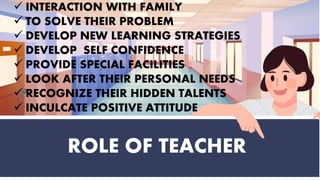
ROLE OF TEACHER
 INTERACTION WITH FAMILY
 TO SOLVE THEIR PROBLEM
 DEVELOP NEW LEARNING STRATEGIES
 DEVELOP SELF CONFIDENCE
 PROVIDE SPECIAL FACILITIES
 LOOK AFTER THEIR PERSONAL NEEDS
 RECOGNIZE THEIR HIDDEN TALENTS
 INCULCATE POSITIVE ATTITUDE
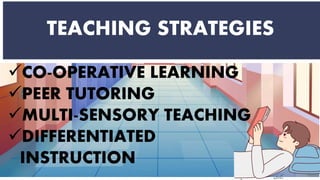
TEACHING STRATEGIES
CO-OPERATIVE LEARNING
PEER TUTORING
MULTI-SENSORY TEACHING
DIFFERENTIATED
INSTRUCTION
We are for difference,
for respecting difference,
for valuing difference,
until difference no longer
makes a difference.
THANK YOU!

INCLUSIVE EDUCATION.pptx

  • 2.
    Let’s take alook at the instructional strategies we typically use in our classrooms and see how they affect our students’ memory retention rates.
  • 3.
    LEAST EFFECTIVE MOST EFFECTIVE AUDIO/VISUALS BRAINSTORMING DISCUSSIONS GAMES AND SIMULATIONS CASE STUDY READING LECTURE Rankthe Strategies on the right of the pyramid from least effective to most effective. Then try to guess the percentage of information that may retain from the students
  • 4.
  • 5.
  • 6.
    In fact, someof us do not address our students` diversity. -Howard Gardner The biggest mistake of past centuries in teaching has been to treat all children as if they were variants of the same individual and thus to feel justified in teaching them all the same subjects in the same way.
  • 7.
    WHEN YOU HEAR THEWORD DIVERSITY, WHAT COMES UP TO YOUR MIND?
  • 8.
    • The practiceor quality of including or involving people from a range of different social and ethnic backgrounds and of different genders, sexual orientations, etc. • is a wide array of people that come from different backgrounds, lifestyles, social experiences, races, and religions.
  • 9.
  • 10.
    Learner Objectives: Participants will… •Become familiar with vocabulary related to INCLUSIVE EDUCATION. • Understand basic principles of inclusive education in an academically diverse classroom. • Be able to implement one or more instructional strategies that support Inclusive education.
  • 11.
  • 12.
    INCLUSIONS According to Alur(2002), “Inclusion is about minimizing exclusion and fostering participation for all students in the culture within the wider framework of support for all children in ordinary schools.”
  • 13.
  • 14.
    Inclusion is aneducational approach and philosophy that provides ALL STUDENTS with community membership and greater opportunities for academic and social achievement. Schools and districts have a 'zero-rejection' policy when it comes to registering and teaching children in their region. ALL CHILDREN ARE WELCOMED AND VALUED
  • 15.
    Inclusion encompasses curriculum flexibility,pedagogy, infrastructural changes, sensitization of parents and peers are the integral components of the accommodations that schools must make. Initiative and commitment on part of a school must be viewed as imperative to the successful implementation of an inclusive education program. Unless a school wholeheartedly embraces the ideology of inclusion in principle and in practice, there are no guarantees for its success.
  • 16.
    Inclusive Education is definedas a learning environment that promotes the full personal, academic and professional development of all learners irrespective of race, class, color, gender, disability, sexual preference, learning styles.
  • 17.
    Describes the processby which a school accepts children with special needs for enrollment in regular classes where they can learn side by side with their peers. The school organizes its special education program includes a special education teacher in its faculty. The school provides the mainstream where regular teachers and special education teachers organize and implement appropriate programs for both special and regular students.
  • 18.
    AIMS AND OBJECTIVES OF INCLUSIVEEDUCATION PROTECTION OF HUMAN RIGHTS IDENTIFICATION OF SKILLS 1 2 3 EDUCATION FOR ALL
  • 19.
    AIMS AND OBJECTIVES OF INCLUSIVEEDUCATION To prepare for new challenges 4 5 6 Development of social consciousness To improve quality of education
  • 20.
    The Legal Basesof Inclusive Education  1935. Articles 356 and 259 of Commonwealth Act No. 3203 asserted “the right of every child to live in an atmosphere conducive to his physical, moral and intellectual development “and the concomitant duty of the government. “To promote the full growth of the faculties of every child.”
  • 21.
    The Legal Basesof Inclusive Education  The 1987 Constitution of the Philippines cites the rights of exceptional children to education in Article XIV. Section 1 declares the State shall protect and promote the right of all citizens to quality education at all levels and shall take appropriate steps to make such education accessible to all. Section 2 emphasizes that “the State shall provide adult citizens, the disabled and out of school youth with training in civics, vocational efficiency and other skills.”
  • 22.
    The Legal Basesof Inclusive Education  In 1992, R.A. No. 7610 was enacted. The law is “An Act Providing for Strong Deterrence and Special Protection against Child Abuse, Exploitation and Discrimination, Providing Penalties for its Violation and Other Purposes.”
  • 23.
    BARRIERS IN INCLUSIVEEDUCATION • Negative approach • Lack of physical facilities • Lack of funds • Lack of trained teachers • Social discrimination • Emotional problems • Educational problems
  • 24.
    PRINCIPLES OF INCLUSIVE EDUCATION •No discrimination with students • Equal educational opportunity to all • School adapt to the need of student • Equal educational benefits for all students • The student's views are listened to and taken seriously • Individual differences between students are a source of richness and diversity, and not a problem
  • 25.
    PRACTICE OF INCLUSIVE EDUCATION •Understanding Inclusion as a continuing process, not a one time event. • Strengthening and sustaining the participation of all students, teachers, parents and community members in the work of the school. • Restructuring the cultures, policies and practices in schools to respond to the diversity of pupils within their locality.
  • 26.
    PRACTICE OF INCLUSIVE EDUCATION •Providing an accessible curriculum and appropriate training programs for all (teachers and students). • Identifying and providing support for staff as well as students.
  • 29.
    ROLE OF TEACHER INTERACTION WITH FAMILY  TO SOLVE THEIR PROBLEM  DEVELOP NEW LEARNING STRATEGIES  DEVELOP SELF CONFIDENCE  PROVIDE SPECIAL FACILITIES  LOOK AFTER THEIR PERSONAL NEEDS  RECOGNIZE THEIR HIDDEN TALENTS  INCULCATE POSITIVE ATTITUDE
  • 30.
    TEACHING STRATEGIES CO-OPERATIVE LEARNING PEERTUTORING MULTI-SENSORY TEACHING DIFFERENTIATED INSTRUCTION
  • 31.
    We are fordifference, for respecting difference, for valuing difference, until difference no longer makes a difference.
  • 32.

Editor's Notes

  • #5 WHAT ATTRIBUTES DO STUDENTS HAVE WHEN THEY COME TO SCHOOL?
  • #18 WHAT ATTRIBUTES DO STUDENTS HAVE WHEN THEY COME TO SCHOOL?