
JIRCAS
        Research Activities
          at JIRCAS

         Masa Iwanaga
          President

Japan International Research Center
  for Agricultural Sciences (JIRCAS)


           CIAT, Cali, Colombia
           October 22, 2012
Contents


1. Overall introduction of JIRCAS
2. Research highlights
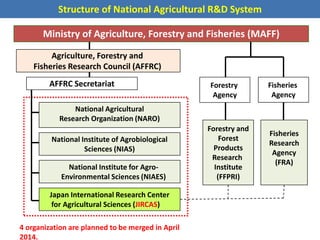
Structure of National Agricultural R&D System

       Ministry of Agriculture, Forestry and Fisheries (MAFF)
         Agriculture, Forestry and
    Fisheries Research Council (AFFRC)
        AFFRC Secretariat                          Forestry       Fisheries
                                                    Agency         Agency
               National Agricultural
           Research Organization (NARO)
                                                   Forestry and
                                                                  Fisheries
         National Institute of Agrobiological          Forest
                                                                  Research
                   Sciences (NIAS)                   Products
                                                                   Agency
                                                    Research
                                                                    (FRA)
              National Institute for Agro-           Institute
            Environmental Sciences (NIAES)            (FFPRI)

         Japan International Research Center
          for Agricultural Sciences (JIRCAS)

4 organization are planned to be merged in April
2014.
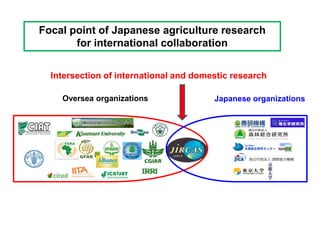
Focal point of Japanese agriculture research
       for international collaboration


  Intersection of international and domestic research

    Oversea organizations               Japanese organizations
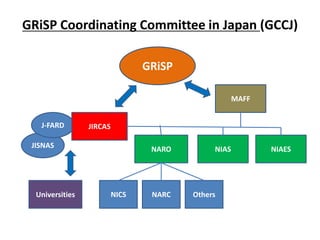
GRiSP Coordinating Committee in Japan (GCCJ)

                                 GRiSP

                                                     MAFF


   J-FARD        JIRCAS

 JISNAS                           NARO        NIAS          NIAES


  Universities            NICS    NARC   Others
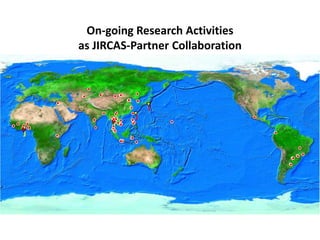
On-going Research Activities
        as JIRCAS-Partner Collaboration


                      J
                  J
    4
              J
J
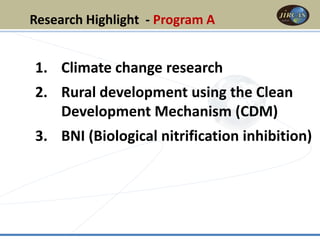
Research Highlight - Program A


1. Climate change research
2. Rural development using the Clean
   Development Mechanism (CDM)
3. BNI (Biological nitrification inhibition)
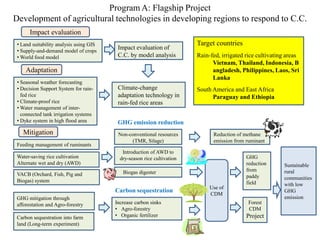
Program A: Flagship Project
Development of agricultural technologies in developing regions to respond to C.C.
       Impact evaluation
 • Land suitability analysis using GIS                                   Target countries
 • Supply-and-demand model of crops
                                          Impact evaluation of
 • World food model                       C.C. by model analysis         Rain-fed, irrigated rice cultivating areas
                                                                               Vietnam, Thailand, Indonesia, B
     Adaptation                                                                angladesh, Philippines, Laos, Sri
                                                                               Lanka
 • Seasonal weather forecasting
 • Decision Support System for rain-      Climate-change                 South America and East Africa
   fed rice                               adaptation technology in             Paraguay and Ethiopia
 • Climate-proof rice                     rain-fed rice areas
 • Water management of inter-
   connected tank irrigation systems
 • Dyke system in high flood area         GHG emission reduction
   Mitigation                             Non-conventional resources           Reduction of methane
                                               (TMR, Silage)                   emission from ruminant
 Feeding management of ruminants
                                            Introduction of AWD to
 Water-saving rice cultivation             dry-season rice cultivation                       GHG
 Alternate wet and dry (AWD)                                                                 reduction      Sustainable
                                            Biogas digester                                  from           rural
 VACB (Orchard, Fish, Pig and                                                                paddy
 Biogas) system                                                                                             communities
                                                                                             field          with low
                                                                              Use of
                                         Carbon sequestration                                               GHG
                                                                              CDM
 GHG mitigation through                                                                                     emission
 afforestation and Agro-forestry         Increase carbon sinks                                Forest
                                         • Agro-forestry                                      CDM
 Carbon sequestration into farm          • Organic fertilizer                                Project
 land (Long-term experiment)
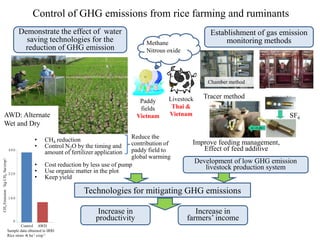
Control of GHG emissions from rice farming and ruminants
                                      Demonstrate the effect of water                                            Establishment of gas emission
                                        saving technologies for the                     Methane                       monitoring methods
                                       reduction of GHG emission                        Nitrous oxide


                                                                                                                 Chamber method


                                                                                                 Livestock     Tracer method
                                                                                      Paddy
                                                                                      fields      Thai &
     AWD: Alternate                                                                  Vietnam     Vietnam                                 SF6
     Wet and Dry

                                           •     CH4 reduction                     Reduce the
                                           •     Control N2O by the timing and     contribution of       Improve feeding management,
                                480
                                                 amount of fertilizer application  paddy field to           Effect of feed additive
                                                                                   global warming
CH4 Emission(kg CH4 /ha/crop)


                                           •     Cost reduction by less use of pump
                                                                                                             Development of low GHG emission
                                           •     Use organic matter in the plot
                                                                                                                livestock production system
                                320
                                           •     Keep yield

                                                                 Technologies for mitigating GHG emissions
                                160


                                                                       Increase in                         Increase in
                                  0
                                                                      productivity                      farmers’ income
                                    Control AWD
                           Sample data obtained in IRRI
                           Rice straw 4t ha-1 crop-1
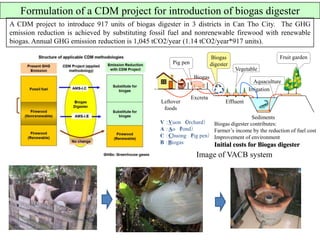
Formulation of a CDM project for introduction of biogas digester
A CDM project to introduce 917 units of biogas digester in 3 districts in Can Tho City. The GHG
emission reduction is achieved by substituting fossil fuel and nonrenewable firewood with renewable
biogas. Annual GHG emission reduction is 1,045 tCO2/year (1.14 tCO2/year*917 units).

                                                                          Biogas                         Fruit garden
                                                      Pig pen             digester
                                                                                     Vegetable
                                                                 Biogas
                                                                                               Aquaculture
                                                                                            Irrigation
                                                                Excreta
                                                 Leftover                        Effluent
                                                  foods
                                                                                    Sediments
                                                 V:Vuon ( Orchard) Biogas digester contributes:
                                                 A: (
                                                   Ao Pond)        Farmer’s income by the reduction of fuel cost
                                                 C:Chuong ( pen) Improvement of environment
                                                            Pig
                                                 B:Biogas          Initial costs for Biogas digester
                                                                  Image of VACB system
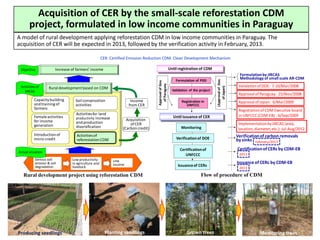
Acquisition of CER by the small-scale reforestation CDM
       project, formulated in low income communities in Paraguay
A model of rural development applying reforestation CDM in low income communities in Paraguay. The
acquisition of CER will be expected in 2013, followed by the verification activity in February, 2013.

                                                      CER: Certified Emission Reduction CDM: Clean Development Mechanism

 Objective              Increase of farmers’ income                                                   Until registration of CDM
                                                                                                                                                         Formulation by JIRCAS
                                                                                                                                                         Methodology of small scale AR-CDM


                                                                                                                                    (Approval of Gov.
                                                                                                          Formulation of PDD


                                                                                   Approval of Gov.
                                                                                     of Paraguay
 Activities of                                                                                                                                           Validation of DOE: 7-10/Mar/2008


                                                                                                                                        of Japan)
                    Rural development based on CDM                                                      Validation of the project
   JIRCAS
                                                                                                                                                         Approval of Paraguay: 25/Nov/2008
          Capacity building        Soil conservation                  Income                                  Registration in
          and training of                                                                                                                                Approval of Japan: 6/Mar/2009
                                   activities                        from CER                                    UNFCCC
          farmers                                                                                                                                        Registration of CDM Executive board
                                   Activities for land                                                                                                   in UNFCCC (CDM-EB) : 6/Sep/2009
          Female activities        productivity increase                                                Until issuance of CER
          for income                                               Acquisition
                                   and production                    of CER                                                                              Implementation by JIRCAS (area,
          generation               diversification               (Carbon credit)                             Monitoring                                  location, diameter, etc.): Jul-Aug/2012
          Introduction of           Activities of                                                                                                       Verification of carbon removals
          micro-credit              reforestation CDM                                                     Verification of DOE                           by sinks February/2013
                                                                                                             Certification of                           Certification of CERs by CDM-EB
Actual situation
                                                                                                                UNFCCC                                   2013
           Serious soil          Low productivity           Low
           erosion & soil        in agriculture and         income                                                                                      Issuance of CERs by CDM-EB
           degradation           livestock                                                                 Issuance of CERs
                                                                                                                                                         2013

   Rural development project using reforestation CDM                                                                      Flow of procedure of CDM


Producing seedlings                                     Planting seedlings                                       Grown trees                                         Monitoring trees
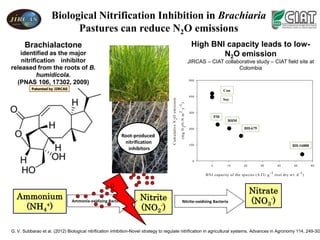
Biological Nitrification Inhibition in Brachiaria
                           Pastures can reduce N2O emissions
       Brachialactone                                                                                                High BNI capacity leads to low-
   identified as the major                                                                                                   N2O emission
    nitrification inhibitor                                                                                         JIRCAS – CIAT collaborative study – CIAT field site at
released from the roots of B.                                                                                                           Colombia
           humidicola.
                                                                                                                    500
  (PNAS 106, 17302, 2009)
          Patented by JIRCAS                                                                                                           Con
                                                                                                                    400


                                                                                     C um ulative N 2 O em ission
                                                                                                                                       Soy


                                                                                        (m g N 2 O -N m y )
                                                                                                        2 -1
                                                                                                                    300
                                                                                                                                  PM
                                                                                                                                         BHM

                                                                                                                    200                           BH-679

                                                          Root-produced
                                                           nitrification                                            100                                                             BH-16888
                                                            inhibitors

                                                                                                                      0
                                                                                                                              0          10      20        30             40         50             60

                                                                                                                                                                    -1                     -1
                                                                                                                           B N I capacity of the species (A T U g        root dry w t. d        )


                                                                                                                                                      Nitrate
  Ammonium                                                         Nitrite
                                Ammonia-oxidizing Bacteria                                              Nitrite-oxidizing Bacteria                    (NO3-)
   (NH4+)                                                          (NO2-)

G. V. Subbarao et al. (2012) Biological nitrification inhibition-Novel strategy to regulate nitrification in agricultural systems. Advances in Agronomy 114, 249-302
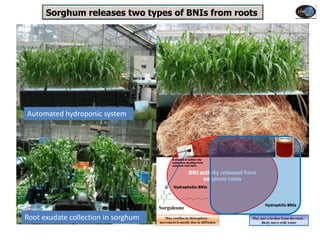
Sorghum releases two types of BNIs from roots


Automated hydroponic system


                                                    A droplet of yellow oily
                                                    substance exuding from
                                                    sorghum root hairs


                                                                BNI activity released from
                                                                     sorghum roots
                                                    Hydrophobic BNIs
                                           O
                                               OH


                                     O
                                           O
                                                                                               Hydrophilic BNIs
                                     Sorgoleone
Root exudate collection in sorghum         May confine to rhizosphere –
                                         movement is mostly due to diffusion
                                                                                        May move farther from the roots –
                                                                                            likely move with water
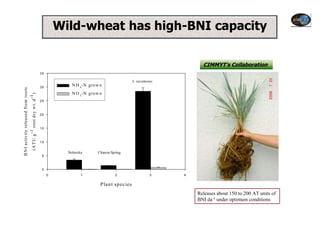
Wild-wheat has high-BNI capacity

                                                                                                      CIMMYT’s Collaboration
                                     35

                                                                                 L. racemosus
                                     30
                                                  N H 4 -N grow n
B N I activity released from roots


                                                  N O 3 -N grow n
   (A T U g root dry w t. d )
                            -1


                                     25


                                     20


                                     15
            -1


                                     10


                                                Nobeoka        Chinese Spring
                                      5


                                      0
                                          0           1                  2                 3    4


                                                                P lant species
                                                                                                    Releases about 150 to 200 AT units of
                                                                                                    BNI da-1 under optimum conditions
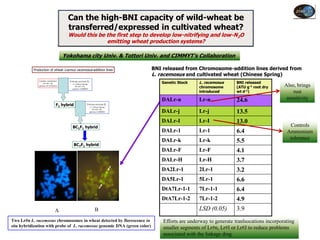
Can the high-BNI capacity of wild-wheat be
                                   transferred/expressed in cultivated wheat?
                                   Would this be the first step to develop low-nitrifying and low-N2O
                                                 emitting wheat production systems?

                                 Yokohama city Univ. & Tottori Univ. and CIMMYT’s Collaboration

           Production of wheat-Leymus racemosus-addition lines                  BNI released from Chromosome-addition lines derived from
                                                                                L. racemosus and cultivated wheat (Chinese Spring)
                                                       L.
                                                                                   Genetic Stock    L. racemosus      BNI released
              Leymus racemosus     Triticum aestivum
                  2N=4X =28;
              genome Ns NsXmXm
                                     cv. Chinese Spring
                                        2N=6X =42;
                                                                                                    chromosome        (ATU g-1 root dry     Also, brings
                                     genome AABBDD
                                                                                                    introduced        wt d-1)                   rust
                                                                                   DALr-n           Lr-n              24.6                   sensitivity
                            F1 hybrid                  Triticum aestivum   L.
                                                          cv. Chinese Spring
                                                             2N=6X =42;
                                                          genome AABBDD            DALr-j           Lr-j              13.5
                                                                                   DALr-I           Lr-I              13.0
                                      BC1F1 hybrid                                                                                            Controls
                                                                                   DALr-1           Lr-1              6.4                    Ammonium
                                                                                   DALr-k           Lr-k                                      tolerance
                                                                                                                      5.5
                                       BC7F1 hybrid
                                                                                   DALr-F           Lr-F              4.1
                                                                                   DALr-H           Lr-H              3.7
                                                                                   DA2Lr-1          2Lr-1             3.2
                                                                                   DA5Lr-1          5Lr-1             6.6
                                                                                   DtA7Lr-1-1       7Lr-1-1           6.4
                                                                                   DtA7Lr-1-2       7Lr-1-2           4.9
                            A                                   B                                   LSD (0.05)        3.9
Two Lr#n L. racemosus chromosomes in wheat detected by florescence in               Efforts are underway to generate tranlsocations incorporating
situ hybridization with probe of L. racemosus genomic DNA (green color)             smaller segments of Lr#n, Lr#I or Lr#J to reduce problems
                                                                                    associated with the linkage drag
Research Highlight - Program B


1. Genetic engineering for stress-
   tolerant crops
2. Phosphorus deficiency in rice
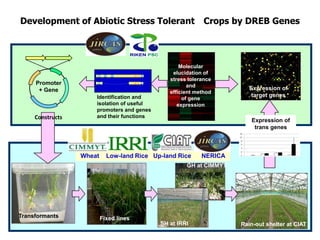
Development of Abiotic Stress Tolerant Crops by DREB Genes


                                                       Molecular
                                        B   L
                                                    elucidation of
                                                   stress tolerance
     Promoter                           B   L

                                                          and
      + Gene                                                               Expression of
                                                   efficient method
                      Identification and                                    target genes
                                                        of gene
                      isolation of useful             expression
                      promoters and genes
     Constructs       and their functions
                                                                           Expression of
                                                                            trans genes


                  Wheat     Low-land Rice Up-land Rice         NERICA
                                                         GH at CIMMYT


Transformants             Fixed lines
                                                SH at IRRI              Rain-out shelter at CIAT
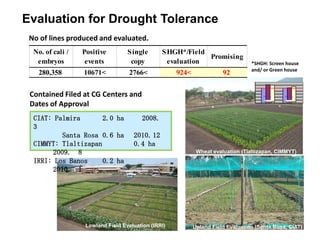
Evaluation for Drought Tolerance
 No of lines produced and evaluated.
  No. of cali /   Positive         S ingle       S HGH*/Field
                                                              Promising
   embryos         events           copy           evaluation                     *SHGH: Screen house
                                                                                  and/ or Green house
   280,358        10671<           2766<             924<              92


 Contained Filed at CG Centers and                                                     Fielder    Fielder


 Dates of Approval                                                                      Drought   Irrigated


  CIAT: Palmira       2.0 ha             2008.
  3
          Santa Rosa 0.6 ha          2010. 12
  CIMMYT: Tlaltizapan                0.4 ha
       2009. 8                                               Wheat evaluation (Tlaltizapan, CIMMYT)
  IRRI: Los Banos     0.2 ha
       2010. 1


                   Lowland Field Evaluation (IRRI)          Upland Field Evaluation (Santa Rosa, CIAT)
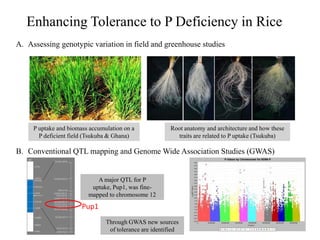
Enhancing Tolerance to P Deficiency in Rice
A. Assessing genotypic variation in field and greenhouse studies


     P uptake and biomass accumulation on a             Root anatomy and architecture and how these
       P deficient field (Tsukuba & Ghana)                traits are related to P uptake (Tsukuba)

B. Conventional QTL mapping and Genome Wide Association Studies (GWAS)


                            A major QTL for P
                          uptake, Pup1, was fine-
                         mapped to chromosome 12
                       Pup1
                                Through GWAS new sources
                                 of tolerance are identified
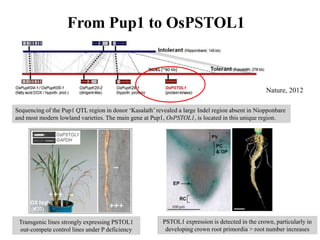
From Pup1 to OsPSTOL1


                                                                                                 Nature, 2012

Sequencing of the Pup1 QTL region in donor ‘Kasalath’ revealed a large Indel region absent in Niopponbare
and most modern lowland varieties. The main gene at Pup1, OsPSTOL1, is located in this unique region.


 Transgenic lines strongly expressing PSTOL1             PSTOL1 expression is detected in the crown, particularly in
 out-compete control lines under P deficiency             developing crown root primordia > root number increases
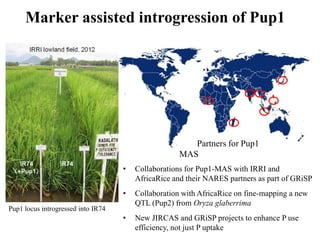
Marker assisted introgression of Pup1


                                                        Partners for Pup1
                                                     MAS
                                    •   Collaborations for Pup1-MAS with IRRI and
                                        AfricaRice and their NARES partners as part of GRiSP
                                    •   Collaboration with AfricaRice on fine-mapping a new
                                        QTL (Pup2) from Oryza glaberrima
Pup1 locus introgressed into IR74
                                    •   New JIRCAS and GRiSP projects to enhance P use
                                        efficiency, not just P uptake
Research Highlight - Program C


1. Improving livelihood in the rural areas
   of Indo-China
2. Biofuel production from non-food
   biomass
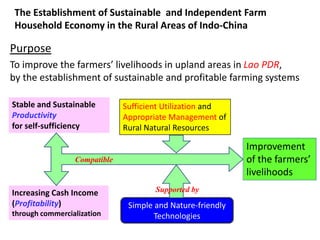
The Establishment of Sustainable and Independent Farm
 Household Economy in the Rural Areas of Indo-China

Purpose
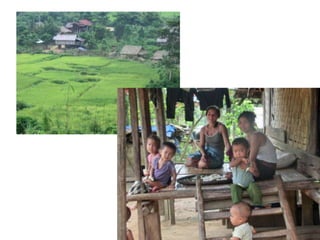
To improve the farmers’ livelihoods in upland areas in Lao PDR,
by the establishment of sustainable and profitable farming systems

Stable and Sustainable        Sufficient Utilization and
Productivity                  Appropriate Management of
for self-sufficiency          Rural Natural Resources

                                                            Improvement
                 Compatible                                 of the farmers’
                                                            livelihoods
Increasing Cash Income                Supported by
(Profitability)                Simple and Nature-friendly
through commercialization             Technologies
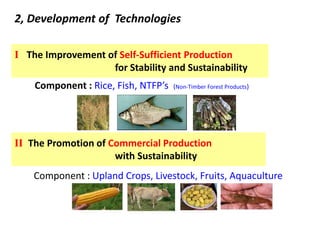
2, Development of Technologies

I The Improvement of Self-Sufficient Production
                   for Stability and Sustainability
    Component : Rice, Fish, NTFP’s   (Non-Timber Forest Products)


II The Promotion of Commercial Production
                     with Sustainability
    Component : Upland Crops, Livestock, Fruits, Aquaculture
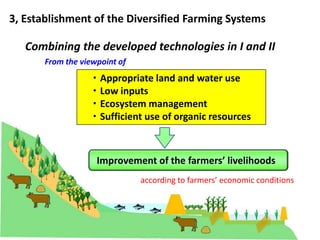
3, Establishment of the Diversified Farming Systems

   Combining the developed technologies in I and II
       From the viewpoint of
                  ・Appropriate land and water use
                  ・Low inputs
                  ・Ecosystem management
                  ・Sufficient use of organic resources


                    Improvement of the farmers’ livelihoods
                               according to farmers’ economic conditions
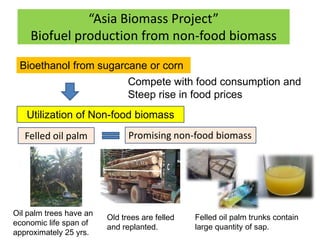
“Asia Biomass Project”
    Biofuel production from non-food biomass

 Bioethanol from sugarcane or corn
                               Compete with food consumption and
                               Steep rise in food prices
   Utilization of Non-food biomass
   Felled oil palm             Promising non-food biomass

                             8~10m


Oil palm trees have an
                         Old trees are felled   Felled oil palm trunks contain
economic life span of
                         and replanted.         large quantity of sap.
approximately 25 yrs.
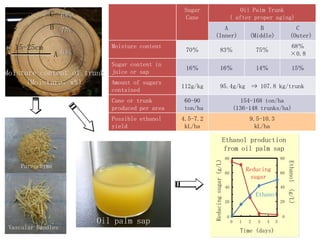
Sugar                                    Oil Palm Trunk
              C 68%                             Cane                                  ( after proper aging)
              B 75%                                          A                                      B                    C
                                                          (Inner)                                (Middle)              (Outer)
   15-25cm                  Moisture content                                                                           68%
                                                 70%                     83%                        75%
                 A 83%                                                                                                 ×0.8
                            Sugar content in
                                                 16%                     16%                        14%                    15%
Moisture content of trunk   juice or sap
     (Moisture; w%)         Amount of sugars
                                                112g/kg                 95.4g/kg ⇒ 107.8 kg/trunk
                            contained
                            Cane or trunk       60-90                                       154-168 ton/ha
                            produced per area   ton/ha                                    (136-148 trunks/ha)
                            Possible ethanol    4.5-7.2                                          9.5-10.3
                            yield                kL/ha                                            kL/ha

                                                                                 Ethanol production
                                                                                  from oil palm sap
                                                                                 80                             80


                                                          Reducing sugar (g/L)


                                                                                                                     Ethanol (g/L)
    Parenchyma
                                                                                                Reducing
                                                                                 60                             60
                                                                                                 sugar
                                                                                 40                             40
                                                                                                    Ethanol
                                                                                 20                             20


                                                                                  0                             0
                         Oil palm sap                                                 0     1   2   3   4   5
 Vascular Bundles
                                                                                            Time (days)
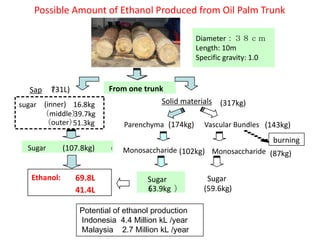
Possible Amount of Ethanol Produced from Oil Palm Trunk

                                                  Diameter:38cm
                                                  Length: 10m
                                                  Specific gravity: 1.0


  Sap (731L)            トランク trunk
                        From one
                               1本から
sugar (inner) 16.8kg              Solid materials (317kg)
      (middle)39.7kg
      (outer) 51.3kg        Parenchyma (174kg)      Vascular Bundles (143kg)
                                                                          burning
  Sugar 発酵糖 (107.8kg)
          (107.8kg)         Monosaccharide (102kg) Monosaccharide (87kg)


   Ethanol:    69.8L              発酵糖
                                  Sugar              Sugar
               41.4L              (63.9kg )
                                   63.9kg)          (59.6kg)

                Potential of ethanol production
                Indonesia 4.4 Million kL /year
                Malaysia 2.7 Million kL /year
JIRCAS


Thank you for your attention!!

     miwanaga@affrc.go.jp

Research Activities at JIRCAS

  • 1.
    JIRCAS Research Activities at JIRCAS Masa Iwanaga President Japan International Research Center for Agricultural Sciences (JIRCAS) CIAT, Cali, Colombia October 22, 2012
  • 2.
    Contents 1. Overall introductionof JIRCAS 2. Research highlights
  • 3.
    Structure of NationalAgricultural R&D System Ministry of Agriculture, Forestry and Fisheries (MAFF) Agriculture, Forestry and Fisheries Research Council (AFFRC) AFFRC Secretariat Forestry Fisheries Agency Agency National Agricultural Research Organization (NARO) Forestry and Fisheries National Institute of Agrobiological Forest Research Sciences (NIAS) Products Agency Research (FRA) National Institute for Agro- Institute Environmental Sciences (NIAES) (FFPRI) Japan International Research Center for Agricultural Sciences (JIRCAS) 4 organization are planned to be merged in April 2014.
  • 4.
    Focal point ofJapanese agriculture research for international collaboration Intersection of international and domestic research Oversea organizations Japanese organizations
  • 5.
    GRiSP Coordinating Committeein Japan (GCCJ) GRiSP MAFF J-FARD JIRCAS JISNAS NARO NIAS NIAES Universities NICS NARC Others
  • 7.
    On-going Research Activities as JIRCAS-Partner Collaboration J J 4 J J
  • 8.
    Research Highlight -Program A 1. Climate change research 2. Rural development using the Clean Development Mechanism (CDM) 3. BNI (Biological nitrification inhibition)
  • 9.
    Program A: FlagshipProject Development of agricultural technologies in developing regions to respond to C.C. Impact evaluation • Land suitability analysis using GIS Target countries • Supply-and-demand model of crops Impact evaluation of • World food model C.C. by model analysis Rain-fed, irrigated rice cultivating areas Vietnam, Thailand, Indonesia, B Adaptation angladesh, Philippines, Laos, Sri Lanka • Seasonal weather forecasting • Decision Support System for rain- Climate-change South America and East Africa fed rice adaptation technology in Paraguay and Ethiopia • Climate-proof rice rain-fed rice areas • Water management of inter- connected tank irrigation systems • Dyke system in high flood area GHG emission reduction Mitigation Non-conventional resources Reduction of methane (TMR, Silage) emission from ruminant Feeding management of ruminants Introduction of AWD to Water-saving rice cultivation dry-season rice cultivation GHG Alternate wet and dry (AWD) reduction Sustainable Biogas digester from rural VACB (Orchard, Fish, Pig and paddy Biogas) system communities field with low Use of Carbon sequestration GHG CDM GHG mitigation through emission afforestation and Agro-forestry Increase carbon sinks Forest • Agro-forestry CDM Carbon sequestration into farm • Organic fertilizer Project land (Long-term experiment)
  • 10.
    Control of GHGemissions from rice farming and ruminants Demonstrate the effect of water Establishment of gas emission saving technologies for the Methane monitoring methods reduction of GHG emission Nitrous oxide Chamber method Livestock Tracer method Paddy fields Thai & AWD: Alternate Vietnam Vietnam SF6 Wet and Dry • CH4 reduction Reduce the • Control N2O by the timing and contribution of Improve feeding management, 480 amount of fertilizer application paddy field to Effect of feed additive global warming CH4 Emission(kg CH4 /ha/crop) • Cost reduction by less use of pump Development of low GHG emission • Use organic matter in the plot livestock production system 320 • Keep yield Technologies for mitigating GHG emissions 160 Increase in Increase in 0 productivity farmers’ income Control AWD Sample data obtained in IRRI Rice straw 4t ha-1 crop-1
  • 11.
    Formulation of aCDM project for introduction of biogas digester A CDM project to introduce 917 units of biogas digester in 3 districts in Can Tho City. The GHG emission reduction is achieved by substituting fossil fuel and nonrenewable firewood with renewable biogas. Annual GHG emission reduction is 1,045 tCO2/year (1.14 tCO2/year*917 units). Biogas Fruit garden Pig pen digester Vegetable Biogas Aquaculture Irrigation Excreta Leftover Effluent foods Sediments V:Vuon ( Orchard) Biogas digester contributes: A: ( Ao Pond) Farmer’s income by the reduction of fuel cost C:Chuong ( pen) Improvement of environment Pig B:Biogas Initial costs for Biogas digester Image of VACB system
  • 12.
    Acquisition of CERby the small-scale reforestation CDM project, formulated in low income communities in Paraguay A model of rural development applying reforestation CDM in low income communities in Paraguay. The acquisition of CER will be expected in 2013, followed by the verification activity in February, 2013. CER: Certified Emission Reduction CDM: Clean Development Mechanism Objective Increase of farmers’ income Until registration of CDM Formulation by JIRCAS Methodology of small scale AR-CDM (Approval of Gov. Formulation of PDD Approval of Gov. of Paraguay Activities of Validation of DOE: 7-10/Mar/2008 of Japan) Rural development based on CDM Validation of the project JIRCAS Approval of Paraguay: 25/Nov/2008 Capacity building Soil conservation Income Registration in and training of Approval of Japan: 6/Mar/2009 activities from CER UNFCCC farmers Registration of CDM Executive board Activities for land in UNFCCC (CDM-EB) : 6/Sep/2009 Female activities productivity increase Until issuance of CER for income Acquisition and production of CER Implementation by JIRCAS (area, generation diversification (Carbon credit) Monitoring location, diameter, etc.): Jul-Aug/2012 Introduction of Activities of Verification of carbon removals micro-credit reforestation CDM Verification of DOE by sinks February/2013 Certification of Certification of CERs by CDM-EB Actual situation UNFCCC 2013 Serious soil Low productivity Low erosion & soil in agriculture and income Issuance of CERs by CDM-EB degradation livestock Issuance of CERs 2013 Rural development project using reforestation CDM Flow of procedure of CDM Producing seedlings Planting seedlings Grown trees Monitoring trees
  • 14.
    Biological Nitrification Inhibitionin Brachiaria Pastures can reduce N2O emissions Brachialactone High BNI capacity leads to low- identified as the major N2O emission nitrification inhibitor JIRCAS – CIAT collaborative study – CIAT field site at released from the roots of B. Colombia humidicola. 500 (PNAS 106, 17302, 2009) Patented by JIRCAS Con 400 C um ulative N 2 O em ission Soy (m g N 2 O -N m y ) 2 -1 300 PM BHM 200 BH-679 Root-produced nitrification 100 BH-16888 inhibitors 0 0 10 20 30 40 50 60 -1 -1 B N I capacity of the species (A T U g root dry w t. d ) Nitrate Ammonium Nitrite Ammonia-oxidizing Bacteria Nitrite-oxidizing Bacteria (NO3-) (NH4+) (NO2-) G. V. Subbarao et al. (2012) Biological nitrification inhibition-Novel strategy to regulate nitrification in agricultural systems. Advances in Agronomy 114, 249-302
  • 15.
    Sorghum releases twotypes of BNIs from roots Automated hydroponic system A droplet of yellow oily substance exuding from sorghum root hairs BNI activity released from sorghum roots Hydrophobic BNIs O OH O O Hydrophilic BNIs Sorgoleone Root exudate collection in sorghum May confine to rhizosphere – movement is mostly due to diffusion May move farther from the roots – likely move with water
  • 16.
    Wild-wheat has high-BNIcapacity CIMMYT’s Collaboration 35 L. racemosus 30 N H 4 -N grow n B N I activity released from roots N O 3 -N grow n (A T U g root dry w t. d ) -1 25 20 15 -1 10 Nobeoka Chinese Spring 5 0 0 1 2 3 4 P lant species Releases about 150 to 200 AT units of BNI da-1 under optimum conditions
  • 17.
    Can the high-BNIcapacity of wild-wheat be transferred/expressed in cultivated wheat? Would this be the first step to develop low-nitrifying and low-N2O emitting wheat production systems? Yokohama city Univ. & Tottori Univ. and CIMMYT’s Collaboration Production of wheat-Leymus racemosus-addition lines BNI released from Chromosome-addition lines derived from L. racemosus and cultivated wheat (Chinese Spring) L. Genetic Stock L. racemosus BNI released Leymus racemosus Triticum aestivum 2N=4X =28; genome Ns NsXmXm cv. Chinese Spring 2N=6X =42; chromosome (ATU g-1 root dry Also, brings genome AABBDD introduced wt d-1) rust DALr-n Lr-n 24.6 sensitivity F1 hybrid Triticum aestivum L. cv. Chinese Spring 2N=6X =42; genome AABBDD DALr-j Lr-j 13.5 DALr-I Lr-I 13.0 BC1F1 hybrid Controls DALr-1 Lr-1 6.4 Ammonium DALr-k Lr-k tolerance 5.5 BC7F1 hybrid DALr-F Lr-F 4.1 DALr-H Lr-H 3.7 DA2Lr-1 2Lr-1 3.2 DA5Lr-1 5Lr-1 6.6 DtA7Lr-1-1 7Lr-1-1 6.4 DtA7Lr-1-2 7Lr-1-2 4.9 A B LSD (0.05) 3.9 Two Lr#n L. racemosus chromosomes in wheat detected by florescence in Efforts are underway to generate tranlsocations incorporating situ hybridization with probe of L. racemosus genomic DNA (green color) smaller segments of Lr#n, Lr#I or Lr#J to reduce problems associated with the linkage drag
  • 18.
    Research Highlight -Program B 1. Genetic engineering for stress- tolerant crops 2. Phosphorus deficiency in rice
  • 19.
    Development of AbioticStress Tolerant Crops by DREB Genes Molecular B L elucidation of stress tolerance Promoter B L and + Gene Expression of efficient method Identification and target genes of gene isolation of useful expression promoters and genes Constructs and their functions Expression of trans genes Wheat Low-land Rice Up-land Rice NERICA GH at CIMMYT Transformants Fixed lines SH at IRRI Rain-out shelter at CIAT
  • 20.
    Evaluation for DroughtTolerance No of lines produced and evaluated. No. of cali / Positive S ingle S HGH*/Field Promising embryos events copy evaluation *SHGH: Screen house and/ or Green house 280,358 10671< 2766< 924< 92 Contained Filed at CG Centers and Fielder Fielder Dates of Approval Drought Irrigated CIAT: Palmira 2.0 ha 2008. 3 Santa Rosa 0.6 ha 2010. 12 CIMMYT: Tlaltizapan 0.4 ha 2009. 8 Wheat evaluation (Tlaltizapan, CIMMYT) IRRI: Los Banos 0.2 ha 2010. 1 Lowland Field Evaluation (IRRI) Upland Field Evaluation (Santa Rosa, CIAT)
  • 21.
    Enhancing Tolerance toP Deficiency in Rice A. Assessing genotypic variation in field and greenhouse studies P uptake and biomass accumulation on a Root anatomy and architecture and how these P deficient field (Tsukuba & Ghana) traits are related to P uptake (Tsukuba) B. Conventional QTL mapping and Genome Wide Association Studies (GWAS) A major QTL for P uptake, Pup1, was fine- mapped to chromosome 12 Pup1 Through GWAS new sources of tolerance are identified
  • 22.
    From Pup1 toOsPSTOL1 Nature, 2012 Sequencing of the Pup1 QTL region in donor ‘Kasalath’ revealed a large Indel region absent in Niopponbare and most modern lowland varieties. The main gene at Pup1, OsPSTOL1, is located in this unique region. Transgenic lines strongly expressing PSTOL1 PSTOL1 expression is detected in the crown, particularly in out-compete control lines under P deficiency developing crown root primordia > root number increases
  • 23.
    Marker assisted introgressionof Pup1 Partners for Pup1 MAS • Collaborations for Pup1-MAS with IRRI and AfricaRice and their NARES partners as part of GRiSP • Collaboration with AfricaRice on fine-mapping a new QTL (Pup2) from Oryza glaberrima Pup1 locus introgressed into IR74 • New JIRCAS and GRiSP projects to enhance P use efficiency, not just P uptake
  • 24.
    Research Highlight -Program C 1. Improving livelihood in the rural areas of Indo-China 2. Biofuel production from non-food biomass
  • 25.
    The Establishment ofSustainable and Independent Farm Household Economy in the Rural Areas of Indo-China Purpose To improve the farmers’ livelihoods in upland areas in Lao PDR, by the establishment of sustainable and profitable farming systems Stable and Sustainable Sufficient Utilization and Productivity Appropriate Management of for self-sufficiency Rural Natural Resources Improvement Compatible of the farmers’ livelihoods Increasing Cash Income Supported by (Profitability) Simple and Nature-friendly through commercialization Technologies
  • 27.
    2, Development ofTechnologies I The Improvement of Self-Sufficient Production for Stability and Sustainability Component : Rice, Fish, NTFP’s (Non-Timber Forest Products) II The Promotion of Commercial Production with Sustainability Component : Upland Crops, Livestock, Fruits, Aquaculture
  • 28.
    3, Establishment ofthe Diversified Farming Systems Combining the developed technologies in I and II From the viewpoint of ・Appropriate land and water use ・Low inputs ・Ecosystem management ・Sufficient use of organic resources Improvement of the farmers’ livelihoods according to farmers’ economic conditions
  • 29.
    “Asia Biomass Project” Biofuel production from non-food biomass Bioethanol from sugarcane or corn Compete with food consumption and Steep rise in food prices Utilization of Non-food biomass Felled oil palm Promising non-food biomass 8~10m Oil palm trees have an Old trees are felled Felled oil palm trunks contain economic life span of and replanted. large quantity of sap. approximately 25 yrs.
  • 30.
    Sugar Oil Palm Trunk C 68% Cane ( after proper aging) B 75% A B C (Inner) (Middle) (Outer) 15-25cm Moisture content 68% 70% 83% 75% A 83% ×0.8 Sugar content in 16% 16% 14% 15% Moisture content of trunk juice or sap (Moisture; w%) Amount of sugars 112g/kg 95.4g/kg ⇒ 107.8 kg/trunk contained Cane or trunk 60-90 154-168 ton/ha produced per area ton/ha (136-148 trunks/ha) Possible ethanol 4.5-7.2 9.5-10.3 yield kL/ha kL/ha Ethanol production from oil palm sap 80 80 Reducing sugar (g/L) Ethanol (g/L) Parenchyma Reducing 60 60 sugar 40 40 Ethanol 20 20 0 0 Oil palm sap 0 1 2 3 4 5 Vascular Bundles Time (days)
  • 31.
    Possible Amount ofEthanol Produced from Oil Palm Trunk Diameter:38cm Length: 10m Specific gravity: 1.0 Sap (731L) トランク trunk From one 1本から sugar (inner) 16.8kg Solid materials (317kg) (middle)39.7kg (outer) 51.3kg Parenchyma (174kg) Vascular Bundles (143kg) burning Sugar 発酵糖 (107.8kg) (107.8kg) Monosaccharide (102kg) Monosaccharide (87kg) Ethanol: 69.8L 発酵糖 Sugar Sugar 41.4L (63.9kg ) 63.9kg) (59.6kg) Potential of ethanol production Indonesia 4.4 Million kL /year Malaysia 2.7 Million kL /year
  • 32.
    JIRCAS Thank you foryour attention!! miwanaga@affrc.go.jp