Let’s watch it again!
This time, focus your
attention only at the
right corner.

 Did
 you
 notice
 the                      The human brain is able to
 star                      completely miss a fully-
 In the                 visible, but unexpected object
 right                  because of over activity in top-
 corner?                       down processing.
LOOK
CLOSELY!


             The human brain is able to
              completely miss a fully-
           visible, but unexpected object
           because of over activity in top-
                  down processing.
1. Change Blindness: the inability to detect a change in an object or a scene.
            The difference between the phenomena is that inattentional blindness is
             the inability to detect a new and unexpected object.


                                               Causes of Inattentional Blindness
                                               1. Conspicuity: Is it attention-grabbing?

                                               2. Mental Workload: A lot on your mind?

                                               3. Expectation: What did you expect?

                                               4. Capacity: Expert vs. Novice- how
                                               much attention is required?
                                               (Hannon & Richards, 2012)
2. Selective Attention: responding selectively to certain sources of
information while ignoring other sources.
     Inattentional blindness also illustrates a critical aspect of visual processing.
      Specifically, it reveals the role of selective attention in perception.
     Inattentional blindness represents a consequence of this critical process that
      allows us to remain focused on important aspects of our world without distraction
      from irrelevant objects and events.

 (Hannon & Richards, 2012)
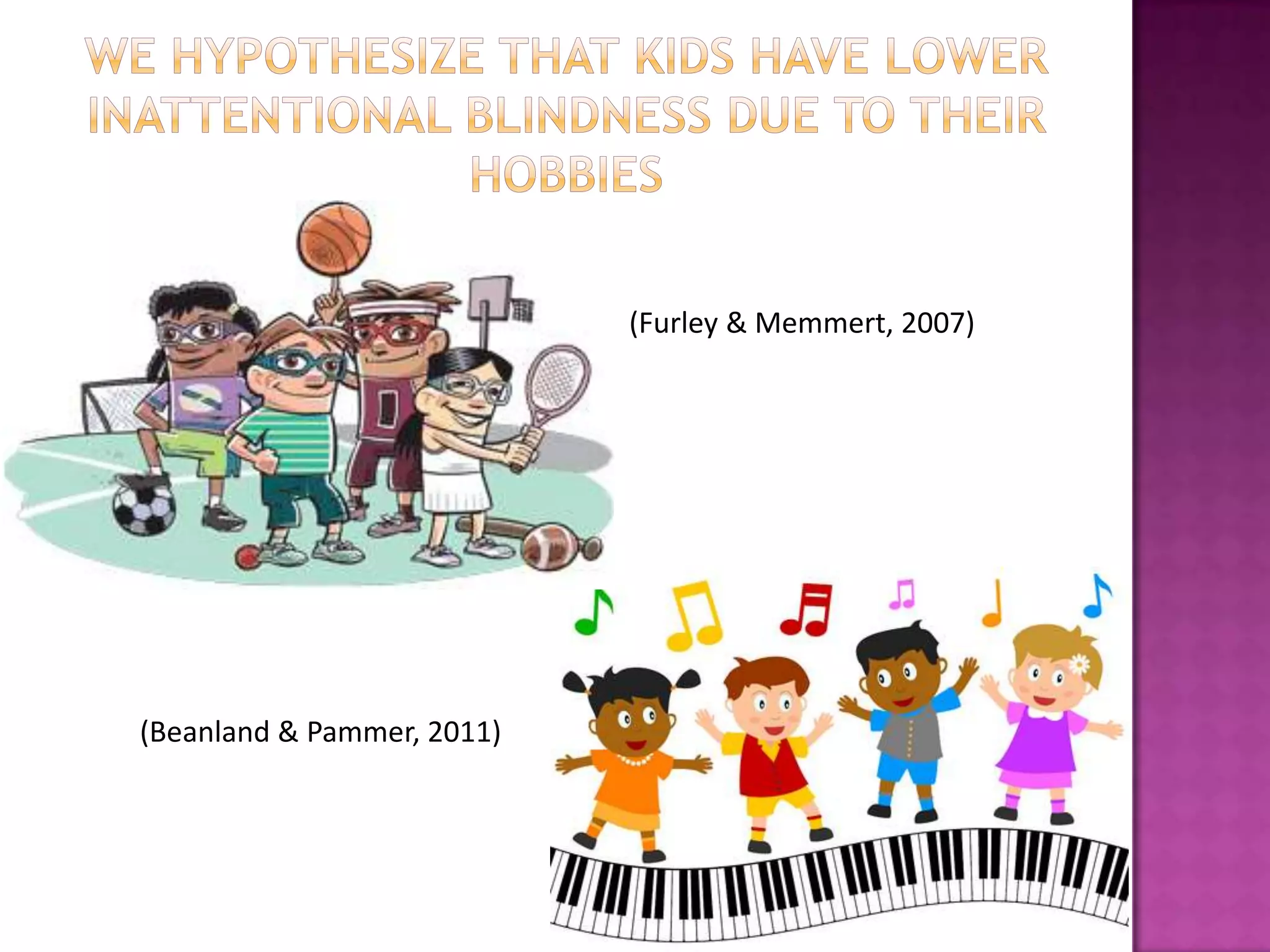
(Furley & Memmert, 2007)


(Beanland & Pammer, 2011)
Research shows that there is a relationship between
inattentional blindness and action-demanding team
sports.
            o   More tactical instructions can lead to a narrower
                breadth of attention, which increases inattentional
                blindness, whereas fewer tactical instructions widen
                the breadth of attention in the area of team ball sports
                and therefore decreases inattentional blindness.
                (Furley & Memmert, 2007)
Research shows that attending to music decreases
inattentional blindness.
           o   Listening to music will decrease inattentional
               blindness by reducing observers' frequency of task-
               unrelated thoughts, this was due to the distracting
               qualities of the audio task
           o   (Beanland & Pammer, 2011)
Beanland, V. & Pammer, K. (2011). Attending to music decreases
         inattentional blindness. Consciousness and Cognition, 20(4), 1282-
         1292. doi: 10.1016/j.concog.2011.04.009
Furley, P. & Memmert, D., (2007). "I spy with my little eye"! breadth of
           attention, inattentional blindness, and tactical decision making in
           team sports. Journal of Sport and Exercise Psychology, 29(3), 365-
           381. Retrieved from
           http://apps.webofknowledge.com.proxy.ohiolink.edu:9099/full_re
           cord.do?product=UA&search_mode=Refine&qid=2&SID=2BBp3EM
           m72bDfdN32BF&page=1&doc=3
Hannon, E.M. & Richards, A. (2012). Distracted by distractors: Eye
         movements in a dynamic inattentional blindness task . Social
         Sciences Citation Index,21, 170-176. Retrieved from
         http://xlib1.ohiolink.edu:8331/V/RH2UI1MD5IXUEPXU2SU7HDESC
         QEJIME2
Mack, A. (2003). Inattentional blindness: looking without seeing.
          Psychology and Behavioral Sciences Collection, 12(5), 180.
          Retrieved from http://content.epnet.com/ContentServer.asp?T=P

Inattentional blindness wikicog

  • 1.
    Let’s watch itagain! This time, focus your attention only at the right corner. Did you notice the The human brain is able to star completely miss a fully- In the visible, but unexpected object right because of over activity in top- corner? down processing.
  • 2.
    LOOK CLOSELY! The human brain is able to completely miss a fully- visible, but unexpected object because of over activity in top- down processing.
  • 3.
    1. Change Blindness:the inability to detect a change in an object or a scene.  The difference between the phenomena is that inattentional blindness is the inability to detect a new and unexpected object. Causes of Inattentional Blindness 1. Conspicuity: Is it attention-grabbing? 2. Mental Workload: A lot on your mind? 3. Expectation: What did you expect? 4. Capacity: Expert vs. Novice- how much attention is required? (Hannon & Richards, 2012)
  • 4.
    2. Selective Attention:responding selectively to certain sources of information while ignoring other sources.  Inattentional blindness also illustrates a critical aspect of visual processing. Specifically, it reveals the role of selective attention in perception.  Inattentional blindness represents a consequence of this critical process that allows us to remain focused on important aspects of our world without distraction from irrelevant objects and events. (Hannon & Richards, 2012)
  • 5.
    (Furley & Memmert,2007) (Beanland & Pammer, 2011)
  • 6.
    Research shows thatthere is a relationship between inattentional blindness and action-demanding team sports. o More tactical instructions can lead to a narrower breadth of attention, which increases inattentional blindness, whereas fewer tactical instructions widen the breadth of attention in the area of team ball sports and therefore decreases inattentional blindness. (Furley & Memmert, 2007)
  • 7.
    Research shows thatattending to music decreases inattentional blindness. o Listening to music will decrease inattentional blindness by reducing observers' frequency of task- unrelated thoughts, this was due to the distracting qualities of the audio task o (Beanland & Pammer, 2011)
  • 8.
    Beanland, V. &Pammer, K. (2011). Attending to music decreases inattentional blindness. Consciousness and Cognition, 20(4), 1282- 1292. doi: 10.1016/j.concog.2011.04.009 Furley, P. & Memmert, D., (2007). "I spy with my little eye"! breadth of attention, inattentional blindness, and tactical decision making in team sports. Journal of Sport and Exercise Psychology, 29(3), 365- 381. Retrieved from http://apps.webofknowledge.com.proxy.ohiolink.edu:9099/full_re cord.do?product=UA&search_mode=Refine&qid=2&SID=2BBp3EM m72bDfdN32BF&page=1&doc=3 Hannon, E.M. & Richards, A. (2012). Distracted by distractors: Eye movements in a dynamic inattentional blindness task . Social Sciences Citation Index,21, 170-176. Retrieved from http://xlib1.ohiolink.edu:8331/V/RH2UI1MD5IXUEPXU2SU7HDESC QEJIME2 Mack, A. (2003). Inattentional blindness: looking without seeing. Psychology and Behavioral Sciences Collection, 12(5), 180. Retrieved from http://content.epnet.com/ContentServer.asp?T=P