Cybersecurity and
Cyber Resilience
Framework (CSCRF)
for SEBI-regulated entities
Point of View | September 2024
Point of view on Consolidated Cyber Security and Cyber Resilience Framework (CSCRF) for SEBI-regulated entities
© 2024 Deloitte Touche Tohmatsu India LLP. 2
Introduction
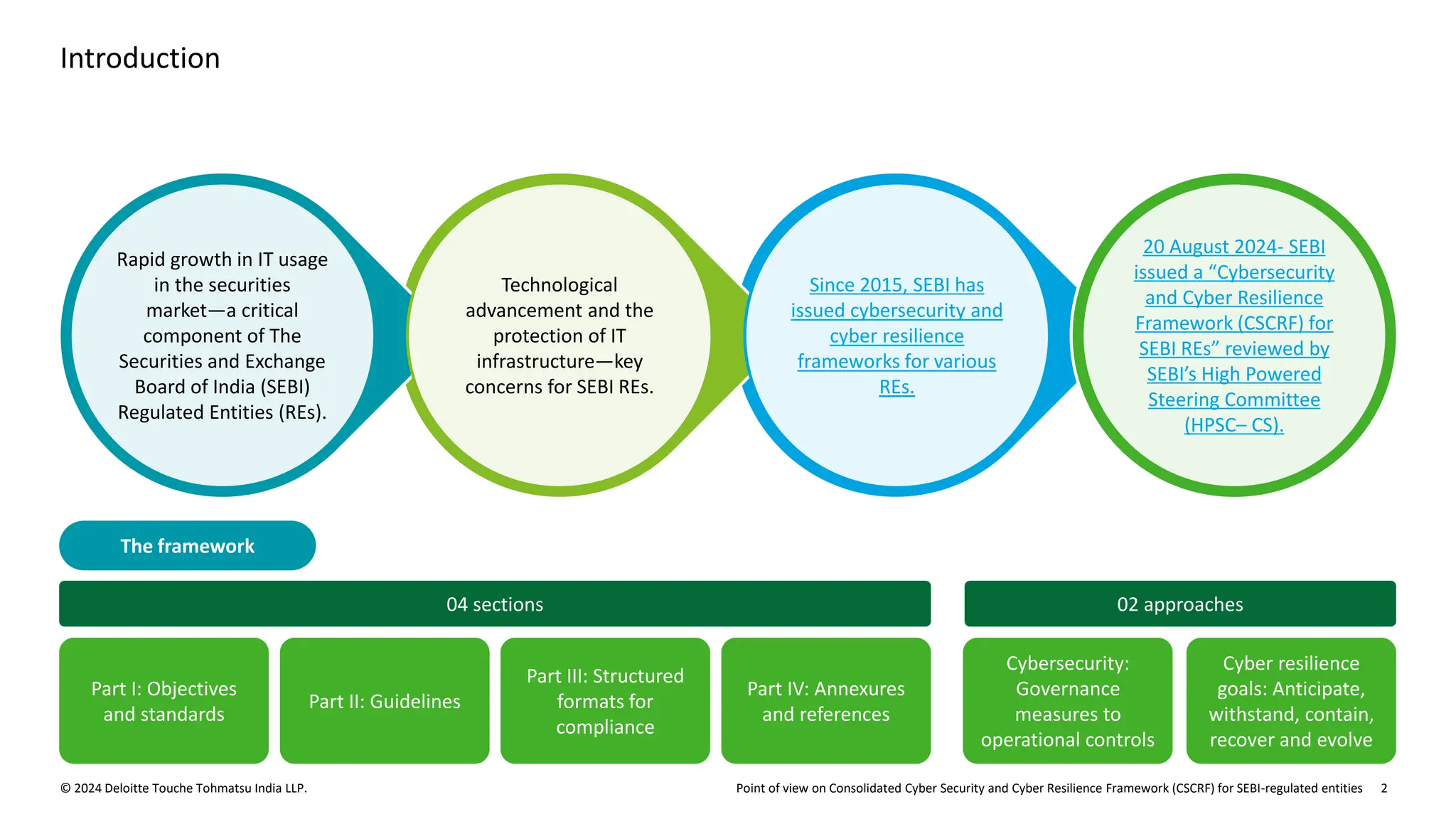
20 August 2024- SEBI
issued a “Cybersecurity
and Cyber Resilience
Framework (CSCRF) for
SEBI REs” reviewed by
SEBI’s High Powered
Steering Committee
(HPSC– CS).
Since 2015, SEBI has
issued cybersecurity and
cyber resilience
frameworks for various
REs.
Technological
advancement and the
protection of IT
infrastructure—key
concerns for SEBI REs.
Rapid growth in IT usage
in the securities
market—a critical
component of The
Securities and Exchange
Board of India (SEBI)
Regulated Entities (REs).
The framework
04 sections
Part I: Objectives
and standards
Part II: Guidelines
Part III: Structured
formats for
compliance
Cybersecurity:
Governance
measures to
operational controls
Cyber resilience
goals: Anticipate,
withstand, contain,
recover and evolve
Part IV: Annexures
and references
02 approaches
Point of view on Consolidated Cyber Security and Cyber Resilience Framework (CSCRF) for SEBI-regulated entities
© 2024 Deloitte Touche Tohmatsu India LLP. 3
CSCRF: Need of the hour
SEBI REs have increased their technology adoption in recent years. With the fast pace of technological developments in the securities market,
maintaining robust cybersecurity and cyber resilience to protect REs’ operations from cyber risks and cyber incidents has become necessary.
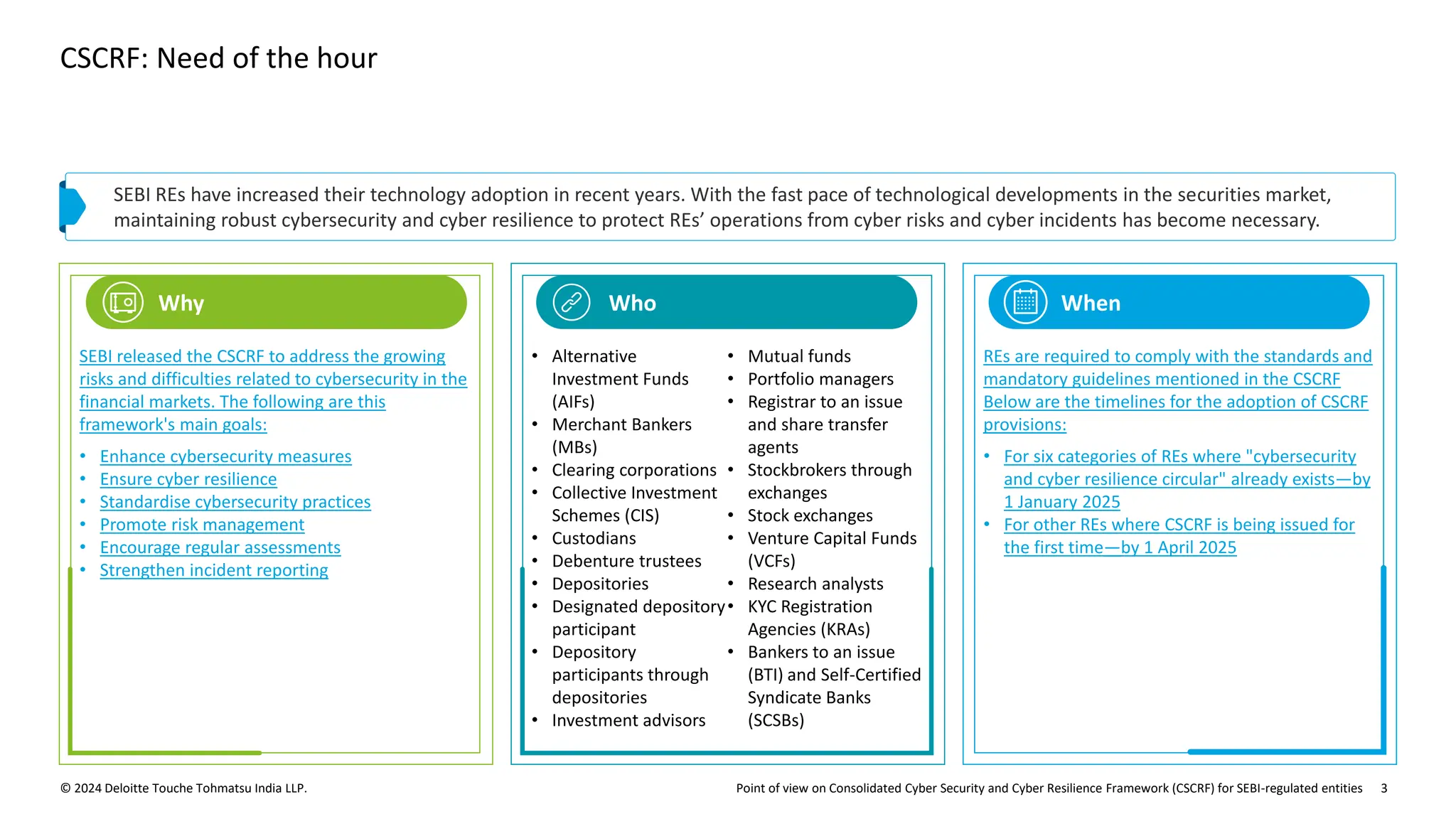
REs are required to comply with the standards and
mandatory guidelines mentioned in the CSCRF
Below are the timelines for the adoption of CSCRF
provisions:
• For six categories of REs where "cybersecurity
and cyber resilience circular" already exists—by
1 January 2025
• For other REs where CSCRF is being issued for
the first time—by 1 April 2025
• Alternative
Investment Funds
(AIFs)
• Merchant Bankers
(MBs)
• Clearing corporations
• Collective Investment
Schemes (CIS)
• Custodians
• Debenture trustees
• Depositories
• Designated depository
participant
• Depository
participants through
depositories
• Investment advisors
• Mutual funds
• Portfolio managers
• Registrar to an issue
and share transfer
agents
• Stockbrokers through
exchanges
• Stock exchanges
• Venture Capital Funds
(VCFs)
• Research analysts
• KYC Registration
Agencies (KRAs)
• Bankers to an issue
(BTI) and Self-Certified
Syndicate Banks
(SCSBs)
SEBI released the CSCRF to address the growing
risks and difficulties related to cybersecurity in the
financial markets. The following are this
framework's main goals:
• Enhance cybersecurity measures
• Ensure cyber resilience
• Standardise cybersecurity practices
• Promote risk management
• Encourage regular assessments
• Strengthen incident reporting
Why Who When
Point of view on Consolidated Cyber Security and Cyber Resilience Framework (CSCRF) for SEBI-regulated entities
© 2024 Deloitte Touche Tohmatsu India LLP. 4
CSCRF: Overview
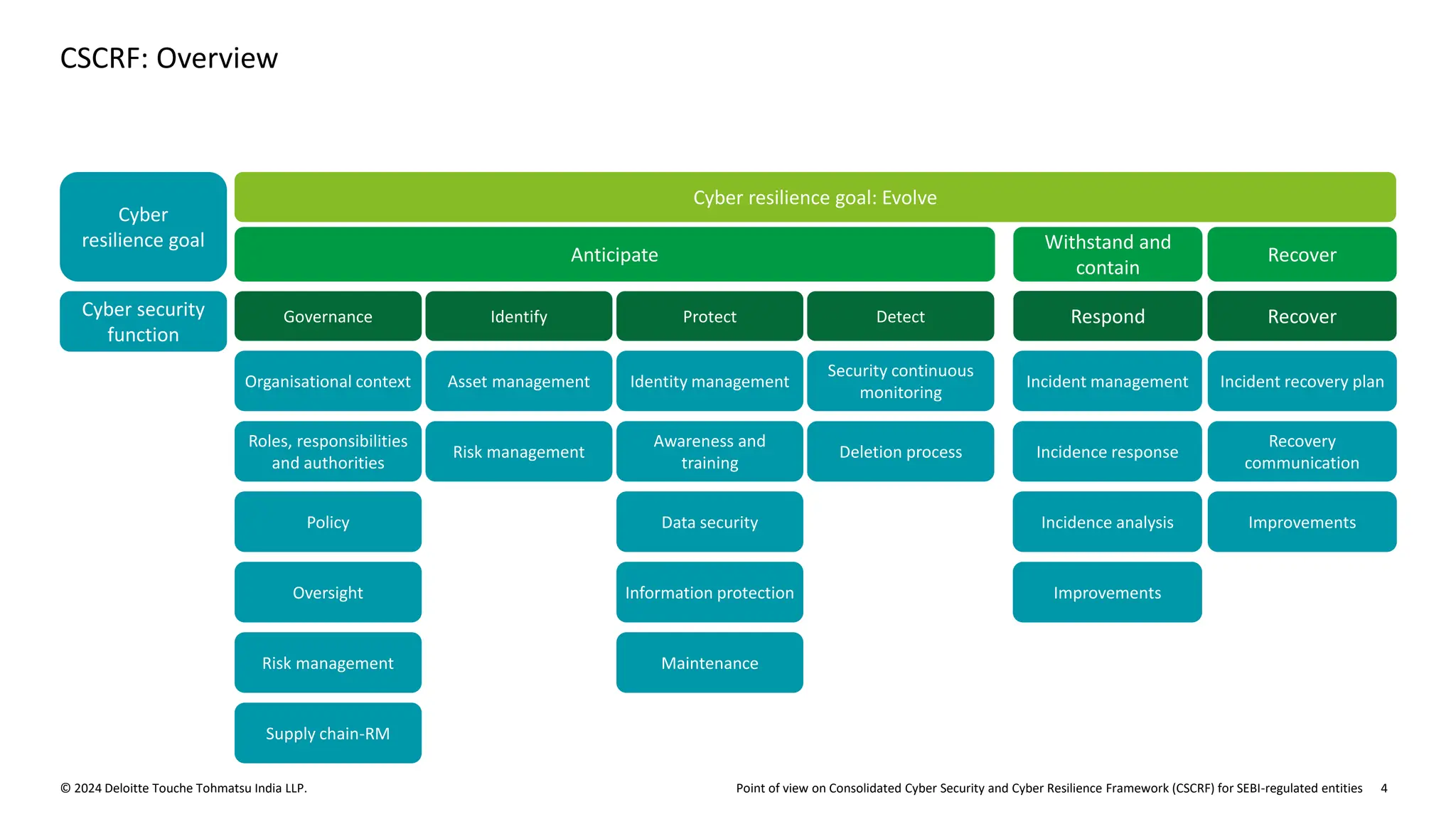
Cyber
resilience goal
Cyber resilience goal: Evolve
Anticipate
Governance Detect
Identify Protect
Organisational context
Roles, responsibilities
and authorities
Policy
Risk management
Supply chain-RM
Oversight
Recover
Withstand and
contain
Cyber security
function
Recover
Respond
Asset management
Risk management
Identity management
Awareness and
training
Data security
Maintenance
Information protection
Security continuous
monitoring
Deletion process
Incident management
Incidence response
Incidence analysis
Improvements
Incident recovery plan
Recovery
communication
Improvements
Point of view on Consolidated Cyber Security and Cyber Resilience Framework (CSCRF) for SEBI-regulated entities
© 2024 Deloitte Touche Tohmatsu India LLP. 5
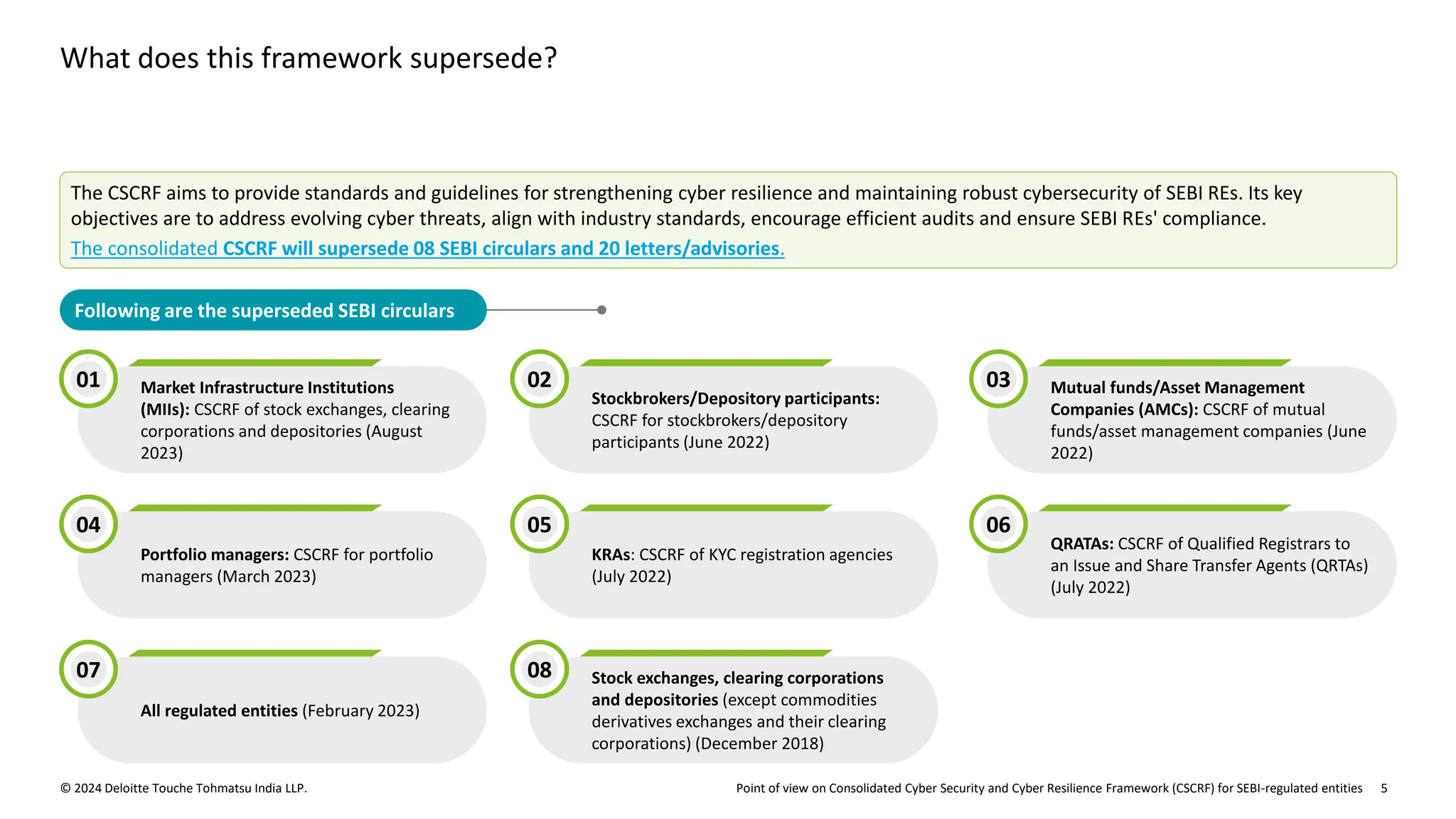
What does this framework supersede?
The CSCRF aims to provide standards and guidelines for strengthening cyber resilience and maintaining robust cybersecurity of SEBI REs. Its key
objectives are to address evolving cyber threats, align with industry standards, encourage efficient audits and ensure SEBI REs' compliance.
The consolidated CSCRF will supersede 08 SEBI circulars and 20 letters/advisories.
Following are the superseded SEBI circulars
Market Infrastructure Institutions
(MIIs): CSCRF of stock exchanges, clearing
corporations and depositories (August
2023)
01
Stockbrokers/Depository participants:
CSCRF for stockbrokers/depository
participants (June 2022)
02 Mutual funds/Asset Management
Companies (AMCs): CSCRF of mutual
funds/asset management companies (June
2022)
03
Portfolio managers: CSCRF for portfolio
managers (March 2023)
04
KRAs: CSCRF of KYC registration agencies
(July 2022)
05
QRATAs: CSCRF of Qualified Registrars to
an Issue and Share Transfer Agents (QRTAs)
(July 2022)
06
All regulated entities (February 2023)
07 Stock exchanges, clearing corporations
and depositories (except commodities
derivatives exchanges and their clearing
corporations) (December 2018)
08
Point of view on Consolidated Cyber Security and Cyber Resilience Framework (CSCRF) for SEBI-regulated entities
© 2024 Deloitte Touche Tohmatsu India LLP. 6
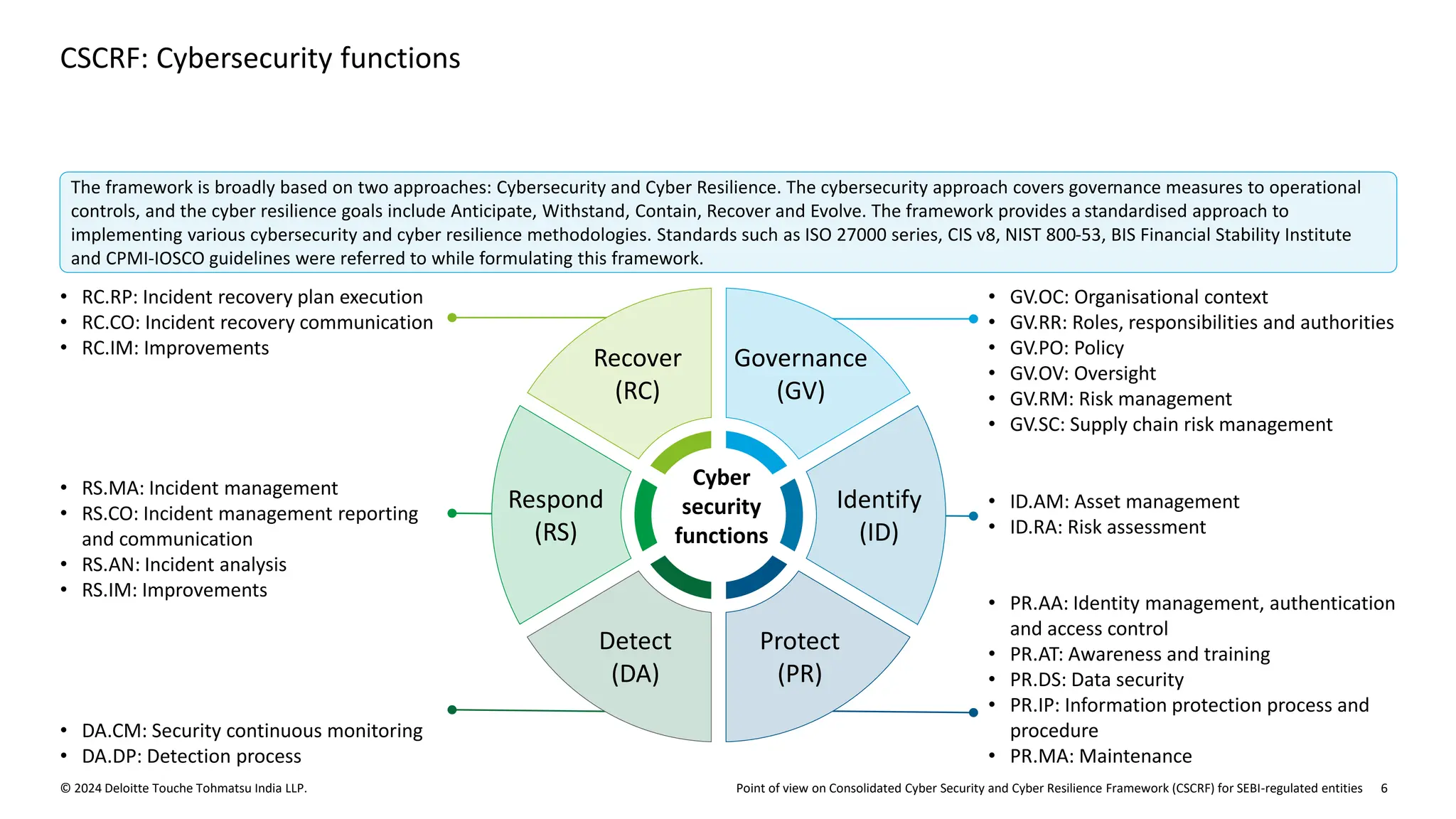
CSCRF: Cybersecurity functions
The framework is broadly based on two approaches: Cybersecurity and Cyber Resilience. The cybersecurity approach covers governance measures to operational
controls, and the cyber resilience goals include Anticipate, Withstand, Contain, Recover and Evolve. The framework provides a standardised approach to
implementing various cybersecurity and cyber resilience methodologies. Standards such as ISO 27000 series, CIS v8, NIST 800-53, BIS Financial Stability Institute
and CPMI-IOSCO guidelines were referred to while formulating this framework.
Identify
(ID)
Governance
(GV)
Detect
(DA)
Respond
(RS)
Protect
(PR)
Recover
(RC)
Cyber
security
functions
• GV.OC: Organisational context
• GV.RR: Roles, responsibilities and authorities
• GV.PO: Policy
• GV.OV: Oversight
• GV.RM: Risk management
• GV.SC: Supply chain risk management
• ID.AM: Asset management
• ID.RA: Risk assessment
• PR.AA: Identity management, authentication
and access control
• PR.AT: Awareness and training
• PR.DS: Data security
• PR.IP: Information protection process and
procedure
• PR.MA: Maintenance
• RC.RP: Incident recovery plan execution
• RC.CO: Incident recovery communication
• RC.IM: Improvements
• RS.MA: Incident management
• RS.CO: Incident management reporting
and communication
• RS.AN: Incident analysis
• RS.IM: Improvements
• DA.CM: Security continuous monitoring
• DA.DP: Detection process
Point of view on Consolidated Cyber Security and Cyber Resilience Framework (CSCRF) for SEBI-regulated entities
© 2024 Deloitte Touche Tohmatsu India LLP. 7
• Create a unified control
framework based on applicable
regulatory requirements and
frameworks/baselines adopted
by the organisation (e.g., SEBI
CSCRF, PCI, NIST, ISO 27001)
• Identify the scope's applicability
per the unified control
framework (Locations,
infrastructure, business
units, etc.)
• Inventorize current activities
being performed and map with
SEBI CSCRF requirements
• Perform the gap assessment per
the current state analysis against
the SEBI CSCRF guidelines and
other regulatory circulars (as
applicable)
• Identify and evaluate current
control effectiveness against the
unified framework
• Continue existing controls
operations for controls that
address CSCRF requirement
• Design and select new
cybersecurity controls based on
identified risks and gaps
• Establish security governance
and oversight
• Create or update security
policies, procedures or
guidelines to align with
organisational goals and a
unified control framework
• Implement the controls and
strengthen data protection
measures (such as IAM, incident
response, DLP, IPS/IDS and EDR)
• Improve security monitoring and
strengthen incident response
and management through SOC
services or M-SOC (Market SOC)
• Ensure that newly incorporated
controls comply with relevant
regulations and standards
• Continuous Controls Monitoring
(CCM) - Conduct regular
compliance checks and audits to
verify operational effectiveness
of controls framework
• Perform thorough testing of new
controls to ensure they work as
intended
• Tailor training content to the
specific needs and
responsibilities of identified
different organisational roles
• Plan and schedule regular
training sessions to ensure all
employees can participate,
including new hires and those
needing refresher training
• Establish a process for
continuously evaluating and
improving cybersecurity controls
based on CCM
• Track the effectiveness of the
corrective actions
• Continuously monitor
compliance with reporting
requirements and address any
issues or discrepancies
• Gathering feedback from
stakeholders involved in or
affected by the corrective
actions
• Incorporate successful corrective
actions into Standard Operating
Procedures (SOPs) or company
policies
• Regularly reviewing the
corrective actions and their
outcomes to ensure they remain
effective
• Create an annual calendar for
the submission of the reports
per the frequency specified in
SEBI CSCRF reporting
requirements
• Use the standardised formats of
reporting provided by the SEBI
CSCRF circular
• Set up processes for reviewing
and validating report content to
ensure accuracy and compliance
with the reporting requirements
of SEBI CSCRF
• Align the assessments /
governance / monitoring
activities according to the
reporting requirements
• Gather feedback from
stakeholders on the reporting
process and content to make
necessary adjustments
• Prepare and present reports to
internal stakeholders, including
management and the board
• Submit required reports to SEBI
per reporting requirements
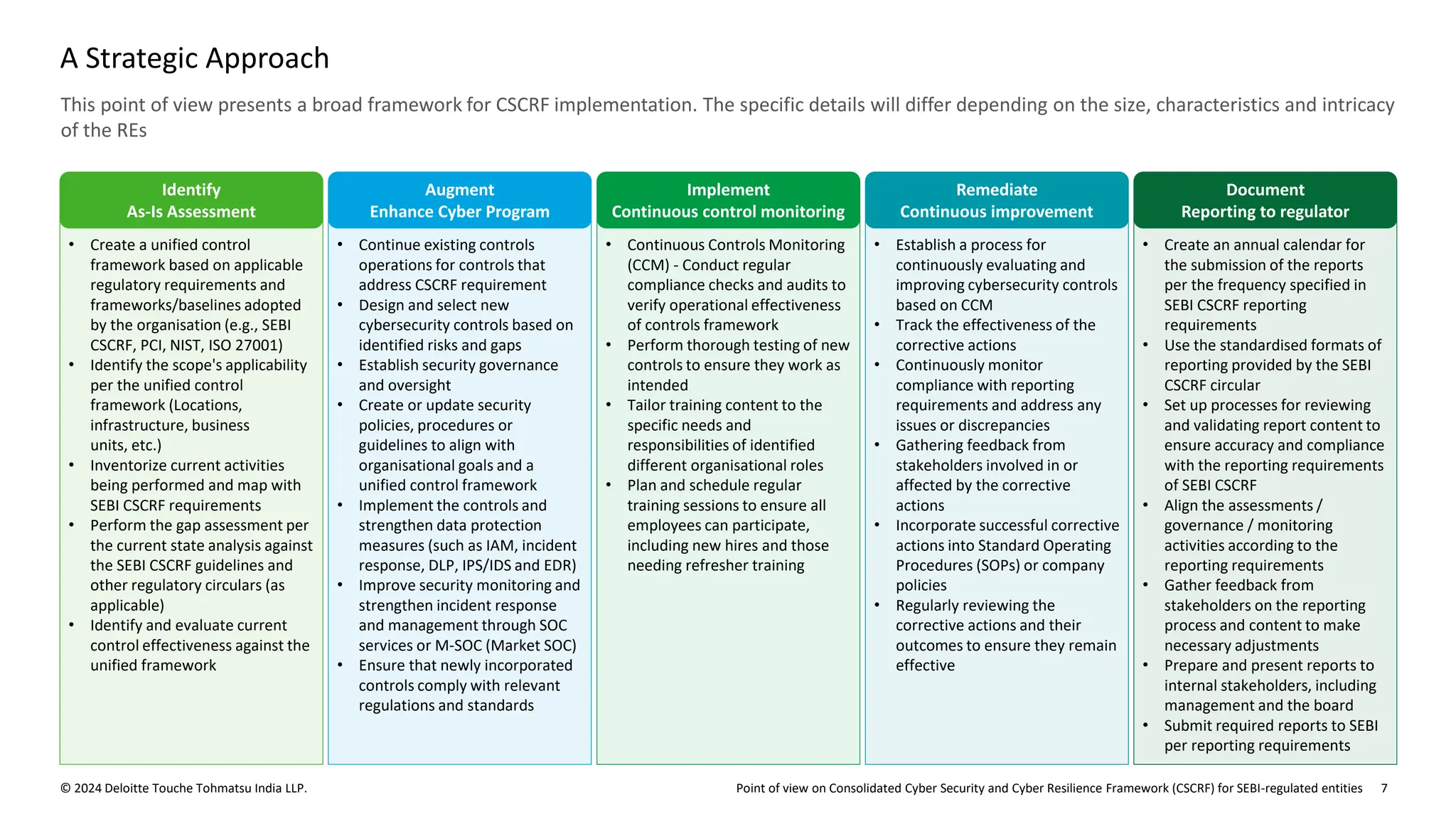
This point of view presents a broad framework for CSCRF implementation. The specific details will differ depending on the size, characteristics and intricacy
of the REs
A Strategic Approach
Identify
As-Is Assessment
Augment
Enhance Cyber Program
Implement
Continuous control monitoring
Remediate
Continuous improvement
Document
Reporting to regulator
Point of view on Consolidated Cyber Security and Cyber Resilience Framework (CSCRF) for SEBI-regulated entities
© 2024 Deloitte Touche Tohmatsu India LLP. 8
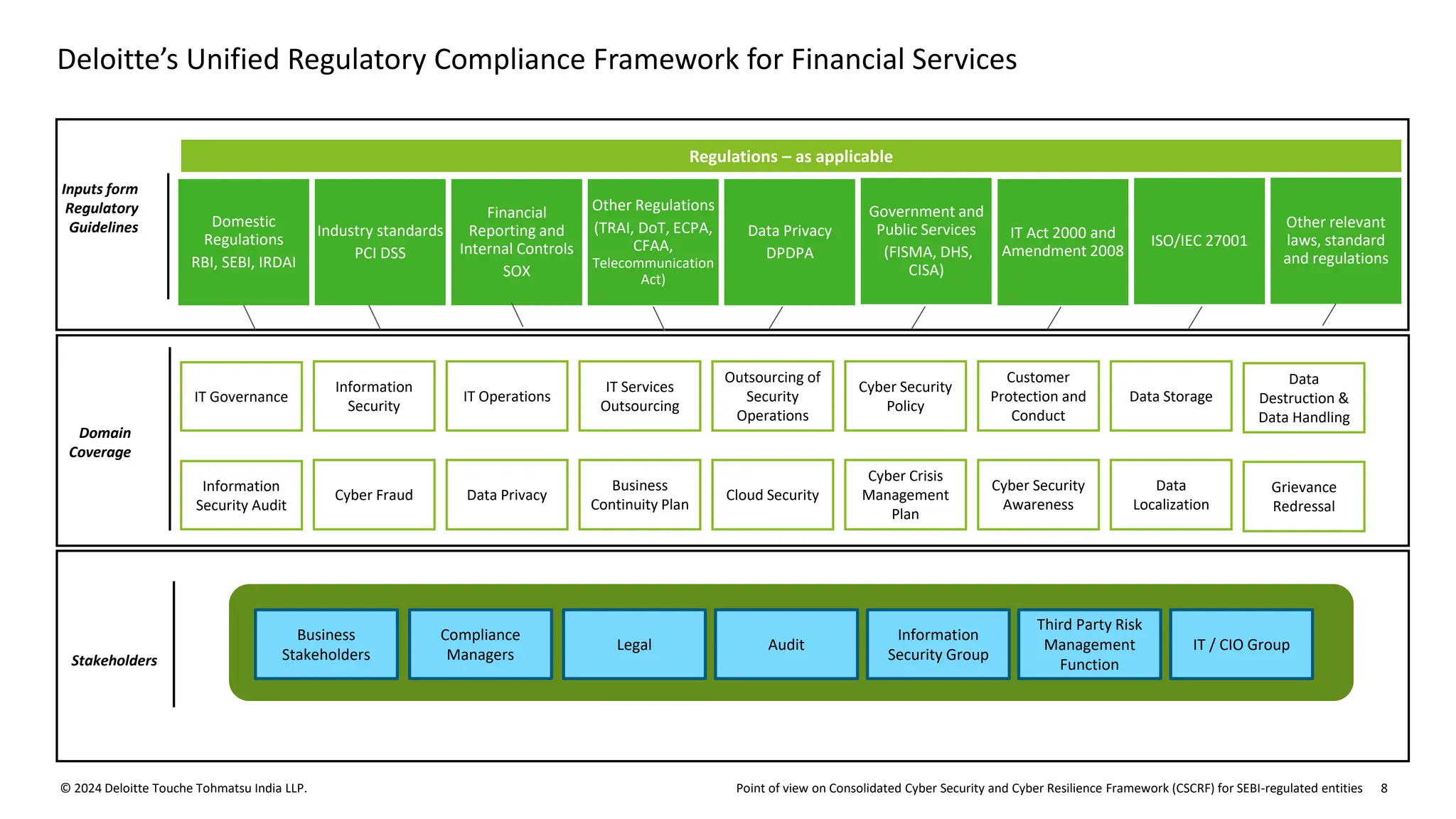
Deloitte’s Unified Regulatory Compliance Framework for Financial Services
Inputs form
Regulatory
Guidelines
Domain
Coverage
Domestic
Regulations
RBI, SEBI, IRDAI
Business
Stakeholders
Compliance
Managers
Information
Security Group
Legal Audit
Third Party Risk
Management
Function
IT / CIO Group
Stakeholders
Regulations – as applicable
IT Governance
Information
Security Audit
Information
Security
Cyber Fraud
IT Operations
Data Privacy
IT Services
Outsourcing
Business
Continuity Plan
Outsourcing of
Security
Operations
Cloud Security
Cyber Security
Policy
Cyber Crisis
Management
Plan
Customer
Protection and
Conduct
Cyber Security
Awareness
Data Storage
Data
Localization
Data
Destruction &
Data Handling
Grievance
Redressal
Industry standards
PCI DSS
Financial
Reporting and
Internal Controls
SOX
Other Regulations
(TRAI, DoT, ECPA,
CFAA,
Telecommunication
Act)
Data Privacy
DPDPA
Government and
Public Services
(FISMA, DHS,
CISA)
IT Act 2000 and
Amendment 2008
ISO/IEC 27001
Other relevant
laws, standard
and regulations
Deloitte refers to one or more of Deloitte Touche Tohmatsu Limited, a UK private company limited by guarantee (“DTTL”), its network of member firms, and their related entities. DTTL and each of its member firms are legally separate
and independent entities. DTTL (also referred to as “Deloitte Global”) does not provide services to clients. Please see www.deloitte.com/about for a more detailed description of DTTL and its member firms.
This material has been prepared by Deloitte Touche Tohmatsu India LLP (“DTTILLP”), a member of Deloitte Touche Tohmatsu Limited, on a specific request from you and contains proprietary and confidential information. This material
may contain information sourced from publicly available information or other third party sources. DTTILLP does not independently verify any such sources and is not responsible for any loss whatsoever caused due to reliance placed on
information sourced from such sources. The information contained in this material is intended solely for you. Any disclosure, copying or further distribution of this material or its contents is strictly prohibited.
Nothing in this material creates any contractual relationship between DTTILLP and you. Any mutually binding legal obligations or rights may only be created between you and DTTILLP upon execution of a legally binding contract. By
using this material and any information contained in it, the user accepts this entire notice and terms of use.
©2024 Deloitte Touche Tohmatsu India LLP. Member of Deloitte Touche Tohmatsu Limited
Deloitte Touche Tohmatsu India Private Limited (U74140MH199 5PTC093339), a private company limited by shares, was converted into Deloitte Touche Tohmatsu India LLP, a limited liability partnership (LLP Identification No. AAE-
8458),with effect from October 1, 2015.
Sathish Gopalaiah
President, T&T, Deloitte India
sathishtg@deloitte.com
Deepa Seshadri
Partner & Leader – Cyber,
Deloitte South Asia
deseshadri@deloitte.com
Gaurav Shukla
Partner, Deloitte India
shuklagaurav@deloitte.com
Munjal Kamdar
Partner, Deloitte India
mkamdar@deloitte.com
Ashish Sharma
Partner, Deloitte India
sashish@deloitte.com
Himanshu Surange
Partner, Deloitte
hsurange@deloitte.com
Vikas Garg
Partner, Deloitte India
vikasgarg@deloitte.com
Digvijay Chudasama
Partner, Deloitte India
dchudasama@deloitte.com
Bhavesh Bhurat
Partner, Deloitte India
bhaveshbhurat@deloitte.com
Sabarinath Madhumohan
Partner, Deloitte India
smadhumohan@deloitte.com
Sowmya Vedarth
Partner, Deloitte India
sovedarth@deloitte.com
Sahil Tagra
Partner, Deloitte India
stagra@deloitte.com
Gaurav Khera
Partner, Deloitte India
gkhera@deloitte.com
Sanbir Keer
Executive Director, Deloitte India
skeer@deloitte.com
Dr. Vikram Venkateswaran
Partner, Deloitte India
vikramv@deloitte.com
Aniket Likhite
Executive Director, Deloitte India
alikhite@deloitte.com
Jignesh Oza
Partner, Deloitte India
jigneshoza@deloitte.com

in-ra-cscrf-for-sebi-regulated-entities-deloitte-india-20.09-noexp.pdf

  • 1.
    Cybersecurity and Cyber Resilience Framework(CSCRF) for SEBI-regulated entities Point of View | September 2024
  • 2.
    Point of viewon Consolidated Cyber Security and Cyber Resilience Framework (CSCRF) for SEBI-regulated entities © 2024 Deloitte Touche Tohmatsu India LLP. 2 Introduction 20 August 2024- SEBI issued a “Cybersecurity and Cyber Resilience Framework (CSCRF) for SEBI REs” reviewed by SEBI’s High Powered Steering Committee (HPSC– CS). Since 2015, SEBI has issued cybersecurity and cyber resilience frameworks for various REs. Technological advancement and the protection of IT infrastructure—key concerns for SEBI REs. Rapid growth in IT usage in the securities market—a critical component of The Securities and Exchange Board of India (SEBI) Regulated Entities (REs). The framework 04 sections Part I: Objectives and standards Part II: Guidelines Part III: Structured formats for compliance Cybersecurity: Governance measures to operational controls Cyber resilience goals: Anticipate, withstand, contain, recover and evolve Part IV: Annexures and references 02 approaches
  • 3.
    Point of viewon Consolidated Cyber Security and Cyber Resilience Framework (CSCRF) for SEBI-regulated entities © 2024 Deloitte Touche Tohmatsu India LLP. 3 CSCRF: Need of the hour SEBI REs have increased their technology adoption in recent years. With the fast pace of technological developments in the securities market, maintaining robust cybersecurity and cyber resilience to protect REs’ operations from cyber risks and cyber incidents has become necessary. REs are required to comply with the standards and mandatory guidelines mentioned in the CSCRF Below are the timelines for the adoption of CSCRF provisions: • For six categories of REs where "cybersecurity and cyber resilience circular" already exists—by 1 January 2025 • For other REs where CSCRF is being issued for the first time—by 1 April 2025 • Alternative Investment Funds (AIFs) • Merchant Bankers (MBs) • Clearing corporations • Collective Investment Schemes (CIS) • Custodians • Debenture trustees • Depositories • Designated depository participant • Depository participants through depositories • Investment advisors • Mutual funds • Portfolio managers • Registrar to an issue and share transfer agents • Stockbrokers through exchanges • Stock exchanges • Venture Capital Funds (VCFs) • Research analysts • KYC Registration Agencies (KRAs) • Bankers to an issue (BTI) and Self-Certified Syndicate Banks (SCSBs) SEBI released the CSCRF to address the growing risks and difficulties related to cybersecurity in the financial markets. The following are this framework's main goals: • Enhance cybersecurity measures • Ensure cyber resilience • Standardise cybersecurity practices • Promote risk management • Encourage regular assessments • Strengthen incident reporting Why Who When
  • 4.
    Point of viewon Consolidated Cyber Security and Cyber Resilience Framework (CSCRF) for SEBI-regulated entities © 2024 Deloitte Touche Tohmatsu India LLP. 4 CSCRF: Overview Cyber resilience goal Cyber resilience goal: Evolve Anticipate Governance Detect Identify Protect Organisational context Roles, responsibilities and authorities Policy Risk management Supply chain-RM Oversight Recover Withstand and contain Cyber security function Recover Respond Asset management Risk management Identity management Awareness and training Data security Maintenance Information protection Security continuous monitoring Deletion process Incident management Incidence response Incidence analysis Improvements Incident recovery plan Recovery communication Improvements
  • 5.
    Point of viewon Consolidated Cyber Security and Cyber Resilience Framework (CSCRF) for SEBI-regulated entities © 2024 Deloitte Touche Tohmatsu India LLP. 5 What does this framework supersede? The CSCRF aims to provide standards and guidelines for strengthening cyber resilience and maintaining robust cybersecurity of SEBI REs. Its key objectives are to address evolving cyber threats, align with industry standards, encourage efficient audits and ensure SEBI REs' compliance. The consolidated CSCRF will supersede 08 SEBI circulars and 20 letters/advisories. Following are the superseded SEBI circulars Market Infrastructure Institutions (MIIs): CSCRF of stock exchanges, clearing corporations and depositories (August 2023) 01 Stockbrokers/Depository participants: CSCRF for stockbrokers/depository participants (June 2022) 02 Mutual funds/Asset Management Companies (AMCs): CSCRF of mutual funds/asset management companies (June 2022) 03 Portfolio managers: CSCRF for portfolio managers (March 2023) 04 KRAs: CSCRF of KYC registration agencies (July 2022) 05 QRATAs: CSCRF of Qualified Registrars to an Issue and Share Transfer Agents (QRTAs) (July 2022) 06 All regulated entities (February 2023) 07 Stock exchanges, clearing corporations and depositories (except commodities derivatives exchanges and their clearing corporations) (December 2018) 08
  • 6.
    Point of viewon Consolidated Cyber Security and Cyber Resilience Framework (CSCRF) for SEBI-regulated entities © 2024 Deloitte Touche Tohmatsu India LLP. 6 CSCRF: Cybersecurity functions The framework is broadly based on two approaches: Cybersecurity and Cyber Resilience. The cybersecurity approach covers governance measures to operational controls, and the cyber resilience goals include Anticipate, Withstand, Contain, Recover and Evolve. The framework provides a standardised approach to implementing various cybersecurity and cyber resilience methodologies. Standards such as ISO 27000 series, CIS v8, NIST 800-53, BIS Financial Stability Institute and CPMI-IOSCO guidelines were referred to while formulating this framework. Identify (ID) Governance (GV) Detect (DA) Respond (RS) Protect (PR) Recover (RC) Cyber security functions • GV.OC: Organisational context • GV.RR: Roles, responsibilities and authorities • GV.PO: Policy • GV.OV: Oversight • GV.RM: Risk management • GV.SC: Supply chain risk management • ID.AM: Asset management • ID.RA: Risk assessment • PR.AA: Identity management, authentication and access control • PR.AT: Awareness and training • PR.DS: Data security • PR.IP: Information protection process and procedure • PR.MA: Maintenance • RC.RP: Incident recovery plan execution • RC.CO: Incident recovery communication • RC.IM: Improvements • RS.MA: Incident management • RS.CO: Incident management reporting and communication • RS.AN: Incident analysis • RS.IM: Improvements • DA.CM: Security continuous monitoring • DA.DP: Detection process
  • 7.
    Point of viewon Consolidated Cyber Security and Cyber Resilience Framework (CSCRF) for SEBI-regulated entities © 2024 Deloitte Touche Tohmatsu India LLP. 7 • Create a unified control framework based on applicable regulatory requirements and frameworks/baselines adopted by the organisation (e.g., SEBI CSCRF, PCI, NIST, ISO 27001) • Identify the scope's applicability per the unified control framework (Locations, infrastructure, business units, etc.) • Inventorize current activities being performed and map with SEBI CSCRF requirements • Perform the gap assessment per the current state analysis against the SEBI CSCRF guidelines and other regulatory circulars (as applicable) • Identify and evaluate current control effectiveness against the unified framework • Continue existing controls operations for controls that address CSCRF requirement • Design and select new cybersecurity controls based on identified risks and gaps • Establish security governance and oversight • Create or update security policies, procedures or guidelines to align with organisational goals and a unified control framework • Implement the controls and strengthen data protection measures (such as IAM, incident response, DLP, IPS/IDS and EDR) • Improve security monitoring and strengthen incident response and management through SOC services or M-SOC (Market SOC) • Ensure that newly incorporated controls comply with relevant regulations and standards • Continuous Controls Monitoring (CCM) - Conduct regular compliance checks and audits to verify operational effectiveness of controls framework • Perform thorough testing of new controls to ensure they work as intended • Tailor training content to the specific needs and responsibilities of identified different organisational roles • Plan and schedule regular training sessions to ensure all employees can participate, including new hires and those needing refresher training • Establish a process for continuously evaluating and improving cybersecurity controls based on CCM • Track the effectiveness of the corrective actions • Continuously monitor compliance with reporting requirements and address any issues or discrepancies • Gathering feedback from stakeholders involved in or affected by the corrective actions • Incorporate successful corrective actions into Standard Operating Procedures (SOPs) or company policies • Regularly reviewing the corrective actions and their outcomes to ensure they remain effective • Create an annual calendar for the submission of the reports per the frequency specified in SEBI CSCRF reporting requirements • Use the standardised formats of reporting provided by the SEBI CSCRF circular • Set up processes for reviewing and validating report content to ensure accuracy and compliance with the reporting requirements of SEBI CSCRF • Align the assessments / governance / monitoring activities according to the reporting requirements • Gather feedback from stakeholders on the reporting process and content to make necessary adjustments • Prepare and present reports to internal stakeholders, including management and the board • Submit required reports to SEBI per reporting requirements This point of view presents a broad framework for CSCRF implementation. The specific details will differ depending on the size, characteristics and intricacy of the REs A Strategic Approach Identify As-Is Assessment Augment Enhance Cyber Program Implement Continuous control monitoring Remediate Continuous improvement Document Reporting to regulator
  • 8.
    Point of viewon Consolidated Cyber Security and Cyber Resilience Framework (CSCRF) for SEBI-regulated entities © 2024 Deloitte Touche Tohmatsu India LLP. 8 Deloitte’s Unified Regulatory Compliance Framework for Financial Services Inputs form Regulatory Guidelines Domain Coverage Domestic Regulations RBI, SEBI, IRDAI Business Stakeholders Compliance Managers Information Security Group Legal Audit Third Party Risk Management Function IT / CIO Group Stakeholders Regulations – as applicable IT Governance Information Security Audit Information Security Cyber Fraud IT Operations Data Privacy IT Services Outsourcing Business Continuity Plan Outsourcing of Security Operations Cloud Security Cyber Security Policy Cyber Crisis Management Plan Customer Protection and Conduct Cyber Security Awareness Data Storage Data Localization Data Destruction & Data Handling Grievance Redressal Industry standards PCI DSS Financial Reporting and Internal Controls SOX Other Regulations (TRAI, DoT, ECPA, CFAA, Telecommunication Act) Data Privacy DPDPA Government and Public Services (FISMA, DHS, CISA) IT Act 2000 and Amendment 2008 ISO/IEC 27001 Other relevant laws, standard and regulations
  • 9.
    Deloitte refers toone or more of Deloitte Touche Tohmatsu Limited, a UK private company limited by guarantee (“DTTL”), its network of member firms, and their related entities. DTTL and each of its member firms are legally separate and independent entities. DTTL (also referred to as “Deloitte Global”) does not provide services to clients. Please see www.deloitte.com/about for a more detailed description of DTTL and its member firms. This material has been prepared by Deloitte Touche Tohmatsu India LLP (“DTTILLP”), a member of Deloitte Touche Tohmatsu Limited, on a specific request from you and contains proprietary and confidential information. This material may contain information sourced from publicly available information or other third party sources. DTTILLP does not independently verify any such sources and is not responsible for any loss whatsoever caused due to reliance placed on information sourced from such sources. The information contained in this material is intended solely for you. Any disclosure, copying or further distribution of this material or its contents is strictly prohibited. Nothing in this material creates any contractual relationship between DTTILLP and you. Any mutually binding legal obligations or rights may only be created between you and DTTILLP upon execution of a legally binding contract. By using this material and any information contained in it, the user accepts this entire notice and terms of use. ©2024 Deloitte Touche Tohmatsu India LLP. Member of Deloitte Touche Tohmatsu Limited Deloitte Touche Tohmatsu India Private Limited (U74140MH199 5PTC093339), a private company limited by shares, was converted into Deloitte Touche Tohmatsu India LLP, a limited liability partnership (LLP Identification No. AAE- 8458),with effect from October 1, 2015. Sathish Gopalaiah President, T&T, Deloitte India sathishtg@deloitte.com Deepa Seshadri Partner & Leader – Cyber, Deloitte South Asia deseshadri@deloitte.com Gaurav Shukla Partner, Deloitte India shuklagaurav@deloitte.com Munjal Kamdar Partner, Deloitte India mkamdar@deloitte.com Ashish Sharma Partner, Deloitte India sashish@deloitte.com Himanshu Surange Partner, Deloitte hsurange@deloitte.com Vikas Garg Partner, Deloitte India vikasgarg@deloitte.com Digvijay Chudasama Partner, Deloitte India dchudasama@deloitte.com Bhavesh Bhurat Partner, Deloitte India bhaveshbhurat@deloitte.com Sabarinath Madhumohan Partner, Deloitte India smadhumohan@deloitte.com Sowmya Vedarth Partner, Deloitte India sovedarth@deloitte.com Sahil Tagra Partner, Deloitte India stagra@deloitte.com Gaurav Khera Partner, Deloitte India gkhera@deloitte.com Sanbir Keer Executive Director, Deloitte India skeer@deloitte.com Dr. Vikram Venkateswaran Partner, Deloitte India vikramv@deloitte.com Aniket Likhite Executive Director, Deloitte India alikhite@deloitte.com Jignesh Oza Partner, Deloitte India jigneshoza@deloitte.com