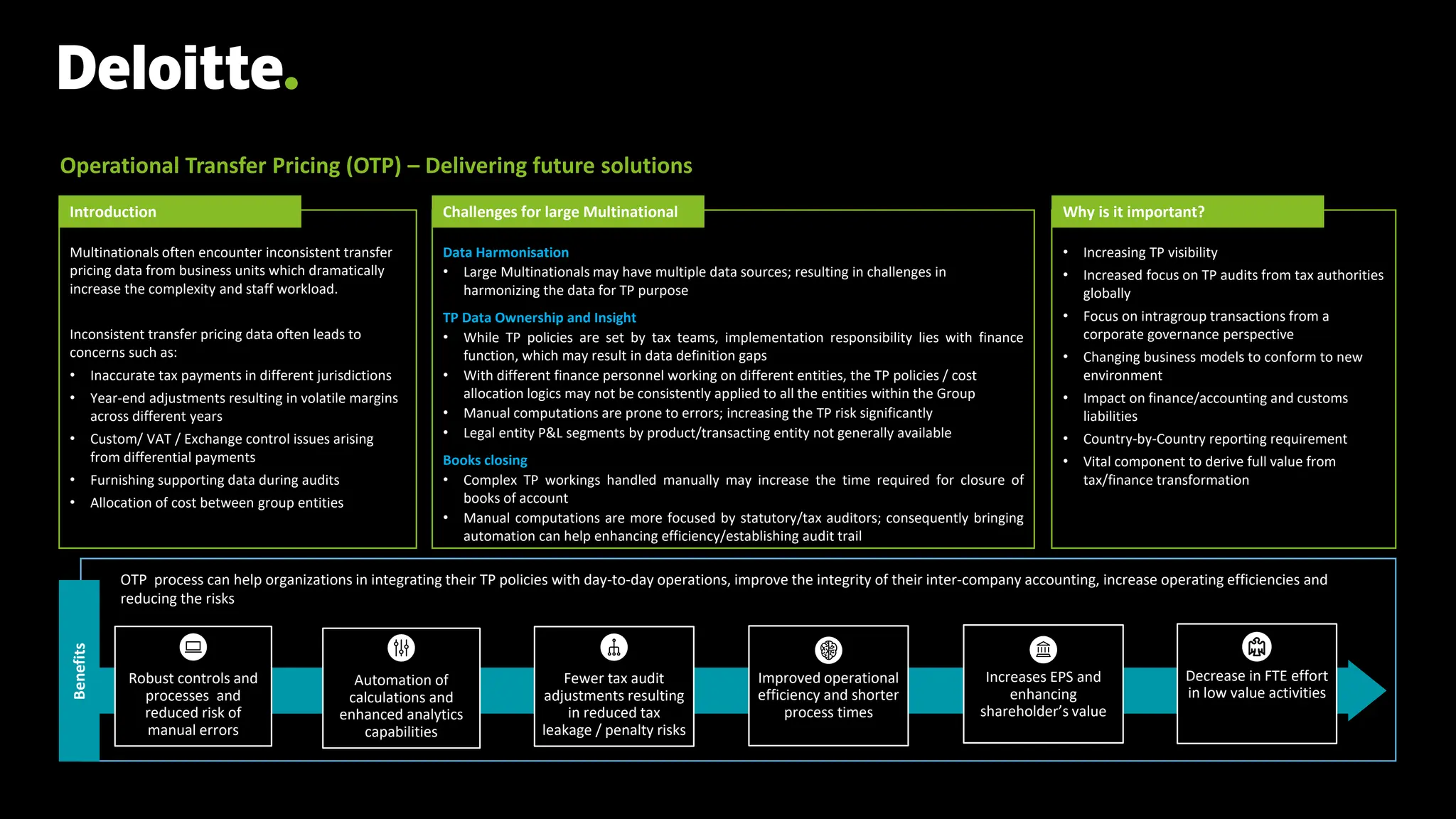
OTP process can help organizations in integrating their TP policies with day-to-day operations, improve the integrity of their inter-company accounting, increase operating efficiencies and
reducing the risks
Multinationals often encounter inconsistent transfer
pricing data from business units which dramatically
increase the complexity and staff workload.
Inconsistent transfer pricing data often leads to
concerns such as:
• Inaccurate tax payments in different jurisdictions
• Year-end adjustments resulting in volatile margins
across different years
• Custom/ VAT / Exchange control issues arising
from differential payments
• Furnishing supporting data during audits
• Allocation of cost between group entities
Operational Transfer Pricing (OTP) – Delivering future solutions
Introduction
Data Harmonisation
• Large Multinationals may have multiple data sources; resulting in challenges in
harmonizing the data for TP purpose
TP Data Ownership and Insight
• While TP policies are set by tax teams, implementation responsibility lies with finance
function, which may result in data definition gaps
• With different finance personnel working on different entities, the TP policies / cost
allocation logics may not be consistently applied to all the entities within the Group
• Manual computations are prone to errors; increasing the TP risk significantly
• Legal entity P&L segments by product/transacting entity not generally available
Books closing
• Complex TP workings handled manually may increase the time required for closure of
books of account
• Manual computations are more focused by statutory/tax auditors; consequently bringing
automation can help enhancing efficiency/establishing audit trail
Challenges for large Multinational
• Increasing TP visibility
• Increased focus on TP audits from tax authorities
globally
• Focus on intragroup transactions from a
corporate governance perspective
• Changing business models to conform to new
environment
• Impact on finance/accounting and customs
liabilities
• Country-by-Country reporting requirement
• Vital component to derive full value from
tax/finance transformation
Why is it important?
Benefits
Decrease in FTE effort
in low value activities
Robust controls and
processes and
reduced risk of
manual errors
Automation of
calculations and
enhanced analytics
capabilities
Fewer tax audit
adjustments resulting
in reduced tax
leakage / penalty risks
Improved operational
efficiency and shorter
process times
Increases EPS and
enhancing
shareholder’s value
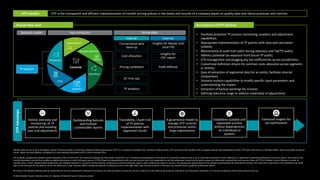
Process flow cycle
• Facilitate proactive TP process monitoring, analytics and adjustment
capabilities;
• Appropriate implementation of TP policies with data and calculation
visibility;
• Maintenance of audit trail useful during statutory and Tax/TP audits;
• Address potential tax exposure from future TP audits;
• ETR management and plugging any tax inefficiencies across jurisdictions;
• Customized definition drivers for common costs allocation across segments
or entities
• Ease of extraction of segmental data for an entity; facilitate internal
comparisons
• Scenario analysis capabilities to modify specific input parameters and
understanding the impact
• Extraction of backup workings for invoices
• Defining tolerance range to address materiality of adjustments
Key Features of OTP Solution
OTP
Advantage
Enhanced insights for
tax optimization
Holistic overview and
monitoring of TP
policies and avoiding
year end adjustments
Dashboarding features
and multiple
customizable reports
Traceability / Audit trail
of TP policies
implementation with
segmental results
A governance model to
manage OTP controls
and processes within
large organisations
Establishes scalable and
repeatable process
without dependencies
on individuals or
systems
OTP solution OTP is the transparent and efficient implementation of transfer pricing policies in the books and records of a company based on quality data and robust processes and controls.
Business model Key connectors
Stakeholders
Responsibilities
Data
Systems
Processes
Controls
Workflow
Deliverables
Internal External
TP analytics
I/C true-ups
Pricing conditions
Cost allocation
Transactional data
back-up
Audit defense
Insights for
CbC report
Insights for Master and
Local File
TP policies
Deloitte refers to one or more of Deloitte Touche Tohmatsu Limited, a UK private company limited by guarantee (“DTTL”), its network of member firms, and their related entities. DTTL and each of its member firms are legally separate and independent entities. DTTL (also referred to as “Deloitte Global”) does not provide services to
clients. Please see www.deloitte.com/about for a more detailed description of DTTL and its member firms.
This material is prepared by Deloitte Touche Tohmatsu India LLP (DTTILLP). This material (including any information contained in it) is intended to provide general information on a particular subject(s) and is not an exhaustive treatment of such subject(s) or a substitute to obtaining professional services or advice. This material may
contain information sourced from publicly available information or other third party sources. DTTILLP does not independently verify any such sources and is not responsible for any loss whatsoever caused due to reliance placed on information sourced from such sources. None of DTTILLP, Deloitte Touche Tohmatsu Limited, its
member firms, or their related entities (collectively, the “Deloitte Network”) is, by means of this material, rendering any kind of investment, legal or other professional advice or services. You should seek specific advice of the relevant professional(s) for these kind of services. This material or information is not intended to be relied
upon as the sole basis for any decision which may affect you or your business. Before making any decision or taking any action that might affect your personal finances or business, you should consult a qualified professional adviser.
No entity in the Deloitte Network shall be responsible for any loss whatsoever sustained by any person or entity by reason of access to, use of or reliance on, this material. By using this material or any information contained in it, the user accepts this entire notice and terms of use.
© 2021 Deloitte Touche Tohmatsu India LLP. Member of Deloitte Touche Tohmatsu Limited

Operational Transfer Pricing (OTP) – Delivering future solutions

  • 1.
    OTP process canhelp organizations in integrating their TP policies with day-to-day operations, improve the integrity of their inter-company accounting, increase operating efficiencies and reducing the risks Multinationals often encounter inconsistent transfer pricing data from business units which dramatically increase the complexity and staff workload. Inconsistent transfer pricing data often leads to concerns such as: • Inaccurate tax payments in different jurisdictions • Year-end adjustments resulting in volatile margins across different years • Custom/ VAT / Exchange control issues arising from differential payments • Furnishing supporting data during audits • Allocation of cost between group entities Operational Transfer Pricing (OTP) – Delivering future solutions Introduction Data Harmonisation • Large Multinationals may have multiple data sources; resulting in challenges in harmonizing the data for TP purpose TP Data Ownership and Insight • While TP policies are set by tax teams, implementation responsibility lies with finance function, which may result in data definition gaps • With different finance personnel working on different entities, the TP policies / cost allocation logics may not be consistently applied to all the entities within the Group • Manual computations are prone to errors; increasing the TP risk significantly • Legal entity P&L segments by product/transacting entity not generally available Books closing • Complex TP workings handled manually may increase the time required for closure of books of account • Manual computations are more focused by statutory/tax auditors; consequently bringing automation can help enhancing efficiency/establishing audit trail Challenges for large Multinational • Increasing TP visibility • Increased focus on TP audits from tax authorities globally • Focus on intragroup transactions from a corporate governance perspective • Changing business models to conform to new environment • Impact on finance/accounting and customs liabilities • Country-by-Country reporting requirement • Vital component to derive full value from tax/finance transformation Why is it important? Benefits Decrease in FTE effort in low value activities Robust controls and processes and reduced risk of manual errors Automation of calculations and enhanced analytics capabilities Fewer tax audit adjustments resulting in reduced tax leakage / penalty risks Improved operational efficiency and shorter process times Increases EPS and enhancing shareholder’s value
  • 2.
    Process flow cycle •Facilitate proactive TP process monitoring, analytics and adjustment capabilities; • Appropriate implementation of TP policies with data and calculation visibility; • Maintenance of audit trail useful during statutory and Tax/TP audits; • Address potential tax exposure from future TP audits; • ETR management and plugging any tax inefficiencies across jurisdictions; • Customized definition drivers for common costs allocation across segments or entities • Ease of extraction of segmental data for an entity; facilitate internal comparisons • Scenario analysis capabilities to modify specific input parameters and understanding the impact • Extraction of backup workings for invoices • Defining tolerance range to address materiality of adjustments Key Features of OTP Solution OTP Advantage Enhanced insights for tax optimization Holistic overview and monitoring of TP policies and avoiding year end adjustments Dashboarding features and multiple customizable reports Traceability / Audit trail of TP policies implementation with segmental results A governance model to manage OTP controls and processes within large organisations Establishes scalable and repeatable process without dependencies on individuals or systems OTP solution OTP is the transparent and efficient implementation of transfer pricing policies in the books and records of a company based on quality data and robust processes and controls. Business model Key connectors Stakeholders Responsibilities Data Systems Processes Controls Workflow Deliverables Internal External TP analytics I/C true-ups Pricing conditions Cost allocation Transactional data back-up Audit defense Insights for CbC report Insights for Master and Local File TP policies Deloitte refers to one or more of Deloitte Touche Tohmatsu Limited, a UK private company limited by guarantee (“DTTL”), its network of member firms, and their related entities. DTTL and each of its member firms are legally separate and independent entities. DTTL (also referred to as “Deloitte Global”) does not provide services to clients. Please see www.deloitte.com/about for a more detailed description of DTTL and its member firms. This material is prepared by Deloitte Touche Tohmatsu India LLP (DTTILLP). This material (including any information contained in it) is intended to provide general information on a particular subject(s) and is not an exhaustive treatment of such subject(s) or a substitute to obtaining professional services or advice. This material may contain information sourced from publicly available information or other third party sources. DTTILLP does not independently verify any such sources and is not responsible for any loss whatsoever caused due to reliance placed on information sourced from such sources. None of DTTILLP, Deloitte Touche Tohmatsu Limited, its member firms, or their related entities (collectively, the “Deloitte Network”) is, by means of this material, rendering any kind of investment, legal or other professional advice or services. You should seek specific advice of the relevant professional(s) for these kind of services. This material or information is not intended to be relied upon as the sole basis for any decision which may affect you or your business. Before making any decision or taking any action that might affect your personal finances or business, you should consult a qualified professional adviser. No entity in the Deloitte Network shall be responsible for any loss whatsoever sustained by any person or entity by reason of access to, use of or reliance on, this material. By using this material or any information contained in it, the user accepts this entire notice and terms of use. © 2021 Deloitte Touche Tohmatsu India LLP. Member of Deloitte Touche Tohmatsu Limited