Unlocking ISO 37008:
The key to an effective
investigation strategy
August 2024
02
Unlocking ISO 37008 | The key to an effective investigation strategy
Internal investigations are evolving to address the growing
intricacies of financial crimes, fraud and misconduct while
facing increased scrutiny from regulators and enforcement
agencies worldwide.
Organisations globally lose approximately 5 percent of
their annual revenue to fraud, an estimated loss exceeding
US$5 trillion (India: ~US$169 billion)1
. However, an effective
fraud investigation process as part of the incident response
framework can offset this loss to some extent. Organisations
with strong internal investigation processes which are
supported by a standardised investigative process framework
can streamline forensic procedures and uphold the integrity of
the investigation process.
Many organisations have attempted to streamline their
investigation framework through internal policies, customised
investigation manuals, etc. In terms of best practices/
guidelines, the International Standards Organisation (ISO)
has recently introduced the ISO 37008 Internal investigations
of organisations—Guidance, that stands out as a pivotal
development. It offers comprehensive guidelines to forensic
service providers to refine their methodologies in order to
yield rigorous investigative results. In addition, Institute of
Chartered Accountants of India (ICAI) has also rolled out the
Forensic Accounting and Investigation Standards (FAIS).
The frameworks of ISO 37008 and the FAIS standards integrate
legal and regulatory compliance into investigative procedures,
ensuring adherence to relevant legislation, standards and
ethical principles. However, these two standards differ in
applicability. ISO 37008 is universally applicable across various
organisations and industries, providing a structured framework
for internal investigations in line with standardised procedures.
On the other hand, ICAI standards are tailored for chartered
accountants involved in forensic accounting and investigation,
providing comprehensive guidelines to help them carry out an
investigation.
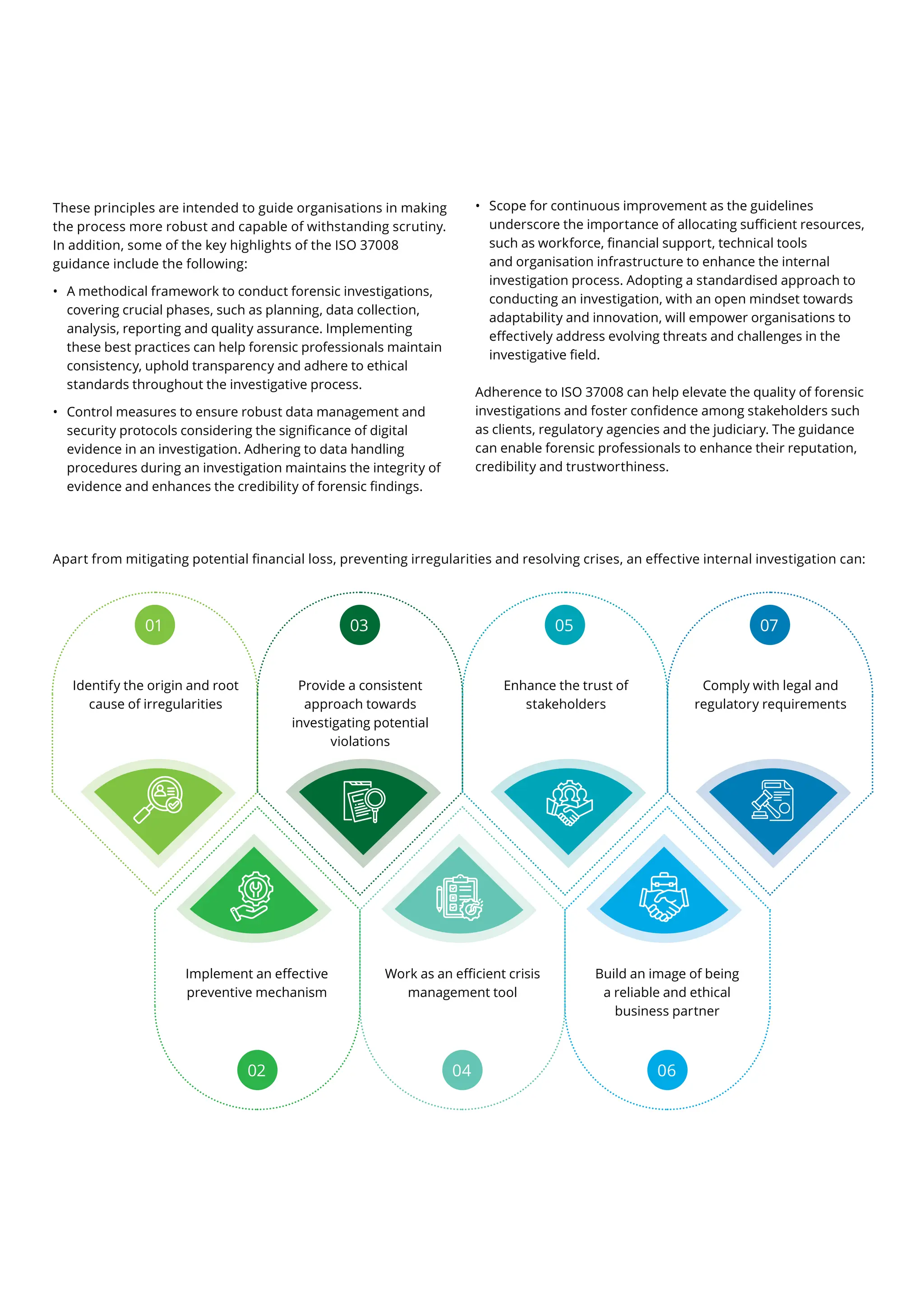
Following are the five fundamental principles laid out by ISO 37008:
Independence Legal and lawful
Confidential
Competent and
professional
Objective and
impartial
1
Source: https://legacy.acfe.com/report-to-the-nations/2024/
These principles are intended to guide organisations in making
the process more robust and capable of withstanding scrutiny.
In addition, some of the key highlights of the ISO 37008
guidance include the following:
• 
A methodical framework to conduct forensic investigations,
covering crucial phases, such as planning, data collection,
analysis, reporting and quality assurance. Implementing
these best practices can help forensic professionals maintain
consistency, uphold transparency and adhere to ethical
standards throughout the investigative process.
• 
Control measures to ensure robust data management and
security protocols considering the significance of digital
evidence in an investigation. Adhering to data handling
procedures during an investigation maintains the integrity of
evidence and enhances the credibility of forensic findings.
• 
Scope for continuous improvement as the guidelines
underscore the importance of allocating sufficient resources,
such as workforce, financial support, technical tools
and organisation infrastructure to enhance the internal
investigation process. Adopting a standardised approach to
conducting an investigation, with an open mindset towards
adaptability and innovation, will empower organisations to
effectively address evolving threats and challenges in the
investigative field.
Adherence to ISO 37008 can help elevate the quality of forensic
investigations and foster confidence among stakeholders such
as clients, regulatory agencies and the judiciary. The guidance
can enable forensic professionals to enhance their reputation,
credibility and trustworthiness.
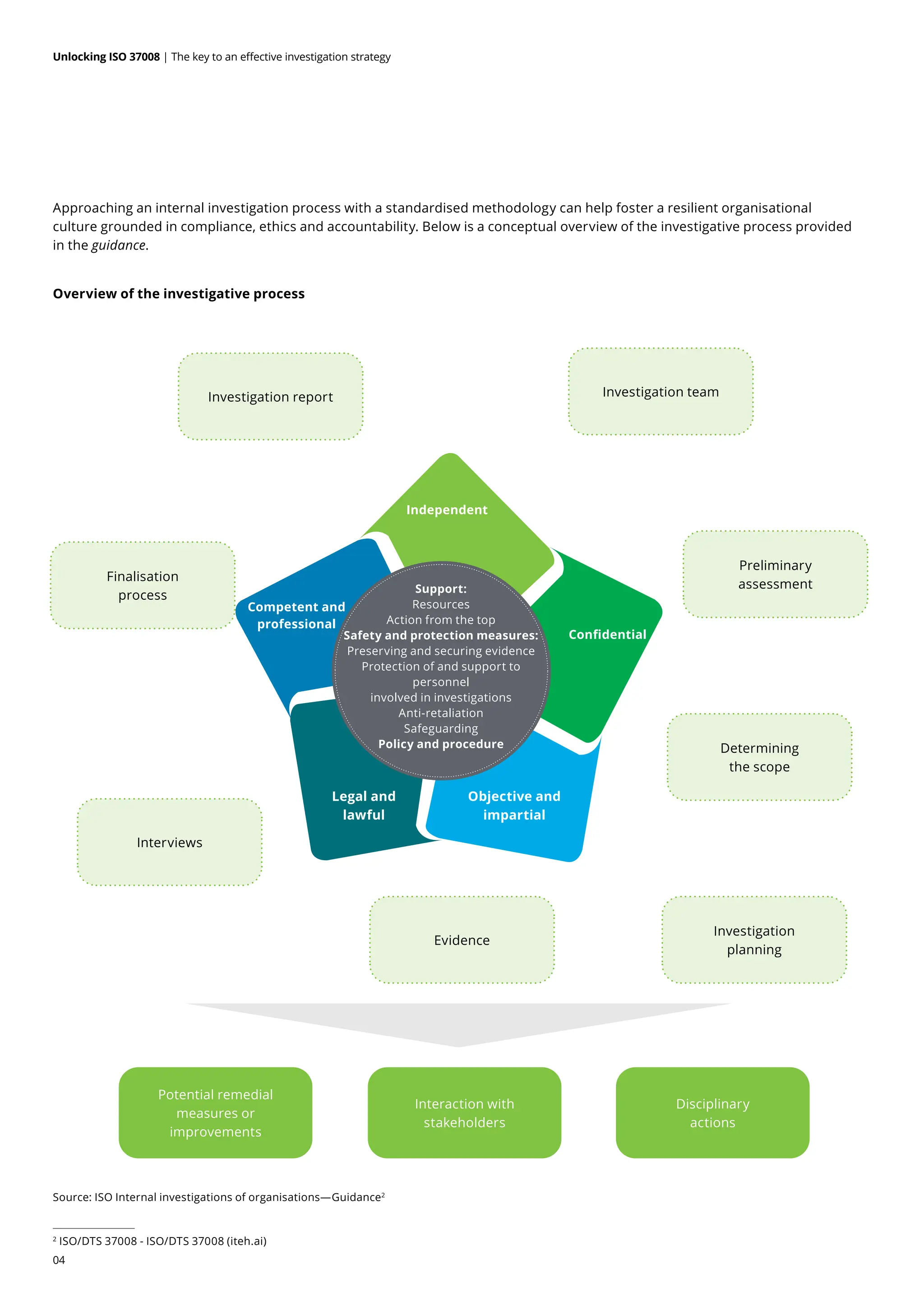
Apart from mitigating potential financial loss, preventing irregularities and resolving crises, an effective internal investigation can:
Identify the origin and root
cause of irregularities
Provide a consistent
approach towards
investigating potential
violations
Implement an effective
preventive mechanism
Work as an efficient crisis
management tool
Build an image of being
a reliable and ethical
business partner
Enhance the trust of
stakeholders
Comply with legal and
regulatory requirements
01
02 04 06
03 05 07
04
Unlocking ISO 37008 | The key to an effective investigation strategy
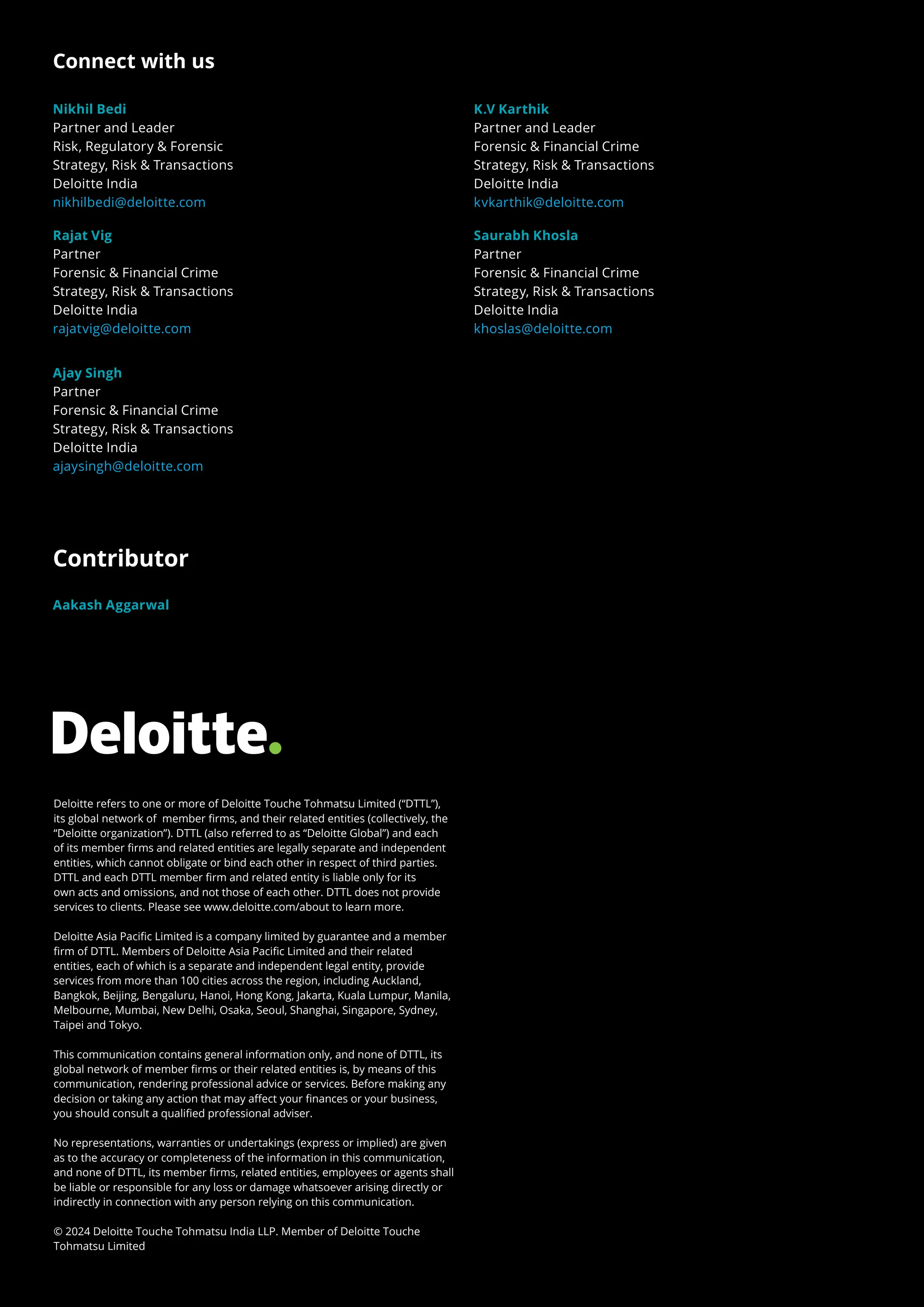
Approaching an internal investigation process with a standardised methodology can help foster a resilient organisational
culture grounded in compliance, ethics and accountability. Below is a conceptual overview of the investigative process provided
in the guidance.
Overview of the investigative process
Potential remedial
measures or
improvements
Interaction with
stakeholders
Disciplinary
actions
Investigation report
Finalisation
process
Preliminary
assessment
Determining
the scope
Investigation
planning
Evidence
Interviews
Investigation team
2
ISO/DTS 37008 - ISO/DTS 37008 (iteh.ai)
Source: ISO Internal investigations of organisations—Guidance2
Independent
Confidential
Objective and
impartial
Competent and
professional
Legal and
lawful
Support:
Resources
Action from the top
Safety and protection measures:
Preserving and securing evidence
Protection of and support to
personnel
involved in investigations
Anti-retaliation
Safeguarding
Policy and procedure
05
Unlocking ISO 37008 | The key to an effective investigation strategy
Benefits of complying with the ISO 37008:

Increased awareness among the involved parties in
terms of their rights, the significance of cooperation
along with the minimal risk of perceived biases for/
against any of the parties involved
1
A high level of transparency, consistency, quality and
anti-retaliation in the investigation process
2
Improved risk management and regulatory
compliance (as applicable)
3
High confidentiality, independence, consistency and
sensitivity among stakeholders
4
Enhance an organisation’s reputation by assuring
investors/stakeholders that their concerns are
resolved consistently
5
Poorly executed internal investigations may be
counterproductive and affect the outcomes of any
subsequent legal proceedings. Moreover, an effective
internal investigation forms a pivotal component of an
organisation's compliance management framework,
aiding in identifying potential threats and
managing risk.
Implementing guidelines such as ISO 37008 and ICAI
FAIS is highly beneficial as they help organisations
enhance their internal investigations and ensure
compliance with international best practices.
At the same time, organisations and their internal
investigation teams must keep up with the changing
landscape of the corporate world to ensure they have an effective
investigation methodology. ISO 37008 can work as a crucial guide,
equipping forensic professionals with the necessary principles in their
quest for truth. However, the outcome of investigations will depend on
the capability, integrity and experience of the forensic professionals
involved.
Clause 8.1 of ISO 37008 prescribes that the “Top
management or the governing body should
appoint or authorise a person or team to conduct
an investigation unless an existing investigation
charter pre-sets the appointment process. If the
current management has a conflict of interest, the
management of the next level should make such an
appointment or authorisation. An investigation can
be assigned to external investigators.”
An organisation should have a mechanism to
identify incidents wherein external investigators
will be better suited to conduct the investigation.
Organisations must ensure external investigators
possess the requisite knowledge to detect and
investigate irregularities and be equipped with
essential technological tools (used to perform data
analytics and review digital information) and
discreet market intelligence procedures. In our
experience, involving external investigators
enhances the independence quotient and makes
the process objective, precise and reliable,
contributing to credible outcomes.
Saurabh Khosla
Partner, Forensic  Financial Crime
Deloitte India
(Saurabh represents Deloitte on ISO’s Technical
Committee on the standard, with its nodal agency
in India)
Connect with us
Contributor
Nikhil Bedi
Partner and Leader
Risk, Regulatory  Forensic
Strategy, Risk  Transactions
Deloitte India
nikhilbedi@deloitte.com
Aakash Aggarwal
Rajat Vig
Partner
Forensic  Financial Crime
Strategy, Risk  Transactions
Deloitte India
rajatvig@deloitte.com
Ajay Singh
Partner
Forensic  Financial Crime
Strategy, Risk  Transactions
Deloitte India
ajaysingh@deloitte.com
K.V Karthik
Partner and Leader
Forensic  Financial Crime
Strategy, Risk  Transactions
Deloitte India
kvkarthik@deloitte.com
Saurabh Khosla
Partner
Forensic  Financial Crime
Strategy, Risk  Transactions
Deloitte India
khoslas@deloitte.com
Deloitte refers to one or more of Deloitte Touche Tohmatsu Limited (“DTTL”),
its global network of member firms, and their related entities (collectively, the
“Deloitte organization”). DTTL (also referred to as “Deloitte Global”) and each
of its member firms and related entities are legally separate and independent
entities, which cannot obligate or bind each other in respect of third parties.
DTTL and each DTTL member firm and related entity is liable only for its
own acts and omissions, and not those of each other. DTTL does not provide
services to clients. Please see www.deloitte.com/about to learn more.
Deloitte Asia Pacific Limited is a company limited by guarantee and a member
firm of DTTL. Members of Deloitte Asia Pacific Limited and their related
entities, each of which is a separate and independent legal entity, provide
services from more than 100 cities across the region, including Auckland,
Bangkok, Beijing, Bengaluru, Hanoi, Hong Kong, Jakarta, Kuala Lumpur, Manila,
Melbourne, Mumbai, New Delhi, Osaka, Seoul, Shanghai, Singapore, Sydney,
Taipei and Tokyo.
This communication contains general information only, and none of DTTL, its
global network of member firms or their related entities is, by means of this
communication, rendering professional advice or services. Before making any
decision or taking any action that may affect your finances or your business,
you should consult a qualified professional adviser.
No representations, warranties or undertakings (express or implied) are given
as to the accuracy or completeness of the information in this communication,
and none of DTTL, its member firms, related entities, employees or agents shall
be liable or responsible for any loss or damage whatsoever arising directly or
indirectly in connection with any person relying on this communication.
© 2024 Deloitte Touche Tohmatsu India LLP. Member of Deloitte Touche
Tohmatsu Limited

ISO 37008 Guidelines for Effective Internal Investigations

  • 1.
    Unlocking ISO 37008: Thekey to an effective investigation strategy August 2024
  • 2.
    02 Unlocking ISO 37008| The key to an effective investigation strategy Internal investigations are evolving to address the growing intricacies of financial crimes, fraud and misconduct while facing increased scrutiny from regulators and enforcement agencies worldwide. Organisations globally lose approximately 5 percent of their annual revenue to fraud, an estimated loss exceeding US$5 trillion (India: ~US$169 billion)1 . However, an effective fraud investigation process as part of the incident response framework can offset this loss to some extent. Organisations with strong internal investigation processes which are supported by a standardised investigative process framework can streamline forensic procedures and uphold the integrity of the investigation process. Many organisations have attempted to streamline their investigation framework through internal policies, customised investigation manuals, etc. In terms of best practices/ guidelines, the International Standards Organisation (ISO) has recently introduced the ISO 37008 Internal investigations of organisations—Guidance, that stands out as a pivotal development. It offers comprehensive guidelines to forensic service providers to refine their methodologies in order to yield rigorous investigative results. In addition, Institute of Chartered Accountants of India (ICAI) has also rolled out the Forensic Accounting and Investigation Standards (FAIS). The frameworks of ISO 37008 and the FAIS standards integrate legal and regulatory compliance into investigative procedures, ensuring adherence to relevant legislation, standards and ethical principles. However, these two standards differ in applicability. ISO 37008 is universally applicable across various organisations and industries, providing a structured framework for internal investigations in line with standardised procedures. On the other hand, ICAI standards are tailored for chartered accountants involved in forensic accounting and investigation, providing comprehensive guidelines to help them carry out an investigation. Following are the five fundamental principles laid out by ISO 37008: Independence Legal and lawful Confidential Competent and professional Objective and impartial 1 Source: https://legacy.acfe.com/report-to-the-nations/2024/
  • 3.
    These principles areintended to guide organisations in making the process more robust and capable of withstanding scrutiny. In addition, some of the key highlights of the ISO 37008 guidance include the following: • A methodical framework to conduct forensic investigations, covering crucial phases, such as planning, data collection, analysis, reporting and quality assurance. Implementing these best practices can help forensic professionals maintain consistency, uphold transparency and adhere to ethical standards throughout the investigative process. • Control measures to ensure robust data management and security protocols considering the significance of digital evidence in an investigation. Adhering to data handling procedures during an investigation maintains the integrity of evidence and enhances the credibility of forensic findings. • Scope for continuous improvement as the guidelines underscore the importance of allocating sufficient resources, such as workforce, financial support, technical tools and organisation infrastructure to enhance the internal investigation process. Adopting a standardised approach to conducting an investigation, with an open mindset towards adaptability and innovation, will empower organisations to effectively address evolving threats and challenges in the investigative field. Adherence to ISO 37008 can help elevate the quality of forensic investigations and foster confidence among stakeholders such as clients, regulatory agencies and the judiciary. The guidance can enable forensic professionals to enhance their reputation, credibility and trustworthiness. Apart from mitigating potential financial loss, preventing irregularities and resolving crises, an effective internal investigation can: Identify the origin and root cause of irregularities Provide a consistent approach towards investigating potential violations Implement an effective preventive mechanism Work as an efficient crisis management tool Build an image of being a reliable and ethical business partner Enhance the trust of stakeholders Comply with legal and regulatory requirements 01 02 04 06 03 05 07
  • 4.
    04 Unlocking ISO 37008| The key to an effective investigation strategy Approaching an internal investigation process with a standardised methodology can help foster a resilient organisational culture grounded in compliance, ethics and accountability. Below is a conceptual overview of the investigative process provided in the guidance. Overview of the investigative process Potential remedial measures or improvements Interaction with stakeholders Disciplinary actions Investigation report Finalisation process Preliminary assessment Determining the scope Investigation planning Evidence Interviews Investigation team 2 ISO/DTS 37008 - ISO/DTS 37008 (iteh.ai) Source: ISO Internal investigations of organisations—Guidance2 Independent Confidential Objective and impartial Competent and professional Legal and lawful Support: Resources Action from the top Safety and protection measures: Preserving and securing evidence Protection of and support to personnel involved in investigations Anti-retaliation Safeguarding Policy and procedure
  • 5.
    05 Unlocking ISO 37008| The key to an effective investigation strategy Benefits of complying with the ISO 37008: Increased awareness among the involved parties in terms of their rights, the significance of cooperation along with the minimal risk of perceived biases for/ against any of the parties involved 1 A high level of transparency, consistency, quality and anti-retaliation in the investigation process 2 Improved risk management and regulatory compliance (as applicable) 3 High confidentiality, independence, consistency and sensitivity among stakeholders 4 Enhance an organisation’s reputation by assuring investors/stakeholders that their concerns are resolved consistently 5 Poorly executed internal investigations may be counterproductive and affect the outcomes of any subsequent legal proceedings. Moreover, an effective internal investigation forms a pivotal component of an organisation's compliance management framework, aiding in identifying potential threats and managing risk. Implementing guidelines such as ISO 37008 and ICAI FAIS is highly beneficial as they help organisations enhance their internal investigations and ensure compliance with international best practices. At the same time, organisations and their internal investigation teams must keep up with the changing landscape of the corporate world to ensure they have an effective investigation methodology. ISO 37008 can work as a crucial guide, equipping forensic professionals with the necessary principles in their quest for truth. However, the outcome of investigations will depend on the capability, integrity and experience of the forensic professionals involved. Clause 8.1 of ISO 37008 prescribes that the “Top management or the governing body should appoint or authorise a person or team to conduct an investigation unless an existing investigation charter pre-sets the appointment process. If the current management has a conflict of interest, the management of the next level should make such an appointment or authorisation. An investigation can be assigned to external investigators.” An organisation should have a mechanism to identify incidents wherein external investigators will be better suited to conduct the investigation. Organisations must ensure external investigators possess the requisite knowledge to detect and investigate irregularities and be equipped with essential technological tools (used to perform data analytics and review digital information) and discreet market intelligence procedures. In our experience, involving external investigators enhances the independence quotient and makes the process objective, precise and reliable, contributing to credible outcomes. Saurabh Khosla Partner, Forensic Financial Crime Deloitte India (Saurabh represents Deloitte on ISO’s Technical Committee on the standard, with its nodal agency in India)
  • 6.
    Connect with us Contributor NikhilBedi Partner and Leader Risk, Regulatory Forensic Strategy, Risk Transactions Deloitte India nikhilbedi@deloitte.com Aakash Aggarwal Rajat Vig Partner Forensic Financial Crime Strategy, Risk Transactions Deloitte India rajatvig@deloitte.com Ajay Singh Partner Forensic Financial Crime Strategy, Risk Transactions Deloitte India ajaysingh@deloitte.com K.V Karthik Partner and Leader Forensic Financial Crime Strategy, Risk Transactions Deloitte India kvkarthik@deloitte.com Saurabh Khosla Partner Forensic Financial Crime Strategy, Risk Transactions Deloitte India khoslas@deloitte.com Deloitte refers to one or more of Deloitte Touche Tohmatsu Limited (“DTTL”), its global network of member firms, and their related entities (collectively, the “Deloitte organization”). DTTL (also referred to as “Deloitte Global”) and each of its member firms and related entities are legally separate and independent entities, which cannot obligate or bind each other in respect of third parties. DTTL and each DTTL member firm and related entity is liable only for its own acts and omissions, and not those of each other. DTTL does not provide services to clients. Please see www.deloitte.com/about to learn more. Deloitte Asia Pacific Limited is a company limited by guarantee and a member firm of DTTL. Members of Deloitte Asia Pacific Limited and their related entities, each of which is a separate and independent legal entity, provide services from more than 100 cities across the region, including Auckland, Bangkok, Beijing, Bengaluru, Hanoi, Hong Kong, Jakarta, Kuala Lumpur, Manila, Melbourne, Mumbai, New Delhi, Osaka, Seoul, Shanghai, Singapore, Sydney, Taipei and Tokyo. This communication contains general information only, and none of DTTL, its global network of member firms or their related entities is, by means of this communication, rendering professional advice or services. Before making any decision or taking any action that may affect your finances or your business, you should consult a qualified professional adviser. No representations, warranties or undertakings (express or implied) are given as to the accuracy or completeness of the information in this communication, and none of DTTL, its member firms, related entities, employees or agents shall be liable or responsible for any loss or damage whatsoever arising directly or indirectly in connection with any person relying on this communication. © 2024 Deloitte Touche Tohmatsu India LLP. Member of Deloitte Touche Tohmatsu Limited