Нічого про нас без нас
Ничего о нас без нас
ոչինչ մեր մասին առանց մեզ
Nothing about us without us

Neil Crowther, October 2013
Presentation delivered on behalf of the British
Council for the European Commission IDEAS
project on inclusive local decision-making in
Armenia, Azerbaijan, Georgia, Jordan,
Lebanon and Ukraine.
Nothing about us without us


Disability is a situation, caused by social conditions,
which requires for its elimination the following:

›

That disabled people should, with the advice and help of
others, assume control over their own lives.
› That professionals, experts and others who seek to help
must be committed to promoting such control by disabled
people.
›

Union of the Physically Impaired Against Segregation,
1975
Participation is the means and
the ends


―As disabled persons have equal rights, they also have
equal obligations. It is their duty to take part in the
building of society‖ – UN World Programme of Action
on Disability 1981

Participation is about gaining power and ‗being in the
world‘
 It is about transforming attitudes and expectations
 It is about equal citizenship

UNCRPD




Recognizing the valued existing and potential
contributions made by persons with disabilities…which
will will result in their enhanced sense of belonging and
in significant advances in the human, social and
economic development of society…
Recognizing the importance for persons with disabilities
of their individual autonomy and independence,
including the freedom to make their own choices
UNCRPD






Considering that persons with disabilities should have
the opportunity to be actively involved in decisionmaking processes about policies and programmes,
including those directly concerning them
In the development and implementation of legislation
and policies to implement the present Convention, and
in other decision-making processes concerning issues
relating to persons with disabilities, States Parties shall
closely consult with and actively involve persons with
disabilities, including children with disabilities, through
their representative organizations (Article 4 (3))
Civil society, in particular persons with disabilities and
their representative organizations, shall be involved and
participate fully in the monitoring process. (Article
33.3)
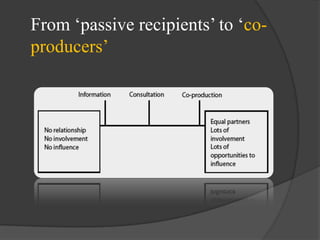
From ‗passive recipients‘ to ‗coproducers‘
Consultation, involvement and ‗coproduction’
Consultation – what do you think about these
proposals?
 Involvement – can you help us to work out what to do
and help us to do it?
 Co-production – what are we going to do and how can
we do it together as partners?

Different levels of involvement
& co-production
In national and local elected office and governance
 In regulation
 In designing public policy, developing practice,
monitoring & evaluating success
 As Employees within organisations
 Disabled people‘s user led organisations
 Self advocacy and peer support
 Disabled people as ‗authors of their own lives‘ –
supported decision making, direct payments, personal
budgets, employers

Timeline of UK law related to
disability equality and human rights






Disability Discrimination Act (DDA) 1995 – prohibits
discrimination in employment & goods and services
Human Rights Act 1998 – incorporates European
Convention on Human Rights into UK law
Disability Rights Commission Act 1999 – established
Disability Rights Commission
Special Educational Needs and Disability Act 2002 –
extends DDA to cover schools, colleges and universities
October 2004 – duty to make reasonable adjustments to
physical access comes into force
Timeline of UK law related to disability
equality and human rights








Disability Discrimination Act 2005 – extends DDA to
transport, public functions & introduces new duty on
public authorities to promote equality of opportunity
Equality Act 2006 – dissolves DRC & establishes
Equality and Human Rights Commission with a
statutory Disability Committee
Equality Act 2010 – replaced DDA while maintaining
its features and also covers non-discrimination &
equality in relation to age, gender, race, sexual
orientation, religion & belief, marital status and
pregnancy
2010 Act introduced new provision prohibiting use of
‗pre employment health questionnaires‘ in recruitment
Involvement and the law


Disability Equality Duty – duty to promote disabled people‘s
participation in public life & duty to involve disabled people
in preparation of disability equality schemes



Replaced by the Public Sector Equality Duty - duty to
‗encourage persons who share a relevant protected
characteristic to participate in public life or in any other
activity in which participation by such persons is
disproportionately low‘ but lost explicit ‗duty to involve‘



Equality and Human Rights Commission – Britain‘s
‗independent mechanism‘ under UNCRPD – legally required
to have at least 1 Commissioner who is or had been a disabled
person and to have a statutory Disability Committee until
2013.
Care Bill
The general duty of a local authority, in exercising a
function under this Part in the case of an individual, is to
promote that individual‘s well-being.
(2)―Well-being‖, in relation to an individual, means that
individual‘s well-being so far as relating to any of the
following—
(c)control by the individual over day-to-day life (including
over care and support, or support, provided to the
individual and the way in which
it is provided);
Examples of involvement and coproduction in the UK
In national policy and regulation
 In local policy and implementation
 In elected office

Examples of involvement at the
national level







Equality 2025 – official advisory body to Ministers
Disabled Persons Transport Advisory Committee –
advises government on transport policy
Disability Rights Commission & Equality and Human
Rights Commission Disability Committee –
‗independent mechanism‘
Care Quality Commission – experts by experience
regulating health and social care
Ofcom advisory committee on older and disabled
people – promoting accessible telecommunications
Examples of involvement at the
national level
Independent Living Strategy & scrutiny group– coproduction
 Independent Living in Scotland
 Disability Action Alliance
 Government consultation on ‗better working with
disabled people‘

Examples of involvement & ‗co-production‘ at the
local level
Making Stonehenge accessible






Wiltshire & Swindon Users Network worked with
English Heritage to review why so few disabled people
visited the the world-famous ‗Stonehenge‘ site
Access audit, consultation with local disabled people,
information audit
Worked with the architects for the new visitor centre –
designed was revised
Local access groups work with local planning
authorities, public bodies and businesses to improve
accessibility
Homes for life




Hull City Council established Hull Access
Improvement Group (HAIG) a practitioners‘ group
of disabled people who were trained in reading
planning documents and able to provide training to
other disabled people. Following the revised
planning guidance, the regeneration partnership
undertook extensive public consultation (including
with HAIG).
They then agreed to a significant change in policy:
to incorporate ‗Lifetime homes‘ (inclusive design)
standards into the planning requirements for the
redevelopment.
Accessible healthcare


Islington Primary Care Trust set up a disability group
with staff providing adult and children‘s services as
well as with representatives from Islington Disability
Network, Islington Age Concern and Islington Borough
Users Group (mental health).



The Group worked together to identify the priorities for
disabled people. These included providing and
disseminating information in alternative formats such as
―easy read‖, and advice to all GPs, dentists,
pharmacists and opticians in Islington about improving
their services for disabled people, including about using
British Sign Language (BSL) Services.
Disabled people‘s user led
organisations





The government established a £3M ‗Facilitation
Fund‘ that finances individual DPULOs to undertake
projects that will build the sustainability of their
organization.
Over 130 DPULOs have been funded to date.
DPULO‘s involved in wide range of activity including
employment support, tackling hate crime, social care
The right to control in Essex
Essex Coalition of Disabled People works with local
authorities and the Department for Work and Pensions
to support disabled people to ‗take control‘ of their
support.
 Disabled people have a right to:
 Continue with the same support services as at present if
happy with the service
 Let a public body (for example, Essex County Council
or Jobcentre arrange support services required
 Enable a person to buy their own support using money
given to you by a public body
 Have a mix of these

Disability hate crime


Greenwich Association of Disabled People is
recognised by the Metropolitan Police as a ‗a third party
disability hate crime reporting centre‘ which means that
disabled people can report incidents and seek support
from them and that the incidents are officially recorded
without the person having to go to the police
Disability Jury promotes
accessible transport




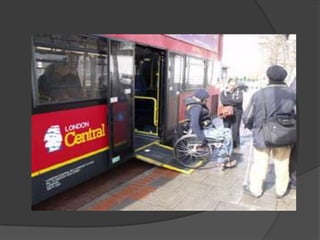
Transport for London Disability Jury – 14 disabled
jurors appointed who held several sessions with senior
management of Transport for London on barriers to
travelling
Put together three year action plan for TFL
Investing in tomorrow‘s leaders


Disability Rights UK's Leadership Programme provides
disabled people with the skills and confidence to
improve their lives and make a difference to the lives of
many other disabled people across every sector of
society. Each year the Leadership Programme provides
training for disabled people in leadership skills such as
public speaking, confidence building and networking
for success
Involvement in national and local
elected office
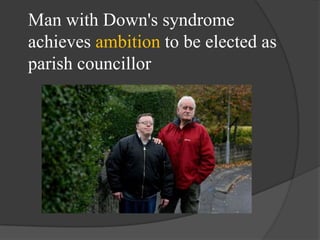
Man with Down's syndrome
achieves ambition to be elected as
parish councillor
Access to elected office strategy




A £2.6 million access to elected office fund to help
candidates with the disability-related costs of standing
for election e,g, difficulties using public transport,
paying for sign language interpreters, paying extra
travel or accommodation costs if a support worker is
needed
An introductory online training course which gives an
overview of the skills needed when standing for office. .
Access to elected office strategy



Paid internships gives people from diverse backgrounds
the opportunity to get a taste of working in politics.
Online guidance for political parties on the legal
requirements to provide reasonable adjustments.
Making the case for involvement
& co-production





Harnessing the voice of disabled people locally has
both quantitative and qualitative benefits
Data from Department of Health on LINks
(HealthWatch from 2013), which empower people in
the community to have their say or influence local
health and social care services, suggests savings of
£4.10 for every £1 invested in LINks
Studies on community development which harness
local community‘s social capital suggest this approach
can save between £3 to £3.80 for every £1 invested
Making the case for involvement
& co-production


The user-led mental health Personalisation Forum
Group is estimated to save some £250,000 per year
through using users‘ social capital rather than only
statutory services



Demos reported that coproduction between DPULOs
and local authorities helped to mitigate or minimize
effects of difficult decisions regarding budget changes
and/or de-commissioning



Beyond social care, there is a higher incidence of
reporting of disability hate crime where independent
support services through DPULOs exist
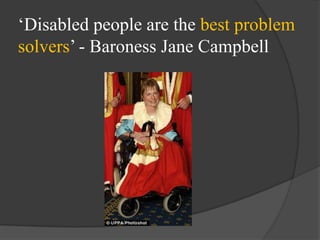
‗Disabled people are the best problem
solvers‘ - Baroness Jane Campbell
‗Nothing about us without us‘
Resources








Examples of involvement
http://www.equalityhumanrights.com/advice-andguidance/public-sector-equality-duty/case-studies/casestudies-consultation-involvement/
Essex Right to Control http://www.essex.gov.uk/HealthSocial-Care/Care-for-Adults/Staying-Independent/Rightto-Control/Pages/Default.aspx
Lights, Camera, Action – Promoting disability equality in
the public sector
http://www.equalityhumanrights.com/uploaded_files/Equa
lityAct/PSED/radar-ded_acc.pdf
Involvement and co-production – Office for Disability
Issues http://odi.dwp.gov.uk/involving-disabledpeople/co-production.php

Inclusive local decision making & the UNCRPD

  • 1.
    Нічого про насбез нас Ничего о нас без нас ոչինչ մեր մասին առանց մեզ Nothing about us without us Neil Crowther, October 2013
  • 2.
    Presentation delivered onbehalf of the British Council for the European Commission IDEAS project on inclusive local decision-making in Armenia, Azerbaijan, Georgia, Jordan, Lebanon and Ukraine.
  • 3.
    Nothing about uswithout us  Disability is a situation, caused by social conditions, which requires for its elimination the following: › That disabled people should, with the advice and help of others, assume control over their own lives. › That professionals, experts and others who seek to help must be committed to promoting such control by disabled people. › Union of the Physically Impaired Against Segregation, 1975
  • 4.
    Participation is themeans and the ends  ―As disabled persons have equal rights, they also have equal obligations. It is their duty to take part in the building of society‖ – UN World Programme of Action on Disability 1981 Participation is about gaining power and ‗being in the world‘  It is about transforming attitudes and expectations  It is about equal citizenship 
  • 6.
    UNCRPD   Recognizing the valuedexisting and potential contributions made by persons with disabilities…which will will result in their enhanced sense of belonging and in significant advances in the human, social and economic development of society… Recognizing the importance for persons with disabilities of their individual autonomy and independence, including the freedom to make their own choices
  • 7.
    UNCRPD    Considering that personswith disabilities should have the opportunity to be actively involved in decisionmaking processes about policies and programmes, including those directly concerning them In the development and implementation of legislation and policies to implement the present Convention, and in other decision-making processes concerning issues relating to persons with disabilities, States Parties shall closely consult with and actively involve persons with disabilities, including children with disabilities, through their representative organizations (Article 4 (3)) Civil society, in particular persons with disabilities and their representative organizations, shall be involved and participate fully in the monitoring process. (Article 33.3)
  • 9.
    From ‗passive recipients‘to ‗coproducers‘
  • 10.
    Consultation, involvement and‗coproduction’ Consultation – what do you think about these proposals?  Involvement – can you help us to work out what to do and help us to do it?  Co-production – what are we going to do and how can we do it together as partners? 
  • 11.
    Different levels ofinvolvement & co-production In national and local elected office and governance  In regulation  In designing public policy, developing practice, monitoring & evaluating success  As Employees within organisations  Disabled people‘s user led organisations  Self advocacy and peer support  Disabled people as ‗authors of their own lives‘ – supported decision making, direct payments, personal budgets, employers 
  • 12.
    Timeline of UKlaw related to disability equality and human rights      Disability Discrimination Act (DDA) 1995 – prohibits discrimination in employment & goods and services Human Rights Act 1998 – incorporates European Convention on Human Rights into UK law Disability Rights Commission Act 1999 – established Disability Rights Commission Special Educational Needs and Disability Act 2002 – extends DDA to cover schools, colleges and universities October 2004 – duty to make reasonable adjustments to physical access comes into force
  • 13.
    Timeline of UKlaw related to disability equality and human rights     Disability Discrimination Act 2005 – extends DDA to transport, public functions & introduces new duty on public authorities to promote equality of opportunity Equality Act 2006 – dissolves DRC & establishes Equality and Human Rights Commission with a statutory Disability Committee Equality Act 2010 – replaced DDA while maintaining its features and also covers non-discrimination & equality in relation to age, gender, race, sexual orientation, religion & belief, marital status and pregnancy 2010 Act introduced new provision prohibiting use of ‗pre employment health questionnaires‘ in recruitment
  • 14.
    Involvement and thelaw  Disability Equality Duty – duty to promote disabled people‘s participation in public life & duty to involve disabled people in preparation of disability equality schemes  Replaced by the Public Sector Equality Duty - duty to ‗encourage persons who share a relevant protected characteristic to participate in public life or in any other activity in which participation by such persons is disproportionately low‘ but lost explicit ‗duty to involve‘  Equality and Human Rights Commission – Britain‘s ‗independent mechanism‘ under UNCRPD – legally required to have at least 1 Commissioner who is or had been a disabled person and to have a statutory Disability Committee until 2013.
  • 15.
    Care Bill The generalduty of a local authority, in exercising a function under this Part in the case of an individual, is to promote that individual‘s well-being. (2)―Well-being‖, in relation to an individual, means that individual‘s well-being so far as relating to any of the following— (c)control by the individual over day-to-day life (including over care and support, or support, provided to the individual and the way in which it is provided);
  • 16.
    Examples of involvementand coproduction in the UK In national policy and regulation  In local policy and implementation  In elected office 
  • 17.
    Examples of involvementat the national level      Equality 2025 – official advisory body to Ministers Disabled Persons Transport Advisory Committee – advises government on transport policy Disability Rights Commission & Equality and Human Rights Commission Disability Committee – ‗independent mechanism‘ Care Quality Commission – experts by experience regulating health and social care Ofcom advisory committee on older and disabled people – promoting accessible telecommunications
  • 18.
    Examples of involvementat the national level Independent Living Strategy & scrutiny group– coproduction  Independent Living in Scotland  Disability Action Alliance  Government consultation on ‗better working with disabled people‘ 
  • 19.
    Examples of involvement& ‗co-production‘ at the local level
  • 21.
    Making Stonehenge accessible     Wiltshire& Swindon Users Network worked with English Heritage to review why so few disabled people visited the the world-famous ‗Stonehenge‘ site Access audit, consultation with local disabled people, information audit Worked with the architects for the new visitor centre – designed was revised Local access groups work with local planning authorities, public bodies and businesses to improve accessibility
  • 22.
    Homes for life   HullCity Council established Hull Access Improvement Group (HAIG) a practitioners‘ group of disabled people who were trained in reading planning documents and able to provide training to other disabled people. Following the revised planning guidance, the regeneration partnership undertook extensive public consultation (including with HAIG). They then agreed to a significant change in policy: to incorporate ‗Lifetime homes‘ (inclusive design) standards into the planning requirements for the redevelopment.
  • 23.
    Accessible healthcare  Islington PrimaryCare Trust set up a disability group with staff providing adult and children‘s services as well as with representatives from Islington Disability Network, Islington Age Concern and Islington Borough Users Group (mental health).  The Group worked together to identify the priorities for disabled people. These included providing and disseminating information in alternative formats such as ―easy read‖, and advice to all GPs, dentists, pharmacists and opticians in Islington about improving their services for disabled people, including about using British Sign Language (BSL) Services.
  • 24.
    Disabled people‘s userled organisations    The government established a £3M ‗Facilitation Fund‘ that finances individual DPULOs to undertake projects that will build the sustainability of their organization. Over 130 DPULOs have been funded to date. DPULO‘s involved in wide range of activity including employment support, tackling hate crime, social care
  • 25.
    The right tocontrol in Essex Essex Coalition of Disabled People works with local authorities and the Department for Work and Pensions to support disabled people to ‗take control‘ of their support.  Disabled people have a right to:  Continue with the same support services as at present if happy with the service  Let a public body (for example, Essex County Council or Jobcentre arrange support services required  Enable a person to buy their own support using money given to you by a public body  Have a mix of these 
  • 26.
    Disability hate crime  GreenwichAssociation of Disabled People is recognised by the Metropolitan Police as a ‗a third party disability hate crime reporting centre‘ which means that disabled people can report incidents and seek support from them and that the incidents are officially recorded without the person having to go to the police
  • 27.
    Disability Jury promotes accessibletransport   Transport for London Disability Jury – 14 disabled jurors appointed who held several sessions with senior management of Transport for London on barriers to travelling Put together three year action plan for TFL
  • 29.
    Investing in tomorrow‘sleaders  Disability Rights UK's Leadership Programme provides disabled people with the skills and confidence to improve their lives and make a difference to the lives of many other disabled people across every sector of society. Each year the Leadership Programme provides training for disabled people in leadership skills such as public speaking, confidence building and networking for success
  • 30.
    Involvement in nationaland local elected office
  • 31.
    Man with Down'ssyndrome achieves ambition to be elected as parish councillor
  • 32.
    Access to electedoffice strategy   A £2.6 million access to elected office fund to help candidates with the disability-related costs of standing for election e,g, difficulties using public transport, paying for sign language interpreters, paying extra travel or accommodation costs if a support worker is needed An introductory online training course which gives an overview of the skills needed when standing for office. .
  • 33.
    Access to electedoffice strategy   Paid internships gives people from diverse backgrounds the opportunity to get a taste of working in politics. Online guidance for political parties on the legal requirements to provide reasonable adjustments.
  • 34.
    Making the casefor involvement & co-production    Harnessing the voice of disabled people locally has both quantitative and qualitative benefits Data from Department of Health on LINks (HealthWatch from 2013), which empower people in the community to have their say or influence local health and social care services, suggests savings of £4.10 for every £1 invested in LINks Studies on community development which harness local community‘s social capital suggest this approach can save between £3 to £3.80 for every £1 invested
  • 35.
    Making the casefor involvement & co-production  The user-led mental health Personalisation Forum Group is estimated to save some £250,000 per year through using users‘ social capital rather than only statutory services  Demos reported that coproduction between DPULOs and local authorities helped to mitigate or minimize effects of difficult decisions regarding budget changes and/or de-commissioning  Beyond social care, there is a higher incidence of reporting of disability hate crime where independent support services through DPULOs exist
  • 36.
    ‗Disabled people arethe best problem solvers‘ - Baroness Jane Campbell
  • 37.
    ‗Nothing about uswithout us‘
  • 38.
    Resources     Examples of involvement http://www.equalityhumanrights.com/advice-andguidance/public-sector-equality-duty/case-studies/casestudies-consultation-involvement/ EssexRight to Control http://www.essex.gov.uk/HealthSocial-Care/Care-for-Adults/Staying-Independent/Rightto-Control/Pages/Default.aspx Lights, Camera, Action – Promoting disability equality in the public sector http://www.equalityhumanrights.com/uploaded_files/Equa lityAct/PSED/radar-ded_acc.pdf Involvement and co-production – Office for Disability Issues http://odi.dwp.gov.uk/involving-disabledpeople/co-production.php