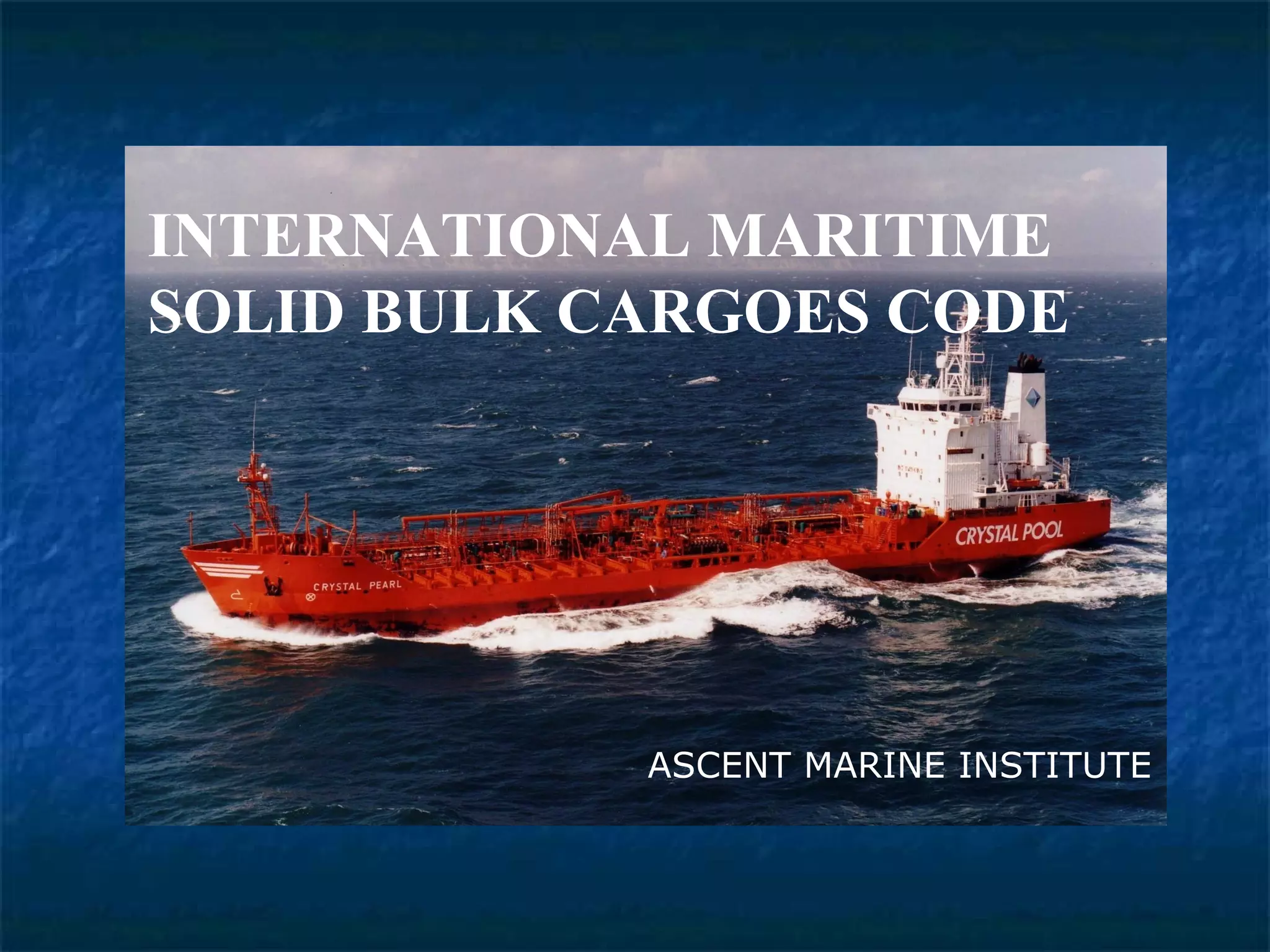
INTERNATIONAL MARITIME
SOLID BULK CARGOES CODE
ASCENT MARINE INSTITUTE
RequirementsRequirements
 SOLAS CHAPTER VI PART A & BSOLAS CHAPTER VI PART A & B
(Carriage of Cargoes)(Carriage of Cargoes)
 SOLAS CHAPTER VII ( Carriage ofSOLAS CHAPTER VII ( Carriage of
Dangerous Goods)Dangerous Goods)
 EIF: 1EIF: 1stst
JAN 2011JAN 2011
 Applicable to all cargo shipsApplicable to all cargo ships
 CONTENTS
1. General Provisions n Definitions
2. Loading, carriage and unloading
precautions
3. Safety of Personnel and ship
4. Assessment of acceptability of
consignments for safe shipment.
5. Trimming procedures
6. Methods of determining angle of
repose
7. Cargoes that may liquify
8. Test procedures for above
9. Materials possessing chemical
hazards
10. Carriage of solid bulk wastes
11. Security provisions
12. Stowage factor conversion tables
13. References
Appendices
General Provisions n Definitions
- Angle of Repose: Maximum slope
angle of non-cohesive granular
material.
- Flow Moisture Point: Percentage of
moisture content at which a flow state
develops.
- Moisture Content: Percentage of water,
ice or other liquid to the total wet mass
- TML: Moisture content that is
1. Group A: Cargoes which may liquify if
shipped at a MC in excess of TML
2. Group B: Cargoes which possess a
chemical hazard which could give rise
to a dangerous situation on ship
3. Group C: Cargoes which are neither
liable to liquefy (Group A) nor to
possess chemical hazards (Group C)
4. High density solid bulk cargo: Those
with a S.F. of 0.56 cbm/ton or less.
Loading, carriage and unloading
precautions
- Attention paid to distribution of weights
to avoid excessive stresses
- Stability to be adequate at all times
- High density cargoes loaded at lower
spaces, FSM to be controlled by
adequate means
- Bilge wells and strainer plates to be
well maintained – proper drainage
- Bilge lines, sounding pipes etc. to be in
good order
- Cargo space fitting to be protected
from damage during loading at speed
- Ventilation systems shall be shut down
or screened and air conditioning
systems shall be on recirculation mode
to minimize dust ingress into living
quarters or interior spaces
- Dk machinery / external nav aids to be
covered to protect from dust
Safety of Personnel and ship
- Oxygen depletion
- Emission of toxic gases
- Self heating
- Corrosive to skin, eyes and mucous
membranes or to ships structures
- Enclosed space entry procedures
- Even after ventilation, small pockets of
oxygen deficient or toxic gases may
exist – Oxygen measuring instruments.
- Emergency entry to cargo space only
be trained personnel wearing SCBA /
protective clothing / under supervision
- Precautions against health hazards
due to dust – masks, protective
clothing etc
- Dust Explosion – good ventilation to
prevent dust accumulation, hosing
down etc
- Flammable gases – ventilation / gas
detector
- Importance of ventilation – except for
spontaneously heating cargoes.
Assessment of acceptability of
consignments for safe shipment.
- Each cargo assigned a BCSN (Bulk
Cargo Shipping Name for identification,
along with UN number for dangerous
goods
- Cargo information provided by shipper:
- BCSN / Cargo group / IMO class / UN
number / total quantity fo cargo /
stowage factor / trimming required?? /
Likelihood of shifting / MC / TML /
special hazards of cargo / etc..
- Certificate of test – cargo to be properly
sampled and tested
- Sampling to include:
- Type of material, particle size
distribution, composition of material
- Chemical hazards,
- Variation in moisture distribution
thoughout the sample
- Test for TML to be conducted within six
months prior to loading
- Dangerous goods manifest
Trimming procedures
- Reduces chance of cargo shifting
- Non cohesive cargoes require trimming
- Non cohesive cargoes having angle of
repose equal to or less than 30o
are
free flowing and grain requirements
apply.
- Non cohesive cargoes having angle of
repose 30o
to35o
, max vert dist between
highest and lowest level og cargo:
B/10, max 1.5m and for angle of
repose >35o
, 2m. (B = beam)
Methods of determining angle of
repose
- Tilting box method
- Lab test method
- Flow table test
- Penetration test
- Proctor / Fagerberg test
- Shipboard test method
- Alternative procedure – pour carefully
on a shhet of paper and measure using
a protractor at four places.
Cargoes that may liquify
- Group A cargoes
- If moisture content exceeds TML the
moisture migrates to the surface under
the forces of vibration and compaction.
- This causes the surface of the cargo to
liquefy to a loose slurry
- This leads to Free surface correction
and subsequent reduction of GM.
- Cargoes having MC > TML can only be
carried in specially constructed ships or
in specially fitted cargo ships.
Test procedures for cargoes that
may liquefy
- Measurement of Moisture content
- Measurement of TML
- Shipboard procedure for liquefaction:
- Half fill a cylindrical can (0.5 to 1 l) with
the sample. Take the can and bring it
down sharply to strike on a hard surface
from a height of 0.2m. Repeat the
procedure 25 times with one to two
seconds interval
- Examine the surface for free moisture.
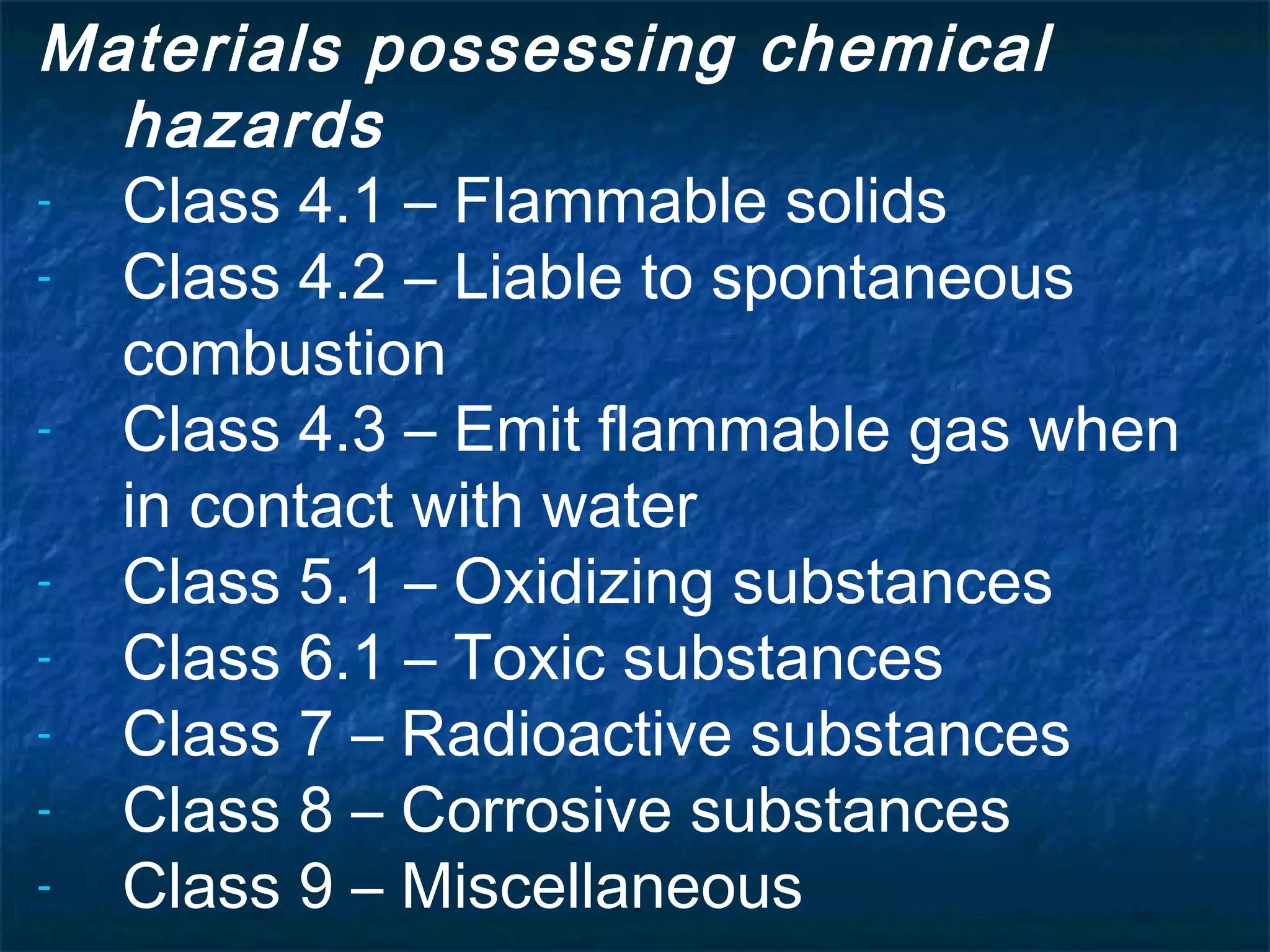
Materials possessing chemical
hazards
- Class 4.1 – Flammable solids
- Class 4.2 – Liable to spontaneous
combustion
- Class 4.3 – Emit flammable gas when
in contact with water
- Class 5.1 – Oxidizing substances
- Class 6.1 – Toxic substances
- Class 7 – Radioactive substances
- Class 8 – Corrosive substances
- Class 9 – Miscellaneous
Carriage of solid bulk wastes
- Applicable to above classes envisaged
for dumping, incineration or other
sources of disposal.
- Covered by the Basel Convention of
Transboundary Movements of
Hazardous Wastes and their disposal
- Precedence of hazards – higher
category shall apply
- Waste Movement Document
- In case of accident of threat of pollution
Master to inform authorities.
Security Provisions
- ISPS code shall apply
- Shore based personnel should receive
security training
- Ship personnel should receive security
training
- Bulk cargoes with high potential
security implications are those that
have potential for misuse in an
unlawful act and may have serious
consequences such as mass
casualities, destruction etc.

Imsbc

  • 1.
    INTERNATIONAL MARITIME SOLID BULKCARGOES CODE ASCENT MARINE INSTITUTE
  • 2.
    RequirementsRequirements  SOLAS CHAPTERVI PART A & BSOLAS CHAPTER VI PART A & B (Carriage of Cargoes)(Carriage of Cargoes)  SOLAS CHAPTER VII ( Carriage ofSOLAS CHAPTER VII ( Carriage of Dangerous Goods)Dangerous Goods)  EIF: 1EIF: 1stst JAN 2011JAN 2011  Applicable to all cargo shipsApplicable to all cargo ships
  • 3.
     CONTENTS 1. GeneralProvisions n Definitions 2. Loading, carriage and unloading precautions 3. Safety of Personnel and ship 4. Assessment of acceptability of consignments for safe shipment. 5. Trimming procedures 6. Methods of determining angle of repose
  • 4.
    7. Cargoes thatmay liquify 8. Test procedures for above 9. Materials possessing chemical hazards 10. Carriage of solid bulk wastes 11. Security provisions 12. Stowage factor conversion tables 13. References Appendices
  • 5.
    General Provisions nDefinitions - Angle of Repose: Maximum slope angle of non-cohesive granular material. - Flow Moisture Point: Percentage of moisture content at which a flow state develops. - Moisture Content: Percentage of water, ice or other liquid to the total wet mass - TML: Moisture content that is
  • 6.
    1. Group A:Cargoes which may liquify if shipped at a MC in excess of TML 2. Group B: Cargoes which possess a chemical hazard which could give rise to a dangerous situation on ship 3. Group C: Cargoes which are neither liable to liquefy (Group A) nor to possess chemical hazards (Group C) 4. High density solid bulk cargo: Those with a S.F. of 0.56 cbm/ton or less.
  • 7.
    Loading, carriage andunloading precautions - Attention paid to distribution of weights to avoid excessive stresses - Stability to be adequate at all times - High density cargoes loaded at lower spaces, FSM to be controlled by adequate means - Bilge wells and strainer plates to be well maintained – proper drainage
  • 8.
    - Bilge lines,sounding pipes etc. to be in good order - Cargo space fitting to be protected from damage during loading at speed - Ventilation systems shall be shut down or screened and air conditioning systems shall be on recirculation mode to minimize dust ingress into living quarters or interior spaces - Dk machinery / external nav aids to be covered to protect from dust
  • 9.
    Safety of Personneland ship - Oxygen depletion - Emission of toxic gases - Self heating - Corrosive to skin, eyes and mucous membranes or to ships structures - Enclosed space entry procedures - Even after ventilation, small pockets of oxygen deficient or toxic gases may exist – Oxygen measuring instruments.
  • 10.
    - Emergency entryto cargo space only be trained personnel wearing SCBA / protective clothing / under supervision - Precautions against health hazards due to dust – masks, protective clothing etc - Dust Explosion – good ventilation to prevent dust accumulation, hosing down etc - Flammable gases – ventilation / gas detector - Importance of ventilation – except for spontaneously heating cargoes.
  • 11.
    Assessment of acceptabilityof consignments for safe shipment. - Each cargo assigned a BCSN (Bulk Cargo Shipping Name for identification, along with UN number for dangerous goods - Cargo information provided by shipper: - BCSN / Cargo group / IMO class / UN number / total quantity fo cargo / stowage factor / trimming required?? / Likelihood of shifting / MC / TML / special hazards of cargo / etc..
  • 12.
    - Certificate oftest – cargo to be properly sampled and tested - Sampling to include: - Type of material, particle size distribution, composition of material - Chemical hazards, - Variation in moisture distribution thoughout the sample - Test for TML to be conducted within six months prior to loading - Dangerous goods manifest
  • 13.
    Trimming procedures - Reduceschance of cargo shifting - Non cohesive cargoes require trimming - Non cohesive cargoes having angle of repose equal to or less than 30o are free flowing and grain requirements apply. - Non cohesive cargoes having angle of repose 30o to35o , max vert dist between highest and lowest level og cargo: B/10, max 1.5m and for angle of repose >35o , 2m. (B = beam)
  • 14.
    Methods of determiningangle of repose - Tilting box method - Lab test method - Flow table test - Penetration test - Proctor / Fagerberg test - Shipboard test method - Alternative procedure – pour carefully on a shhet of paper and measure using a protractor at four places.
  • 15.
    Cargoes that mayliquify - Group A cargoes - If moisture content exceeds TML the moisture migrates to the surface under the forces of vibration and compaction. - This causes the surface of the cargo to liquefy to a loose slurry - This leads to Free surface correction and subsequent reduction of GM. - Cargoes having MC > TML can only be carried in specially constructed ships or in specially fitted cargo ships.
  • 16.
    Test procedures forcargoes that may liquefy - Measurement of Moisture content - Measurement of TML - Shipboard procedure for liquefaction: - Half fill a cylindrical can (0.5 to 1 l) with the sample. Take the can and bring it down sharply to strike on a hard surface from a height of 0.2m. Repeat the procedure 25 times with one to two seconds interval - Examine the surface for free moisture.
  • 17.
    Materials possessing chemical hazards -Class 4.1 – Flammable solids - Class 4.2 – Liable to spontaneous combustion - Class 4.3 – Emit flammable gas when in contact with water - Class 5.1 – Oxidizing substances - Class 6.1 – Toxic substances - Class 7 – Radioactive substances - Class 8 – Corrosive substances - Class 9 – Miscellaneous
  • 18.
    Carriage of solidbulk wastes - Applicable to above classes envisaged for dumping, incineration or other sources of disposal. - Covered by the Basel Convention of Transboundary Movements of Hazardous Wastes and their disposal - Precedence of hazards – higher category shall apply - Waste Movement Document - In case of accident of threat of pollution Master to inform authorities.
  • 19.
    Security Provisions - ISPScode shall apply - Shore based personnel should receive security training - Ship personnel should receive security training - Bulk cargoes with high potential security implications are those that have potential for misuse in an unlawful act and may have serious consequences such as mass casualities, destruction etc.