Feby sam
MBA 2nd year
05
• The International Ship and Port Facility
Security (ISPS) Code is an amendment to the Safety of
Life at Sea (SOLAS) Convention (1974/1988) on
minimum security arrangements
for ships, ports and government agencies.
• Came into force in 2004, it prescribes responsibilities to
governments, shipping companies, shipboard personnel,
and port/facility personnel to "detect security threats and
take preventative measures against security incidents
affecting ships or port facilities used in international
trade."
• The Code does not specify specific measures that each
port and ship must take to ensure the safety of the facility
against terrorism because of the many different types
and sizes of these facilities. Instead it outlines "a
standardized, consistent framework for evaluating risk,
enabling governments to offset changes in threat with
changes in vulnerability for ships and port facilities."
• Ship security plans
• Ship security officers
• Company security officers
• Certain onboard equipment
• Port facility security plans
• Port facility security officers
• Certain security equipment
• Monitoring and controlling access
• Monitoring the activities of people and cargo
• Ensuring security communications are readily available
• enables the detection and deterrence of security threats
within an international framework
• establishes roles and responsibilities
• enables collection and exchange of security information
• provides a methodology for assessing security
• ensures that adequate security measures in place.
• gather and assess information
• maintain communication protocols
• restrict access, prevent the introduction of unauthorized
weapons, etc.
• provide the means to raise alarms
• put in place vessel and port security plans and ensure
training and drills are conducted.
• The regulatory provisions do not extend to the actual
response to security incidents or to any necessary clear-
up activities after such an incident.
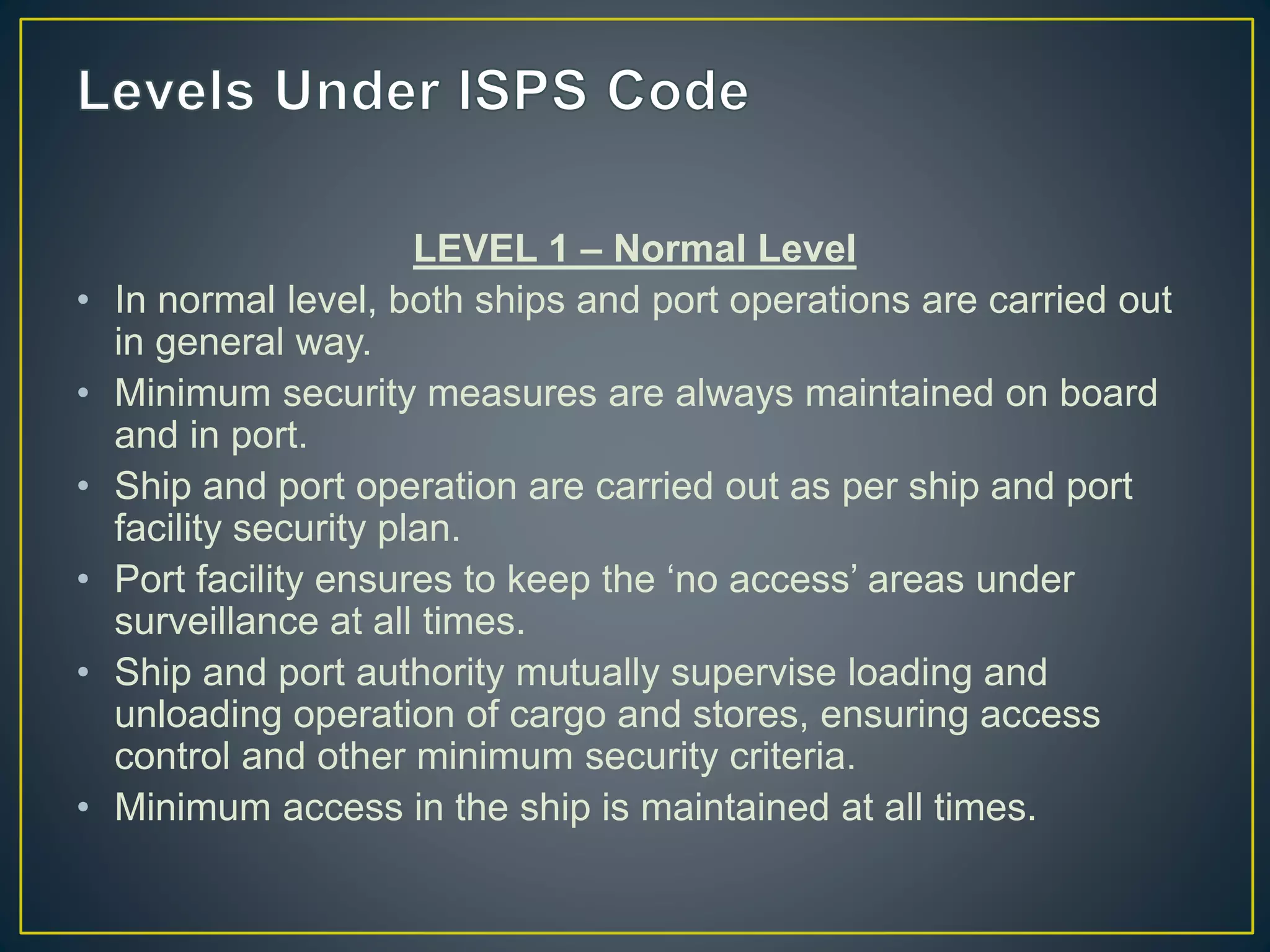
LEVEL 1 – Normal Level
• In normal level, both ships and port operations are carried out
in general way.
• Minimum security measures are always maintained on board
and in port.
• Ship and port operation are carried out as per ship and port
facility security plan.
• Port facility ensures to keep the ‘no access’ areas under
surveillance at all times.
• Ship and port authority mutually supervise loading and
unloading operation of cargo and stores, ensuring access
control and other minimum security criteria.
• Minimum access in the ship is maintained at all times.
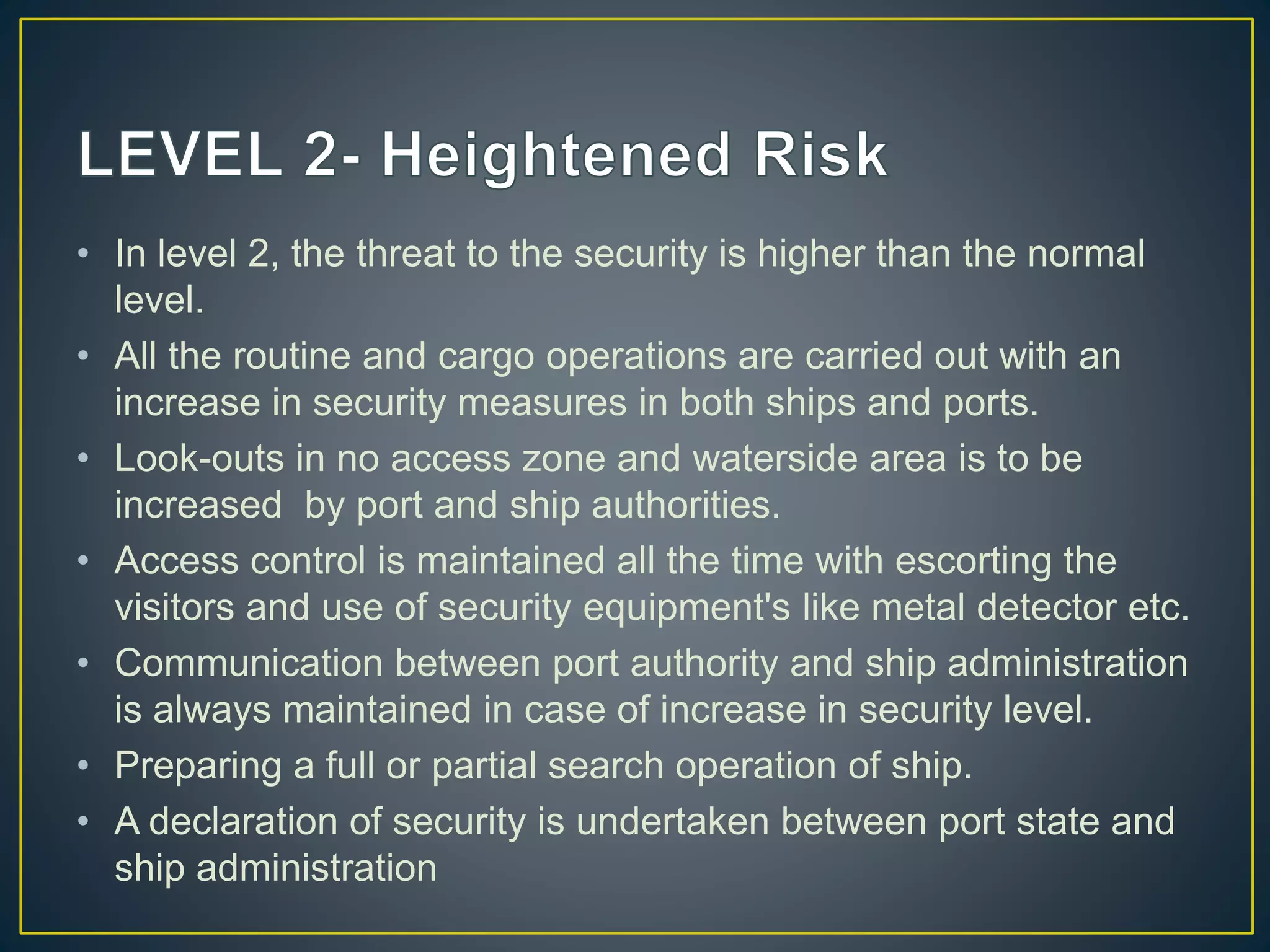
• In level 2, the threat to the security is higher than the normal
level.
• All the routine and cargo operations are carried out with an
increase in security measures in both ships and ports.
• Look-outs in no access zone and waterside area is to be
increased by port and ship authorities.
• Access control is maintained all the time with escorting the
visitors and use of security equipment's like metal detector etc.
• Communication between port authority and ship administration
is always maintained in case of increase in security level.
• Preparing a full or partial search operation of ship.
• A declaration of security is undertaken between port state and
ship administration
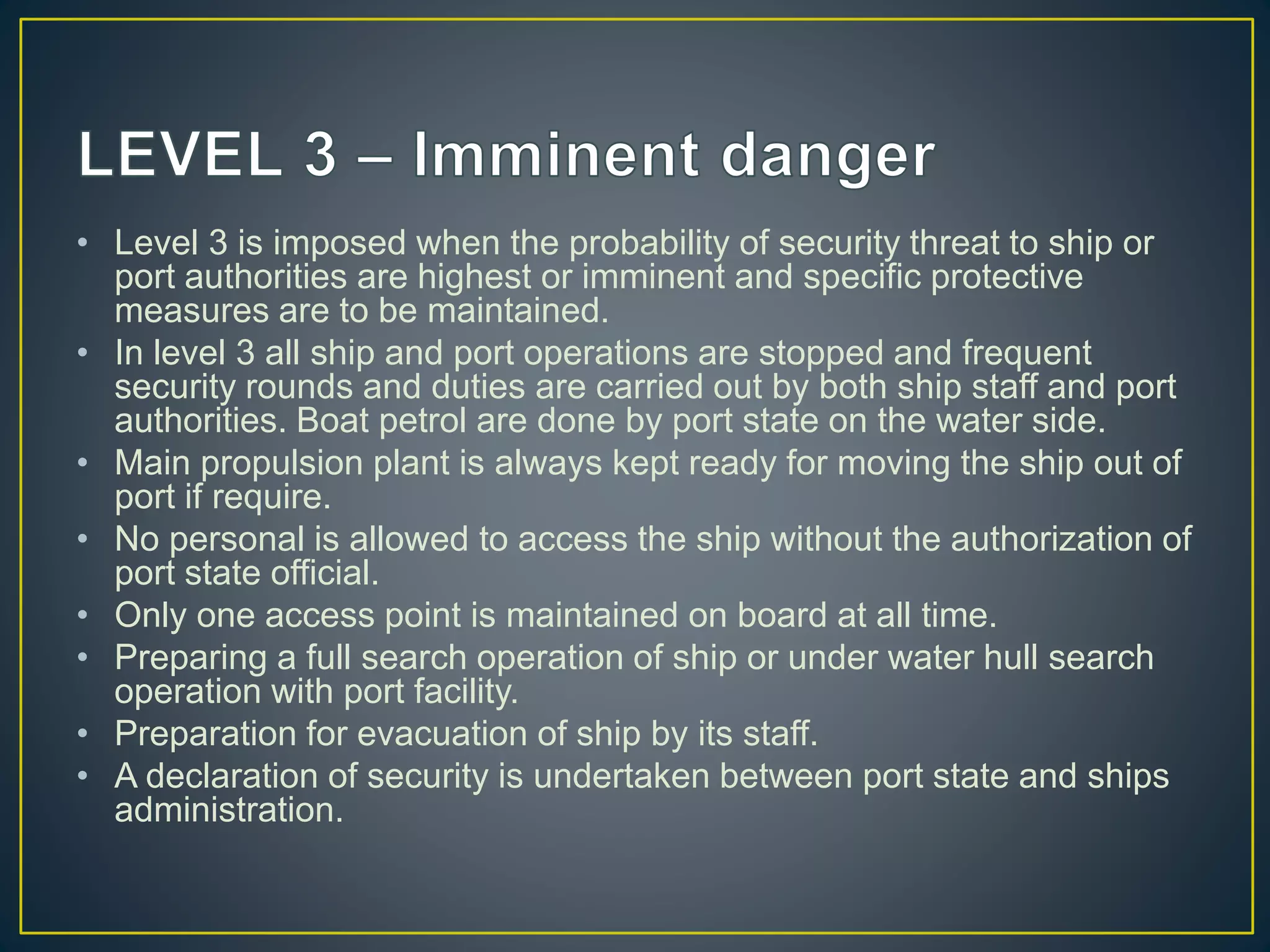
• Level 3 is imposed when the probability of security threat to ship or
port authorities are highest or imminent and specific protective
measures are to be maintained.
• In level 3 all ship and port operations are stopped and frequent
security rounds and duties are carried out by both ship staff and port
authorities. Boat petrol are done by port state on the water side.
• Main propulsion plant is always kept ready for moving the ship out of
port if require.
• No personal is allowed to access the ship without the authorization of
port state official.
• Only one access point is maintained on board at all time.
• Preparing a full search operation of ship or under water hull search
operation with port facility.
• Preparation for evacuation of ship by its staff.
• A declaration of security is undertaken between port state and ships
administration.
Isps code

Isps code

  • 1.
  • 2.
    • The InternationalShip and Port Facility Security (ISPS) Code is an amendment to the Safety of Life at Sea (SOLAS) Convention (1974/1988) on minimum security arrangements for ships, ports and government agencies. • Came into force in 2004, it prescribes responsibilities to governments, shipping companies, shipboard personnel, and port/facility personnel to "detect security threats and take preventative measures against security incidents affecting ships or port facilities used in international trade."
  • 3.
    • The Codedoes not specify specific measures that each port and ship must take to ensure the safety of the facility against terrorism because of the many different types and sizes of these facilities. Instead it outlines "a standardized, consistent framework for evaluating risk, enabling governments to offset changes in threat with changes in vulnerability for ships and port facilities."
  • 4.
    • Ship securityplans • Ship security officers • Company security officers • Certain onboard equipment
  • 5.
    • Port facilitysecurity plans • Port facility security officers • Certain security equipment
  • 6.
    • Monitoring andcontrolling access • Monitoring the activities of people and cargo • Ensuring security communications are readily available
  • 7.
    • enables thedetection and deterrence of security threats within an international framework • establishes roles and responsibilities • enables collection and exchange of security information • provides a methodology for assessing security • ensures that adequate security measures in place.
  • 8.
    • gather andassess information • maintain communication protocols • restrict access, prevent the introduction of unauthorized weapons, etc. • provide the means to raise alarms • put in place vessel and port security plans and ensure training and drills are conducted. • The regulatory provisions do not extend to the actual response to security incidents or to any necessary clear- up activities after such an incident.
  • 9.
    LEVEL 1 –Normal Level • In normal level, both ships and port operations are carried out in general way. • Minimum security measures are always maintained on board and in port. • Ship and port operation are carried out as per ship and port facility security plan. • Port facility ensures to keep the ‘no access’ areas under surveillance at all times. • Ship and port authority mutually supervise loading and unloading operation of cargo and stores, ensuring access control and other minimum security criteria. • Minimum access in the ship is maintained at all times.
  • 10.
    • In level2, the threat to the security is higher than the normal level. • All the routine and cargo operations are carried out with an increase in security measures in both ships and ports. • Look-outs in no access zone and waterside area is to be increased by port and ship authorities. • Access control is maintained all the time with escorting the visitors and use of security equipment's like metal detector etc. • Communication between port authority and ship administration is always maintained in case of increase in security level. • Preparing a full or partial search operation of ship. • A declaration of security is undertaken between port state and ship administration
  • 11.
    • Level 3is imposed when the probability of security threat to ship or port authorities are highest or imminent and specific protective measures are to be maintained. • In level 3 all ship and port operations are stopped and frequent security rounds and duties are carried out by both ship staff and port authorities. Boat petrol are done by port state on the water side. • Main propulsion plant is always kept ready for moving the ship out of port if require. • No personal is allowed to access the ship without the authorization of port state official. • Only one access point is maintained on board at all time. • Preparing a full search operation of ship or under water hull search operation with port facility. • Preparation for evacuation of ship by its staff. • A declaration of security is undertaken between port state and ships administration.