INTERNATIONAL CODE FOR THE
SAFE CARRIAGE OF GRAIN-
THIS PPT PROGRAM COVERS ALL
CONTENTS MENTIONED IN SYLLABUS
– 8.3.2.3
FROM 8.3.2.3.1 to 16
Capt. Ranjith Perera - CINEC Maritime
Campus
1
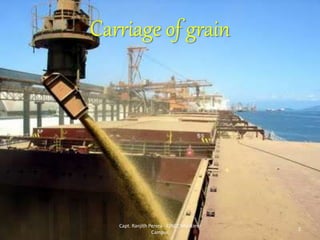
Carriage of grain
2
Capt. Ranjith Perera - CINEC Maritime
Campus
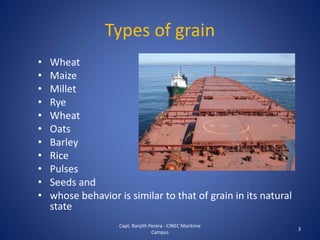
Types of grain
• Wheat
• Maize
• Millet
• Rye
• Wheat
• Oats
• Barley
• Rice
• Pulses
• Seeds and
• whose behavior is similar to that of grain in its natural
state
3
Capt. Ranjith Perera - CINEC Maritime
Campus
Dangers involve with bulk grain
Grain has a tendency to settle during the
course of a voyage, as air is forced out when
the individual grains sink. This leads to a gap
developing between the top of the cargo and
the hatch cover. This in turn enables the cargo
to move from side to side as the ship rolls and
pitches. This movement can cause the ship to
list and in worst cases, the ship can capsize.
4
Capt. Ranjith Perera - CINEC Maritime
Campus
Grain Code
• The Grain Code will be applied on all the ships
irrespective of their sizes which carry grain,
but,
• If the Administration considers that due to the
sheltered nature and conditions of the voyage,
the application of any of the requirements of
this Code is unreasonable or unnecessary,
exempt from those particular requirements.
5
Capt. Ranjith Perera - CINEC Maritime
Campus
Documents required to load grain
• A document of authorization shall be issued
for every ship, either by the Administration or
an organization recognized by it or by a
Contracting Government (to the grain Code)
on behalf of the Administration.
• Grain loading manual
• Vessels can carry grain partially, without a
document authorization under certain
conditions. Refer Grain Code for details.
6
Capt. Ranjith Perera - CINEC Maritime
Campus
Grain regulations
Heeling moments (at least) due to grain shift throughout the voyage
shall:
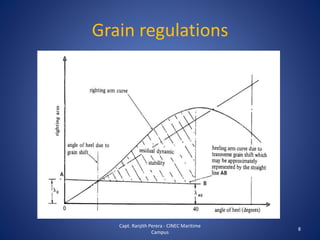
• The angle of heel due to shift of grain shall not be greater than 12° or for
ships of constructed on or after 1st January 1994 the angle at which the
deck edge is immersed, which ever is the lesser.
• In the statical stability diagram, the net or residual area between the
heeling arm curve and the righting arm curve up to the angle of heal of
maximum difference between the ordinates of the two curves, or 40° or
the angle of flooding, which ever is the least, shall in all conditions of
loading be not less than 0.075 m radians.
• The initial metacentric height, after correction for the free surface effects
of liquid in tanks , shall be not less than 0.30m.
After loading, the master shall ensure that the ship is upright before
proceeding to sea.
7
Capt. Ranjith Perera - CINEC Maritime
Campus
Grain regulations
8
Capt. Ranjith Perera - CINEC Maritime
Campus
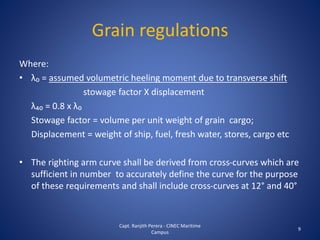
Where:
• λ₀ = assumed volumetric heeling moment due to transverse shift
stowage factor X displacement
λ₄₀ = 0.8 x λ₀
Stowage factor = volume per unit weight of grain cargo;
Displacement = weight of ship, fuel, fresh water, stores, cargo etc
• The righting arm curve shall be derived from cross-curves which are
sufficient in number to accurately define the curve for the purpose
of these requirements and shall include cross-curves at 12° and 40°
9
Grain regulations
Capt. Ranjith Perera - CINEC Maritime
Campus
Preparing for loading
• Inspect the hold (check the ladders, frames, tank tops for
corrosion, damages, cleanliness etc).
• Check the holds for infestation.
• Check the bilge well, strainer plates, sounding pipes.
• Clean the bilges, test the suction, cover the bilge well with a
strainer. Put a gunny bag on top of the trainer and put cement
around the gunny bag to hold it in place.
• Put the accommodation air condition on re-circulation.
• Check the bilge soundings before & after loading.
• To avoid the extra stresses, it is advisable to load in the lower
holds than tween decks.
10
Capt. Ranjith Perera - CINEC Maritime
Campus
• Prepare the loading sequence and de-ballast sequence
plans.
• Make sure no excessive stresses are created during
loading
• Agree the loading sequence plan with the terminal.
• Attend moorings, gangways and ballasting/de-
ballasting, list, trim should be monitored.
• Always keep the vessel upright during loading
• Before the completion of loading rig the lashing if
bundling or wire mesh securing is to be done (for
partially filled compartments)
11
Preparing for loading
Capt. Ranjith Perera - CINEC Maritime
Campus
How to stop grain shift in a filled
compartment
• longitudinal subdivisions
• Saucer of bags as a plug in the hatchway
(should not be used for linseed or similar
cargo)
• Bulk bundle of grain as a plug in the hatchway
• The wings & ends of the compartment are to
be tightly stowed with bagged grain.
• Using feeders
12
Capt. Ranjith Perera - CINEC Maritime
Campus
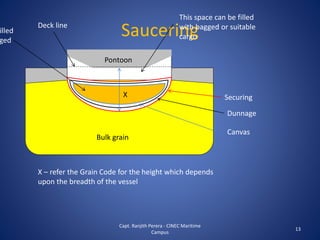
Saucering
13
Bulk grain
illed
ged
Securing
Dunnage
Canvas
Pontoon
This space can be filled
with bagged or suitable
cargo
Deck line
X
X – refer the Grain Code for the height which depends
upon the breadth of the vessel
Capt. Ranjith Perera - CINEC Maritime
Campus
14
Saucering
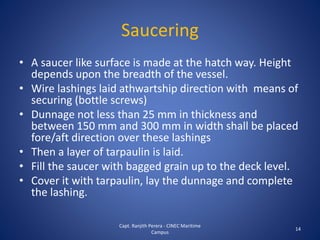
• A saucer like surface is made at the hatch way. Height
depends upon the breadth of the vessel.
• Wire lashings laid athwartship direction with means of
securing (bottle screws)
• Dunnage not less than 25 mm in thickness and
between 150 mm and 300 mm in width shall be placed
fore/aft direction over these lashings
• Then a layer of tarpaulin is laid.
• Fill the saucer with bagged grain up to the deck level.
• Cover it with tarpaulin, lay the dunnage and complete
the lashing.
Capt. Ranjith Perera - CINEC Maritime
Campus
How to reduce grain shift in a partially
filled compartment
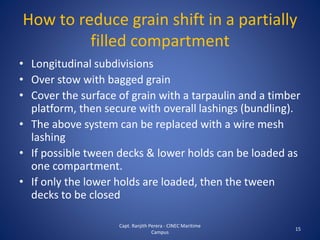
• Longitudinal subdivisions
• Over stow with bagged grain
• Cover the surface of grain with a tarpaulin and a timber
platform, then secure with overall lashings (bundling).
• The above system can be replaced with a wire mesh
lashing
• If possible tween decks & lower holds can be loaded as
one compartment.
• If only the lower holds are loaded, then the tween
decks to be closed
15
Capt. Ranjith Perera - CINEC Maritime
Campus
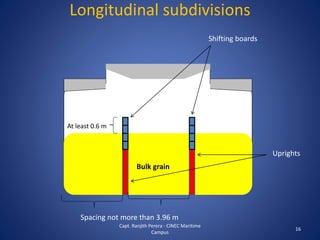
Longitudinal subdivisions
16
Bulk grain
Shifting boards
At least 0.6 m
Spacing not more than 3.96 m
Uprights
Capt. Ranjith Perera - CINEC Maritime
Campus
17
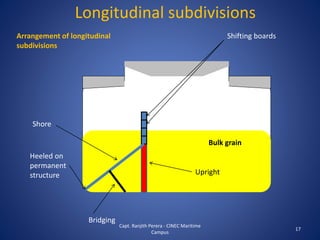
Longitudinal subdivisions
Bulk grain
Shifting boards
Upright
Bridging
Shore
Heeled on
permanent
structure
Arrangement of longitudinal
subdivisions
Capt. Ranjith Perera - CINEC Maritime
Campus
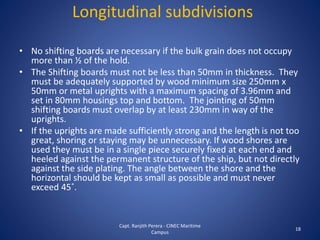
• No shifting boards are necessary if the bulk grain does not occupy
more than ½ of the hold.
• The Shifting boards must not be less than 50mm in thickness. They
must be adequately supported by wood minimum size 250mm x
50mm or metal uprights with a maximum spacing of 3.96mm and
set in 80mm housings top and bottom. The jointing of 50mm
shifting boards must overlap by at least 230mm in way of the
uprights.
• If the uprights are made sufficiently strong and the length is not too
great, shoring or staying may be unnecessary. If wood shores are
used they must be in a single piece securely fixed at each end and
heeled against the permanent structure of the ship, but not directly
against the side plating. The angle between the shore and the
horizontal should be kept as small as possible and must never
exceed 45˚.
18
Longitudinal subdivisions
Capt. Ranjith Perera - CINEC Maritime
Campus
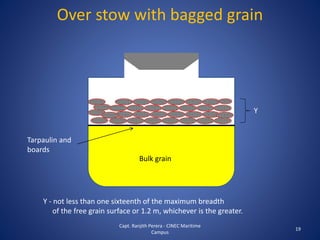
Over stow with bagged grain
19
Bulk grain
Y
Y - not less than one sixteenth of the maximum breadth
of the free grain surface or 1.2 m, whichever is the greater.
Tarpaulin and
boards
Capt. Ranjith Perera - CINEC Maritime
Campus
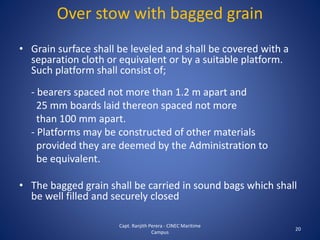
• Grain surface shall be leveled and shall be covered with a
separation cloth or equivalent or by a suitable platform.
Such platform shall consist of;
- bearers spaced not more than 1.2 m apart and
25 mm boards laid thereon spaced not more
than 100 mm apart.
- Platforms may be constructed of other materials
provided they are deemed by the Administration to
be equivalent.
• The bagged grain shall be carried in sound bags which shall
be well filled and securely closed
20
Over stow with bagged grain
Capt. Ranjith Perera - CINEC Maritime
Campus
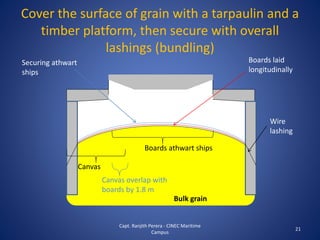
Cover the surface of grain with a tarpaulin and a
timber platform, then secure with overall
lashings (bundling)
21
Boards athwart ships
Canvas
Canvas overlap with
boards by 1.8 m
Bulk grain
Securing athwart
ships
Boards laid
longitudinally
Wire
lashing
Capt. Ranjith Perera - CINEC Maritime
Campus
• The grain shall be trimmed and leveled to the
extent that it is very slightly crowned and covered
with tarpaulins.
• The tarpaulins shall overlap by at least 1.8 m.
• Two solid floors of rough 25 mm by 150 mm to
300 mm lumber shall be laid with the top floor
running longitudinally and nailed to an
athwartships bottom floor.
• Prior to the completion of loading the lashing
shall be positively attached to the framing (Steel
wire rope of 19mm diameter or equivalent)
22
Cover the surface of grain with a tarpaulin and a
timber platform, then secure with overall
lashings (bundling)
Capt. Ranjith Perera - CINEC Maritime
Campus
Securing with wire mesh
• The grain shall be trimmed to form a slight
crown along the fore and aft centre line of the
compartment.
• The entire surface of the grain shall be
covered with tarpaulins
• Two layers of wire reinforcement mesh shall
be laid on top of the tarpaulin. The bottom
layer is to be laid athwartships and the top
layer is to be laid longitudinally.
23
Capt. Ranjith Perera - CINEC Maritime
Campus
Important
• Refer the grain code for the sizes of dunnages,
uprights, shifting boards and wire ropes. It
varies with the length of such materials.
• Check the anti-shifting mechanisms in partly
filled compartments during the passage.
24
Capt. Ranjith Perera - CINEC Maritime
Campus

3 - Grain - Carrying Grain.pptx

  • 1.
    INTERNATIONAL CODE FORTHE SAFE CARRIAGE OF GRAIN- THIS PPT PROGRAM COVERS ALL CONTENTS MENTIONED IN SYLLABUS – 8.3.2.3 FROM 8.3.2.3.1 to 16 Capt. Ranjith Perera - CINEC Maritime Campus 1
  • 2.
    Carriage of grain 2 Capt.Ranjith Perera - CINEC Maritime Campus
  • 3.
    Types of grain •Wheat • Maize • Millet • Rye • Wheat • Oats • Barley • Rice • Pulses • Seeds and • whose behavior is similar to that of grain in its natural state 3 Capt. Ranjith Perera - CINEC Maritime Campus
  • 4.
    Dangers involve withbulk grain Grain has a tendency to settle during the course of a voyage, as air is forced out when the individual grains sink. This leads to a gap developing between the top of the cargo and the hatch cover. This in turn enables the cargo to move from side to side as the ship rolls and pitches. This movement can cause the ship to list and in worst cases, the ship can capsize. 4 Capt. Ranjith Perera - CINEC Maritime Campus
  • 5.
    Grain Code • TheGrain Code will be applied on all the ships irrespective of their sizes which carry grain, but, • If the Administration considers that due to the sheltered nature and conditions of the voyage, the application of any of the requirements of this Code is unreasonable or unnecessary, exempt from those particular requirements. 5 Capt. Ranjith Perera - CINEC Maritime Campus
  • 6.
    Documents required toload grain • A document of authorization shall be issued for every ship, either by the Administration or an organization recognized by it or by a Contracting Government (to the grain Code) on behalf of the Administration. • Grain loading manual • Vessels can carry grain partially, without a document authorization under certain conditions. Refer Grain Code for details. 6 Capt. Ranjith Perera - CINEC Maritime Campus
  • 7.
    Grain regulations Heeling moments(at least) due to grain shift throughout the voyage shall: • The angle of heel due to shift of grain shall not be greater than 12° or for ships of constructed on or after 1st January 1994 the angle at which the deck edge is immersed, which ever is the lesser. • In the statical stability diagram, the net or residual area between the heeling arm curve and the righting arm curve up to the angle of heal of maximum difference between the ordinates of the two curves, or 40° or the angle of flooding, which ever is the least, shall in all conditions of loading be not less than 0.075 m radians. • The initial metacentric height, after correction for the free surface effects of liquid in tanks , shall be not less than 0.30m. After loading, the master shall ensure that the ship is upright before proceeding to sea. 7 Capt. Ranjith Perera - CINEC Maritime Campus
  • 8.
    Grain regulations 8 Capt. RanjithPerera - CINEC Maritime Campus
  • 9.
    Where: • λ₀ =assumed volumetric heeling moment due to transverse shift stowage factor X displacement λ₄₀ = 0.8 x λ₀ Stowage factor = volume per unit weight of grain cargo; Displacement = weight of ship, fuel, fresh water, stores, cargo etc • The righting arm curve shall be derived from cross-curves which are sufficient in number to accurately define the curve for the purpose of these requirements and shall include cross-curves at 12° and 40° 9 Grain regulations Capt. Ranjith Perera - CINEC Maritime Campus
  • 10.
    Preparing for loading •Inspect the hold (check the ladders, frames, tank tops for corrosion, damages, cleanliness etc). • Check the holds for infestation. • Check the bilge well, strainer plates, sounding pipes. • Clean the bilges, test the suction, cover the bilge well with a strainer. Put a gunny bag on top of the trainer and put cement around the gunny bag to hold it in place. • Put the accommodation air condition on re-circulation. • Check the bilge soundings before & after loading. • To avoid the extra stresses, it is advisable to load in the lower holds than tween decks. 10 Capt. Ranjith Perera - CINEC Maritime Campus
  • 11.
    • Prepare theloading sequence and de-ballast sequence plans. • Make sure no excessive stresses are created during loading • Agree the loading sequence plan with the terminal. • Attend moorings, gangways and ballasting/de- ballasting, list, trim should be monitored. • Always keep the vessel upright during loading • Before the completion of loading rig the lashing if bundling or wire mesh securing is to be done (for partially filled compartments) 11 Preparing for loading Capt. Ranjith Perera - CINEC Maritime Campus
  • 12.
    How to stopgrain shift in a filled compartment • longitudinal subdivisions • Saucer of bags as a plug in the hatchway (should not be used for linseed or similar cargo) • Bulk bundle of grain as a plug in the hatchway • The wings & ends of the compartment are to be tightly stowed with bagged grain. • Using feeders 12 Capt. Ranjith Perera - CINEC Maritime Campus
  • 13.
    Saucering 13 Bulk grain illed ged Securing Dunnage Canvas Pontoon This spacecan be filled with bagged or suitable cargo Deck line X X – refer the Grain Code for the height which depends upon the breadth of the vessel Capt. Ranjith Perera - CINEC Maritime Campus
  • 14.
    14 Saucering • A saucerlike surface is made at the hatch way. Height depends upon the breadth of the vessel. • Wire lashings laid athwartship direction with means of securing (bottle screws) • Dunnage not less than 25 mm in thickness and between 150 mm and 300 mm in width shall be placed fore/aft direction over these lashings • Then a layer of tarpaulin is laid. • Fill the saucer with bagged grain up to the deck level. • Cover it with tarpaulin, lay the dunnage and complete the lashing. Capt. Ranjith Perera - CINEC Maritime Campus
  • 15.
    How to reducegrain shift in a partially filled compartment • Longitudinal subdivisions • Over stow with bagged grain • Cover the surface of grain with a tarpaulin and a timber platform, then secure with overall lashings (bundling). • The above system can be replaced with a wire mesh lashing • If possible tween decks & lower holds can be loaded as one compartment. • If only the lower holds are loaded, then the tween decks to be closed 15 Capt. Ranjith Perera - CINEC Maritime Campus
  • 16.
    Longitudinal subdivisions 16 Bulk grain Shiftingboards At least 0.6 m Spacing not more than 3.96 m Uprights Capt. Ranjith Perera - CINEC Maritime Campus
  • 17.
    17 Longitudinal subdivisions Bulk grain Shiftingboards Upright Bridging Shore Heeled on permanent structure Arrangement of longitudinal subdivisions Capt. Ranjith Perera - CINEC Maritime Campus
  • 18.
    • No shiftingboards are necessary if the bulk grain does not occupy more than ½ of the hold. • The Shifting boards must not be less than 50mm in thickness. They must be adequately supported by wood minimum size 250mm x 50mm or metal uprights with a maximum spacing of 3.96mm and set in 80mm housings top and bottom. The jointing of 50mm shifting boards must overlap by at least 230mm in way of the uprights. • If the uprights are made sufficiently strong and the length is not too great, shoring or staying may be unnecessary. If wood shores are used they must be in a single piece securely fixed at each end and heeled against the permanent structure of the ship, but not directly against the side plating. The angle between the shore and the horizontal should be kept as small as possible and must never exceed 45˚. 18 Longitudinal subdivisions Capt. Ranjith Perera - CINEC Maritime Campus
  • 19.
    Over stow withbagged grain 19 Bulk grain Y Y - not less than one sixteenth of the maximum breadth of the free grain surface or 1.2 m, whichever is the greater. Tarpaulin and boards Capt. Ranjith Perera - CINEC Maritime Campus
  • 20.
    • Grain surfaceshall be leveled and shall be covered with a separation cloth or equivalent or by a suitable platform. Such platform shall consist of; - bearers spaced not more than 1.2 m apart and 25 mm boards laid thereon spaced not more than 100 mm apart. - Platforms may be constructed of other materials provided they are deemed by the Administration to be equivalent. • The bagged grain shall be carried in sound bags which shall be well filled and securely closed 20 Over stow with bagged grain Capt. Ranjith Perera - CINEC Maritime Campus
  • 21.
    Cover the surfaceof grain with a tarpaulin and a timber platform, then secure with overall lashings (bundling) 21 Boards athwart ships Canvas Canvas overlap with boards by 1.8 m Bulk grain Securing athwart ships Boards laid longitudinally Wire lashing Capt. Ranjith Perera - CINEC Maritime Campus
  • 22.
    • The grainshall be trimmed and leveled to the extent that it is very slightly crowned and covered with tarpaulins. • The tarpaulins shall overlap by at least 1.8 m. • Two solid floors of rough 25 mm by 150 mm to 300 mm lumber shall be laid with the top floor running longitudinally and nailed to an athwartships bottom floor. • Prior to the completion of loading the lashing shall be positively attached to the framing (Steel wire rope of 19mm diameter or equivalent) 22 Cover the surface of grain with a tarpaulin and a timber platform, then secure with overall lashings (bundling) Capt. Ranjith Perera - CINEC Maritime Campus
  • 23.
    Securing with wiremesh • The grain shall be trimmed to form a slight crown along the fore and aft centre line of the compartment. • The entire surface of the grain shall be covered with tarpaulins • Two layers of wire reinforcement mesh shall be laid on top of the tarpaulin. The bottom layer is to be laid athwartships and the top layer is to be laid longitudinally. 23 Capt. Ranjith Perera - CINEC Maritime Campus
  • 24.
    Important • Refer thegrain code for the sizes of dunnages, uprights, shifting boards and wire ropes. It varies with the length of such materials. • Check the anti-shifting mechanisms in partly filled compartments during the passage. 24 Capt. Ranjith Perera - CINEC Maritime Campus