Responsibilities of Module
Leader
How do you going to select research
topics?
1
Topic Selection
The researcher interest on the phenomena may
arise from:
Own experience
Literature reading
Talking to knowledgeable people
8/4/2022 2
Criteria for topic selection (1)
1. Relevance: priority, magnitude of problem
2. Avoidance of duplication
3. Feasibility: complexity, manpower, time,
equipment, money…
4. Political commitment: interest and support
to utilize results
8/4/2022 3
Criteria for topic selection (2)
5. Applicability (cost-effectiveness): availability of
resources
6. Timeliness: urgency of data needed for making
decision
7. Ethical acceptability: Consider the different
ethical principles
8/4/2022 4
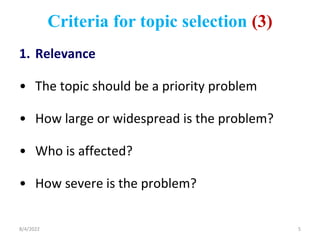
Criteria for topic selection (3)
1. Relevance
• The topic should be a priority problem
• How large or widespread is the problem?
• Who is affected?
• How severe is the problem?
8/4/2022 5
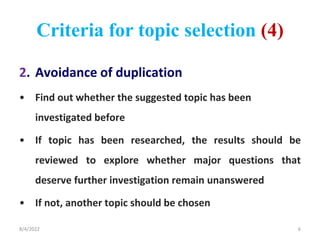
Criteria for topic selection (4)
2. Avoidance of duplication
• Find out whether the suggested topic has been
investigated before
• If topic has been researched, the results should be
reviewed to explore whether major questions that
deserve further investigation remain unanswered
• If not, another topic should be chosen
8/4/2022 6
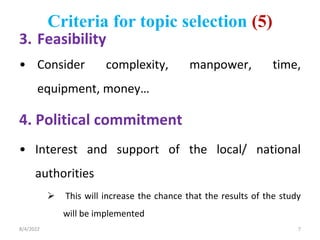
Criteria for topic selection (5)
3. Feasibility
• Consider complexity, manpower, time,
equipment, money…
4. Political commitment
• Interest and support of the local/ national
authorities
 This will increase the chance that the results of the study
will be implemented
8/4/2022 7
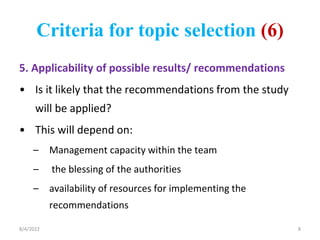
Criteria for topic selection (6)
5. Applicability of possible results/ recommendations
• Is it likely that the recommendations from the study
will be applied?
• This will depend on:
– Management capacity within the team
– the blessing of the authorities
– availability of resources for implementing the
recommendations
8/4/2022 8
Criteria for topic selection (7)
6. Timeliness (urgency)
• urgency of data needed for making decision
7. Ethical acceptability
• Consider the different ethical principles
8/4/2022 9
Titles should:
– Describe contents clearly and precisely,
so that readers can decide whether to
read the report
Titles should NOT:
– Include wasted words such as "studies
on," "an investigation of"
– Use abbreviations and jargon
8/4/2022 10
Example
• Administrative System of Local NGOs, the
case of Southern Nations Nationalities and
Peoples, South Ethiopia.
8/4/2022 11
Assignment
By forming a group identify a research topic
that potentially is used in the proposal work.
• Final date of topic submission: _______
8/4/2022 12
Planning Research
/Developing Proposal/
A written proposal is important:
• To clearly define the problem under study
• To avoid reinventing the wheel
• To clearly depict the methodology to be used
• To be cost and time conscious
• To be clear about what to expect in the end
8/4/2022 13
Components of Research Proposal
1. Summary
2. Introduction
3. Literature review
4. Objectives
5. Methodology
6. Work plan
7.Cost of the Project
• References
• Annex
– Questionnaire
– Assurance of the
investigator
– Advisor (approval)
8/4/2022 14
Summary
• Summary of proposal includes:
–Statement of the problem(introduction)
–Objective
–Hypothesis
–Methods
–Study period, and total cost
8/4/2022 15
Introduction
• Can be divided into 3 sections or the concepts
of the 3 sections can be merged together
• Sections:
– Background of the study
– Statement of the problem
– Justification of the study
8/4/2022 16
Background of the study
• should address the foundation of knowledge
about the issue
– Definitions
– Basic facts
– Principles
– Scientifics explanations
• Different literatures should be revised.
8/4/2022 17
Statement of the problem (1)
Includes:
• Size, distribution, and severity of the problem
• Major factors that influence the problem
• Solutions that have been tried in the past
• How well the solutions worked
8/4/2022 18
Statement of the problem (2)
• Why further research is needed (more in the
justification)
• If necessary a short list of definitions of crucial
concepts
8/4/2022 19
Justification (1)
• Why your research is needed?
E.gs of possible answers…
Others not large enough
Different populations
Different method/intervention
8/4/2022 20
Justification (2)
Questions addressed before writing the
significance of the study:
• Are there gaps in evidence?
• Will results influence programs, methods, and/or
interventions?
• Will results contribute to the solution of the problems?
• Will results influence the decision making of organizations or
companies?
8/4/2022 21
Justification (3)
Questions addressed before writing the
significance of the study…..
• What will be improved or changed as a result of the
research?
• How will results of the study be implemented, and
what innovations will come about?
8/4/2022 22
Literature review (1)
• Search widely
• Reference all literature that you refer to in your review
• Evaluate the relevance of the literature to your study
• Include information directly relevant to your study
• There should be logical sequence in writing literature
review (you can also create sub-sections)
• Be concise
8/4/2022 23
Literature review (2)
Steps of literature review
Step 1: Identifying key words or phrases
useful in locating materials in an academic library at
• a college/university and/or websites.
Step 2: Searching
the library catalog for holding
• journals and books
– internet center for searching.
8/4/2022 24
Literature review (3)
Step 3: locate about 20 reports of research in
articles or books related to research on your topic.
Step 4: Look at the articles and select those central
to your topic.
– look over the abstract and
– skim the article or chapter
8/4/2022 25
Literature review (4)
Step 5: Designing the literature map on your topic.
Step 6: Organize the literature into your literature
map.
• Continue to draft summaries of the most relevant
articles.
• Summaries are then combined into the final
literature review that you write for proposal.
8/4/2022 26
Literature review (5)
 Discuss the magnitude of the problem:
globally, then regionally, and finally locally
 Discuss causes of the problem
 Discuss risk factors:
 Discuss any methodological issues: what is the best or
alternative approach to study the proposed problem, why?
Are there ethical challenges in conducting the proposed
study?
 Put forward the rationale of the proposed study by indicating
the gaps in knowledge that is not addressed in the literature
8/4/2022 27
Referencing (1)
• What is referencing?
– Referencing is a standardized way of
acknowledging sources of information and ideas
that you have used in your assignments and which
allows the sources to be identified.
– It is important to be consistent when you are
referencing.
8/4/2022 28
Referencing (2)
• Why reference?
– Referencing is important
to avoid plagiarism,
to verify quotations and
to enable readers to follow up what you have
written
to give credit to other people’s work.
8/4/2022 29
Referencing (3)
• Types of referencing styles
• Harvard referencing style
• Vancouver referencing style
• Modern Language Association (MLA)
• American Psychological Association (APA)
• Chicago Manual of Style
• Royal Society of Chemistry
• Before you write your list of references, check with your
lecturer or tutor for the bibliographic style preferred by
the School.
8/4/2022 30
Referencing (4)
Possible sources of references
Journals or other published materials
Books
Websites
Grey literature
 use only for statement of the problem
8/4/2022 31
Referencing (5)
Steps in referencing
 Record the full bibliographic details and relevant page
numbers of the source from which information is taken.
 Punctuation marks and spaces in the reference list and
citations are very important.
 Insert the citation at the appropriate place in the text of
your document.
 Include a reference list that includes all in-text citations at
the end of your document.
8/4/2022 32
Referencing (6)
Citing References
Reference to a journal should include:
– The name(s) of the author(s)
– Years of publication
– Title of the article
– Journal abbreviation (according to the index
medicus usage)
– Volume number
– first and last page numbers.
8/4/2022 33
• Example:
–Hart CA, Kariuki S; (1998); Anti microbial
resistance in developing countries. Br Med
J; 317: 647-650.
8/4/2022 34
Referencing (7)
Reference to a book
Should contain:-
 The name(s) of the author(s)
 Year of publication
 Full title
 Place of publication
 Name of editor (s) and edition
 If applicable, name and domicile of publishers, first and
last page number.
8/4/2022 35
• Example:
–Perry AG. Potter PA, eds. 1994. Clinical
Nursing skills and Techniques, 3rd ed St.
Lonis, Mosby. 390-408.
8/4/2022 36
Referencing (8)
Reference to website
should contain:-
– the name(s) of the author (s)
– years of publication,
– full title (online),
– the website address ,and
– the date of information retrieved.
8/4/2022 37
Example:
• Snell, we (1997). The stereotypes about AIDS
questionnaire (on line), Available:
http://wwwsemo.edu./Snell/Scales/SAAQ.
Htm (2006, may 2).
8/4/2022 38
Referencing (9)
Vancouver style
• Is the type of referencing predominantly used in the
medical field.
• When referencing your work in the Vancouver style, it
is very important that you use the right punctuation
and that the order of details in the reference is also
correct.
• In the Vancouver Style, citations within the text of the
essay/paper are identified by Arabic numbers in round
brackets or Arabic numbers in superscript.
8/4/2022 39
Referencing (10)
• The Vancouver System assigns a number to each
reference as it is cited.
• The original number assigned to the reference is
reused each time the reference is cited in the text,
regardless of its previous position in the text.
• When multiple references are cited at a given place in
the text, use a hyphen to join the first and last numbers
that are inclusive. Use commas (without spaces) to
separate non-inclusive numbers in a multiple citation
e.g. (2,3,4,5,7,10) is abbreviated to (2-5,7,10).
8/4/2022 40
Referencing (11)
Examples (books)
 Butler SW. Secrets from the Black Bag. London: The
Royal College of General Practitioners; 2005.
 Cheers B, Darracott R, Lonne B. Social care practice in
rural communities. Sydney: The Federation Press;
2007.
 Hofmeyr GJ, Neilson JP, Alfirevic Z, Crowther CA,
Gulmezoglu AM, Hodnett ED et al. A Cochrane
pocketbook: Pregnancy and childbirth. Chichester,
West Sussex, England: John Wiley & Sons Ltd; 2008.
8/4/2022 41
Referencing (12)
• Examples (Journals)
– Snowdon J. Severe depression in old age. Medicine Today.
2002 Dec;3(12):40-47.
– Hanna JN, McBride WJ, Brookes DL, Shield J, Taylor CT,
Smith IL, Craig SB, Smith GA. Hendra virus infection in a
veterinarian. Med J Aust. 2006 Nov 20;185(10):562-64.
Electronic article
• Lemanek K. Adherence issues in the medical
management of asthma. J Pediatr Psychol [ Internet].
1990 [cited 2010 Apr 22]; 15(4):437-58. Available from:
http://jpepsy.oxfordjournals.org/cgi/reprint /15/4/437
8/4/2022 42
Objectives (1)
• General objective:
– summarizes what is to be achieved by the study
– should be clearly related to the statement of the
problem.
• Specific objectives:
– logically connected parts of the general objective
– focus the study on the essentials
– direct the design of the investigation
– orient collection, analysis and interpretation of the data
8/4/2022 43
Objectives (2)
Criteria for setting research objectives
• Focused, each covering a single point
• Ordered in a logical sequence
• Realistic and feasible to answer
• Operational, using action verbs such as:
– determine - verify -identify
– describe - assess - compare
– calculate - establish -explore
• Measurable outcomes at the end of the research
8/4/2022 44
Objectives (3)
• The study proposal is primarily judged by the clarity
of the study objectives
• You don’t have to write too many objectives but if
your objective is comprehensive and requires
assessing/measuring more than one aspect then
divide your objective into general and specific.
• Advisable not to set more than 3 specific objectives
8/4/2022 45
Objectives (4)
Examples:
General objective
To assess factors which influence for low hemoglobin level
among pregnant women.
Specific objectives
• To determine hemoglobin level variation among pregnant
women by income.
• To identify the type of food offered during gestation which
makes influence Hgb.
• To examine the relation between infection and hgb.
8/4/2022 46
Objectives (5)
Research questions VS Hypotheses
• A hypothesis requires sufficient knowledge of the problem
to be able to predict relationships among factors which
then can be explicitly tested.
• Research questions are formulated when the investigators
do not have enough insight into the problem being studied.
8/4/2022 47
.
8/4/2022 48

2 Topic Selection, Abstrat, Introduction and Objectives.pptx

  • 1.
    Responsibilities of Module Leader Howdo you going to select research topics? 1
  • 2.
    Topic Selection The researcherinterest on the phenomena may arise from: Own experience Literature reading Talking to knowledgeable people 8/4/2022 2
  • 3.
    Criteria for topicselection (1) 1. Relevance: priority, magnitude of problem 2. Avoidance of duplication 3. Feasibility: complexity, manpower, time, equipment, money… 4. Political commitment: interest and support to utilize results 8/4/2022 3
  • 4.
    Criteria for topicselection (2) 5. Applicability (cost-effectiveness): availability of resources 6. Timeliness: urgency of data needed for making decision 7. Ethical acceptability: Consider the different ethical principles 8/4/2022 4
  • 5.
    Criteria for topicselection (3) 1. Relevance • The topic should be a priority problem • How large or widespread is the problem? • Who is affected? • How severe is the problem? 8/4/2022 5
  • 6.
    Criteria for topicselection (4) 2. Avoidance of duplication • Find out whether the suggested topic has been investigated before • If topic has been researched, the results should be reviewed to explore whether major questions that deserve further investigation remain unanswered • If not, another topic should be chosen 8/4/2022 6
  • 7.
    Criteria for topicselection (5) 3. Feasibility • Consider complexity, manpower, time, equipment, money… 4. Political commitment • Interest and support of the local/ national authorities  This will increase the chance that the results of the study will be implemented 8/4/2022 7
  • 8.
    Criteria for topicselection (6) 5. Applicability of possible results/ recommendations • Is it likely that the recommendations from the study will be applied? • This will depend on: – Management capacity within the team – the blessing of the authorities – availability of resources for implementing the recommendations 8/4/2022 8
  • 9.
    Criteria for topicselection (7) 6. Timeliness (urgency) • urgency of data needed for making decision 7. Ethical acceptability • Consider the different ethical principles 8/4/2022 9
  • 10.
    Titles should: – Describecontents clearly and precisely, so that readers can decide whether to read the report Titles should NOT: – Include wasted words such as "studies on," "an investigation of" – Use abbreviations and jargon 8/4/2022 10
  • 11.
    Example • Administrative Systemof Local NGOs, the case of Southern Nations Nationalities and Peoples, South Ethiopia. 8/4/2022 11
  • 12.
    Assignment By forming agroup identify a research topic that potentially is used in the proposal work. • Final date of topic submission: _______ 8/4/2022 12
  • 13.
    Planning Research /Developing Proposal/ Awritten proposal is important: • To clearly define the problem under study • To avoid reinventing the wheel • To clearly depict the methodology to be used • To be cost and time conscious • To be clear about what to expect in the end 8/4/2022 13
  • 14.
    Components of ResearchProposal 1. Summary 2. Introduction 3. Literature review 4. Objectives 5. Methodology 6. Work plan 7.Cost of the Project • References • Annex – Questionnaire – Assurance of the investigator – Advisor (approval) 8/4/2022 14
  • 15.
    Summary • Summary ofproposal includes: –Statement of the problem(introduction) –Objective –Hypothesis –Methods –Study period, and total cost 8/4/2022 15
  • 16.
    Introduction • Can bedivided into 3 sections or the concepts of the 3 sections can be merged together • Sections: – Background of the study – Statement of the problem – Justification of the study 8/4/2022 16
  • 17.
    Background of thestudy • should address the foundation of knowledge about the issue – Definitions – Basic facts – Principles – Scientifics explanations • Different literatures should be revised. 8/4/2022 17
  • 18.
    Statement of theproblem (1) Includes: • Size, distribution, and severity of the problem • Major factors that influence the problem • Solutions that have been tried in the past • How well the solutions worked 8/4/2022 18
  • 19.
    Statement of theproblem (2) • Why further research is needed (more in the justification) • If necessary a short list of definitions of crucial concepts 8/4/2022 19
  • 20.
    Justification (1) • Whyyour research is needed? E.gs of possible answers… Others not large enough Different populations Different method/intervention 8/4/2022 20
  • 21.
    Justification (2) Questions addressedbefore writing the significance of the study: • Are there gaps in evidence? • Will results influence programs, methods, and/or interventions? • Will results contribute to the solution of the problems? • Will results influence the decision making of organizations or companies? 8/4/2022 21
  • 22.
    Justification (3) Questions addressedbefore writing the significance of the study….. • What will be improved or changed as a result of the research? • How will results of the study be implemented, and what innovations will come about? 8/4/2022 22
  • 23.
    Literature review (1) •Search widely • Reference all literature that you refer to in your review • Evaluate the relevance of the literature to your study • Include information directly relevant to your study • There should be logical sequence in writing literature review (you can also create sub-sections) • Be concise 8/4/2022 23
  • 24.
    Literature review (2) Stepsof literature review Step 1: Identifying key words or phrases useful in locating materials in an academic library at • a college/university and/or websites. Step 2: Searching the library catalog for holding • journals and books – internet center for searching. 8/4/2022 24
  • 25.
    Literature review (3) Step3: locate about 20 reports of research in articles or books related to research on your topic. Step 4: Look at the articles and select those central to your topic. – look over the abstract and – skim the article or chapter 8/4/2022 25
  • 26.
    Literature review (4) Step5: Designing the literature map on your topic. Step 6: Organize the literature into your literature map. • Continue to draft summaries of the most relevant articles. • Summaries are then combined into the final literature review that you write for proposal. 8/4/2022 26
  • 27.
    Literature review (5) Discuss the magnitude of the problem: globally, then regionally, and finally locally  Discuss causes of the problem  Discuss risk factors:  Discuss any methodological issues: what is the best or alternative approach to study the proposed problem, why? Are there ethical challenges in conducting the proposed study?  Put forward the rationale of the proposed study by indicating the gaps in knowledge that is not addressed in the literature 8/4/2022 27
  • 28.
    Referencing (1) • Whatis referencing? – Referencing is a standardized way of acknowledging sources of information and ideas that you have used in your assignments and which allows the sources to be identified. – It is important to be consistent when you are referencing. 8/4/2022 28
  • 29.
    Referencing (2) • Whyreference? – Referencing is important to avoid plagiarism, to verify quotations and to enable readers to follow up what you have written to give credit to other people’s work. 8/4/2022 29
  • 30.
    Referencing (3) • Typesof referencing styles • Harvard referencing style • Vancouver referencing style • Modern Language Association (MLA) • American Psychological Association (APA) • Chicago Manual of Style • Royal Society of Chemistry • Before you write your list of references, check with your lecturer or tutor for the bibliographic style preferred by the School. 8/4/2022 30
  • 31.
    Referencing (4) Possible sourcesof references Journals or other published materials Books Websites Grey literature  use only for statement of the problem 8/4/2022 31
  • 32.
    Referencing (5) Steps inreferencing  Record the full bibliographic details and relevant page numbers of the source from which information is taken.  Punctuation marks and spaces in the reference list and citations are very important.  Insert the citation at the appropriate place in the text of your document.  Include a reference list that includes all in-text citations at the end of your document. 8/4/2022 32
  • 33.
    Referencing (6) Citing References Referenceto a journal should include: – The name(s) of the author(s) – Years of publication – Title of the article – Journal abbreviation (according to the index medicus usage) – Volume number – first and last page numbers. 8/4/2022 33
  • 34.
    • Example: –Hart CA,Kariuki S; (1998); Anti microbial resistance in developing countries. Br Med J; 317: 647-650. 8/4/2022 34
  • 35.
    Referencing (7) Reference toa book Should contain:-  The name(s) of the author(s)  Year of publication  Full title  Place of publication  Name of editor (s) and edition  If applicable, name and domicile of publishers, first and last page number. 8/4/2022 35
  • 36.
    • Example: –Perry AG.Potter PA, eds. 1994. Clinical Nursing skills and Techniques, 3rd ed St. Lonis, Mosby. 390-408. 8/4/2022 36
  • 37.
    Referencing (8) Reference towebsite should contain:- – the name(s) of the author (s) – years of publication, – full title (online), – the website address ,and – the date of information retrieved. 8/4/2022 37
  • 38.
    Example: • Snell, we(1997). The stereotypes about AIDS questionnaire (on line), Available: http://wwwsemo.edu./Snell/Scales/SAAQ. Htm (2006, may 2). 8/4/2022 38
  • 39.
    Referencing (9) Vancouver style •Is the type of referencing predominantly used in the medical field. • When referencing your work in the Vancouver style, it is very important that you use the right punctuation and that the order of details in the reference is also correct. • In the Vancouver Style, citations within the text of the essay/paper are identified by Arabic numbers in round brackets or Arabic numbers in superscript. 8/4/2022 39
  • 40.
    Referencing (10) • TheVancouver System assigns a number to each reference as it is cited. • The original number assigned to the reference is reused each time the reference is cited in the text, regardless of its previous position in the text. • When multiple references are cited at a given place in the text, use a hyphen to join the first and last numbers that are inclusive. Use commas (without spaces) to separate non-inclusive numbers in a multiple citation e.g. (2,3,4,5,7,10) is abbreviated to (2-5,7,10). 8/4/2022 40
  • 41.
    Referencing (11) Examples (books) Butler SW. Secrets from the Black Bag. London: The Royal College of General Practitioners; 2005.  Cheers B, Darracott R, Lonne B. Social care practice in rural communities. Sydney: The Federation Press; 2007.  Hofmeyr GJ, Neilson JP, Alfirevic Z, Crowther CA, Gulmezoglu AM, Hodnett ED et al. A Cochrane pocketbook: Pregnancy and childbirth. Chichester, West Sussex, England: John Wiley & Sons Ltd; 2008. 8/4/2022 41
  • 42.
    Referencing (12) • Examples(Journals) – Snowdon J. Severe depression in old age. Medicine Today. 2002 Dec;3(12):40-47. – Hanna JN, McBride WJ, Brookes DL, Shield J, Taylor CT, Smith IL, Craig SB, Smith GA. Hendra virus infection in a veterinarian. Med J Aust. 2006 Nov 20;185(10):562-64. Electronic article • Lemanek K. Adherence issues in the medical management of asthma. J Pediatr Psychol [ Internet]. 1990 [cited 2010 Apr 22]; 15(4):437-58. Available from: http://jpepsy.oxfordjournals.org/cgi/reprint /15/4/437 8/4/2022 42
  • 43.
    Objectives (1) • Generalobjective: – summarizes what is to be achieved by the study – should be clearly related to the statement of the problem. • Specific objectives: – logically connected parts of the general objective – focus the study on the essentials – direct the design of the investigation – orient collection, analysis and interpretation of the data 8/4/2022 43
  • 44.
    Objectives (2) Criteria forsetting research objectives • Focused, each covering a single point • Ordered in a logical sequence • Realistic and feasible to answer • Operational, using action verbs such as: – determine - verify -identify – describe - assess - compare – calculate - establish -explore • Measurable outcomes at the end of the research 8/4/2022 44
  • 45.
    Objectives (3) • Thestudy proposal is primarily judged by the clarity of the study objectives • You don’t have to write too many objectives but if your objective is comprehensive and requires assessing/measuring more than one aspect then divide your objective into general and specific. • Advisable not to set more than 3 specific objectives 8/4/2022 45
  • 46.
    Objectives (4) Examples: General objective Toassess factors which influence for low hemoglobin level among pregnant women. Specific objectives • To determine hemoglobin level variation among pregnant women by income. • To identify the type of food offered during gestation which makes influence Hgb. • To examine the relation between infection and hgb. 8/4/2022 46
  • 47.
    Objectives (5) Research questionsVS Hypotheses • A hypothesis requires sufficient knowledge of the problem to be able to predict relationships among factors which then can be explicitly tested. • Research questions are formulated when the investigators do not have enough insight into the problem being studied. 8/4/2022 47
  • 48.

Editor's Notes

  • #11 Jargon –words used by a particular profession that difficult for others to understand
  • #31 Difference between Reference List and Bibliography Reference is a list of sources we have cited in our text arranged in the order they appeared within the text. Bibliography is a separate list of sources we have consulted but not specifically cited in our work including background reading. It is arranged alphabetically by the author’s surname.
  • #36 Domicile = Permanent residence