Improving Java
Performance
#perfmatters
Raimon Ràfols
...or the mumbo-jumbo
behind the java compiler
Agenda
- Disclaimer
- Who am I?
- Our friend the java compiler
- Language additions & things to consider
- Tooling
Disclaimer
This presentation contains bytecode
Who am I?
Software Delivery & Engineering Manager
at AXA Group Solutions
Twitter: @rrafols
raimon.rafols@gmail.com
http://blog.rafols.org
Our friend the java compiler
Javac vs other compilers
Compilers
Produces optimised code for
target platform
Javac
Doesn't optimise anything
Javac
Doesn't know on which
architecture will the code
be executed
For the same reason
Java bytecode is stack based
Easy to interpret
No assumptions
But not the most optimal solution
(regarding performance)
Quick example
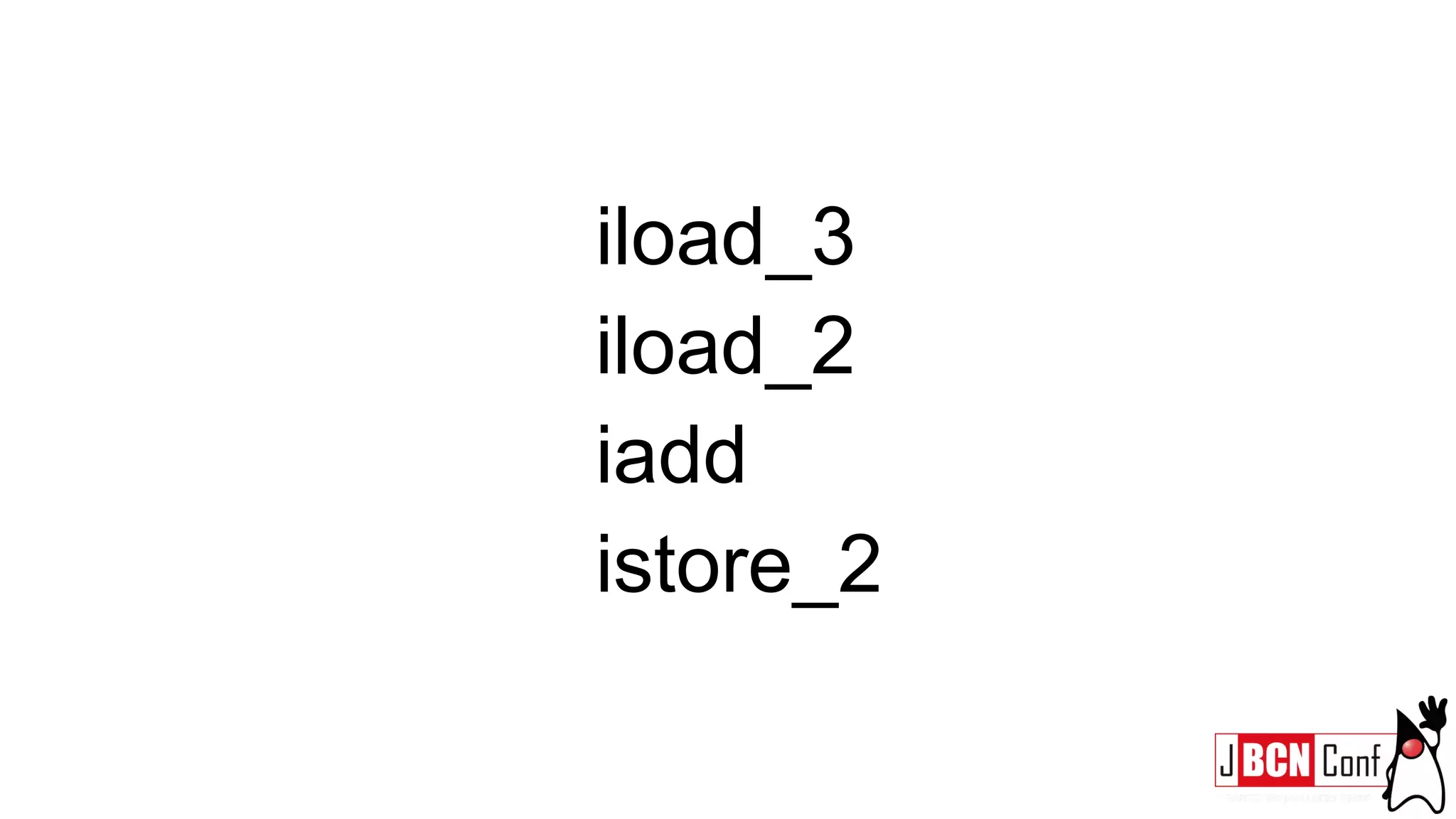
Stack based integer addition
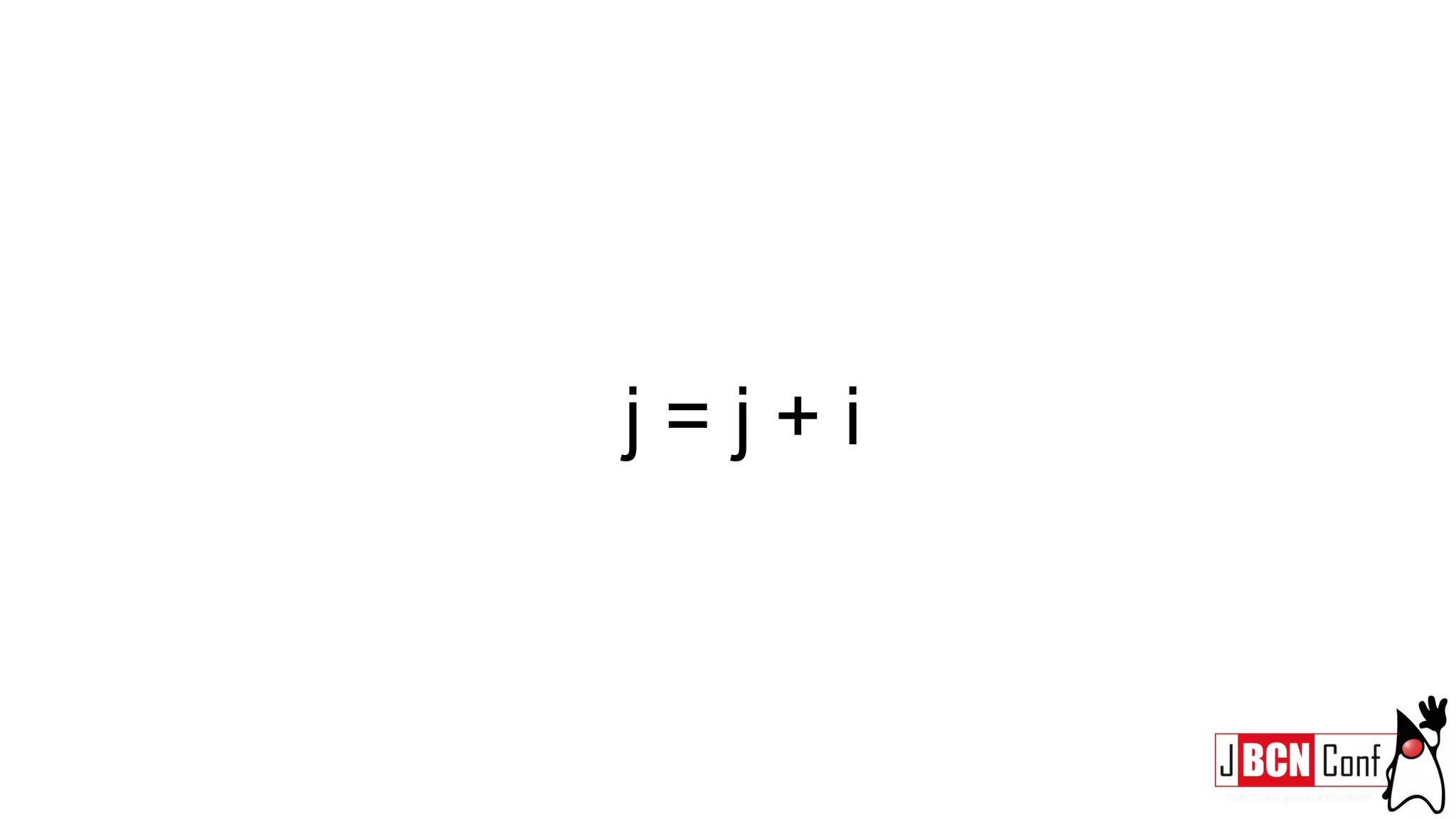
j = j + i
Java bytecode
iload_3
iload_2
iadd
istore_2
Java VM (JVM)
Only the JVM knows on which
architecture is running
Java VM (JVM)
All optimisations are left to be
done by the JVM
Maybe takes this concept a bit too
far...
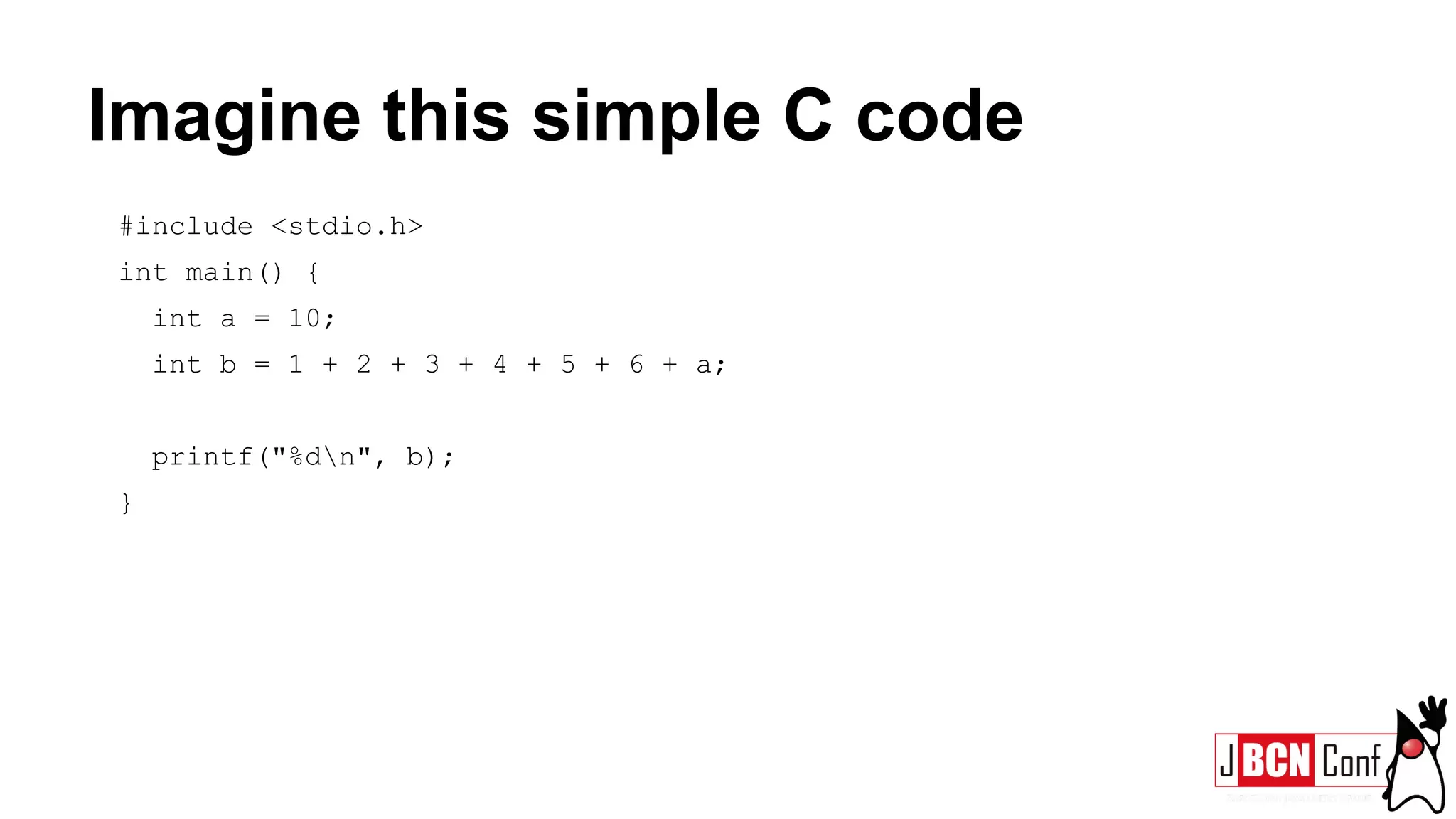
Imagine this simple C code
#include <stdio.h>
int main() {
int a = 10;
int b = 1 + 2 + 3 + 4 + 5 + 6 + a;
printf("%dn", b);
}
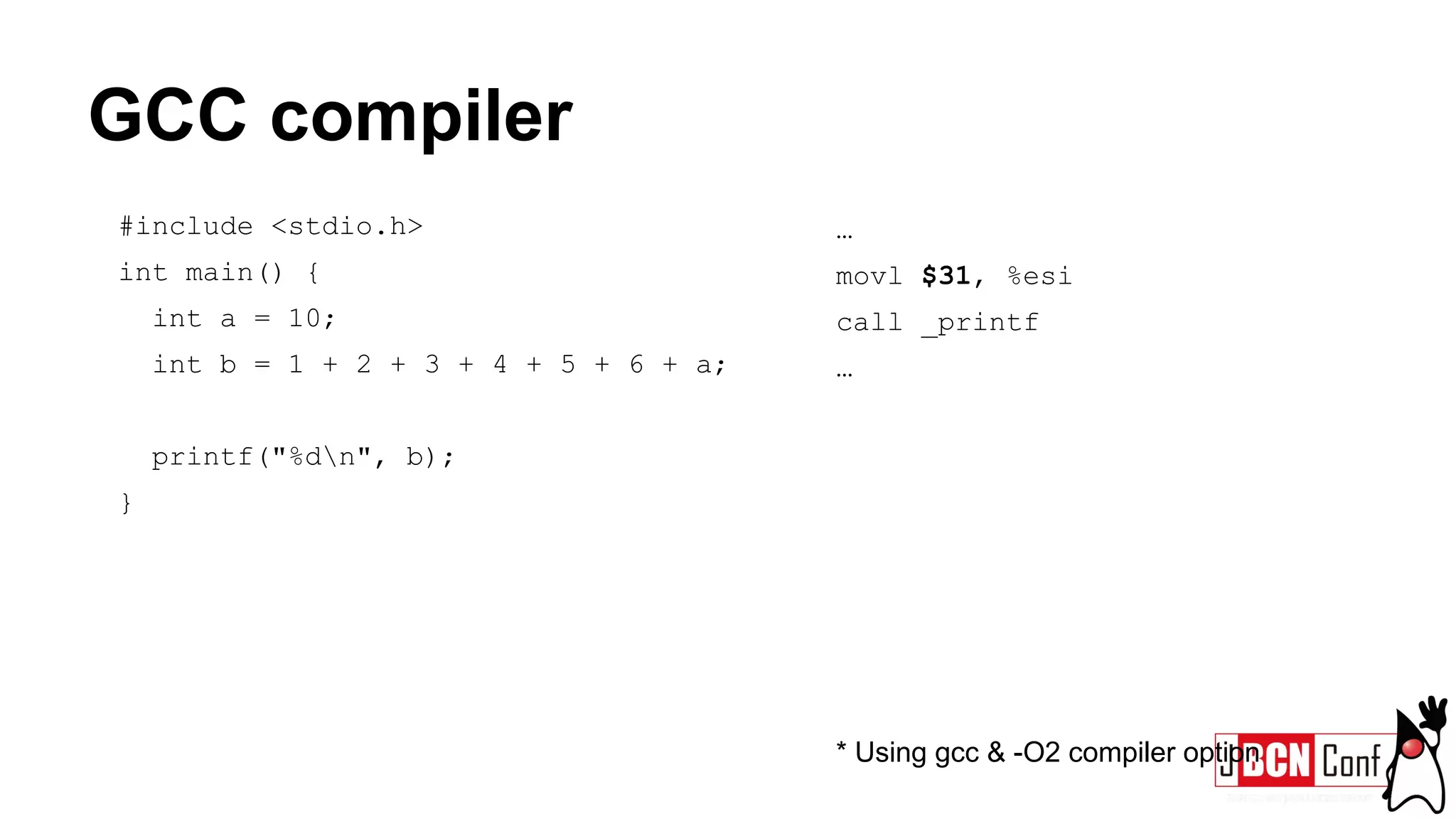
GCC compiler
#include <stdio.h>
int main() {
int a = 10;
int b = 1 + 2 + 3 + 4 + 5 + 6 + a;
printf("%dn", b);
}
…
movl $31, %esi
call _printf
…
* Using gcc & -O2 compiler option
javac
public static void main(String args[]) {
int a = 10;
int b = 1 + 2 + 3 + 4 + 5 + 6 + a;
System.out.println(b);
}
0: bipush 10
2: istore_1
3: bipush 21
5: iload_1
6: iadd
7: istore_2
...
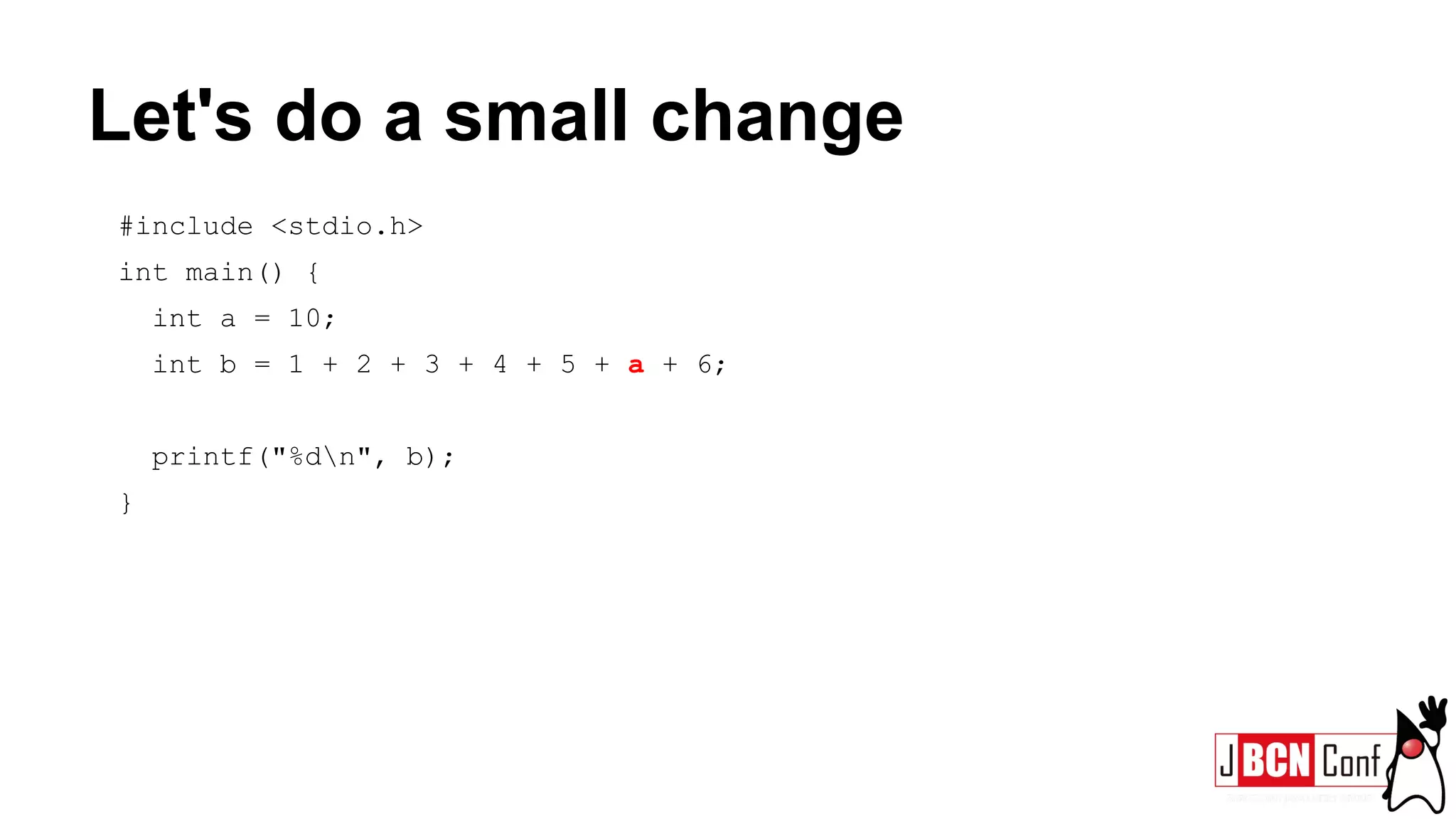
Let's do a small change
#include <stdio.h>
int main() {
int a = 10;
int b = 1 + 2 + 3 + 4 + 5 + a + 6;
printf("%dn", b);
}
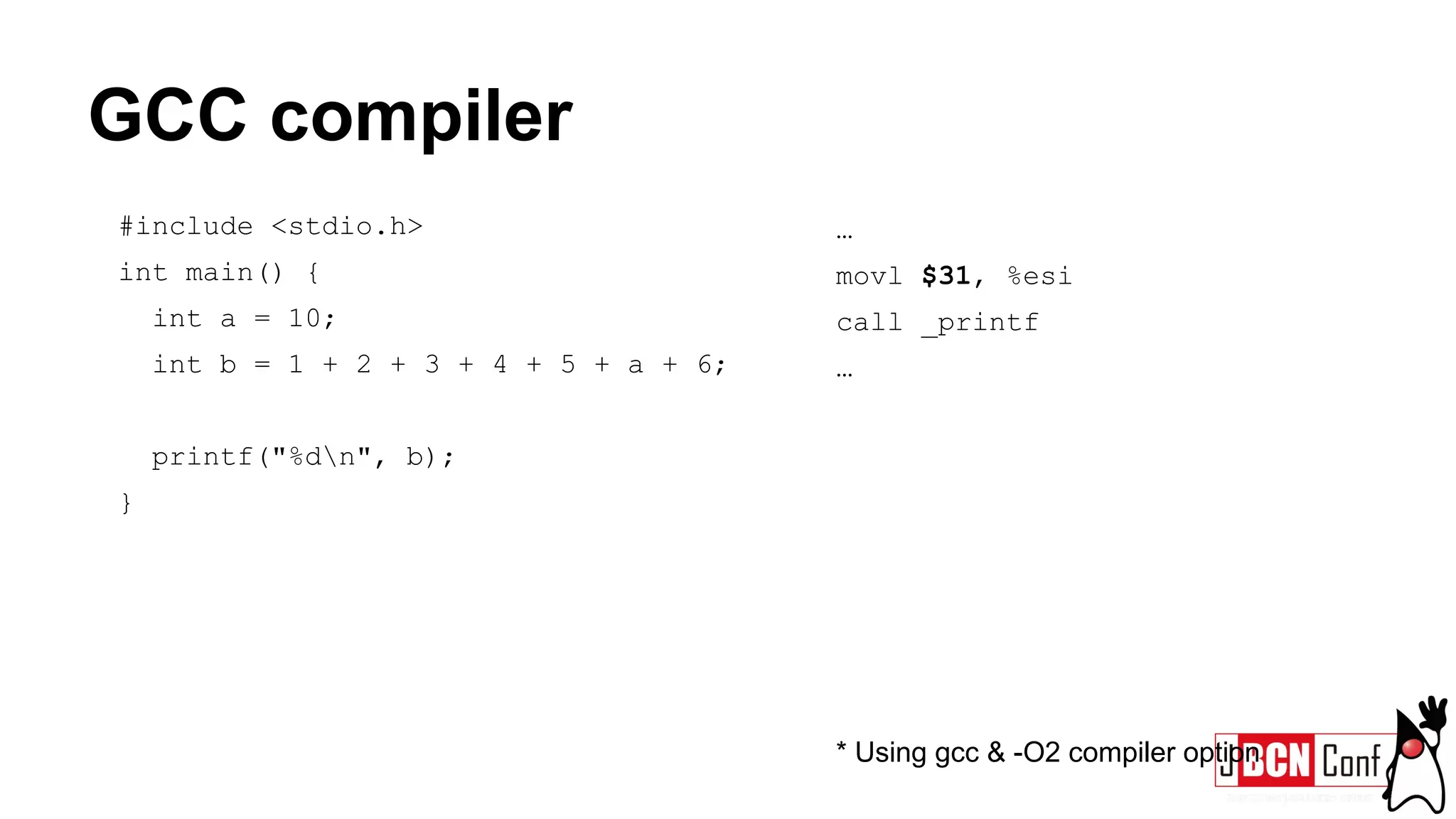
GCC compiler
#include <stdio.h>
int main() {
int a = 10;
int b = 1 + 2 + 3 + 4 + 5 + a + 6;
printf("%dn", b);
}
…
movl $31, %esi
call _printf
…
* Using gcc & -O2 compiler option
javac
public static void main(String args[]) {
int a = 10;
int b = 1 + 2 + 3 + 4 + 5 + a + 6;
System.out.println(b);
}
0: bipush 10
2: istore_1
3: bipush 15
5: iload_1
6: iadd
7: bipush 6
9: iadd
10: istore_2
...
Let's do another quick change..
public static void main(String args[]) {
int a = 10;
int b = a + 1 + 2 + 3 + 4 + 5 + 6;
System.out.println(b);
}
javac
public static void main(String args[]) {
int a = 10;
int b = a + 1 + 2 + 3 + 4 + 5 + 6;
System.out.println(b);
}
0: bipush 10
2: istore_1
3: iload_1
4: iconst_1
5: iadd
6: iconst_2
7: iadd
8: iconst_3
9: iadd
10: iconst_4
11: iadd
12: iconst_5
13: iadd
14: bipush 6
16: iadd
17: istore_2
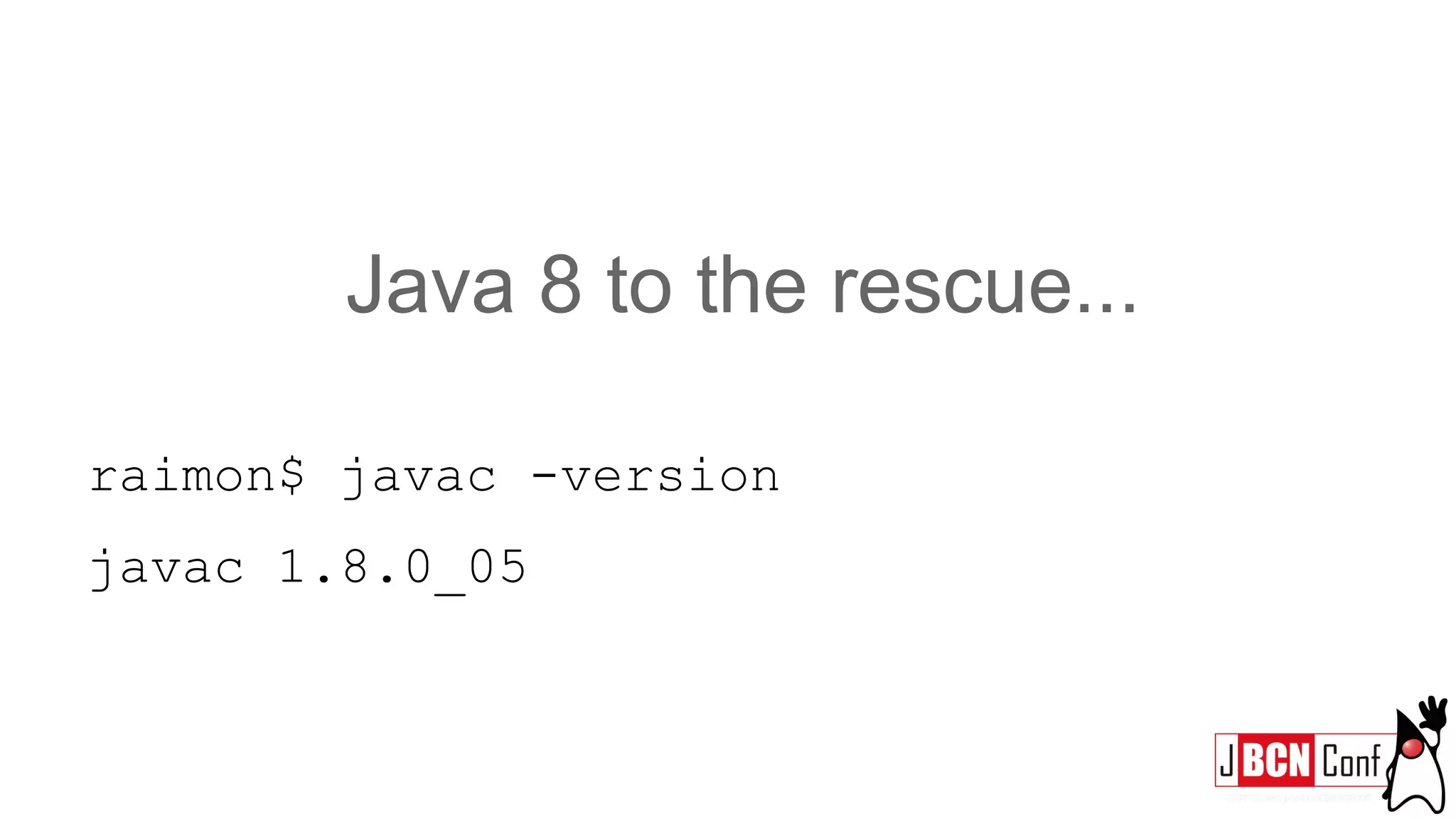
Java 8 to the rescue...
raimon$ javac -version
javac 1.8.0_05
javac
public static void main(String args[]) {
int a = 10;
int b = a + 1 + 2 + 3 + 4 + 5 + 6;
System.out.println(b);
}
0: bipush 10
2: istore_1
3: iload_1
4: iconst_1
5: iadd
6: iconst_2
7: iadd
8: iconst_3
9: iadd
10: iconst_4
11: iadd
12: iconst_5
13: iadd
14: bipush 6
16: iadd
17: istore_2
Compiler optimisation flag!
javac -O
public static void main(String args[]) {
int a = 10;
int b = a + 1 + 2 + 3 + 4 + 5 + 6;
System.out.println(b);
}
0: bipush 10
2: istore_1
3: iload_1
4: iconst_1
5: iadd
6: iconst_2
7: iadd
8: iconst_3
9: iadd
10: iconst_4
11: iadd
12: iconst_5
13: iadd
14: bipush 6
16: iadd
17: istore_2
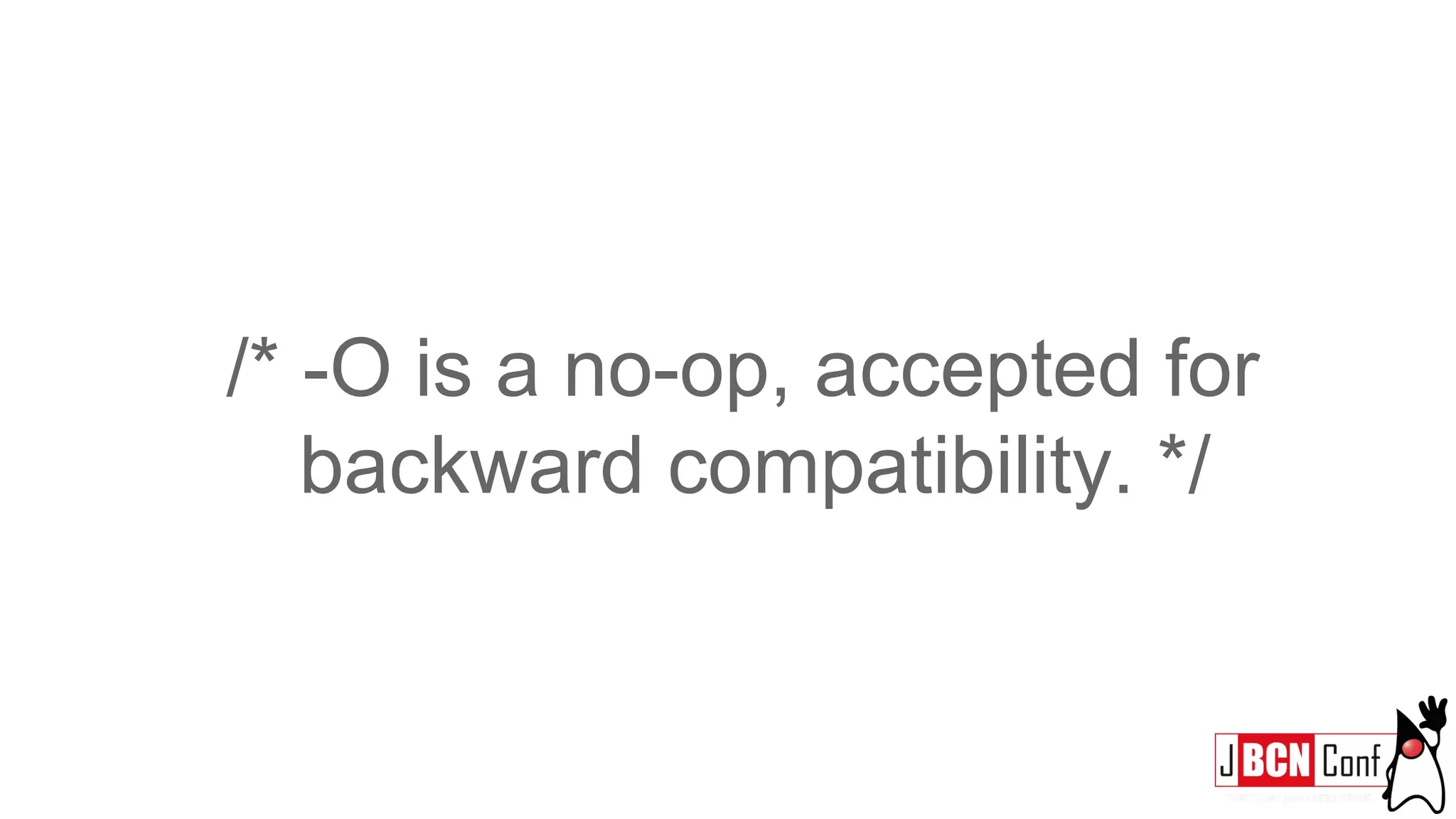
/* -O is a no-op, accepted for
backward compatibility. */
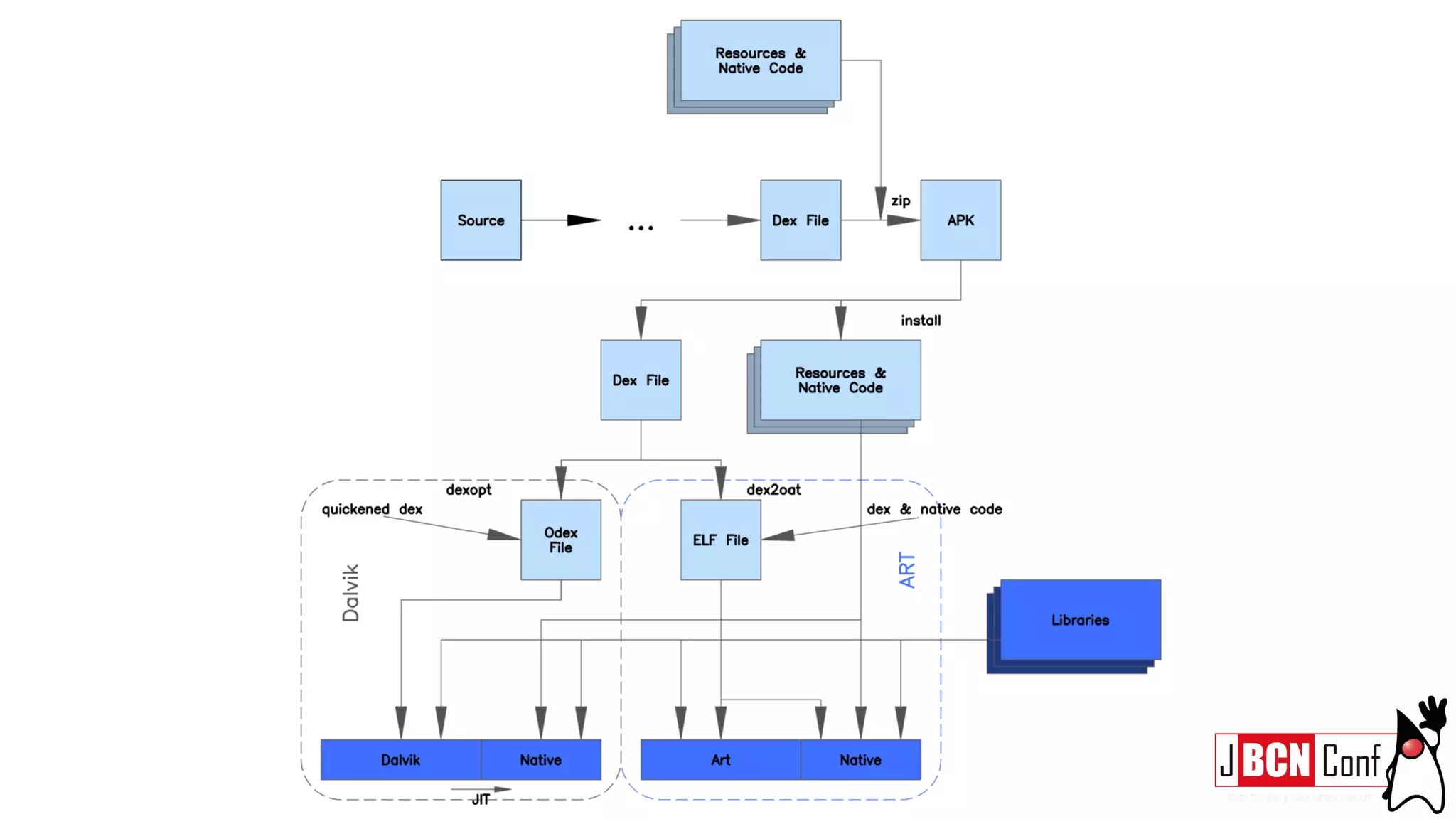
Dalvik VM / ART
What about other “JVM”?
Dalvik VM / ART
Generated dex bytecode & native
(by ART) are based on the
original java bytecode
Language additions
Thinks to consider
The Java compiler adds some
code under the hood.
Autoboxing
Transparent to the developer but
compiler adds some 'extra' code
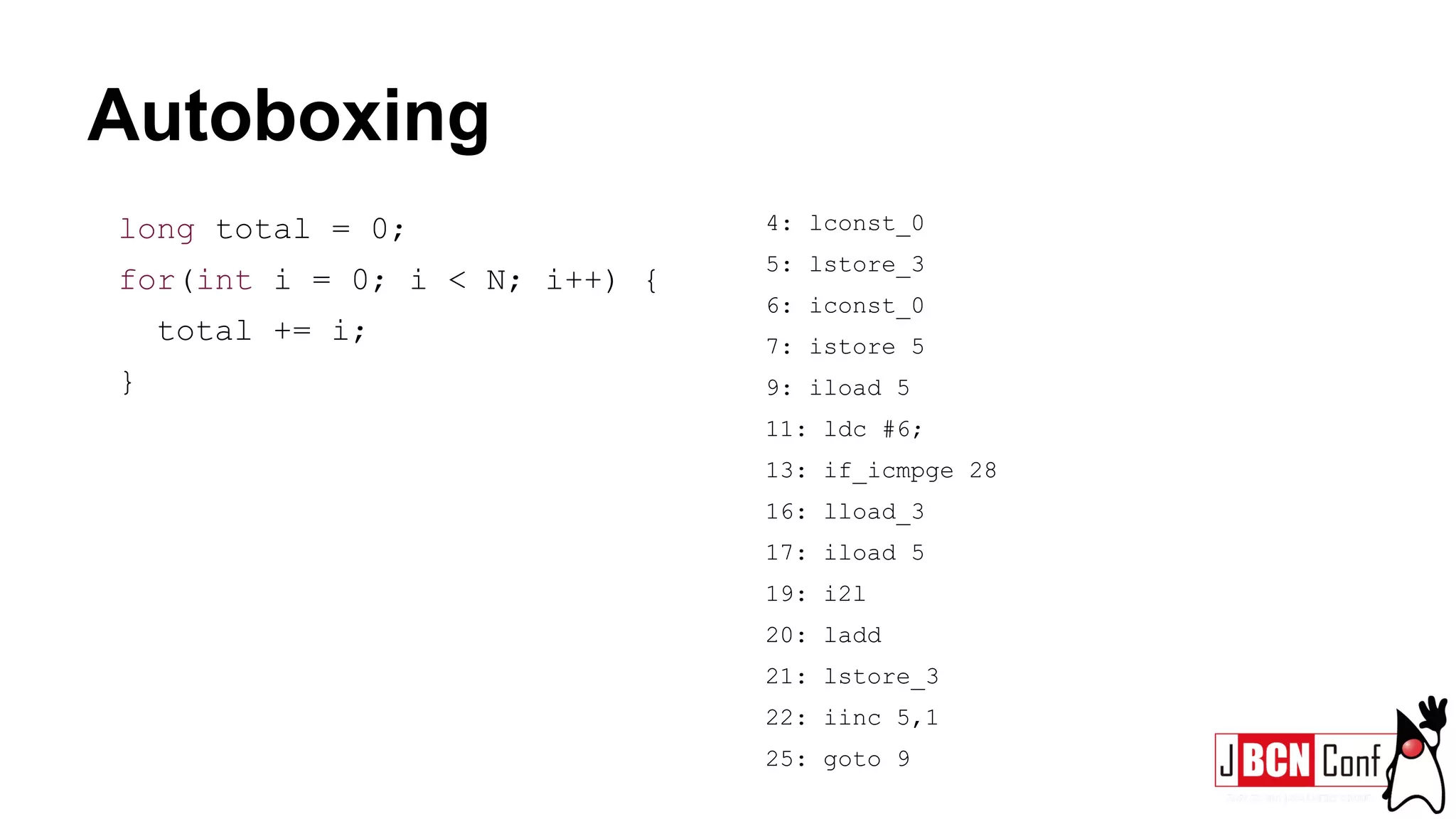
Autoboxing
long total = 0;
for(int i = 0; i < N; i++) {
total += i;
}
4: lconst_0
5: lstore_3
6: iconst_0
7: istore 5
9: iload 5
11: ldc #6;
13: if_icmpge 28
16: lload_3
17: iload 5
19: i2l
20: ladd
21: lstore_3
22: iinc 5,1
25: goto 9
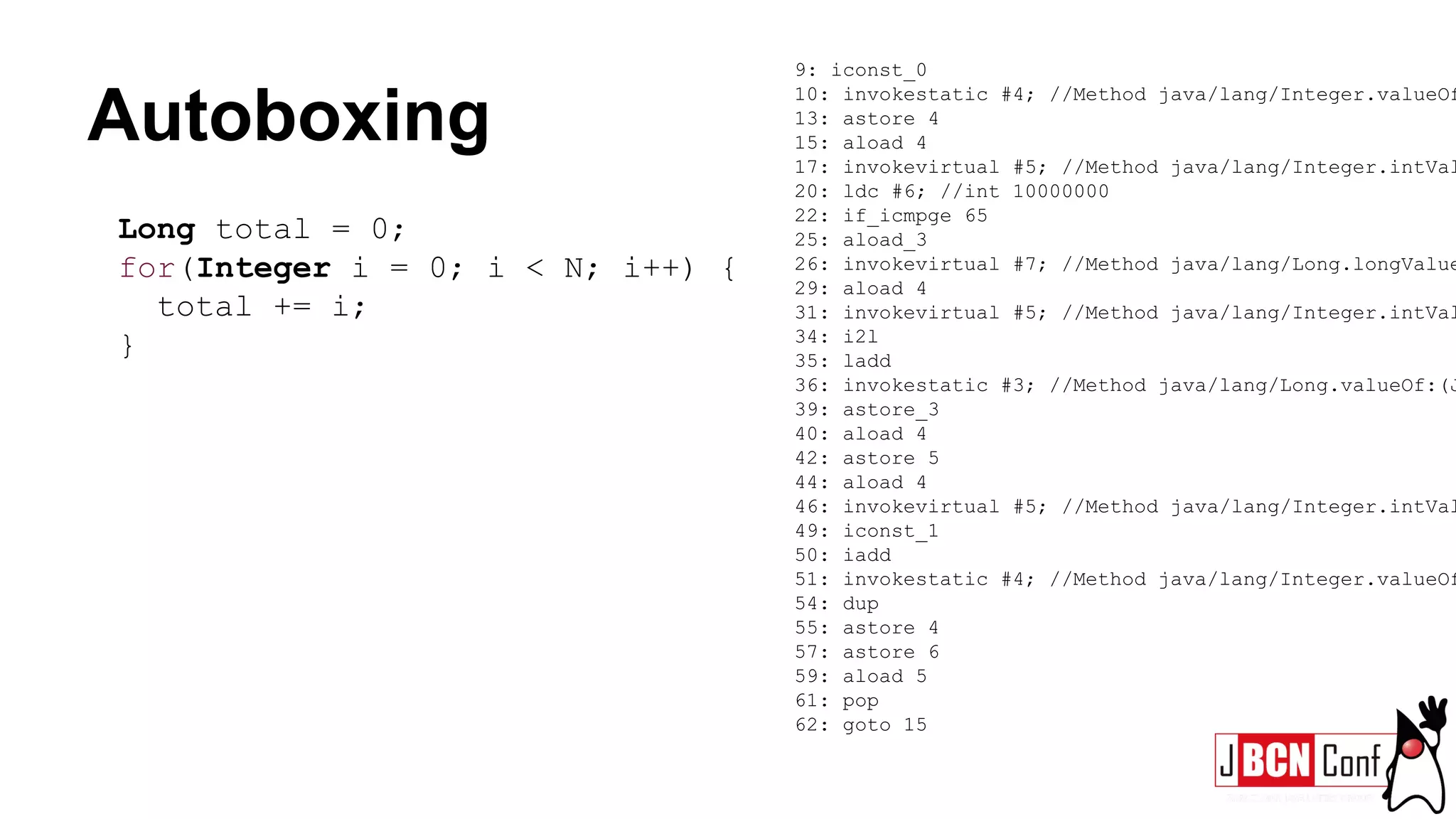
Autoboxing
Long total = 0;
for(Integer i = 0; i < N; i++) {
total += i;
}
9: iconst_0
10: invokestatic #4; //Method java/lang/Integer.valueOf
13: astore 4
15: aload 4
17: invokevirtual #5; //Method java/lang/Integer.intVal
20: ldc #6; //int 10000000
22: if_icmpge 65
25: aload_3
26: invokevirtual #7; //Method java/lang/Long.longValue
29: aload 4
31: invokevirtual #5; //Method java/lang/Integer.intVal
34: i2l
35: ladd
36: invokestatic #3; //Method java/lang/Long.valueOf:(J
39: astore_3
40: aload 4
42: astore 5
44: aload 4
46: invokevirtual #5; //Method java/lang/Integer.intVal
49: iconst_1
50: iadd
51: invokestatic #4; //Method java/lang/Integer.valueOf
54: dup
55: astore 4
57: astore 6
59: aload 5
61: pop
62: goto 15
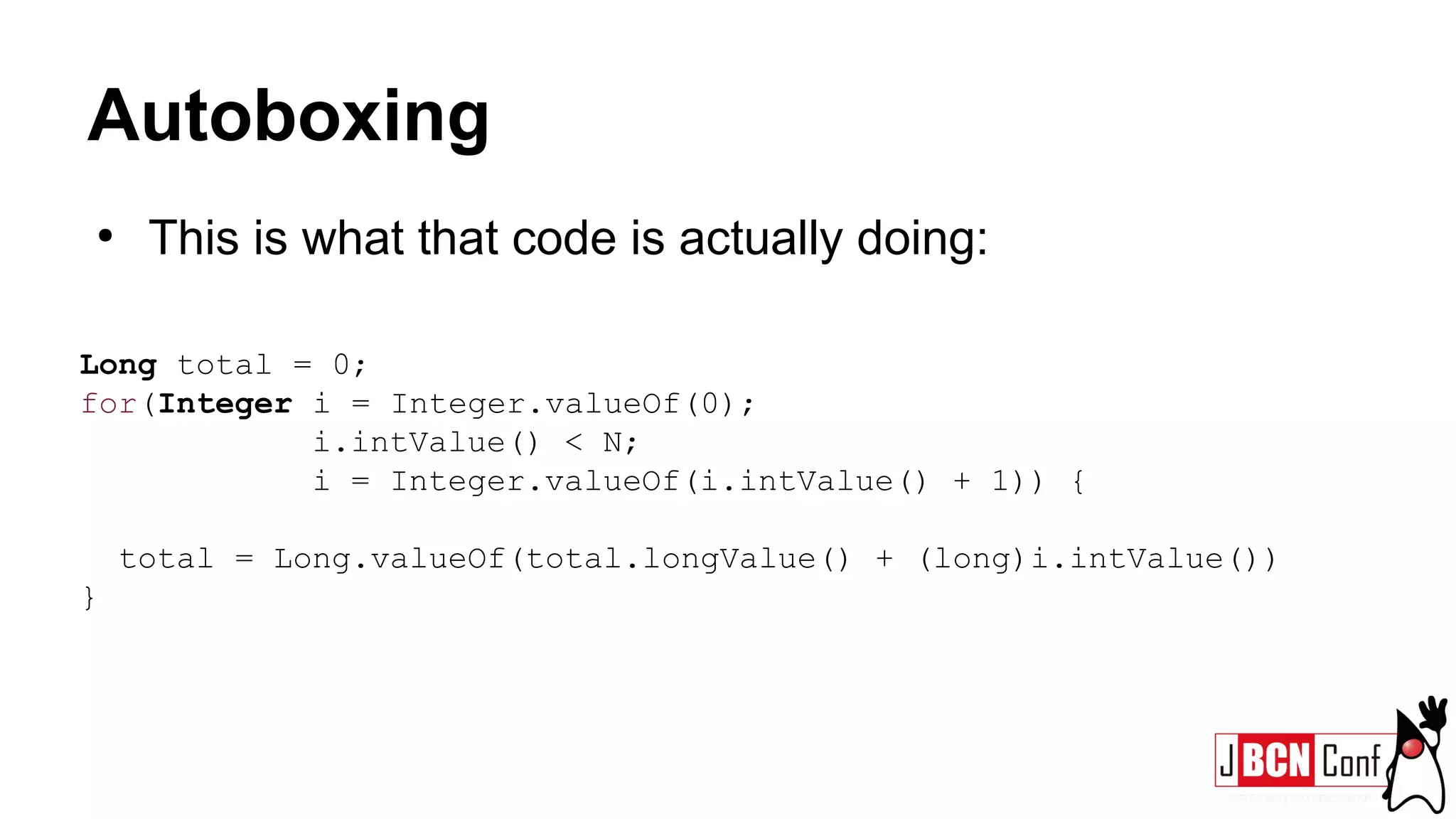
Autoboxing
●
This is what that code is actually doing:
Long total = 0;
for(Integer i = Integer.valueOf(0);
i.intValue() < N;
i = Integer.valueOf(i.intValue() + 1)) {
total = Long.valueOf(total.longValue() + (long)i.intValue())
}
Autoboxing
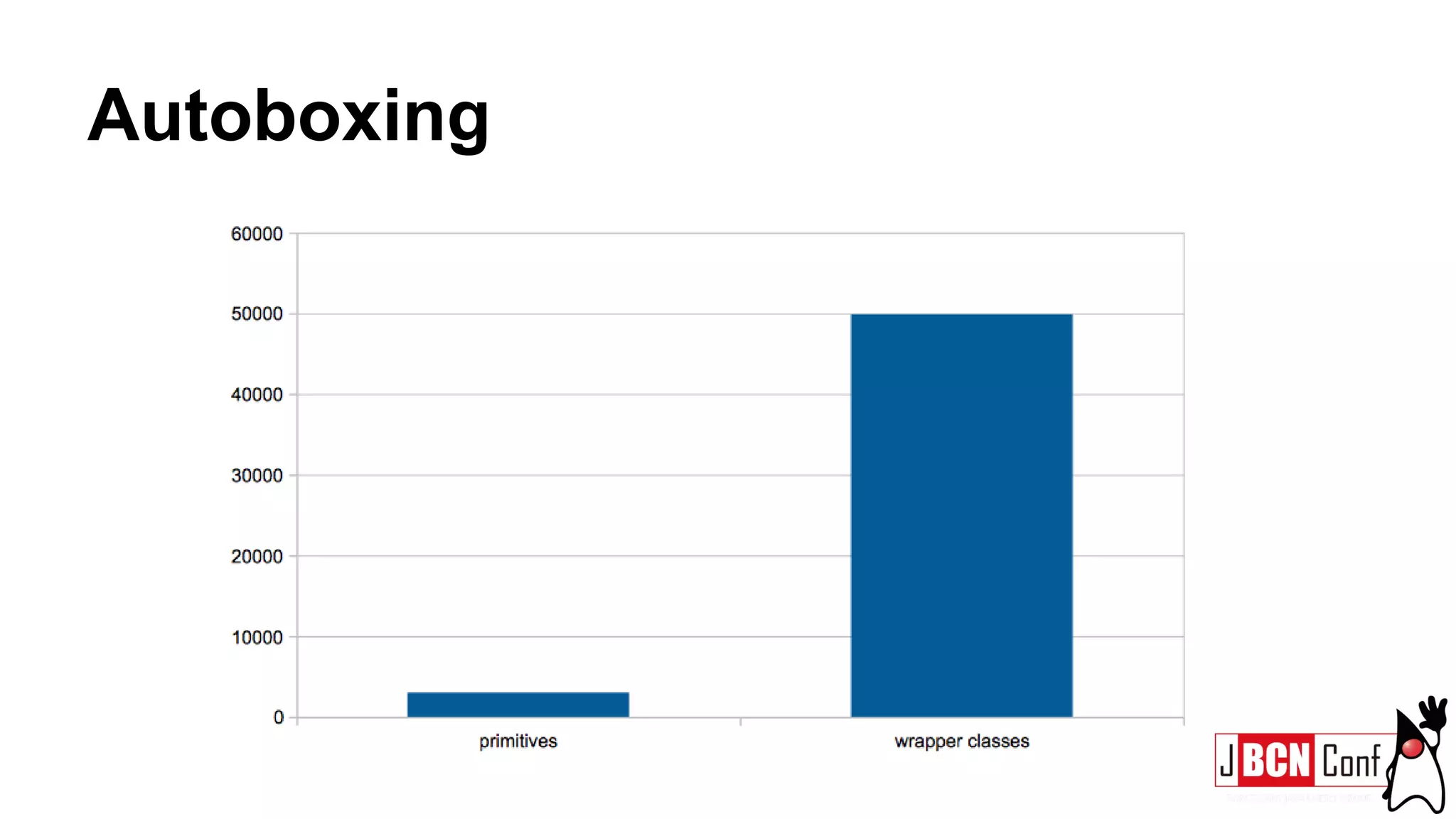
Let's run that loop
10.000.000.000 times
(on my desktop computer)
Autoboxing
Autoboxing
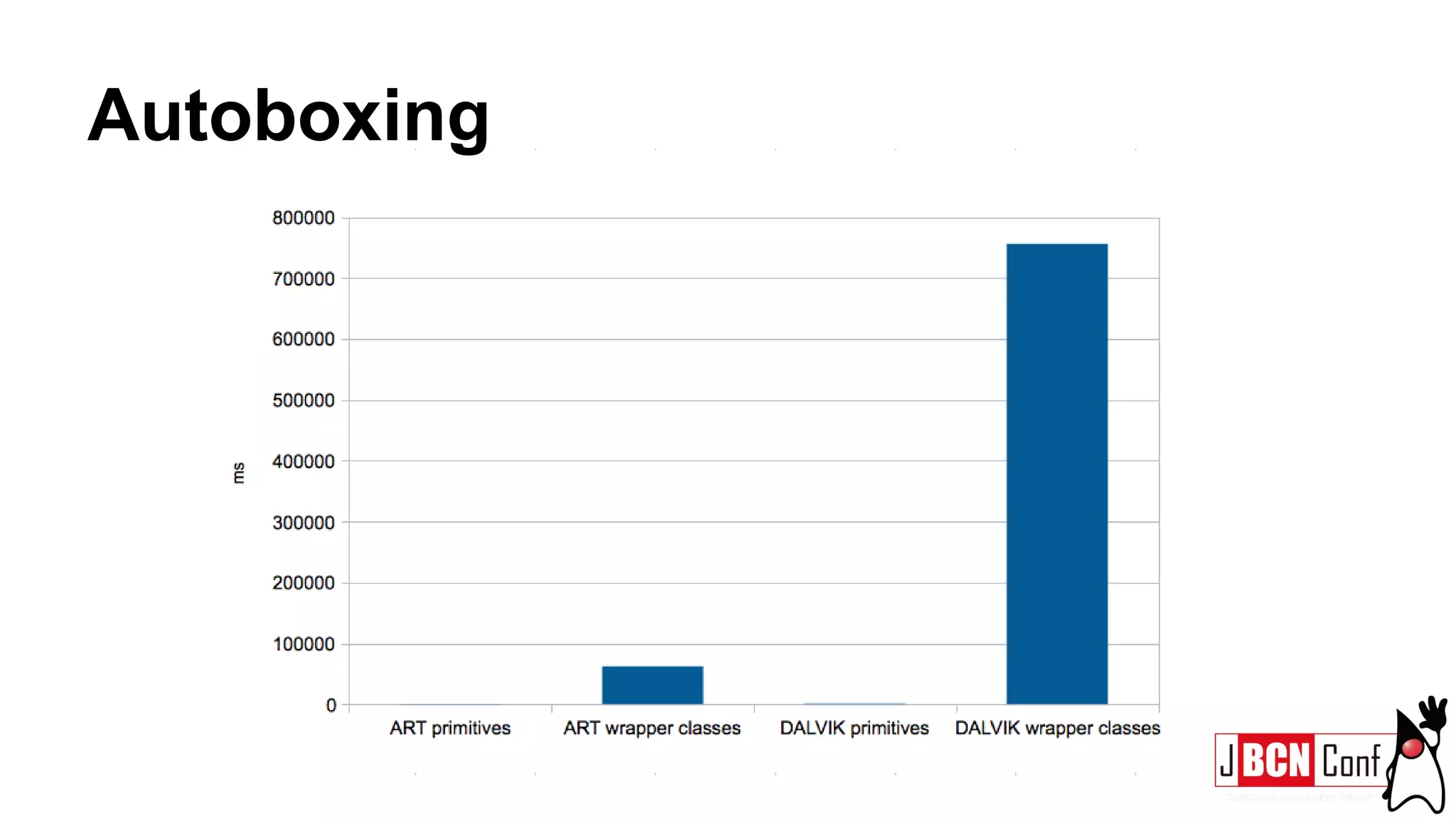
Let's run that loop 100.000.000
Times on two Nexus 5
KitKat & Lollipop
Dalvik VM & ART
Autoboxing
Sorting
The easy way
Let's sort some numbers
Arrays.sort(...)
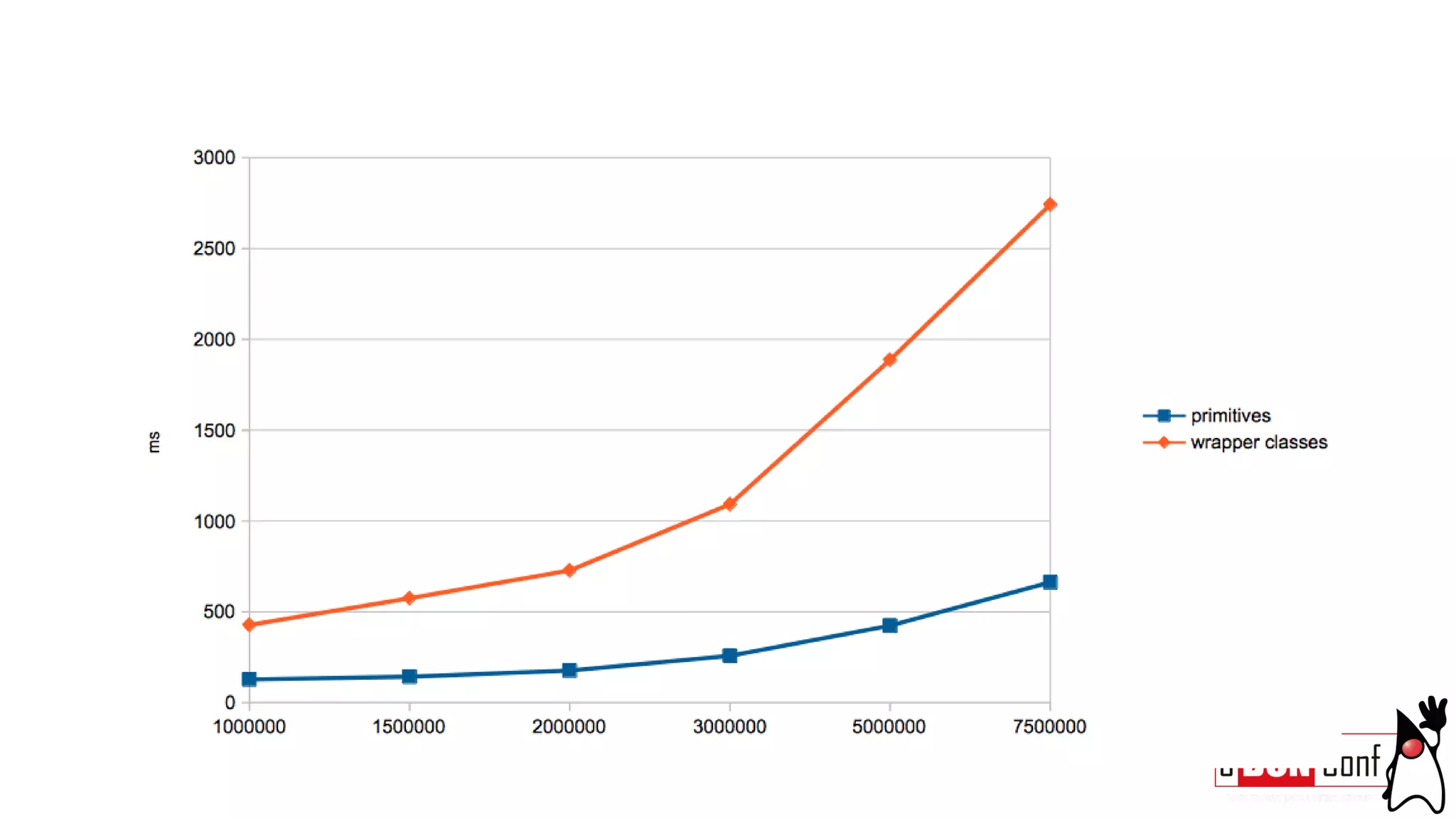
Difference between sorting
primitive types & objects
Sorting objects is a stable sort
Default java algorithm: TimSort
(derived from MergeSort)
Sorting primitives doesn't require
to be stable sort
Default java algorithm:
Dual-Pivot quicksort
Sorting
Use primitive types as much as
possible
Loops
What's going on behind the
scenes
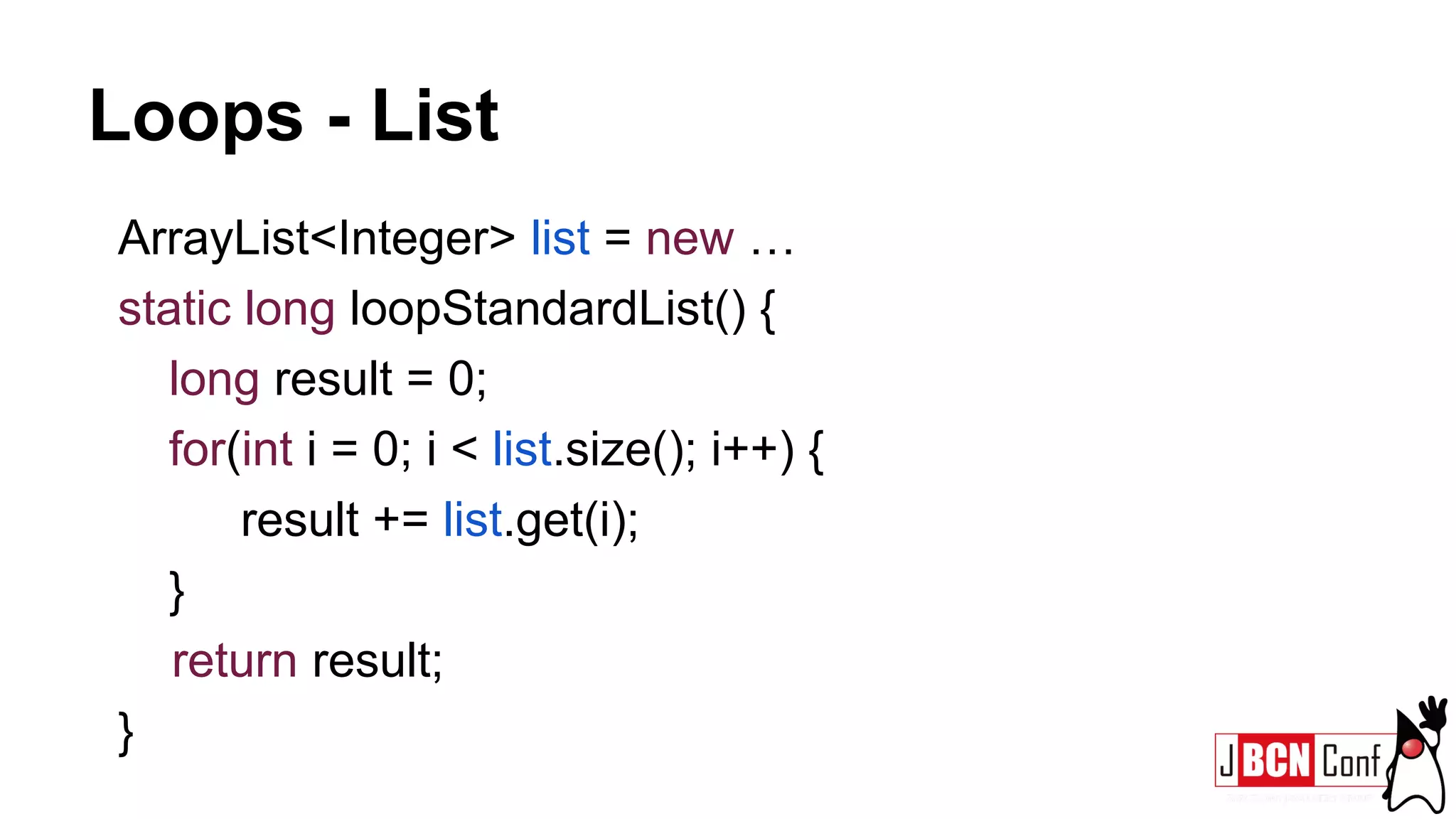
Loops - List
ArrayList<Integer> list = new …
static long loopStandardList() {
long result = 0;
for(int i = 0; i < list.size(); i++) {
result += list.get(i);
}
return result;
}
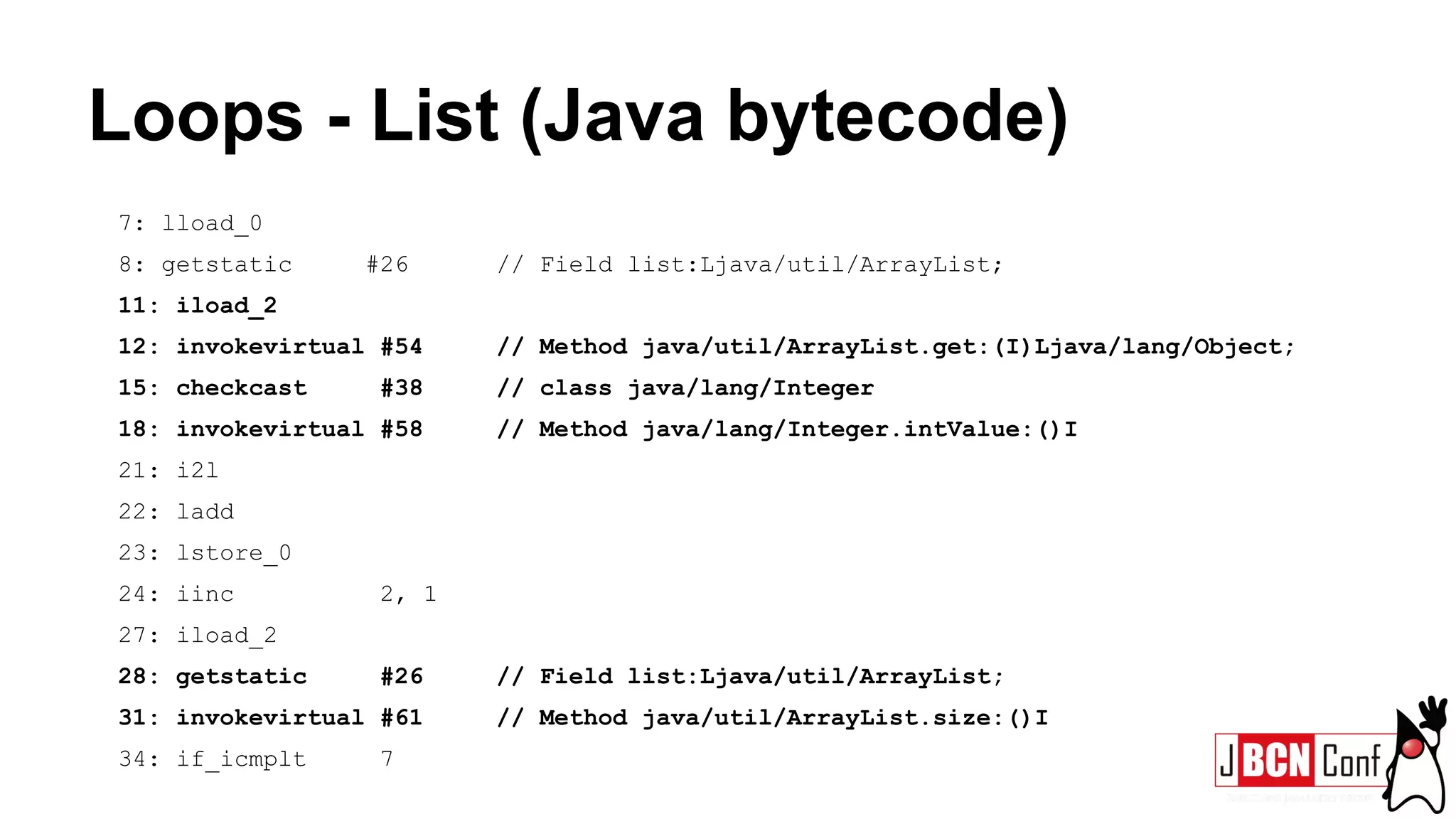
Loops - List (Java bytecode)
7: lload_0
8: getstatic #26 // Field list:Ljava/util/ArrayList;
11: iload_2
12: invokevirtual #54 // Method java/util/ArrayList.get:(I)Ljava/lang/Object;
15: checkcast #38 // class java/lang/Integer
18: invokevirtual #58 // Method java/lang/Integer.intValue:()I
21: i2l
22: ladd
23: lstore_0
24: iinc 2, 1
27: iload_2
28: getstatic #26 // Field list:Ljava/util/ArrayList;
31: invokevirtual #61 // Method java/util/ArrayList.size:()I
34: if_icmplt 7
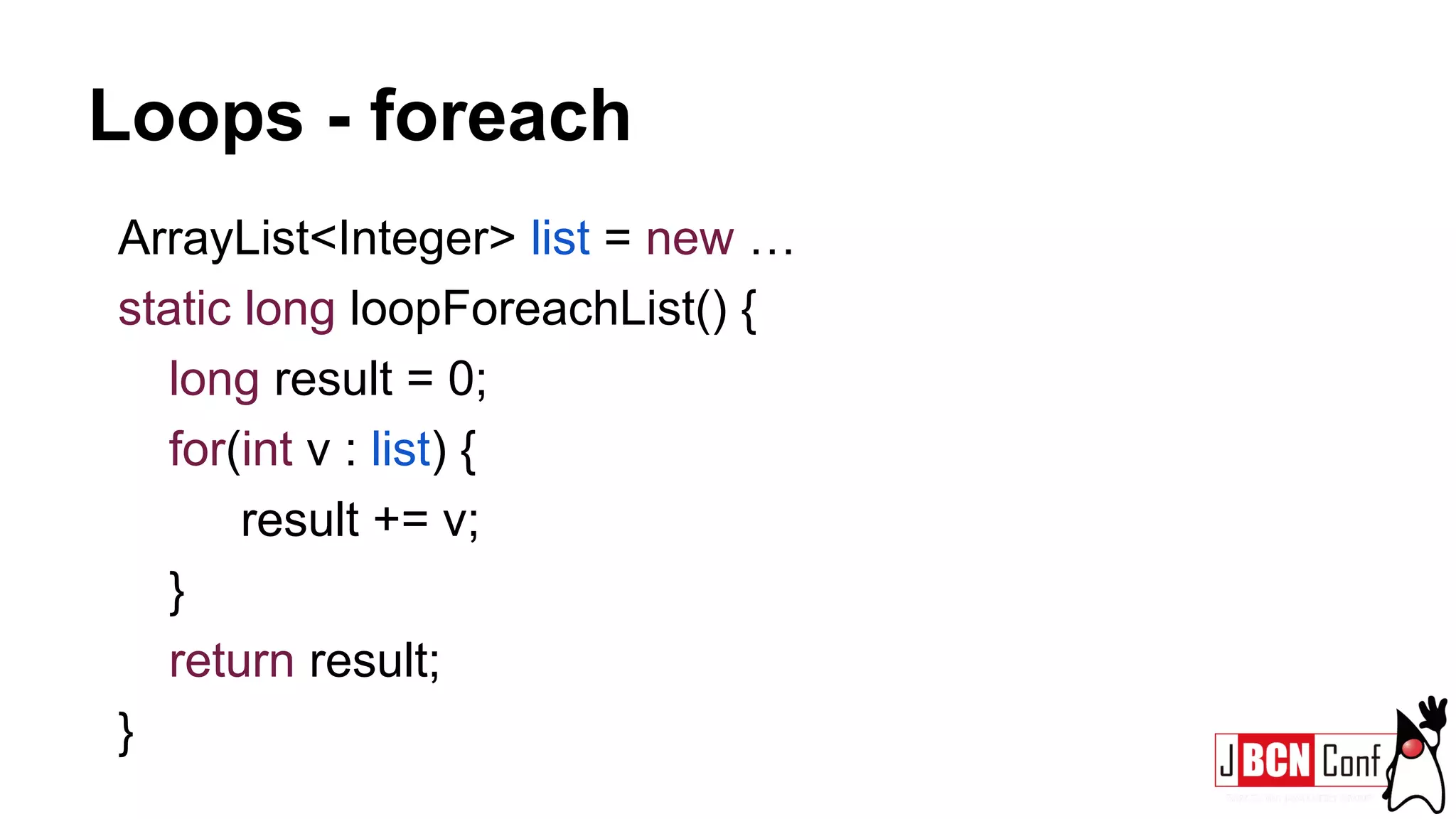
Loops - foreach
ArrayList<Integer> list = new …
static long loopForeachList() {
long result = 0;
for(int v : list) {
result += v;
}
return result;
}
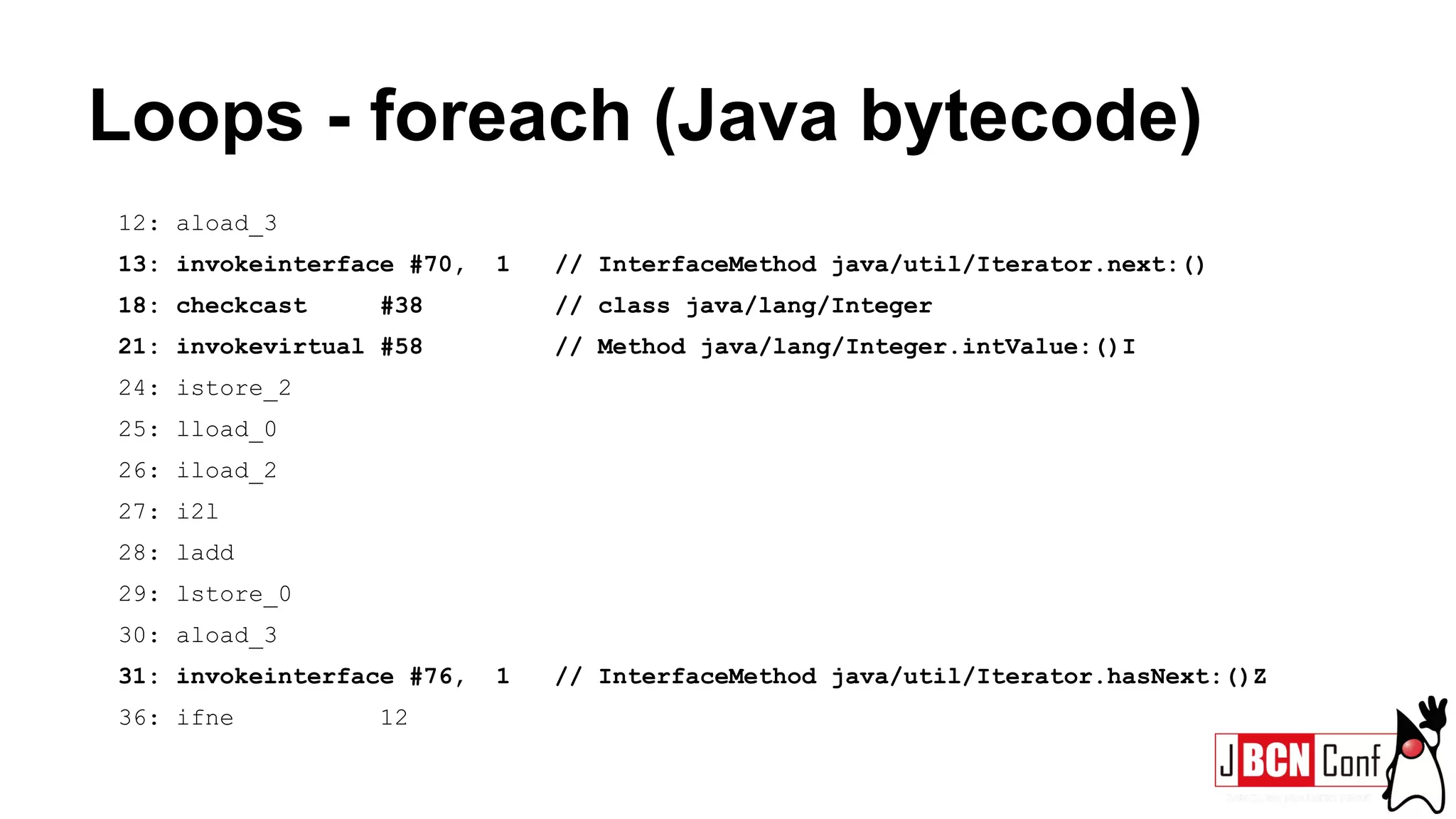
Loops - foreach (Java bytecode)
12: aload_3
13: invokeinterface #70, 1 // InterfaceMethod java/util/Iterator.next:()
18: checkcast #38 // class java/lang/Integer
21: invokevirtual #58 // Method java/lang/Integer.intValue:()I
24: istore_2
25: lload_0
26: iload_2
27: i2l
28: ladd
29: lstore_0
30: aload_3
31: invokeinterface #76, 1 // InterfaceMethod java/util/Iterator.hasNext:()Z
36: ifne 12
Loops - Array
static int[] array = new ...
static long loopStandardArray() {
long result = 0;
for(int i = 0; i < array.length; i++) {
result += array[i];
}
return result;
}
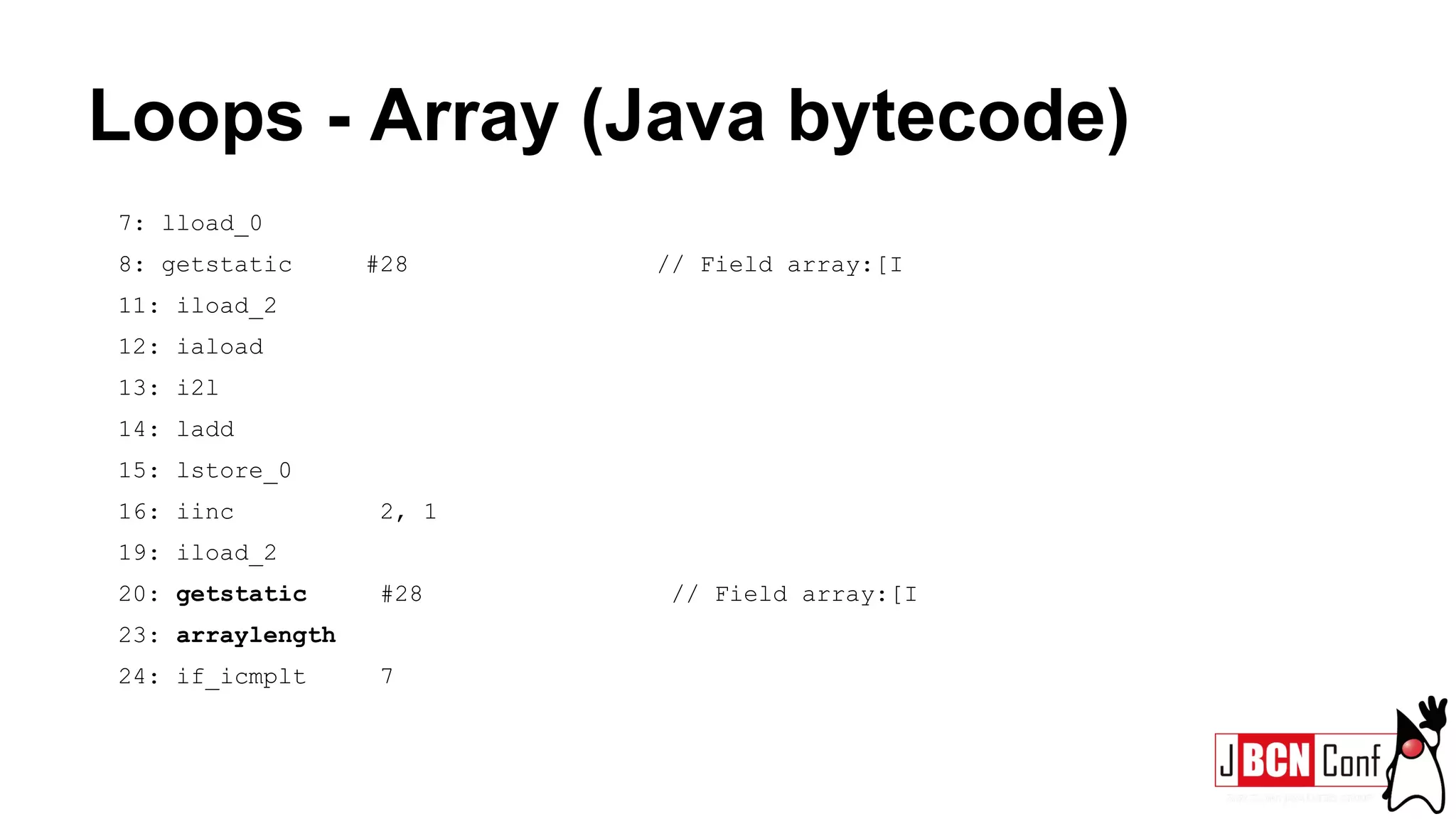
Loops - Array (Java bytecode)
7: lload_0
8: getstatic #28 // Field array:[I
11: iload_2
12: iaload
13: i2l
14: ladd
15: lstore_0
16: iinc 2, 1
19: iload_2
20: getstatic #28 // Field array:[I
23: arraylength
24: if_icmplt 7
Loops - size cached
static int[] array = new ...
static long loopStandardArraySizeStored() {
long result = 0; int length = array.length;
for(int i = 0; i < length; i++) {
result += array[i];
}
return result;
}
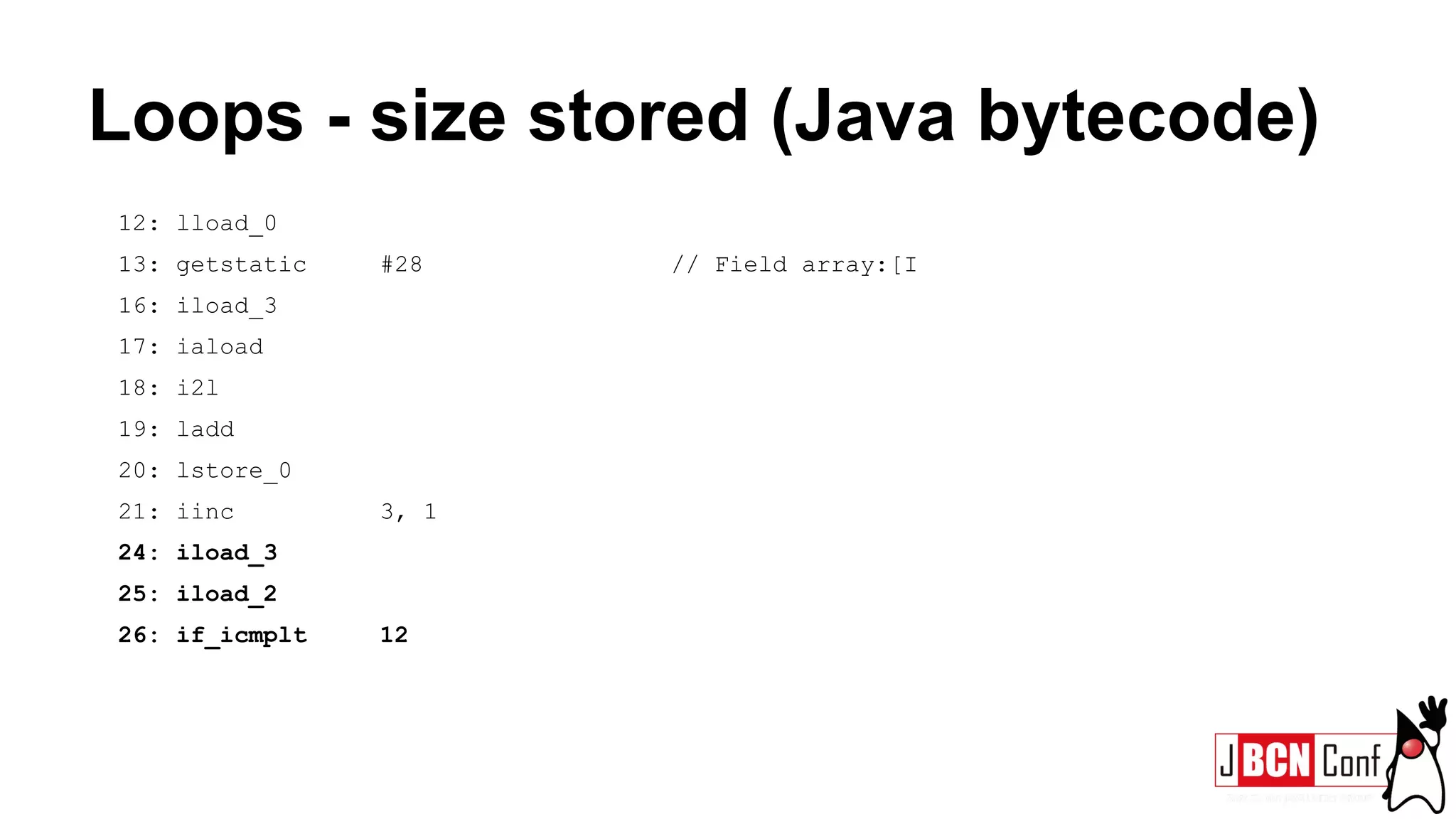
Loops - size stored (Java bytecode)
12: lload_0
13: getstatic #28 // Field array:[I
16: iload_3
17: iaload
18: i2l
19: ladd
20: lstore_0
21: iinc 3, 1
24: iload_3
25: iload_2
26: if_icmplt 12
Loops - backwards
static int[] array = new ...
static long loopStandardArrayBackwards() {
long result = 0;
for(int i = array.length - 1; i >= 0; i--) {
result += array[i];
}
return result;
}
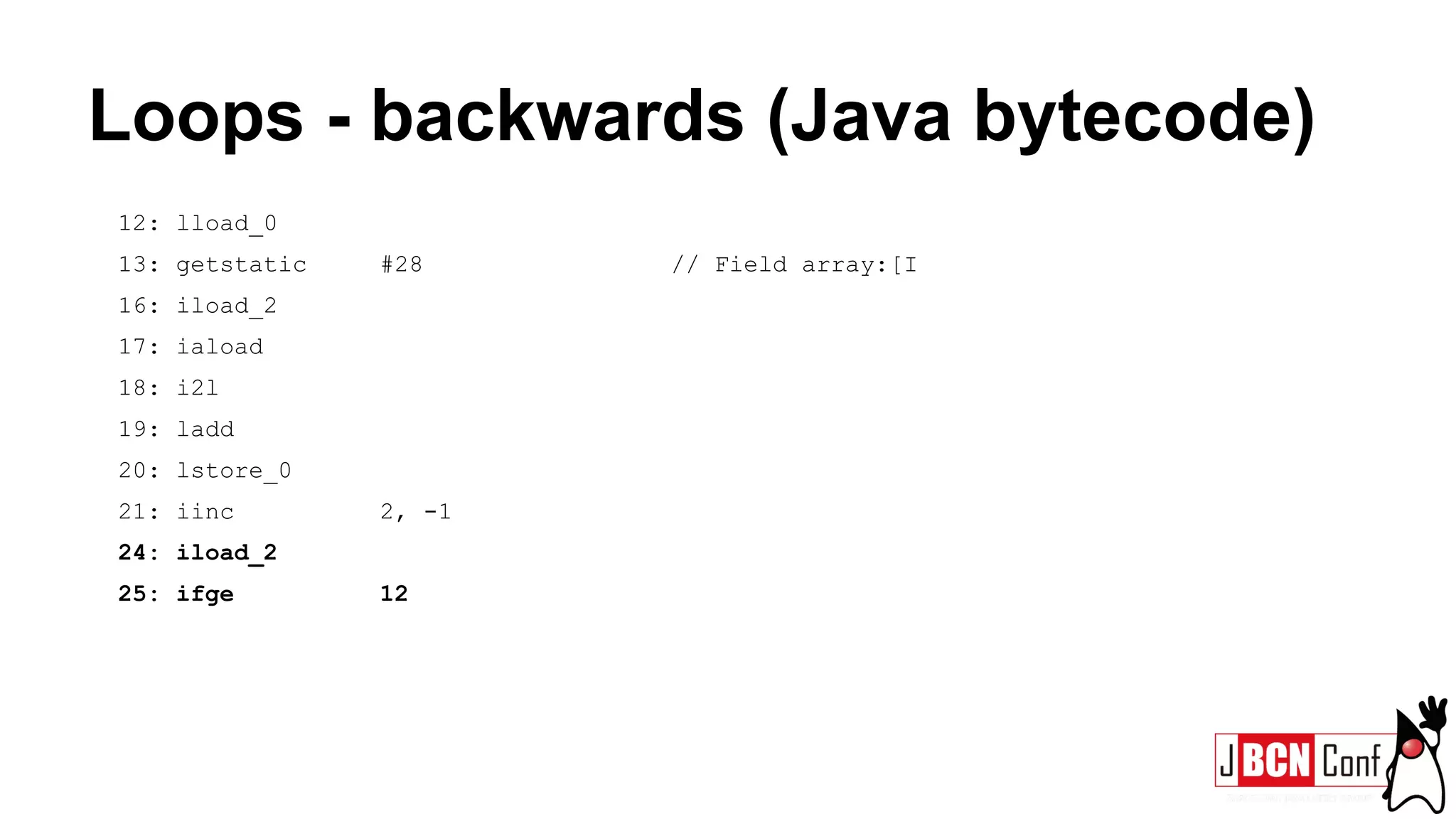
Loops - backwards (Java bytecode)
12: lload_0
13: getstatic #28 // Field array:[I
16: iload_2
17: iaload
18: i2l
19: ladd
20: lstore_0
21: iinc 2, -1
24: iload_2
25: ifge 12
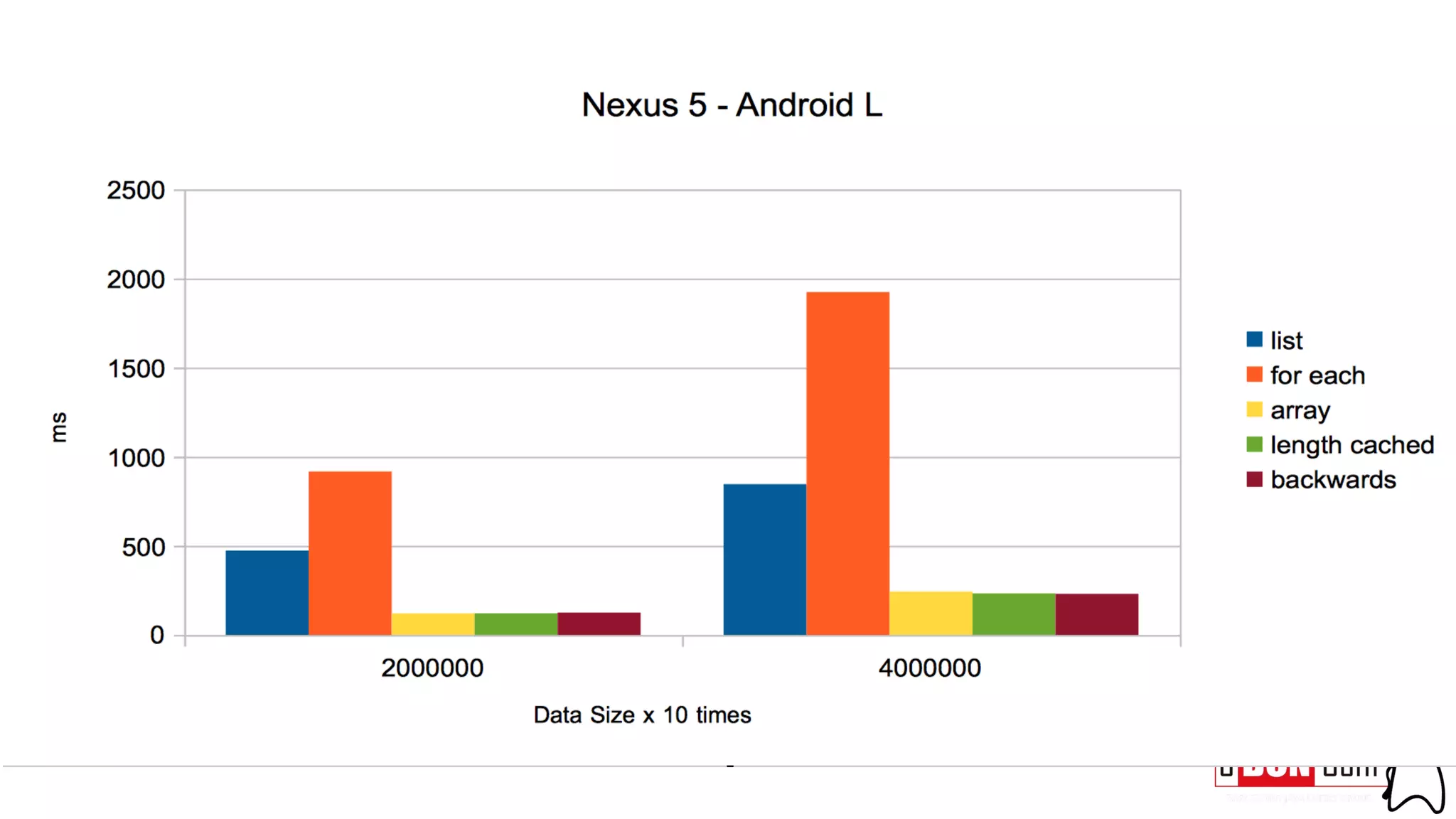
Loops
Avoid foreach constructions if
performance is a requirement
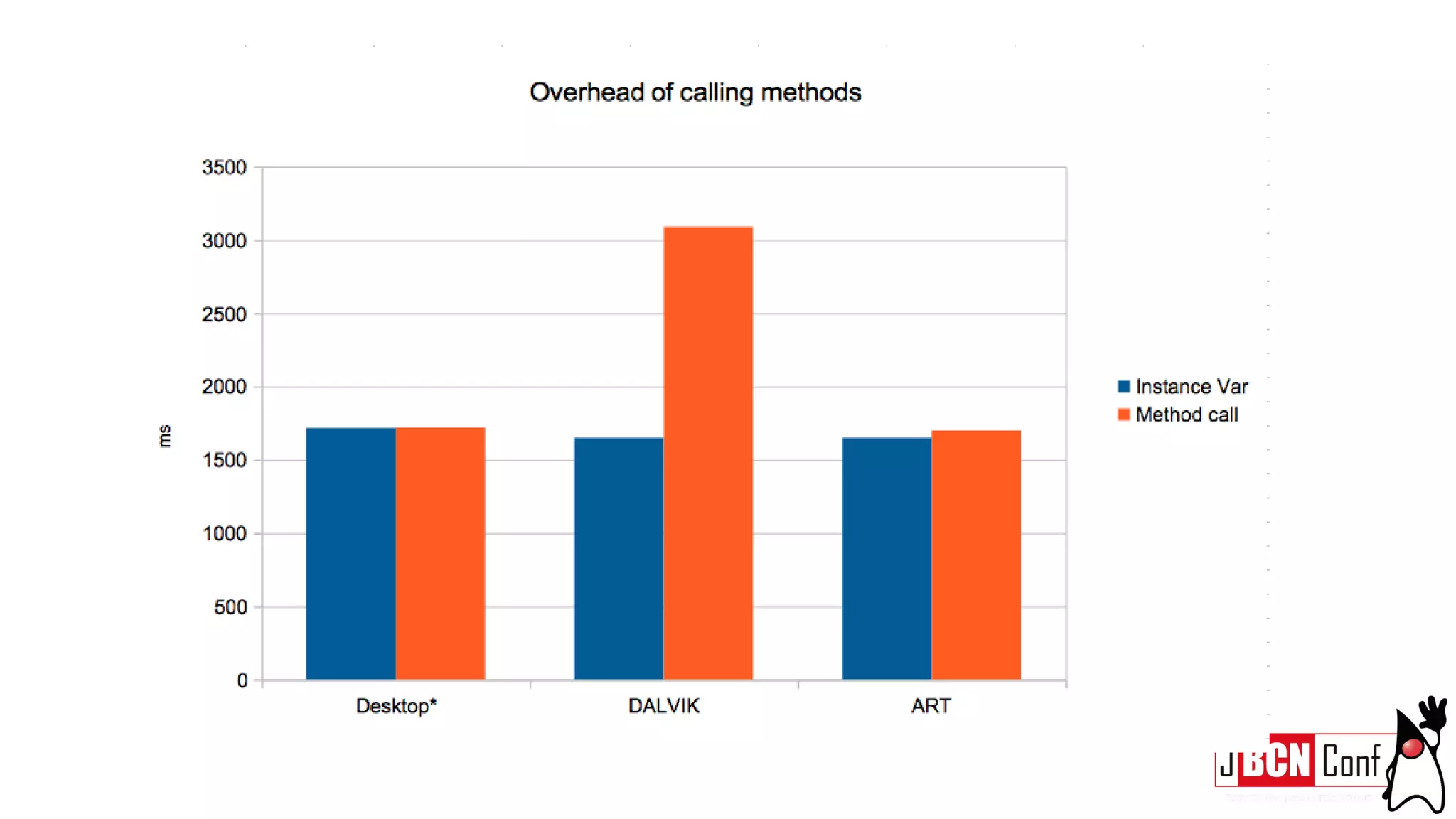
Calling a method
Is there an overhead?
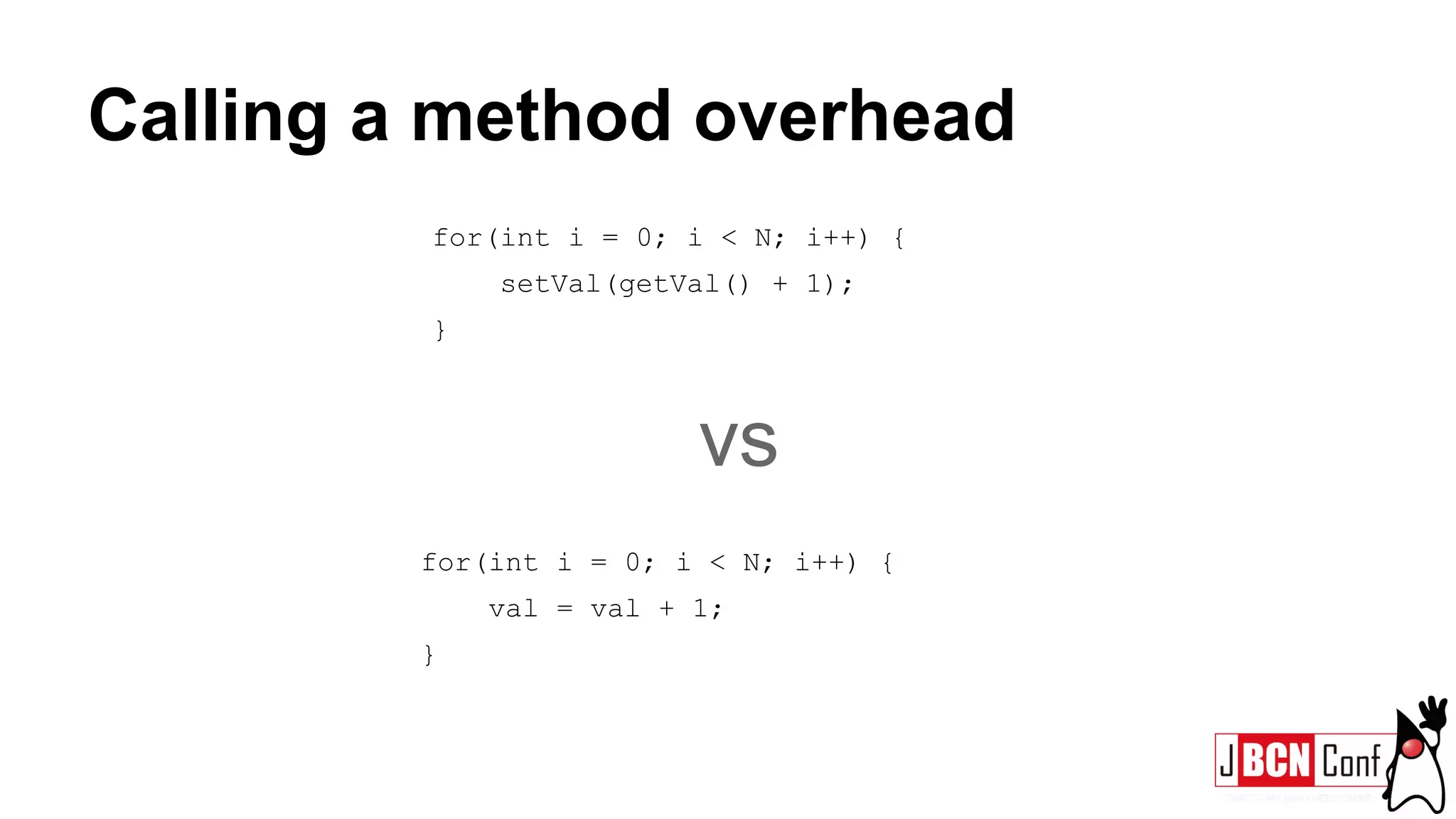
Calling a method overhead
for(int i = 0; i < N; i++) {
setVal(getVal() + 1);
}
for(int i = 0; i < N; i++) {
val = val + 1;
}
vs
String concatenation
The evil + sign
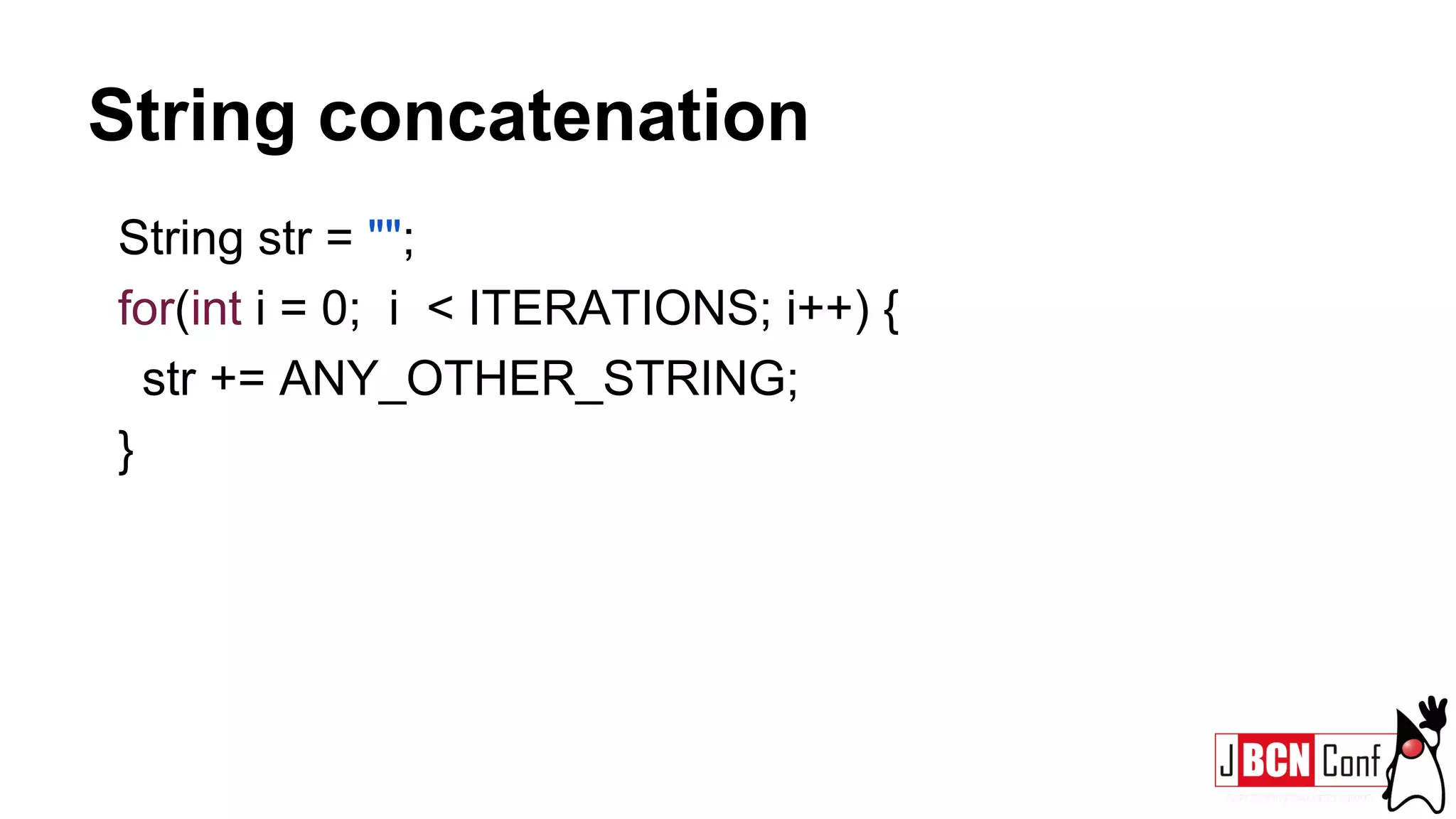
String concatenation
String str = "";
for(int i = 0; i < ITERATIONS; i++) {
str += ANY_OTHER_STRING;
}
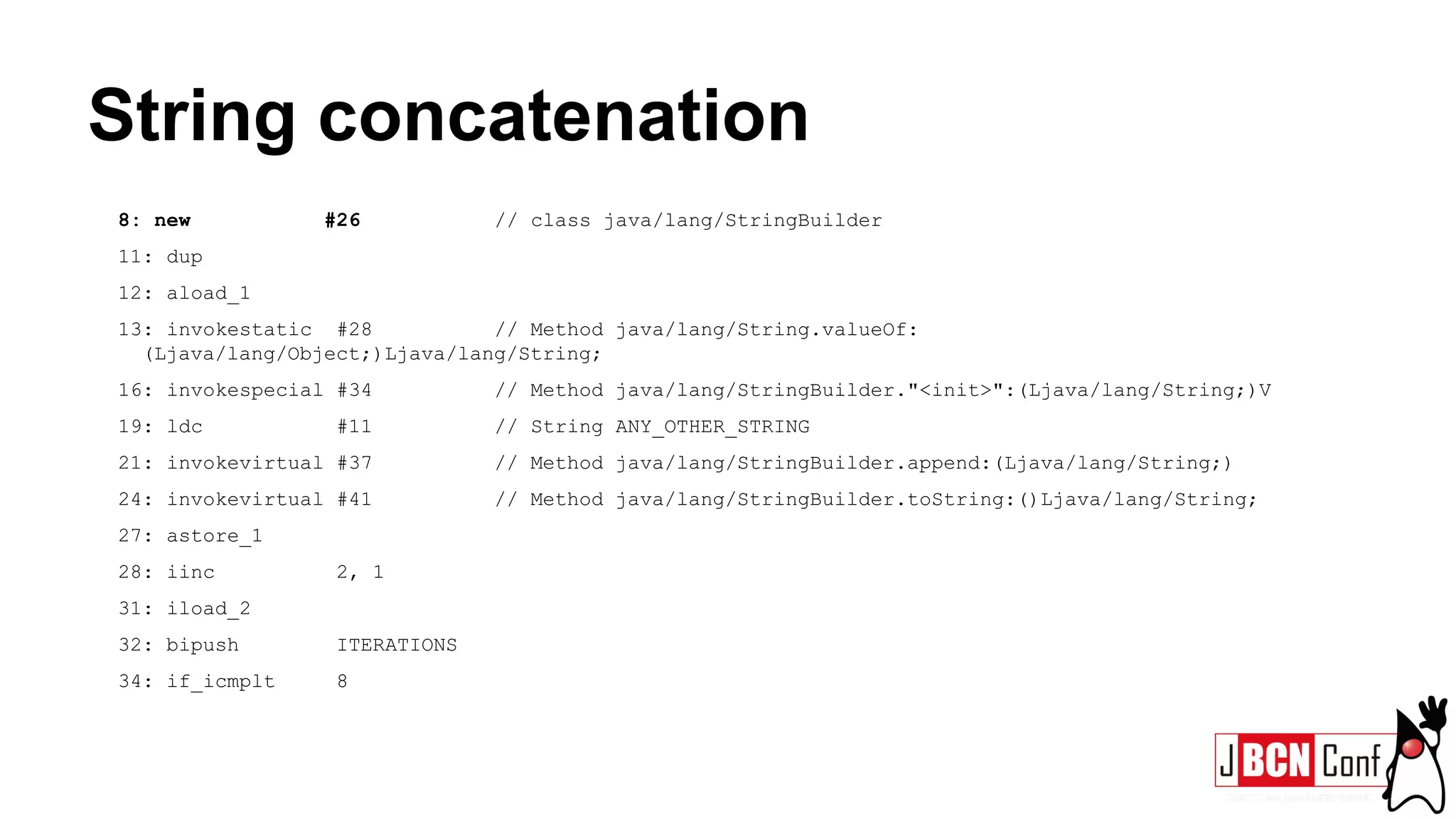
String concatenation
8: new #26 // class java/lang/StringBuilder
11: dup
12: aload_1
13: invokestatic #28 // Method java/lang/String.valueOf:
(Ljava/lang/Object;)Ljava/lang/String;
16: invokespecial #34 // Method java/lang/StringBuilder."<init>":(Ljava/lang/String;)V
19: ldc #11 // String ANY_OTHER_STRING
21: invokevirtual #37 // Method java/lang/StringBuilder.append:(Ljava/lang/String;)
24: invokevirtual #41 // Method java/lang/StringBuilder.toString:()Ljava/lang/String;
27: astore_1
28: iinc 2, 1
31: iload_2
32: bipush ITERATIONS
34: if_icmplt 8
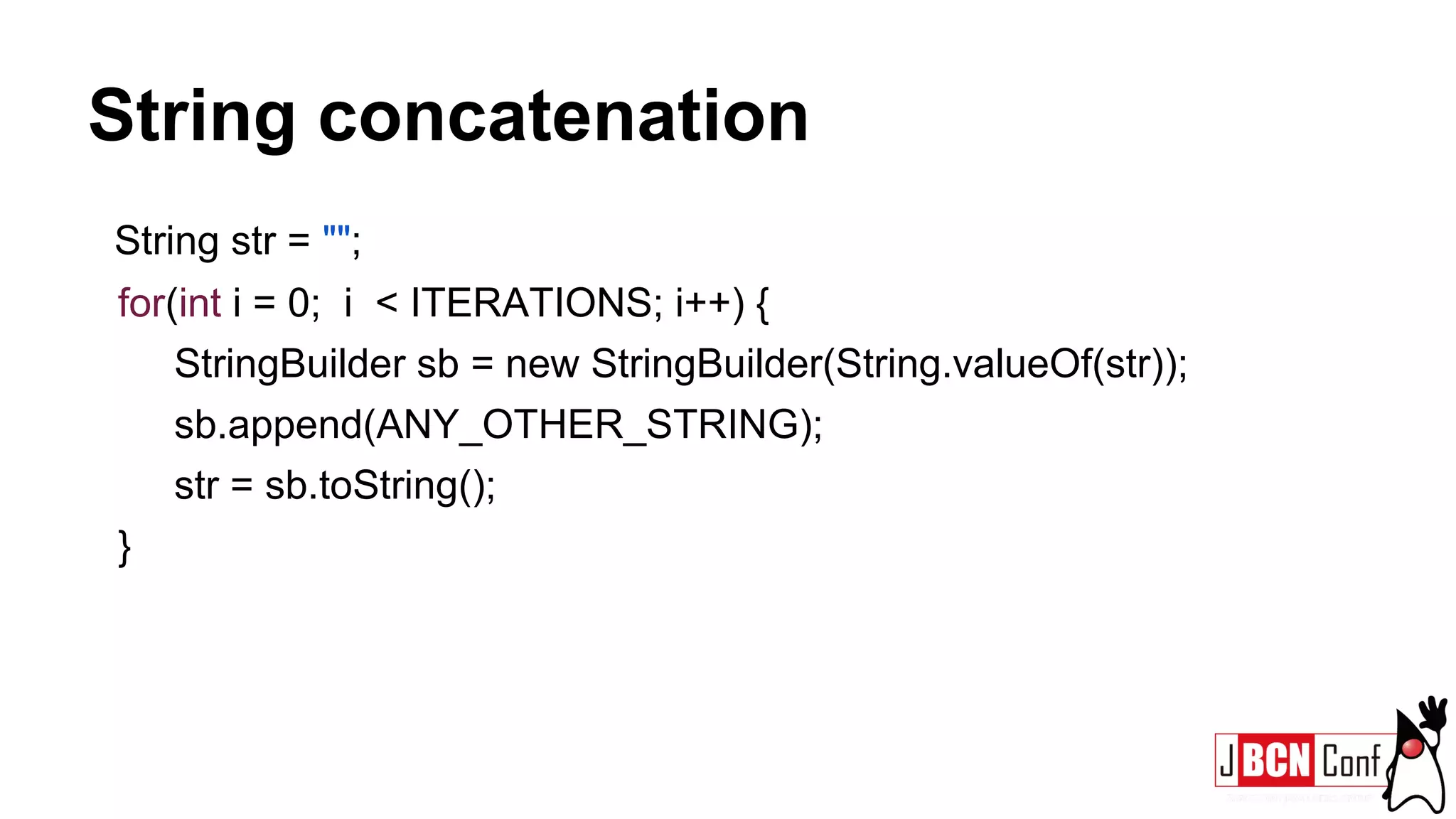
String concatenation
String str = "";
for(int i = 0; i < ITERATIONS; i++) {
StringBuilder sb = new StringBuilder(String.valueOf(str));
sb.append(ANY_OTHER_STRING);
str = sb.toString();
}
String concatenation
alternatives
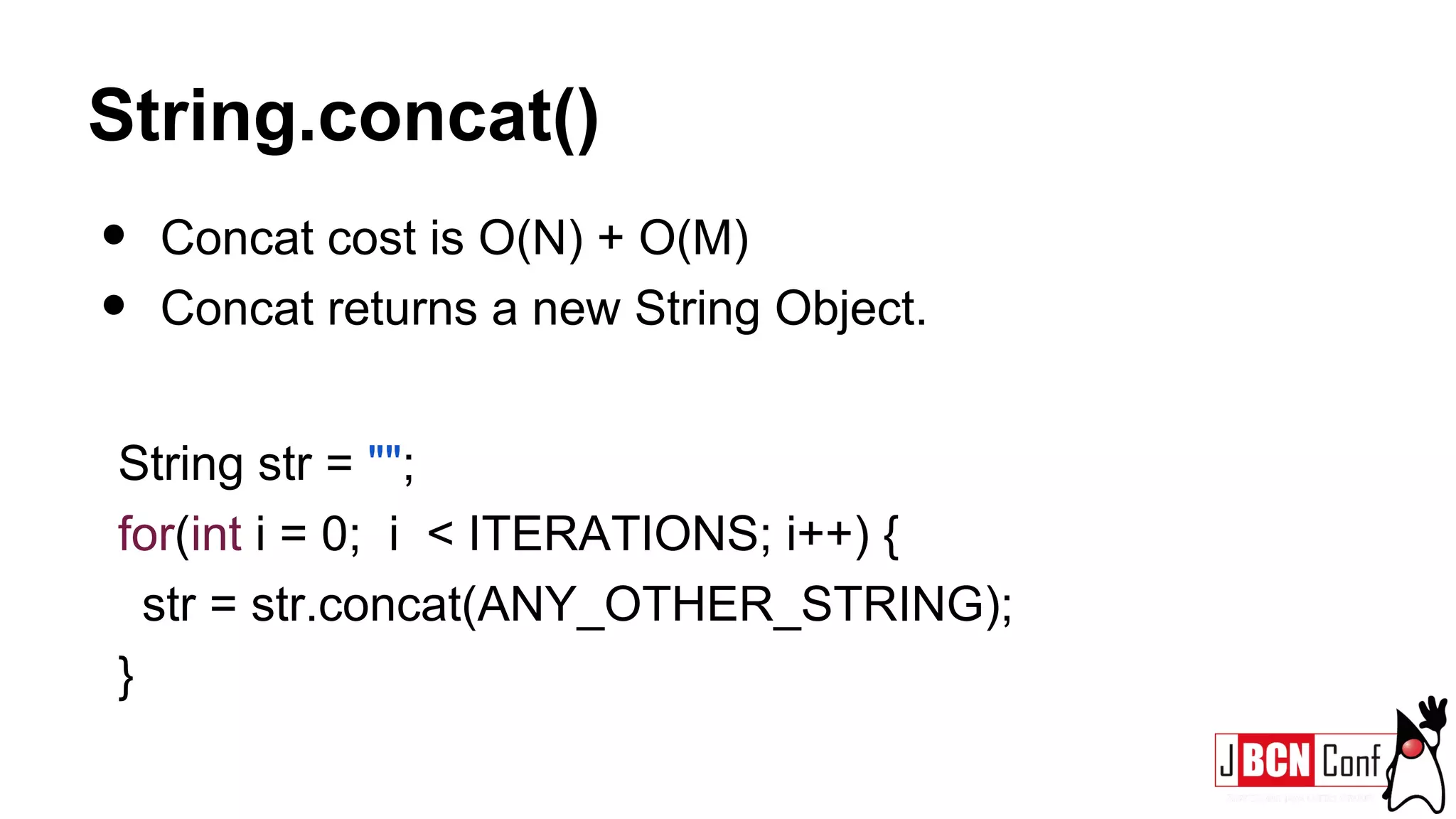
String.concat()
• Concat cost is O(N) + O(M)
• Concat returns a new String Object.
String str = "";
for(int i = 0; i < ITERATIONS; i++) {
str = str.concat(ANY_OTHER_STRING);
}
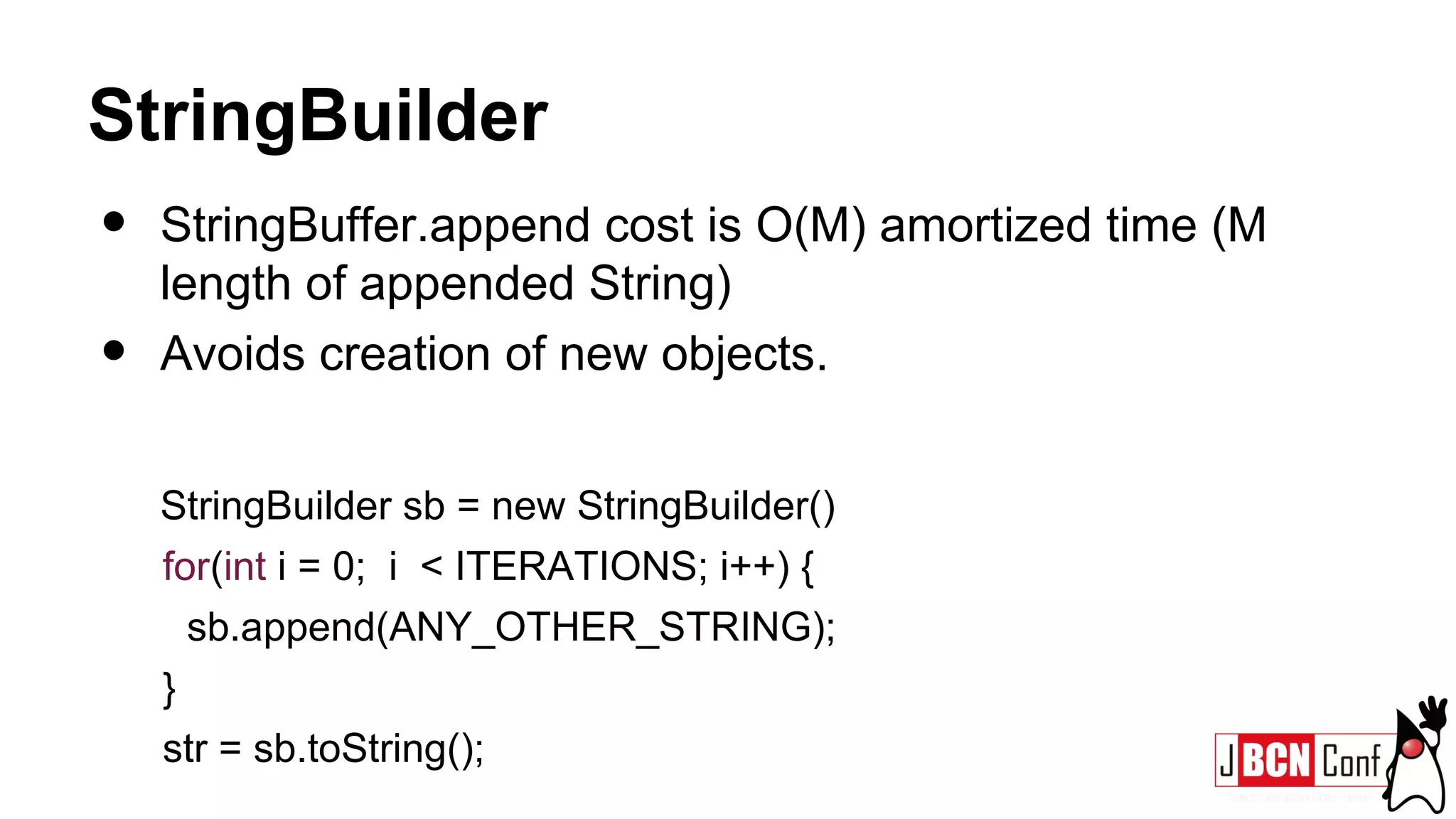
StringBuilder
• StringBuffer.append cost is O(M) amortized time (M
length of appended String)
• Avoids creation of new objects.
StringBuilder sb = new StringBuilder()
for(int i = 0; i < ITERATIONS; i++) {
sb.append(ANY_OTHER_STRING);
}
str = sb.toString();
String concatenation
Use StringBuilder (properly) as
much as possible. StringBuffer is
the thread safe implementation.
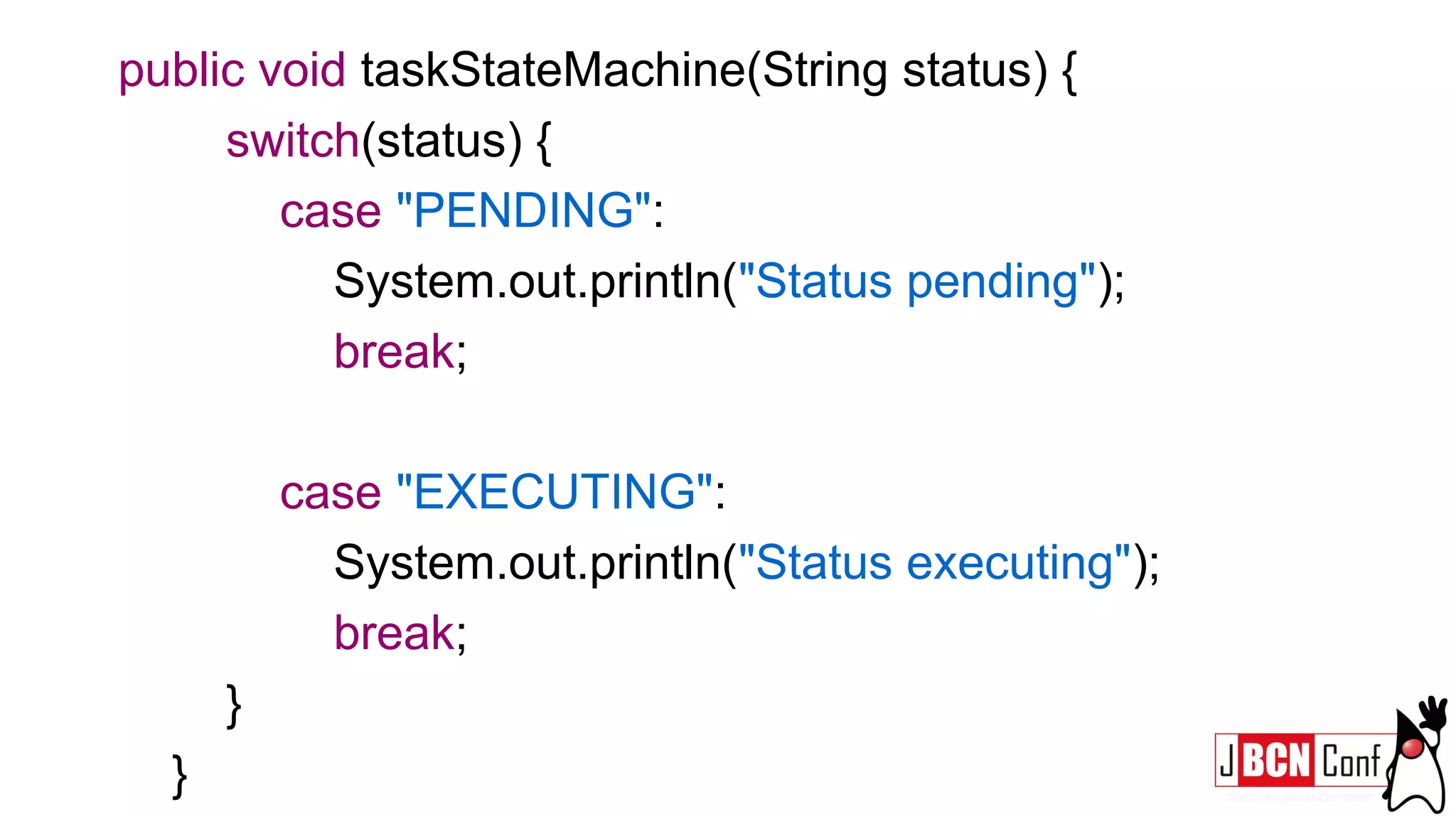
Strings in case statements
public void taskStateMachine(String status) {
switch(status) {
case "PENDING":
System.out.println("Status pending");
break;
case "EXECUTING":
System.out.println("Status executing");
break;
}
}
Tooling
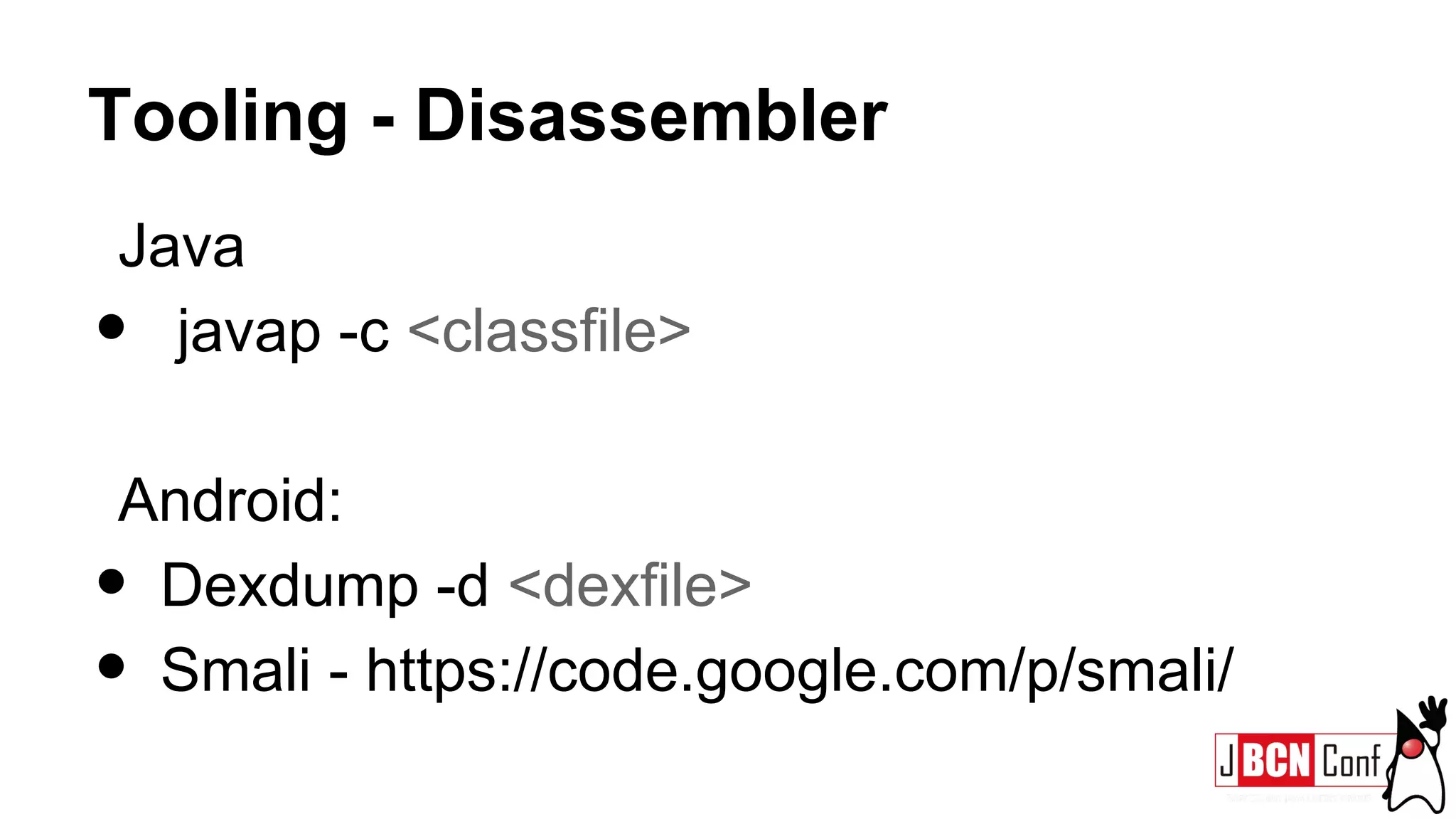
Tooling - Disassembler
Java
• javap -c <classfile>
Android:
• Dexdump -d <dexfile>
• Smali - https://code.google.com/p/smali/
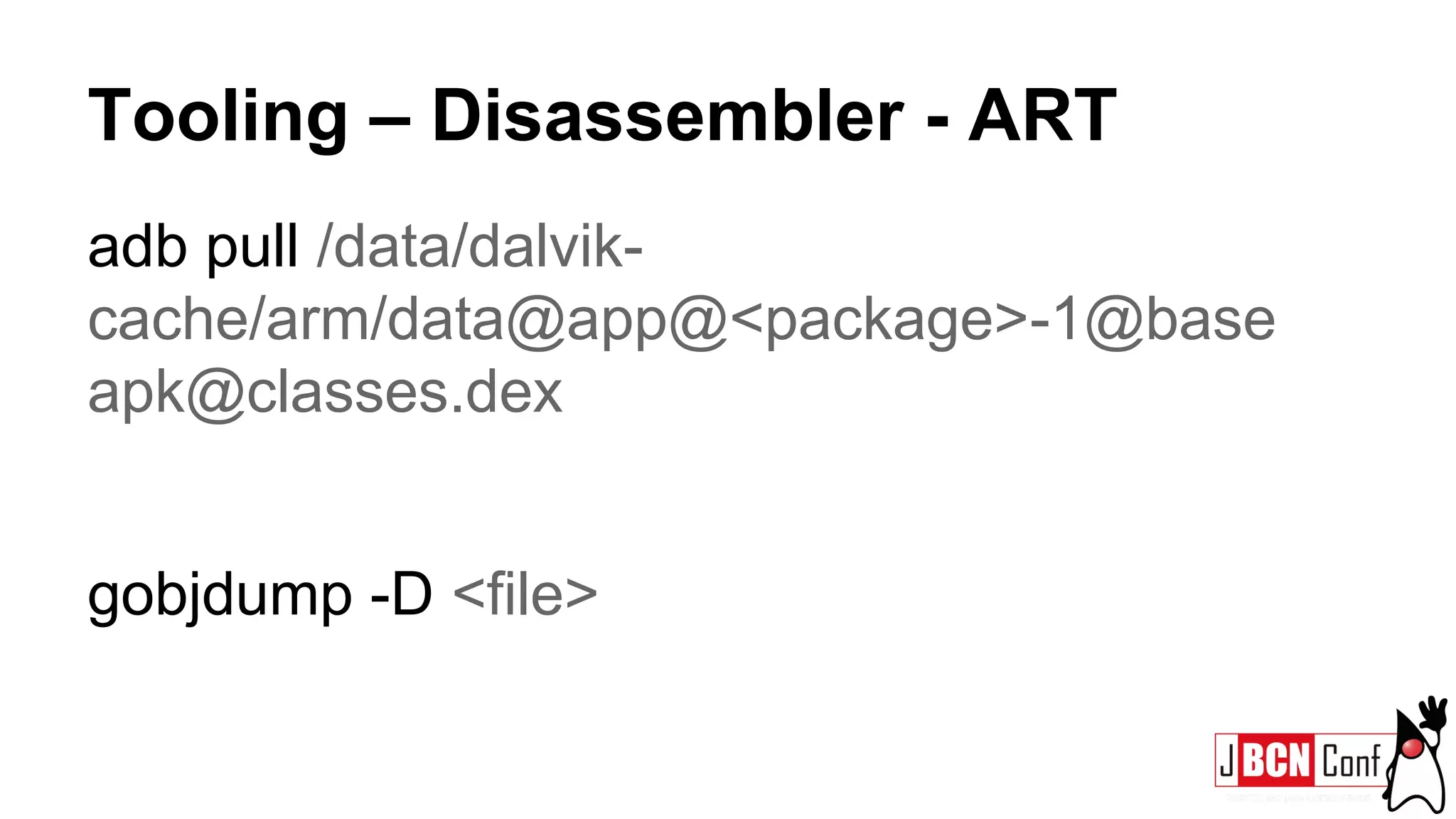
Tooling – Disassembler - ART
adb pull /data/dalvik-
cache/arm/data@app@<package>-1@base
apk@classes.dex
gobjdump -D <file>
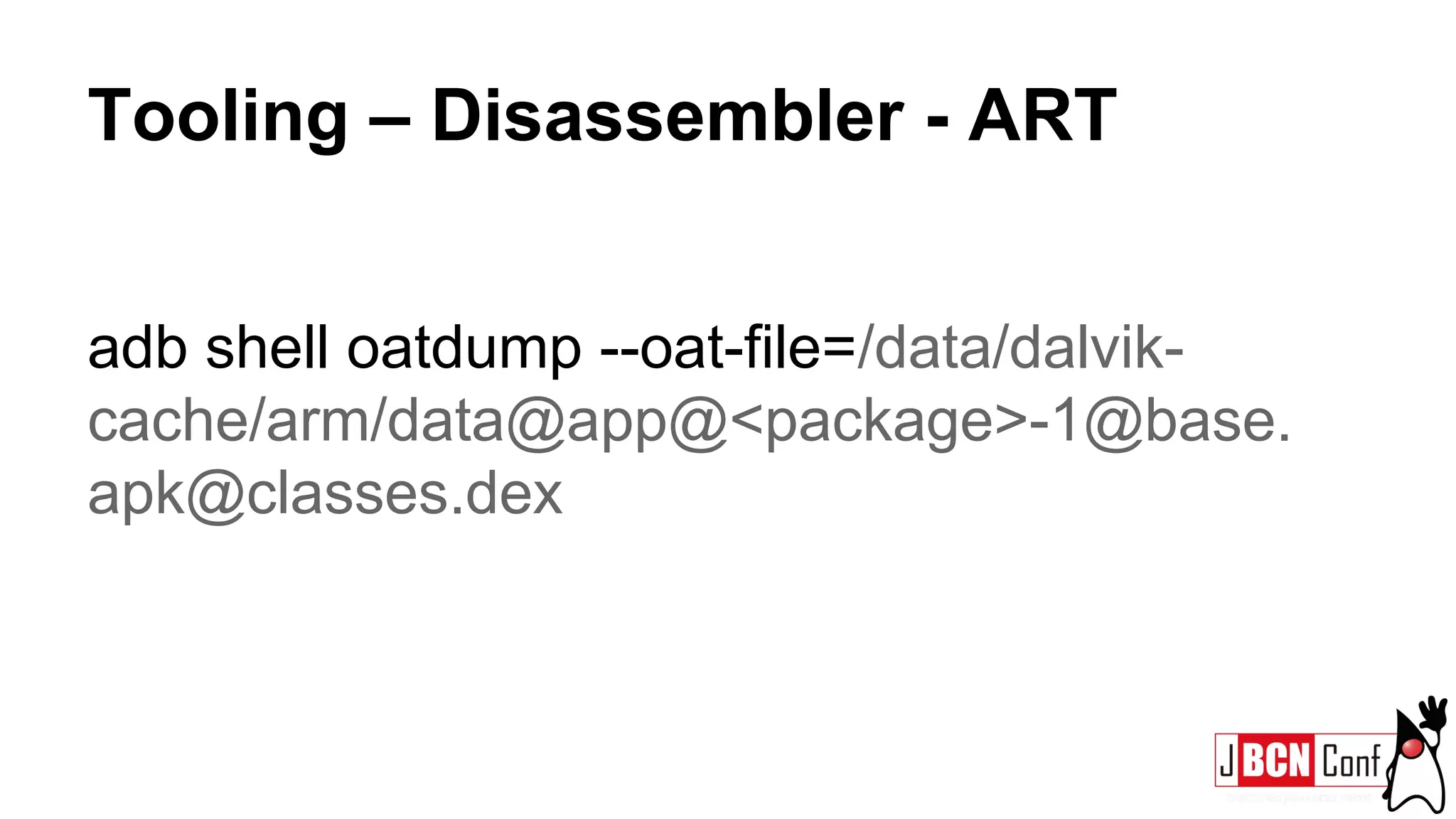
Tooling – Disassembler - ART
adb shell oatdump --oat-file=/data/dalvik-
cache/arm/data@app@<package>-1@base.
apk@classes.dex
Performance measurements
Avoid doing multiple tests in one run
JIT might be evil!
Do not trust the compiler!
@rrafols
http://blog.rafols.org

Improving Java performance at JBCNConf 2015

  • 1.
  • 2.
  • 3.
    Agenda - Disclaimer - Whoam I? - Our friend the java compiler - Language additions & things to consider - Tooling
  • 4.
  • 5.
    Who am I? SoftwareDelivery & Engineering Manager at AXA Group Solutions Twitter: @rrafols raimon.rafols@gmail.com http://blog.rafols.org
  • 6.
    Our friend thejava compiler
  • 7.
    Javac vs othercompilers
  • 8.
  • 9.
  • 10.
    Javac Doesn't know onwhich architecture will the code be executed
  • 11.
    For the samereason Java bytecode is stack based
  • 12.
  • 13.
  • 14.
    But not themost optimal solution (regarding performance)
  • 15.
    Quick example Stack basedinteger addition
  • 16.
    j = j+ i
  • 17.
  • 18.
  • 19.
    Java VM (JVM) Onlythe JVM knows on which architecture is running
  • 20.
    Java VM (JVM) Alloptimisations are left to be done by the JVM
  • 21.
    Maybe takes thisconcept a bit too far...
  • 22.
    Imagine this simpleC code #include <stdio.h> int main() { int a = 10; int b = 1 + 2 + 3 + 4 + 5 + 6 + a; printf("%dn", b); }
  • 23.
    GCC compiler #include <stdio.h> intmain() { int a = 10; int b = 1 + 2 + 3 + 4 + 5 + 6 + a; printf("%dn", b); } … movl $31, %esi call _printf … * Using gcc & -O2 compiler option
  • 24.
    javac public static voidmain(String args[]) { int a = 10; int b = 1 + 2 + 3 + 4 + 5 + 6 + a; System.out.println(b); } 0: bipush 10 2: istore_1 3: bipush 21 5: iload_1 6: iadd 7: istore_2 ...
  • 25.
    Let's do asmall change #include <stdio.h> int main() { int a = 10; int b = 1 + 2 + 3 + 4 + 5 + a + 6; printf("%dn", b); }
  • 26.
    GCC compiler #include <stdio.h> intmain() { int a = 10; int b = 1 + 2 + 3 + 4 + 5 + a + 6; printf("%dn", b); } … movl $31, %esi call _printf … * Using gcc & -O2 compiler option
  • 27.
    javac public static voidmain(String args[]) { int a = 10; int b = 1 + 2 + 3 + 4 + 5 + a + 6; System.out.println(b); } 0: bipush 10 2: istore_1 3: bipush 15 5: iload_1 6: iadd 7: bipush 6 9: iadd 10: istore_2 ...
  • 28.
    Let's do anotherquick change.. public static void main(String args[]) { int a = 10; int b = a + 1 + 2 + 3 + 4 + 5 + 6; System.out.println(b); }
  • 29.
    javac public static voidmain(String args[]) { int a = 10; int b = a + 1 + 2 + 3 + 4 + 5 + 6; System.out.println(b); } 0: bipush 10 2: istore_1 3: iload_1 4: iconst_1 5: iadd 6: iconst_2 7: iadd 8: iconst_3 9: iadd 10: iconst_4 11: iadd 12: iconst_5 13: iadd 14: bipush 6 16: iadd 17: istore_2
  • 30.
    Java 8 tothe rescue... raimon$ javac -version javac 1.8.0_05
  • 31.
    javac public static voidmain(String args[]) { int a = 10; int b = a + 1 + 2 + 3 + 4 + 5 + 6; System.out.println(b); } 0: bipush 10 2: istore_1 3: iload_1 4: iconst_1 5: iadd 6: iconst_2 7: iadd 8: iconst_3 9: iadd 10: iconst_4 11: iadd 12: iconst_5 13: iadd 14: bipush 6 16: iadd 17: istore_2
  • 32.
  • 33.
    javac -O public staticvoid main(String args[]) { int a = 10; int b = a + 1 + 2 + 3 + 4 + 5 + 6; System.out.println(b); } 0: bipush 10 2: istore_1 3: iload_1 4: iconst_1 5: iadd 6: iconst_2 7: iadd 8: iconst_3 9: iadd 10: iconst_4 11: iadd 12: iconst_5 13: iadd 14: bipush 6 16: iadd 17: istore_2
  • 34.
    /* -O isa no-op, accepted for backward compatibility. */
  • 35.
  • 36.
    What about other“JVM”? Dalvik VM / ART
  • 38.
    Generated dex bytecode& native (by ART) are based on the original java bytecode
  • 39.
  • 40.
    The Java compileradds some code under the hood.
  • 41.
    Autoboxing Transparent to thedeveloper but compiler adds some 'extra' code
  • 42.
    Autoboxing long total =0; for(int i = 0; i < N; i++) { total += i; } 4: lconst_0 5: lstore_3 6: iconst_0 7: istore 5 9: iload 5 11: ldc #6; 13: if_icmpge 28 16: lload_3 17: iload 5 19: i2l 20: ladd 21: lstore_3 22: iinc 5,1 25: goto 9
  • 43.
    Autoboxing Long total =0; for(Integer i = 0; i < N; i++) { total += i; } 9: iconst_0 10: invokestatic #4; //Method java/lang/Integer.valueOf 13: astore 4 15: aload 4 17: invokevirtual #5; //Method java/lang/Integer.intVal 20: ldc #6; //int 10000000 22: if_icmpge 65 25: aload_3 26: invokevirtual #7; //Method java/lang/Long.longValue 29: aload 4 31: invokevirtual #5; //Method java/lang/Integer.intVal 34: i2l 35: ladd 36: invokestatic #3; //Method java/lang/Long.valueOf:(J 39: astore_3 40: aload 4 42: astore 5 44: aload 4 46: invokevirtual #5; //Method java/lang/Integer.intVal 49: iconst_1 50: iadd 51: invokestatic #4; //Method java/lang/Integer.valueOf 54: dup 55: astore 4 57: astore 6 59: aload 5 61: pop 62: goto 15
  • 44.
    Autoboxing ● This is whatthat code is actually doing: Long total = 0; for(Integer i = Integer.valueOf(0); i.intValue() < N; i = Integer.valueOf(i.intValue() + 1)) { total = Long.valueOf(total.longValue() + (long)i.intValue()) }
  • 45.
    Autoboxing Let's run thatloop 10.000.000.000 times (on my desktop computer)
  • 46.
  • 47.
    Autoboxing Let's run thatloop 100.000.000 Times on two Nexus 5 KitKat & Lollipop Dalvik VM & ART
  • 48.
  • 49.
  • 50.
    Let's sort somenumbers Arrays.sort(...)
  • 51.
  • 53.
    Sorting objects isa stable sort Default java algorithm: TimSort (derived from MergeSort)
  • 54.
    Sorting primitives doesn'trequire to be stable sort Default java algorithm: Dual-Pivot quicksort
  • 55.
    Sorting Use primitive typesas much as possible
  • 56.
    Loops What's going onbehind the scenes
  • 57.
    Loops - List ArrayList<Integer>list = new … static long loopStandardList() { long result = 0; for(int i = 0; i < list.size(); i++) { result += list.get(i); } return result; }
  • 58.
    Loops - List(Java bytecode) 7: lload_0 8: getstatic #26 // Field list:Ljava/util/ArrayList; 11: iload_2 12: invokevirtual #54 // Method java/util/ArrayList.get:(I)Ljava/lang/Object; 15: checkcast #38 // class java/lang/Integer 18: invokevirtual #58 // Method java/lang/Integer.intValue:()I 21: i2l 22: ladd 23: lstore_0 24: iinc 2, 1 27: iload_2 28: getstatic #26 // Field list:Ljava/util/ArrayList; 31: invokevirtual #61 // Method java/util/ArrayList.size:()I 34: if_icmplt 7
  • 59.
    Loops - foreach ArrayList<Integer>list = new … static long loopForeachList() { long result = 0; for(int v : list) { result += v; } return result; }
  • 60.
    Loops - foreach(Java bytecode) 12: aload_3 13: invokeinterface #70, 1 // InterfaceMethod java/util/Iterator.next:() 18: checkcast #38 // class java/lang/Integer 21: invokevirtual #58 // Method java/lang/Integer.intValue:()I 24: istore_2 25: lload_0 26: iload_2 27: i2l 28: ladd 29: lstore_0 30: aload_3 31: invokeinterface #76, 1 // InterfaceMethod java/util/Iterator.hasNext:()Z 36: ifne 12
  • 61.
    Loops - Array staticint[] array = new ... static long loopStandardArray() { long result = 0; for(int i = 0; i < array.length; i++) { result += array[i]; } return result; }
  • 62.
    Loops - Array(Java bytecode) 7: lload_0 8: getstatic #28 // Field array:[I 11: iload_2 12: iaload 13: i2l 14: ladd 15: lstore_0 16: iinc 2, 1 19: iload_2 20: getstatic #28 // Field array:[I 23: arraylength 24: if_icmplt 7
  • 63.
    Loops - sizecached static int[] array = new ... static long loopStandardArraySizeStored() { long result = 0; int length = array.length; for(int i = 0; i < length; i++) { result += array[i]; } return result; }
  • 64.
    Loops - sizestored (Java bytecode) 12: lload_0 13: getstatic #28 // Field array:[I 16: iload_3 17: iaload 18: i2l 19: ladd 20: lstore_0 21: iinc 3, 1 24: iload_3 25: iload_2 26: if_icmplt 12
  • 65.
    Loops - backwards staticint[] array = new ... static long loopStandardArrayBackwards() { long result = 0; for(int i = array.length - 1; i >= 0; i--) { result += array[i]; } return result; }
  • 66.
    Loops - backwards(Java bytecode) 12: lload_0 13: getstatic #28 // Field array:[I 16: iload_2 17: iaload 18: i2l 19: ladd 20: lstore_0 21: iinc 2, -1 24: iload_2 25: ifge 12
  • 68.
    Loops Avoid foreach constructionsif performance is a requirement
  • 69.
    Calling a method Isthere an overhead?
  • 70.
    Calling a methodoverhead for(int i = 0; i < N; i++) { setVal(getVal() + 1); } for(int i = 0; i < N; i++) { val = val + 1; } vs
  • 72.
  • 73.
    String concatenation String str= ""; for(int i = 0; i < ITERATIONS; i++) { str += ANY_OTHER_STRING; }
  • 74.
    String concatenation 8: new#26 // class java/lang/StringBuilder 11: dup 12: aload_1 13: invokestatic #28 // Method java/lang/String.valueOf: (Ljava/lang/Object;)Ljava/lang/String; 16: invokespecial #34 // Method java/lang/StringBuilder."<init>":(Ljava/lang/String;)V 19: ldc #11 // String ANY_OTHER_STRING 21: invokevirtual #37 // Method java/lang/StringBuilder.append:(Ljava/lang/String;) 24: invokevirtual #41 // Method java/lang/StringBuilder.toString:()Ljava/lang/String; 27: astore_1 28: iinc 2, 1 31: iload_2 32: bipush ITERATIONS 34: if_icmplt 8
  • 75.
    String concatenation String str= ""; for(int i = 0; i < ITERATIONS; i++) { StringBuilder sb = new StringBuilder(String.valueOf(str)); sb.append(ANY_OTHER_STRING); str = sb.toString(); }
  • 76.
  • 77.
    String.concat() • Concat costis O(N) + O(M) • Concat returns a new String Object. String str = ""; for(int i = 0; i < ITERATIONS; i++) { str = str.concat(ANY_OTHER_STRING); }
  • 78.
    StringBuilder • StringBuffer.append costis O(M) amortized time (M length of appended String) • Avoids creation of new objects. StringBuilder sb = new StringBuilder() for(int i = 0; i < ITERATIONS; i++) { sb.append(ANY_OTHER_STRING); } str = sb.toString();
  • 79.
    String concatenation Use StringBuilder(properly) as much as possible. StringBuffer is the thread safe implementation.
  • 80.
    Strings in casestatements
  • 81.
    public void taskStateMachine(Stringstatus) { switch(status) { case "PENDING": System.out.println("Status pending"); break; case "EXECUTING": System.out.println("Status executing"); break; } }
  • 84.
  • 85.
    Tooling - Disassembler Java •javap -c <classfile> Android: • Dexdump -d <dexfile> • Smali - https://code.google.com/p/smali/
  • 86.
    Tooling – Disassembler- ART adb pull /data/dalvik- cache/arm/data@app@<package>-1@base apk@classes.dex gobjdump -D <file>
  • 87.
    Tooling – Disassembler- ART adb shell oatdump --oat-file=/data/dalvik- cache/arm/data@app@<package>-1@base. apk@classes.dex
  • 88.
    Performance measurements Avoid doingmultiple tests in one run JIT might be evil!
  • 89.
    Do not trustthe compiler! @rrafols http://blog.rafols.org